Original Article


Affiliation:
1Plants for Biotechnological Resources Research Group, Department of Biochemistry, Federal University, Oye-Ekiti 371104, Nigeria
Email: olubukola.oyeniran@fuoye.edu.ng
ORCID: https://orcid.org/0000-0001-5262-7487


 ,
Affiliation:
2Department of Biochemistry, Joseph Ayo Babalola University, Ikeji-Arakeji 233121, Nigeria
3Department of Biology, Jackson State University, Jackson, MS 39217, USA
Affiliation:
4Applied Bioinformatics Laboratory, Department of Biochemistry, Federal University, Oye-Ekiti 371104, Nigeria
Affiliation:
1Plants for Biotechnological Resources Research Group, Department of Biochemistry, Federal University, Oye-Ekiti 371104, Nigeria
Affiliation:
5Department of Biological Sciences, Bamidele Olumilua University of Education Science and Technology, Ikere-Ekiti 361101, Nigeria
6Plant Systems Biology, International Centre for Genetic Engineering and Biotechnology (ICGEB), Cape Town 7925, South Africa
Affiliation:
7Phytomedicine and Molecular Toxicology Research Laboratory, Department of Biochemistry, Federal University, Oye-Ekiti 371104, Nigeria
Affiliation:
4Applied Bioinformatics Laboratory, Department of Biochemistry, Federal University, Oye-Ekiti 371104, Nigeria
7Phytomedicine and Molecular Toxicology Research Laboratory, Department of Biochemistry, Federal University, Oye-Ekiti 371104, Nigeria
Affiliation:
1Plants for Biotechnological Resources Research Group, Department of Biochemistry, Federal University, Oye-Ekiti 371104, Nigeria
Explor Neurosci. 2026;5:1006153 DOI: https://doi.org/10.37349/en.2026.1006153
Received: May 07, 2026 Accepted: September 11, 2026 Published: October 26, 2026
Academic Editor: Kaibin Huang, Southern Medical University, China
The article belongs to the special issue Medicinal Plants and Bioactive Phytochemicals in Neuroprotection (Vol II)
Aim: This study assessed the neuroprotective effect of lime (Citrus aurantifolia) leaf via the interaction of its inherent alkaloid compounds with specific neuronal protein targets [acetylcholinesterase (AChE), adenosine deaminase (ADA), and monoamine oxidase (MAO)] in scopolamine-induced amnesic rats.
Methods: Lime leaf alkaloid-rich extract (LLARE) compounds were characterised using gas chromatography-mass spectrometry, and the in silico absorption, distribution, metabolism, and excretion (ADME) screening was accomplished on the SwissADME server. Ligand-protein molecular docking was performed using AutoDock Vina version 1.2.3. Experimental animals were treated with LA extract (100 mg/kg and 200 mg/kg) and donepezil (5 mg/kg) for fourteen days before inducing cognitive dysfunction with a single dose of scopolamine (3 mg/kg). Neurobehavioral evaluations that utilised the Morris water maze, Y-maze, and open field maze tests were carried out, and the AChE, ADA, and MAO activities were determined in the cortex and hippocampus.
Results: Key findings supporting the neuroprotective functions of the alkaloid compounds in LA were obtained. Predictions from the in silico ADME study show that the molecular weight (MW) of the majority of LA appears to fall below 500 Da. Pyrazine trimethyl demonstrated the highest binding affinities of –5.443, –5.360, and –5.971 kcal/mol to AChE, ADA, and MAO proteins, respectively. LA-treated rats exhibited improved neurobehavioural functions: escape latency (82 to 19 s) and memory index (22% to 86%) with significantly (p < 0.01) attenuated AChE (14.38 to 2.91 μmol/min/mg protein), ADA (0.84 to 0.21 mmol/mg protein), and MAO (0.17 to 0.03 mmol/mg protein) activities relative to scopolamine-induced rats.
Conclusions: The observed cognition-enhancing effects of LA extract may be attributed to its positive modulation of key neuronal enzymes, making it a promising nutraceutical agent for alleviating cognitive impairment.
In human experience, memory and cognitive function play an integral role that shapes our perceptions, decisions, and interactions with the world. The ability to remember, learn, and process information is a cornerstone of our identity and functionality. Unfortunately, as the world’s population ages and faces various health challenges, the prevalence of cognitive and memory impairment also becomes a major concern for both individuals and societies at large [1, 2]. The burden of cognitive and memory dysfunction is intensifying globally. Previous reports have shown that about 50 million people are living with cognitive disorders worldwide, and it has been projected to triple by 2050 [3, 4]. Cognitive and memory impairment affect individuals across diverse age groups, without being confined to aging alone. However, the impact of cognitive decline on the elderly population becomes more pronounced, underscoring the urgency of developing effective interventions [5]. This demographic shift places emotional and financial burdens on families and carers, and strains healthcare systems and social structures. A prominent category of memory and cognitive function disorders is amnesia. Amnesia is a threat to the well-being and quality of life of individuals in society [6]. It is a hallmark feature of neurodegenerative diseases involving the impairment of memory processes with a plausible severe effect on an individual’s cognitive function [7, 8].
The brain houses vital components, including the cortex, a region responsible for memory and cognition, and the hippocampus, a region responsible for learning [5, 9]. The intricate processes of memory formation, consolidation, and retrieval are a complex and delicate interplay of various neurotransmitters, receptors, and neural networks. The cortex and hippocampus are particularly vulnerable to oxidative damage, which disrupts the complex processes of memory formation, thus leading to cortical and hippocampal dysfunction that manifests as cognitive disruption and memory deficits. This complexity is reflected in the fact that cognitive impairment can arise from a myriad of causes, including neurodegenerative diseases [e.g., Alzheimer’s disease (AD) and Parkinson’s disease (PD)], brain injuries, psychiatric disorders, and even certain medications [2]. Scopolamine, a muscarinic acetylcholine receptor antagonist, has been widely employed in animal models to induce cognitive impairment due to its ability to disrupt cholinergic neurotransmission, particularly in the cortex and hippocampus regions, which are crucial for memory formation, consolidation, and cognitive functioning [10, 11]. This model is valued for its ability to mimic the key features of cholinergic dysfunction in AD, coupled with its ability to increase oxidative stress in brain tissues, thus making scopolamine very useful for screening novel potential therapeutic agents [12].
As the search for remedies to combat cognitive impairment intensifies, researchers are increasingly turning to nature for inspiration. Natural compounds have a long history of medicinal use across cultures and offer the potential to modulate intricate biochemical pathways in the brain. Among these compounds, alkaloids stand out as a diverse group of secondary metabolites that exhibit many biological activities. Alkaloids, produced by plants as a defence mechanism against predators, exhibit proven neuroprotective and cognitive-enhancing properties [13]. They often exert their effects through various mechanisms, including modulation of neurotransmitter systems, anti-inflammatory actions, and antioxidant activity. Amid the vast landscape of known natural remedies, plants from the Citrus genus have recently received attention owing to their nutritional and biological properties, particularly in neurodegenerative disorders such as AD, amnesia, and other forms of cognitive impairment [14, 15]. Citrus aurantifolia (Christm.) Swingle, commonly known as lime, emerges as a promising candidate for cognitive enhancement with the potential ability to attenuate oxidative stress and memory impairment. Lime, a ubiquitous fruit plant in tropical and subtropical regions, is a small shrubby tree belonging to the Rutaceae family. Typically, it grows to about 5 m in length with ovate leaves of about 6.5 cm long and 4.5 cm wide, short thorny and slender branches, short yellowish to white flowers, and is distinguished by its characteristic seed-bearing and aromatic, highly acidic green fruit that grows to about 5 cm in diameter and ripens to yellow [16, 17]. It has long been celebrated for its culinary and medicinal applications. Most importantly, its leaf contains a rich repository of alkaloids, flavonoids, limonoids, phenolic acids, terpenoids, coumarins, and essential oils that have demonstrated several therapeutic potentials, including neuroprotective, cardioprotective, anti-diabetic, anti-inflammatory, anti-cancer, antibacterial, anti-obesity, and anti-platelet properties [18, 19].
Previous reports have provided compelling evidence supporting the protective potential of alkaloids derived from Citrus plants, with numerous other studies highlighting their efficacy in mitigating oxidative stress, a trigger of cognitive dysfunction [20–22]. These alkaloids, with their diverse chemical structures, hold promise as neuroprotective agents that may mitigate cognitive decline, oxidative stress, and memory impairments [23]. In addition, previous studies have demonstrated that other bioactive compounds in Citrus plants exhibit significant neuroprotective effects by reducing oxidative stress and inflammation in neuronal cells [21, 24]. This is particularly relevant given that redox imbalance is a potent causative factor in the development and progression of neurodegenerative diseases. Moreover, Ademiluyi et al. [25] posited that plant-derived alkaloids possess substantial neuroprotective properties, which further substantiates the rationale for assessing the neuroprotective properties of alkaloid extracts from lime in an animal model. This study suggests that alkaloids can modulate various biochemical pathways in the brain, which could possibly enhance cognitive function and protect against neurodegenerative damage. Likewise, Elhawary et al. [22] explored the effects of Citrus aurantium leaf extracts and identified significant antioxidant and neuroprotective activities that can counteract the neurotoxic effects associated with AD.
This study underpins the hypothesis that alkaloids in lime leaf may offer similar protective benefits in vivo. The comparative study by Tundis et al. [20] further supports this premise by showing that essential oil from lime exhibits superior antioxidant capacity and cholinesterase inhibitory activity when compared to other Citrus species, suggesting its potential in mitigating cholinergic dysfunction, a hallmark of cognitive decline. Together, these studies provided a robust scientific foundation for the hypothesis that Citrus aurantifolia (Christm.) lime leaf alkaloid-rich extract (LLARE) could effectively attenuate cognitive impairment. In addition, there is limited scientific data on the cognitive-enhancing properties of alkaloid extracts from lime leaves, most importantly, the interaction of certain alkaloid compounds with specific neuronal protein targets. The current study builds on this evidence and aims to explore the specific neuroprotective effects of Citrus aurantifolia leaf alkaloid-rich extract in scopolamine-induced amnesic rats, thereby advancing broader understanding of its potential therapeutic applications in neurodegenerative diseases.
Here, we investigate the possible interactions between Citrus aurantifolia leaf alkaloid compounds and protein targets in scopolamine-induced amnesic rats using in silico, neurobehavioural, and biochemical approaches to unravel the mechanisms underlying the cognitive-enhancing property of Citrus aurantifolia (Christm.) leaf in scopolamine-induced amnesic rats.
Lime [Citrus aurantifolia (Christm.)] leaves were collected at a local farm in Igbara-Odo Ekiti, Southwest, Nigeria. The identification and authentication were carried out at the Department of Forestry and Wood Technology, Federal University of Technology, Akure (FUTA), Nigeria. A voucher sample was deposited at the institution herbarium (Voucher Number: 17745). The leaf was subsequently air-dried, pulverised in an electric blender, and kept at 4°C in an airtight container.
All chemicals (analytical grade) used in this study were procured from Sigma-Aldrich (Sigma-Aldrich Inc., St. Louis, MO, USA). Glass-distilled water was used throughout the experiment.
Lime leaves were extracted using acetic acid (10%) in ethanol for 24 h at room temperature with continuous agitation. Thereafter, a muslin cloth was used to filter the mixture, and concentrated filtrate was achieved with a rotary evaporator (Senco Technology Co. Ltd. Model No: W2–1005) at 40°C. This was followed by precipitation of the concentrate using ammonium hydroxide (NH4OH); the resulting precipitate was collected and dried in an oven to obtain a crude alkaloid extract without solvent. A yield of 56.67 mg/g alkaloid extract of dried lime leaf was obtained. Thereafter, the dried alkaloid-rich extract was dissolved in 1% dimethyl sulfoxide (DMSO) and stored at 4°C [25, 26].
The GC-MS analysis of alkaloid compounds was performed using a Varian 3800/4000 gas chromatograph mass spectrometer connected to an Agilent with a BP5 capillary column (30 m × 0.25 mm × 0.25 microns). Nitrogen was utilized as a gas carrier at a steady flow rate of 0.8 mL min–1. Oven temperature was programmed at 80°C for 1 min, 80–250°C (10°C min–1), 250°C for 2 min, 250–300°C (10°C min–1), 10 min hold at 300°C, and the injector temperature was 250°C. Methanol was used to dissolve the extract, and all injections were run in splitless mode. Experimental processes were scanned using a 40–800 m/z range at 0.5-second intervals. ChemStation software was used to examine and deconvolute the spectra of co-eluting chromatographic peaks. The compounds were identified by comparing their mass spectral fragmentation to standard reference spectra provided by the National Institute of Standardization and Technology (NIST) Mass Spectral Database, PC-Version 8.0, Gaithersburg, MD, USA.
The structure of notable alkaloid compounds identified in Citrus aurantifolia leaf was prepared using a computational approach to generate the ligands. The chemical structure of the ligands was obtained from the PubChem database (https://pubchem.ncbi.nlm.nih.gov/) in the simplified molecular input line entry system (SMILES) format. The SMILES of the ligands were reconstructed and subjected to 3D structure optimisation using ACDLab/Chemsketch software and saved in mol format.
The in silico ADME screening of Citrus aurantifolia alkaloid compounds was carried out on the SwissADME server (https://www.swissadme.ch/). The pkCSM server (http://biosig.unimelb.edu.au/pkcsm/) was used for ADME prediction.
The SMILES of Citrus aurantifolia ligands were used for the target prediction analysis on the SEA Search Server (http://www.sea.bkslab.org/) [27] and the NETINFER webserver (http://lmmd.ecust.edu.cn/netinfer). Targets from both Homo sapiens and non-Homo sapiens were selected for gene network and protein interaction studies.
The predicted gene IDs were then used for another network analysis to determine the enrichment of transcription factors and kinases as well as protein-protein interactions. This was carried out on the eXpression2Kinases (X2K) web server, available at https://maayanlab.cloud/X2K/ [28].
The gene IDs of the targets were utilised to predict interaction networks using the STRING webserver v5.0 (https://www.string-db.org). The target organism specified for this analysis was Homo sapiens.
Prior to docking, PyMOL software was used for the conversion of ligand files from mol to .pdb format and for the preparation of the protein chain A by removing water molecules and existing ligands. Subsequently, the ligands and target protein structures in pdb format were formatted to pdbqt using AutoDock Tools (ADT) v1.5.6 [29]. Ligand-protein molecular docking was accomplished using AutoDock Vina v1.2.3 [30, 31]. Afterward, binding affinity was obtained, and close interactions of ligands binding with the targets were analysed and visualised using ezLigPlot on ezCADD web server at http://dxulab.org/software [32].
To ensure the reliability of the molecular docking procedure, validation was performed through a redocking approach. A co-crystallised ligand-protein complex of acetylcholinesterase (AChE) was retrieved from the Protein Data Bank (PDB). The native inhibitor donepezil was extracted from the binding pocket and redocked into the active site using the same grid box dimensions and docking parameters employed for the test ligands. The docked pose was superimposed onto the crystallographic pose, and the root-mean-square deviation (RMSD) between heavy atoms was calculated. An RMSD value ≤ 2.0 Å was considered indicative of acceptable docking accuracy and reproducibility of experimentally observed binding conformations.
Forty-two male Wistar rats (160–200 g) were sourced from the Showgold Rat Laboratory, Oye-Ekiti, Nigeria. They were maintained at room temperature under a 12 h light/dark cycle with unrestricted access to water and food (rat’s pellets chow). The rats were acclimatized for 14 days following the ethical guidelines of the National Institutes of Health (NIH) for the care and use of laboratory animals. The Research Ethics Committee for animal experimentation of the Faculty of Science, Federal University, Oye-Ekiti (FUOYE) gave approval for the methods used in this study (FUOYEFSC 201122 – REC2023/013). The rats were randomly divided into seven (7) groups (n = 6) as follows:
Group 1 (CT): Normal saline (negative control);
Group 2 (SP): 3 mg/kg scopolamine (positive control);
Group 3 (T1): 100 mg/kg lime (C. aurantifolia) leaf alkaloid-rich extract (LLARE);
Group 4 (T2): 200 mg/kg lime (C. aurantifolia) leaf alkaloid-rich extract (LLARE);
Group 5 (T3): Scopolamine plus 5 mg/kg donepezil;
Group 6 (T4): Scopolamine plus 100 mg/kg LLARE; and
Group 7 (T5): Scopolamine plus 200 mg/kg LLARE.
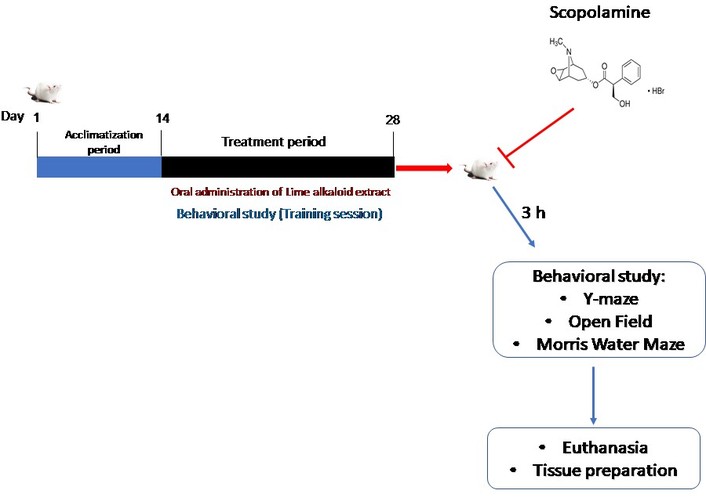
Administration of LLARE and donepezil was done orally, while scopolamine was administered intraperitoneally. The experiment lasted for fourteen days (Figure 1). Our preliminary studies established the choice of dosage for LLARE (Tables S1–S4), donepezil and scopolamine dosages were according to Ademosun et al. [33] and Elbaz et al. [34], respectively.
For Morris water maze (MWM), Y-maze, and open field maze tests, the animals were trained for 4 days with a minimum of 3 trials for each experimental animal and were digitally recorded. However, the animals were finally evaluated on the 14th day after scopolamine induction.
Experimental animals’ learning and memory abilities were measured using the MWM. A circular tank of 120 cm diameter and 50 cm height was used as the maze pool. The tank was filled with water to a depth of 30 cm and was maintained at 27 ± 2°C. A small rectangular concealed platform was placed in the centre of the tank throughout the experiment. The time taken by the animals to find the concealed platform was digitally recorded and graphed as escape latency [35, 36].
The Y-maze test was used to assess the spatial working memory of the experimental animal. The maze consisted of 3 parallel arms (labelled A, B and C) positioned at equal angles to each other, each measuring 50 cm in length, 50 cm in height and 12 cm in width. One experimental rat was placed at the centre of the maze at each time and was allowed to move freely for a period of 5 min. The sequence of arm choices made by each animal was digitally recorded, and the total number of triple sets (e.g., ABC, BAC, CBA, etc.) was taken as total alternation. The percentage memory index was determined from the frequency of alternation to the total number of entries [33].
The experimental animals’ locomotor activities were measured using the open field maze (OFM). An enclosed chamber measuring 50 cm in length and width and 38 cm in height was used as the OFM. The time taken in the chamber’s central square before crossing the boxes and the total number of boxes crossed in 5 min were digitally recorded [37].
The rats were immediately sacrificed by cervical decapitation after the neurobehavioural evaluations. The brain was removed, placed in cold saline, and rapidly dissected on ice to obtain the cortex and hippocampus tissues. These were homogenized separately in ice-cold phosphate buffer (0.1 M, pH 7.4), centrifuged at 10,000 g and −4°C for 10 min, and the supernatants were collected and kept at –20°C for analyses.
The Coomassie blue method, which uses bovine serum albumin (BSA) as a standard, was used. The reaction mixture contained 10 µL distilled water, 20 µL phosphate buffer (0.1 M, pH 7.4), 20 μL cortex and/or hippocampus tissue homogenates, and 200 µL Coomassie blue. Incubation was done at 25°C for 30 min, and the absorbance was measured at 595 nm [38].
AChE activity was determined in the cortex and/or hippocampus homogenates according to the method described by Ellman et al. [39]. The mixture contained 800 μL phosphate buffer (100 mM, pH 7.5), 100 μL dithio-bisnitrobenzoic acid (1 mM) and 50 μL of sample. This was incubated for 2 min, followed by the addition of 50 μL acetylthiocholine iodide substrate (0.8 mM) and absorbance was taken at 412 nm for 5 min at 30 s intervals.
The method described by Oboh et al. [40] and Behrsin et al. [41] was used to determine ADA activity in the cortex and/or hippocampus homogenates. The assay contained 100 μL adenosine (21 mM, pH 6.5) and 50 μL cortex and/or hippocampus tissue homogenates, incubation was done for 1 h at 37°C and this was followed by the addition of 250 μL each of phenol-nitroprusside and sodium hypochlorite. Absorbance was taken at 620 nm and ammonium sulphate (75 mM) was used as a standard.
This was estimated using the method described by Erwin and Hellerman [42]. The mixture consisted of 1 mL water, 0.5 mL phosphate buffer (0.2 M, pH 7.0), 0.2 mL semicarbazide hydrochloride (0.125 M, pH 7.0) and 0.1 mL sample. Incubation was done at 37°C for 10 min, followed by the addition of 0.2 mL adrenaline (0.1 M) and incubation at 37°C for 30 min. Two millilitres of 2, 4-dinitrophenylhydrazine (0.5 mg/mL hydrochloric acid) and 4 mL benzene were subsequently added, mixed, and centrifuged. The benzene layer was transferred to a test tube containing 5 mL sodium hydroxide (0.1 N), mixed, and allowed to stand for 5 min to separate the benzene layer, which was discarded. The resulting mixture was incubated at 80°C for 10 min, and absorbance was taken at 420 nm.
The data were analysed and visualised using the R project for statistical computing version 4.3.3. One-way analysis of variance (ANOVA) followed by Tukey’s multiple comparison test was used. The difference was taken to be significant at p < 0.01.
This was carried out to identify the alkaloid compounds that could improve cognition and memory. GC-MS characterisation of the alkaloid-rich extract of lime leaf, as shown in Table 1, indicates the presence of several biological compounds (Table S5 for their structures). The most abundant alkaloid compound was synephrine (12.65%), however, large amounts of phenol 4-[2-(methylamino) ethyl] (7.27%), pyridine 3-(1-methyl-2-pyrrolidinyl)-(S) (7.17%), citracridone I (6.20%), and 6-methylnicotinic acid (6.13%) were also obtained in the LLARE.
GC-MS characterization of LLARE.
| Alkaloid compounds | RT | Weight (%) | Peak area (%) | m/z |
|---|---|---|---|---|
| Pyrazine trimethyl | 2.00 | 4.47 | 3.85 | 42, 81, 122 |
| Tyramine | 5.18 | 5.24 | 5.09 | 77, 107, 137 |
| 6-Methylnicotinic acid | 10.00 | 6.13 | 7.68 | 45, 92, 137 |
| Phenol 4-[2-(methylamino) ethyl] | 11.49 | 7.27 | 4.85 | 44, 71, 151 |
| Octopamine | 14.38 | 3.25 | 5.46 | 77, 123, 153 |
| Hordenine | 17.00 | 5.04 | 4.24 | 42, 58, 165 |
| Methoxyquinoline | 18.75 | 4.59 | 4.95 | 50, 116, 159 |
| Pyridine 3-(1-methyl-2-pyrrolidinyl)-(S) | 19.61 | 7.17 | 6.66 | 42, 84, 162 |
| Synephrine | 25.23 | 12.65 | 9.35 | 116, 193, 267 |
| 2-Norbornanamine N-ethyl-3-phenyl | 27.75 | 2.13 | 3.83 | 58, 98, 215 |
| Citracridone I | 35.68 | 6.20 | 6.26 | 43, 325, 353 |
The results obtained for the in silico ADME predictions of LLARE phytochemicals and target prediction and network analysis (target key, target name, p-value, and max TC values were obtained in humans) are presented in Tables 2 and 3, respectively. The in silico ADME predictions revealed that the molecular weight (MW) of most of the leaf extract phytoconstituents appears to fall below 500 Da, the topological polar surface area (TPSA) of the alkaloids ranges from 12.03 Å2 to 110.94 Å2 and the LogP values of the examined compounds range from 0.20 to 3.20. The target prediction and network analysis revealed several potential protein targets linked to neuroprotection.
ADME predictions of lime leaf alkaloid rich extract phytoconstituents.
| S/N | Ligand | PubChem ID | MW | MR | TPSA (Å2) | LogP | ESOL LOGS | ESOL CLASS | GA | BBB | P-GP | CYPs inhibitor | LogKP (CM/S) | BS | SA |
|---|---|---|---|---|---|---|---|---|---|---|---|---|---|---|---|
| 1. | Pyrazine trimethyl | 26808 | 122.17 g/mol | 36.93 | 25.78 Å2 | 1.73 | –1.69 | Very soluble | High | Yes | No | None | –6.37 cm/s | 0.55 | 1.73 |
| 2. | Tyramine | 5610 | 137.18 g/mol | 40.95 | 46.25 Å2 | 1.36 | –1.70 | Very soluble | High | Yes | No | None | –6.36 cm/s | 0.55 | 1.00 |
| 3. | 6-Methylnicotinic acid | 137860 | 137.14 g/mol | 36.16 | 50.19 Å2 | 0.68 | –1.56 | Very soluble | High | Yes | No | None | –6.58 cm/s | 0.85 | 1.23 |
| 4. | Phenol 4-[2-(methylamino) ethyl | 9727 | 151.21 g/mol | 45.85 | 32.26 Å2 | 1.57 | –2.00 | Very soluble | High | Yes | No | None | –6.08 cm/s | 0.55 | 1.00 |
| 5. | Octopamine | 4581 | 153.18 g/mol | 42.11 | 66.48 Å2 | 0.20 | –0.49 | Very soluble | High | No | No | None | –7.87 cm/s | 0.55 | 1.35 |
| 6. | Hordenine | 68313 | 165.23 g/mol | 50.75 | 23.47 Å2 | 1.82 | –2.35 | Soluble | High | Yes | No | CYP1A2 inhibitor | –5.83 cm/s | 0.55 | 1.00 |
| 7. | Quinoline 4-methoxy- | 72145 | 500.54 g/mol | 135.19 | 110.94 Å2 | 3.10 | –4.96 | Moderately soluble | High | No | No | CYP2C19 inhibitor | –6.76 cm/s | 0.55 | 4.94 |
| 8. | Pyridine 3-(1-methyl-2-pyrrolidinyl)-(S) | 89594 | 162.23 g/mol | 53.13 | 16.13 Å2 | 1.48 | –1.89 | Very soluble | High | Yes | No | None | –6.46 cm/s | 0.55 | 2.05 |
| 9. | Synephrine | 7172 | 167.21 g/mol | 47.01 | 52.49 Å2 | 0.55 | –0.66 | Very soluble | High | No | No | None | –7.76 cm/s | 0.55 | 1.48 |
| 10. | 2-Norbornanamine N-ethyl-3-phenyl | 14584 | 215.33 g/mol | 68.44 | 12.03 Å2 | 3.20 | –3.27 | Soluble | High | Yes | No | CYP2D6 inhibitor | –5.34 cm/s | 0.55 | 3.42 |
| 11. | Citracridone I | 5487591 | 353.37 g/mol | 101.63 | 80.92 Å2 | 2.88 | –4.57 | Moderately soluble | High | No | No | CYP1A2 inhibitor | –5.96 cm/s | 0.55 | 3.51 |
Target prediction and network analysis.
| Ligand | Target key | Target name | Description | P-value | MaxTC |
|---|---|---|---|---|---|
| Pyrazine trimethyl | TGT_ZYMMO | tgt | Queuine tRNA-ribosyltransferase | 1.217e-09 | 0.32 |
| Tyramine | H9TVJ1_CHISP | TyR1 | 3.027e-111 | 1.00 | |
| TAAR5_HUMAN | TAAR5 | Trace amine-associated receptor 5 | 1.414e-62 | 0.50 | |
| SYYC_HUMAN | YARS1 | Tyrosine-tRNA ligase, cytoplasmic | 2.048e-26 | 0.32 | |
| HMGB1_HUMAN | HMGB1 | High mobility group protein B1 | 3.081e-26 | 0.32 | |
| 6-Methylnicotinic acid | P4HA1_HUMAN | P4HA1 | Prolyl 4-hydroxylase subunit alpha-1 | 1.051e-102 | 0.62 |
| HCAR3_HUMAN | HCAR3 | Hydroxycarboxylic acid receptor 3 | 1.943e-98 | 0.57 | |
| P4HTM_HUMAN | P4HTM | Transmembrane prolyl 4-hydroxylase | 1.225e-65 | 0.62 | |
| Phenol 4-[2-(methylamino) ethyl | ERR3_HUMAN | ESRRG | Estrogen-related receptor gamma | 1.83e-30 | 0.47 |
| Octopamine | 5HT3A_HUMAN | HTR3A | 5-hydroxytryptamine receptor 3A | 0.05302 | 1.00 |
| Hordenine | TOP2B_HUMAN | TOP2B | DNA topoisomerase 2-beta | 4.648e-30 | 0.31 |
| Quinoline 4-methoxy- | S22A2_HUMAN | SLC22A2 | Solute carrier family 22 member 2 | 1.449e-10 | 0.64 |
| Pyridine 3-(1-methyl-2-pyrrolidinyl)-(S) | ACHB2_HUMAN | CHRNB2 | Neuronal acetylcholine receptor subunit beta-2 | 2.682e-43 | 1.00 |
| Synephrine | NMUR2_HUMAN | NMUR2 | Neuromedin-U receptor 2 | 3.937e-30 | 1.00 |
| ADRB2_HUMAN | ADRB2 | Beta-2 adrenergic receptor | 1.371e-27 | 0.63 | |
| 2-Norbornanamine N-ethyl-3-phenyl | ADRB2_HUMAN | ADRB2 | Beta-2 adrenergic receptor | 1.371e-27 | 0.63 |
| Citracridone I | DCOR_HUMAN | ODC1 | Ornithine decarboxylase | 7.101e-61 | 0.44 |
| CATL2_HUMAN | CTSV | Cathepsin L2 | 2.22e-16 | 0.48 |
The predicted gene IDs were then used for another network analysis to determine the enrichment of transcription factors and kinases, as well as protein-protein interactions. Figure 2a represents transcription factor enrichment analysis (TFEA). Descending from the transcription factor with the higher p-value to the transcription factor with the lower p-value. Likewise, the kinase enrichment analysis (KEA) is shown in Figure 2b. Descending from the kinase with the higher p-value to the kinase with the lower p-value.
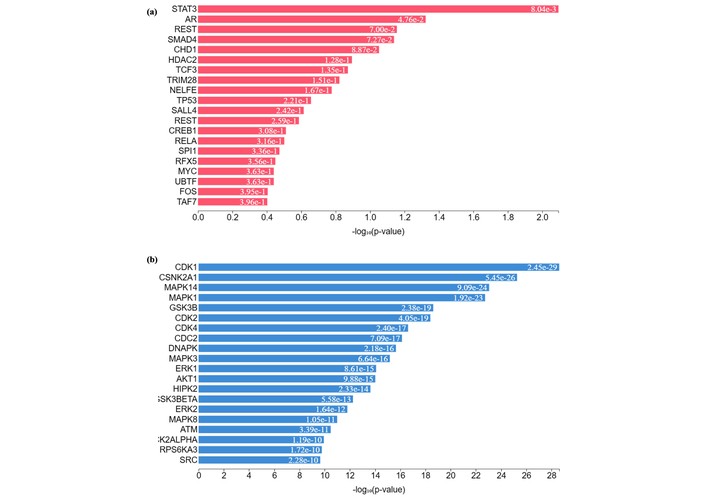
Gene network analysis. (a) Transcription factor enrichment analysis and (b) kinase enrichment analysis.
The protein-protein interaction expansion of the predicted protein targets of LLARE phytoconstituents is presented in Figure 3a. The eXpression2Kinases Network, showing the transcription factor networking with intermediate proteins and kinases is shown in Figure 3b. This revealed several crucial routes and nodes involved in the control of metabolic processes.
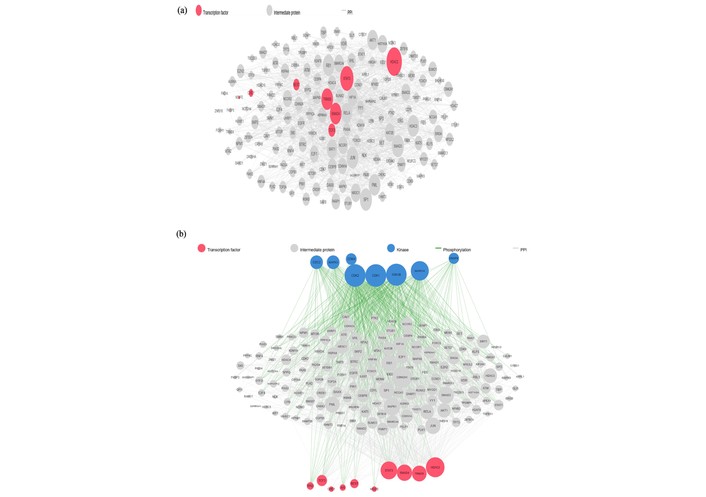
Predicted protein targets. (a) Protein-protein interaction expansion and (b) eXpression2Kinases network.
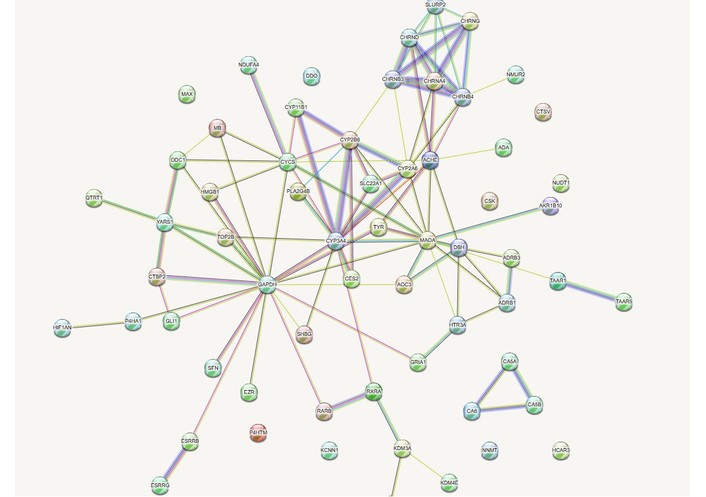
Figure 4 represents the typical protein-protein interactions in LLARE phytochemical protein targets. This provides a better understanding of the complex interactions between the proteins implicated in cognitive and memory functions.
The binding affinity between the phytoconstituent of LLARE and the target protein is shown in Table 4, with each column having docking parameters for each target protein. Figure 5a and 5b represent selected binding affinity visualisations in 3D for the neuroprotective effects of LLARE in scopolamine-induced memory dysfunction in the cortex and hippocampus tissues of the rats. This reveals significant binding affinities between the phytochemicals and target proteins. After docking the phytochemicals with all the targeted proteins, results were categorised into ligands 1 through 11. Among these, ligand 1 demonstrated the highest binding affinity compared to ligands 2 through 11. Subsequently, each protein, along with ligand 1, was visualised using the PyMOL molecular graphics system and saved in PDB format to preserve the structural details. This PDB file was uploaded to the protein-ligand interaction profiler (PLIP) platform to analyse the three-dimensional interactions between ligand 1 and the protein. The analysis provided a detailed representation of the amino acid residues located at the active site, thereby elucidating the molecular interactions involved in the binding process. The ligand (green) is bound to the active site of the protein (alpha fold). Several hydrogen bonds (yellow dashed lines) are visible between the ligand and the surrounding amino acid residues.
Molecular binding affinity of the major constituents of lime leaf alkaloid-rich extract to major memory and cognitive functions linked protein targets.
| S/N | Ligands | Target protein binding affinity (kcal.mol–1) | ||
|---|---|---|---|---|
| Acetylcholinesterase(P22303) | Adenosine deaminase(P00813) | Monoamine oxidase(P21397) | ||
| 1. | Pyrazine trimethyl | –5.443 | –5.360 | –5.971 |
| 2. | Tyramine | –6.233 | –6.709 | –6.832 |
| 3. | 6-Methylnicotinic acid | –5.906 | –5.456 | –5.989 |
| 4. | Phenol 4-[2-(methylamino) ethyl] | –5.956 | –5.888 | –5.976 |
| 5. | Octopamine | –5.571 | –5.832 | –6.006 |
| 6. | Hordenine | –5.415 | –4.910 | –5.293 |
| 7. | Quinoline 4-methoxy- | –7.230 | –6.401 | –6.386 |
| 8. | Pyridine 3-(1-methyl-2-pyrrolidinyl)-(S) | –4.770 | –5.009 | –4.473 |
| 9. | Synephrine | –6.111 | –5.265 | –5.034 |
| 10. | 2-Norbornanamine N-ethyl-3-phenyl | –6.100 | –6.485 | –5.319 |
| 11. | Citracridone I | –7.101 | –7.620 | –7.406 |
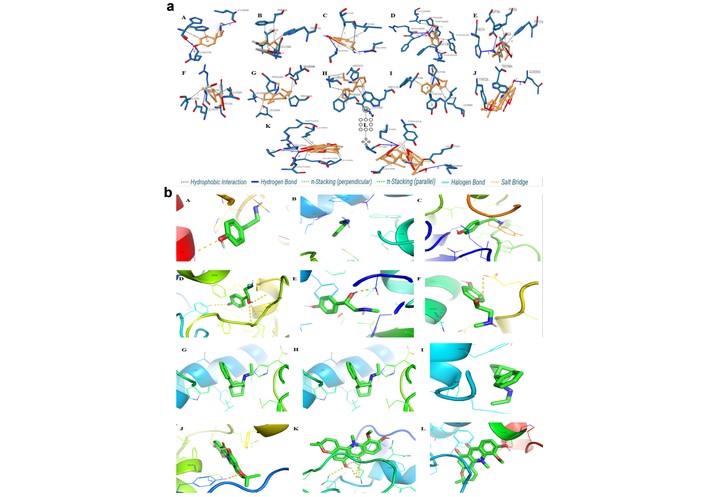
Molecular binding affinity. (a) 3D structure showing the ligand-protein binding affinity of the LLARE phytochemicals and their target proteins. Binding mode and docking interaction with tyramine, synephrine, 2-norbornanamine N-ethyl-3-phenyl, and citracridone I: (A) AChE and tyramine (B) ADA and tyramine, (C) MAO and tyramine, (D) AChE and synephrine, (E) ADA and synephrine, (F) MAO and synephrine, (G) AChE and 2-norbornanamine N-ethyl-3-phenyl, (H) ADA and 2-norbornanamine N-ethyl-3-phenyl, (I) MAO and 2-norbornanamine N-ethyl-3-phenyl, (J) AChE and citracridone I, (K) ADA and citracridone I, and (L) MAO and citracridone I. (b) 3D visualization of proteins and ligand interactions using PyMOL. Binding mode and docking interaction with tyramine, synephrine 2-norbornanamine N-ethyl-3-phenyl, and citracridone I: (A) AChE and tyramine (B) ADA and tyramine (C) MAO and tyramine (D) AChE and synephrine (E) ADA and synephrine, (F) MAO and synephrine, (G) AChE and 2-norbornanamine N-ethyl-3-phenyl (H) ADA and 2-norbornanamine N-ethyl-3-phenyl (I) MAO and 2-norbornanamine N-ethyl-3-phenyl (J) AChE and citracridone I (K) ADA and citracridone I, and (L) MAO and citracridone I.
The redocking of the donepezil-AChE complex reproduced the experimentally observed binding orientation with a RMSD value of 1.45 Å. The obtained RMSD value (< 2.0 Å) confirms that the docking protocol reliably reproduces the crystallographic binding pose. The binding affinity of the redocked ligand was −9.2 kcal/mol, which is consistent with reported experimental binding interactions. This validation supports the credibility of the docking results obtained for Citrus aurantifolia phytochemicals.
A neurobehavioural study was carried out to ascertain that scopolamine caused damage to the brain and neurons of the experimental rats. Escape latency decreases with increased number of trials and days using the MWM task, as shown in Figure 6. LLARE attenuated the scopolamine-induced increase in escape latency of amnesic rats (Figure 7a). The scopolamine-induced rats had significant (p = 1 × 10⁻⁷) prolonged escape latency in comparison with the normal control group. However, treatment with donepezil (standard drug) and LLARE significantly (p = 1 × 10⁻⁷; 1 × 10⁻⁸; 2 × 10⁻⁷) reduced the escape latency when compared with the scopolamine-induced control group. The enhanced effect of LLARE on memory index using the Y-maze presented in Figure 7b shows that the scopolamine-induced group had a significantly (p = 1 × 10⁻⁷) lowered memory index when compared with the control group, while treatment with donepezil and LLARE caused a significant (p = 4 × 10⁻⁷; 8 × 10⁻⁷; 1 × 10⁻⁷) dose-dependent increase in memory index. The modulatory effect of LLARE on the number of boxes crossed and the time spent in the central square of the open field by scopolamine-induced rats, in Figure 7c and 7d, reveals that scopolamine-induced rats had significantly (p = 1 × 10⁻⁷; 1 × 10⁻⁷) reduced locomotive and exploratory activities owing to their reduction in the number of boxes crossed with a simultaneous increase in time spent at the centre when compared with the normal control group. However, treatment with donepezil and LLARE caused a significant and dose-dependent increase in the number of boxes crossed (p = 7 × 10⁻⁷; 1 × 10⁻⁷; 4 × 10⁻⁷) and a reduction in the time spent at the centre (p = 1 × 10⁻⁷; 8 × 10⁻⁷; 1 × 10⁻⁷) of the open field (see Supplementary material; statistics 1–4).
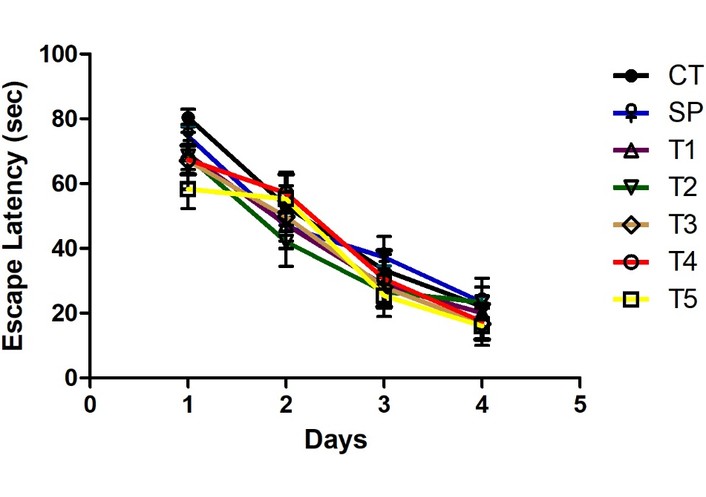
Lime leaf alkaloid-rich extracts enhance escape latency in experimental rats using the MWM test during the training session. CT: Control; SP/SCOP: scopolamine-induced; T1: 100 mg/kg LLARE; T2: 200 mg/kg LLARE; T3: SCOP + donepezil; T4: SCOP + 100 mg/kg LLARE; T5: SCOP + 200 mg/kg LLARE. Values represent the mean ± standard deviation (n = 6) and were not significantly different from each other at p < 0.01. Note: The experimental rats were not yet induced with scopolamine during the training sessions. However, these animal groupings were retained to avoid confusion.
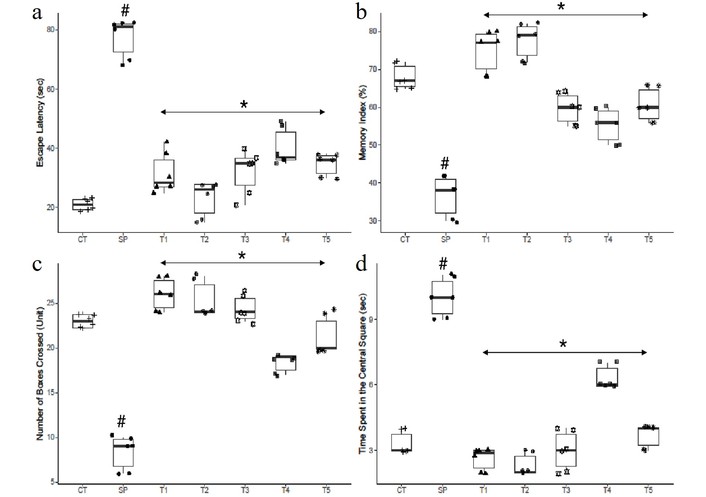
Lime leaf alkaloid-rich extracts enhance neurobehavioural activities in scopolamine-induced rats. (a) Escape latency—Morris water maze test; (b) memory index—Y maze test; (c) number of boxes crossed—open field test; (d) time spent in the central square—open field test. Boxplots showing data points for the different treatment groups (n = 6). ▬ indicates the mean; # represents a significant difference at p < 0.01 from normal control; * represents a significant difference at p < 0.01 from scopolamine-induced control. CT: Control; SP/SCOP: scopolamine-induced; T1: 100 mg/kg LLARE; T2: 200 mg/kg LLARE; T3: SCOP + donepezil; T4: SCOP + 100 mg/kg LLARE; T5: SCOP + 200 mg/kg LLARE.
These assessments were done to find out if LLARE was able to improve cognitive and memory dysfunctions caused by the induction of scopolamine in the experimental rats. Our results show that scopolamine administration led to a significant (p = 2 × 10⁻⁷; 1 × 10⁻⁷) increase in AChE activity (Figure 8a and 8b) in comparison with the normal control group, and treatment with LLARE caused significant (p = 1.6 × 10⁻⁶; 1 × 10⁻⁷; 1 × 10⁻⁷; 1 × 10⁻⁷) reduction in AChE activity in the cortex and hippocampus when compared with the scopolamine-induced control group. Likewise, treatment of scopolamine-induced rats administered with LLARE resulted in significant (p = 4 × 10⁻⁷; 4 × 10⁻⁷; 2.5 × 10⁻⁵; 1 × 10⁻⁷) decreased ADA activity (Figure 8c and 8d) in the cortex and hippocampus, like the outcome of donepezil treatment (p = 1 × 10⁻⁷; 2.5 × 10⁻⁶) in comparison with the scopolamine-induced control. In the like manner, scopolamine-administered rats treated with LLARE showed a significant (p = 1 × 10⁻⁷; 4 × 10⁻⁷) decrease in MAO activity (Figure 8e and 8f) when compared with the control group in the hippocampus, as well as those treated with donepezil (p = 4 × 10⁻⁷; 6 × 10⁻⁷) compared to the scopolamine-induced control group in both the cortex and hippocampus (see Supplementary material; statistics 5–10).
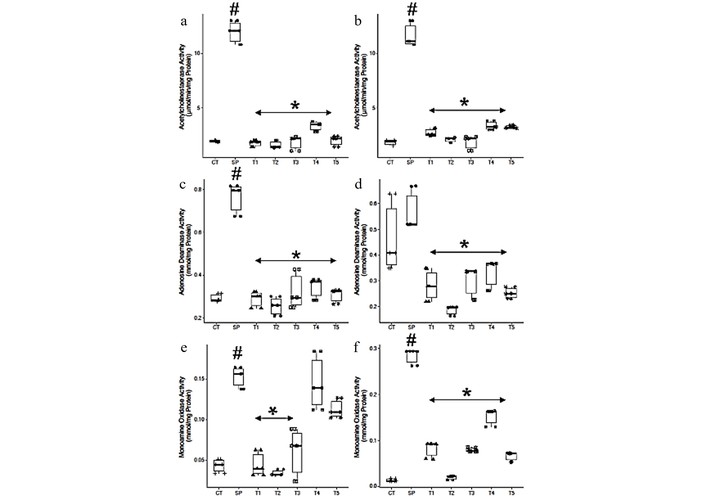
Lime leaf alkaloid-rich extracts (LLAREs) modulate activity of some neuronal enzymes in scopolamine-induced amnesic rats. (a) Cortex; and (b) hippocampal AChE activity; (c) cortex; and (d) hippocampal ADA activity; and (e) cortex; and (f) hippocampal MAO activity. Boxplots showing data points for the different treatments (n = 6). ▬ indicates the mean/average; # represents a significant difference at p < 0.01 from normal control; * represents a significant difference at p < 0.01 from scopolamine-induced control. CT: Control; SP/SCOP: scopolamine-induced; T1: 100 mg/kg LLARE; T2: 200 mg/kg LLARE; T3: SCOP + donepezil; T4: SCOP + 100 mg/kg LLARE; T5: SCOP + 200 mg/kg LLARE.
Cognitive function and memory are fundamental aspects of human and animal behaviour, reflecting the intricate workings of the brain’s neural networks. The exploration and understanding of cognitive and memory biomarkers hold profound implications for unravelling the mysteries of brain health, cognitive decline, and potential cognitive-ability-enhancing interventions [43]. In developing countries, a significant proportion of people rely on natural remedies for amelioration of various neurological disorders due to their affordability and the limited availability of advanced medical infrastructure. To overcome such barriers towards healthy living, researchers have, over time, attempted to discover the therapeutic potentials of remedial plants used historically [44, 45]. A range of phytoconstituents present in plants, such as alkaloid compounds, might be responsible for these medicinal characteristics [46, 47]. Therefore, LLARE was characterised to ascertain the presence of alkaloid compounds with neuroprotective properties. Our findings reveal the presence of several alkaloid constituents with potent cognitive and memory-enhancing properties. Synephrine was the most abundant alkaloid compound in LLARE. Previous studies have reported that synephrine is a sympathomimetic phenethylamine alkaloid with central nervous system stimulant properties [48]. Jung et al. [49] evaluated the effects of oral supplementation of synephrine on cognition and observed improved cognitive and mental focus functions. The importance of the other acridone alkaloid compounds, like citracridone I and nicotinic acid, in improving learning and memory cannot be underestimated [24, 50].
For the in silico studies, phytochemical components identified in LLARE were used, and their molecular structures were obtained. The ligands were prepared for additional analysis by reconstructing them using the SMILES format and optimising their 3D structure using ACDLab/Chem sketch. By ensuring that the ligands’ structures are appropriately represented, this step makes dependable in silico studies possible. Accurate structure optimisation is crucial for computational drug discovery since it improves the accuracy of subsequent predictions and docking investigations demonstrated by earlier research [51].
Predicting the potential behavior of these phytoconstituents in the body using SwissADME provides plausible ligand profiles of ADME by assessing their pharmacokinetic properties. Likewise, ADME properties can provide significant information about the therapeutic potential of these phytoconstituents. The MW of these molecules, which mostly appear to be within the favourable range for blood-brain barrier (BBB) permeability of typically below 500 Da, is one of our key findings. This characteristic is crucial for their potential neuroprotective effects, as compounds with lower MW are more likely to cross the BBB and exert their effects in the cortex and hippocampus regions. For example, molecules such as tyramine (137.18 g/mol) and synephrine (167.21 g/mol) fall within this range; this could possibly enhance their ability to mitigate scopolamine-induced cognitive dysfunction. On the other hand, compounds like quinoline 4-methoxy- (500.54 g/mol) appeared to be very close to the upper limit, suggesting plausibly limited permeability and absorption, potentially reducing their effectiveness as potent neuroprotective agents [32].
TPSA is another key factor that impacts drug absorption. The TPSA values of the lime leaf alkaloids range from 16.13 Å2 to 80.92 Å2, with most compounds falling below the critical threshold of 90 Å2 for effective BBB penetration. For example, hordenine (TPSA: 23.47 Å2) and synephrine (TPSA: 52.49 Å2) indicated their permeability to the BBB. However, compounds like citracridone I, with higher TPSA values (TPSA: 80.92 Å2), may exhibit reduced bioavailability. Lipophilicity, represented by LogP, is another critical factor. The LogP values of the examined alkaloid compounds range from 0.20 to 3.20. A balance between hydrophilicity and lipophilicity also ensures effective membrane permeability and bioavailability. For instance, hordenine (LogP: 1.82) and synephrine (LogP: 0.55) fall within the optimal range; this could contribute to their suitability for neuroprotective applications. Likewise, the capacity of a medicine to be absorbed and made bioavailable depends on its solubility [32]. Many of the lime alkaloids, like synephrine, tyramine and octopamine are categorised as “very soluble”, this could enhance their absorption potential. However, moderately soluble compounds, such as 4-methoxyquinoline, may require formulation strategies to improve solubility. Predictions of the gastrointestinal absorption (GA) profiles for the majority of these compounds also reveal high GA scores. However, larger molecular sizes and higher TPSA values might impede the absorption of certain compounds, necessitating alternative delivery methods or structural modifications to enhance bioavailability. A compound’s ability to cross the BBB is essential for central nervous system-targeted drugs [24]. Our findings show that most of the alkaloids in the SwissADME dataset were predicted to have high BBB permeability. This property could ensure their bioavailability in the hippocampus and cortex, hence supporting their role in counteracting scopolamine-induced cognitive dysfunction.
The bioavailability scores of the alkaloids, typically around 0.55, likely indicate moderate systemic absorption. Though not optimal, this can be addressed through formulation strategies. Synthetic accessibility scores for most of the alkaloid compounds are low, indicating relative ease of synthesis. This could simplify development timelines and production costs, making these alkaloids attractive candidates for further investigation. The ADME study of LLARE phytoconstituents reveals several important variables affecting their potential as medicinal agents. Although absorption may be restricted by higher MWs and TPSA values, the diverse lipophilicity and solubility profiles show some potential. Thus, it is necessary to address issues such as low anticipated GA, absence of BBB permeability, and P-glycoprotein (P-GP) substrate status. Furthermore, moderate bioavailability scores and possible drug-drug interactions resulting from CYP enzyme inhibition are important factors to consider. These compounds have the potential for further development since their relatively low synthetic accessibility scores may indicate that they can be synthesised effectively. This was enhanced by the pkCSM server’s prediction of toxicity parameters. Findings from this study indicated that most of the phytochemicals had good ADME qualities, which may be likely useful in a plausible application as therapeutic agents. Low toxicity concerns for the investigated ligands were also suggested by the toxicity projections, which agreed with the safety profiles.
The phytoconstituents’ target prediction analysis was carried out using the SEA Search Server. Only targets that were relevant to Homo sapiens were included in the filter. This investigation yielded several neuroprotection-linked potential protein targets. AChE and other important proteins, including those involved in cognitive and memory functions, were among the expected targets. To ascertain the enrichment of transcription factors, kinases, and protein-protein interactions, the predicted gene IDs were submitted to network analysis on the eXpression2Kinases (X2K) server. These results revealed several crucial routes and nodes involved in the control of metabolic processes. The enrichment analysis revealed transcription factors like STAT3 and kinases like MAPK3, which are essential for insulin signalling and inflammatory responses, respectively, and also supporting findings from Clarke et al. [28]. Findings from this study indicate that the phytochemicals found in LLARE may have their therapeutic effects through modification of these important regulatory pathways.
Utilizing target gene IDs on the STRING web server v5.0 to forecast interaction networks yielded key insights into understanding of the complex interactions between the proteins implicated in cognitive and memory functions from the ensuing network maps. The concept that the components of this alkaloid compound can activate numerous pathways simultaneously is supported by the significant connections among insulin receptor substrate proteins. STRING-based network studies play a crucial role in revealing the interconnectedness of disease-related proteins [51]. Molecular docking investigations show significant binding affinities between the phytochemicals and target proteins. Synephrine, a primary constituent of LLARE, demonstrated a strong binding affinity to CYP3A4, this supports its potential as therapeutic agent and further corroborates an earlier study.
The strength of interaction between the target protein and the ligand, which is a component of the LLARE, is shown by the binding affinity values expressed in kcal/mol. Stronger binding affinity is shown by a greater negative number, which indicates that the ligand binds to the protein more firmly. Using AChE as the target protein in cognitive and memory functions, the highest binding affinity was observed in 4-methoxyquinolone (–7.230 kcal/mol), because AChE inhibitors may increase the expression of nicotinic receptors, thereby contributing to their potential therapeutic effects [52]. Using ADA as a protein target, the highest binding affinity was observed in citracridone I (–7.620 kcal/mol). Additionally, ADA inhibitors play a significant role in neuroprotection during ischaemic conditions by preventing the excess breakdown of adenosine in the brain. Adenosine is a known neuroprotective agent that can reduce nerve damage and inhibit neuronal excitability. Using MAO as the protein target in cognitive and memory functions, the highest binding affinity was also observed in citracridone I (–7.406 kcal/mol). MAO plays a vital role in neurodegenerative disorders like AD and PD. Thus, the phytoconstituents of LLARE are plausibly potent AChE, ADA, and MAO inhibitors, which could help to protect neurons and may slow the progression of these diseases [53].
All protein interactions shown in the molecular docking highlight the importance of hydrogen bonds in stabilising the ligand within the protein’s binding pocket. These interactions are critical for the specificity and strength of binding. The ligand fits well within the binding pocket in all cases, suggesting good shape complementarity. The presence of aromatic residues interacting with the ligand also indicates π-π stacking or other hydrophobic interactions, which could further stabilize the binding. However, the protein’s conformation in the binding region adapts to accommodate the ligand, which might indicate induced fit mechanisms where the binding of the ligand induces a conformational change in the protein, thereby enhancing the binding affinity. Therefore, these interactions likely depict a well-fitted ligand in the protein’s binding site, stabilized by various non-covalent interactions, crucial for effective drug design and the understanding of protein function modulation [30, 31].
The neuroprotective potential of LLARE was also assessed by conducting neurobehavioural studies on the experimental rats. The MWM test was employed to evaluate learning and memory, which progressively diminish due to certain disorders like amnesia. Open field maze and Y-maze assessments were utilised to evaluate anxiety and spatial working memory, respectively. This gives intriguing insights into the effects of LLARE in scopolamine-induced amnesic rats. We observed that scopolamine-induced rats exhibited memory impairment, as shown by their longer escape latency and lower memory index compared to the control and the non-induced, treated groups. This is consistent with a previous report that scopolamine-induced memory deficits are due to its antagonistic action on muscarinic receptors [33]. Interestingly, the groups treated with LLARE demonstrated improved cognition, with decreased latency times and increased memory index. This suggests a potential ameliorating effect of LLARE on spatial memory impairment. These findings align with studies on other natural compounds that have demonstrated memory-enhancing effects, possibly through cholinergic modulation and neuroprotection [54].
The open field test provided further insights into the effects of LLARE on locomotor and exploratory behaviours of experimental rats. The observed reduced locomotor activity and exploratory behaviours displayed by scopolamine-induced amnesic rats indicate anxiogenic-like effects. In contrast, the LLARE-treated group exhibited increased locomotion, exploration, and target quadrant occupancy that resulted in a significantly increased number of boxes crossed. This suggests a potential anxiolytic effect of LLARE, possibly through their interaction with neurotransmitter systems involved in anxiety regulation, as demonstrated by Asgharian et al. [55] and Fasakin et al. [56]. These neurobehavioral improvements observed in the LLARE-treated groups may be attributed to the presence of health-promoting alkaloid compounds in the lime leaf, as previous studies demonstrated the efficacy of natural products at mitigating cognitive impairments [54, 57]. This correlates with the results obtained in the in silico studies, where the obtained ADME pharmacokinetic properties of the alkaloid compounds support neuroprotective potential.
The evaluation of AChE, ADA, and MAO activities in the cortex and hippocampus tissues sheds light on potential mechanisms underlying the observed cognitive effects. AChE is an enzyme that breaks down the neurotransmitter acetylcholine; it’s intricately involved in learning and memory. Elevated AChE activity is linked to reduced acetylcholine levels or availability, contributing to cognitive impairments [58, 59]. Interestingly, the observed increased AChE activity in scopolamine-administered rats was mitigated by treatment with LLARE in the cortex and hippocampus. This could be attributed to the highest binding affinity obtained in the docking of 4-methoxyquinolone and AChE. This agrees with the report of Basha et al. [60] with a position that neuroprotection has been attributed to the presence of diverse phytochemicals in Citrus plants. This might possibly contribute to the observed cognitive enhancement in the neurobehavioural studies. LLARE possibly modulates cholinergic neurotransmission by inhibiting AChE activity, consequently maintaining adequate acetylcholine concentration required for learning and memory, hence contributing to improved cognitive performance.
Adenosine is a purine nucleoside known to play an important role in modulating neuronal excitability and synaptic plasticity [40]. Appropriate levels of adenosine are maintained through the inhibition of ADA. ADA is a neuronal enzyme that catalyses the permanent deamination of adenosine, leading to the formation of inosine and ammonia [61]. This present study observed that scopolamine administration facilitated increased ADA activity; this leads to depletion of adenosine; hence, purinergic neurotransmission could be negatively modulated, and its role in memory formation will be altered. A lowered ADA activity obtained after treatment with LLARE could indicate a potential prevention of the depletion of adenosine in the cortex and hippocampus. This could be related to the presence of citracridone I, which had the highest binding affinity upon docking with ADA. Hence, this may contribute to the enhanced cognitive function observed in LLARE-treated rats.
MAO is a neuronal enzyme responsible for the oxidation of amine neurotransmitters like adrenaline and serotonin. The amine neurotransmitters are intricately linked to cognitive functions and memory processes [40]. Previous reports have posited that increased MAO activity leads to the degradation of amine neurotransmitters; hence, inappropriate levels of these amine neurotransmitters could cause cognitive impairment [62, 63]. The obtained increase in MAO activity in scopolamine-administered rats was reduced in LLARE- and donepezil-treated rats, possibly contributing to improved cognitive performance. Likewise, the highest binding affinity obtained upon docking of citracridone I and MAO suggests that the presence of citracridone I could possibly contribute to the capability of LLARE as a potential inhibitor of MAO, hence influencing the availability of amine neurotransmitters like dopamine and epinephrine and thus making these findings particularly noteworthy. Interestingly, this observed inhibition of neuronal enzymes with consequent cognitive enhancement by LLARE agrees with results from the in silico analysis and neurobehavioural evaluation of the experimental animals.
In spite of the interesting findings presented in this study, the following limitations should be considered when interpreting the findings of the present study. Firstly, although the scopolamine-induced amnesia model is widely used to investigate learning and memory impairment and to screen potential cognitive-enhancing agents, it primarily produces a pharmacologically induced, transient cholinergic dysfunction and does not fully reproduce the complex, progressive, and multifactorial pathophysiology of human AD. In particular, the model does not adequately capture characteristic features of AD, including progressive amyloid-β and tau pathology, chronic neuroinflammation, neuronal loss, and the long-term interactions among these processes. Therefore, the cognitive and molecular effects observed following administration of the Citrus aurantifolia leaf alkaloid-rich extract should not be interpreted as directly representing therapeutic effects in human AD.
Secondly, the use of an alkaloid-rich extract introduces uncertainty regarding the contribution of individual constituents to the observed effects. Because the extract contains multiple alkaloid compounds, the present findings cannot establish whether the biological activity is primarily attributed to one or more major constituents or to interactions among several compounds. Possible additive, synergistic, or antagonistic effects among the alkaloids may contribute to the overall pharmacological response. Consequently, the protein-ligand interactions and predicted activities identified for individual constituents should be regarded as potential contributors rather than definitive evidence of their individual pharmacodynamic effects. Isolation and testing of the major alkaloid constituents individually, followed by controlled combination studies, would be necessary to determine their respective contributions and possible interactions.
Furthermore, the predicted absorption, distribution, metabolism, excretion and toxicity (ADME/T) profiles should be interpreted cautiously in relation to the in vivo pharmacodynamic findings. In silico ADME/T predictions provide estimates based on computational models and do not necessarily reflect the actual absorption, distribution, metabolism, bioavailability, protein binding, tissue penetration, metabolic transformation, or elimination of the compounds in living animals. Similarly, a favorably predicted interaction with a protein target does not establish that the compound reaches a sufficient concentration at the relevant tissue or target site to produce the predicted biological effect. Differences in extract composition, constituent concentrations, metabolism, and compound–compound interactions may further contribute to discrepancies between computational predictions and the observed in vivo response. Thus, the ADME/T and molecular docking results in the present study should be considered supportive and hypothesis-generating rather than definitive evidence of target engagement or pharmacological efficacy. Future studies incorporating isolated compounds, quantitative pharmacokinetic measurements, target-engagement assays, and disease-relevant animal models will be important to validate these findings and clarify the translational relevance of the LLARE.
Lastly, the sample size used in this study is small. Future studies are encouraged to use a larger sample size.
Findings from this research show that Citrus aurantifolia leaf alkaloid-rich extract exerts a positive impact by lessening the scopolamine-induced cognitive deficits in experimental animals. This study provides significant insights into Citrus aurantifolia leaf alkaloid-rich extract, emphasizing its possible therapeutic roles in combating cognitive and memory dysfunctions. The in silico ADME analysis revealed favorable pharmacokinetic properties for most of the alkaloid compounds, including high BBB permeability and acceptable bioavailability, thus making them promising candidates for managing central nervous system-related diseases. Molecular docking studies demonstrated strong binding affinities between some of the identified alkaloid compounds (e.g., quinoline 4-methoxy- and citracridone I) and target proteins (AChE, ADA, and MAO) implicated in cognitive and memory dysfunction. This multi-target binding profile observed supports the ability of LLARE to enhance cognitive and memory functions and positively modulate neuronal enzymes, hence suggesting its plausible therapeutic application in neurodegenerative diseases. These findings do not only affirm the therapeutic potential of Citrus aurantifolia alkaloid compounds; they also support the significance of plants’ secondary metabolites as sources of therapeutic agents to promote cognition and memory by modulating multiple biochemical pathways, including those linked to neurotransmission. However, prolonged administration of LLARE could pose adverse effects. Therefore, future studies should evaluate the potential toxic effects of long-term administration of LLARE. Likewise, the observation of this study warrants further investigation into the molecular mechanisms behind the observed effects as a basis for future research into their long-term outcomes in management of neurodegenerative diseases. Moreover, findings from this study may benefit from further investigation into clinical human studies to bridge the translational gap.
AChE: acetylcholinesterase
AD: Alzheimer’s disease
ADA: adenosine deaminase
ADME/T: absorption, distribution, metabolism, excretion and toxicity
GC-MS: gas chromatography-mass spectrometry
LLARE: lime leaf alkaloid-rich extract
MAO: monoamine oxidase
MW: molecular weight
MWM: Morris water maze
NH4OH: ammonium hydroxide
PD: Parkinson’s disease
PLIP: protein-ligand interaction profiler
RMSD: root-mean-square deviation
TPSA: topological polar surface area
The supplementary materials for this article are available at: https://www.explorationpub.com/uploads/Article/file/1006153_sup_1.pdf.
The authors gratefully acknowledge the contribution of Dr Ajayi Babajide towards the purchase of scopolamine hydrobromide trihydrate.
OHO: Conceptualization, Project administration, Formal analysis, Writing—original draft. AAA: Methodology, Formal analysis, Investigation. VOO: Formal analysis, Investigation, Data curation. OPIO: Writing—original draft, Data curation. KAO: Formal analysis, Investigation, Validation. CDF: Data curation, Formal analysis, Methodology. AOA: Formal analysis, Data curation, Validation. OI: Conceptualization, Supervision. All authors reviewed, edited, and approved the final manuscript.
The authors declare that they do not have any conflicts of interest.
All international, national, and/or institutional guidelines for the care and the use of laboratory animals were strictly followed. The experimental methods were approved by the Research Ethics Committee for animal experimentation of the Faculty of Science, (FUOYE) with ethical approval number, FUOYEFSC 201122 – REC2023/013.
Not applicable.
Not applicable.
Datasets are available on request.
This research did not receive any funds, grants, or support from any organisation.
© The Author(s) 2026.
Open Exploration maintains a neutral stance on jurisdictional claims in published institutional affiliations and maps. All opinions expressed in this article are the personal views of the author(s) and do not represent the stance of the editorial team or the publisher.
Copyright: © The Author(s) 2026. This is an Open Access article licensed under a Creative Commons Attribution 4.0 International License (https://creativecommons.org/licenses/by/4.0/), which permits unrestricted use, sharing, adaptation, distribution and reproduction in any medium or format, for any purpose, even commercially, as long as you give appropriate credit to the original author(s) and the source, provide a link to the Creative Commons license, and indicate if changes were made.



View: 75
Download: 6
Times Cited: 0
Odunayo M. Agunloye ... Ganiyu Oboh
Jamil A. Chahrour ... Akram Hijazi