 Meta-Analysis


Affiliation:
1Lee Kong Chian School of Medicine, Nanyang Technological University, 308232, Singapore
ORCID: https://orcid.org/0009-0000-9640-2554

 ,
Affiliation:
1Lee Kong Chian School of Medicine, Nanyang Technological University, 308232, Singapore
ORCID: https://orcid.org/0009-0003-6767-0252
,
Affiliation:
2Department of Psychology, National University of Singapore, 117572, Singapore
ORCID: https://orcid.org/0000-0002-4768-1793
,
Affiliation:
1Lee Kong Chian School of Medicine, Nanyang Technological University, 308232, Singapore
3Singapore General Hospital, SingHealth, 169608, Singapore
Email: JWANG082@e.ntu.edu.sg
ORCID: https://orcid.org/0009-0009-0400-6999

Explor Neurosci. 2026;5:1006154 DOI: https://doi.org/10.37349/en.2026.1006154
Received: July 4, 2026 Accepted: August 24, 2026 Published: October 26, 2026
Academic Editor: Sheng-Tao Hou, Southern University of Science and Technology, China
The article belongs to the special issue The Science of Ischemic Stroke
Background: Stroke is a neurovascular condition that has been globally rising in prevalence due to ageing populations and an increasing burden of cardiovascular risk factors. To help patients recover their motor and neurological abilities post-stroke, physiotherapy and occupational therapy have been traditionally employed. In recent years, immersive virtual reality (IVR) has emerged as a promising tool that offers visuospatial stimuli that emulate real world environments, enhancing conventional stroke rehabilitation methods. This systematic review and meta-analysis aims to assess the effectiveness of complementing conventional therapies with IVR therapy in stroke recovery.
Methods: PubMed, Embase, Cochrane, and Scopus were systematically searched from inception to January 2026 for randomized controlled trials (RCTs) comparing the clinical outcomes of conventional stroke rehabilitation to those with an additional IVR rehabilitation component, using terms “stroke”, “virtual reality” and “rehabilitation”. Risk ratios (RRs) with 95% confidence intervals (CIs) for each study were computed and represented on a forest plot using a random-effects meta-analysis.
Results: A total of 2,570 studies were initially screened, and 9 RCTs were included for meta-analysis. IVR adjunct demonstrated an improvement in upper limb motor function as measured by the Fugl-Meyer Assessment (SMD = 0.76, 95% CI 0.08–1.45; I2 = 70.3%). There was no statistically significant effects of IVR on Barthel Index, Berg Balance Scale, and gait speed.
Discussion: Despite heterogeneity from pooled estimates, IVR has been shown to improve motor function when used in conjunction with conventional rehabilitation, which could potentially be translated to functional recovery post-stroke. Future research should focus on conducting pragmatic multi-centre RCTs with large participant sizes, where IVR can be integrated within routine stroke rehabilitation pathways. This will allow better translation of clinical research into practice and possibly extend IVR rehabilitation beyond stroke patients.
Stroke is a neurovascular condition that has been globally rising in prevalence due to ageing populations and increasing burden of cardiovascular risk factors. Among non-communicable diseases, stroke ranks as the third leading cause of death and disability combined worldwide, as measured by disability-adjusted life-years (DALYs) lost [1]. Approximately 55–75% of stroke survivors experience persistent post-stroke motor deficits impacting balance, strength, and coordination of body movements, with around 85% suffering a degree of upper limb dysfunction [2]. The prognosis is affected by factors like the patient’s baseline comorbidities, door-to-needle time for thrombolysis, and rehabilitation efforts [3]. These impairments not only limit patients’ independence in walking, activities of daily living (ADL) and workforce participation [4], but also significantly affect patients’ emotional well-being, autonomy and quality of life [5].
To help patients recover their motor and neurological abilities post-stroke past the initial critical phase, physiotherapy and occupational therapy have been traditionally employed. Despite early and active intervention with these therapies, about 50% of patients continue to experience long-term motor impairments that affect ADLs such as walking and self-hygiene [6].
Conventional rehabilitation is the cornerstone for post-stroke recovery. However, there are limitations to these therapies. First, the repetitive nature of conventional treatment reduces motivation and long-term adherence [7]. Moreover, system-level barriers such as short hospital stays and limited healthcare manpower restrict the intensity and frequency of rehabilitation [8]. This gap underscores the need for technology-assisted, dose-based rehabilitation capable of delivering higher-intensity training with more creative ways of repetition to improve recovery outcomes [9].
In recent years, technology-based rehabilitation approaches have emerged as adjuncts or alternatives to conventional rehabilitation, including exergames, robotic-assisted systems, virtual reality (VR), wearable sensors, and smartphone applications [10]. While preliminary studies have shown promising data for these novel rehabilitation modalities, there is still insufficient research in analyzing their effects on improving functional outcomes for stroke patients [11].
VR is an umbrella term that encompasses a wide spectrum of applications depending on the degree of immersion in the virtual environment, i.e., how fully users perceive and interact with the virtual environment. Immersive VR (IVR) makes use of head-mounted devices (HMDs) and motion controllers to fully immerse users in a 3D environment where they can interact with objects. Studies have shown that the degree of VR immersion strongly influences how participants coordinate movements that emulate the real world, improving sensorimotor integration and feedback [12, 13]. This makes IVR with HMDs the method that most closely emulates the real world through visuospatial stimulation, and in theory, the rehabilitation modality to most effectively improve patients’ function. Compared to conventional methods, IVR enhances repetition and intensity of motor exercises through engaging, game-like tasks, providing constant feedback on progress and boosting motivation. Both are key factors in shaping neuroplasticity and thereby promoting neural reorganization and recovery [14].
Therefore, research on IVR rehabilitation remains highly heterogeneous in terms of systems used, intervention duration, and clinical metrics used to objectively assess patients’ progress. As a relatively novel concept, its precise role, optimal dosage, and long-term benefit over conventional rehabilitation are still unclear [15]. Although numerous studies suggest IVR to be pragmatic and effective, current evidence does not support completely replacing conventional rehabilitation. Therefore, this systematic review and meta-analysis aims to assess the effectiveness of using IVR as a complementary therapy to conventional rehabilitation for motor recovery post-stroke.
This systematic review and meta-analysis was conducted in accordance with the PRISMA 2020 guidelines. The systematic search included Medical Subject Headings (MeSH) and keywords relevant to the key concepts of “virtual reality”, “rehabilitation”, “stroke” and “cerebrovascular accident”. This search strategy was applied across Cochrane, PubMed, Scopus and Embase from date of database inception to January 2026. The full search strategy is in the Supplementary material. Figure 1 illustrates the PRISMA flow diagram [16].
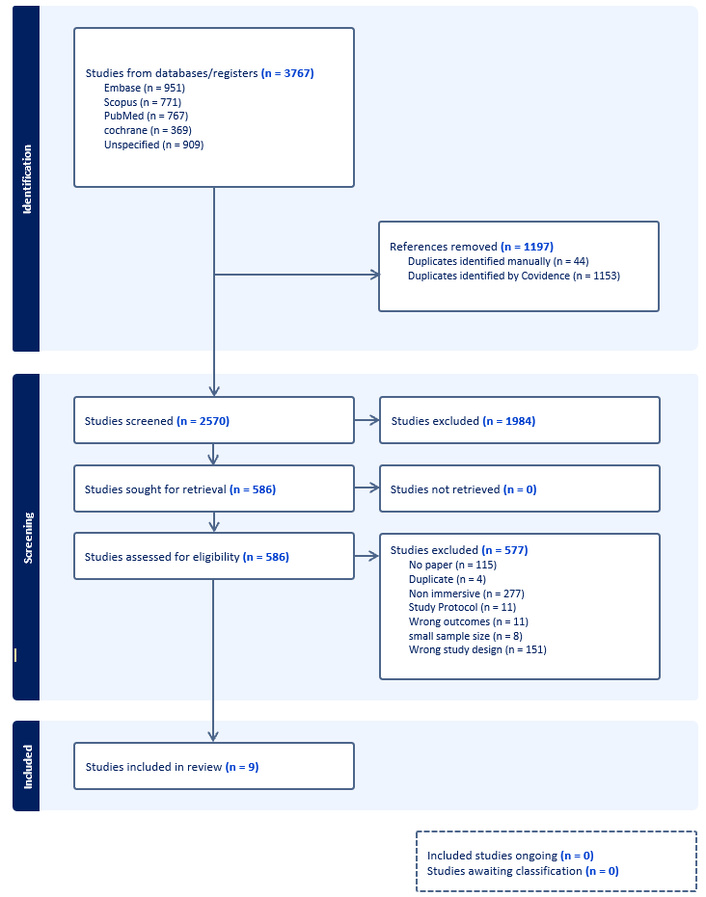
PRISMA flow chart diagram. Adapted from [16]. © 2021, The Author(s). Distributed under a Creative Commons Attribution license (CC BY 4.0).
Studies where the intervention group received IVR rehabilitation with HMDs in addition to conventional rehabilitation and the control group received only conventional rehabilitation were considered eligible. Only randomised controlled trials were considered and other study types such as case series, review articles, and study protocols were excluded. Studies using non-IVR without an HMD (e.g., Nintendo Wii, Microsoft Kinect, ReHabGame platforms) or other non-VR, non-conventional rehabilitation methods in either the control or interventional group (e.g., deep brain stimulation, robot-assisted rehabilitation, mirror therapy) were excluded. Only full-text studies published in English on adult human subjects were included. No restrictions were placed on the duration of therapy, duration of follow-up, and number of points at which the outcome was measured. All references found were imported into Covidence and screened for duplicates.
Studies were screened blindly firstly via title and abstract and subsequently via full text by 3 independent reviewers (JS, HZT, GS), where a study had to be approved by 2 reviewers to move to the next stage. All conflicts were resolved via consensus or referral to the corresponding author (JDW).
Data were extracted by 3 independent reviewers (JS, HZT, GS) on a standardised data collection template. Data collected included authors, year and country of publication, type of study, total number of participants, age and sex of study participants, details of technology used, and the rehabilitation protocols of the control and intervention groups, respectively. Data on the rehabilitation outcomes in various domains of stroke rehabilitation were also collected and subsequently analysed. Functional independence was assessed via Barthel Index (BI), balance and mobility via Berg Balance Scale (BBS) and gait speed and motor function via Fugl-Meyer Assessment of the upper extremity (FMA-UE) and Box and Block Test (BBT). Discrepancies were resolved via consensus or referral to the corresponding author (JDW).
Quality assessment was conducted by 2 independent reviewers (JS, HZT) using the Joanna Briggs Institute Critical Appraisal Tools checklist. This checklist assesses risk of bias via 13 questions centred on study design and blinding. Discrepancies were resolved via consensus or referral to the corresponding author (JDW).
All meta-analyses were done using RStudio (ver 4.5.2). Random-effects models were applied to all analyses to examine study heterogeneity, which was reported via the I2 statistic. Forest plots were generated to graphically display individual and pooled effect estimates as well as confidence intervals (CIs), where p-value < 0.05 indicated statistical significance. Due to the relatively small number of studies, funnel plots were not included and no subgroup analyses were conducted.
A total of 3,767 studies were found after searching PubMed, Embase, Scopus and Cochrane. After removing 1,197 duplicates, 2,570 studies remained for title and abstract screening. Of these, 1,984 were excluded, leaving 586 studies for full-text assessment. Following a full-text review, 577 studies were excluded. The study selection process and reasons for excluding these 577 studies are illustrated in Figure 1. Finally, 9 studies involving 293 patients were included in the final analysis.
The 9 included trials enrolled adults with stroke and evaluated IVR-based interventions as an adjunct to conventional rehabilitation compared with conventional therapy alone. They are listed as follows: Amin et al. [17], Jo et al. [18], Peláez-Vélez et al. [19], Hsu et al. [20], Huang et al. [21], Kwak et al. [22], Mekbib et al. [23], Huang et al. [24], Lee et al. [25]. Among the 9 studies included, 3 studies used Oculus Quest 2 head-mounted display [17, 19, 22], 2 studies used Oculus Rift head-mounted display [20, 23], 1 study used IVR-based mirror therapy based on a 360° camera [18], 2 studies used the HTC Vive head-mounted display [21, 24], 1 study used the Pico G2 VR 4K head-mounted display [18], and 1 study used the i-visor fx601 Super Video Graphics Array (SVGA) HMD [25].
All studies required sufficient cognitive capacity to follow instructions throughout interventions, and this was outlined in 5 studies as using the Mini-Mental State Examination (MMSE) scores [18, 20, 21, 23, 25]. Moreover, the remaining 4 studies ensured that patients had the cognitive ability to understand simple instructions [17, 19, 22, 24]. At recruitment for the study, stroke chronicity of included patients varied from early subacute (within 2 weeks to 6 months post-stroke) [17–21, 23, 24] to chronic stages beyond 6 months [22, 25]. All IVR-based interventions targeted either upper limb function or balance and gait and were delivered alongside conventional physiotherapy and/or occupational therapy at frequencies of 3 to 5 sessions per week, over a range of 2 to 6 weeks. Across studies, primary clinical endpoints most frequently included FMA-UE or FM-UE [17, 18, 20, 21, 23, 24], followed by BBT [17, 18, 20], BBS [22], gait speed [22, 25], and BI [23, 24], consistent with our predefined primary outcomes. A summary of the characteristics of included studies can be found in Table 1 below.
Summary of patient demographics and study details (meta-analysis).
| Study (year) | IVR with conventional therapy | Conventional therapy | Stroke onset | Inclusion criteria | VR intervention | Control | VR tools | Outcome | ||||
|---|---|---|---|---|---|---|---|---|---|---|---|---|
| n | Male (%) | Age (SD) | n | Male (%) | Age (SD) | |||||||
| Amin et al. (2025) [17] | 26 | 62 | 51.8 (12.9) | 26 | 69 | 49.8 (9.9) | 2 weeks–6 months | Subacute stroke; MAS < 4; FMA-UE 25–55; MoCA ≥ 21; age ≥ 18 | 48 min × 4/week × 6 weeks (24 sessions): 24 min VR hand games + 24 min conventional therapy | 48 min conventional PT + OT for upper limb | Oculus Quest 2 + Unity3D | Significant improvement in FMA-UE, ARAT, BBT (all p < 0.001) vs. control |
| Jo et al. (2024) [18] | 15 | 46.7 | 51.7 (13.6) | 15 | 53.3 | 47.1 (13.9) | < 6 months | < 6 month post-stroke; MMSE-K ≥ 21; mild-moderate motor impairment (FMA) | 60 min conventional × 5/week + 30 min 360° mirror therapy × 3/week × 4 weeks (wrist/hand/forearm/elbow tasks) | Neurodevelopmental therapy, muscle strengthening, joint mobilization | Pico G2 VR 4K head-mounted device (HMD) | 360MT group: significantly greater gains in FMA-UE, MFT, BBT vs. TMT (p < 0.05) and CG (p < 0.001); higher engagement |
| Peláez-Vélez et al. (2023) [19] | 13 | 75 | 51.9 (18.6) | 13 | 58.3 | 59.6 (16.0) | < 6 months | Stroke < 6 month (ischemic/haemorrhagic); age 18–80; active upper limb mobility; able to stand | 1 h neuro PT × 5/week × 6 weeks + 3 VR sessions/week; standing VR games (chopping, rowing, tree climbing) × 40 reps | Strengthening, resistance, kinesitherapy, aerobic, gait training on stable/unstable surfaces | Oculus Quest 2 + Kinect 360 | Significant gains in motricity index (p = 0.005), trunk control (p = 0.008), Tinetti (p = 0.004), BBS (p = 0.007), FAC (p = 0.038) |
| Hsu et al. (2022) [20] | 18 | 44 | 52.9 (11.8) | 17 | 29 | 56.9 (13.0) | < 6 months | Chronic stroke > 6 months; unilateral infarction/haemorrhage; FM-UE 23–60; MMSE ≥ 24 | 20 min task-specific training + 30 min VR-MT / 30 min OT × 2/week × 9 weeks; forearm/wrist/hand exercises × 50 reps | Sensorimotor stimulation + ADL skill training (remediated + compensatory) | Oculus Rift + Leap Motion Controller | No significant group × time effect on FM-UE (p = 0.075); significant effects on FM-UE wrist (p = 0.012) and BBT (p = 0.044) |
| Huang et al. (2022) [21] | 15 | 40 | 50.8 (12.3) | 15 | 27 | 58.3 (11.2) | < 6 months | Age 20–75; stroke > 3 months; Brunnstrom stage of stroke > 3; confirmed by CT/MRI; MMSE > 18; no other neuro comorbidities | 16 sessions × 60 min, 2–3 days/week + regular OT; 6–10 VR tasks/session (aiming, shooting, punching, ADLs) | Conventional tools: peg board, climbing ladder, stacking cones for upper limb | HTC Vive + wireless controllers | Significant time effects on IL-6, HO-1, 8‑hydroxy‑2‑deoxyguanosine, most clinical scales; group × time effects on FMA-UE shoulder/elbow/forearm (p = 0.004), total (p = 0.008), AROM-shoulder flexion (p = 0.001) |
| Kwak et al. (2024) [22] | 18 | 55.6 | 54.3 (17.7) | 18 | 61.1 | 59.2 (13.9) | > 6, < 27 months | Stroke > 6 months;; conscious; independent walking > 10 m; able to operate VR | 30 min conventional × 5/week × 5 weeks + 30 min IVR × 3/week × 5 weeks; standing balance sports games (tennis, bowling, air gun) | ROM exercises, mat training, weight-shift training | Oculus Quest 2 + touch controllers | Significant gains in BBS and TUG (p < 0.01); improved gait velocity, step/stride length, single-limb support (p < 0.01) |
| Mekbib et al. (2021) [23] | 12 | 75 | 52.2 (13.3) | 11 | 73 | 61 (7.7) | < 3 months | Moderate-severe UE impairment; first ischemic/haemorrhagic stroke < 3 months; age ≥ 18; intact hearing/vision; MMSE > 16.3 | 1 h VR + 1 h OT × 4 days/week × 2 weeks; reach/grasp/release tasks with virtual colour balls (mirror + affected limb modes) | OT: ADLs, balance, gait training, weight shift, distal/proximal UE movements | Oculus Rift + Leap Motion | Both groups improved BI (p < 0.05); VR group: significantly greater FM-UE gains (p < 0.05); increased neural activity in primary motor cortex |
| Huang et al. (2024) [24] | 20 | 65 | 51.8 (12.9) | 20 | 55 | 49.8 (9.9) | < 6 months | Age 30–85; first stroke < 1 month; subacute subcortical lesion (basal ganglia/internal capsule/corona radiata/brainstem); Brunnstrom stage of stroke II–IV | 30 min conventional + 30 min IVR × 5 days/week × 3 weeks; 6 VR programs (kitchen, shooting, playground, basketball, boxing, fencing) | PT + OT: grips, finger/gross movements, strength, stretching, ADL training | HTC Vive + wireless controllers | VR > control on FMA-UE post-intervention (MD 9.1, p = 0.019) and follow-up (MD 11.5, p = 0.020); consistent BI results; FC changes in ipsilesional pre-motor/dorsolateral prefrontal cortex and visual/middle frontal regions |
| Lee et al. (2014) [25] | 10 | 80 | 47.9 (12.0) | 11 | 54.5 | 54.0 (11.9) | < 12 months | Chronic stroke ≥ 6 months; no balance-affecting meds; MMSE < 24; sitting > 10 s unsupported; standing unsupported 1 min | 30 min general PT + 30 min VR postural control × 3/week × 4 weeks; AR training in 3 stages (lying, sitting, standing with ball/foothold) | General PT with therapist | Super Video Graphics Array (SVGA) HMD + 2 computers for display/data | Significant time effect on TUG, BBS, velocity, cadence, step/stride length; group × time effect on gait velocity and step/stride length bilaterally |
ADL: activities of daily living; ARAT: Action Research Arm Test; AROM: active range of motion; BBS: Berg Balance Scale; BBT: Box and Block Test; BI: Barthel Index; CG: control group; FMA-UE/FM-UE: Fugl-Meyer Assessment of the Upper Extremity; HMD: head-mounted device; IVR: immersive virtual reality; MMSE: Mini-Mental State Examination; MoCA: Montreal Cognitive Assessment; MRI: magnetic resonance imaging; OT: occupational therapy; PT: physiotherapy; ROM: range of motion; TUG: Timed Up and Go test; VR: virtual reality.
IVR as an adjunct to conventional therapy demonstrated beneficial effects on several primary rehabilitation outcomes as compared with conventional therapy alone. Across six randomized controlled trials (RCTs) reporting FMA-UE, IVR therapy demonstrated a pooled effect in favor of the experimental group with statistical significance [standardised mean difference (SMD) 0.76, 95% CI 0.08 to 1.45, I2 = 70.3%] (Figure 2A). Two trials using the gait speed showed a statistically insignificant effect of IVR (SMD 0.42, 95% CI –0.02 to 0.86, I2 = 0.0%) (Figure 2B). Three studies assessing balance with BBS showed no improvement associated with IVR adjunct (SMD 0.80, 95% CI –0.03 to 1.64, I2 = 0.0%) (Figure 2C). For ADLs, two studies using BI showed no statistically significant effects in favor of IVR (SMD 0.66, 95% CI –0.00 to 1.31; I2 = 0.0%) (Figure 2D). Pooled results from three studies did not demonstrate a clear advantage of IVR for gross manual dexterity measured via BBT (SMD 1.05, 95% CI –1.37 to 3.47, I2 = 86.9%) (Figure 2E).
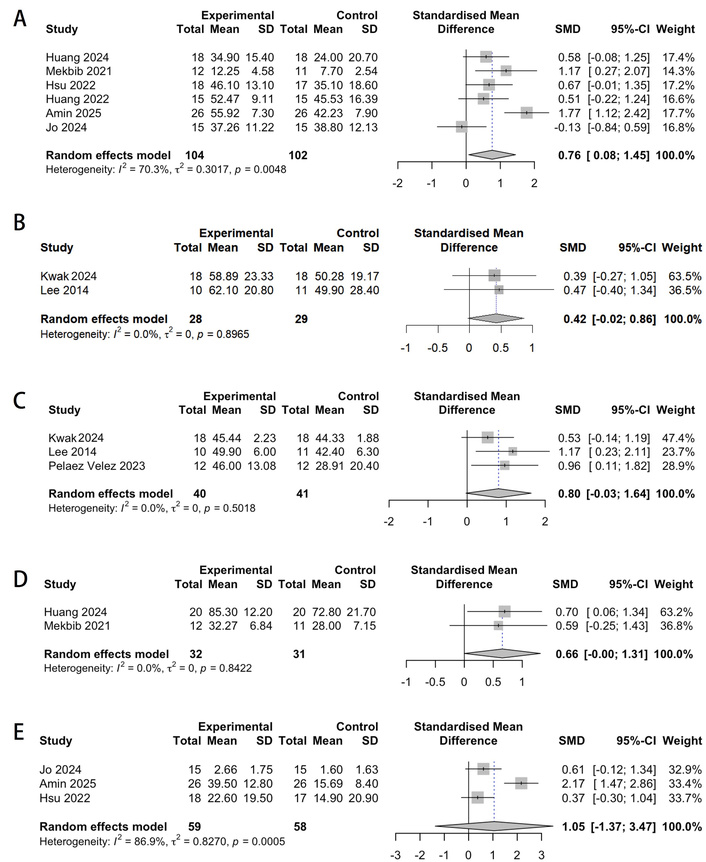
Forest plots summarizing the effects of immersive virtual reality (IVR) on functional outcomes in stroke survivors. (A) Effect of IVR on balance and upper limb functions (measured by the Fugl-Meyer analysis). (B) Effect of IVR on activities of daily living (measured by the gait speed test). (C) Effect of IVR on balance (measured by the Berg Balance Scale). (D) Effect of IVR on activities of daily living (measured by the Barthel Index). (E) Effect of IVR on gross manual dexterity (measured by the Box and Block Test).
Our findings suggest that adding IVR to conventional therapy yielded notable benefits for proximal upper limb motor control, but has no noted positive effect on BI, BBS, and gait speed. Results for FMA-UE demonstrated the most significant improvement when IVR-adjunct was used. These improvements are consistent with positive trends in prior studies exploring the effect of IVR therapy [26]. Chen et al. [27] also demonstrated improvement in gait rehabilitation as measured by Modified BI and FMA-lower extremities and gait spatiotemporal parameters such as gait speed, stride length and cadence.
The analyses of BI, BBS, and gait speed showed no statistical improvement, indicating that IVR-based adjunct training does not improve ADL functional recovery and postural control across different study settings. The lack of improvement in other parameters could be attributed to the wide CIs and high heterogeneity, which means that there are substantial between-study differences in protocols, sample characteristics, or task specificity. Although our analysis did not demonstrate a statistically significant improvement in gait speed, this outcome remains an important indicator of locomotor recovery after stroke and is strongly correlated with functional mobility and community ambulation [28–31]. In their analyses of electromechanical-assisted gait training and treadmill training, Mehrholz et al. [29] identified gait velocity and maximum walking distance as key outcomes for evaluating the effectiveness of post-stroke gait rehabilitation. The absence of a statistically significant pooled effect in the present review should therefore not be interpreted as evidence that IVR has no potential benefit for gait recovery. Rather, the current evidence may have been limited by a small study population. Further trials are needed to establish the impact of IVR on gait speed.
Overall, the pattern of results supports IVR as a promising adjunct to conventional stroke rehabilitation for upper extremity motor function while highlighting the need for more targeted and methodologically consistent trials to clarify its effects on balance, functional recovery, gait and manual dexterity.
Despite the analysis of FMA-UE showing statistically significant improvements, clinical significance should be interpreted with caution. Although minimal clinically important difference (MCID) thresholds have been established for the FMA-UE, these thresholds are expressed as changes in raw FMA-UE points [32]. In the present review, SMDs were used as the included studies employed different versions of the FMA-UE and reported outcomes using varying score ranges (e.g., modified upper extremity scales), precluding direct pooling of raw mean differences. Consequently, the pooled SMD cannot be directly compared with published MCID values. Nevertheless, IVR rehabilitation has the advantage of personalisation to every patient, with task difficulty, intensity, and feedback based on motor function and progression of the patient. Such individualisation may enhance the clinical relevance of observed improvements beyond group-level effect estimates. While the observed effect supports the statistical efficacy of IVR-based rehabilitation, further studies using standardised FMA-UE outcome reporting are needed to determine whether these improvements consistently reach clinically meaningful thresholds.
Considerable heterogeneity was observed across the included studies, particularly for FMA-UE (I2 = 70.3%) and BBT (I2 = 86.9%). A random-effects model was therefore used to account for between-study variability and provide a more conservative estimate of the average intervention effect.
Several clinical and methodological factors may have contributed to the observed heterogeneity. First, participants were recruited at different stages of stroke recovery. In our meta-analysis, most trials enrolled patients within the subacute post-stroke window of 2 weeks to 6 months, while two studies studied chronic stroke populations beyond 6 months. Studies have shown individuals in the subacute stage to generally demonstrate greater improvements in rehabilitation than those in the chronic stage with variations observed across functional domains [33]. For example, a meta-analysis of 43 trials reported that patients with subacute stroke showed greater improvements in arm and hand motor ability, while patients with chronic stroke demonstrated larger gains in hand function and quality of life, with significant differences between subacute and chronic groups for each outcome [34]. These findings suggest that the stage of recovery impacts rehabilitation outcomes to varying extents, contributing to pooled outcomes and heterogeneity.
Second, baseline motor impairment varied across studies, potentially influencing participants’ engagement and capacity for functional recovery. IVR may therefore be personalised to patients’ impairment severity and functional abilities.
Lastly, intervention protocols varied in rehabilitation duration (2–6 weeks), frequency (2–5 sessions/week), session length (30–60 minutes), and VR tasks. These differences could have possibly contributed to variability across motor recovery, balance, gait, and ADL outcomes.
In the case of FMA-UE, these factors are plausible contributors to heterogeneity but could not be further examined reliably using subgroup analysis due to the limited number of studies included. The pooled result supports a potentially beneficial effect of IVR and future trials should be done for standardised reporting of stroke chronicity and intervention for further analysis.
The studies analysed employed a diversity of IVR systems including the Oculus Quest, Oculus Rift, HTC Vive, and Pico G2, contributing clinical and technological heterogeneity to the present review. These platforms differ in technical specifications such as display resolution, field of view, tracking technology, processing capability, and controller design. Furthermore, individual studies implemented different rehabilitation software, therapeutic tasks, session durations, and levels of therapist supervision. Such variations may influence user experience, engagement, and overall performance in rehabilitation tasks.
However, despite these differences, studies using IVR were analyzed as a single intervention category regardless of the specific software application and hardware platform. The interventions were considered conceptually comparable and fit for group analysis as they utilised the same underlying therapeutic modality with shared defining characteristics. This includes HMDs providing immersive environments with real-time interaction and sensor-based tracking to conduct task-based rehabilitation. Similar approaches have been adopted in previous VR rehabilitation meta-analysis [12].
Nevertheless, the observed heterogeneity should be considered when interpreting the pooled estimates, and future studies with a larger evidence base should investigate whether specific IVR platforms or technological features are associated with differential clinical outcomes.
It is suggested that IVR manages to achieve such improvements across various rehabilitation domains through greater repetition and intensity by immersing patients in games that emulate real-life environments. This increases user engagement and thereby improves patients’ motivation to participate in rehabilitation, enhancing rehabilitation effectiveness [35, 36].
Moreover, real-time visuo-auditory and proprioceptive feedback is provided and continuously monitored by therapists, who can tailor the intensity and number of repetitions according to the patient’s performance [37].
Furthermore, studies using functional magnetic resonance imaging (fMRI) and electroencephalography (EEG) have reported changes in interhemispheric balance, cortical connectivity, and the cortical representation of affected-limb muscles following VR-based rehabilitation. These findings provide preliminary evidence that VR training may engage motor-cortical networks and experience-dependent neuroplastic processes that could contribute to functional recovery [38]. In a similar vein, both You et al. [39] and Jang et al. [40] have shown cortical reorganisation and locomotor recovery through VR training in chronic stroke patients. However, these findings were derived from studies with relatively small samples ranging from 5–10 patients, and the extent to which they apply specifically to IVR remains uncertain. Moreover, our meta-analysis evaluated clinical rather than neurophysiological outcomes and therefore cannot establish whether cortical reorganization mediated the observed functional improvements. This is in line with previous reviews that propose these mechanisms as possible reasons for improvement after IVR therapy [41, 42]. Future trials should focus on the effect of IVR on neuroplasticity through clinical assessments on a larger scale to determine its correlation with motor recovery.
Lastly, IVR allows for ecologically valid training where entire virtual environments can be designed to emulate a wide range of scenarios, supporting the translation of skills gained from rehabilitation to the patients’ real ADLs [43–45]. Conventional rehabilitation can be effective in driving impairment-level gains, where patients improve at accomplishing specific tasks for laboratory motor function scales [46]. However, due to the multifactorial and complex nature of daily activities such as commuting and self-hygiene, conventional rehabilitation techniques face limitations in preparing patients beyond the specific, set tasks during rehabilitation sessions. IVR however can replicate community and home settings, allowing patients to prepare for instrumental ADLs that may be otherwise difficult or unsafe to practice in real life, allowing for a smoother transition to home and community living [47].
Overall, IVR allows for personalized rehabilitation experiences which adapt in real-time to users’ progress and specific needs through gamification of real-life tasks, allowing for improvements in various functional domains which translate well to everyday scenarios [48].
There are some studies which have evaluated IVR as a possible alternative to conventional therapies and shown its effectiveness even as a monotherapy. In the study by Specht et al. [49], which explored cognition training using IVR, patients in the VR monotherapy group demonstrated significant improvement in the planning, executive control and problem-solving domains. Similarly, Ögün et al. [50] demonstrated that IVR outperformed conventional therapy in improving upper extremity function and self-care skills, though this was not true for functional independence. These findings suggest that IVR, even when used in isolation, is effective in targeting specific motor or cognitive domains through engaging and task-oriented training.
However, in conjunction with the majority of existing literature and the results of this review, we still purport IVR to be more effective and useful as an adjunct to rather than a replacement for conventional therapy. The lack of improvement in broader functional independence in the study by Ögün et al. [50] indicates that VR alone may not allow for holistic achievement of rehabilitation outcomes across all functional domains. Moreover, practical considerations such as limited equipment and resources, safety considerations, and therapist supervision make VR standalone unsustainable in the clinical setting [51]. Conventional physiotherapy and occupational therapy provide comprehensive functional training, which includes mobility, ADLs, and therapist-guided interventions that remain essential for holistic recovery. IVR should thus be integrated as an adjunct as part of a multidisciplinary approach to management of stroke. Early discussion between stroke survivors, clinicians and VR developers is crucial to ensure that IVR systems are designed to meet clinical needs and can be smoothly integrated into rehabilitation programmes.
Based on user-experience studies found in our systematic review, IVR with an HMD was generally well received, with stroke survivors and clinicians describing the technology as enjoyable, motivating and overall acceptable. Users frequently highlighted the sense of presence from the immersive experience, game-like tasks, and prompt visual score-based feedback (e.g., achieving points, progressing levels) as key facilitators of engagement and adherence. Participants across Moan et al. [52], Gustavsson et al. [53] and Crosbie et al. [54] described feeling more willing to perform high-repetition movements and to extend training time compared with conventional therapy, particularly when task difficulty could be personalized and progress was clearly signposted through scores, visual cues and perceived functional gains. This view was echoed by the clinicians in Moan et al. [52], who noted the structured, feedback-rich environment to be effective in supporting goal-directed gait and upper-limb practice while maintaining users’ motivation, making IVR a promising adjunct to conventional rehabilitation.
However, all three studies also identified important comfort and usability considerations. This included notable headset weights, cable management, the need for therapist assistance with donning equipment, and occasional cybersickness-related symptoms such as dizziness, fatigue and visual discomfort, particularly in older patients. Users with greater impairment often required more support to interact with controllers and to maintain safe posture during immersive sessions. However, current evidence has shown that with proper design and preparation, most stroke patients are able to tolerate HMD-VR well and report low cybersickness alongside good acceptance and user experience [55–57]. Additionally, some participants in treadmill-based VR rehabilitation also reported physical exertion that necessitated rest breaks, although no serious adverse events occurred. Overall, the evidence from these qualitative studies suggests that IVR using a headset is a feasible and well-accepted adjunct to conventional stroke rehabilitation when systems are adaptable, easy to operate. However, caution must be exercised and patients should remain supervised throughout the duration of rehabilitation to maintain patient safety and the technology should be utilised under supervision.
This study has several limitations that should be considered when interpreting results. Firstly, most included trials enrolled relatively small sample sizes, ranging from 21 to 52 participants in the studies by Lee et al. [25] and Amin et al. [17], respectively. This limited sample size reduced statistical power and increased imprecision of effect estimates.
Secondly, there was substantial heterogeneity across studies in study design, setting, and equipment. This is owed not only to the wide variety of VR hardware and software available, but also to the variation across healthcare institutions in their rehabilitation duration and intensity, time of intervention post-stroke, content of “conventional” rehabilitation, and follow-up protocols. This meant that even control conditions were not well standardized across studies, making it difficult to isolate the true additive effect of IVR therapy and compare effect sizes across trials. Further, this heterogeneity, in conjunction with the limited number of studies available for the analysis of each stroke rehabilitation metric, complicated synthesis and prevented further, more precise subgroup analyses.
Thirdly, the external validity of the included studies may be limited. Due to the largely experimental nature of IVR technology, many trials were conducted in highly controlled environments, often with specialized equipment and close therapist supervision, which may not fully reflect routine stroke rehabilitation settings. As a result, the generalizability of these findings to broader clinical populations, including patients with more severe disability, comorbidities, or limited access to advanced rehabilitation infrastructure and necessary manpower, may be constrained. Due to the technical and instructional nature of IVR intervention (i.e., it is practically challenging to have a placebo for IVR), blinding in the included studies was also often incomplete or absent at the level of participants, therapists and in some instances outcome assessors.
Lastly, current trials fail to include elderly patients aged 85 and above. This age group presents with vastly different vascular risk profiles, tolerance to intensive or technology-assisted rehabilitation and trajectories of functional recovery [58]. More research should be conducted as age does not negate the capacity for functional recovery entirely and IVR has the potential to help them with stroke rehabilitation as well.
Future research should ideally focus on conducting pragmatic multi-centre RCTs with large participant sizes, where IVR can be integrated within routine stroke rehabilitation pathways. This includes detailed reporting of recruitment, adherence, and implementation barriers across various health-care settings. Future trials should also ideally report additional participant characteristics such as stroke subtype (e.g., lacunar vs. non-lacunar), lesion topography, stroke mechanism and baseline comorbidities (diabetes mellitus, dyslipidaemia, obesity and other vascular risk factors), as these factors are known to influence functional prognosis and may modulate responsiveness to IVR-based rehabilitation [59, 60]. More granular characterization would help contextualize trial results and enable stratified analyses that are more informative for individualized clinical decision-making.
To allow for meaningful pooling of results, we would encourage research centres or respective healthcare institutions to adopt standardised, stroke-relevant core outcome sets to report equivocally across stroke rehabilitation domains. This should include the domains investigated in this paper, such as motor function, balance and mobility, functional independence. Furthermore, papers such as those by Chatterjee et al. [61] and Gao et al. [62] have demonstrated that VR adjunct to conventional rehabilitation can improve outcomes for other domains such as overall cognition, attention/execution, and depressive mood in post-stroke patients. As such, we propose that outcome sets in future studies should ideally also be extended to include quality of life, cognitive function and patient-reported user-experience assessments to gain a more comprehensive understanding of the effect of IVR on both the motor and non-motor aspects of stroke recovery.
Trials should also report longer follow-up periods with multiple post-intervention assessments at fixed timepoints (e.g., 3, 6, and 12 months). This can help determine whether observed improvements in post-stroke rehabilitation metrics are sustained, augmented, or attenuated over time. In addition to the length of therapy, future research should also explore the optimal session duration, frequency, and cumulative dose of IVR sessions, as well as the most effective balance of VR with conventional therapy. Incorporation with other evidence-based stroke rehabilitation technologies such as invasive and non-invasive neuromodulation can also be further explored [63].
IVR rehabilitation may extend beyond stroke to other disabling neurological diseases, thereby improving the quality of life of patients beyond stroke, including cerebral palsy and Parkinson’s disease [64–66]. Shum et al. [67] demonstrated that IVR using the Oculus Rift system in 17 children allowed improvements in bimanual movement symmetry in both groups using increased error feedback during VR use. A systematic review by Maggio et al. [68] on IVR treatment for children with cerebral palsy showed promising results for both cognitive and motor recovery. Promising results are also seen when IVR is used as a treatment modality for Parkinson’s disease. Wang et al. [66] demonstrated enhanced balance. These positive outcomes could be evaluated in future studies for longer-term functional changes for IVR to have broader applicability beyond stroke. As IVR technology becomes more established, emerging media technologies such as text-to-video systems and telemedicine-enabled platforms may even enable IVR to be remotely delivered, as seen in other medical specialties [69, 70]. This would allow patients who cannot attend frequent in-person sessions to continue receiving personalised rehabilitation and should be evaluated in dedicated pragmatic trials.
In conclusion, supplemental IVR demonstrated a statistically significant improvement in FMA-UE, while there was no statistically significant effect on BBS, gait speed, BI, and BBT. This paper thus highlights IVR as a promising intervention for improving not only motor function, but also other domains of health, including cognition and mental health. In doing so, it enables healthcare professionals to manage patients more comprehensively through a holistic biopsychosocial approach. As IVR is still a relatively new concept, future research should explore standardizing intervention protocols, determine ideal length and dose of treatment, and evaluate long-term outcomes to optimize functional recovery of patients and re-integration into the community.
ADL: activities of daily living
BBS: Berg Balance Scale
BBT: Box and Block Test
BI: Barthel Index
CIs: confidence intervals
EEG: electroencephalography
FMA-UE: Fugl-Meyer Assessment of the upper extremity
HMDs: head-mounted devices
IVR: immersive virtual reality
MCID: minimal clinically important difference
MRI: magnetic resonance imaging
RCTs: randomized controlled trials
VR: virtual reality
The supplementary material for this article is available at: https://www.explorationpub.com/uploads/Article/file/1006154_sup_1.pdf.
JS: Conceptualization, Data curation, Formal analysis, Investigation, Methodology, Validation, Writing—original draft, Writing—review & editing. HZT: Conceptualization, Data curation, Formal analysis, Investigation, Methodology, Validation, Writing—original draft, Writing—review & editing. GS: Conceptualization, Data curation, Formal analysis, Investigation, Methodology, Validation, Writing—original draft, Writing—review & editing. JDJW: Conceptualization, Project administration, Supervision, Validation, Writing—review & editing. All authors read and approved the submitted version.
The authors declare that they have no conflicts of interest.
Not applicable.
Not applicable.
Not applicable.
The primary data for this systematic review were sourced online from databases listed in the methods. Referenced articles are accessible on Cochrane, PubMed, Scopus, and Embase. Additional supporting data are available from the corresponding author upon request.
Not applicable.
© The Author(s) 2026.
Open Exploration maintains a neutral stance on jurisdictional claims in published institutional affiliations and maps. All opinions expressed in this article are the personal views of the author(s) and do not represent the stance of the editorial team or the publisher.
Copyright: © The Author(s) 2026. This is an Open Access article licensed under a Creative Commons Attribution 4.0 International License (https://creativecommons.org/licenses/by/4.0/), which permits unrestricted use, sharing, adaptation, distribution and reproduction in any medium or format, for any purpose, even commercially, as long as you give appropriate credit to the original author(s) and the source, provide a link to the Creative Commons license, and indicate if changes were made.



View: 75
Download: 8
Times Cited: 0
Ahmed Abdulaziz Almohammadi


