 Editorial


Affiliation:
1National Institute for Agricultural and Veterinary Research (INIAV, I.P.), Rua dos Lágidos, Lugar da Madalena, 4485-655 Vairão, Vila do Conde, Portugal
2CIMO, La SusTEC, Instituto Politécnico de Bragança, Campus de Santa Apolónia, 5300-253 Bragança, Portugal
Email: jose.pinela@iniav.pt
ORCID: https://orcid.org/0000-0001-7523-1637


 ,
,
Affiliation:
3Departamento de Nutrición y Ciencia de los Alimentos, Facultad de Farmacia, Universidad Complutense de Madrid, Plaza Ramón y Cajal s/n, 28040 Madrid, Spain
Email: joseigal@ucm.es
ORCID: https://orcid.org/0000-0002-1593-2631
Explor Foods Foodomics. 2026;4:1010114 DOI: https://doi.org/10.37349/eff.2026.1010114
Received: December 16, 2025 Accepted: January 26, 2026 Published: February 12, 2026
Academic Editor: Elena Ibáñez, Institute of Food Science Research (CIAL) belonging to the CSIC, Spain
The article belongs to the special issue The food (r)evolution towards food quality/security and human nutrition
The growing global demand for nutritious, safe, and sustainable foods is driving the exploration of alternative nutrient sources and innovative processing technologies. In this context, largely underexploited resources such as marine macroalgae, agri-food by-products, acorns, and edible insects are attracting increasing attention as promising avenues for diversifying food systems. When integrated with advanced extraction, processing, and preservation methods, these natural resources can be transformed into novel functional foods and ingredients, while simultaneously contributing to the mitigation of environmental and public health challenges. As illustrated in Figure 1, this Special Issue brings together state-of-the-art research on innovative raw materials and technological advances, ranging from the recovery of valuable compounds to the development of functional foods and beverages with extended shelf life.
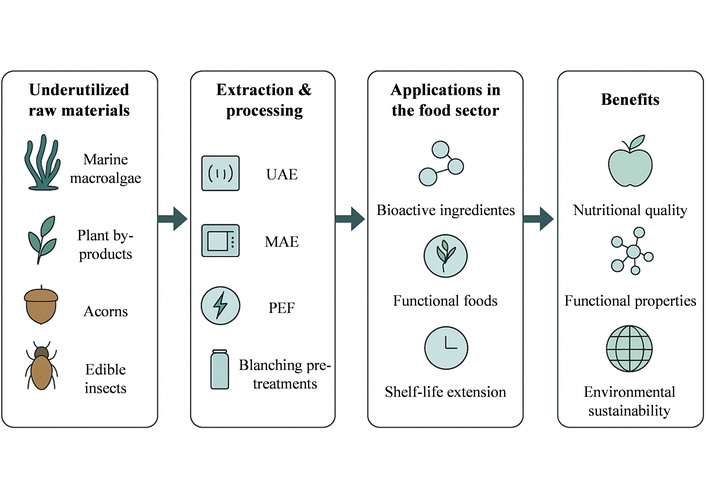
Conceptual overview of the themes explored in this Special Issue, from the valorization of underexploited food resources to innovative processing technologies and functional food development. UAE: ultrasound-assisted extraction; MAE: microwave-assisted extraction; PEF: pulsed electric fields.
Marine macroalgae from the North Atlantic represent a promising yet underutilized food source and reservoir of high-value compounds [1]. Despite the region’s rich algal diversity, only a few species are cultivated or commercialized on a large scale, and historical consumption in Europe has been largely limited to periods of scarcity. Since the 1970s, phycocolloids such as agar, carrageenans, and alginates have been widely used in the food industry as thickeners and stabilizers in soups, meat products, dairy goods, and pastries. Although consumption has been increasing in both Europe and North America, driven by growing recognition of their nutritional and functional properties, certain barriers (e.g., technological limitations, low consumer awareness, and outdated regulatory frameworks) must be overcome to fully realize the potential of North Atlantic macroalgae.
Complementing this marine perspective, ellagitannins from Eucalyptus camaldulensis Dehnh. have been investigated for their potential applications in the food sector [2]. Traditionally valued for its medicinal properties, this species contains bioactive compounds with strong antioxidant and antimicrobial activities, including tellimagrandin I, pedunculagin, and castalagin/vescalagin. Leaves and small branches, often discarded as by-products, could serve as a valuable source of these compounds. Ellagitannins have demonstrated the ability to inhibit lipid oxidation in foods and hold potential for broader applications in pharmaceuticals and cosmetics. Further research focusing on purified compounds, rather than crude extracts alone, is necessary to better elucidate their functional benefits.
In the field of bioactive compound extraction, ultrasound-assisted extraction (UAE) and microwave-assisted extraction (MAE) have been compared for the recovery of polyphenols from partially defatted chia (Salvia hispanica L.) flour [3]. Both methods outperformed conventional solvent-based techniques, with MAE yielding higher polyphenol content and antioxidant activity in shorter processing times. Optimal conditions included a 0.02 g/mL solid–liquid ratio with a 60:40 ethanol–water mixture at 60°C for 3.5 min.
Nanotechnology offers another frontier for innovation, enhancing the stability, delivery, and bioavailability of natural antioxidants (including phenolics, carotenoids, and vitamins) within food matrices and active packaging [4]. Techniques such as UAE and pulsed electric fields (PEF) also support these advancements by improving extraction efficiency and compound stability. However, the promise of nano-formulated ingredients necessitates further research into their safety aspects, regulatory frameworks, and cross-sector applications.
Edible insects are increasingly recognized as a sustainable and nutrient-dense alternative protein source. A study on mulberry silkworm pupae and African palm weevil larvae demonstrated their suitability as substitutes for beef, chicken, and mackerel in gluten-free oat breakfast wraps [5]. These products provided high protein levels, favorable amino acid and fatty acid profiles, and micronutrient levels (particularly vitamin B12) that exceeded those of conventional wraps. Palm weevil larvae also increased dietary fiber, carbohydrate, and vitamin A content. These innovative products met microbial safety standards and achieved strong consumer acceptance in sensory evaluations, especially silkworm pupae-filled wraps, demonstrating their potential to improve nutrition while reducing the environmental footprint of protein production.
Beyond raw-material innovation, processing technologies remain critical for product development. The impact of pretreatments (blanching at 100°C for 4 min and submersion in 5% citric acid or 1% ascorbic acid solutions) combined with oven drying on the chemical composition and sensory quality of fried yam (Dioscorea rotundata Poir.) chips was evaluated [6]. Blanching for 4 min produced chips with the highest scores for taste, color, crispiness, and overall acceptability, whereas acid treatments effectively reduced browning but were less favored in sensory tests. These results indicate that blanching coupled with drying optimizes sensory quality, while acid treatments are useful for browning control.
Resistant starch extracted from pedunculate oak (Quercus robur L.) acorns has been investigated as a functional ingredient in chocolate milk puddings [7]. Acorn starch, extracted using non-thermal PEF and high hydrostatic pressure (HHP), replaced conventional corn starch, improving texture and flow properties without altering nutritional composition, internal structure, or digestibility. Puddings containing PEF-extracted starch maintained superior color and texture over 28 days of refrigerated storage, exhibited no microbiological issues, and were preferred by sensory panels.
Functional flours have been used to develop high-fiber bakery products [8]. Biscuits prepared from bran-enriched blends of wheat, corn, sorghum, and sweet potato showed increased fiber, protein, and essential mineral contents, along with enhanced antioxidant activity. Sensory evaluation results were generally positive, and two formulations maintained stable blood glucose levels for over 90 min, with one exhibiting the highest glucose-binding capacity, suggesting potential benefits for diabetes management.
Advances have also been made in plant-based protein processing. The type of coagulant, seed-to-water ratio, and coagulation temperature were shown to influence the physicochemical and textural quality of kenaf seed tofu [9]. Aluminum potassium salt at 0.50 and 1.00 g/100 mL, added at 80°C, yielded the highest production (71–78%). Coagulants such as aluminum potassium salt and glucono-δ-lactone produced tofu with desirable firmness and chewiness when combined with a 1:3 seed-to-water ratio at 70–80°C. Potash produced the firmest texture, while magnesium dichloride yielded a softer tofu with a lower yield.
Shelf-life extension in alcoholic and non-alcoholic beverages has been addressed through immersion batch pasteurization for craft beers, with particular attention to containers and bottle closure integrity [10]. The developed method extended shelf life without compromising crown cork liner performance, pressure retention, or sensory quality, offering a practical solution for artisanal brewers.
Collectively, the studies featured in this Special Issue illustrate the transformative potential of coupling innovative raw materials with advanced processing technologies to foster a more sustainable and resilient food system. By valorizing underutilized natural resources and adopting innovative extraction, processing, and formulation techniques, the food sector can deliver nutritious, functional products with a lower environmental footprint. Scaling these innovations will require addressing regulatory gaps, production challenges, and consumer acceptance, highlighting the need to integrate science, technology, and sustainability to advance global food security.
MAE: microwave-assisted extraction
PEF: pulsed electric fields
UAE: ultrasound-assisted extraction
The authors thank all contributing authors and reviewers for their invaluable work in advancing food science knowledge.
JP and JIAE: Conceptualization, Writing—original draft, Writing—review & editing. Both authors read and approved the submitted version.
José Pinela, Editorial Board Member and Guest Editor of Exploration of Foods and Foodomics, and José Ignacio Alonso-Esteban, Guest Editor of Exploration of Foods and Foodomics, had no involvement in the decision-making or the review process of this manuscript. Both authors declare that they have no other conflicts of interest.
Not applicable.
Not applicable.
Not applicable.
Not applicable.
This work was supported by national funds through FCT/MCTES (PIDDAC): CIMO UID/00690/2025 (10.54499/UID/00690/2025) and UID/PRR/00690/2025 (10.54499/UID/PRR/00690/2025); SusTEC, LA/P/0007/2020 (10.54499/LA/P/0007/2020). The funders had no role in study design, data collection and analysis, decision to publish, or preparation of the manuscript.
© The Author(s) 2026.
Open Exploration maintains a neutral stance on jurisdictional claims in published institutional affiliations and maps. All opinions expressed in this article are the personal views of the author(s) and do not represent the stance of the editorial team or the publisher.
Copyright: © The Author(s) 2026. This is an Open Access article licensed under a Creative Commons Attribution 4.0 International License (https://creativecommons.org/licenses/by/4.0/), which permits unrestricted use, sharing, adaptation, distribution and reproduction in any medium or format, for any purpose, even commercially, as long as you give appropriate credit to the original author(s) and the source, provide a link to the Creative Commons license, and indicate if changes were made.



View: 2119
Download: 82
Times Cited: 0
Leonel Pereira
Micaela Antón ... Rafael Borneo
Rut Domínguez ... Manuel Domínguez
Eliseo Sánchez-Loredo ... Juan A. Ascacio-Valdés
Ayla Elmi Kashtiban ... Sayna Zahedinia
Shafa’atu Giwa Ibrahim, Roselina Karim
Brice Ulrich Foudjo Saha ... Lifoter Kenneth Navti
Olamide Akande ... Daniel Ajewole
Evans Ntim Amedor ... James Owusu-Kwarteng
Luís M.G. Castro ... Manuela Pintado


