Systematic Review


Affiliation:
1Department of Manufacturing Pharmacy, Faculty of Pharmacy, Mahidol University, Bangkok 10400, Thailand
Email: mudassirfaroooq@gmail.com
ORCID: https://orcid.org/0000-0002-0586-3476


 ,
,
Affiliation:
2Department of Pharmaceutics, Faculty of Pharmacy, Bahauddin Zakariya University, Multan 66000, Pakistan
ORCID: https://orcid.org/0009-0004-2655-2193
Explor Drug Sci. 2026;4:1008174 DOI: https://doi.org/10.37349/eds.2026.1008174
Received: April 10, 2026 Accepted: June 24, 2026 Published: August 03, 2026
Academic Editor: Fernando Albericio, University of KwaZulu-Natal, South Africa, Universidad de Barcelona, Spain; Xiqun Jiang, Nanjing University, China
Background: Acid-hydrolyzed nanocrystalline starch has attracted interest as a sustainable pharmaceutical excipient because of its crystallinity, compactibility, and potential suitability for direct compression tableting. However, the available evidence on its fabrication methods, material attributes, and performance as a direct compression tablet excipient remains scattered.
Methods: A systematic review was conducted using MEDLINE, Scopus, PubMed, Embase®, and Google Scholar to identify studies published from 2000 to 2025. Search terms included starch nanocrystals, acid-modified starch, hydrolyzed starch, acid-hydrolyzed starch, nanostarch, and direct compression fillers. Forward and backward snowballing were also performed. Studies were screened using predefined eligibility criteria, excluding reviews, conference abstracts, non-pharmaceutical applications, low crystallinity products, and studies lacking adequate characterization, particularly X-ray diffraction.
Results: The search identified 651 records; after removal of 3 duplicate records, 648 records were screened, 51 underwent full text assessment, and 34 were included in the review. Acid hydrolysis was the most widely reported method for preparing nanocrystalline starch, while pretreatment strategies such as enzymatic treatment, ultrasonication, ball milling, heat moisture treatment, organic acid treatment, and mixed acid hydrolysis were reported to reduce preparation time or improve yield and crystallinity. Across tablet related studies, acid modified nanocrystalline starch generally showed improved crystallinity, compactibility, and tablet hardness compared with native starch. Spray drying and agglomeration further improved flow and direct compression performance in several studies.
Discussion: Acid modified nanocrystalline starch shows promise as a sustainable direct compression tablet excipient. However, broader pharmaceutical adoption remains limited by low or variable yield, long processing time, botanical source variability, inconsistent powder flow, limited standardization, and unclear scale up pathways. Future studies should connect preparation methods, material characterization, powder flow engineering, and tablet performance testing to support industrial development.
Starch is a naturally occurring, sustainable, and biodegradable biopolymer synthesized by many plants as an energy reserve [1]. It is the world’s second most abundant biomass material and is present in the roots, stems, and seeds of many crops and staple foods, including rice, chickpea, corn, wheat, mung bean, tapioca, and potato [2]. Nevertheless, native starch often shows functional limitations, including low solubility, limited resistance to shear stress, and poor thermal properties, which can restrict its use in some industrial applications. These limitations can be addressed by physical modifications such as pregelatinization, heat moisture treatment, and annealing, or by chemical modifications such as hydrolysis (acid or enzymatic), debranching, esterification, and substitution [3].
Starch consists mainly of two homopolymers of D-glucose, amylose and amylopectin, together with small amounts of proteins, lipids, fibers, and minerals. Amylose is generally regarded as a mostly linear polymer, whereas amylopectin is highly branched. Branching occurs approximately every 20–25 glucose units through α-1,6-glycosidic linkages that connect α-1,4-glucan chains to the C-6 hydroxymethyl group of a glucose residue. Amylopectin also generally has a higher molecular weight than amylose. The amylopectin to amylose ratio varies according to botanical origin and genetic background, but starch typically contains about 70–80% amylopectin and 20–25% amylose. These structural differences lead to important differences in physical and chemical properties. Starch is often considered a preferred alternative to synthetic polymers because it is nontoxic, biodegradable, biocompatible, renewable, affordable, and readily available. It may be used either in its native form or after modification. However, native starch is unsuitable for some industrial applications because of limited stability and solubility, retrogradation behavior, poor thermal stability, and low mechanical strength. It is therefore commonly processed to improve its structural and functional properties for specific applications [4]. Among modified forms, starch nanocrystals (SNCs) are widely studied because of their favorable physicochemical and biological properties, including greater surface area, stronger adsorption capacity, enhanced solubility, and improved flow compared with native starch [5].
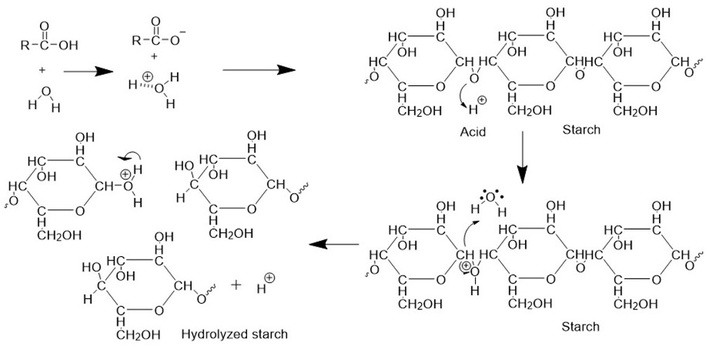
Starch can undergo chemical or physical modification to enhance, reduce, or introduce specific functional properties. Acid hydrolysis is the most widely used technique for producing SNC because it can generate small particles with high crystallinity and good stability. SNCs are commonly prepared using strong mineral acids such as sulfuric acid or hydrochloric acid at temperatures below the gelatinization temperature [6]. During acid hydrolysis, hydronium ions cleave glycosidic bonds, increasing the proportion of shorter linear chains, as illustrated in Figure 1. The process initially hydrolyzes the amorphous regions rapidly and is then followed by a slower second stage involving the crystalline regions. The key principle of acid hydrolysis is therefore to remove the amorphous regions while preserving the crystalline domains. Acid hydrolysis is influenced by several factors, including starch botanical source, particle morphology, amylose and amylopectin content, and hydrolysis conditions. In addition, pretreatment of native starch can improve SNC yield and crystallinity [7].
Acid-modified starch, microcrystalline starch, hydrolyzed starch, SNC, and, in some cases, nanostarch are terms used to describe crystalline fractions generated by hydrolysis, although they may differ in their degree of crystallinity. The terminology used in this review is presented in Table 1. Notably, studies describing starch nanoparticles prepared by acid hydrolysis often refer to SNC because selective degradation of the amorphous regions markedly increases crystallinity [8]. By contrast, starch nanoparticles that are largely amorphous in nature are not SNC [9, 10]. The rate and efficiency of acid hydrolysis depend on acid concentration, temperature, reaction time, acid type, and substrate concentration. Although this systematic review does not discuss these parameters in detail, readers are referred to Harun et al. [11] for a comprehensive analysis of factors affecting acid hydrolysis and nanoparticle preparation.
Terminology used in the review.
| Term | Operational meaning in this review | Distinction/limitation |
|---|---|---|
| Starch nanocrystal (SNC)/nanocrystalline starch | Acid-hydrolyzed starch material with increased crystallinity compared with native starch, preservation of crystalline domains, and characterization evidence such as X-ray diffraction (XRD) and particle size/morphology analysis. | Not all starch nanoparticles are SNCs. |
| Acid-modified starch | Starch modified by acid hydrolysis with altered physicochemical, flow, or compression properties. | Considered nanocrystalline only when increased crystallinity or crystalline character is reported. |
| Nanostarch/starch nanoparticles | Nanoscale starch particles prepared by chemical, physical, or enzymatic methods. | May be amorphous; not classified as SNC unless crystallinity is confirmed. |
| Agglomerated starch-based excipients | Larger engineered particles prepared from acid modified or nanocrystalline starch to improve flow and tableting performance. | Discussed separately because direct compression performance may result from agglomeration or spray drying rather than the nanocrystal state alone. |
SNCs are widely used in several industries, including food packaging [12], textiles [13], environmental protection [14], and petroleum applications [15]. Because SNCs are biodegradable, biocompatible, and nontoxic, they are also attractive for pharmaceutical applications. Their small size enables them to act as carriers in drug delivery systems and to encapsulate drugs. Related starch-based nanoparticle systems have also been investigated for Pickering emulsions, films, hydrogels, transdermal formulations, and drug delivery applications, although not all these reports provide crystallinity confirmation required for classification as acid hydrolyzed nanocrystalline starch. For example, related starch-based nanoparticles have been used to stabilize Pickering emulsions [16–18], to reinforce films [19], to develop supramolecular hydrogels [20], to serve as fillers in transdermal patches [21] and deliver antitumor drugs effectively [22], thereby enabling sustained and controlled drug delivery [23–25]. Moreover, SNCs have been investigated as binders, disintegrants [26], diluents, and materials for sustained release [27] and pulsatile release [28] tablet formulations, where they can enhance tablet mechanical strength because of their low cost. However, it remains unclear which preparation methods are most effective for producing SNC with optimal yield, crystallinity, and particle size, and which drying methods best improve the flow behavior of SNC powders intended for direct compression. This systematic review was therefore undertaken to map the current evidence on SNC preparation methods, examine the main pharmaceutical applications of SNC as direct compression fillers, and summarize the synthesis processes and characterization techniques most commonly reported.
We searched Scopus, MEDLINE, Embase®, and PubMed using keywords related to SNCs, acid-modified starch, hydrolyzed starch, acid hydrolyzed starch, nanostarch, nano starch, microcrystalline starch, and starch as a direct compression filler. Filters were applied to identify studies published between 2000 and 2025. A supplementary snowball search was conducted by screening the reference lists of eligible full text articles and by using Google Scholar and Scopus to identify articles that cited them. The database search was updated on August 6, 2024, followed by additional snowball and supplementary searches on November 10, 2025, using the same strategy and restricted to studies published from 2000 onward. Review articles, book chapters, conference abstracts, studies related to environmental or petroleum applications, and studies reporting lower crystallinity products, particularly those prepared by enzymatic hydrolysis, were excluded because such materials are better described as starch nanoparticles rather than SNC. Studies lacking appropriate characterization techniques, especially X-ray diffraction, to distinguish SNC from starch nanoparticles were also excluded. Studies on starch nanoparticles were included only when they exhibited higher crystallinity than native starch, and all studies on SNC reporting pharmaceutical applications in tablet formulations were included. Only articles published in English were included. The review protocol was not registered. Study screening was performed using predefined eligibility criteria. Titles and abstracts were first screened for relevance, followed by full text assessment of potentially eligible studies. Disagreements or uncertain eligibility decisions were resolved through discussion among the authors. Data were charted using a predefined extraction framework including starch source, preparation method, acid type, hydrolysis time, particle size, crystallinity, yield, drying method, flow behavior, compression conditions, tablet hardness or tensile strength, friability, disintegration, dilution capacity, and lubricant sensitivity where available. A formal risk of bias assessment was not conducted because the objective of this review was to map the available evidence, terminology, preparation methods, and excipient performance gaps rather than to estimate pooled treatment effects. The general search terms and Boolean operators were adapted for each database, as summarized in Table 2. The inclusion and exclusion criteria are summarized in Table 3. The excluded articles and reasons for exclusion are presented in Table 4, and the flow chart of the systematic review is shown in Figure 2.
Search strategy used for the review.
| Item | Description |
|---|---|
| Databases searched | Scopus, MEDLINE, Embase®, PubMed, and Google Scholar |
| Publication period | 2000–2025 |
| Final database search date | 6 August 2024 |
| Supplementary search date | November 10, 2025 |
| Search terms | “starch nanocrystals”, “nanocrystalline starch”, “acid-modified starch”, “acid modified starch”, “acid-hydrolyzed starch”, “hydrolyzed starch”, “nanostarch”, “nano starch”, “microcrystalline starch”, “starch nanoparticles”, “direct compression filler”, “tablet filler”, “tablet diluent”, “pharmaceutical excipient” |
| General Boolean search structure | (“starch nanocrystals” OR “nanocrystalline starch” OR “acid-modified starch” OR “acid-hydrolyzed starch” OR “hydrolyzed starch” OR “nanostarch” OR “starch nanoparticles” OR “microcrystalline starch”) AND (“direct compression” OR “tablet filler” OR “tablet diluent” OR “pharmaceutical excipient” OR tablet OR filler OR diluent) |
| Additional search method | Forward and backward snowballing of eligible full text articles using Google Scholar and Scopus |
Inclusion and exclusion criteria.
| Criterion | Inclusion criteria | Exclusion criteria |
|---|---|---|
| Article type | Research articles | Reviews, book chapters, conference abstracts, editorials, and non-research articles |
| Publication year | Studies published from 2000 to 2025 | Studies published before 2000 |
| Material type | Acid-hydrolyzed nanocrystalline starch, starch nanocrystals, acid-modified starch with increased crystallinity, and related starch-based excipients relevant to tableting | Starch nanoparticles or nanostarch without evidence of crystallinity or crystalline domain preservation |
| Characterization | Studies reporting relevant characterization such as X-ray diffraction (XRD), crystallinity, particle size, morphology, or physicochemical properties | Studies lacking adequate characterization to distinguish nanocrystalline starch from amorphous starch nanoparticles |
| Applications | Studies related to pharmaceutical excipients, tablet fillers, direct compression, compactibility, compressibility, or tablet formulation | Studies focused only on environmental, petroleum, textile, food, or non-pharmaceutical applications |
| Pharmaceutical relevance | Studies reporting flow, compression, tabletability, compactibility, hardness, tensile strength, friability, disintegration, or drug loading information | Studies not providing any pharmaceutical or excipient relevant data |
Excluded studies after full text review and reasons for exclusion.
| Article title | Year of publication | Reason for exclusion | Reference |
|---|---|---|---|
| Effect of ultrasonic treatments on nanoparticle preparation of acid-hydrolyzed waxy maize starch | 2013 | Lower crystallinity | [10] |
| Starch nanocrystal stabilized Pickering emulsion polymerization for nanocomposites with improved performance | 2014 | Crystallinity of Starch nanocrystal (SNC) not reported | [16] |
| Starch nanocrystals based hydrogel: construction, characterizations and transdermal application | 2016 | Comparison related to crystallinity not reported with native starch | [21] |
| Native and modified starch nano-crystals loaded with doxorubicin mediated apoptosis in human breast cancer MCF7 cells | 2024 | No X-ray diffraction (XRD) based or quantitative crystallinity assessment was provided | [22] |
| Native and modified Digitaria exilis starch nanoparticles as a carrier system for the controlled release of naproxen | 2019 | Qualitative structural changes were reported, but no quantitative XRD crystallinity comparison with native starch was provided | [24] |
| First-line anti-tubercutilosis drugs-loaded starch nanocrystals for combating the threat of M. tuberculosis H37Rv strain | 2020 | Crystallinity of SNC not reported | [25] |
| Acetylated starch nanocrystals: preparation and antitumor drug delivery study | 2016 | Nanostarch structured modified | [23] |
| Effect of the mode of incorporation on the disintegrant properties of acid modified water and white yam starches | 2012 | Crystallinity of SNC not reported | [29] |
| Design of bilayer tablets using modified Dioscorea starches as novel excipients for immediate and sustained release of aceclofenac sodium | 2015 | The modified Dioscorea starches were not identified or sufficiently characterized as acid-hydrolyzed nanocrystalline starch | [27] |
| Use of cassava starch nanocrystals to make a robust rupturable pulsatile release pellet | 2018 | Crystallinity of SNC not reported | [28] |
| Evidence of micro- and nanoscaled particles during starch nanocrystals preparation and their isolation | 2011 | Crystallinity of SNC not reported | [30] |
| Evaluation of rheological behavior of starch nanocrystals by acid hydrolysis and starch nanoparticles by self-assembly: a comparative study | 2016 | Insufficient crystallinity characterization to confirm eligibility according to the review criteria | [31] |
| Characterization of Starch Nanocrystals from Lablab purpureus (L.) Sweet and Its Application as a Stabilizer in Pickering Emulsions | 2023 | Crystallinity of SNC not reported | [18] |
| Surface chemical compositions and dispersity of starch nanocrystals formed by sulfuric and hydrochloric acid hydrolysis | 2014 | Crystallinity of SNC not reported | [32] |
| Characterization of nanoparticles prepared by acid hydrolysis of various starches | 2012 | Lower crystallinity | [9] |
| Characterization of acid hydrolysis of granular potato starch under induced electric field | 2017 | Lower crystallinity | [33] |
| Enhancement of the gut-retention time of resveratrol using waxy maize starch nanocrystal-stabilized and chitosan-coated Pickering emulsions | 2021 | Crystallinity of SNC not reported | [34] |
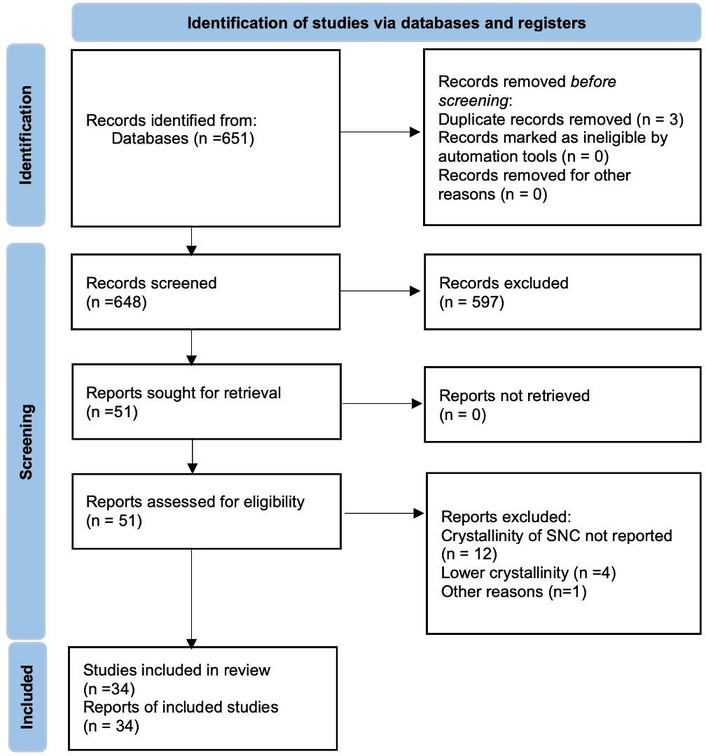
PRISMA-style flow diagram of study selection for the systematic review. This flow diagram was drawn in accordance with PRISMA guidelines (adapted from https://www.prisma-statement.org/prisma-2020-flow-diagram). © 2024–2026 the PRISMA Executive. Licensed under a CC BY 4.0.
The characteristics of SNC obtained from various plant sources were reviewed in terms of crystallinity, particle size, drying method, flow behavior, and compression conditions relevant to their use as direct compression fillers in tableting.
The systematic review process initially identified 651 records through database and supplementary searches, 3 were removed as duplicate records. After title and abstract screening, 597 records were excluded, and 51 full text articles were assessed for eligibility. Of these, 17 full text articles were excluded for the reasons listed in Table 4, leaving 34 studies included in the final systematic review. The revised study selection process is shown in Figure 2. China contributed the highest number of publications, followed by Thailand, whereas other countries contributed fewer articles. Maize accounted for the highest number of publications, followed by potato and cassava, whereas other crops such as quinoa, banana, and Lablab purpureus were represented by fewer studies. An increasing publication trend in SNC research was observed from 2020 to 2024, as shown in Figure 3.
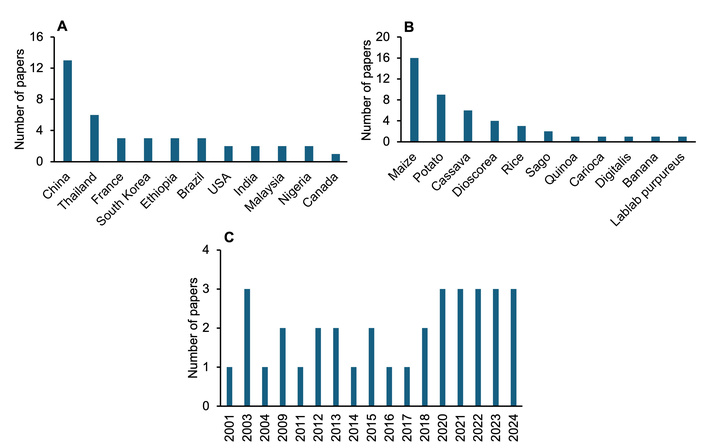
Number of papers categorized by countries represented by the authors’ institutional affiliations (A), starch sources investigated (B), and year of publication (C). In bar charts A and B, one article may be counted in more than one category when it includes authors from multiple countries or investigates multiple starch sources. Numbers were calculated based on the total number of included papers (n = 34).
Research on SNC began in the late nineteenth century; however, limited progress was made until the twentieth century. In 2001, Atichokudom-chai et al. [35] prepared tapioca SNC by hydrolyzing a tapioca starch suspension in 6% w/v HCl at room temperature for up to 32 days to explore the use of SNC as direct compression excipients. The resulting SNC showed a relative crystallinity of 57.75%. Two years later, Putaux et al. [36] first reported that six weeks of acid hydrolysis with 2.2 N HCl at room temperature produced platelet like structures measuring 20–40 nm in length, 15–30 nm in width, and 5–7 nm in thickness. Angellier et al. [37] later modified the method by replacing HCl with H2SO4 and prepared waxy maize SNC using 3.16 mol/L H2SO4 at 40°C and 100 rpm for 5 days. Under these conditions, SNC with a 15.7% yield was obtained, with a morphology similar to that produced by HCl after six weeks of hydrolysis. This method has since been widely used as a standard approach for SNC preparation. The low yield of SNC has been attributed to the decline in native starch crystallinity and the need for prolonged acid treatment to obtain uniform SNC, during which preformed SNC may undergo partial hydrolysis [38]. In another study, SNC prepared from Dioscorea starch by HCl hydrolysis showed higher crystallinity and yield [39].
Several approaches have been proposed to shorten production time and increase the crystallinity of SNC. Enzyme pretreatment has been shown to reduce the time required for SNC synthesis. Among α-amylase, β-amylase, and glucoamylase, glucoamylase was the most effective for producing microporous starch. Pretreating waxy corn starch with glucoamylase for 2 h enabled the effects of traditional acid hydrolysis for 24 and 120 h to be achieved after only 6 and 45 h of acid hydrolysis, respectively [40]. More recently, researchers have explored ultrasonication combined with acid hydrolysis for SNC preparation. Amini and Razavi [41] reported that SNC could be produced within 45 min by simultaneously treating corn starch with ultrasound and H2SO4 hydrolysis. The resulting particles were smaller than 100 nm, with a yield of 21.6%. However, this approach has not been widely adopted because it often requires specialized equipment and may reduce SNC crystallinity by affecting the crystalline regions non selectively.
Saeng-On and Aht-Ong [42] investigated acid hydrolysis of banana and tapioca starch and compared the efficiency of HCl and H2SO4. Relative crystallinity values of 47.13% for banana starch and 60.06% for tapioca starch were obtained using H2SO4. These findings are consistent with previous studies on waxy maize starch: LeCorre et al. [30] used HCl, whereas Jiang et al. [31] used H2SO4 to prepare SNC. Wei et al. [32] reported that although H2SO4 produced lower SNC yields than HCl, the suspensions obtained with H2SO4 were more stable. Sulfate esters introduce negative charges on the SNC surface, increasing the zeta potential of the suspension. The resulting electrostatic repulsion reduces particle aggregation and produces a more stable and homogeneous suspension than hydrochloric acid-hydrolyzed SNC, which lacks sulfate groups [32]. Ball milling has also been used as a pretreatment to reduce the preparation time of SNC from 5 days to 2 days. After ball milling and hydrolysis of waxy corn starch with 3.12 mol/L H2SO4, SNC measuring 20–40 nm, with a yield of 19.3% and crystallinity of 47.7%, were obtained [43]. However, the use of ethanol as a wet ball milling agent raises environmental concerns. Hao et al. [44] used glucoamylase to pretreat waxy potato starch and obtained square shaped SNC with diameters of 50–100 nm and excellent dispersibility after 5 days of hydrolysis. However, enzyme pretreatment introduces additional substances that complicate subsequent isolation and purification. Enzymatic hydrolysis alone also tends to produce nanostarch rather than SNC, with lower crystallinity [45]. Dai et al. [46] combined heat moisture pretreatment with H2SO4 hydrolysis and effectively produced SNC within 4 days, achieving a yield of 26.7% and relative crystallinity of approximately 50%. This approach offers good efficiency and operational simplicity, making it a promising option for SNC preparation. Further innovation in pretreatment technologies, such as irradiation, ultra-high pressure, electrophoresis, and magnetophoresis, may further improve SNC preparation efficiency and facilitate large scale production. Organic acids have also received recent attention because they are easier to recover, less corrosive, and may introduce useful functional group changes. Zhou et al. [1] reported a yield of 89.6% and crystallinity of 38.5% for waxy maize SNC prepared by dry heated oxalic acid treatment; however, yield decreased as crystallinity increased because of hydrolysis of the starch crystalline regions. Nlandu et al. [47] reported a method involving supercritical CO2 pretreatment followed by enzymatic hydrolysis using pullulanase, which produced SNC with sizes of 20–150 nm and crystallinity of 60.2%. More recently, a neutral dispersion and acidic precipitation method was used to prevent excessive hydrolysis during SNC preparation from waxy potato starch by H2SO4 hydrolysis. This approach removed larger particles at pH 7 and precipitated highly crystalline, stable SNC at pH 5, thereby improving yield and quality while producing smaller particles with better thermal stability [48]. Li et al. [49] reported an SNC preparation method using a mixture of HCl and H2SO4 that substantially reduced preparation time (1 h versus 5 days) and produced higher relative crystallinity than conventional H2SO4 hydrolysis. The study also showed that the mixed acid method could convert A-type starch into V-type crystalline starch. Hu et al. [50] recently reported an ethanol acid penetration and dry heating method for SNC preparation. Using a mixture of 40% ethanol and 10.6 mM chloric acid and heating for 1.5 h, SNC were formed within 48 h rather than the 5 days required for conventional acid hydrolysis. The resulting SNC were smaller, showed lower yield but higher crystallinity, and possessed superior thermal stability. In summary, current SNC preparation methods mainly focus on particle size, yield, crystallinity, and hydrolysis time. The different methods used to prepare acid-hydrolyzed nanocrystalline starch are summarized in Table 5. A comparative synthesis of preparation methods is presented in Table 6. The reviewed preparation methods show clear trade-offs among crystallinity, yield, hydrolysis time, and pharmaceutical processability. Conventional HCl and H2SO4 hydrolysis remain the most widely reported and technically simple approaches, but they often require prolonged processing time and may provide limited yield. Assisted approaches, including ultrasonication, mixed acid hydrolysis, heat moisture pretreatment, supercritical CO2 pretreatment, organic acid hydrolysis, and ethanol acid dry heating, may shorten preparation time or improve selected material attributes. However, their reproducibility, scalability, residual processing concerns, and pharmaceutical suitability require further confirmation. The highest reported yield was not necessarily associated with the highest crystallinity, indicating that yield alone is insufficient for judging nanocrystalline starch quality. For direct compression applications, the most relevant evidence comes from studies that connect material attributes with flow behavior, compactibility, tablet hardness or tensile strength, friability, disintegration, dilution capacity, and lubricant sensitivity. Therefore, future work should integrate preparation method, material characterization, powder engineering, and tablet performance testing rather than reporting particle preparation alone.
Preparation methods of acid-hydrolyzed nanocrystalline starch.
| Botanical source | Method/conditions | Time | Yield (%) | Particle size | Crystallinity (%) | Classification | Reference |
|---|---|---|---|---|---|---|---|
| Tapioca/cassava starch | Acid hydrolysis; 6% w/v HCl | 32 days | Not reported | 14.28–14.29 µm | 57.75 | Acid-hydrolyzed nanocrystalline starch | [35] |
| Waxy maize | Acid hydrolysis; 2.2 N HCl | 42 days | 5 | 20–40 nm | Not reported | Acid-hydrolyzed nanocrystalline starch | [36] |
| Waxy maize | Acid hydrolysis; 3.16 mol/L H2SO4 | 5 days | 15.7 | 20–40 nm | Not reported | Acid-hydrolyzed nanocrystalline starch | [37] |
| Dioscorea starch | Acid hydrolysis; HCl; concentration not reported in table | 16 days | 37.4 | 18.2 µm | 50.5–71.3 | Acid-modified nanocrystalline starch | [39] |
| Dioscorea starch | Acid hydrolysis; HCl; concentration not reported in table | 40 days | 44.9 | 11.2 µm | 67.7 | Acid-modified nanocrystalline starch | [51] |
| Waxy maize | Acid hydrolysis; HCl; concentration not reported in table | 32 days | 35.8 | 9.4 nm | Not reported | Acid-hydrolyzed nanocrystalline starch | [52] |
| Waxy maize | Enzyme pretreatment + acid hydrolysis; H2SO4; concentration not reported in table; enzyme pretreatment | 45 h | 15 | 50–100 nm | 40 | Acid-hydrolyzed nanocrystalline starch | [40] |
| Cassava starch | Acid hydrolysis; H2SO4; concentration not reported in table | 5 days | 1.10 | 5–20 nm | Not reported | Acid-hydrolyzed nanocrystalline starch | [53] |
| Waxy maize | Ultrasound-assisted acid hydrolysis; H2SO4; concentration not reported in table; ultrasound pretreatment/assistance | 45 min | 21.6 | < 100 nm | Not reported | Acid-hydrolyzed nanocrystalline starch | [41] |
| Cassava starch | Acid hydrolysis; 3.5 M H2SO4 | 10 h | 85.66 | 30–70 nm | 60.06 | Acid-hydrolyzed nanocrystalline starch | [42] |
| Waxy potato | Enzyme pretreatment + acid hydrolysis; H2SO4; concentration not reported in table; enzyme pretreatment | 5 days | 16.2 | 50–100 nm | 50.8 | Acid-hydrolyzed nanocrystalline starch | [44] |
| Waxy maize | Ball milling + acid hydrolysis; 3.12 mol/L H2SO4; ball milling | 3 days | 19.3 | 20–40 nm | 47.7 | Acid-hydrolyzed nanocrystalline starch | [43] |
| Waxy maize | Heat-moisture pretreatment + acid hydrolysis; H2SO4 concentration not reported in table; heat-moisture pretreatment | 4 days | 26.7 | 30–50 nm | 49.8 | Acid-hydrolyzed nanocrystalline starch | [46] |
| Waxy maize | Dry-heated organic acid hydrolysis; oxalic acid; concentration not reported in table; dry heating | Not reported | 89.6 | 46.6–197.5 nm | 38.5 | Acid-hydrolyzed nanocrystalline starch | [1] |
| Waxy potato | Supercritical CO2 pretreatment + enzymatic hydrolysis; enzymatic hydrolysis; acid not reported; supercritical CO2 pretreatment | Not reported | Not reported | 20–150 nm | 60.2 | Nanocrystalline starch/nanostarch system | [47] |
| Waxy potato | Neutral dispersion and acidic precipitation; H2SO4; concentration not reported in table; neutral dispersion and acidic precipitation | Not reported | Not reported | < 750 nm | 35.59–46.25 | Acid-hydrolyzed nanocrystalline starch | [48] |
| Waxy maize | Mixed-acid hydrolysis; H2SO4 + HCl | 1 h | Not reported | 540–670 nm | > 32.1 | Acid-hydrolyzed nanocrystalline starch | [49] |
| Waxy potato | Ethanol acid penetration + dry-heating treatment; ethanol-acid mixture; concentration reported as 10.6 mM in text; ethanol-acid penetration + dry heating | 48 h | 8.5 | 539.2 nm | 61.22 | Acid-hydrolyzed nanocrystalline starch | [50] |
Comparative synthesis of acid-hydrolyzed nanocrystalline starch preparation methods.
| Comparison | Evidence from reviewed studies | Interpretation |
|---|---|---|
| Highest reported crystallinity | HCl hydrolyzed Dioscorea starch showed relative crystallinity up to 71.3%; ethanol-acid penetration with dry heating showed crystallinity of 61.22%; supercritical CO2 pretreatment followed by enzymatic hydrolysis showed crystallinity of 60.2%. | HCl hydrolysis can produce high crystallinity, but newer assisted methods may also improve crystallinity while reducing processing time. |
| Highest reported yield | Dry-heated oxalic acid hydrolysis showed the highest reported yield of 89.6%, followed by H2SO4 hydrolysis of cassava starch with yield of 85.66%. | High yield does not necessarily indicate better nanocrystalline quality because higher yield may occur with lower crystallinity. Yield and crystallinity should therefore be interpreted together. |
| Shortest preparation time | Ultrasound assisted H2SO4 hydrolysis produced particles within 45 min, while mixed HCl/H2SO4 hydrolysis reduced preparation time to 1 h. | Assisted hydrolysis methods are promising for time reduction, but their reproducibility, crystallinity retention, and suitability for pharmaceutical processing require further confirmation. |
| Operational simplicity | Conventional HCl or H2SO4 hydrolysis. | These methods are widely reported and technically simple, but they often require long hydrolysis times and may produce low yield. |
| Potential scalability | Heat moisture pretreatment followed by H2SO4 hydrolysis, mixed acid hydrolysis, and organic acid-based hydrolysis. | These approaches may offer better balance between processing time, operational simplicity, yield, and product quality, but scale-up evidence remains limited. |
| Potential pharmaceutical suitability | Methods that produce reproducible crystallinity, minimize harsh processing concerns, and generate material suitable for drying, agglomeration, or direct-compression evaluation. | Pharmaceutical suitability cannot be judged by crystallinity alone; residual acid control, batch reproducibility, flowability, compactibility, and excipient safety also need consideration. |
| Direct-compression relevance | Spray dried or agglomerated acid hydrolyzed starch excipients reporting flow indices, compression force/pressure, tensile strength or hardness, friability, disintegration, dilution capacity, and lubricant sensitivity. | Direct compression relevance is strongest when studies evaluate tablet performance, not only particle preparation. |
Pharmaceutical products play a crucial role in the global effort to diagnose and treat disease and to improve overall well-being at lower cost. Among solid dosage forms, tablets are particularly preferred because they are easy to administer, cost effective, convenient, and have a long shelf life. Tablets are commonly produced by compacting a blend of drug powder and excipients into a solid mass. Direct compression is favored because of its simplicity, cost effectiveness, and time efficiency [54]. With the advent of high-speed tableting equipment and greater reliance on direct compression, the performance requirements for excipients continue to increase. Tablet quality is strongly influenced by the diluents or fillers used, which should have suitable particle size, deformability, and stability. Native starch, however, lacks the flowability and compressibility needed for use as a direct compression filler [55]. It therefore needs to be modified, and acid treatment is among the most cost-effective modification methods. Acid-modified starches have shown improved flowability and compressibility, making them more suitable for direct compression. The following section provides an overview of acid-modified nanocrystalline starch and related starch-based excipients evaluated as direct-compression tablet excipients from 2003 onward. For direct-compression applications, acid-hydrolyzed nanocrystalline starch may be used either as a fine crystalline material or converted into larger engineered particles through spray drying or agglomeration. Therefore, studies involving spray-dried or agglomerated starch-based excipients are discussed separately where the reported improvement in flow or tableting performance may arise partly from particle size enlargement, morphology modification, or co-processing rather than from nanocrystallinity alone. Flowability is a critical material attribute for direct compression excipients and cannot be predicted from crystallinity alone. Although acid hydrolysis may improve crystallinity and compactibility, nanoscale or very fine particles generally show stronger cohesive forces, including van der Waals attraction, electrostatic interaction, and moisture related adhesion. These interactions may reduce powder flow and cause poor die filling during tableting. Therefore, the direct compression performance of acid-modified nanocrystalline starch should be evaluated using multiple powder and tablet attributes, including particle size distribution, morphology, true density, bulk and tapped density, Carr’s index, Hausner ratio, angle of repose, moisture content, electrostatic tendency, agglomerate strength, lubricant sensitivity, compactibility, tabletability, and dilution potential. Spray drying, agglomeration, or co-processing may improve flow by increasing particle size, producing more spherical particles, reducing interparticle cohesion, and improving packing behavior. Compression performance should also be interpreted mechanistically rather than only by reporting hardness or friability values. Acid modification and nanocrystalline domain enrichment may improve compactibility by increasing surface roughness, exposing additional bonding sites, and promoting interparticulate bonding during compression. Depending on the starch source and processing method, compaction may involve a combination of plastic deformation, brittle fragmentation, particle rearrangement, and moisture mediated bonding. Higher crystallinity may contribute to stronger compact formation, but excessive fine particle cohesion may reduce flow and die filling. Lubricant sensitivity is also important because hydrophobic lubricants can reduce bonding between starch particles and lower tablet strength. Therefore, tabletability should be interpreted using tensile strength, friability, disintegration, dilution capacity, and lubricant sensitivity in addition to simple crushing strength or hardness. This is particularly important for formulations containing poorly compressible model drugs such as paracetamol, where the excipient must maintain tablet strength at higher drug loading.
To investigate the potential of rice starch as a direct compression filler, both nonwaxy and waxy rice starches were subjected to partial hydrolysis in 6% w/v HCl at ambient temperature for different durations. This process increased crystallinity and produced acid-modified rice starches. Scanning electron micrographs showed that after 192 h of hydrolysis, acid-modified waxy rice starch exhibited surface exo-corrosion, whereas acid-modified rice starch remained unaltered. Hydrolysis reduced amylose content and particle size, and X-ray diffraction confirmed that relative crystallinity increased with longer hydrolysis times. Spherical agglomerates of native and acid-modified starches were compressed into tablets using a single punch rotary tablet machine, and higher crystallinity improved crushing strength and disintegration time while reducing friability [56]. Atichokudom-chai et al. [35] prepared cross-linked tapioca starch and then hydrolyzed it with 6% w/v HCl for 192 h. The final product was spray dried to obtain agglomerated acid-modified cross-linked tapioca starch. Cross linking did not increase the relative crystallinity or melting enthalpy of tapioca starch. Upon compression, both native and cross-linked tapioca starches showed low crushing strength. Acid hydrolysis removed noncrystalline regions and increased crystallinity, resulting in higher tablet hardness. In this study, tablets prepared from acid-modified cross-linked tapioca starch showed better performance than those prepared from acid-modified tapioca starches (ACMS). Furthermore, Akin-Ajani et al. [57] investigated the compressional behavior of acid-modified white fonio and sweet potato starches. They reported significant differences in the physicochemical and compressional properties of the two starches. Acid modification increased solubility and crystallinity while decreasing swelling and viscosity. Modified starches showed earlier onset but lower overall plastic deformation under pressure and produced stronger tablets at lower compression pressures than native starches. Longer steeping times increased tablet tensile strength, suggesting that modified fonio and sweet potato starches have potential for direct compression formulations. However, despite improvement over native starch, flow remained poor after acid modification, indicating the need for further enhancement of powder flow properties. Particle size enlargement is one strategy to improve flow. Smaller particles have a higher surface to volume ratio, which increases cohesive forces such as van der Waals and electrostatic interactions. These stronger forces hinder particle rearrangement and packing, resulting in more interstitial voids, lower bulk density, and a higher Hausner ratio, all of which indicate poorer flowability.
Odeku and Picker-Freyer [26] prepared acid-modified starches from four Dioscorea species: White yam (D. rotundata), Water yam (D. alata), Chinese yam (D. oppositifolia), and Bitter yam (D. dumetorum). Acid hydrolysis increased solubility and reduced swelling, while also improving compressibility relative to the native starches. Intact and stable tablets were obtained only at higher maximum relative densities for acid-modified water yam and white yam. By contrast, tablets prepared from acid-modified Chinese yam and bitter yam showed deformation at all relative densities. Nevertheless, the tablets exhibited higher crushing strength and acceptable disintegration times, indicating potential utility as excipients for direct compression.
Tessema et al. [58] evaluated the effects of acid modification and drying method on Dioscorea starch. The starch was hydrolyzed in 6% HCl for 8 days and then dried by either oven drying or spray drying. Native Dioscorea starch and oven-dried acid-modified Dioscorea starch showed unsatisfactory flow properties, whereas the spray-dried acid-modified starch exhibited improved flow, with a flow rate of 13.24 g/s and an angle of repose of 21.37°. The swelling power and percentage solubility of the starches increased with temperature. The acid-modified starch showed a solubility of 68.53%. Tablets were prepared using a single punch press under a constant compression force. The spray dried acid-modified starch was less sensitive to lubricant than the oven dried sample and Starch 1500®. It also showed a crushing strength of 50.9 N. Gulla et al. [59] prepared and characterized acid-modified Ethiopian potato starch as a directly compressible excipient and compared it with native Ethiopian potato starch and Starch 1500®. The starch was hydrolyzed with 6% HCl for 8 days and then dried by oven drying or spray drying. Acid hydrolysis reduced moisture content and swelling power while increasing solubility. Spray dried acid-modified Ethiopian potato starch showed better flowability than the native starch. Tablets containing paracetamol and a lubricant were prepared using a single punch tablet machine at a compression force of 15 kN. Compactability testing showed that the tensile strength of spray dried acid-modified Ethiopian potato starch was substantially higher (16.76 kg/cm2) than that of spray dried native Ethiopian potato starch (7.07 kg/cm2) and Starch 1500® (11.66 kg/cm2). The modified starch showed lower lubricant sensitivity and higher dilution potential than the native starch and Starch 1500®. It accommodated up to 50% paracetamol, whereas the native starch and Starch 1500® could accommodate only 30% (Gulla et al. [59]).
To study tabletability, ACMS and alkali-modified tapioca starches (ALMS) were prepared using HCl or NaOH solutions at concentrations of 0.1–1.0 N for 48 h, followed by tray drying and sieving through a 150 μm sieve. The particle size ranged from 75 to 150 μm. Both ACMS and ALMS showed poor flow characteristics. Propranolol tablets were prepared using native starch, ACMS, and ALMS at a compression pressure of 12.3 MPa. ACMS tablets showed higher hardness (38.02 N) than ALMS tablets (8.04 N), likely because the rougher surface of ACMS granules promoted cold welding at interparticulate contact points. The disintegration time and dissolution rate of ACMS tablets were comparable to those of ALMS tablets in both acidic and neutral media. The results also showed that ACMS prepared with higher HCl concentration (1 N) and ALMS prepared with higher NaOH concentration (0.2 N) exhibited greater crystallinity than native starch, whereas particle size decreased as acid or base concentration increased [60]. These findings are consistent with previous reports showing that stronger acid or alkaline treatment can reduce starch particle size; Md Shahrodin et al. [53] also reported that higher acid concentration reduced particle size in SNC prepared using HCl and H2SO4.
More recently, researchers prepared acid-modified Taro Boloso-I starch (AMTBIS) by hydrolyzing it in 6% w/v HCl for 192 h followed by spray drying. The resulting product was evaluated for compactibility in direct compression. The acid-treated starch showed reduced moisture content, increased crystallinity, and improved flow properties. Compaction studies also demonstrated better compactibility, with a tensile strength of 16.82 kg/cm2, which was higher than that of the native starch (13.17 kg/cm2) and Starch 1500® (11.2 kg/cm2). In addition, paracetamol tablets prepared with spray-dried AMTBIS using a single-punch tablet machine showed greater hardness (53.5 N) than tablets prepared with native Taro Boloso-I starch (38.5 N) and Starch 1500® (37.8 N), together with lower friability at all paracetamol concentrations. The formulation accommodated up to 40% paracetamol while maintaining satisfactory tablet properties, whereas native starch and Starch 1500® were limited to 30% (w/w) [61].
In another study, Siriwachirachai and Pongjanyakul [62] prepared ACMS agglomerates using polyvinylpyrrolidone (PVP) as an agglomerating agent to improve flow properties and particle strength, with particle sizes ranging from 75 to 150 μm. The ACMS agglomerates showed good flowability. Tablets were prepared using a hydraulic press at compression pressures of 4.9–12.3 MPa. ACMS agglomerate tablets containing 4% PVP showed greater particle strength than native starch agglomerates. The findings demonstrated that increasing the acid concentration to 1 N during ACMS modification increased crystallinity, which in turn improved compressibility and tablet hardness compared with native starch. Incorporation of PVP prolonged disintegration time and reduced the dissolution rate in both acidic and neutral media. ACMS agglomerated tablets also showed good carrying capacity for acetaminophen up to 30%, with desirable characteristics for direct compression using a single-punch tablet machine [62]. The properties and performance of acid-hydrolyzed SNCs and related acid-modified starch excipients used as direct compression fillers are summarized in Table 7.
Summary of acid-hydrolyzed starch nanocrystals as direct compression fillers.
| Material/source | Class/processing | Drug model/load | Flow/compression information | Tablet performance | Comparator | Conclusion | Reference |
|---|---|---|---|---|---|---|---|
| Tapioca/cassava starch | Acid-modified nanocrystalline starch | Not applicable | Not reported | Crushing strength 250 N; relative crystallinity 57.75% | Not reported | Acid hydrolysis increased crystallinity and tablet crushing strength. | [35] |
| Waxy and non-waxy rice starch | Spray-dried/agglomerated acid-modified starch excipient | Not applicable | Spherical particles; flow not fully reported; compression: 4 kN; single-punch rotary tablet machine | Crushing strength up to 158.9 N; friability: lower friability reported; disintegration/dissolution: disintegration time up to 16 min | Native starch/agglomerated starches | Hydrolysis and spherical agglomeration improved crystallinity, strength, friability, and disintegration behavior. | [56] |
| Acid-modified cross-linked tapioca starch | Spray-dried acid-modified starch excipient | Not applicable | Spherical particles; 42 µm; compression: flat-face tablet press | Crushing strength 64.75 N; relative crystallinity 52.9%; disintegration/dissolution: disintegration time < 4 min | Native/cross-linked tapioca starches | Acid hydrolysis plus spray drying improved tablet hardness and maintained short disintegration. | [63] |
| Dioscorea starches (white, bitter, Chinese, water yam) | Acid-modified starch excipient | Not applicable | Poor flowability reported; compression: eccentric tableting machine | Crushing strength: white 19.4 N, bitter 51.2 N, Chinese 149.6 N, water yam 26 N; disintegration/dissolution: acceptable disintegration times reported | Native Dioscorea starches | Acid modification improved solubility, crystallinity, compressibility, and crushing strength, although flow remained limited. | [26] |
| Fonio and sweet potato starches | Acid-modified starch excipient | Not applicable | Poor flow after 96 h; better flow after 24 h but lower crystallinity/hardness; compression: hydraulic press | Intact tablets formed at lower compression pressure | Native starches | Acid modification increased crystallinity and tablet strength, but flowability remained a limitation. | [55] |
| Dioscorea starch | Spray-dried acid-modified starch excipient | Paracetamol; up to 40% drug | Spray-dried powder free flowing; oven-dried sample poor flow; compression: eccentric tableting machine | Crushing strength 50.9 N; disintegration/dissolution: disintegration time < 7 min; lubricant sensitivity: lower lubricant sensitivity than oven-dried sample and Starch 1500® | Oven-dried acid-modified starch; Starch 1500® | Spray drying improved flow and reduced lubricant sensitivity while supporting paracetamol tablet formation. | [58] |
| Ethiopian potato starch | Spray-dried acid-modified starch excipient | Paracetamol; up to 50% drug | Good flow reported; compression: 15 ± 2 kN; single-punch tablet machine | Crushing strength approx. 85 N with 1% lubricant; higher compactibility; disintegration/dissolution: disintegration time < 15 min; lubricant sensitivity: lower lubricant sensitivity reported | Native potato starch; Starch 1500® | Spray-dried acid-modified starch improved compactibility, flow, dilution capacity, and tablet strength versus comparators. | [59] |
| Tapioca starch [acid-/alkali-modified tapioca starches (ACMS/ALMS)] | Acid-modified and alkali-modified starch excipient | Propranolol; load not reported | Improved relative to native starch but still poor flow at 1 N HCl/NaOH; particle size 75–150 µm; compression: 4.9–12.3 MPa; hydraulic press | ACMS hardness 38.02 N; ALMS hardness 8.04 N; crystallinity 48.9–51.5%; disintegration/dissolution: similar disintegration and dissolution profiles | Native tapioca starch; alkali-modified starch | Acid-modified tapioca starch showed higher crystallinity and tablet hardness than alkali-modified starch, but flow remained limited. | [60] |
| Tapioca starch agglomerates with polyvinylpyrrolidone (PVP) | Agglomerated/co-processed acid-modified starch excipient | Acetaminophen/propranolol; up to 30% drug | Good flow behavior; particle size 75–150 µm; compression: 4.9–12.3 MPa; hydraulic press | Increased tablet hardness; enhanced compressibility; disintegration/dissolution: PVP prolonged disintegration and reduced dissolution rate | Native starch agglomerates/modified starches | Agglomeration with PVP improved flow, compressibility, and drug-carrying capacity, but changed disintegration/dissolution behavior. | [62] |
| Taro Boloso-I starch | Spray-dried acid-modified starch excipient | Paracetamol; up to 30% drug | Good flow behavior; decreased moisture content; compression: single-punch tablet machine | Hardness 53.5 N; increased crystallinity to 45.33%; friability: lower friability reported; lubricant sensitivity: lower lubricant sensitivity reported | Native Taro Boloso-I starch; Starch 1500® | Spray-dried acid-modified Taro Boloso-I starch improved flow, crystallinity, hardness, friability, and lubricant response. | [61] |
Although acid-modified nanocrystalline starch shows promise as a direct compression tablet excipient, several technical, pharmaceutical, regulatory, and manufacturing challenges remain before broader industrial adoption. These challenges are not limited to crystallinity or tablet hardness, but also include process scalability, purification, batch reproducibility, powder flow, excipient safety, regulatory acceptance, and commercial feasibility.
Conventional acid hydrolysis remains one of the most widely used methods for preparing acid-modified nanocrystalline starch; however, long hydrolysis time, low or variable yield, high acid consumption, and repeated washing steps limit its industrial scalability. Large scale production would require better control of acid concentration, temperature, starch to acid ratio, reaction time, neutralization, and drying conditions. Acid recovery and reuse are also important because mineral acid hydrolysis may generate acidic waste streams and increase production cost. Newer approaches, including assisted hydrolysis, organic acid treatment, heat moisture pretreatment, and combined physical-chemical methods, may reduce preparation time, but their scalability and batch reproducibility still require systematic evaluation.
For pharmaceutical use, residual acid and by-products from the hydrolysis process must be carefully controlled. Sulfuric acid hydrolysis may introduce sulfate ester groups on the starch surface, which can improve dispersion stability but may also alter excipient behavior, compatibility, and safety profile. Hydrochloric acid and organic-acid methods may avoid some sulfate related changes, but they still require adequate purification, neutralization, and drying. Future studies should therefore report residual acid, pH, ash content, ionic residues, surface substitution where relevant, and compatibility with model drugs and common excipients. Safety evaluation should also include cytotoxicity, irritation potential, microbial quality, and stability under storage conditions.
Starch properties depend strongly on botanical source, amylose to amylopectin ratio, granule morphology, native crystallinity, lipid and protein content, and harvesting or processing conditions. As a result, acid-modified nanocrystalline starch prepared from different sources may show different particle size, crystallinity, yield, flow behavior, and compaction performance. Even within the same botanical source, batch to batch variability may occur if raw material quality and hydrolysis conditions are not tightly controlled. Standardized specifications for starting starch, hydrolysis conditions, crystallinity, particle size distribution, moisture content, and powder performance are therefore necessary for reproducible excipient development.
One major limitation of nanocrystalline or very fine starch particles is poor flowability. Although acid hydrolysis may improve crystallinity and compactibility, small particle size can increase interparticle cohesion, electrostatic effects, and moisture related adhesion. These properties may impair die filling and weight uniformity during direct compression. For this reason, spray drying, agglomeration, granulation, or co-processing with binders and flow enhancing excipients may be required. However, when improved flow or tabletability is observed after agglomeration or spray drying, the improvement should not be attributed to nanocrystallinity alone. Future studies should distinguish the contribution of crystallinity from the contribution of particle engineering.
Although starch and several modified starches are already used in pharmaceutical formulations, acid-modified nanocrystalline starch intended as a direct compression excipient may require additional regulatory justification, especially if the material differs substantially in particle size, surface chemistry, crystallinity, or manufacturing process from established starch excipients. Regulatory acceptance would require clear specifications, validated manufacturing controls, impurity limits, safety data, stability data, and compatibility information. The regulatory pathway may be easier if the material is developed as a co-processed starch-based excipient with well-defined quality attributes and consistent performance.
A quality by design approach would be useful for future development of acid-modified nanocrystalline starch excipients. Critical material attributes may include botanical source, amylose content, particle size distribution, morphology, crystallinity, moisture content, density, Carr’s index, Hausner ratio, angle of repose, compactibility, lubricant sensitivity, and dilution potential. Critical process parameters may include acid type and concentration, hydrolysis time, temperature, agitation, starch concentration, washing, neutralization, drying method, and agglomeration conditions. Linking these process parameters and material attributes to tablet performance would help establish a rational design space for direct-compression applications.
At present, there is limited commercial standardization for acid-modified nanocrystalline starch as a direct compression excipient. Many studies report crystallinity, particle size, hardness, or friability, but fewer studies provide complete excipient specifications or compare performance against established commercial fillers such as microcrystalline cellulose, lactose, dicalcium phosphate, or pregelatinized starch. Future studies should include benchmark comparisons with commercial excipients and report standard tableting outcomes such as flow indices, compression force, tensile strength, friability, disintegration, dissolution behavior, dilution capacity, and lubricant sensitivity.
The environmental and economic feasibility of acid-modified nanocrystalline starch will depend on raw material availability, processing time, acid consumption, water use, washing requirements, drying energy, solvent recovery, and product yield. Although starch is renewable, biodegradable, and widely available, the environmental advantage may be reduced if preparation requires prolonged acid hydrolysis, large volumes of washing water, or energy-intensive drying. More sustainable preparation routes, including recoverable organic acids, reduced acid concentration, shorter reaction time, and efficient drying or agglomeration methods, should be investigated.
Future research should move beyond particle preparation and provide integrated excipient performance evaluation. Studies should report standardized crystallinity, particle size distribution, morphology, flow indices, compactibility, tabletability, dilution capacity, lubricant sensitivity, drug excipient compatibility, stability, and safety data. Direct compression studies should include model drugs with different compressibility profiles and should compare acid-modified nanocrystalline starch with established commercial excipients under similar compression conditions. Scale-up studies, process validation, storage stability, and regulatory oriented safety assessment will be essential before acid-modified nanocrystalline starch can be considered for routine industrial use as a direct-compression tablet excipient.
ACMS: acid-modified tapioca starches
ALMS: alkali-modified tapioca starches
AMTBIS: acid-modified Taro Boloso-I starch
PVP: polyvinylpyrrolidone
SNCs: starch nanocrystals
XRD: X-ray diffraction
During the preparation of this work, the authors used Grammarly tool for language editing, grammar improvement, and formatting assistance. After utilizing the tool/service, the authors reviewed and edited the content as necessary and take full responsibility for the final content of the publication.
MF: Conceptualization, Methodology, Investigation, Data curation, Formal analysis, Resources, Supervision, Visualization, Writing—original draft, Writing—review & editing. SS: Conceptualization, Methodology, Formal analysis, Validation, Visualization, Writing—review & editing. Both authors read and approved the submitted version.
The authors declare that they have no conflicts of interest.
Not applicable.
Not applicable.
Not applicable.
Data are available upon reasonable request.
Not applicable.
© The Author(s) 2026.
Open Exploration maintains a neutral stance on jurisdictional claims in published institutional affiliations and maps. All opinions expressed in this article are the personal views of the author(s) and do not represent the stance of the editorial team or the publisher.
Copyright: © The Author(s) 2026. This is an Open Access article licensed under a Creative Commons Attribution 4.0 International License (https://creativecommons.org/licenses/by/4.0/), which permits unrestricted use, sharing, adaptation, distribution and reproduction in any medium or format, for any purpose, even commercially, as long as you give appropriate credit to the original author(s) and the source, provide a link to the Creative Commons license, and indicate if changes were made.



View: 1005
Download: 24
Times Cited: 0