Commentary


Affiliation:
1Department of Internal Medicine, Azienda Ospedaliero-Universitaria of Modena, Ospedale Civile di Baggiovara (–2023), 41100 Modena, Italy
†
Email: a.lonardo@libero.it
ORCID: https://orcid.org/0000-0001-9886-0698


 ,
,
Affiliation:
2Institute of Molecular Pathobiochemistry, Experimental Gene Therapy and Clinical Chemistry (IFMPEGKC), RWTH University Hospital Aachen, D-52074 Aachen, Germany
†
ORCID: https://orcid.org/0000-0003-3888-0931
Explor Drug Sci. 2026;4:1008175 DOI: https://doi.org/10.37349/eds.2026.1008175
Received: June 22, 2026 Accepted: July 20, 2026 Published: August 17, 2026
Academic Editor: Fernando Albericio, University of KwaZulu-Natal, South Africa, Universidad de Barcelona, Spain
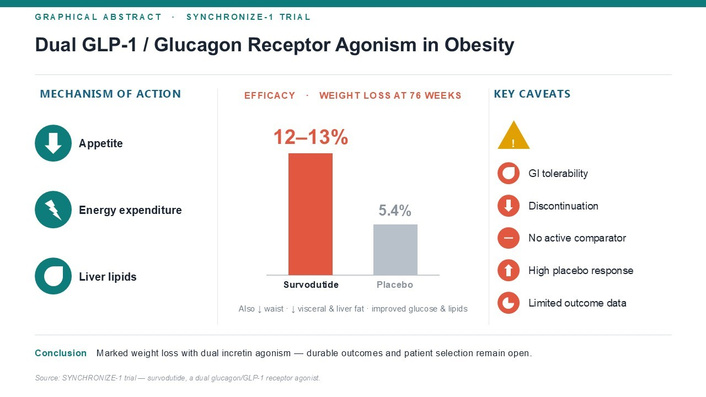
The therapeutic landscape for obesity is changing rapidly, driven by the recognition of obesity as a chronic, biologically heterogeneous disease, with clinically relevant organ consequences. In this context, the phase 3 SYNCHRONIZE™-1 trial of survodutide, a once-weekly dual agonist of glucagon receptor and glucagon-like peptide 1 (GLP-1) receptor, is notable not simply because it adds another effective incretin-based therapy, but because it tests a broader metabolic concept. By pairing GLP-1-mediated appetite suppression with glucagon-mediated effects on energy expenditure and hepatic lipid handling, survodutide aims to extend treatment beyond appetite control towards coordinated modulation of adiposity, cardiometabolic risk and steatotic liver disease. In adults with obesity without diabetes, SYNCHRONIZE™-1 showed sustained body-weight reductions of approximately 12–13% over 76 weeks, compared with 5.4% with placebo, and increased the proportion of participants achieving clinically ambitious weight-loss thresholds, including at least 20% weight loss. Improvements in waist circumference, glycemic and lipid measures, together with reductions in visceral and liver fat content (LFC) in imaging analyses, support the possibility of benefits that are metabolically broader than scale weight alone. Yet the trial also illustrates familiar tensions in obesity pharmacotherapy: gastrointestinal tolerability, treatment discontinuation, the absence of an active comparator, unexpectedly high placebo-associated weight loss and limited outcome data. Thus, SYNCHRONIZE™-1 should be read as an important proof of principle for dual glucagon-GLP-1 receptor agonism rather than as a definitive positioning of the therapy within the treatment landscape. The next challenge is to determine whether this mechanism delivers durable cardiovascular, renal, and hepatic benefits, and in which patient populations.
Obesity has traditionally been defined by body mass index (BMI), with a threshold of ≥ 30 kg/m2 identifying individuals at increased risk of adverse health outcomes [1]. However, BMI neither directly measures adiposity, fat distribution, nor adipose-tissue function, nor does it reliably capture individual health risk. In 2025, an international commission proposed a revised framework that distinguishes between preclinical obesity and clinical obesity, the latter defined as illness resulting from the effects of excess adiposity on organ and tissue function [2]. In this novel classification system, BMI is retained as a screening tool, but—among those with BMI < 40 kg/m2—excess adiposity should be confirmed by direct body-fat measurement or by at least one validated anthropometric criterion, including waist circumference, emphasizing the importance of visceral adiposity [2]. Although conceptually appealing, this framework remains contested because of practical challenges in measuring adiposity and concerns that, if most individuals meeting BMI-defined obesity criteria also fulfil the criteria for clinical obesity, its added clinical utility may be limited.
Obesity is a chronic relapsing disorder in which excess adiposity and adaptive pathophysiological responses sustain weight regain and increase health risk [3]. It contributes substantially to cardiovascular disease (CVD), cancers, type 2 diabetes (T2D), metabolic dysfunction-associated steatotic liver disease (MASLD), metabolic dysfunction-associated steatohepatitis (MASH), arterial hypertension, dementia, osteoarthritis, and obstructive sleep apnea, with marked effects on quality of life and a 5–20-year reduction in life expectancy according to disease severity and comorbidity burden [3]. Its prevalence has risen substantially in the United States, where clinical obesity is the predominant phenotype [4]. Compared with preclinical obesity, clinical obesity is associated with higher all-cause and cardiovascular mortality, particularly in individuals with multiple comorbidities or renal dysfunction-dominant disease [5].
Management therefore requires recognition of the biological, behavioral, and environmental determinants of positive energy balance, including genetic and epigenetic susceptibility, neuroendocrine regulation, thermogenesis, sarcopenia, gut dysbiosis, sociocultural context, health literacy, sleep deprivation, medication use, and physical limitations [3]. This heterogeneity explains the limited durability of remission and supports multimodal therapy. Although treatment of preclinical obesity remains debated, clinical obesity warrants timely evidence-based intervention to prevent end-organ damage [6].
In this context, survodutide may extend obesity pharmacotherapy by combining appetite suppression with increased energy expenditure. Through glucagon receptor (GCGR) stimulation, it may also improve hepatic lipid metabolism and reduce liver fat and MASH [7]. These properties position survodutide among next-generation incretin-based therapies targeting multiple metabolic pathways, and the present commentary discusses a recently published trial that may help reshape current principles of obesity management [7].
Pharmacotherapy, including survodutide, should be considered within a staged, complication-focused model of obesity care. Within this framework, therapeutic intensity is matched to adiposity, metabolic risk, and disease burden, and may be escalated from lifestyle intervention to pharmacotherapy, endoscopic approaches, and metabolic or bariatric surgery [8].
Lifestyle intervention remains first-line for individuals with a BMI ≥ 25 kg/m2. Energy restriction, physical activity, and behavioral support typically aim for 5–10% weight loss, which is sufficient to improve cardiometabolic risk, although adaptive metabolic and hormonal responses commonly limit durability and promote weight regain [9].
Pharmacotherapy is generally added when lifestyle measures are insufficient, usually in adults with a BMI ≥ 30 kg/m2 or a BMI ≥ 27 kg/m2 with weight-related comorbidities. Glucagon-like peptide 1 (GLP-1) and glucose-dependent insulinotropic polypeptide (GIP)-based agents act through central and gastrointestinal pathways to suppress appetite, delay gastric emptying, and support sustained weight loss, but their effects depend on long-term adherence [10, 11]. Tirzepatide has shown efficacy in achieving MASH resolution without worsening fibrosis and has been reported to be superior to semaglutide for reductions in BMI and waist circumference [12–14]. By contrast, survodutide extends this therapeutic rationale through GCGR agonism, linking appetite and glycemic effects to energy expenditure and liver-directed metabolism (Table 1).
Characteristics of semaglutide, tirzepatide, and survodutide.
| Compound | Doses and routes of administration | Mechanism of action | Clinical efficacy | Adverse events | Ref. |
|---|---|---|---|---|---|
| Semaglutide | OW sc or OD oral; initiated at 0.25 mg OW sc. | GLP-1 analogue that delays gastric emptying and promotes hypothalamic satiety signaling. | Produces clinically meaningful weight loss, reductions in WC, and improvements in blood pressure, fasting glucose, CRP, lipids, ASCVD outcomes, renal outcomes, MASH resolution, and HRQL. | Mainly mild-to-moderate GI events; weight regain may occur after withdrawal. | [11] |
| Tirzepatide | Initiated at 2.5 mg OW sc. | Dual GIP/GLP-1R agonist that reduces appetite and food-related behaviors. | In SURMOUNT-5, tirzepatide produced greater reductions in body weight and WC than semaglutide over 72 weeks, with more participants reaching ≥ 10% to ≥ 25% weight-loss thresholds. | GI events, usually mild to moderate and concentrated during dose escalation. | [13] |
| Survodutide | Dose-escalated to 3.6 mg or 6.0 mg OW sc. | Unimolecular GCGR/GLP-1R agonist with an extended half-life. | At week 76, body weight decreased by 12.2% with 3.6 mg and 13.0% with 6.0 mg versus 5.4% with placebo; ≥ 5% loss occurred in 72.6%, 71.9% and 46.3%, respectively. | Mild-to-moderate GI events occurred in 80.9%, 89.7% and 47.9% of participants receiving 3.6 mg, 6.0 mg and placebo, respectively. | [7] |
ASCVD: atherosclerotic cardiovascular disease; BMI: body mass index; CRP: C-reactive protein; GCGR: glucagon receptor; GIP: glucose-dependent insulinotropic polypeptide; GLP-1: glucagon-like peptide 1; GLP-1R: glucagon-like peptide 1 receptor; HRQL: health-related quality of life; MASH: metabolic dysfunction-associated steatohepatitis; OD: once daily; OW: once weekly; sc: subcutaneous; WC: waist circumference.
Endoscopic bariatric and metabolic therapies, such as endoscopic sleeve gastroplasty and intragastric balloons, occupy an intermediate position between pharmacotherapy and surgery. In selected patients with a BMI of 30–40 kg/m2, they can augment satiety and weight loss, particularly when lifestyle and pharmacological treatments are inadequate or when preoperative bridging is needed [15].
Metabolic and bariatric surgery remains the most intensive intervention and is recommended for individuals with a BMI ≥ 35 kg/m2, irrespective of comorbidities, or a BMI ≥ 30 kg/m2 with severe metabolic disease, including poorly controlled T2D. Roux-en-Y gastric bypass and sleeve gastrectomy deliver durable weight loss through restriction and favorable gut-hormone remodeling [16].
The rationale for survodutide is based on the complementary biology of the two receptor systems. GLP-1 receptor (GLP-1R) activation reduces energy intake by enhancing satiety, delaying gastric emptying, and improving glucose-dependent insulin secretion, whereas GCGR activation can increase energy expenditure, stimulate hepatic fatty acid oxidation, and promote mobilization of intrahepatic lipids. In principle, this dual mechanism could dissociate part of the weight-loss effect from simple appetite suppression and extend therapeutic benefit to obesity-associated liver disease, a key unmet need in cardiometabolic medicine [17–19].
Clinical data support this mechanistic premise, although survodutide remains investigational. In a 46-week, randomized, double-blind, dose-finding phase 2 trial in adults with BMI ≥ 27 kg/m2 and without diabetes, survodutide produced dose-dependent reductions in body weight, reaching a mean loss of 14.9% with the 4.8 mg dose compared to 2.8% with placebo [17]. In a separate phase 2 study in people with T2D, survodutide reduced HbA1c and body weight in a dose-dependent manner, with greater weight loss than semaglutide at doses of 1.8 mg or higher, suggesting that GCGR engagement may add clinically relevant metabolic effects beyond GLP-1R agonism alone [18]. The liver-directed component is supported by a 48-week phase 2 trial in biopsy-confirmed MASH with fibrosis stages F1–F3, in which improvement in MASH without worsening of fibrosis occurred in 47%, 62% and 43% of participants receiving survodutide 2.4, 4.8 and 6.0 mg, respectively, compared to 14% receiving placebo; reductions in LFC of at least 30% were also substantially more frequent with survodutide than with placebo [19]. These findings place dual incretin agonism among the most biologically plausible approaches for simultaneously targeting adiposity, glycemic dysregulation and MASH.
The main limitation of this pharmacological strategy is tolerability. Gastrointestinal adverse events, particularly nausea, vomiting and diarrhea, were more frequent with survodutide than with placebo and contributed to treatment discontinuation in up to 20% of cases [7]. This profile is broadly consistent with the incretin-based class, but the optimal balance between receptor potency, dose escalation, weight reduction, liver benefit and long-term adherence remains to be defined. Ongoing phase 3 programs in obesity and MASH will therefore be important not only for establishing efficacy and safety at scale, but also for clarifying whether dual incretin agonism can translate improvements in weight and hepatic fat into durable reductions in cardiovascular, renal, and liver-related outcomes.
Survodutide (BI 456906) is a synthetic peptide that was developed to mimic the physiological actions of oxyntomodulin, an endogenous peptide hormone that naturally activates both receptors and is involved in the regulation of appetite, energy expenditure, and metabolic homeostasis [20]. Structurally, survodutide is engineered as a single peptide molecule with modifications that enhance receptor activation and prolong its circulating half-life, allowing once-weekly subcutaneous administration (Figure 1). These structural modifications also increase stability against enzymatic degradation and improve pharmacokinetic properties compared to native incretin peptides [20]. By integrating activity at both receptors within a single molecule, survodutide aims to exploit complementary physiological mechanisms that influence body-weight regulation by combining appetite reduction with increased energy expenditure, potentially producing additive or synergistic effects on weight reduction. Moreover, survodutide may affect hepatic lipid metabolism, potentially contributing to reductions in liver fat and improvements in MASH.
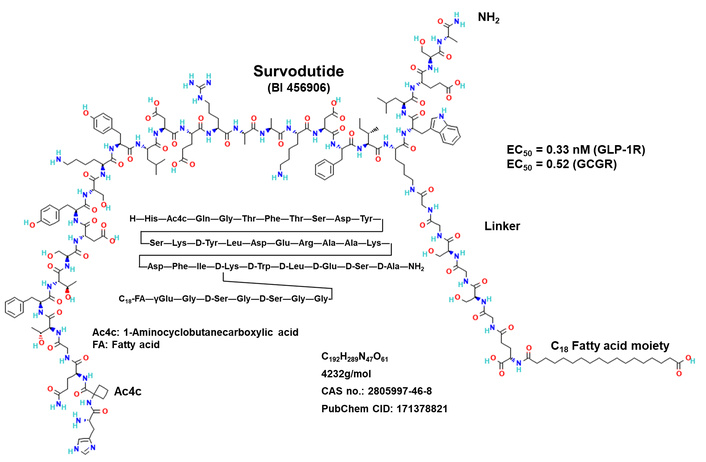
Structural features and dual receptor activity of survodutide. Depicted are the structural features of survodutide and its dual glucagon receptor/GLP-1 receptor agonist activity, highlighting peptide-engineering modifications that prolong stability and support once-weekly administration; the cited literature provides the relevant background on glucagon/incretin structure-function relationships and survodutide pharmacology [20–23]. The peptide structure was obtained from PubChem (available at: https://pubchem.ncbi.nlm.nih.gov/; entry CID: 171378821). GCGR: glucagon receptor.
SYNCHRONIZE™-1 was an international, randomized, double-blind, placebo-controlled phase 3 trial assessing once-weekly survodutide, a dual incretin agonist, in adults with obesity or overweight without diabetes [24]. Eligible participants were ≥ 18 years old and had a BMI ≥ 30 kg/m2, or ≥ 27 kg/m2 with obesity-related complications, including arterial hypertension, dyslipidemia, obstructive sleep apnea, CVD, or MASH, and at least one unsuccessful dietary attempt at weight reduction.
In total, 726 participants were randomized and 725 received at least one dose of study medication. Participants were assigned in a 1:1:1 ratio to subcutaneous survodutide titrated to 3.6 mg or 6.0 mg, or placebo, together with structured lifestyle counselling, a reduced-calorie diet targeting an approximately 500 kcal daily deficit, and advice to undertake at least 150 minutes of moderate physical activity per week. Treatment lasted 76 weeks and incorporated flexible dose escalation to improve gastrointestinal tolerability.
The co-primary endpoints were percentage change in body weight from baseline to week 76 and the proportion of participants achieving ≥ 5% weight reduction. Secondary outcomes included higher weight-loss thresholds (≥ 10%, ≥ 15% and ≥ 20%), waist circumference, metabolic variables, eating-behaviour scores and selected cardiometabolic risk factors.
The study population was representative of patients with clinically significant obesity-related risk. Mean age was 47.1 years, mean BMI was 37.9 kg/m2, and mean baseline body weight was 108.8 kg; 69.7% had at least one obesity-related comorbidity, most often hypertension or dyslipidemia. Baseline reporting further documented a mean waist circumference of 115.2 cm and frequent hypertension (40.0%), dyslipidemia (33.7%), and prediabetes (30.2%) [24]. Recruitment across 14 countries and a relatively high proportion of male participants strengthened the generalizability of the findings [24]. Overall completion was 91.3%.
Survodutide produced significantly greater weight loss than placebo. At week 76, mean body weight decreased by –12.2% with 3.6 mg and –13.0% with 6.0 mg, versus –5.4% with placebo. Absolute mean reductions were 13.1 kg and 14.1 kg with the 3.6-mg and 6.0-mg doses, respectively, compared with 5.9 kg with placebo. Clinically meaningful responses were more frequent with active treatment: ≥ 5% weight loss occurred in 72.6% and 71.9% of participants receiving survodutide 3.6 mg and 6.0 mg, respectively, versus 46.3% with placebo, and approximately 25–29% achieved ≥ 20% weight loss compared with 6.6% in the placebo group.
Benefits extended beyond body weight. Survodutide was associated with reductions in waist circumference, fasting glucose, fasting insulin, triglycerides, and other lipid markers. In a magnetic resonance imaging (MRI) subgroup, reductions in visceral fat and liver fat suggested preferential effects on metabolically harmful adipose depots and potential hepatic benefits beyond total weight loss.
The safety profile was consistent with incretin-based obesity therapies. Gastrointestinal adverse events—mainly nausea, vomiting, diarrhea, and constipation—were most common, occurred more frequently with survodutide than placebo, and were generally mild to moderate, particularly during dose escalation. Serious adverse events occurred in approximately 8.3% of survodutide-treated participants and 6.2% of placebo-treated participants; no deaths were reported.
Mechanistically, survodutide shows a pharmacological balance between GCGR and GLP-1R activation, with approximately eightfold greater GLP-1R than GCGR activation in vitro, a profile compatible with metabolic efficacy while preserving glucose homeostasis [25]. GCGR agonism may also promote hepatic fatty acid oxidation and lipid clearance, potentially contributing to reductions in LFC beyond weight loss alone [25]. Together, these data indicate that onceweekly survodutide induces clinically meaningful weight loss and improves biomarkers of metabolic dysfunction in adults with obesity without diabetes.
The SYNCHRONIZE™-1 trial provides important evidence supporting the clinical potential of dual GCGR/GLP-1R agonism as a therapeutic strategy for obesity. Several methodological strengths enhance the reliability and relevance of its findings.
First, the randomized, double-blind, placebo-controlled design represents the gold standard for evaluating therapeutic efficacy and safety. Blinding of investigators and participants reduces the risk of bias in outcome assessment and treatment behavior. The multicenter, international recruitment across 116 clinical sites in 14 countries also enhances the generalizability of the results across diverse healthcare settings.
Second, the study included a relatively large sample size of more than 700 participants and a long treatment duration of 76 weeks. Obesity pharmacotherapy trials often require extended follow-up periods to evaluate sustained weight loss and safety signals, and the nearly 1.5-year treatment period allows assessment of long-term treatment effects. The trial also achieved a high completion rate of more than 90%, which strengthens the validity of the reported outcomes.
Another notable strength is the use of clinically meaningful endpoints aligned with regulatory guidance from agencies such as the Food and Drug Administration (FDA) and the European Medicines Agency (EMA). The trial evaluated both relative weight change and categorical thresholds of weight reduction, including ≥ 5%, ≥ 10%, ≥ 15%, and ≥ 20%. These thresholds are clinically relevant because greater degrees of weight loss are associated with progressive improvements in cardiometabolic risk factors.
The inclusion of metabolic, cardiovascular, and body-composition outcomes further strengthens the study. The MRI-based substudy provided valuable insight into changes in visceral and hepatic fat, which are closely linked to cardiometabolic disease risk. Such mechanistic insights are particularly relevant given the theoretical metabolic benefits of GCGR activation.
Further support for the clinical development of survodutide is provided by the ongoing phase 3 SYNCHRONIZE-JP trial, which evaluates once-weekly survodutide in Japanese adults with obesity over a 76-week treatment period [26]. The trial uses the same core efficacy endpoints as other studies in the SYNCHRONIZE program, namely percentage change in body weight and the proportion of participants achieving ≥ 5% weight reduction at the end of treatment [26]. Baseline characteristics of the enrolled cohort demonstrate a substantial cardiometabolic burden, with high prevalence of dyslipidemia, hypertension, and MASLD, reflecting the clinical population targeted by obesity pharmacotherapy [26]. Importantly, the study extends the evaluation of survodutide to an East Asian population with different BMI thresholds for obesity and a higher metabolic risk at lower BMI levels, thereby strengthening the generalizability of the overall SYNCHRONIZE clinical program [26].
A major limitation of SYNCHRONIZE™-1 is the absence of an active comparator, which precludes definitive positioning of survodutide against established incretin-based therapies such as semaglutide and tirzepatide. Accordingly, although network meta-analyses rank tirzepatide and subcutaneous semaglutide among the most effective agents for long-term weight loss [27], direct comparative trials are needed to define the relative efficacy, tolerability, and clinical role of survodutide.
Further results from the ongoing SYNCHRONIZE™ phase 3 program (ClinicalTrials.gov ID: NCT06077864) on cardiovascular safety in people with overweight or obesity are awaited and will be important for clarifying the long-term efficacy, tolerability, and clinical positioning of survodutide within obesity pharmacotherapy.
Several limitations should temper interpretation of SYNCHRONIZE™-1. Although more than 90% of participants completed the study, only about 63% remained on study medication at week 76, potentially affecting treatment-effect estimates and explaining differences between treatment regimen and efficacy estimands. Generalizability is also limited by exclusion of individuals with uncontrolled hypertension, recent cardiovascular events, or unstable mood disorders, leaving the safety and efficacy of survodutide in higher-risk populations uncertain.
The unexpectedly large placebo-associated weight loss, approximately 5.4%, also warrants consideration, as it exceeded the 2–3% typically reported in comparable trials and may partly reflect use of approved or compounded obesity medications outside the protocol. In addition, gastrointestinal adverse events were frequent and contributed to treatment discontinuation in some participants. Longer-term data, particularly for cardiovascular outcomes, remain needed.
Mechanistic data suggest that the appetite-suppressive effects of survodutide are mediated mainly through central GLP-1R signaling. Imaging studies showed access to peptide-sensitive brain regions, including the area postrema and arcuate nucleus, and activation of appetite-regulating nuclei such as the nucleus of the solitary tract and parabrachial nucleus [28]. Transcriptomic analyses indicated GLP-1Rs, but not substantial GCGR expression, in these regions, whereas selective GCGR agonism did not acutely activate satiety circuits or reduce food intake [28]. These findings support complementary roles for GLP-1R-mediated anorexia and GCGR-driven energy expenditure, highlighting the potential advantages of combining GLP-1 and GCGR activity within a single therapeutic agent.
Overall, SYNCHRONIZE™-1 supports the efficacy of survodutide while underscoring the need for longer-term, higher-risk cardiovascular outcome studies to define its place in obesity management.
In SYNCHRONIZE™-1, once-weekly survodutide produced clinically meaningful weight loss in adults with obesity without diabetes. Weight reduction exceeded placebo, averaging about 12–13% at 76 weeks, with many participants reaching ≥ 15% and ≥ 20% loss. These reductions appear numerically smaller than those reported with tirzepatide in SURMOUNT-1 and semaglutide in STEP-1, although such cross-trial comparisons should be interpreted with caution given differences in study design, populations, and analytical assumptions. Interpretation of survodutide’s weight-loss efficacy should therefore account for substantial treatment discontinuation and the inherent uncertainty of indirect comparisons with tirzepatide and semaglutide.
Overall, these findings support dual incretin receptor agonism as a promising therapeutic strategy for obesity. Dual receptor agonism may offer metabolic benefits beyond GLP-1R agonism alone, with reductions in visceral fat and LFC suggesting broader metabolic improvement. The emergence of dual and triple agonists, including mazdutide, cotadutide, and retatrutide, underscores the need for direct comparative studies to define the relative efficacy and clinical positioning of survodutide within this rapidly evolving therapeutic class.
Safety was consistent with other incretin-based therapies. Gastrointestinal symptoms were the most common adverse events, generally mild to moderate and mainly during dose escalation. The divergence between the treatment regimen and efficacy estimands was driven largely by treatment discontinuation, underscoring adherence as a key determinant of how trial efficacy may translate into real-world effectiveness. No deaths or major adverse cardiovascular events occurred with survodutide.
Despite these encouraging findings, the clinical role of survodutide remains uncertain. Cardiovascular outcome data from SYNCHRONIZE-CVOT, expected to finish by the end of June 2026 [29], are needed to determine whether cardiometabolic improvements translate into cardiovascular protection. Head-to-head comparisons with semaglutide or tirzepatide should define relative efficacy, tolerability, and predictors of response, whereas studies in MASH, CVD, and T2D will clarify benefits in key obesity-related comorbidities. Longer-term data are also required to establish durability after treatment discontinuation. Thus, SYNCHRONIZE™-1 supports dual GCGR/GLP-1R agonism as a promising strategy for next-generation obesity pharmacotherapy, but comparative effectiveness, long-term safety, and optimal clinical use remain to be established.
BMI: body mass index
CVD: cardiovascular disease
GCGR: glucagon receptor
GLP-1: glucagon-like peptide 1
GLP-1R: glucagon-like peptide 1 receptor
LFC: liver fat content
MASH: metabolic dysfunction-associated steatohepatitis
MASLD: metabolic dysfunction-associated steatotic liver disease
MRI: magnetic resonance imaging
T2D: type 2 diabetes
Authors used GPT 5.3-chat and Copilot to improve the readability and language of the manuscript. Copilot was also used for creating the graphical abstract. After using these AI tools, the authors reviewed and edited the content as needed and take full responsibility for the content of the published article.
AL and RW: Conceptualization, Data curation, Formal analysis, Investigation, Methodology, Project administration, Software, Supervision, Validation, Visualization, Writing—original draft, Writing—review & editing. Both authors read and approved the submitted version.
Amedeo Lonardo and Ralf Weiskirchen serve as Associate Editors of Exploration of Drug Science; Dr. Weiskirchen also serves as Guest Editor of Exploration of Drug Science, and neither author was involved in the decision-making or review process of this manuscript.
Not applicable.
Not applicable.
Not applicable.
Not applicable.
Not applicable.
© The Author(s) 2026.
Open Exploration maintains a neutral stance on jurisdictional claims in published institutional affiliations and maps. All opinions expressed in this article are the personal views of the author(s) and do not represent the stance of the editorial team or the publisher.
Copyright: © The Author(s) 2026. This is an Open Access article licensed under a Creative Commons Attribution 4.0 International License (https://creativecommons.org/licenses/by/4.0/), which permits unrestricted use, sharing, adaptation, distribution and reproduction in any medium or format, for any purpose, even commercially, as long as you give appropriate credit to the original author(s) and the source, provide a link to the Creative Commons license, and indicate if changes were made.



View: 1020
Download: 18
Times Cited: 0