 Review


Affiliation:
1Licenciatura en Nutrición, Facultad de Enfermería y Obstetricia, Universidad Autónoma “Benito Juárez” de Oaxaca, Oaxaca de Juárez, CP 68120, México
2Facultad de Enfermería y Obstetricia, Universidad Autónoma “Benito Juárez” de Oaxaca, Oaxaca de Juárez, CP 68120, México
Email: asaddominguez@gmail.com
ORCID: https://orcid.org/0000-0002-5116-7463


 ,
,
Affiliation:
2Facultad de Enfermería y Obstetricia, Universidad Autónoma “Benito Juárez” de Oaxaca, Oaxaca de Juárez, CP 68120, México
ORCID: https://orcid.org/0009-0001-0499-858X
,
Affiliation:
3Departamento de Biomedicina Experimental, Facultad de Medicina y Cirugía de la, Universidad Autónoma “Benito Juárez” de Oaxaca, Oaxaca de Juárez, CP 68120, México
Affiliation:
3Departamento de Biomedicina Experimental, Facultad de Medicina y Cirugía de la, Universidad Autónoma “Benito Juárez” de Oaxaca, Oaxaca de Juárez, CP 68120, México
ORCID: https://orcid.org/0009-0007-5000-8317
,
Affiliation:
3Departamento de Biomedicina Experimental, Facultad de Medicina y Cirugía de la, Universidad Autónoma “Benito Juárez” de Oaxaca, Oaxaca de Juárez, CP 68120, México
ORCID: https://orcid.org/0009-0004-2907-1440
,
Affiliation:
4Facultad de Sistemas Biológicos e Innovación Tecnológica, Universidad Autónoma “Benito Juárez” de Oaxaca, Oaxaca de Juárez, CP 68120, México
Affiliation:
4Facultad de Sistemas Biológicos e Innovación Tecnológica, Universidad Autónoma “Benito Juárez” de Oaxaca, Oaxaca de Juárez, CP 68120, México
Affiliation:
5Facultad de Medicina y Cirugía, Benemérita Universidad de Oaxaca, Oaxaca de Juárez, CP 68020, México
Explor Drug Sci. 2026;4:1008173 DOI: https://doi.org/10.37349/eds.2026.1008173
Received: March 15, 2026 Accepted: June 13, 2026 Published: July 26, 2026
Academic Editor: Barbara De Filippis, University of G. d’Annunzio Chieti and Pescara, Italy
Human milk is widely recognized as the biological standard for early-life nutrition, providing both essential nutrients and bioactive components that support immune development. However, breastfeeding is not always feasible, and infant formula remains a necessary alternative in specific clinical and social contexts. Despite advances in formulation, significant immunological differences persist between breastfed and formula-fed infants, contributing to the so-called “immunological gap.” This review critically examines the potential of human milk-derived antimicrobial peptides (HM-AMPs) as functional ingredients to partially address this gap. Current evidence indicates that these peptides, derived from proteins such as lactoferrin, caseins, and α-lactalbumin, exhibit antimicrobial and immunomodulatory activities through mechanisms including membrane disruption and modulation of inflammatory pathways. However, most available data are derived from in vitro and preclinical models, limiting direct translation to clinical outcomes. In addition, significant challenges remain, including peptide instability during industrial processing, uncertain bioavailability in the gastrointestinal tract, and limited clinical validation. While emerging computational and bioengineering strategies offer opportunities to optimize peptide functionality, their large-scale implementation remains constrained by technological and regulatory factors. Overall, HM-AMPs represent a promising but still developing approach to improving infant formula functionality. Their contribution should be interpreted as partial and context-dependent, rather than as a complete replication of the immunological properties of human milk.
Mammalian lactation has evolved over more than 200 million years, widely recognized as the “gold standard” of early-life nutrition, functioning as a biologically active immunological fluid that provides comprehensive protection during the most vulnerable stages of human development [1–3]. It contains a complex and dynamic array of cellular, molecular, and enzymatic constituents, including antimicrobial peptides (AMPs), also referred to as host defense peptides (HDPs), which serve as critical effectors of innate immunity [4–7]. These molecules promote broad-spectrum defense, mucosal maturation, and microbiome development.
Despite significant advances in nutritional engineering and the industrial development of infant formulas (IFs), substantial differences in immune protection remain between infants fed human milk (HM) and those receiving bovine-based formulas [8–10]. Commercial formulas contain lower concentrations of several bioactive immune components, which may compromise antimicrobial defense mechanisms and contribute to an increased susceptibility to severe conditions such as necrotizing enterocolitis (NEC) and neonatal sepsis. These disparities are particularly relevant in preterm infants, for whom the choice of feeding strategy can significantly influence clinical outcomes, ranging from improved physiological stability to the prevention of life-threatening complications [11–16].
Recent research on AMPs has moved beyond simple description toward rational design, positioning these peptides as key players in innate immunity and as promising candidates for therapeutic development [17]. Since Fleming identified lysozyme in 1922, research has increasingly focused on naturally occurring peptide reservoirs, particularly the “cryptic peptidome” [9], a concept that refers to bioactive fragments released from larger milk proteins such as β-casein, lactoferrin (LF), and osteopontin through programmed proteolysis in both the mammary gland and the infant gastrointestinal tract [18, 19]. A notable advancement is the identification of milk-derived antimicrobial peptide-1 (MAMP-1), an endogenous peptide enriched in preterm HM. MAMP-1 exerts protective effects against NEC and mitigates sepsis-associated acute lung injury (SALI) by regulating lipid metabolism genes such as apolipoprotein A-IV (APOA4) [12].
The identification of these peptides is now facilitated by DeepMAMP, a deep learning model that integrates Light Gradient Boosting Machine (LightGBM) and Long Short-Term Memory (LSTM) networks to predict AMP activity with 81.4% accuracy [20]. Additionally, tools such as EvoGradient enable “in silico directed evolution,” allowing virtual modification of peptide sequences to generate more potent AMPs against multidrug-resistant pathogens, including carbapenem-resistant E. coli, Klebsiella pneumoniae (K. pneumoniae), and Acinetobacter baumannii (A. baumannii) [21].
Integrating bioengineered peptides into IF remains challenging because processing conditions can compromise their stability [22–24]. While thermal treatments ensure sterility, they may also induce peptide degradation [25]. Therefore, low-temperature dehydration and advanced encapsulation technologies are being explored to preserve bioactivity and enable controlled release to preserve functional integrity and enable controlled release [25, 26].
The objective is to evaluate whether the targeted implementation of milk-derived AMPs can help mitigate specific immunological differences associated with artificial feeding. Recent advances integrate transformer-based protein language models, such as ESM-2, with hybrid deep learning architectures (convolutional neural networks [CNNs], bidirectional long short-term memory [BiLSTM], and attention mechanisms) to capture both global and local sequence features. These approaches enhance AMP identification and enable the prediction of multiple functional activities, accelerating the discovery of peptides with broad-spectrum antimicrobial and immunomodulatory properties [17].
This review suggests that human milk-derived antimicrobial peptides (HM-AMPs) could contribute to the development of IFs with greater biological functionality, constituting a potential strategy to strengthen some of their immunological properties. This goal presents important scientific, technological, and regulatory challenges, particularly regarding the stability, bioavailability, and safety of bioactive compounds, and demands careful evaluation of both evidence and translational feasibility. Despite the mechanistic and preclinical evidence supporting the antimicrobial and immunomodulatory roles of HM-AMPs, clinical data in human infants remain limited. Most current knowledge is derived from in vitro systems, animal models, or indirect observational studies. Consequently, the translational relevance of these findings warrants cautious interpretation until they are validated in controlled clinical trials.
The World Health Organization (WHO) and UNICEF recognize exclusive breastfeeding (EBF) as the biological standard for neonatal survival [27]. Despite this, structural and social barriers, such as maternal health complications, occupational demands, and perceived insufficient milk supply, frequently necessitate the use of IF as a nutritional alternative [28, 29]. While modern formulations strive to replicate the macronutrient profile of HM, they do not capture its dynamic and individualized complexity [30]. This limitation contributes to observable differences in growth patterns, including increased fat mass accumulation and a higher risk of childhood obesity [31, 32]. More critically, the absence of endogenous immune signals in standard formula constitutes a significant alteration in the infant's ecological and immunological development, correlating with a greater incidence of gastrointestinal infections and NEC [33, 34].
Immune components, defined as bioactive factors that modulate innate and adaptive immune responses through anti-inflammatory, regenerative, and immune-enhancing mechanisms, are central to addressing this disparity [35]. These constituents, added to the formula to promote neonatal immune maturation and neuro-gastrointestinal development, include non-digestible oligosaccharides, lipids, minerals, and peptides, and provide direct defense against pathogens by reducing cellular proliferation in intestinal crypts, supporting epithelial maturation, and enhancing epithelial barrier function [36–38]. HM contains over 200 unique human milk oligosaccharides (HMOs), whereas concentrations in bovine milk are 100 to 1,000 times lower, necessitating their synthetic production via microbial metabolic engineering [39–43].
HMOs, such as 2-fucosyllactose (2-FL) and lacto-N-neotetraose (LNnT), function as molecular decoys that prevent pathogen adhesion [38, 44, 45]. Clinical trials demonstrate that supplementation with 2-FL and LNnT significantly reduces antibiotic use by up to 42% and the incidence of lower respiratory tract infections [44, 46]. In addition to these glycans, prebiotics serve as microbial substrates that generate immunomodulatory postbiotics such as short-chain fatty acids (SCFAs), which act as protective agents against allergies such as Sialyllactoses (3’-SL and 6’-SL), further supporting neurodevelopment and immune system maturation by modulating the NF-κB and MAPK signaling pathways [47, 48]. The inclusion of prebiotics and probiotics, including Bifidobacterium and Lactobacillus, is intended to promote the production of postbiotics such as short-chain SCFAs, which help maintain mucosal integrity and stimulate secretory IgA release [48, 49]. Postbiotics, derived from bacterial metabolism or cell lysis, further prevent infections by regulating immune cell proliferation and balancing cytokine profiles [42].
The milk fat globule membrane (MFGM) forms a trilayer of polar lipids and glycoproteins that facilitates a metabolic shift toward lipid utilization and supports neurodevelopment [36]. Supplementation with MFGM, currently derived from bovine sources in research, preserves glycopeptides and modulates immunity by promoting the production of anti-inflammatory cytokines [50, 51].
Recent research also explores TGF-β as a promoter of oral tolerance and microRNAs (miRNAs) as facilitators of bone differentiation. However, the North American Society for Pediatric Gastroenterology, Hepatology and Nutrition (NASPGHAN) (June 2025) emphasizes that the bioavailability of these molecules in industrially processed formulas requires further validation [36, 52].
Bioactive glycopeptides remain a primary focus, particularly given the approved fortification with AMPs, LF, and osteopontin. Osteopontin binds specifically to the bacterial glycocalyx to facilitate phagocytosis and to prevent systemic infections, and it is resistant to peptic degradation [36].
AMPs are a key component of the biological framework underlying host defense in HM and have been proposed as candidates to address specific immunological limitations of formula feeding through targeted fortification. HM integrates a dual defense system comprising endogenous AMPs—such as defensins and cathelicidins—and “cryptic” fragments released from major proteins, such as LF and caseins, upon digestion [53, 54]. LF serves as the central precursor to lactoferricin (LFcin) and lactoferrampin (LFampin), fragments characterized by basic residues and hydrophobic amino acids that confer broad activity against bacteria, fungi, and protozoa [53–55]. Functional evidence indicates that these LF-derived peptides primarily provide local protection within the neonatal gastrointestinal tract, where physiological traits optimize their efficacy. Notably, the infant stomach maintains a pH typically above 4, in contrast to the highly acidic milieu (pH 1.5 to 3) seen in adults. This milder acidity, combined with immature proteolytic activity, permits longer peptide residence times and favors the release and survival of antimicrobial fragments that would otherwise be degraded swiftly [55, 56]. Consequently, these physiological differences highlight the importance of age-specific delivery vehicles or encapsulation technologies that selectively respond to neonatal digestive conditions, ensuring functional integrity until they reach their target sites in the intestine.
Caseins (alpha s1-, alpha s2-, beta -, and kappa-casein) represent an additional reservoir of AMPs whose enzymatic hydrolysis releases fragments that inhibit neonatal pathogens including Staphylococcus aureus (S. aureus), E. coli, and Cronobacter sakazakii (C. sakazakii) [57–60]. Specific fragments, such as kappacin and casein macropetide (CMP), interfere with pathogen adhesion and replication, yet their generation profile in formula-fed infants is significantly simpler than in breastfed infants [61]. Similarly, α-lactalbumin yields microbicidal domains targeting Gram-positive pathogens only after enzymatic release, as the intact protein lacks detectable activity [62]. Complementing these protein-derived fragments, mammary epithelial cells and maternal immune cells actively secrete endogenous α- and β-defensins (HNP-1, HD-5, hBD-2), which peak during the colostrum phase to facilitate mucosal defense and early immune maturation [63–67]. The human cathelicidin family is represented solely by LL-37, a cationic peptide that provides multi-target bactericidal functions, neutralizes endotoxins, and inhibits biofilms [65, 68, 69]. The synergistic coexistence of these systems underscores the functional complexity of HM and defines the requirements for effective antimicrobial implementation in formula feeding. While these mechanisms are well characterized in controlled experimental systems, their functional relevance under physiological conditions in human infants remains to be fully established.
Recent analysis of the peptides generated during HM digestion has redefined our understanding of the neonatal digestive process. It has shifted from a model focused solely on amino acid release to one that accounts for the programmed generation of AMPs and immunomodulators [70]. Peptidomic and functional studies demonstrate that HM and IF exhibit vastly different immunological and peptide profiles despite similar macronutrient contents [71]. HM displays higher levels of IgA, IgG, and LF, and a predominance of β-casein-derived peptides with known bioactivity, whereas IF often exhibits heterogeneous bovine fragments altered by industrial processing [72]. In vivo characterization of the gastric peptidome in preterm infants has identified thousands of peptides, with a significant increase in the number of sequences showing AMP homology following digestion. This suggests that peptide generation depends on specific proteolytic kinetics and the unique neonatal enzymatic environment [73]. Key fragments of LF, caseins, and lysozyme have been shown to persist in the intestine, where they inhibit pathogens like E. coli and S. aureus while simultaneously promoting the growth of Bifidobacterium [74]. Furthermore, the digestion of colostrum releases bacteriostatic fragments effective against pathogens associated with NEC, such as Klebsiella aerogenes (K. aerogenes) and Citrobacter freundii (C. freundii) [8]. These findings highlight that neonatal digestion drives the digestion-microbiota-immunity axis, underscoring the need for formula innovation to consider structural architecture and release kinetics, not just total protein content (Figure 1).
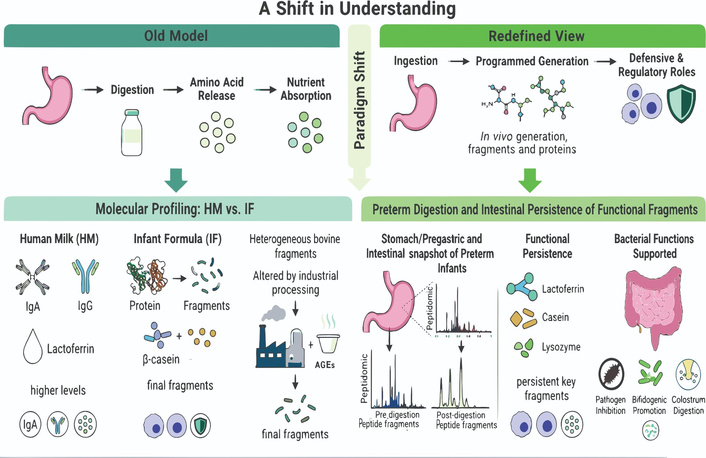
Evolving approaches in neonatal gastroenterology: from linear digestion to the generation of functional bioactive compounds. Top panel: Contrast between the Old Model—where milk ingestion leads to progressive digestion, complete amino acid release, and nutrient absorption—and the Redefined View, which highlights ingestion as a process of programmed generation, releasing specific in vivo peptide fragments and intact proteins that exert direct defensive and regulatory roles. Bottom left (Molecular profiling): Structural differences between human milk (HM), characterized by high levels of intact immunoglobulins (IgA, IgG) and lactoferrin, and infant formula (IF), where industrial processing alters heterogeneous bovine fragments, resulting in modified β-casein peptides and the formation of advanced glycation end-products (AGEs). Bottom right (Preterm digestion): An intestinal snapshot of preterm infants showcasing the mapping of the peptidome before digestion, during gastric breakdown, and post-digestion (intestinal phase). Key functional fragments from lactoferrin, casein, and lysozyme structurally persist throughout this immature digestive tract, subsequently supporting critical downstream bacterial functions such as pathogen inhibition, bifidogenic promotion, and colostrum digestion.
The stability and safety of powdered infant formula (PIF) have historically been addressed through a microbiological control approach focused on intensive thermal processing. However, this paradigm has evolved into a more comprehensive perspective that simultaneously considers the nutritional quality, chemical stability, and biological functionality of the added components. In this context, storage conditions, industrial processing, and microbiological control systems remain key determinants of the safety of the final product. In formulations enriched with polyunsaturated fatty acids (PUFAs), lipid oxidation poses a significant risk after opening the package and exposure to oxygen, as evidenced by increased malondialdehyde levels at specific storage temperatures [75]. This phenomenon not only deteriorates nutritional quality but can also compromise the structural integrity and functional activity of the incorporated bioactive peptides.
In parallel, pathogen control remains a critical challenge. Traditional methods, such as ISO/TS 22964, have been instrumental in detecting C. sakazakii, but their limited sensitivity has prompted the adoption of molecular techniques, such as real-time PCR, which can detect low bacterial loads more quickly and accurately [76]. Despite these advances, the presence of microorganisms such as Mycobacterium avium subsp. paratuberculosis in commercial formulations highlights the need for more robust safety frameworks, especially due to their possible association with neonatal gut dysbiosis [77]. In addition, the persistence of resistant bacteria such as Bacillus cereus (B. cereus), even after reconstitution at temperatures above 70°C, reinforces the idea that safety cannot depend solely on thermal removal, but must also explain the intrinsic ability of the matrix to resist microbial colonization [76, 78].
In response to these limitations, innovative strategies based on biological barriers have emerged. In this regard, although bacteriophage therapy has demonstrated efficacy against specific pathogens and has received regulatory approval, AMPs derived from milk proteins such as LF and casein stand out as more stable and versatile alternatives [79, 80]. These AMPs are highly compatible with complex food matrices and align with current “clean label” trends. However, their functionality is highly dependent on processing conditions, as intensive heat treatments and chemical reactions such as the Maillard reaction can induce protein aggregation and reduce immune activity [81–83]. Although some degree of denaturation may facilitate initial digestion, the formation of pepsin-resistant aggregates may limit the effective release of bioactive sequences [82].
To address these challenges, the industry has begun to implement gentler technologies, such as membrane filtration and moderate heat treatments, which preserve key native proteins, including secretory IgA, lysozyme, and LF [84]. Semi-industrial pilot studies have shown that these approaches minimize protein denaturation without compromising microbiological safety, thereby optimizing the preservation of bioactive protein structures [85]. Overall, current evidence indicates that, although macronutrients remain stable during storage, precise control of processing parameters is essential to preserve the structural integrity and psychochemical pH stability of the incorporated AMPs throughout manufacturing and storage [86].
Within this framework, the integration of AMPs together with management systems such as hazard analysis and critical control points (HACCP) represents a dual strategy that not only provides direct antimicrobial action but also contributes to the ecological modulation of intestinal colonization. This approach reflects a shift from models focused exclusively on sterility to more complex systems that seek to balance safety, biological functionality, and nutritional quality in modern IFs (Figure 2).
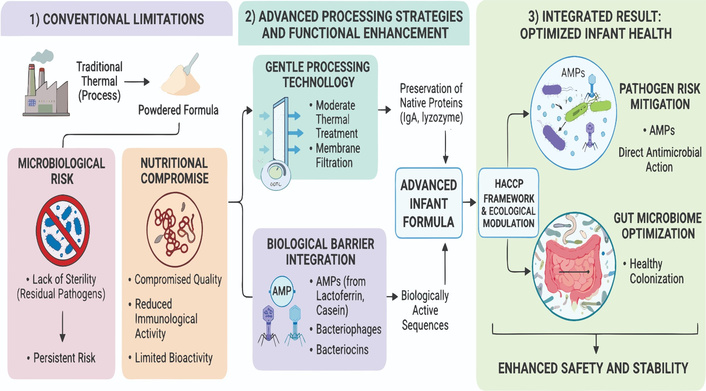
Conceptual framework for modernizing infant formula development: Overcoming conventional limitations through advanced processing and biological barrier integration. (1) Conventional limitations: Traditional thermal processing often results in microbiological risks (e.g., lack of sterility and residual pathogens) and severe nutritional compromise, including reduced immunological activity and limited overall bioactivity. (2) Advanced processing strategies and functional enhancement: The implementation of gentle processing technologies, such as moderate thermal treatment and membrane filtration, ensures the preservation of critical native proteins (e.g., IgA and lysozyme). Concurrently, biological barrier integration incorporates AMPs (derived from lactoferrin and casein), bacteriophages, and bacteriocins to generate a bioactively enhanced infant formula. (3) Integrated result: Governed by a strict hazard analysis and critical control points (HACCP) framework and ecological modulation, the optimized formula achieves efficient pathogen risk mitigation via direct antimicrobial action and drives gut microbiome optimization through healthy colonization, delivering enhanced safety and stability for infant health. AMPs: antimicrobial peptides.
The evolution of the IF market reflects a broader global dietary transition, in which sustained growth, particularly in middle- and high-income countries, has contributed to the displacement of breastfeeding [87]. This expansion has been accompanied by increasingly sophisticated marketing strategies that frequently employ terms such as “protection” and “immunity” to create a perception of functional equivalence with HM, often without comparable biological evidence [88]. While research on the cost-effectiveness of specialized formulas has demonstrated clear benefits in specific clinical contexts, these advantages remain context-dependent. For example, partially hydrolyzed whey-based formula (PHF-W) has been shown to reduce the risk of atopic dermatitis in high-risk infants, and extensively hydrolyzed formulas supplemented with Lacticaseibacillus rhamnosus (L. rhamnosus) GG (EHCF+LGG) are cost-effective in managing cow’s milk protein allergy [89–91]. However, these targeted applications do not justify their use as substitutes for breastfeeding in general.
In response to these trends, public health initiatives grounded in the International Code of Marketing of Breast-milk Substitutes emphasize that specialized nutrition should complement, not replace, breastfeeding, which remains the primary and irreplaceable strategy for neonatal immune protection. Despite these efforts, documented violations of the NetCode protocol persist across multiple countries, highlighting ongoing gaps between policy and practice [92].
Within this evolving landscape, the transition from the discovery of bioactive peptides to their implementation in IF represents a complex challenge that must balance industrial feasibility, clinical safety, and public health ethics. As outlined in previous sections, the bioactivity of milk-derived AMPs depends critically on their structural integrity, which is often compromised by conventional manufacturing and commercialization processes [22, 93].
The incorporation of advanced bioactives into IFs is therefore occurring within a market context that is not only expanding but also increasingly shaped by commercial and informational influences. IF sales have risen steadily in recent decades, often displacing breastfeeding, even though HM remains the biological gold standard due to its dynamic, synergistic composition of endogenous AMPs and immunomodulatory factors [87]. This contrast underscores a key limitation of current formulations: while individual components, such as recombinant LF or selected AMP sequences, can be added, they do not replicate the complex, multilayered matrix of peptides, oligosaccharides, and bioactive molecules present in HM.
Marketing dynamics further complicate this scenario. Evidence indicates that strategies integrated into healthcare systems, including academic sponsorship and the promotion of specialized formulas within medical settings, can significantly influence both professional recommendations and maternal decision-making, even when breastfeeding is a viable option [88]. From the consumer perspective, brand preference is shaped not only by product composition but also by digital marketing, social media, and medical endorsements [94]. For the infant as the end-user, this translates into an amplified exposure to claims centered on immune protection, concepts that are indirectly linked to the antimicrobial mechanisms discussed throughout this review.
The convergence of rapid market expansion and the strategic use of bioactivity narratives highlights the urgent need for robust regulatory oversight. Recent initiatives, such as the FDA’s Operation Stork Speed, launched in March 2025, aim to modernize IF regulation by increasing transparency and ensuring that claims of nutritional adequacy and functionality are supported by rigorous scientific evidence rather than marketing-driven assertions. Ultimately, regulatory frameworks must ensure that the incorporation of AMPs into IFs is positioned as a targeted clinical tool for vulnerable populations, rather than as a commercial strategy that contributes to the displacement of breastfeeding, which remains the cornerstone of neonatal health and immune protection.
The ultimate success of fortification strategies and technological innovations in IF depends not only on the preservation of AMPs during manufacturing and storage but also on their ability to remain biologically active after ingestion. While section Perspectives on AMP implementation and safety addressed the preservation of AMPs’ integrity during processing, storage, and microbiological control, their clinical efficacy ultimately depends on surviving gastrointestinal digestion and reaching biologically relevant target sites. In this context, bioavailability refers to the capacity of these molecules to resist premature degradation and exert local or systemic biological effects within the neonatal host [95].
Building upon the digestive kinetics discussed in section In vivo biosynthesis and digestive kinetics, current evidence confirms that milk-derived peptides can remain functionally active within the infant intestinal lumen. Research using direct peptide extraction from neonatal intestinal samples, coupled with high-resolution peptidomics, has identified specific fragments that exert a dual biological effect: direct inhibition of pathogens such as E. coli and S. aureus, and simultaneous stimulation of beneficial commensals such as Bifidobacterium longum (B. longum) subsp. infantis [74]. This selective ecological modulation is a hallmark of HM that researchers are now seeking to reproduce in IF matrices to reduce the risk of dysbiosis-associated complications, including NEC. For these peptides to exert systemic immunomodulatory or protective effects, they must overcome the proteolytic barriers of the stomach and small intestine and reach the epithelial surface intact [95, 96].
Importantly, experimental evidence indicates that a fraction of milk-derived peptides remains biologically available after digestion. In vitro models have demonstrated that naturally digested HM generates β-casein-derived fragments capable of crossing Caco-2 human intestinal epithelial cell monolayers, suggesting that a limited but physiologically relevant proportion of the milk peptidome can be absorbed transepithelially and enter systemic circulation [96]. Furthermore, experimental studies suggest that certain digestion-resistant fragments, particularly those derived from αS1-casein, may cross both the intestinal and blood–brain barriers, potentially contributing to neurodevelopmental signalling during critical stages of infant growth [97].
Translating these molecular findings into clinically meaningful outcomes remains a major priority. Recent real-world evidence (RWE) from 2025 has begun to bridge the gap between in silico peptide design and pediatric application. Longitudinal studies involving infants aged 6–12 months have demonstrated that formulas fortified with LF at concentrations resembling those found in HM are associated with significantly improved linear growth and feeding tolerance. Microbiota analyses revealed enrichment of Bifidobacterium breve and butyrate-producing taxa, including Faecalibacterium and members of the Ruminococcaceae family, resulting in a microbial profile that more closely resembles that of exclusively breastfed infants. These findings suggest that the incorporation of bioactive peptides into IF may contribute to a partial functional approximation of selected components of the HM ecosystem [98].
By ensuring that these molecules are not only present but also bioavailable and biologically active after ingestion, next-generation IFs may provide a complementary biological support system capable of promoting immune maturation, microbial homeostasis, and healthy growth in formula-fed infants (Figure 3).
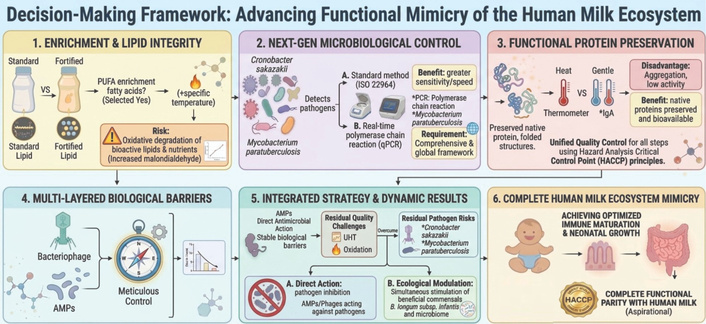
Decision-making framework for safety and functional optimization in advanced infant formulas. (1) Enrichment & lipid integrity: Evaluation of polyunsaturated fatty acid (PUFA) fortification under specific temperature constraints, highlighting the risk of oxidative degradation and subsequent malondialdehyde generation. (2) Next-gen microbiological control: Pathogen detection pathways contrasting standard ISO 22964 methodologies with high-sensitivity real-time polymerase chain reaction (qPCR) for critical strains such as C. sakazakii and Mycobacterium paratuberculosis. (3) Functional protein preservation: Comparison between conventional thermal treatments and gentle processing alternatives to prevent protein aggregation and preserve the bioactivity of native structures (e.g., IgA) under a unified HACCP framework. (4) Multi-layered biological barriers: Application of strict parameter controls managing synergistic biological agents, including bacteriophages and AMPs. (5) Integrated strategy & dynamic results: Mitigation of residual quality challenges (ultra-high temperature processing [UHT] thermal stress, oxidation) and pathogen risks through dual mechanisms: direct pathogen inhibition (Action A) and ecological modulation of the gut microbiome via beneficial commensals like B. longum subsp. infantis (Action B). (6) Complete human milk ecosystem mimicry: The ultimate developmental outcomes driven by optimized immune maturation and neonatal growth, verified through real-time data dashboards and international quality standards. AMPs: antimicrobial peptides.
Key unresolved issues include the long-term safety of chronic exposure to bioactive peptides during early life, particularly regarding immune tolerance and unintended immunostimulation [99]. Dose standardization remains a major challenge, as peptide activity is highly dependent on concentration, stability, and delivery matrix. Additionally, potential off-target effects, including disruption of commensal microbiota, require careful evaluation.
Regulatory frameworks also differ significantly between regions. While the U.S. FDA has initiated modernization efforts (e.g., Operation Stork Speed), the European Food Safety Authority (EFSA) maintains stricter requirements for functional claims and safety validation. Harmonization of these regulatory pathways will be essential for global implementation [100].
In conclusion, HM-AMPs represent a promising strategy for the development of next-generation IFs designed for situations in which breastfeeding is not possible or is medically insufficient. Their antimicrobial and immunomodulatory properties may help support infant health and immune development; however, their clinical and industrial application still requires overcoming scientific, technological, and clinical challenges to ensure their safety, efficacy, and stability.
Advancing the application of HM-AMPs will require multidisciplinary efforts spanning peptidomics, computational biology, food technology, clinical research, and regulatory science. Future progress will depend not only on characterizing the individual functions of these peptides but also on understanding their interactions with the host, food matrix, and intestinal microbiome. Emerging technologies, including high-resolution peptidomics and in silico peptide design, provide promising avenues for the development of safer and more effective formulations, although their implementation must be supported by robust clinical and safety evidence.
Moreover, the development of HM-AMP-based innovations must be guided by ethical and public health principles. Breastfeeding remains the gold standard for infant nutrition and should continue to be the preferred feeding option whenever possible. Accordingly, HM-AMP-enriched formulas should not be considered equivalent to HM, but rather as targeted alternatives for infants with specific medical or nutritional needs, including situations in which breastfeeding is not feasible or HM is unavailable. In this context, transparent communication, evidence-based claims, and strict regulatory compliance are essential to ensure responsible innovation and safeguard public trust. Overall, HM-AMPs represent a promising avenue for developing more biofunctional and HM-inspired nutritional strategies. Nevertheless, their application should be limited to situations with a clear medical or nutritional indication, while preserving breastfeeding as the optimal standard for infant nutrition and health.
2-FL: 2-fucosyllactose
AMPs: antimicrobial peptides
HACCP: hazard analysis and critical control points
HM: human milk
HM-AMPs: human milk-derived antimicrobial peptides
HMOs: human milk oligosaccharides
IFs: infant formulas
LF: lactoferrin
LNnT: lacto-N-neotetraose
MAMP-1: milk-derived antimicrobial peptide-1
MFGM: milk fat globule membrane
NEC: necrotizing enterocolitis
SCFAs: short-chain fatty acids
During the preparation of this work, the author(s) used the Gemini AI tool for the initial visual generation of figures, and detailed formatting of all figures was manually carried out using CorelDRAW Graphics Suite 2024. After utilizing the tool/service, the authors reviewed and edited the content as necessary and take full responsibility for the final content of the publication.
ASAD: Conceptualization, Investigation, Writing—original draft, Supervision. NPSC: Investigation. SRAR: Writing—review & editing, Writing—original draft. ALH: Investigation, Writing—review & editing, Supervision. DdJGM: Investigation, Writing—review & editing, Supervision. KISM: Investigation, Writing—review & editing. AIMA: Writing—review & editing. GHJ: Investigation, Writing—review & editing. All authors read and approved the submitted version.
The authors declare that they have no conflicts of interest.
Not applicable.
Not applicable.
Not applicable.
Not applicable.
Not applicable.
© The Author(s) 2026.
Open Exploration maintains a neutral stance on jurisdictional claims in published institutional affiliations and maps. All opinions expressed in this article are the personal views of the author(s) and do not represent the stance of the editorial team or the publisher.
Copyright: © The Author(s) 2026. This is an Open Access article licensed under a Creative Commons Attribution 4.0 International License (https://creativecommons.org/licenses/by/4.0/), which permits unrestricted use, sharing, adaptation, distribution and reproduction in any medium or format, for any purpose, even commercially, as long as you give appropriate credit to the original author(s) and the source, provide a link to the Creative Commons license, and indicate if changes were made.



View: 982
Download: 19
Times Cited: 0


