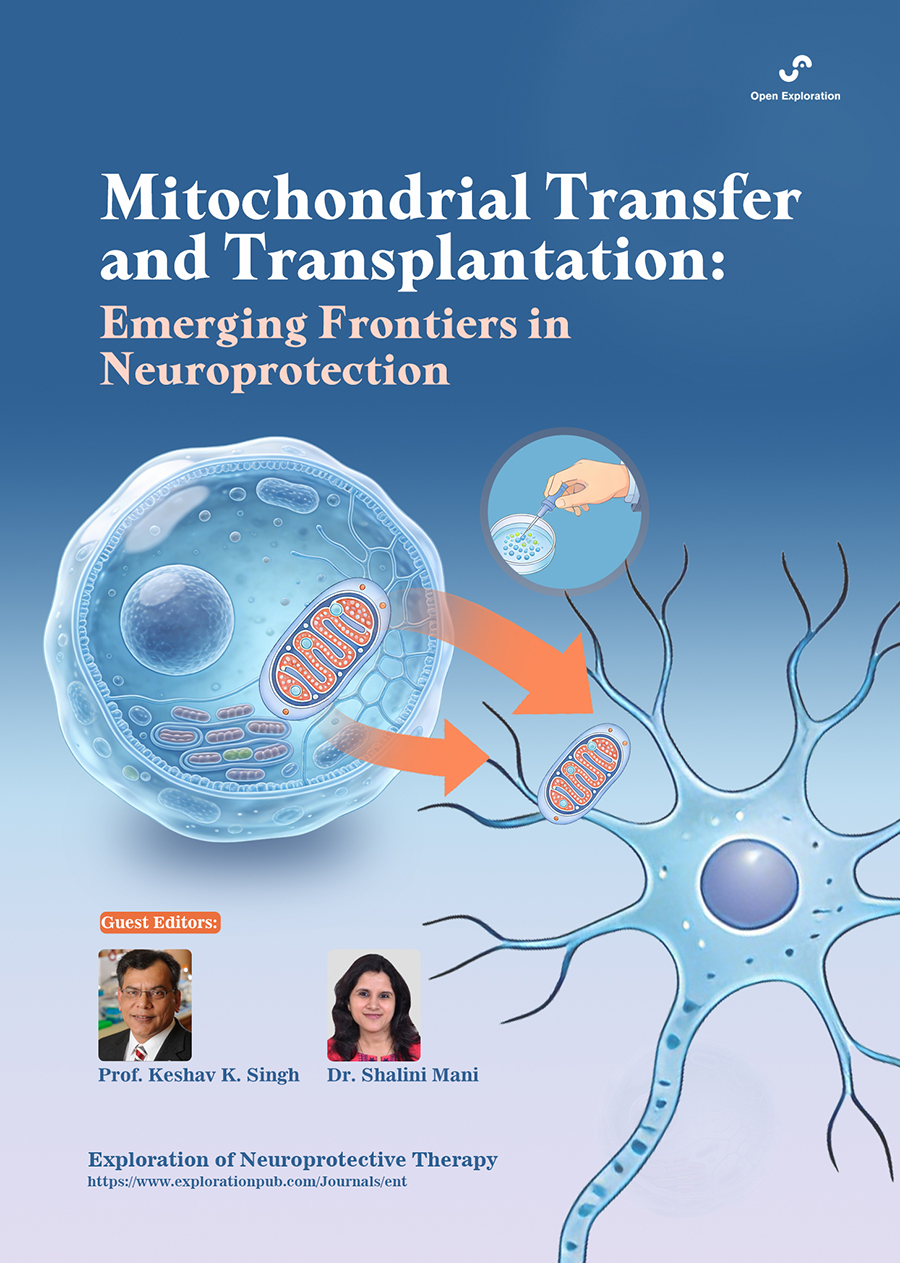
Mitochondrial Transfer and Transplantation: Emerging Frontiers in Neuroprotection
Guest Editors
Prof. Keshav K. Singh E-Mail
Professor, Department of Genetics, Heersink School of Medicine, The University of Alabama at Birmingham, Birmingham, Alabama, USA
Research Keywords: Mitochondrial biology of human diseases
Dr. Shalini Mani E-Mail
Centre for Emerging Diseases, Department of Biotechnology, Jaypee Institute of Information Technology, Noida, India
Research Keywords: Targeting Mitochondria in different diseases
About the Special lssue
Mitochondria are central regulators of neuronal survival, plasticity, and function, and their dysfunction is a defining hallmark of a wide spectrum of neurological disorders, including neurodegenerative diseases, ischemic stroke, traumatic brain injury, and neuroinflammatory conditions. Neurons are especially susceptible to mitochondrial damage, bioenergetic failure, oxidative stress, and impaired mitochondrial dynamics due to their high energy requirements and restricted regenerative ability. Conventional neuroprotective strategies have primarily concentrated on alleviating the downstream effects of mitochondrial dysfunction; however, these methods have achieved minimal clinical success, highlighting the pressing necessity for novel therapeutic frameworks.
In this context, mitochondrial transfer and transplantation have emerged as transformative frontiers in neuroprotection. Accumulating evidence demonstrates that functional mitochondria can be actively transferred between cells through mechanisms such as tunnelling nanotubes, extracellular vesicles, gap junctions, and cell fusion. Endogenous mitochondrial transfer from glial cells, stem cells, or immune cells to compromised neurons has been demonstrated to restore bioenergetics, diminish oxidative stress, modulate neuroinflammation, and improve neuronal survival and functional recovery. Simultaneously, exogenous mitochondrial transplantation—direct delivery of isolated, respiration-competent mitochondria—has garnered interest as an innovative therapeutic approach to rehabilitate damaged neural tissue.
Recent improvements in mitochondrial isolation methods, delivery routes, targeting strategies, and imaging techniques have greatly sped up progress in this area. The integration of mitochondrial transfer with stem cell therapy, biomaterials, nanotechnology, and gene-editing techniques is opening new avenues for precision neuroprotection. Even though it has a lot of potential, mitochondrial compatibility, immune responses, long-term functional integration, and ethical consideration remains a challenge.
This special issue aims to provide a comprehensive platform to consolidate cutting-edge research, mechanistic insights, and translational perspectives on mitochondrial transfer and transplantation in neuroprotection, promoting interdisciplinary discourse and influencing the future trajectory of mitochondrial-based neurotherapeutics.
Keywords: Mitochondrial transfer, mitochondrial transplantation, neuroprotection, bioenergetics, CNS injury, translational therapy