 Original Article


Affiliation:
1Department of Agricultural Management, Ra.C., Islamic Azad University, Rasht 4147654919, Iran
2Faculty of Economic and Management Sciences, North-West University, Potchefstroom 2520, South Africa
Email: ms.allahyari@iau.ac.ir
ORCID: https://orcid.org/0000-0002-6734-2692


 ,
Affiliation:
1Department of Agricultural Management, Ra.C., Islamic Azad University, Rasht 4147654919, Iran
Affiliation:
3Agricultural and Rural Development and Economy Research Center, Ra.C., Islamic Azad University, Rasht 4147654919, Iran
Affiliation:
4International Centre for Advanced Mediterranean Agronomic Studies (CIHEAM-Bari), 70010 Valenzano, Italy
ORCID: https://orcid.org/0000-0002-0322-2034
,
Affiliation:
5University of Gastronomic Sciences, 12042 Pollenzo, Italy
6Faculty of Agriculture, University of Herat, Herat 3001, Afghanistan
ORCID: https://orcid.org/0000-0002-0298-8214
Explor Foods Foodomics. 2026;4:1010202 DOI: https://doi.org/10.37349/eff.2026.1010202
Received: February 21, 2026 Accepted: August 23, 2026 Published: November 11, 2026
Academic Editor: Charles Odilichukwu R Okpala, University of Georgia Athens-GA, USA
Aim: Food is a fundamental human necessity and integral to cultural identity. This study investigates the intention of urban citizens to consume local dairy products in Rasht, Iran. Drawing upon improved planned behavior theory, the study examines the influence of factors such as attitudes towards local dairy products, food heritage, perceptions of food health (good food), willingness to pay, and socio-demographic characteristics on consumer intention.
Methods: Data were collected from 220 randomly selected urban citizens of Rasht using a survey questionnaire. Path analysis using partial least squares (PLS) was employed to analyze the data.
Results: The final structural model demonstrated strong explanatory power, accounting for approximately 63% of the variance in attitudes toward local dairy consumption (R2 = 0.631) and approximately 60% of the variance in the intention to consume local dairy products (R2 = 0.598). Path analysis revealed that perceptions of good food (β = 0.512, p < 0.01) and food heritage (β = 0.366, p < 0.01) were the strongest positive predictors of attitudes toward local dairy products. Attitudes toward local and traditional dairy products significantly influenced both willingness to pay (β = 0.682, p < 0.01) and purchase intention (β = 0.387, p < 0.01). Furthermore, willingness to pay exerted a significant direct effect on purchase intention (β = 0.455, p < 0.01), serving as a partial mediator in the relationship between attitude and purchase behavior.
Conclusions: These findings highlight the continued relevance of local dairy products in urban settings and provide valuable insights for local producers and policymakers to promote the consumption of local and sustainable food systems. The strong mediating role of willingness to pay suggests that strategies emphasizing the environmental and cultural value of local dairy may effectively enhance consumer purchase intentions.
The global food system is facing increasing pressure from population growth, urbanization, and climate change, while dairy consumption is projected to rise substantially in the coming decades [1, 2]. At the same time, growing health concerns about ultra-processed foods and industrial production methods have increased consumer interest in local, traditional, and artisanal food alternatives [3, 4]. Dairy products are an essential component of many diets, providing key nutrients, particularly calcium [5, 6], while also holding cultural and historical significance [7–9]. In Iran, dairy production includes both industrial and traditional systems, with consumption patterns varying considerably across regions [10, 11]. Guilan province, particularly its capital, Rasht—recognized as a UNESCO Creative City of Gastronomy—offers a unique setting where local dairy products remain deeply rooted in culinary traditions but increasingly face competition from industrially produced alternatives [12, 13]. Traditional foods reflect a society’s history, culture, and way of life [14, 15]. In developing countries, local and family-run dairy enterprises contribute to poverty reduction and improved nutrition [16]. More recently, consumer interest in local and organic dairy products has increased, particularly among younger consumers and families with children [17].
Although local food systems have received considerable attention in academic literature, relatively few studies have specifically examined consumers’ purchase intention (PI) toward local dairy products [17, 18]. Dairy products are characterized by high perishability, which heightens consumer sensitivity to freshness and safety during transportation [19]. Furthermore, the consumption of local dairy is heavily influenced by distinctive sensory attributes—such as taste and texture—and functional values including quality [20–23]. Furthermore, although the theory of planned behavior (TPB) [24] has been widely applied to explain food choice behavior, the integration of culturally specific constructs, such as food heritage (FH) and perceptions of good food (GF), remains largely unexplored in the context of local dairy consumption [25, 26].
Specifically, research examining willingness to pay (WTP) as a mediator between attitudes and PI, as well as perceived necessity (PN) as a moderator, remains limited in the context of local dairy consumption in developing countries. Understanding these relationships is important because the sustainability of local food systems depends on the close interaction between production and consumption practices [15].
Concerns about the origin of food have become increasingly important, particularly in response to the environmental and social challenges associated with large-scale industrial agriculture [27]. As consumers become more aware of these issues, many are shifting toward local, organic, and healthier food alternatives. Reflecting this trend, the Slow Food movement promotes sustainability through the principle of “good, clean, and fair” food, emphasizing the preservation of local food cultures while encouraging environmentally and socially responsible production and consumption [28, 29]. Within this evolving food landscape, consumers’ purchasing decisions play a central role in shaping more sustainable and healthier food systems [30].
In recent years, numerous theories have been developed to explain food consumption behavior, drawing primarily from the fields of psychology, sociology, and economics. Other theoretical perspectives emphasize the role of marketing-related factors and external stimuli—such as advertising, product differentiation, packaging, product innovation, accessibility, product demonstrations, and direct selling—in shaping consumer behavior [31, 32].
According to Bratman [33], intention refers to the process of forming a plan for future action. It serves as a cognitive link between thought and behavior and is shaped by individuals’ beliefs, desires, practical reasoning, and mechanisms of perception and action. Building on this perspective, a review of the literature identifies several key factors that influence consumers’ propensity to purchase local agricultural products, including environmental attitudes (EA), perceptions of GF, FH, interpersonal influences (II), PN, attitudes toward local and traditional dairy products (ALDC), WTP for fair food, and PI. Among these factors, consumers’ perceptions of local and traditional dairy products play a particularly important role, as PI has been shown to be a strong predictor of actual purchasing and consumption behavior [23, 25, 34, 35].
To address these gaps, this study develops and empirically tests an extended theoretical model that integrates psychological, cultural, and economic determinants of consumers’ intentions to purchase local dairy products. Specifically, the study adapts the conceptual model proposed by Mohammadian and Bakhshandeh [25] for green product purchasing behavior, as it provides a comprehensive framework for examining the key factors that influence consumer decision-making. The original model identifies several important determinants of PI, including health consciousness [36, 37], EA, environmental knowledge [26, 38, 39], II [40], attitudes toward green product consumption, WTP [41], and PN as a moderating variable [26]. Building on this framework, the present study adapts these constructs to the context of local dairy products by incorporating culturally relevant dimensions, thereby providing a more comprehensive understanding of consumer behavior in this setting.
EA plays a crucial role in promoting innovations that further enhance the sustainability of food systems [39, 42]. Initiatives such as the Slow Food movement advocate the production and consumption of “clean food,” emphasizing environmentally responsible production methods [28, 36]. Research in green marketing has consistently shown that positive EA is associated with stronger PI and greater consumption of local and sustainable dairy products [25, 41, 43–45]. The Slow Food movement’s conceptualization of GF—defined as flavorful, diverse, and produced in ways that improve taste while mirroring local geography and culture—was utilized in the current investigation [28, 29, 46]. As discussed by Andrews [29], Michael Pollan’s interpretation of GF emphasizes nutritional value, food safety, and production practices but places relatively less emphasis on sensory qualities and food identity. In contrast, the Slow Food movement argues that food is “good” when it is flavorful, diverse, and produced using methods that preserve taste while expressing local geography and cultural identity [28]. This perspective distinguishes GF from a purely health-oriented concept by emphasizing sensory enjoyment, cultural authenticity, and sustainable production practices. In this study, consumers’ perceptions of GF are measured using five survey items: health concerns, personal responsibility for maintaining health, trust in the quality of local dairy products, the importance of taste, and preference for raw milk over powdered milk. Collectively, these indicators capture the multidimensional nature of the GF construct by reflecting health, quality, sensory experience, and cultural values.
Indigenous and local knowledge, transmitted across generations, has enabled communities to sustainably manage regional biological resources. These communities recognize biodiversity as a prerequisite for the continued availability and sustainable use of these resources [47]. Studies have shown that such knowledge not only contributes to biodiversity conservation but also helps protect traditional food resources, thereby enhancing food security [48, 49].
FH encompasses the history of origin, cultivation, processing, and distribution of plants and animals, as well as the culinary traditions and knowledge associated with them [50]. It also includes the cultural narratives and practices surrounding food [51]. Preserving and passing on culinary knowledge is therefore essential for maintaining cultural identity [52]. In this study, the term FH refers to both traditional food culture and culinary heritage.
II refers to the process of encouraging, persuading, or influencing others to achieve outcomes [26]. According to Social Cognitive Theory, II emerges through reciprocal interactions among individuals and between individuals and their social environment [26, 53]. This concept has become central to consumer behavior research, particularly in studies of social groups, social class, subcultures, status, and social norms [54]. Likewise, Kim and Eves [55] identified interpersonal relationships as important drivers of local food consumption, highlighting social belonging, family influence, and self-expression as key social and psychological motivations.
Researchers at the University of Western Australia proposed PN as a moderating variable in the relationship between consumers’ EA and their intention to purchase environmentally friendly products [26]. They argued that positive EA would have a stronger influence on PI when environmentally friendly products were perceived as necessary. Their findings supported this proposition, demonstrating that EA had a stronger effect on PI for products considered essential than for non-essential products, such as jewelry [26, 56, 57].
Consumers’ values are important determinants of attitudes toward organic and local products, which subsequently influence behavioral intentions [58]. Advocates of these products argue that they not only provide healthier alternatives but also contribute to environmental sustainability [43, 59, 60]. Moreover, many consumers prefer locally produced foods purchased directly from producers, reflecting a preference for shorter and more transparent supply chains [20, 34]. Governments and consumers alike increasingly recognize local food systems as an effective means of promoting economic development while providing sustainable alternatives to industrialized food production [20]. Empirical evidence further indicates that consumers’ attitudes significantly influence their intentions to purchase local, traditional, and organic products, both directly and indirectly through WTP [21, 61].
WTP is defined as the maximum amount of money a consumer is willing to pay for a good or service [62]. In the context of sustainable food systems, WTP is a key determinant of consumers’ intentions to purchase sustainable and locally produced dairy products [63, 64]. It also plays an important role in shaping production decisions, supply chains, market development, and research. Previous studies have shown that consumers are willing to pay a premium for higher-quality animal-based products, particularly those that are locally produced [65–67].
Moreover, concerns related to price fairness—including fair pricing, stronger producer-consumer relationships, and reduced exploitation by intermediaries—have increasingly influenced consumers’ purchasing and consumption behavior [36]. According to the TPB, attitude is a key predictor of PI, a relationship that has been consistently supported by empirical studies on food purchasing behavior [21, 57, 61, 68, 69]. Positive attitudes toward local products increase consumers’ likelihood of purchasing them. Furthermore, social norms can shape these attitudes and, consequently, influence consumers’ WTP [21]. Although large-scale dairy processors dominate milk production in many markets, small-scale local producers continue to play an important role by supplying fresh, locally sourced dairy products [70]. Consumers often prefer these products because they are perceived as handcrafted, locally produced, and more diverse. Promoting the consumption of local dairy products not only supports the livelihoods of local producers but also contributes to healthier diets and more sustainable food systems [21, 71].
This study has three primary objectives: (1) to identify the key factors shaping consumers’ attitudes toward local dairy products; (2) to examine the direct and indirect effects of these factors on PI; and (3) to investigate the mediating role of WTP in the relationship between attitudes and PI. Specifically, the study examines the factors influencing consumers’ preferences for local, traditional dairy products (Figure 1). This research makes three important contributions to literature. First, it extends the TPB by incorporating culturally relevant constructs—FH and perceptions of GF—that are particularly salient in gastronomic destinations such as Rasht. Second, it provides empirical evidence from the relatively underexplored context of urban Iran, offering valuable comparative insights for local food consumption research in developing countries. Third, the findings provide practical implications for local producers and policymakers seeking to strengthen sustainable food systems by emphasizing cultural identity and perceived product quality rather than competing primarily on price.
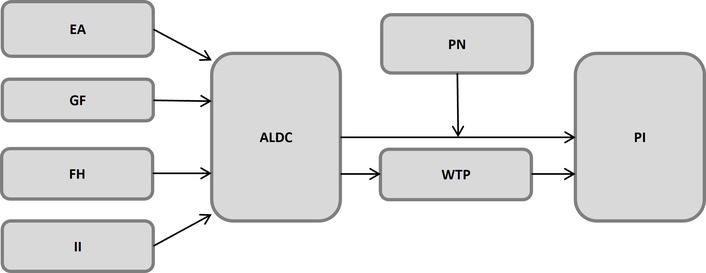
Theoretical model of local dairy product consumption behavior. EA: environmental attitudes; GF: good food; FH: food heritage; II: interpersonal influences; PN: perceived necessity; ALDC: attitudes toward local and traditional dairy products; WTP: willingness to pay; PI: purchase intention.
A better understanding of these relationships is essential for preserving traditional FH, supporting rural livelihoods, and promoting more sustainable consumption patterns amid ongoing dietary and lifestyle transitions.
The following hypotheses have been formulated:
Consumers’ EA has a significant correlation with their ALDC.
Consumers’ focus on GF has a significant correlation with their ALDC.
Consumers’ knowledge of FH has a significant correlation with their ALDC.
II has a significant correlation with consumers’ ALDC.
ALDC has a significant correlation with the PI for local and traditional dairy products.
Consumers’ ALDC have a significant correlation with their WTP for these products.
Consumers’ WTP for local and traditional dairy products has a significant correlation with their PI to local and traditional dairy products.
PN moderates the impact of ALDC on PI to these products.
Consumers’ ALDC are related to their PI to these products through the mediating role of their WTP.
Rasht, the capital of Guilan province in northern Iran, is a major coastal city renowned for its temperate climate and rich culinary heritage. With a population of approximately 700,000, it is a prominent tourist destination and has been designated as a UNESCO Creative City of Gastronomy. Located near the southern coast of the Caspian Sea, Rasht is characterized by predominantly flat terrain and an average elevation of approximately 5 meters above sea level [72].
Data were collected through a structured questionnaire administered in face-to-face interviews with residents of Rasht to assess their propensity to consume local dairy products. To ensure geographic diversity, ten dairy stores were randomly selected from different districts of the city. At each store, 22 customers were approached during their shopping visits and invited to participate in the study. Trained interviewers conducted the interviews using standardized procedures and provided clarification whenever necessary to ensure consistency throughout the data collection process. Face-to-face interviews were chosen to maximize response rates, accommodate respondents with varying literacy levels, and enhance data quality through direct interaction with participants.
Convenience sampling was employed because of practical constraints in accessing the entire population of Rasht, which comprises approximately 700,000 residents. Although this sampling approach may limit the representativeness of the sample and the generalizability of the findings, it was considered appropriate given the exploratory nature of the study and its focus on consumers actively purchasing dairy products at retail outlets. To reduce potential sampling bias, stores were selected from different districts of the city, and interviews were conducted at various times of the day and on different days of the week. Nevertheless, the findings should be interpreted with caution, as they may not be fully representative of all consumers in Rasht or other regions. Future research should employ probability-based sampling methods to enhance the external validity of the findings.
The questionnaire consisted of two sections. The first collected demographic information, and the second included items measuring the study constructs. The research examined eight variables related to consumers’ intentions to purchase local dairy products: EA, perceptions of GF, FH, II, PN, ALDC, WTP, and PI. All items were measured using a five-point Likert scale. The questionnaire items were developed through a systematic review of the literature on consumer food choice behavior, with a particular focus on studies of local and traditional food consumption. Items measuring EA were adapted from previously validated scales used in green consumption research [25, 43]. The GF construct was operationalized using the conceptual framework of the Slow Food movement [28, 29], with items adapted from established measures of health consciousness [36] and food quality perceptions [26]. Items measuring FH were developed based on the literature on cultural identity and traditional food consumption [14, 15]. II items were adapted from validated social influence scales [26], while WTP items were derived from previous studies [23, 65, 67]. Although the questionnaire items were based on established theoretical frameworks and empirical studies, they were adapted to reflect the context of local dairy consumption in Iran.
Content validity was evaluated by a panel of five experts in agricultural economics, consumer behavior, and food science, who assessed the relevance, clarity, and comprehensiveness of each item. Based on their recommendations, the questionnaire was revised to improve cultural appropriateness, conceptual clarity, and content coverage.
Cronbach’s alpha was initially used to assess the internal consistency of the measurement scales (see Table 1). However, during the preliminary analysis, the PN construct yielded a negative Cronbach’s alpha value (–0.122), indicating that its items did not form a unidimensional scale. This issue typically arises when items measure different constructs, exhibit negative inter-item correlations, or require reverse coding. Consequently, the PN construct was excluded from further analysis because of its poor reliability and the absence of significant relationships with the other variables in the path analysis (see the Results section).
Items measuring attitudes towards local dairy products.
| Variable | Items | Cronbach’s alpha |
|---|---|---|
| Environmental attitudes (EA)Adapted from [25, 43] | It’s worth spending money to prevent environmental damage and pollution. | 0.826 |
| We should do everything we can to protect the environment. | ||
| We should choose a lifestyle that causes less harm to the environment. | ||
| I welcome local dairy production that prioritizes the natural environment and conservation. | ||
| Good food (GF)Adapted from [36, 28] | I am very concerned about my health. | 0.644 |
| I am responsible for my own health. | ||
| I trust the quality of local dairy products. | ||
| The taste of local dairy products is a priority for me. | ||
| Using raw milk instead of powdered milk in dairy products is important. | ||
| Food heritage (FH)Developed based on [14, 15] | Preserving the diversity of local dairy products is important to me. | 0.826 |
| I prefer old and traditional foods and flavors to new and trendy ones. | ||
| Consuming local dairy products means caring about the local people and community. | ||
| Buying local dairy products means preserving biological and cultural heritage. | ||
| I find the traditional production methods of local dairy products interesting and appealing. | ||
| Interpersonal influences (II)Adapted from [26] | I usually buy dairy products that others have recommended. | 0.615 |
| Before buying dairy products, I gather information about them from friends, family, or acquaintances. | ||
| I usually use dairy products that I have personally tried. | ||
| Attractive packaging is my main motivation for buying local dairy products. | ||
| Attitudes toward local and traditional dairy products (ALDC)Developed based on [21, 61] | I agree with the idea that “it is better to buy local dairy products.” | 0.860 |
| The continued production of local dairy products is a good and appealing idea. | ||
| Compared to factory-produced dairy products, I have a positive attitude towards local dairy products. | ||
| In terms of taste, local dairy products are better than factory-produced dairy products. | ||
| Willingness to pay (WTP)Adapted from [65, 67] | I am willing to pay more for local dairy products. | 0.660 |
| Paying more for local dairy products is justified. | ||
| By paying more for local dairy products compared to factory-produced dairy products, I contribute to environmental protection. | ||
| Using local dairy products is not economically viable. | ||
| By buying local dairy products, I contribute to the improvement of the rural economy in my province. | ||
| Buying local dairy products leads to a direct connection between the seller and the customer, eliminating intermediaries. | ||
| Perceived necessity (PN)Adapted from [26] | When buying items, I always pay attention to whether they are environmentally friendly. | –0.122* |
| In my daily purchases, I don’t pay attention to whether the products I buy are local. | ||
| Due to some problems, I cannot pay attention to the local and indigenous nature of essential products for life. | ||
| If I am sure of the hygiene of local dairy products, I will use them more. | ||
| Purchase intention (PI)Adapted from [24, 25] | I intend to buy local dairy products this year. | 0.908 |
| I would be happy to be able to buy local dairy products in the future. | ||
| I am eager to buy local dairy products at the first opportunity. | ||
| The probability that I will buy local dairy products is very high. |
*: The PN construct was excluded from the final analysis due to negative Cronbach’s alpha (–0.122) and lack of significant relationships in the path analysis. This indicates the items did not form a reliable unidimensional scale in this context.
Composite reliability (CR), rho_A, and average variance extracted (AVE) were used to assess construct reliability and convergent validity, following established partial least squares (PLS)-structural equation modeling (SEM) guidelines. Discriminant validity was evaluated using the Fornell and Larcker [73] criterion and the heterotrait-monotrait (HTMT) ratio, which has been recommended as a robust criterion for assessing discriminant validity and reducing measurement error [74].
Descriptive statistics (mean scores, standard deviation, multi-response analysis and frequency) were used to summarize the respondents’ socioeconomic and demographic characteristics, while t-tests and SEM were employed to test the study hypotheses and examine the relationships among the variables. Data analysis was conducted using SPSS version 25 and SmartPLS 3. The PLS-SEM approach was applied to evaluate both the measurement and structural models. A predetermined significance level of p < 0.05 was adopted for all statistical tests.
The majority of Rasht residents who participated in this study were male (65.5%) and married (80.9%). Approximately one-third (35.5%) were aged between 35 and 44 years. In terms of employment, 44.9% were employed by companies or government/private organizations, while 55.1% were self-employed.
Regarding dairy product preferences, 25.6% of respondents preferred local products, 22.8% preferred factory-produced products, and 51.6% consumed both. Respondents indicated a preference for purchasing dairy products from local markets (13.7%), supermarkets (62.1%), and local dairy shops (24.2%). According to the survey results, 46.0% of respondents consumed local dairy products, while 54.0% consumed factory-produced dairy products (Table 2). Based on the multi-response analysis, yogurt was the most commonly consumed local dairy product, accounting for 87.3% of responses (Table 3).
Respondent profile.
| Variables | Frequency | Valid percentage |
|---|---|---|
| Gender | ||
| Male | 144 | 65.5 |
| Female | 76 | 34.5 |
| Marital situation | ||
| Single | 42 | 19.1 |
| Married | 178 | 80.9 |
| Age (years) | ||
| 18–24 | 23 | 10.5 |
| 25 to 34 | 43 | 19.5 |
| 35 to 44 | 78 | 35.5 |
| 45 to 54 | 45 | 20.5 |
| More than 54 | 31 | 14.1 |
| Occupations | ||
| Self-employment | 113 | 55.1 |
| Recruitment | 92 | 44.9 |
| Non-response | 15 | |
| Consumption preference | ||
| Local and artisanal | 56 | 25.6 |
| Industrial | 50 | 22.8 |
| Both of them | 113 | 51.6 |
| Non-response | 1 | - |
| Place of shopping | ||
| Local markets | 30 | 13.7 |
| Stores (any kind) | 136 | 62.1 |
| Artisanal dairy shop | 53 | 24.2 |
| Non-response | 1 | - |
| Consuming products | ||
| Local and artisanal | 99 | 46.0 |
| Industrial | 116 | 54.0 |
| Non-response | 5 | - |
Age (years); mean = 41.53, SD = 11.79.
Consumption of dairy products by the respondents (multi-response analysis).
| Variable | Percent of cases |
|---|---|
| Milk | 73.6 |
| Yogurt | 87.3 |
| Doogh* | 63.2 |
| Butter | 35 |
| Cheese | 65 |
| Cream | 15.9 |
| Total | 340 |
*: A traditional fermented yoghurt-based drink.
As presented in Table 4, the mean scores for the eight dimensions under investigation ranged from 3.05 (PN) to 4.37 (EA). The remaining constructs—namely, GF/health consciousness (3.48), FH (3.86), II (3.66), ALDC (3.95), WTP/purchase (3.35), and PI (3.87)—also demonstrated relatively favorable mean values among dairy consumers in Rasht.
Measurement of items affecting attitudes towards local dairy products.
| Variable | Item/Question (Q) | Mean | SD |
|---|---|---|---|
| Environmental attitudes | Q1: It’s worth spending money to prevent environmental damage and pollution. | 4.31 | 0.81 |
| Q2: We should do everything we can to protect the environment. | 4.53 | 0.66 | |
| Q3: We should choose a lifestyle that causes less harm to the environment. | 4.46 | 0.73 | |
| Q4: I welcome local dairy production that prioritizes the natural environment and conservation. | 4.18 | 0.78 | |
| Good food | Q5: I am very concerned about my health. | 3.98 | 0.85 |
| Q6: I am responsible for my own health. | 4.05 | 0.83 | |
| Q7: I trust the quality of local dairy products. | 3.38 | 1.04 | |
| Q8: The taste of local dairy products is a priority for me. | 4.01 | 0.88 | |
| Q9: Using raw milk instead of powdered milk in dairy products is important. | 1.99 | 1.15 | |
| Food heritage | Q10: Preserving the diversity of local dairy products is important to me. | 3.91 | 0.87 |
| Q11: I prefer old and traditional foods and flavors to new and trendy ones. | 4.04 | 0.87 | |
| Q12: Consuming local dairy products means caring about the local people and community. | 3.75 | 1.00 | |
| Q13: Buying local dairy products means preserving biological and cultural heritage. | 3.71 | 1.13 | |
| Q14: I find the traditional production methods of local dairy products interesting and appealing. | 3.90 | 0.87 | |
| Interpersonal influences | Q15: I usually buy dairy products that others have recommended. | 3.65 | 0.93 |
| Q16: Before buying dairy products, I gather information about them from friends, family, or acquaintances. | 3.78 | 0.93 | |
| Q17: I usually use dairy products that I have personally tried. | 4.00 | 0.74 | |
| Q18: Attractive packaging is my main motivation for buying local dairy products. | 3.19 | 1.05 | |
| Attitudes toward local and traditional dairy products | Q19: I agree with the idea that “it is better to buy local dairy products.” | 3.87 | 0.91 |
| Q20: The continued production of local dairy products is a good and appealing idea. | 3.91 | 0.77 | |
| Q21: Compared to factory-produced dairy products, I have a positive attitude towards local dairy products. | 3.91 | 0.92 | |
| Q22: In terms of taste, local dairy products are better than factory-produced dairy products. | 4.11 | 0.87 | |
| Willingness to pay | Q23: I am willing to pay more for local dairy products. | 3.24 | 1.05 |
| Q24: Paying more for local dairy products is justified. | 3.34 | 1.16 | |
| Q25: By paying more for local dairy products compared to factory-produced dairy products, I contribute to environmental protection. | 3.29 | 1.13 | |
| Q26: Using local dairy products is not economically viable. | 2.84 | 1.09 | |
| Q27: By buying local dairy products, I contribute to the improvement of the rural economy in my province. | 3.73 | 1.08 | |
| Q28: Buying local dairy products leads to a direct connection between the seller and the customer, eliminating intermediaries. | 3.65 | 1.05 | |
| Perceived necessity | Q29: When buying items, I always pay attention to whether they are environmentally friendly. | 2.46 | 0.94 |
| Q30: In my daily purchases, I don’t pay attention to whether the products I buy are local. | 2.65 | 0.99 | |
| Q31: Due to some problems, I cannot pay attention to the local and indigenous nature of essential products for life. | 2.90 | 1.01 | |
| Q32: If I am sure of the hygiene of local dairy products, I will use them more. | 4.20 | 0.87 | |
| Purchase intention | Q33: I intend to buy local dairy products this year. | 3.77 | 0.96 |
| Q34: I would be happy to be able to buy local dairy products in the future. | 4.04 | 0.86 | |
| Q35: I am eager to buy local dairy products at the first opportunity. | 3.87 | 0.91 | |
| Q36: The probability that I will buy local dairy products is very high. | 3.80 | 1.03 |
Construct mean (SD): environmental attitudes = 4.37 (0.60); good food = 3.48 (0.54); food heritage = 3.86 (0.72); interpersonal influences = 3.66 (0.58); attitudes toward local and traditional dairy products = 3.95 (0.73); willingness to pay = 3.35 (0.66); perceived necessity = 3.05 (0.35); purchase intention 3.87 (0.83).
During the initial measurement model assessment, the PN construct demonstrated a Cronbach’s alpha of –0.122 (Table 1), indicating poor internal consistency. Further examination revealed that the PN items (Q29–Q32) measured conceptually distinct aspects: environmental consciousness in purchases (Q29), awareness of product locality (Q30), purchasing constraints (Q31), and hygiene concerns (Q32). Given this multidimensionality and the construct’s lack of significant relationships in the preliminary path analysis, PN was excluded from the final structural model. This decision is consistent with the theoretical refinement process, where constructs failing both reliability and validity tests should be removed to maintain model parsimony [75].
In this study, the theoretical model was initially fitted to the empirical data. Results indicated that some items and variables did not support the hypothesized relationships. Subsequently, efforts were made to ensure that the factor loadings were sufficiently high, reflecting the relationship between the latent variable and its observed indicators. Factor loadings greater than 0.60 were deemed acceptable in this analysis. The statistical significance of these coefficients was assessed using t-values of 1.96 and p-values less than 0.05, indicating the strength of the relationship [76] (Figure 2).
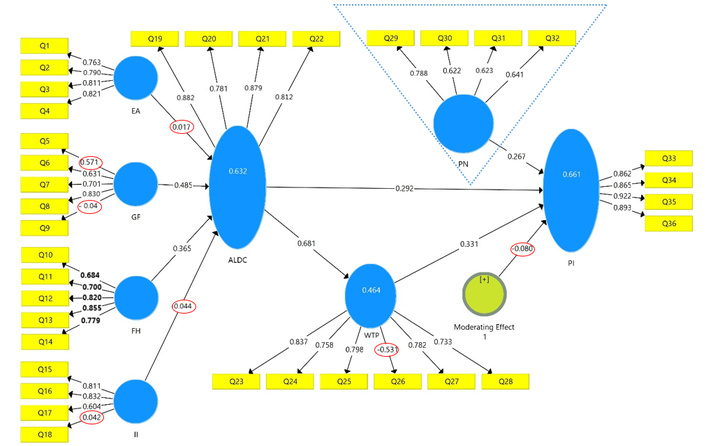
Primary analysis of the theoretical research model. The construct shown in the triangle (PN) was removed from the final analysis in the model due to having an unacceptable Cronbach’s alpha coefficient. All values circled in red have p-values greater than 0.05 and are therefore not statistically significant. These parameters should be removed from the model before re-estimating the final model. EA: environmental attitudes; GF: good food; FH: food heritage; II: interpersonal influences; ALDC: attitudes toward local and traditional dairy products; PN: perceived necessity; WTP: willingness to pay; PI: purchase intention.
Items 5, 9, 18, and 26 exhibited low factor loadings (Figure 2), leading to their exclusion from the model. Path analysis indicated that EA, interpersonal relationships, and PN were not significant predictors of dairy consumption. The final model was re-estimated after removing these insignificant variables.
Following the removal of items with low factor loadings and paths with insignificant coefficients, the modified model was fitted. In this model, factor loadings ranged from 0.604 to 0.922, with a mean of 0.80, which was considered acceptable given the level of significance (p < 0.01). All reported factor loadings exceeded the recommended threshold of 0.5 [77]. Additionally, Cronbach’s alpha values for all constructs were above 0.6, except for the health construct, which had a value of 0.583. This was deemed acceptable due to the values of other indices, especially the CR. Rho_A values were also above 0.6 for all constructs, and the CR values exceeded the desired threshold of 0.7, indicating adequate reliability of the research instrument after the modifications.
Convergent validity was assessed using the AVE of the constructs [78]. The results showed that the AVE values ranged from 0.55 to 0.77, which is significant considering the threshold of 0.5 for this index, indicating that all selected measures accurately assessed the intended attributes. Regarding the independence of the constructs, the Fornell and Larcker [73] criterion demonstrated complete discriminability among the constructs (Table 5).
Validity and reliability of model constructs.
| Variables | ALDC | FH | PI | WTP | Cronbach’s alpha | Rho_A | Composite reliability (CR) | Average variance extracted (AVE) |
|---|---|---|---|---|---|---|---|---|
| Attitudes toward local and traditional dairy products (ALDC) | 0.84 | 0 | 0 | 0 | 0.85 | 0.86 | 0.90 | 0.705 |
| Food heritage (FH) | 0.68 | 0.77 | 0 | 0 | 0.82 | 0.82 | 0.88 | 0.594 |
| Good food (GF) | 0.74 | 0.63 | 0 | 0 | 0.58 | 0.64 | 0.78 | 0.548 |
| Purchase intention (PI) | 0.69 | 0.64 | 0.88 | 0 | 0.90 | 0.91 | 0.94 | 0.785 |
| Willingness to pay (WTP) | 0.68 | 0.74 | 0.72 | 0.79 | 0.84 | 0.85 | 0.89 | 0.624 |
Furthermore, to confirm the quality of the proposed research model, the collinearity between variables and measures was examined. The variance inflation factor (VIF) results for all indicators ranged from 1.11 to 3.73. Given the threshold for these values (2.0–5), it can be concluded that there was no collinearity among the research constructs. Overall, the reliability and validity indices, including construct reliability, convergent validity, and discriminant validity, indicated the suitability of the research model structure.
The modified model was assessed using SEM to examine the relationships between latent variables and test the hypotheses. Goodness-of-fit indices (NFI and SRMR) were employed to evaluate the model fit. The results indicated that the empirical evidence supported the modified theoretical model, with SRMR values of 0.076 (saturated) and 0.103 (estimated) remaining within acceptable limits, and considering SRMR as the key fit criterion in PLS-SEM, the overall model demonstrates an acceptable fit to the data (Table 6). Specifically, factor loadings ranged from 0.604 to 0.922, exceeding the recommended threshold of 0.5. Additionally, Cronbach’s alpha and CR values were above the desired thresholds, suggesting adequate reliability of the measurement scales.
Goodness of fit indices of the model.
| Indicators | Saturated model | Estimated model | Limits |
|---|---|---|---|
| SRMR | 0.076 | 0.103 | < 0.12 |
| d_ULS | 1.349 | 2.436 | HI95 |
| d_G | 0.590 | 0.677 | HI95 |
| Chi-Square | 740.050 | 813.219 | N/A |
| NFI | 0.768 | 0.745 | > 0.70 |
The results indicated a moderate to strong positive relationship between GF and attitude toward local dairy consumption (PC = 0.512), as well as between the inclination to consume local dairy products and WTP (PC = 0.682). Relationships between other variables also demonstrated acceptable magnitudes, consistent with previous social studies (Figure 3). Furthermore, the defined constructs accounted for approximately 60% of the variance in the dependent variable, willingness to purchase local dairy products (R2 = 0.598), which is considered substantial in social behavior research. Additionally, GF and FH and local knowledge explained over 60% of the attitude toward local dairy consumption (Figure 3).
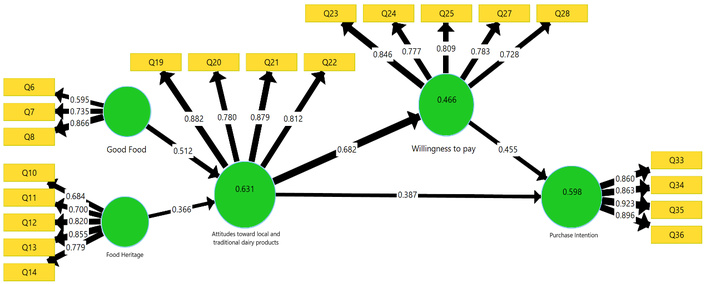
Modified structural model of the research with path coefficients, explained variance, and factor loadings.
The p-values presented in Table 7 are all significantly below the threshold of 0.05, indicating that the relationships among the variables are statistically significant at the 5% level. This implies that the observed relationships are unlikely to have arisen by chance. Significant relationships were identified between attitudes toward local and artisanal dairy consumption and both PI and WTP, whereby favorable attitudes were found to be strong predictors of the behavioral responses. FH was likewise observed to be significantly associated with attitudes toward these products, with higher levels of FH corresponding to more positive attitudes. Additionally, a significant association was detected between the GF concept and attitudes toward local and artisanal dairy, suggesting that a greater emphasis on GF is linked to more favorable consumer attitudes.
Path analysis of factors influencing attitudes and behavioral intentions toward local/artisanal dairy products.
| Hypothesis | Original sample (β) | Mean | SD | t-statistic | p-value |
|---|---|---|---|---|---|
| Attitudes toward local and traditional dairy products → purchase intentions towards local and artisanal dairy | 0.387 | 0.381 | 0.065 | 5.954 | < 0.01 |
| Attitudes toward local and traditional dairy products → willingness to pay | 0.682 | 0.681 | 0.043 | 15.860 | < 0.01 |
| Food heritage → Attitudes toward local and traditional dairy products | 0.366 | 0.368 | 0.067 | 5.463 | < 0.01 |
| Good food → Attitudes toward local and traditional dairy products | 0.512 | 0.512 | 0.069 | 7.420 | < 0.01 |
| Willingness to pay → purchase intentions towards local and artisanal dairy | 0.455 | 0.461 | 0.065 | 7.000 | < 0.01 |
Food plays a multifaceted role in human life, shaped by both its biological functions and its cultural and social significance. Local foods reflect cultural identity, historical heritage, and traditional lifestyles [79]. This study investigates the factors influencing urban consumers’ intention to consume local and artisanal dairy products in Rasht, Iran. The findings provide valuable insights into consumer attitudes and behavioral intentions, offering practical implications for promoting local food consumption and supporting sustainable food systems.
This study extends the TPB [24] by incorporating cultural dimensions that have received limited attention in studies of local food consumption, particularly in developing countries. Specifically, FH and perceptions of GF are introduced as direct antecedents of attitudes toward local and artisanal dairy products. This addresses a research gap identified by Feldmann and Hamm [20] and Shin and Hancer [21], who emphasized the need for culturally grounded models to explain local food consumption. The findings demonstrate that these cultural constructs are not merely contextual factors but significant determinants of consumer attitudes. Among all the variables examined, perceptions of GF exerted the strongest positive effect on attitudes (β = 0.512, p < 0.01). This finding is particularly noteworthy in the context of Rasht, a UNESCO Creative City of Gastronomy, where culinary traditions constitute a central element of local identity. Despite Rasht’s rich gastronomic heritage, empirical evidence linking this cultural capital to consumers’ intentions to purchase local and artisanal dairy products has remained limited.
Empirical evidence indicates that WTP serves as a mechanism linking attitudes to PI. Although previous research has examined WTP, it has predominantly treated it as a dependent outcome variable (e.g., [65, 67]). However, the present findings reveal that WTP functions as a partial mediator in this relationship. The standardized coefficient for this mediating path was 0.455, with a significance level of p < 0.01, underscoring the role of favorable attitudes in translating into behavioral responses. The indirect effect of attitudes on PI through WTP was calculated as 0.310 (i.e., 0.682 × 0.455), indicating that approximately 46% of the total effect of attitudes on PI is channeled via WTP. This suggests that consumers’ readiness to pay a premium constitutes a critical intermediary between cognitive evaluations and actual purchasing behavior. These findings contribute to the growing body of literature on sustainable food consumption by offering a more nuanced understanding of the psychological pathway from perceptions of cultural and quality attributes to consumer behavior [21, 80]. Furthermore, by focusing on an urban Iranian context—an underexplored setting in this domain—the present study provides a valuable comparative baseline for food consumption research in other developing countries. The proposed model demonstrated strong explanatory power, with an R2 of 0.598 for PI and 0.631 for attitudes, substantially exceeding the explained variances reported in comparable studies, such as those by Mohammadian and Bakhshandeh [25] and Cheah and Phau [26]. These results suggest that the incorporation of culturally specific constructs enhances the predictive accuracy of consumer behavior models in culturally rich settings. This corroborates the assertions of Vermeulen et al. [3] and Chedid et al. [15], who emphasized that psychological models cannot be uniformly applied across contexts without appropriate cultural adaptation.
The descriptive findings revealed generally positive evaluations across all study constructs, including EA, health consciousness, FH, II, PN, attitudes toward local dairy products, WTP, and PI. Among these, attitudes toward local and artisanal dairy products received the highest mean score, reflecting their strong cultural significance and perceived quality [23, 81]. In contrast, WTP recorded a comparatively lower mean, suggesting that price remains an important consideration in consumers’ purchasing decisions.
The structural model further demonstrated that health consciousness and FH exerted significant positive effects on consumers’ attitudes toward local and artisanal dairy products, consistent with the findings of previous studies [25, 39, 82]. By contrast, II did not have a significant effect, indicating that consumers’ purchasing decisions in this context are driven more by personal values and beliefs than by social pressure or the opinions of others [83].
Consistent with previous research, attitudes toward environmentally friendly products significantly influence both PI and WTP [25, 26]. However, unlike earlier studies that identified PN as an important determinant or moderating factor [26, 56], the present study found no significant relationship between PN and consumers’ attitudes or behavioral intentions.
The structural equation model demonstrated strong explanatory power. Specifically, perceptions of GF and FH together explained approximately 63% of the variance in attitudes toward local and artisanal dairy products. In turn, attitudes accounted for approximately 47% of the variance in PI, while attitudes and PI jointly explained approximately 60% of the variance in consumers’ intention to consume local dairy products. These findings underscore the importance of considering the interplay of cultural, social, and personal factors in explaining consumer behavior toward local and artisanal foods [84].
The results further indicate that cultural identity, traditional knowledge, and environmental awareness—reflecting consumers’ connections to local FH—are important drivers of positive attitudes toward local dairy products. Despite the increasing prevalence of industrial food products, consumers appear to maintain strong cognitive and emotional ties to traditional food culture [85]. This connection is often mediated by the alignment between a consumer’s self-image and the cultural meaning embedded in local products [86]. Evidence suggests that health, quality, and taste values significantly bolster positive attitudes toward local dairy consumption [23].
The gap between positive attitudes and the continued dominance of industrial dairy products may be explained by several structural and market-related barriers. First, the limited availability of local dairy products restricts consumer access, as these products are primarily sold through traditional or specialized outlets rather than mainstream retail chains. Second, price remains a key consideration, with industrial dairy products generally being more affordable and therefore more accessible to a wider range of consumers [87]. Third, the lack of standardized production practices, quality certification, and professional packaging may reduce consumer confidence in local dairy products compared with industrial brands that benefit from established quality assurance systems and recognizable packaging [88].
Consumers demonstrated a high level of health consciousness, with a mean score of 3.80 out of 5, which was significantly associated with positive attitudes toward local and artisanal dairy products [23]. This finding suggests that consumers value these products not only for their distinctive taste but also for their perceived nutritional and health benefits. Respondents also expressed a strong sense of personal responsibility for maintaining a healthy diet and reported greater trust in traditional local production methods. These results indicate that health-related and cultural values can partially offset structural barriers to the consumption of local dairy products. Consequently, there is considerable market potential for local and artisanal dairy products, provided that challenges related to product availability, affordability, quality assurance, and standardization are effectively addressed.
Attitude emerged as a central psychological construct, exerting a significant influence on both WTP and PI. The relationship between attitude and WTP was notably stronger than that between attitude and PI. This suggests that although favorable attitudes increase consumers’ readiness to pay a premium, they are less directly translated into actual purchasing behavior. These results are consistent with prior research indicating that WTP often functions as a mediating mechanism between attitude and behavior [80].
The comparatively weaker relationship between attitude and PI underscores the multifaceted nature of consumer behavior. Although attitude remains a key determinant, factors such as price sensitivity, product availability, and social norms are likely to contribute to the intention-behavior gap [24]. Accordingly, interventions that focus exclusively on changing attitudes may be insufficient unless they are complemented by strategies that address these contextual and structural constraints. Future research should further examine these moderating and mediating factors to develop more comprehensive behavioral models that better explain and promote local dairy consumption.
Considering existing barriers, the robust appeal of local products and consumers’ WTP a premium present significant opportunity for policymakers to bolster local dairy production and distribution, thereby enhancing public health, fostering job creation, and stimulating rural economic growth.
In conclusion, this study seeks to identify the factors influencing consumer attitudes toward traditional dairy products, with the broader aim of promoting their purchase and utilization. It examines the key determinants of attitudes and PI while assessing their explanatory effectiveness. The analysis also considers the distinctive characteristics of local products in evaluating the relationship between consumer attitudes and PI, both directly and through mediating or moderating effects. The findings indicate that health awareness has a positive and significant effect on attitudes toward both dairy and local products. Concerns regarding the adverse health impacts of environmental pollution, along with the high costs associated with treating related illnesses—often highlighted in public health discourse—have increased consumers’ awareness of the importance of safeguarding personal health. Given the strong influence of health awareness on consumer attitudes, integrating health awareness into school curricula is recommended. Both general and specialized courses should be developed to enhance awareness, and similar initiatives should be extended to workplaces, governmental bodies, and other institutions. The results further indicate that WTP acts as a mediating factor in the relationship between consumer attitudes and PI. Emphasizing the environmental sustainability of local products, as well as the ethical, charitable, and cultural values associated with their consumption, may enhance consumers’ WTP. Highlighting ecological benefits rather than purely material considerations can increase urban consumers’ readiness to pay a premium, thereby supporting broader environmental sustainability goals.
Several limitations of this study should be acknowledged. First, although convenience sampling was appropriate for the exploratory nature of this research, it may limit the representativeness of the sample and the generalizability of the findings to the broader population of Rasht or other Iranian cities. While efforts were made to enhance sample diversity through the random selection of dairy stores and data collection across different locations and times, the sample may not fully reflect the demographic diversity of the target population. In particular, consumers who rarely purchase dairy products from retail outlets or who primarily rely on home-produced dairy products were not represented. Future research should employ probability-based sampling methods, such as stratified random sampling, to improve external validity and support stronger population-level inferences. Second, the study was conducted exclusively in Rasht, a city with a distinctive gastronomic heritage and cultural identity. Consumers in this setting may exhibit stronger preferences for local foods than those in other regions of Iran or in different countries. Consequently, the findings should be generalized to other geographical contexts with caution. Third, the cross-sectional design of the study precludes the establishment of causal relationships among the variables. Future longitudinal research would help verify the direction of the observed relationships and examine how consumers’ attitudes and PI change over time. Fourth, although the measurement model demonstrated acceptable levels of reliability and validity overall, the relatively low Cronbach’s alpha for the GF construct (0.583) indicates that this multidimensional construct could be measured more effectively. In particular, the removal of items with low factor loadings may have reduced the breadth of the construct. Future studies should refine and expand the measurement scale to better capture the multiple dimensions of consumers’ perceptions of GF. Finally, the PN construct, which was initially included based on the framework proposed by Cheah and Phau [26], demonstrated poor internal consistency in the present study (Cronbach’s alpha = –0.122) and was therefore excluded from the final model. This finding suggests that the concept of PN may be influenced by cultural and contextual factors and that measurement items developed in Western settings may not be directly applicable to the Iranian context of local food consumption. Future research should develop and validate context-specific measures of PN to better capture this construct in studies of local food consumption in developing countries.
ALDC: attitudes toward local and traditional dairy products
AVE: average variance extracted
CR: composite reliability
EA: environmental attitudes
FH: food heritage
GF: good food
HTMT: heterotrait-monotrait
II: interpersonal influences
PI: purchase intention
PLS: partial least squares
PN: perceived necessity
SEM: structural equation modeling
TPB: theory of planned behavior
WTP: willingness to pay
During the preparation of this work, the authors used ChatGPT-Plus 6 and editGPT to proofread. After using this tool/service, the authors reviewed and edited the content as needed and take full responsibility for the content of the publication.
MSA: Supervision, Methodology, Formal analysis, Conceptualization, Investigation, Visualization, Writing—original draft, Writing—review & editing. FL: Data curation, Methodology. SM: Writing—original draft, Formal analysis. HEB: Writing—original draft, Formal analysis. AF: Methodology, Formal analysis. All authors read and approved the submitted version.
The authors declare no conflicts of interest.
This study was conducted in accordance with the ethical principles outlined in the Declaration of Helsinki. Approval was granted by the Research Department of Islamic Azad University, Rasht Branch, Iran, with the approval number 11750325972002.
Informed consent was obtained from all participants prior to data collection, and the confidentiality and anonymity of all respondents were guaranteed throughout the research process.
Not applicable.
Data are available from the authors upon reasonable request to the corresponding author.
Not applicable.
© The Author(s) 2026.
Open Exploration maintains a neutral stance on jurisdictional claims in published institutional affiliations and maps. All opinions expressed in this article are the personal views of the author(s) and do not represent the stance of the editorial team or the publisher.
Copyright: © The Author(s) 2026. This is an Open Access article licensed under a Creative Commons Attribution 4.0 International License (https://creativecommons.org/licenses/by/4.0/), which permits unrestricted use, sharing, adaptation, distribution and reproduction in any medium or format, for any purpose, even commercially, as long as you give appropriate credit to the original author(s) and the source, provide a link to the Creative Commons license, and indicate if changes were made.



View: 49
Download: 3
Times Cited: 0


