 Original Article


Affiliation:
1Department of Food Engineering, Gümüşhane University, Gümüşhane 29100, Türkiye

Affiliation:
2Department of Nutrition and Dietetics, Gümüşhane University, Gümüşhane 29100, Türkiye
Email: hilyasoglu@gumushane.edu.tr
ORCID: https://orcid.org/0000-0001-5710-2954


Explor Foods Foodomics. 2026;4:1010201 DOI: https://doi.org/10.37349/eff.2026.1010201
Received: March 08, 2026 Accepted: September 07, 2026 Published: November 10, 2026
Academic Editor: Amit Jaiswal, Technological University Dublin-City Campus, Ireland
Aim: Industrial fruit processing results in massive quantities of by-products, which can pose a risk of environmental pollution. Their utilization can aid in waste management. Although fruit by-products are valuable sources of bioactive compounds for formulating healthy food products, they may have a negative impact on sensory properties. In this study, we aimed to develop healthy cookies with good sensory acceptability by using lemon peel powder (LPP).
Methods: The control sample and five samples incorporating LPP (2–10%) were prepared and analysed for proximate composition, physical, colour, and sensory properties, total phenolic content, vitamin C content, and antioxidant capacity.
Results: LPP enhanced the nutritional and functional values of cookies. The cookies incorporated with the LPP had higher levels of ash and crude fibre in comparison with the control cookie. Moreover, they exhibited higher total phenolic content and antioxidant capacity. Vitamin C was detected in LPP-enriched cookies, with levels up to 2.66 mg/100 g. LPP enhanced the spread ratio and sensory scores such as appearance, flavour, and general acceptability.
Conclusions: LPP (4–6%) may be considered as a preferred range for formulating healthy cookies with acceptable sensory properties.
Industrial food processing generates large quantities of waste, including bran, kernel, peel, pomace, seed, shell, and stem, which can pose a risk for environmental pollution as their disposal is difficult [1–3]. Food industry by-products are generally used in the production of animal feed and compost. An alternative may be to develop value-added products from food industry by-products since they are good sources of dietary fibre, vitamins, minerals, and bioactive compounds [4, 5].
Cookies, a type of bakery product, are widely consumed by people of all ages and social classes. They have low costs and long shelf lives [6]. The main ingredients of cookies are wheat flour, sugar, and hydrogenated fat. They are rich in carbohydrates and lack dietary fibre and bioactive compounds. Their nutritional values can be enhanced by substituting wheat flour with functional ingredients. The addition of fruit by-products to bakery products has the potential to contribute to effective waste management and the development of healthy products. Fruit by-products such as apple pomace [7, 8], berry pomace [9], grape pomace [10], kiwi shell [11], mango peel [1], orange peel [12], and pomegranate peel [3, 13] have been investigated for the enrichment of bakery products.
Lemon is the third most important citrus species after the orange and mandarin. Lemons can be consumed fresh and processed into products such as juices, jam, molasses, etc. After processing, lemon peels are obtained from fresh lemons, representing between 50% and 65% of the total fruit weight [14]. Lemon peels are composed of two distinct tissues, namely flavedo (outer layer) and albedo (inner layer). Flavedo has been used by the fragrance industry because of its essential oil content. Albedo is rich in dietary fibre and includes flavonoids and vitamin C as well [15].
Because of consumers’ demand for healthy foods, the bakery industry always explores new functional ingredients. Utilisation of lemon peel powder (LPP) in the bakery industry may offer several benefits, such as the elimination of waste and its conversion into value-added products. However, it may have a negative impact on quality, especially physical and sensory properties. Although previous studies have examined the incorporation of citrus by-products into bakery products [16, 17], information on the effects of different levels of LPP on the physical and sensory properties of cookies remains limited. We hypothesized that the partial replacement of wheat flour with LPP may enhance the nutritional and functional value of cookies by increasing dietary fiber and bioactive compounds, while potentially exerting adverse effects on their physical and sensory characteristics. Therefore, we aimed to develop healthy cookies by using LPP while ensuring their quality in terms of physical and sensory properties. Cookies incorporating different levels of LPP were prepared and analysed for chemical, physical, colour, and sensory properties, vitamin C content, total phenolic content (TPC), and antioxidant capacity.
Wheat flour (Söke Milling Industry Trade Inc., Aydın, Türkiye), hazelnut oil (Gürsoy Agricultural Products Food Industry Trade Inc., Ordu, Türkiye), powdered sugar, salt, and baking powder were obtained from a local market (Gümüşhane, Türkiye). Wheat flour included 73.8 g 100 g–1 carbohydrate, 11.5 g 100 g–1 protein, 1.5 g 100 g–1 fat, and 2.4 g 100 g–1 fibre according to its label.
Lemons were provided from a local market (Gümüşhane, Türkiye). Firstly, their outer surfaces were washed and dried with a towel. Secondly, the lemons were divided into 4 pieces, and the peels were separated from the fruit flesh. After cutting the peels into approximately 1 cm2 pieces, they were dried in an oven at 40°C for 48 hours and ground using a laboratory mill (IKA M-20, Germany). The peel powder, passed through a 250-micron sieve, was stored at 4°C.
The control cookie formulation was adopted from [18]. Five formulations incorporating LPP were prepared (Table 1). Powdered sugar and hazelnut oil were mixed in a bowl, and flour, LPP, salt, and baking powder were mixed in another bowl. The mixtures were combined and kneaded, with water added gradually to form a dough. The dough was rolled to 7 mm with a rolling cylinder and then shaped using a cookie mold (45 mm diameter). They were baked at 180°C for 15 minutes.
Cookie formulations.
| Component | Control | LPP-2 | LPP-4 | LPP-6 | LPP-8 | LPP-10 |
|---|---|---|---|---|---|---|
| Wheat flour (g) | 100 | 98 | 96 | 94 | 92 | 90 |
| LPP (g) | 0 | 2 | 4 | 6 | 8 | 10 |
| Hazelnut oil (g) | 30 | 30 | 30 | 30 | 30 | 30 |
| Powdered sugar (g) | 30 | 30 | 30 | 30 | 30 | 30 |
| Salt (g) | 1 | 1 | 1 | 1 | 1 | 1 |
| Baking powder (g) | 1 | 1 | 1 | 1 | 1 | 1 |
| Water (mL) | 25 | 25 | 25 | 25 | 25 | 25 |
LPP: lemon peel powder; LPP-2: LPP 2%; LPP-4: LPP 4%; LPP-6: LPP 6%; LPP-8: LPP 8%; LPP-10: LPP 10%.
The surface section of cookie samples is presented in Figure 1.
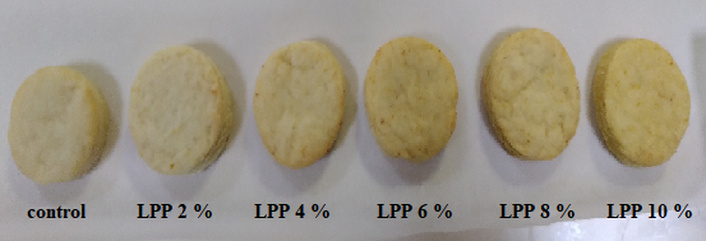
Surface section of cookie samples. LPP: lemon peel powder; LPP-2: LPP 2%; LPP-4: LPP 4%; LPP-6: LPP 6%; LPP-8: LPP 8%; LPP-10: LPP 10%.
The moisture, ash, fat, protein, and crude fibre were analysed using the AOAC methods. Total carbohydrates were calculated using the following formula:
A digital calliper (YU-SU, 0–150 mm, China) was used for the measurement of the height and diameter of cookies. For the measurement of height, three cookies were stacked, measured, restacked, and measured again. For the measurement of diameter, one cookie was measured, then rotated by 90° and measured again. Triplicate samples were measured, and an average of six readings was calculated. The spread ratio was calculated by dividing the diameter by the height.
The hardness and fracturability of cookies were measured using a three-point bending test. A texture analyser (TA-XT2plus, Stable Micro Systems, UK) attached with a 3-point bending ring (HDP/3PB) was used for the measurement.
A colorimeter (Konica Minolta CR400, Japan) was used for the measurement of colour values (L*, a*, and b*).
Vitamin C analysis was performed using an HPLC-UV system (Hewlett-Packard, UV-1100 detector, USA) coupled with a C18 column (Supelco Sil, 250 * 4.6 mm, 5 µm). A cookie sample (1 g) was weighed, and meta-phosphoric acid (3%, 10 mL) was added. The tubes were stirred at 250 rpm for 30 min and then centrifuged at 4,000 rpm. The supernatant was passed through a membrane filter (45 µm) and injected into an HPLC-UV system. The isocratic mobile phase was methanol: water (5:95) at pH 3, and the injection volume was 20 µL.
Two extracts (soluble and insoluble phenolics) were prepared according to [19] with some modifications. Extraction solvents were methanol/water/hydrochloric acid (80:10:1) for extractable (soluble) phenolics and methanol/sulphuric acid (10:1) for hydrolysable (insoluble) phenolics, respectively. Both extracts were stored at –18°C before analyses. The detailed procedure was previously described [20].
The TPC of both extracts was determined [20]. The results were expressed as mg gallic acid equivalent per 100 g of the sample.
The ABTS•+ radical scavenging activity of both extracts was determined [20]. The results were expressed as micromoles of Trolox equivalent per 100 g of the sample.
The FRAP of both extracts was determined. A total of 50 µL of each extract was mixed with FRAP reagent (1,500 µL), and the absorbance was measured at 595 nm after 20 min. The results were expressed as micromoles of Trolox equivalent per 100 g of the sample.
Sensory analysis was conducted with 100 volunteer adults (female: 64; male: 36; age: 18–54). The panel consisted of untrained participants recruited to evaluate the sensory attributes of the samples. The students and staff of Recep Tayyip Erdoğan University, Güneysu Physical Therapy and Rehabilitation College evaluated the appearance, colour (inner and surface), odour, flavour, sourness, sweetness, bitterness, lemon aroma, hardness, fracturability, and general acceptability of cookie samples. They used a 9-point hedonic scale, ranging from 1 (extremely dislike) to 9 (extremely like). The cookie samples coded with random three-digit numbers were presented to the panelists in a randomized order. Water was given to the panellists for rinsing their mouths between the samples. Ethics committee approval was obtained from the Gümüşhane University Ethics Commission (Date: 29/09/2021; Number: 2021/6). Informed consent was obtained from panellists for sensory analysis. The panellists were informed about the presence of lemon peel and potential allergens. The study complies with the Declaration of Helsinki.
Three batches were prepared for each formulation, and at least duplicate analyses were carried out for each batch. The mean values with standard deviation were calculated. One-way analysis of variance (ANOVA) and Duncan’s multiple range test were applied to determine differences between the control cookie and those incorporated with the LPP. Statistical analysis was performed using SPSS 25 software (IBM, NY, USA). Differences were considered statistically significant at p < 0.05.
Table 2 presents the proximate composition, colour properties, and antioxidant capacity of LPP. The main macronutrient in the LPP was carbohydrate (67.27%), followed by protein (8.27%). The LPP was a good source of fibre (15.05%). It included 18.03 mg 100 g–1 of vitamin C. The TPC was found to be 1,111.22 mg 100 g–1. Antioxidant capacity was determined by ABTS radical scavenging activity (1,794.29 µmol 100 g–1) and FRAP (5,439.33 µmol 100 g–1) assays. It had high L* (80.13) and b* (40.60) values.
Physicochemical and antioxidant properties of lemon peel powder.
| Physicochemical properties | Value | Antioxidant properties | Value |
|---|---|---|---|
| Moisture (%) | 19.26 ± 0.42 | TPC1 (mg 100 g–1) | 852.07 ± 157.13 |
| Ash (%) | 3.64 ± 0.05 | TPC2 (mg 100 g–1) | 259.15 ± 57.39 |
| Fat (%) | 1.56 ± 0.12 | TPCT (mg 100 g–1) | 1,111.22 ± 150.35 |
| Protein (%) | 8.27 ± 0.01 | ABTS1 (µmol 100 g–1) | 1,227.74 ± 159.56 |
| Carbohydrate (%) | 67.27 ± 0.45 | ABTS2 (µmol 100 g–1) | 566.55 ± 153.67 |
| Crude fiber (%) | 15.05 ± 0.77 | ABTST (µmol 100 g–1) | 1,794.29 ± 107.47 |
| L* | 80.13 ± 0.07 | FRAP1 (µmol 100 g–1) | 4,790.26 ± 1,069.78 |
| a* | –3.97 ± 0.08 | FRAP2 (µmol 100 g–1) | 649.07 ± 176.41 |
| b* | 40.60 ± 0.14 | FRAPT (µmol 100 g–1) | 5,439.33 ± 895.51 |
| - | - | Vitamin C (mg 100 g–1) | 18.03 ± 1.79 |
L*: lightness; a*: redness/greeness; b*: yellowness/blueness; TPC1: total phenolic content of extract 1; TPC2: total phenolic content of extract 2; TPCT: sum of extracts 1 and 2; ABTS1: ABTS of extract 1; ABTS2: ABTS of extract 2; ABTST: sum of extracts 1 and 2; FRAP1: FRAP of extract 1; FRAP2: FRAP of extract 2; FRAPT: sum of extracts 1 and 2. ABTS: 2,2'-azino-bis(3-ethylbenzothiazoline-6-sulfonic acid); FRAP: ferric reducing antioxidant power; TPC: total phenolic content.
Table 3 presents the proximate composition of cookie samples. The main macronutrient in the cookies was carbohydrate, followed by fat and protein. The LPP had no significant impact on the moisture, fat, or carbohydrate content of the cookies (p > 0.05). The protein content of LPP-4, the ash content of LPP-10, and the crude fibre content of LPP-6, LPP-8, and LPP-10 were significantly higher than the control sample (p < 0.05).
Proximate composition of cookies (%).
| Sample | Moisture | Ash | Protein | Fat | Carbohydrate | Crude fibre |
|---|---|---|---|---|---|---|
| Control | 8.99 ± 0.82a | 0.85 ± 0.04b | 6.70 ± 0.06bc | 17.49 ± 1.24a | 65.97 ± 0.41a | 0.68 ± 0.21b |
| LPP-2 | 9.06 ± 0.77a | 0.87 ± 0.06b | 7.00 ± 0.36ab | 17.24 ± 0.20a | 65.83 ± 1.17a | 0.76 ± 0.08b |
| LPP-4 | 8.03 ± 0.31a | 0.87 ± 0.05b | 7.27 ± 0.43a | 17.97 ± 0.09a | 65.86 ± 1.21a | 0.71 ± 0.03b |
| LPP-6 | 8.33 ± 0.39a | 0.88 ± 0.05b | 6.97 ± 0.20ab | 17.65 ± 0.10a | 66.17 ± 0.64a | 0.99 ± 0.06a |
| LPP-8 | 8.33 ± 0.40a | 0.91 ± 0.04b | 6.72 ± 0.12bc | 18.03 ± 0.37a | 66.01 ± 0.61a | 1.00 ± 0.08a |
| LPP-10 | 8.70 ± 0.65a | 1.01 ± 0.04a | 6.47 ± 0.07c | 18.24 ± 0.31a | 65.58 ± 0.67a | 1.01 ± 0.09a |
Different letters in the column indicate a significant difference (p < 0.05). LPP: lemon peel powder; LPP-2: 2%; LPP-4: 4%; LPP-6: 6%; LPP-8: 8%; LPP-10: 10%.
Tables 4 and 5 present the physical and colour properties of cookies, respectively. The LPP had a negative impact on height values, whereas it had a positive impact on diameter values. Consequently, the spread ratio of cookies increased significantly with the incorporation of LPP (p < 0.05). The hardness values of cookies incorporated with LPP were lower than those of the control cookie. However, the LPP had no significant impact on the hardness values of cookies (p > 0.05). The fracturability of cookies decreased significantly with increasing the lemon peel powder ratio (LPPR) (p < 0.05). No significant differences in the L* values were found between the control cookie and those incorporated with the LPP (p > 0.05). The b* values of cookie samples increased significantly with increasing LPPR (p < 0.05).
Physical properties of cookies.
| Sample | Height (mm) | Diameter (mm) | Spread ratio | Hardness (g) | Fracturability(mm) |
|---|---|---|---|---|---|
| Control | 13.67 ± 0.36a | 37.40 ± 1.12b | 2.74 ± 0.15b | 4,438.42 ± 894.61a | 10.47 ± 0.91a |
| LPP-2 | 12.85 ± 0.91ab | 39.06 ± 0.45a | 3.05 ± 0.24a | 4,106.58 ± 896.94a | 10.15 ± 1.68ab |
| LPP-4 | 12.63 ± 0.77ab | 38.14 ± 0.57ab | 3.03 ± 0.16a | 3,973.77 ± 314.13a | 8.83 ± 0.16bc |
| LPP-6 | 12.68 ± 0.27ab | 38.88 ± 0.51a | 3.07 ± 0.05a | 3,769.90 ± 511.35a | 9.09 ± 0.12bc |
| LPP-8 | 12.58 ± 0.22ab | 38.96 ± 0.07a | 3.10 ± 0.06a | 3,982.86 ± 350.67a | 8.75 ± 0.28bc |
| LPP-10 | 12.29 ± 0.49b | 38.64 ± 0.37a | 3.15 ± 0.12a | 3,774.46 ± 496.35a | 8.19 ± 0.53c |
Different letters in the column indicate a significant difference (p < 0.05). LPP: lemon peel powder; LPP-2: 2%; LPP-4: 4%; LPP-6: 6%; LPP-8: 8%; LPP-10: 10%.
Colour properties of cookies.
| Sample | L* | a* | b* |
|---|---|---|---|
| Control | 75.25 ± 1.22ab | –1.55 ± 0.03ab | 23.43 ± 0.52e |
| LPP-2 | 76.05 ± 0.26a | –2.09 ± 0.09c | 24.61 ± 0.33d |
| LPP-4 | 76.01 ± 0.65a | –1.64 ± 0.05b | 28.29 ± 0.41c |
| LPP-6 | 75.49 ± 0.44ab | –1.91 ± 0.02c | 30.56 ± 0.48b |
| LPP-8 | 74.95 ± 0.91ab | –1.42 ± 0.19a | 31.80 ± 0.68a |
| LPP-10 | 74.33 ± 0.37b | –1.44 ± 0.14a | 32.20 ± 0.51a |
L*: lightness; a*: redness/greeness; b*: yellowness/blueness. Different letters in the column indicate a significant difference (p < 0.05).
Table 6 presents the vitamin C content and TPC of the cookie samples. Table 7 presents antioxidant capacities. Vitamin C was not detected in the control sample. However, the samples incorporated with the LPP included vitamin C, ranging from 10.06 mg 1,000 g–1 to 26.55 mg 1,000 g–1. The vitamin C content and TPC increased significantly with increasing LPP levels, peaking at 8% and 6%, respectively (p < 0.05), beyond which no further significant changes were observed (p > 0.05). Similarly, ABTS radical scavenging activity and FRAP increased significantly up to LPP levels of 4% and 6%, respectively (p < 0.05), after which they remained statistically unchanged (p > 0.05).
Vitamin C and total phenolic content of cookies.
| Sample | Vitamin C(mg 1,000 g–1) | TPC1(mg 100 g–1) | TPC2(mg 100 g–1) | TPCT(mg 100 g–1) |
|---|---|---|---|---|
| Control | NDL | 26.29 ± 4.09c | 235.49 ± 9.69a | 261.78 ± 12.63b |
| LPP-2 | 10.06 ± 1.80d | 60.25 ± 1.58bc | 228.47 ± 10.00ab | 288.72 ± 10.55b |
| LPP-4 | 14.26 ± 1.53c | 70.42 ± 3.25b | 233.67 ± 14.06a | 304.09 ± 14.39ab |
| LPP-6 | 20.70 ± 1.32b | 125.91 ± 24.33a | 220.78 ± 11.76ab | 346.69 ± 14.58a |
| LPP-8 | 26.55 ± 3.48a | 117.02 ± 36.87a | 227.72 ± 16.05ab | 344.74 ± 49.78a |
| LPP-10 | 26.01 ± 1.93a | 134.84 ± 25.55a | 205.59 ± 12.63b | 340.43 ± 16.15a |
Different letters in the column indicate a significant difference (p < 0.05). TPC1: total phenolic content of extract 1; TPC2: total phenolic content of extract 2; TPCT: sum of extracts 1 and 2. LPP: lemon peel powder; LPP-2: 2%; LPP-4: 4%; LPP-6: 6%; LPP-8: 8%; LPP-10: 10%; NDL: not detectable level.
Antioxidant activity of cookies.
| Sample | Extract 1 | Extract 2 | Sum of extracts |
|---|---|---|---|
| ABTS (µmol 100 g–1) | |||
| Control | 13.92 ± 3.31c | 410.15 ± 17.50a | 424.07 ± 15.91b |
| LPP-2 | 50.45 ± 5.27b | 333.13 ± 6.77b | 383.58 ± 1.58b |
| LPP-4 | 95.96 ± 7.29a | 411.23 ± 20.29a | 507.19 ± 20.43a |
| LPP-6 | 101.43 ± 14.69a | 398.68 ± 28.88a | 500.11 ± 22.70a |
| LPP-8 | 115.21 ± 8.40a | 390.53 ± 48.60a | 505.74 ± 43.65a |
| LPP-10 | 108.68 ± 24.56a | 400.52 ± 30.71a | 509.20 ± 25.34a |
| FRAP (µmol 100 g–1) | |||
| Control | 41.03 ± 7.73c | 378.24 ± 27.13c | 419.27 ± 32.14d |
| LPP-2 | 50.06 ± 1.89c | 409.60 ± 63.65bc | 459.66 ± 61.78d |
| LPP-4 | 128.28 ± 7.63b | 459.75 ± 19.13ab | 588.04 ± 12.27c |
| LPP-6 | 223.03 ± 39.33a | 440.53 ± 48.45abc | 663.56 ± 22.71bc |
| LPP-8 | 288.20 ± 43.55a | 441.45±13.55abc | 729.65 ± 33.90ab |
| LPP-10 | 288.72 ± 68.17a | 499.96 ± 50.90a | 788.69 ± 113.31a |
Different letters in the column indicate a significant difference (p < 0.05). LPP: lemon peel powder; LPP-2: 2%; LPP-4: 4%; LPP-6: 6%; LPP-8: 8%; LPP-10: 10%.
Table 8 presents the sensory properties of cookies. The LPP had no significant impact on the appearance, fracturability, or brittleness scores (p > 0.05). It had a positive impact on the colour (inner), colour (surface), odour, sourness, lemon aroma, and hardness scores (p < 0.05). However, it had a negative impact on the sweetness score. The LPP-2 showed the highest flavour score, whereas the LPP-10 showed the lowest; however, neither differed significantly from the control sample. In contrast, the LPP-8 and LPP-10 exhibited significantly higher bitterness scores than the control sample. The general acceptability scores of cookies increased up to the LPP-6 %, and then decreased.
Sensory properties of cookies.
| Sample | Control | LPP-2 | LPP-4 | LPP-6 | LPP-8 | LPP-10 |
|---|---|---|---|---|---|---|
| Apparance | 5.75 ± 1.70a | 5.98 ± 1.48a | 5.95 ± 1.59a | 5.90 ± 1.45a | 6.15 ± 1.60a | 6.22 ± 1.52a |
| Colour (surface) | 4.93 ± 2.28b | 5.82 ± 1.79a | 5.79 ± 1.78a | 5.84 ± 1.72a | 5.98 ± 1.64a | 5.94 ± 1.99a |
| Colour (inner) | 4.99 ± 2.16b | 5.77 ± 1.78a | 5.75 ± 1.75a | 5.84 ± 1.62a | 5.90 ± 1.73a | 6.06 ± 1.67a |
| Odour | 5.34 ± 1.90c | 5.46 ± 1.87bc | 5.94 ± 1.84ab | 6.02 ± 1.60a | 6.03 ± 1.90a | 6.33 ± 1.58a |
| Flavour | 5.33 ± 1.86ab | 5.61 ± 2.14a | 5.43 ± 2.05ab | 5.37 ± 2.18ab | 5.03 ± 2.25ab | 4.91 ± 2.39b |
| Sourness | 3.76 ± 2.50c | 4.54 ± 2.12b | 4.48 ± 2.07b | 4.87 ± 2.02ab | 5.25 ± 2.24a | 5.34 ± 2.06a |
| Sweetness | 5.77±1.78a | 5.71±1.77a | 5.38±1.94ab | 5.10±2.10bc | 4.91±2.01bc | 4.74±2.03c |
| Bitterness | 3.55 ± 2.62c | 3.73 ± 2.42c | 4.03 ± 2.86c | 4.27 ± 2.42c | 5.16 ± 2.35b | 6.13 ± 1.59a |
| Lemon aroma | 3.94 ± 2.06e | 4.74 ± 1.87d | 4.99 ± 1.82cd | 5.39 ± 1.91c | 6.00 ± 1.91b | 6.69 ± 1.61a |
| Hardness | 5.14 ± 2.34c | 5.43 ± 1.93abc | 5.33 ± 1.91bc | 5.37 ± 2.17bc | 5.82 ± 1.94ab | 5.99 ± 1.75a |
| Fracturability | 5.15 ± 2.20a | 5.24 ± 1.87a | 5.38 ± 2.06a | 5.02 ± 2.04a | 5.63 ± 2.15a | 5.39 ± 2.13a |
| Brittleness | 4.72 ± 2.50a | 4.65 ± 2.07a | 4.73 ± 2.28a | 4.48 ± 2.22a | 4.74 ± 2.37a | 4.77 ± 2.30a |
| General acceptability | 6.10 ± 1.86ab | 6.22 ± 1.60ab | 6.43 ± 1.67ab | 6.52 ± 1.75a | 6.28 ± 1.93ab | 5.92 ± 2.29b |
Different letters in the raw data indicate a significant difference (p < 0.05). LPP: lemon peel powder; LPP-2: 2%; LPP-4: 4%; LPP-6: 6%; LPP-8: 8%; LPP-10: 10%.
Our findings revealed that the LPP was a good source of ash and fibre. According to Sadat et al. [15], LPP had 6.26 g 100 g–1 of ash and 15.18 g 100 g–1 of crude fibre. The ash value determined in this study was lower than that of the previous study. The vitamin C content of the LPP (18.03 mg 100 g–1) was lower than the values (58.6–59.8 mg 100 g–1) reported in the literature [21, 22]. However, it had a higher TPC (1,111.22 mg 100 g–1) than those (190–590 mg 100 g–1) reported in the literature [21, 23]. The ABTS radical scavenging activity of the LPP (1,794.29 µmol 100 g–1) was lower than the value (165.30 mmol g–1) determined by Czech et al. [24]. These findings could be related to differences in the lemon variety, climate conditions, drying methods of peels, and extraction methods of antioxidant compounds.
The incorporation of LPP (2%–10%) had no significant effect on the moisture content of the cookies, an important quality parameter related to product stability. However, no shelf-life evaluation was conducted in this study.
Colour, spread ratio, and hardness are important quality properties of bakery products that affect consumers’ preferences. The Maillard and caramelisation reactions cause brown tones on the cookie surface [25]. Moreover, the colour of the flour used has an impact on the colour properties. Based on the L* values of the cookies, it can be concluded that replacing wheat flour with LPP (2%–10%) had no significant impact on the brownness of the cookie surface. An increase observed in the b* value could be due to the carotenoid content of LPP.
A higher spread ratio represents a better quality [25]. An increase observed in the spread ratios of cookies may be related to the higher fibre and lower protein content of the LPP compared to wheat flour. Substituting wheat flour with the LPP could dilute the gluten network, reducing dough viscosity and consequently increasing the spread ratio [2]. Similar findings were reported for the cookies supplemented with apple pomace [7], banana peel [26], goji-berry peel [27], and pineapple [28]. Moreover, fibre–water interactions may alter dough rheology by modifying water distribution within the dough matrix, reducing dough consistency during baking and facilitating greater lateral flow before the structure sets, thereby contributing to an increased spread ratio.
In our study, substituting wheat flour with the LPP (2%–10%) resulted in a non-significant reduction in hardness and a significant reduction in fracturability. The retention of moisture by high levels of fibres in the LPP may yield softer cookies [27]. Previous studies indicated that a reduction or an increment in hardness and fracturability values depended on the fruit by-products used and their levels in bakery products. An increase in hardness for raspberry pomace (10%) [9], pomegranate peel (2.5%–10%) [3], and a reduction in hardness for raspberry pomace (15%–20%) and strawberry pomace (10%–20%) [9] and goji-berry (10%–40%) [27] were reported. Pineli et al. [29] found no significant difference in the hardness and fracturabilty between control cookies and cookies with baru waste up to 50 g 100 g–1. Different findings were previously attributed to differences in the water-holding capacities of fruit by-products.
Sensory properties, the most important parameters, affect the acceptability of products by consumers. The LPP (2%–10%) improved the colour (both surface and inner) and odour scores. Moreover, it enhanced the flavour and general acceptability scores at levels of 2%–6% and 2%–8%, respectively. The flavour and general acceptability scores increased up to 6% and then decreased. These findings may be associated with the presence of limonene, which is responsible for the odour of Citrus fruits. Obafaye and Omoba [12] reported that biscuits supplemented with orange peel (10%–20%) had lower scores of taste and overall acceptability than the control cookie. Biscuits supplemented with the extruded orange pulp at the levels of 5 g 100 g–1 and 15 g 100 g–1 were found to have higher flavour and general acceptance scores than biscuits supplemented at the level of 25 g 100 g–1 [30]. In addition, the increased bitterness and lemon aroma at higher LPP levels are likely due to volatile compounds such as limonene, which imparts the characteristic citrus aroma, and bitter flavonoids naturally present in lemon peel.
Although some sensory scores remained moderate, the findings indicate that LPP could improve certain sensory attributes when incorporated at appropriate levels. In contrast, higher levels may negatively affect flavour and overall acceptability. It should be noted that the base cookie formulation was used as a reference and was not specifically optimized for LPP incorporation. Therefore, the moderate sensory scores observed in some samples may be partly attributed to the use of a non-optimized base formulation.
According to the texture analyser, the cookies incorporated with the LPP had lower values of hardness and fracturability than the control cookie, whereas the panellists gave higher hardness and fracturability scores for the cookies incorporated with the LPP, indicating that changes in these properties with the incorporation of LPP could not be perceived by panellists. The differences between instrumental texture measurements and sensory evaluations may be attributed to the distinct nature of these methods. Instrumental analysis measures the mechanical properties of the product under standardized conditions, whereas sensory perception is influenced by oral processing and individual differences. Furthermore, panellists perceive texture as part of the overall eating experience, where flavour and mouthfeel may influence the perceived hardness and fracturability of the cookies. Therefore, discrepancies between instrumental and sensory results are not unexpected.
Substituting wheat flour with the LPP (6%–10%) significantly improved the fibre content of cookies. The consumption of dietary fibre-rich foods is recommended as they may provide some health benefits, including the prevention and treatment of obesity, cardiovascular diseases, and diabetes [31]. Therefore, the enrichment of bakery products with dietary fibre has gained much interest. Fruit by-products such as apple pomace [8], berry pomace [9], banana peel [26], plantain peel [32], and pomegranate peel [3, 13] were used to enrich the fibre content of cookies. It could be concluded that the use of lemon peel, like other fruit by-products, can be a good way to enrich the nutritional values of bakery products.
The incorporation of LPP enhanced the vitamin C content of the cookies. Vitamin C is heat-sensitive and may undergo degradation during baking at high temperatures; therefore, the reported values represent the residual vitamin C retained after baking. The extent of degradation depends on factors such as the food matrix, moisture content, pH, and interactions with other constituents during processing. In addition, the incorporation of LPP increased the TPC and antioxidant capacity of the final products. Antioxidant activity showed a plateau at a certain level. The plateau in antioxidant activity is likely due to a combination of matrix saturation of phenolic compounds, reduced extractability caused by increased dietary fiber entrapment, and partial thermal degradation of heat-sensitive bioactive compounds during baking. Traditional cookies, including wheat flour, sugar, and fat, don’t present functional properties. Fruit by-products present valuable sources of bioactive compounds for formulating healthy bakery products. Previous studies investigated several fruit by-products, including apple pomace [8], plantain peel [32], pomegranate peel [13], and mango peel [1], and reported an increase in those parameters, as well as in our study. Dietary antioxidants are known to contribute to the reduction of degenerative diseases (cancers and cardiovascular diseases, etc.) by protecting cells from oxidation.
Several limitations of the present study should be acknowledged. Firstly, the base cookie formulation was not specifically optimized for LPP incorporation. Secondly, the present study did not include additional characterization of LPP, such as particle size and water-holding capacity. These properties may influence the technological and sensory properties of the cookies. Thirdly, bioaccessibility or in vitro digestion studies were not performed in the present work.
In conclusion, the use of LPP may offer potential for industrial application because it is derived from an abundant citrus processing by-product. Our findings revealed that, although the improvements in some quality attributes were modest, incorporating 4–6% LPP enhanced the nutritional and functional value of cookies while maintaining acceptable sensory properties. This range may be considered a preferred level for LPP incorporation. The relatively low levels of LPP may facilitate its use in commercial cookie production while contributing to the valorization of food processing waste. These findings highlight the potential of LPP as a sustainable functional ingredient for bakery products. Further studies should focus on formulation optimization to improve the sensory properties of LPP-incorporated cookies. In addition, studies evaluating the physicochemical characteristics of LPP, including particle size and water-holding capacity, as well as the bioaccessibility of its antioxidant compounds, would provide a more comprehensive assessment of its functionality in bakery products. Moreover, assessments of production costs, processing requirements, and large-scale manufacturing are needed to establish its economic feasibility and industrial applicability.
ABTS: 2,2'-azino-bis(3-ethylbenzothiazoline-6-sulfonic acid)
FRAP: ferric reducing antioxidant power
LPP: lemon peel powder
LPPR: lemon peel powder ratio
TPC: total phenolic content
The authors would like to thank Prof. Dr. Cemalletin Baltacı for technical assistance in vitamin C analysis.
AÇ: Conceptualization, Investigation, Methodology. Hİ: Conceptualization, Investigation, Writing—original draft, Writing—review & editing, Supervision, Formal analysis, Visualization. Both authors read and approved the submitted version.
The authors declare that there are no conflicts of interest.
Ethics committee approval was obtained from the Gümüşhane University Ethics Commission (Date: 29/09/2021; number:2021/6) for sensory analysis.
Informed consent to participate in the study was obtained from all participants for sensory analysis.
Not applicable.
The supporting data for the findings are available from the corresponding author upon reasonable request.
Not applicable.
© The Author(s) 2026.
Open Exploration maintains a neutral stance on jurisdictional claims in published institutional affiliations and maps. All opinions expressed in this article are the personal views of the author(s) and do not represent the stance of the editorial team or the publisher.
Copyright: © The Author(s) 2026. This is an Open Access article licensed under a Creative Commons Attribution 4.0 International License (https://creativecommons.org/licenses/by/4.0/), which permits unrestricted use, sharing, adaptation, distribution and reproduction in any medium or format, for any purpose, even commercially, as long as you give appropriate credit to the original author(s) and the source, provide a link to the Creative Commons license, and indicate if changes were made.



View: 46
Download: 7
Times Cited: 0


