Original Article


Affiliation:
1MMICT & BM (HM), Maharishi Markandeshwar (Deemed to be University), Mullana 133207, Haryana, India
Email: akashksr@gmail.com
ORCID: https://orcid.org/0000-0001-7969-5666


 ,
,
Affiliation:
2Institute of Hotel Management, SRM Institute of Science and Technology, Tiruchirappalli 621105, Tamil Nadu, India
ORCID: https://orcid.org/0009-0008-0364-4035
,
Affiliation:
1MMICT & BM (HM), Maharishi Markandeshwar (Deemed to be University), Mullana 133207, Haryana, India
ORCID: https://orcid.org/0000-0003-2011-8287
,
Affiliation:
3University Centre for Research and Development, Chandigarh University, Mohali 140413, Punjab, India
ORCID: https://orcid.org/0000-0003-0299-4443
,
Affiliation:
4Department of Pharmaceutics, Parul Institute of Pharmacy, Faculty of Pharmacy, Parul University, Vadodara 391760, Gujarat, India
ORCID: https://orcid.org/0000-0001-8242-4541
,
Affiliation:
1MMICT & BM (HM), Maharishi Markandeshwar (Deemed to be University), Mullana 133207, Haryana, India
Email: shivk1999@gmail.com
ORCID: https://orcid.org/0000-0003-0655-9561
Explor Foods Foodomics. 2026;4:1010167 DOI: https://doi.org/10.37349/eff.2026.1010167
Received: February 15, 2026 Accepted: May 13, 2026 Published: June 16, 2026
Academic Editor: José Pinela, National Institute of Agrarian and Veterinary Research, Polytechnic Institute of Bragança, Portugal
Aim: Malnutrition and micronutrient deficiencies remain major public health concerns, while the rising prevalence of diabetes highlights the need for low glycemic index (GI) foods. Pearl millet has potential for value-added product development but is underutilized. This study aimed to optimize a pearl millet-based savory porridge premix formulation based on sensory attributes using a mixture design.
Methods: A two-component simplex lattice mixture design was used to optimize the proportions of key ingredients based on sensory evaluation. Data were analyzed using response surface modeling, and the optimized formulation was validated through a house-use test. Additionally, the functional properties, proximate composition, iron and zinc content, and cost analysis were analyzed.
Results: The optimized product consists of 33.524 g of pearl millet flour and 6.476 g of spice mixture, yielding a desirability index of 0.917. Carr’s index (%) and Hausner ratio of the optimized premix were 20.95 ± 0.19 and 1.2650 ± 0.0031. The fiber, iron, and zinc content of the premix were 3.63 g/100 g, 4.216 mg/100 g, and 1.287 mg/100 g, respectively. The cost analysis of the optimized premix demonstrated that the product is economically viable as it can be manufactured at Indian Rupee (INR) 2.32 per 40 g pouch. The house-use test results indicated that 52.7% of participants reported “like very much”, while 27.1% expressed “like” for the product. However, the strongly purchase intention for the optimized product was reported by only approximately 27.1% of the participants.
Conclusions: The optimized premix showed acceptable nutritional quality, sensory attributes, cost feasibility, and a low estimated GI, indicating its potential for health-conscious and at-risk populations.
In recent years, there has been a growing demand for convenient and nutritionally rich food products. This is majorly driven by urbanization, lifestyle changes, and an increasing working population [1]. Consumer food choices are not only determined by nutritional composition but are also influenced by sensory attributes [2–4]. Therefore, dietary patterns are influenced by a complex interplay of factors including cultural practices, religious beliefs, health conditions, emotional influences, and food marketing strategies [5, 6]. In this context, the Indian ready-to-cook (RTC) food market is projected to expand significantly, with an estimated compound annual growth rate (CAGR) of over 16.41% between 2024 and 2030 [7]. This trend reflects a shift toward instant and convenient food products, highlighting the need for developing products that are not only convenient but also nutritionally adequate and health-promoting.
Despite this, among children, malnutrition remains a critical public health challenge in developing countries. Inadequate intake of energy, protein, and essential micronutrients during the complementary feeding period (6–24 months) significantly contributes to undernutrition, including stunting, wasting, and underweight conditions. Conventional cereal-based complementary foods are deficient in protein quality, micronutrients, and functional properties, while also exhibiting a high glycemic response [8]. These limitations necessitate the development of affordable, nutrient-dense, and culturally acceptable food products that can effectively address nutritional deficiencies while supporting long-term health outcomes.
Utilization of millets is a promising approach in this regard. Belonging to the Poaceae family, millets are rich in essential amino acids (with limitations in lysine and threonine), dietary fiber, phytochemicals, and micronutrients. Their consumption has been associated with reduced risks of obesity, cardiovascular diseases, diabetes, and malnutrition. Additionally, millets are gluten-free and suitable for individuals with celiac disease. Pearl millet (Pennisetum glaucum), a climate-resilient crop, is cultivated in semi-arid regions and consists of high iron (Fe) and zinc (Zn) content, antioxidant properties, and adaptability to harsh environmental conditions [9]. Thus, pearl millet can be used for developing functional and sustainable food products aimed at improving nutritional security.
However, one of the major challenges associated with millet-based foods is their relatively low sensory acceptability [10]. To enhance palatability, sugar is often added, which may increase the glycemic load (GL) and contribute to adverse metabolic effects [11]. Additionally, the glycemic index (GI) of baked and extruded products varies significantly depending on the ingredients and processing methods [12]. Whereas, pearl millet-based savory porridge can be a healthier alternative due to its low glycemic response, whole-grain utilization, and potential for improved satiety and portion control [13].
To systematically evaluate the influence of ingredient proportions on sensory quality, mixture design serves as an effective statistical tool for formulation development, particularly when component proportions must sum to a fixed total [14]. This approach enables the development of balanced formulations while assessing interactions among ingredients. Therefore, the present study aims to develop and evaluate a pearl millet-based savory porridge premix using a mixture design approach, with a specific focus on improving sensory quality. The developed and optimized formulation was further characterized through physicochemical analysis, predicted GI, cost evaluation, and household use testing to assess real-world applicability. The product is primarily intended for nutritionally vulnerable populations, including children, adolescents, and adults. By utilizing locally available, low-cost ingredients and simple processing techniques, this study contributes to the development of sustainable, functional RTC foods that can support both nutritional security and public health interventions.
Pearl millet (Pennisetum glaucum) grains were procured from a local market in Ambala. The grains represented commonly cultivated regional varieties grown under semi-arid agro-climatic conditions characterized by sandy loam soils, annual rainfall of approximately 400–600 mm, and temperature ranges between 25–35°C during the cropping season. The grains were cleaned and selected based on uniform size, absence of insect infestation, and lack of physical damage or foreign matter. Food-grade iodized salt, table sugar, monosodium glutamate (MSG), and citric acid (E330) were procured from local suppliers. Skim milk powder (SMP) (35% protein content) of the commercial brand Amul Sagar was used as a standardized dairy ingredient. Spices and condiments were sourced from local vendors. All spices were of food-grade quality and selected based on uniform color, characteristic aroma, and absence of adulteration or visible contaminants. All ingredients were stored under controlled ambient conditions (25 ± 2°C; relative humidity < 60%) in airtight containers before use. The list of spices and condiments is listed in Table S1. This approach was selected to reflect real-world conditions and provide useful insights for small-scale entrepreneurs and underprivileged farmers seeking alternative income opportunities.
All chemicals and reagents used in the study were of analytical grade. Concentrated nitric acid (Batch no. 7392581022) used for digestion was procured from Thermo Fisher Scientific India Pvt. Ltd. (Mumbai, India). The mixed standard solution (Batch no. 0006768456) for Inductively Coupled Plasma Optical Emission Spectroscopy (ICP-OES) calibration was obtained from Agilent Technologies, Singapore. Sulfuric acid (Batch no. L525242409), sodium hydroxide (Batch no. L513682406), boric acid (Batch no. L504242405), and catalyst mixtures (Potassium Sulphate, Batch no. QF2312344) and (Cupric Sulphate, Batch no. L512972406) used in Kjeldahl analysis, as well as petroleum ether (Batch no. QF2312344) used for Soxhlet extraction, were purchased from LOBA Chemie Laboratory Reagents & Fine Chemicals (Mumbai, India). All reagents complied with Association of Official Analytical Chemists (AOAC) requirements, and deionized Milli-Q water (Millipore, USA) was used.
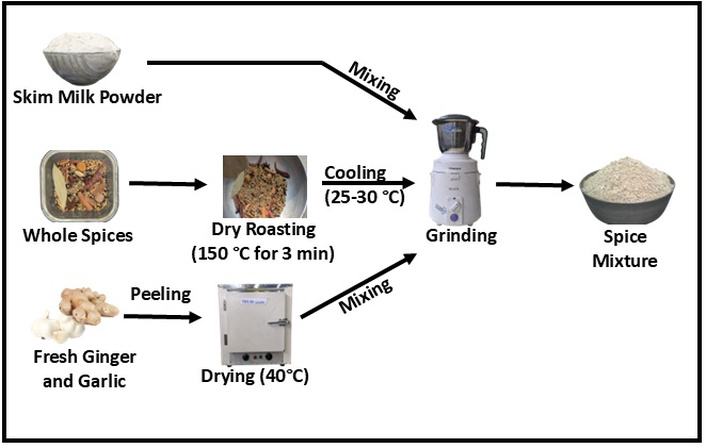
The process scheme for preparing the spice mixture is shown in Figure 1. To prepare the garlic and ginger powder, the fresh ingredients were peeled and dried in a hot air oven at 40°C until the moisture content was reduced to approximately 4% to ensure shelf stability, microbial safety, and inhibit enzymatic activity. All whole spices were dry-roasted at 150°C [15]. Afterward, all the ingredients were ground (in the specified amounts as presented in Table S1) and blended (including SMP) using an electric grinder (Sujata MG01) to obtain a uniform spice mix (sieved from 60 mesh size). However, inclusion of SMP may limit the product’s suitability for individuals with lactose intolerance, which is relatively prevalent in the Indian population.
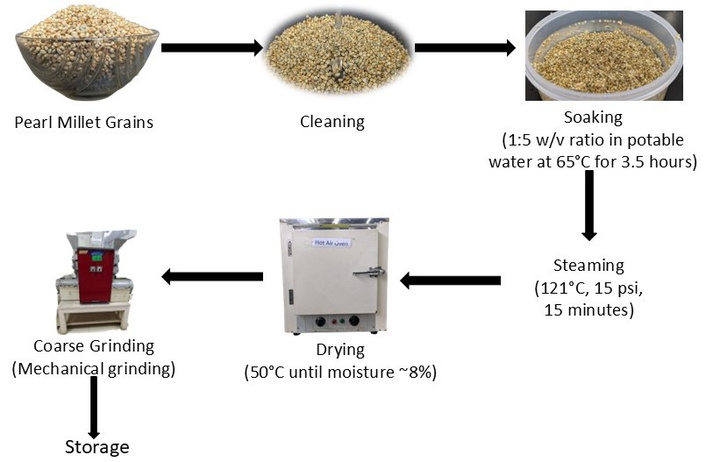
Pearl millet grains were initially cleaned by washing three times with potable water to remove dirt and surface impurities. The cleaned grains were soaked in potable water at a grain-to-water ratio of 1:5 (w/v) for 3.5 hours at 65°C [16]. After soaking, the grains were subjected to steaming at 121°C and 15 psi for 15 minutes to improve digestibility and reduce anti-nutritional factors [17]. However, in the presented study, these parameters were not analyzed due to scope and resource limitations. The parboiled grains were then dried in a hot air oven at 50°C until the moisture content was reduced to approximately 8%. Dried grains were coarsely ground using a mechanical grinder and stored in airtight containers under ambient conditions (25–30°C) for the duration of the experimental and analytical period (20 days). The processing of pearl millets is illustrated in Figure 2.
Dehydrated coarse pearl millet flour and the formulated spice mixture were weighed and combined according to the proportions specified in each experimental run, maintaining a total weight of 40 g per sample. For porridge preparation, the dry mixture was first blended with 80 mL of water to form a slurry, which was then added to 220 mL of boiling water. This stepwise addition was adopted to ensure proper dispersion of ingredients and to prevent lump formation, thereby achieving a consistent product texture. The mixture was cooked on an induction cooktop (Prestige PIC 20) at 1,200 Watts power for 5 minutes using a stainless-steel vessel and a batch size. The mixture was under continuous stirring to ensure a uniform consistency, prevent lump formation, and prevent sticking to the bottom of the vessel. The porridge was allowed to cool to a standardized serving temperature of approximately 45–50°C before serving to the panelists for sensory evaluation. However, the temperature during consumption was not continuously monitored.
Sensory evaluation of the prepared porridge samples was conducted by a consumer panel comprising 100 members, including faculty, chefs, and students (sociodemographic details are presented in Table 1). However, replicate product preparation and independent experimental runs were not performed in the present study, and therefore, inter-batch variability was not explicitly captured.
Sociodemographic characteristics of sensory panelists.
| Variable | Category | Frequency (n) |
|---|---|---|
| Age group (years) | 18–25 | 58 |
| 26–35 | 16 | |
| 36–45 | 18 | |
| > 45 | 8 | |
| Gender | Male | 56 |
| Female | 44 | |
| Educational qualification | Undergraduate | 63 |
| Postgraduate | 14 | |
| Doctorate | 23 | |
| Occupation | Students | 55 |
| PhD scholars | 12 | |
| Faculty | 18 | |
| Professional chefs | 15 | |
| Frequency of porridge consumption | Daily | 18 |
| Weekly | 58 | |
| Occasionally | 24 |
A recruitment template was displayed on the institute’s notice board, and interested participants were screened based on the inclusion and exclusion criteria presented in Table 2.
Inclusion and exclusion criteria for sensory evaluation participants.
| Inclusion criteria | Exclusion criteria |
|---|---|
| Participants aged 18–55 years | Individuals below 18 or above 55 years |
| Faculty members, chefs, and students familiar with millet-based products | Individuals unfamiliar or not willing to consume millet-based products |
| Regular consumers of cereal and millet-based foods | Individuals with known allergies to millet or spice ingredients |
| Willing to participate and provide informed consent | Individuals with medical conditions affecting taste perception |
The study was approved by the Institutional Ethical Committee (Project No. IEC-3343). The panellists were first instructed on the method to be used for assessing the sensory attributes and identifying possible allergens (SMP). The samples were served to the panellists in transparent glass bowls, and to ensure an unbiased assessment, the samples were labeled with 3-digit codes. Between each tasting session, panelists were instructed to cleanse their palates with distilled water. The four sensory parameters, including taste, flavor, mouthfeel, and appearance, were evaluated using a 9-point hedonic scale [18]. The overall acceptability was calculated as the mean of the combined scores of all 4 sensory parameters [19]. The average scores of all sensory attributes were used to optimize the porridge formulation. The data obtained from the sensory analysis of the experimental runs were subjected to one-way analysis of variance (ANOVA) to determine significant differences among the samples, followed by Tukey’s honestly significant difference (HSD) post-hoc test for multiple comparisons.
This study used a simplex lattice I-optimal mixture design to evaluate the individual and interactive effects of two formulation components (pearl millet flour and a spice mixture) on the sensory attributes of a RTC savory porridge. Based on review of the literature [20, 21], preliminary trials, and formulation feasibility, the total weight of the dry blend was fixed at 40 g per sample. The proportions of pearl millet flour and spice mixture were constrained within the ranges of 25–35 g and 5–15 g, respectively. The experimental design included three standard simplex centroid points and two additional augmented runs to enhance model estimation accuracy, resulting in 5 experimental runs (Table 3). During the design of the model, duplicates were removed to minimize fatigue during the analysis. A quadratic mixture model structure was adopted, and the runs were fully randomized without blocking to minimize experimental bias. A sensory evaluation of the porridge was conducted using 5 dependent variables: taste, flavor, mouthfeel, appearance, and overall acceptability. Each sensory response was statistically modeled using mixture design regression analysis to determine the optimal formulation that would maximize overall consumer acceptability of the product.
Experimental runs based on a two-component simplex lattice mixture design and corresponding sensory responses.
| Run | Component A: pearl millet flour (g) | Component B: spice mix (g) | Response 1: taste | Response 2: flavor | Response 3: mouthfeel | Response 4: appearance | Response 5: overall acceptability |
|---|---|---|---|---|---|---|---|
| 1 | 27.5 | 12.5 | 7.3 | 7.7 | 7.3 | 7.2 | 7.4 |
| 2 | 32.5 | 7.5 | 7.8 | 8.4 | 8.2 | 7.6 | 8 |
| 3 | 35 | 5 | 8.1 | 7.8 | 8.3 | 7.9 | 8 |
| 4 | 25 | 15 | 7.2 | 7.5 | 6.6 | 6.7 | 7 |
| 5 | 30 | 10 | 7.8 | 8.2 | 8 | 7.4 | 7.9 |
The study employed the Scheffe quadratic mixture model, which is suitable when the sum of the mixture components is held constant. The quadratic mixture model used for response prediction (Equation 1) was defined as:
where Y is the predicted response, A and B are the proportions of components, b1 and b2 are the linear coefficients, and b12 represents the interaction coefficient between components. Model selection and validation were carried out using established statistical criteria [22]. A model was considered adequate if it demonstrated: (i) statistical significance at sequential p < 0.05; (ii) a high coefficient of determination (R2 > 0.85), with minimal difference (< 0.20) between adjusted R2 and predicted R2, ensuring model stability and predictive accuracy; and (iii) an adequate precision value greater than 4, indicating a satisfactory signal-to-noise ratio. Additionally, models with low predicted residual error sum of squares (PRESS) values were reliable for prediction [22].
Numerical optimization was performed after selecting the appropriate predictive models for each sensory response. The objective was to determine the optimal formulation by simultaneously maximizing all sensory attributes within the defined mixture constraints (Table S2). The equal importance and equal weights were assigned to all sensory attributes to ensure a balanced optimization approach, avoiding bias toward any single attribute during product development. Each response variable was assigned a desirability function, wherein values approaching the upper limit of the response range were given a desirability score close to 1, indicating higher acceptability. Whereas responses nearing the lower limit received scores closer to 0. For responses set to be maintained “within range”, a desirability score of 1 was assigned within the specified bounds, gradually decreasing outside this range. The optimization process aimed to maximize the composite desirability index (D), which integrates the individual desirability of all sensory responses into a single value. The optimal formulation was identified based on the highest composite desirability (D ≈ 1), indicating the most acceptable sensory profile as determined by panel evaluations. All experimental procedures, including mixture design construction, ANOVA, model fitting, optimization, confirmation testing, and generation of three-dimensional surface plots, were performed using Design-Expert software, version 13.0.5.0 (Stat-Ease Inc., Minneapolis, MN, USA).
The functional properties, including bulk density, tapped density, swelling index (SI), and swelling capacity (SC) of the porridge premix, were evaluated according to previously reported methods [23]. Carr’s index (CI) and Hausner ratio (HR) were calculated using standard procedures [24, 25]. The water absorption capacity (WAC) and water solubility index (WSI) of the porridge premix were determined following established methods [26]. Since the product was developed as a ready-to-use porridge premix, these functional properties were evaluated to analyze the behavior of the premix during storage, handling, and reconstitution. These parameters provide valuable insights into the flow behavior, hydration characteristics, compressibility, water-binding capacity, and solubility of the optimized porridge premix.
The moisture content was determined by oven drying at 105°C (AOAC 925.10), crude protein content by the Kjeldahl method (AOAC 960.52), crude fat by the Soxhlet extraction method (AOAC 920.39), crude fiber by acid and alkali digestion (AOAC 978.10), and total ash by incineration in a muffle furnace (AOAC 923.03) [27]. The carbohydrate content was calculated by the subtraction method. The total energy (kcal/100 g) was estimated using conversion factors: 4 kcal/g for protein, 4 kcal/g for carbohydrates, and 9 kcal/g for fat [28]. Fe and Zn were determined using microwave-assisted acid digestion followed by ICP-OES.
The spectrophotometer (Hangzhou CHNSpec DS-700D) was used to evaluate the color coordinates of the optimized porridge. The instrument was first calibrated using standard white and black colors, and then it was used to calculate the L* (lightness), a* (red-green axis), and b* (yellow-blue axis) values. These values were taken in triplicate to ensure accuracy and reproducibility. Additionally, chroma (C*) and hue angle (h°*) were calculated using the following equations: Equation 2 and Equation 3, which were described by Little (1975) [29]:
The GI of the developed porridge was estimated using the weighted average GI method, as recommended by FAO guidelines for mixed meals [30]. This approach calculates the overall GI based on the proportional contribution of available carbohydrates from individual ingredients, as expressed in Equation 4.
For the estimation, only ingredients contributing significantly to available carbohydrates were considered, including pearl millet flour, sugar, and SMP. The GI value of parboiled pearl millet flour from a research article [31], while the GI values for sugar and SMP were obtained from the standardized database of the University of Sydney Glycemic Index Foundation [32]. Available carbohydrate content for each ingredient was determined from proximate composition data, and the weighted GI was calculated accordingly.
In addition to GI, the GL of the porridge was calculated to provide a more realistic measure of glycemic impact based on portion size. GL was determined using the following equation:
The GL values were interpreted according to standard classification criteria, where GL ≤ 10 is considered low, 11–19 moderate, and ≥ 20 high. This parameter complements GI by accounting for both the quality and quantity of carbohydrates consumed. Although the weighted GI method is widely used for composite foods, it does not fully account for processing-induced structural changes in starch, such as gelatinization and retrogradation resulting from parboiling and steaming. Therefore, the estimated GI and GL values should be interpreted as indicative rather than definitive. Further validation through in vitro digestion models and in vivo human studies is recommended to obtain accurate glycemic responses.
The cost analysis of the optimized porridge premix was conducted to evaluate the economic feasibility of the product. The total cost of production was calculated by considering both fixed and variable costs. Ingredient costs were estimated based on the local market prices, with the individual cost of each component determined by its proportion in the formulation. In addition to raw materials, processing charges, packaging and labeling costs, and fixed overheads were also evaluated using the method described by Hussain (2020) [33], with some modifications. However, cost components may vary depending on production scale and shelf-life considerations. In India, VAT was replaced by GST and is calculated at 5% for millet-based pre-packaged and labelled food items (Ministry of Finance-Department of Revenue).
In this method, the product is evaluated by potential consumers within their domestic setting, allowing for authentic feedback on preparation and sensory attributes [34]. A pilot-scale HUT was conducted to evaluate the consumer acceptability of the optimized porridge premix under real-life usage conditions. Cochran’s sample size formula was used to calculate the sample size as the population is infinite, resulting in 385 (95% confidence level (α = 0.05); z value 1.96) [35]. Therefore, we have selected n = 410 households (to account for potential dropouts) using the convenience sampling method from three districts of Haryana (India). The households were selected based on their consumption pattern of millet-based food products (thrice a week). In this study, the selection criteria include homemakers as participants, as they play a key role in household food purchasing and preparation decisions. The participants were informed about the aim of the study, associated risks, their right to withdraw from the study at any time without consequence, and that participation was entirely voluntary. Upon their agreement to participate, consent was obtained from them. From each household, one member who was responsible for cooking was selected to prepare and evaluate the product. Each household was provided with a 160 g package (equivalent to 4 servings) of premix, and the preparation instructions were clearly explained. After consumption, participants completed a structured questionnaire (provided in Supplementary material) that evaluated various product characteristics, including preparation time, ease of preparation, overall liking, and purchase intention. Responses were recorded using a five-point Likert scale.
ANOVA was applied to determine significant differences among the samples for each sensory attribute using Microsoft Excel (Analysis ToolPak). The level of significance was set at p < 0.05. However, Tukey’s HSD test was conducted as a post-hoc analysis. The HSD values were calculated using the mean square error (MSE) obtained from ANOVA and the studentized range statistic at a 95% confidence level. Mean values sharing the same superscript letter within a column were considered not significantly different, whereas different superscripts indicated significant differences.
All physicochemical analyses of optimized formulation were conducted in triplicate, and data are expressed as the mean ± standard deviation. A descriptive statistical analysis was performed to summarize the demographic characteristics of the participants and other variables. Spearman’s rank correlation (Spearman’s rho), a non-parametric test, was used to examine associations between variables without assuming normality. Crosstabulation analysis was conducted to explore relationships between categorical variables and identify patterns across demographic subgroups. Data were screened for completeness and consistency before analysis; however, no normalization or transformation was required. All analyses were performed using IBM SPSS Statistics (Version 31.0).
The average sensory responses obtained from the two-component simplex lattice mixture design are presented in Table 3. Before model selection and optimization, one-way ANOVA was performed to determine the presence of significant differences among the formulations. The results (Table S3) showed highly significant differences (p < 0.001) for all sensory attributes, indicating that the responses were sensitive to variations in ingredient proportions. This further confirms that the panelists were able to reliably discriminate among the samples. Tukey’s HSD post-hoc test (Table S4) was subsequently applied to identify pairwise differences among formulations. The observed statistical significance supports the suitability of the sensory data for mixture design modeling and optimization.
Variation in the proportions of pearl millet flour and spice mix influenced all evaluated sensory attributes. Among the experimental runs, formulations with higher pearl millet flour and moderate spice levels consistently exhibited superior sensory scores. The formulation containing 32.5 g pearl millet flour and 7.5 g spice mix achieved the highest scores for flavor and overall acceptability. In contrast, increasing the spice mix to 15 g resulted in comparatively lower sensory scores.
ANOVA statistics, fit statistics, and equations in terms of the coded component are presented in Table 4. The model analysis revealed that taste and appearance were adequately described by linear models, whereas mouthfeel and overall acceptability followed quadratic models, indicating significant curvature and interaction effects within the mixture space. Flavor was best fitted by a cubic model, suggesting a more complex dependency on component proportions. Although the cubic model exhibited an improved statistical fit for the flavor, the limited number of experimental runs and unique design points may introduce overfitting, which should be considered when interpreting the model’s robustness and generalizability. In all responses, PRESS values were higher than the corresponding residual errors, as expected, reflecting the difference between model fitting and prediction. However, the relatively low PRESS values for sensory attributes suggest acceptable predictive performance of the models. Flavor response exhibited an exceptionally low residual error and PRESS value, indicating a very close fit; however, this may also reflect potential overfitting due to limited design points. Overall, the models demonstrated reasonable agreement between predicted and observed responses within the studied experimental domain.
Response models summarize ANOVA statistics, fit statistics, and equations in terms of the coded component.
| Response | Equation | Model type | F-value (sequential p-value) | CV% | R2 | Adj-R2 | Pred-R2 | Adeq precision | Residual error | PRESS |
|---|---|---|---|---|---|---|---|---|---|---|
| Taste | Y1 = 8.10A + 7.18B | Linear | 36.91 (0.0090) | 1.57 | 0.9248 | 0.8998 | 0.865 | 12.1502 | 0.0143 | 0.0772 |
| Flavor | Y2 = 7.80A + 7.50B + 2.17AB + 2.93AB(A – B) | Cubic | 1,278.33 (0.0206) | 0.1509 | 0.9997 | 0.9990 | 0.9607 | 84.8554 | 0.0001 | 0.0215 |
| Mouthfeel | Y3 = 8.30A + 6.58B + 1.94AB | Quadratic | 163.50 (0.0061) | 1.03 | 0.9939 | 0.9878 | 0.9620 | 28.0076 | 0.0063 | 0.0785 |
| Appearance | Y4 = 7.92A + 6.80B | Linear | 84.00 (0.0027) | 1.31 | 0.9655 | 0.9540 | 0.8767 | 18.3303 | 0.0093 | 0.1002 |
| Overall acceptability | Y5 = 8.01A + 6.97B + 1.37AB | Quadratic | 59.26 (0.0166) | 1.06 | 0.9834 | 0.9668 | 0.8514 | 16.5626 | 0.0066 | 0.1177 |
ANOVA: analysis of variance; CV: coefficient of variation; PRESS: predicted residual error sum of squares.
The study found that the optimal formulation has a composite desirability index of 0.917. A two-tailed confirmation test [comparison of experimentally observed mean values with the predicted values within the 95% prediction interval (PI) generated by the model] was conducted to validate the predictive accuracy of the developed model. The observed sensory responses for the optimized formulation fell within the model-PI at a 95% confidence level (p < 0.05). However, flavor value was close to the lower bound of the 95% PI, indicating acceptable model performance with limited prediction precision. The optimized porridge sample was prepared under the defined optimal conditions and evaluated by a panel of 100 individuals. The mean sensory scores obtained from the panel were compared against the respective predicted intervals for each response variable (Table 5).
Validation of the model using a two-sided confirmation run with 95% confidence (p < 0.05).
| Response | Predicted mean | Experimental mean (± SD) | Residual | Error (%) | 95% PI (low–high) |
|---|---|---|---|---|---|
| Taste | 7.964 | 8.17 ± 0.38 | –0.206 | 2.52 | 7.714–8.215 |
| Flavor | 8.288 | 8.17 ± 0.38 | 0.118 | 1.44 | 8.160–8.416 |
| Mouthfeel | 8.288 | 8.07 ± 0.26 | 0.218 | 2.70 | 8.063–8.512 |
| Appearance | 7.755 | 7.60 ± 0.49 | 0.155 | 2.04 | 7.553–7.957 |
| Overall acceptability | 8.028 | 8.00 ± 0.20 | 0.028 | 0.35 | 7.798–8.257 |
PI: prediction interval.
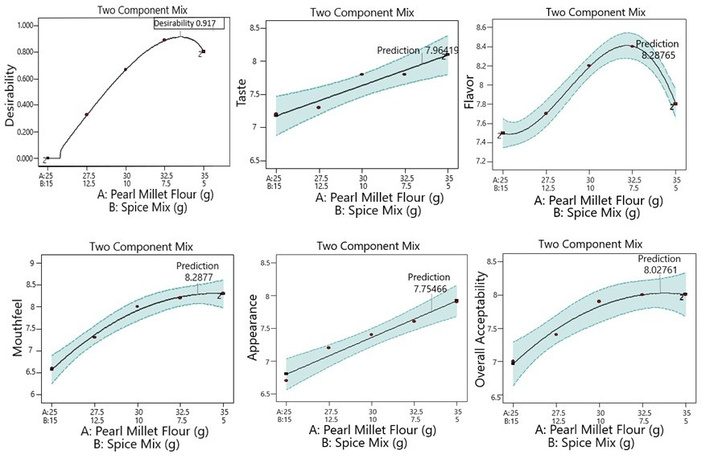
The desirability function indicated a gradual rise in composite desirability with the addition of the spice mixture up to approximately 7.5 g. However, a slight decline was observed with further increases in the spice mixture. The systematic investigation of ingredient interactions and their impact on sensory attributes (shown in Figure 3). The sensory score of taste showed a linear increase with the reduction in levels of the spice mixture. However, a non-linear trend was observed for flavor, with the highest flavor acceptability observed at moderate spice mix concentrations (approximately 7.5 g). The addition or reduction of the spice mixture results in a reduced score for flavor perception. This trend suggests that higher levels of the spice mixture may overpower or impart an astringent flavor, also suppressing the taste of the base cereal component; however, this interpretation is based on sensory responses. The mouthfeel score improved gradually as the quantities of both pearl millet flours increased. The interaction of starch and fiber from the millet flour, along with the spice mixture, may have contributed to enhanced oral sensation and perceived viscosity, as indicated by panelist responses. However, no instrumental rheological measurements were performed. The score of the appearance attribute increased with increasing levels of pearl millet flour and decreased with increasing levels of the spice mixture. This trend reflects the structural and textural contributions of millet flour to the porridge. At higher concentrations of pearl millet, the product exhibited a more desirable porridge-like thickness and uniform texture. In contrast, formulations with 25 g of pearl millet and 15 g of spice mix produced a thinner, slurry-like mixture, resulting in lower appearance scores. Thus, the improved appearance may be associated with the improved thickness and consistency provided by the millet base, while higher spice levels may have negatively influenced color properties. The overall acceptability of porridge samples increased with increasing millet content up to approximately 30 g. However, beyond this point, further increases in millet flour (with a corresponding decrease in spice mix) had only a mild impact. Thus, the millet flour emerged as the dominant driver of acceptability, but with a limit beyond which further improvements were minimal.
The optimal formulation was determined using numerical optimization techniques based on a desirability function approach. The goal was to maximize sensory attributes while considering the constraints of the ingredients. The optimized blend consisted of 33.524 g of pearl millet flour and 6.476 g of spice mixture, yielding a desirability index of 0.917. This formulation achieved high sensory scores across all attributes and was subjected to a confirmation test using a two-tailed PI approach. Sensory scores obtained from a panel of 100 individuals fell within the 95% predicted confidence intervals (p < 0.05), validating the predictive capability and precision of the developed model.
The proximate composition (Table 6) showed that the carbohydrate was predominant macronutrient, followed by protein content. The premix exhibited a relatively high ash content, indicating the presence of significant minerals. The moisture content of the premix was within the acceptable limits, while the moderate quantities of crude fats and fiber contribute to a balanced nutritional profile. While crude fiber provides important insights about indigestible components, it does not include soluble fiber fractions. Thus, the total dietary fiber content may be higher than the value reported. The mineral composition of the premix provides important insight into both its nutritional value and its potential role as a functional food. The premix contained Fe 4.216 mg/100 g and Zn 1.287 mg/100 g.
The functional and proximate properties of optimized porridge.
| Category | Data | |
|---|---|---|
| Functional properties | Bulk density (kg/m3) | 668.54 ± 3.04 |
| Tapped density (kg/m3) | 845.72 ± 3.90 | |
| Carr’s index (%) | 20.95 ± 0.19 | |
| Hausner ratio | 1.2650 ± 0.0031 | |
| Swelling index | 0.4135 ± 0.008 | |
| Swelling capacity (%) | 186.05 ± 1.15 | |
| Water solubility index (%) | 10.23 ± 0.0292 | |
| Water absorption capacity (g/g) | 2.95 ± 0.0016 | |
| Nutritional composition | Moisture (g/100 g) | 8.64 ± 0.06 |
| Protein (g/100 g) | 10.92 ± 0.15 | |
| Fat (g/100 g) | 4.31 ± 0.09 | |
| Ash (g/100 g) | 6.44 ± 0.04 | |
| Fiber (g/100 g) | 3.63 ± 0.12 | |
| Carbohydrate (g/100 g) | 66.06 ± 0.22 | |
| Calories (kcal/100 g) | 346.71 ± 1.34 | |
The functional properties of the optimized porridge premix are represented in Table 6. The bulk and tapped densities of porridge premix were moderate with a CI value of 20.95 ± 0.19%, indicating passable flowability with some cohesiveness. This observation is further supported by the HR. The swelling behavior showed a moderate SI but a high SC. The premix WSI was relatively low, whereas the WAC was high, reflecting strong hydrophilic characteristics.
The color characteristics of the optimized porridge premix were evaluated using the CIELAB color system, represented by L*, a*, and b* values. The results across three independent trials revealed mean values of L* = 61.76 ± 0.13, a* = 4.97 ± 0.02, and b* = 25.95 ± 0.09. The L* value indicates a relatively high lightness, reflecting the visual brightness and homogeneity of the premix, which is important for consumer acceptability. The a* and b* values highlight the slight reddish and prominent yellow tones, respectively, which may be due to the presence of red chilli and turmeric. The chroma was found to be 26.43, indicating vivid and saturated color. The porridge premix has a hue angle of 79.14°, indicating a color in the yellow-orange region of the color wheel. These consistent and vibrant colors may influence consumer perception and acceptance, thereby playing a crucial role in the sensory appeal of the premix.
The GI of the meal was calculated based on carbohydrate contribution from key ingredients, as shown in Table 7. The theoretically estimated GI of optimized porridge was 43.56.
Carbohydrate contribution and glycemic index (GI) of major ingredients in the test meal.
| Ingredient | GI (approximately) | Carbohydrate (%) | Meal (g) | Estimated carbohydrate (g) | GI × carbohydrate |
|---|---|---|---|---|---|
| Pearl millet | 42.7 | 71.7 | 33.524 | 24.03671 | 1,026.367517 |
| Sugar | 91 | 100 | 0.4857 | 0.4857 | 44.1987 |
| SMP | 27 | 38 | 0.376 | 0.14288 | 3.85776 |
SMP: skim milk powder.
The GL of the optimized porridge was calculated to provide a more physiologically relevant assessment of its glycemic impact at the defined serving size. Based on an available carbohydrate content of 66.06 ± 0.22 g/100 g, the available carbohydrate per 40 g serving was calculated as 26.42 g. Using the estimated GI value of 43.56, the GL of the product was determined to be 11.51 per serving. According to established classification criteria, this value falls within the moderate GL range (11–19), indicating a controlled postprandial glycemic response when consumed in typical portion sizes.
Cost analysis was conducted to determine the economic feasibility of producing a pearl millet-based porridge premix. Table S5 represents the total cost of raw materials required to develop a 40 g pouch of the premix, which was calculated to be Indian Rupee (INR) 1.60. The formulation utilized pearl millet (33.524 g) as the base ingredient and mixed with a mixture of spices, condiments, and SMP. The cost of individual ingredients was estimated based on their respective unit costs per 1 kg. Overhead charges were calculated at 20% of the raw material cost (INR 1.60), amounting to INR 0.32, resulting in a total production cost of INR 1.92. Profit was calculated at 15% of the total production cost (INR 1.92), amounting to INR 0.288, giving a pre-GST price of INR 2.208. GST was applied at 5% of the pre-GST price, amounting to INR 0.1104. This resulted in a final sale price of INR 2.32 per 40 g pouch. However, the estimated cost represents a baseline production cost under small-scale conditions and does not include retail markup, distribution, or supply chain margins, which may substantially influence the final consumer price. Furthermore, as no direct comparison with commercial products or traditional alternatives was conducted, the economic feasibility should be interpreted within the context of preliminary cost estimation.
Table 8 presents the frequency and percentage distribution of study variables. The participant profile was predominantly composed of middle-aged individuals, with a higher representation of females and homemakers. Most respondents reported a positive preparation experience, indicating that the product was easy to prepare and that the instructions were generally clear. The results showed a high level of overall liking among participants. However, despite favorable acceptance, purchase intention was comparatively lower, with a considerable proportion of respondents remaining neutral or unwilling to purchase the product.
Frequency and percentage distribution of study variables.
| Variable | Category | Frequency (n) | Percent (%) |
|---|---|---|---|
| Age | 21–30 years | 97 | 23.7 |
| 31–40 years | 124 | 30.2 | |
| 41–50 years | 125 | 30.5 | |
| 51–60 years | 64 | 15.6 | |
| Gender | Female | 341 | 83.2 |
| Male | 69 | 16.8 | |
| Occupation | Homemaker | 208 | 50.7 |
| Nurse | 17 | 4.1 | |
| IT professional | 33 | 8.0 | |
| Engineer | 33 | 8.0 | |
| Government officer | 34 | 8.3 | |
| Teacher | 35 | 8.5 | |
| Shopkeeper | 32 | 7.8 | |
| Entrepreneur | 14 | 3.4 | |
| Doctor | 4 | 1.0 | |
| Preparation experience | Very easy | 237 | 57.8 |
| Easy | 131 | 32.0 | |
| Neutral | 42 | 10.2 | |
| Preparation instructions | Yes | 285 | 69.5 |
| Somewhat | 113 | 27.6 | |
| No | 12 | 2.9 | |
| Overall liking | Like very much | 216 | 52.7 |
| Like | 111 | 27.1 | |
| Neutral | 83 | 20.2 | |
| Purchase intention | Strongly agree | 111 | 27.1 |
| Agree | 41 | 10.0 | |
| Neutral | 145 | 35.4 | |
| Disagree | 113 | 27.6 |
Spearman’s rho was used to explore correlations among demographic and evaluation variables as present in Table S6. Age was significantly and negatively correlated with preparation experience (ρ = –0.834, p < 0.001). The younger participants found the preparation easier, whereas the older participants may have encountered some difficulties. Other minor but significant correlations included occupation and preparation experience (ρ = 0.117, p = 0.018), suggesting that professionals such as engineers and IT workers reported a better preparation experience compared to homemakers. Overall liking showed a weak but statistically significant positive correlation with age (ρ = 0.108, p = 0.029). At the same time, preparation instructions were negatively correlated with age (ρ = –0.126, p = 0.011). No significant correlation was observed between purchase intention and demographic variables (p > 0.05).
Tables S7 and S8 demonstrate the consumer responses regarding the preparation, perception of savory porridge, overall liking, and purchase intention. Most participants across all age groups reported that the preparation experience was “easy” or “very easy”, with no respondents indicating difficulty. The respondents aged 41–50 and 51–60 years reported the preparation as “very easy”, suggesting that older age groups may be more confident or experienced in food preparation. Both males and females can manage the preparation process, although females reported slightly higher ease and compliance with preparation instructions. Homemakers constituted the largest group and found the preparation process “very easy” (134) or “easy” (53), indicating their familiarity and comfort with such a culinary process. Professionals, such as IT personnel, engineers, and teachers, also rated the preparation as easy, with minimal neutral responses. Younger consumers (21–30 years) showed high favorable response rates, with 63 rating “like very much”. A similar positive trend was observed across genders and occupations, with homemakers, IT professionals, and government officers showing a strong affinity. In terms of purchase intention, a significant number of participants expressed strong or moderate agreement with purchasing the product (e.g., homemakers: 56 “strongly agree”, 25 “agree”). At the same time, a substantial number of participants remained neutral or disagreed. The teachers (16), homemakers (72), and individuals in the 31–50 age group were more neutral in their purchase intentions.
The higher tapped density suggests that the premix exhibits moderate compressibility and cohesive interactions. The CI value of the optimized porridge premix indicates passable flowability with some cohesiveness in the porridge premix. This may be due to the presence of SMP in the spice mixture. CI values between 15% and 20% are considered acceptable [24]. However, values above 20% may indicate the need for additives to enhance the flow behavior for large-scale manufacturing. Therefore, the Similarly, the HR values between 1.00 and 1.34 indicate ‘excellent’ to ‘passable’ flow properties, highlighting that the optimized porridge premix can be handled in industrial operations [36]. The incorporation of anti-caking agents and controlled humidity may ease the handling process.
The SI is an indicator of the sample’s ability to absorb water under specific conditions, such as temperature and water availability [23]. Our results indicate that the optimized porridge premix can absorb a significant amount of water relative to its weight. During the processing of pearl millet, the exposure to high temperatures in sufficient amounts of water results in gelatinization of starch. This process may increase the exposure of hydroxyl groups along the molecular backbone of starch [37]. This modification may increase water absorption into the open and amorphous regions of the starch granule, resulting in a high SC [38]. Hydrophilic starch is primarily responsible for the SI and SC, thereby playing a crucial role in modulating digestion and glycemic response [39]. However, a well-designed clinical trial investigating the postprandial glucose response is needed to validate this theoretical observation.
The WSI of the optimized porridge premix indicates moderate solubility, attributable to structural disorganization and partial starch degradation during thermal processing. This may have resulted in increased release of soluble components and enhanced water solubility [37, 40]. The observed WSI value was comparable to values reported in previous studies, ranging from 16.12–22.50% in instant porridge formulations containing mung bean [41] and approximately 6.13–6.40% in roselle-fortified instant porridge powders [42]. The hydrogen bonding of starch in the crystalline and amorphous regions is disrupted by thermal treatment [43], resulting in enhanced water diffusion. This may directly influence the WAC [44]. Overall, the functional properties suggest that the optimized porridge premix exhibits moderate to high hydration and SC, fair flowability, and sufficient solubility. However, for large-scale production, it is necessary to optimize these functional properties by incorporating additives such as anticaking agents.
The optimized porridge premix has the moisture content below 10%, which is crucial for ensuring shelf stability by inhibiting the growth of spoilage microorganisms and pathogenic bacteria [45]. However, water activity (aw) is a more critical parameter for microbial stability. Therefore, in the future studies direct measurement of aw would further strengthen the assessment of shelf stability. Additionally, low moisture content contributes to enhancing the flowability and reconstitution properties of the premix [46]. From the manufacturer’s perspective, low-moisture food products are easy to handle and transport due to their reduced weight [47]. Therefore, the observed moisture level of optimized porridge indicates that the porridge premix is stable and microbiologically safe for long-term storage and commercial distribution. However, to confirm these findings further, additional investigations, such as studies on aw, storage stability, and microbiological quality, are needed.
Carbohydrates are the primary source of energy in the human diet, accounting for 40–80% of total daily energy intake [48]. The carbohydrate content of the optimized porridge premix can meet the energy demands of physiologically vulnerable populations, including children, the elderly, athletes, and individuals recovering from illness or injury. In the present study, the high ash content of optimized porridge premix indicates the presence of significant minerals. Thus, the premix can be considered a potential option to reduce the prevalence of mineral deficiencies [49]. Based on the observed value of Fe and Zn in 100 g of porridge premix, a single serving of porridge premix provides approximately 1.686 mg of Fe and 0.515 mg of Zn, resulting in fulfillment of 15.3% (for Fe) and 3.7% (for Zn) of the recommended dietary allowance for males [50]. Recent reviews indicate that millets can contain 2.2–10.3 mg Fe and 3.01–60.6 mg Zn per 100 g, depending on species and genotype [8]. A study has demonstrated that the Zn contents in millets are within the range of 0.4 and 2.8 mg/100 g [51]. The mineral values obtained for the porridge premix are consistent with a formulation based primarily on whole millets, complemented by SMP and spices. The inclusion of bran and germ fractions, rather than refined endosperm alone, contributes strongly to the mineral density observed.
The crude fiber content of the optimized porridge premix may support gastrointestinal health by promoting regular bowel movements and enhancing satiety. It may also contribute to glycemic regulation through the slowing of carbohydrate digestion [52]; however, this effect depends on factors such as fiber type (soluble vs. insoluble), particle size, and food matrix interactions, which were not characterized in the present study. Thus, these potential health benefits should be interpreted with caution. This aligns with current nutritional trends emphasizing the inclusion of dietary fiber in functional foods for metabolic health promotion.
Dietary fats are essential macronutrients that play a vital role in energy metabolism. However, the fatty acid composition of the product was not analyzed in the present study; therefore, the specific nutritional quality of the fats cannot be determined. Apart from this, fats are also crucial for the absorption of fat-soluble vitamins (A, D, E, and K) [53]. However, the presented study has a limitation in that the vitamin content was not analyzed due to resource and analytical constraints. Overall, the porridge premix offers a nutritionally balanced profile that supports both energy requirements and metabolic health, making it suitable for regular consumption.
The theoretically estimated GI of the developed porridge (43.56) classifies it within the low GI category, indicating a potentially favorable effect on postprandial glycemic response. However, when interpreted alongside GL, a more comprehensive understanding of its metabolic impact emerges. Based on a standard serving size (40 g), the GL was calculated to be 11.51, placing the product in the moderate GL category. This suggests that the quantity of available carbohydrates per serving contributes to a moderate overall glycemic impact, which is considered acceptable for balanced dietary intake. A discrepancy of 1.759 g was observed between the experimentally determined carbohydrate content and the value derived from published literature. This may have influenced the precision of GI and GL estimations. Furthermore, the GI estimation in the present study is based on previous literature values of raw ingredients, representing an inherent methodological limitation. Hydrothermal processing of pearl millet, including parboiling and steaming, is known to induce structural modifications in starch, which can significantly alter starch digestibility and glycemic response. Therefore, the actual GI and GL of the developed product may differ from the theoretically estimated values.
In addition, the glycemic response of composite foods is influenced by multiple intrinsic factors, including dietary fiber, protein, fat content, and the overall food matrix. These can modulate glucose release, gastric emptying, and intestinal absorption kinetics [54]. These interactions are not fully understandable by theoretically predictive GI models. Therefore, while the present findings provide useful preliminary insights, they should be interpreted with caution. Future studies should focus on validating the glycemic response using standardized in vitro digestion protocols and controlled in vivo human trials to establish more accurate and physiologically relevant GI and GL values.
The cost analysis suggests a cost-effective formulation with potential for commercial viability, particularly for underdeveloped and developing nations to address undernutrition or lifestyle-related disorders. The utilization of pearl millet highlights that the developed product aligns with the UN Sustainable Development Goals (SDGs) [8].
In the present study, the sample was received from the researcher, which may have led to an analytical attitude [55]. In real-world situations, women are the primary food handlers [56], which is also observed in our study, as the female actively involved in the study compared to males. Even the 52.7% of respondents reported that they “like very much”, but, when it comes to purchase intention, only 27.1% of participants “strongly agree” to buying the product. This disparity suggests a gap between liking the product and willingness to purchase, possibly influenced by factors such as trustworthiness, novelty seeking, and consumer innovativeness [57].
In the present study, the younger participants found the preparation easier, whereas the older participants may have encountered some difficulties; these findings align with previous study [58]. They have found that the young adults preferred the convenience foods as compared to older adults. This may be due to the fact that the older participants face difficulties in understanding the instructions, and these findings are correlated with the previous literature, where younger participants were more satisfied with the clarity of instructions [58]. However, willingness to purchase is influenced by factors such as consumer perception, trust, packaging, price, and attitude rather than solely demographic variables such as age, gender, or occupation [59, 60]. Since these factors were not directly evaluated in the present study, this explanation is interpretative and requires further investigation. Overall, the study found that the savory porridge formulation was highly acceptable and user-friendly, particularly among homemakers and older adults, with potential for market acceptance. However, there is a need to refine the consumer engagement strategies.
The present study successfully developed a pearl millet-based savory porridge premix using a mixture design approach, emphasizing nutritional quality, glycemic response, and consumer acceptability. The optimized formulation demonstrated a balanced nutrient profile with a considerable amount of protein, dietary fiber, and essential minerals such as Fe and Zn, supporting its potential role in addressing nutritional deficiencies. The theoretically estimated GI classified the product as low GI, while the GL at the defined serving size indicated a moderate glycemic impact, suggesting its suitability for controlled energy release and potential application in diets targeting glycemic management. Sensory evaluation conducted under controlled laboratory conditions, along with HUT, demonstrated high consumer acceptance and practical feasibility of the developed product in real-life settings.
Despite these promising findings, the study has certain limitations that should be acknowledged. The GI values were theoretically estimated rather than experimentally validated, and no in vitro or in vivo bioavailability studies were conducted, which may limit the physiological relevance of the results. Additionally, detailed rheological and pasting properties (e.g., viscosity analysis) were not assessed. The study also did not include comprehensive compositional profiling of individual raw materials, as the focus was on formulation optimization using a mixture design approach under practical and economic conditions. Sensory evaluation, although conducted with a relatively large panel, remains subjective in nature. Therefore, further studies involving experimental determination of glycemic response, nutrient bioavailability, rheological characterization, and clinical validation are recommended to strengthen the applicability and generalizability of the findings.
Overall, the developed RTC porridge premix represents a nutritionally enhanced, culturally acceptable, and cost-effective food product with potential applications in combating malnutrition and supporting metabolic health, particularly in resource-limited settings.
Development of a pearl millet-based savory porridge premix using mixture design.
Optimization of porridge premix formulation to enhance sensory acceptability.
The HUT further confirms the consumer acceptability of the optimized porridge premix in real-life conditions.
ANOVA: analysis of variance
AOAC: Association of Official Analytical Chemists
aw: water activity
CI: Carr’s index
Fe: iron
GI: glycemic index
GL: glycemic load
HR: Hausner ratio
HSD: honestly significant difference
HUT: home-use test
ICP-OES: Inductively Coupled Plasma Optical Emission Spectroscopy
INR: Indian Rupee
PI: prediction interval
PRESS: predicted residual error sum of squares
RTC: ready-to-cook
SC: swelling capacity
SI: swelling index
SMP: skim milk powder
WAC: water absorption capacity
WSI: water solubility index
Zn: zinc
The supplementary materials for this article are available at: https://www.explorationpub.com/uploads/Article/file/1010167_sup_1.pdf.
AK: Conceptualization, Investigation, Formal analysis, Visualization, Writing—original draft, Writing—review & editing. SSM: Investigation, Writing—original draft. RK: Conceptualization, Supervision, Writing—review & editing. RM: Conceptualization, Writing—review & editing. BP: Conceptualization, Supervision. SK: Conceptualization, Formal analysis, Supervision, Validation. All authors read and approved the submitted version.
The authors declare that they have no conflicts of interest.
The study was conducted in accordance with the Declaration of Helsinki and approved by the Institutional Ethical Committee (Maharishi Markandeshwar Institute of Medical Sciences and Research, Mullana, India, Project No. IEC-3343, dated 08/03/2025).
Written consent was obtained from all the subjects after the procedure was explained to them.
Not applicable.
All relevant data supporting the findings of this study are provided as a Supplementary materials.
Not applicable.
© The Author(s) 2026.
Open Exploration maintains a neutral stance on jurisdictional claims in published institutional affiliations and maps. All opinions expressed in this article are the personal views of the author(s) and do not represent the stance of the editorial team or the publisher.
Copyright: © The Author(s) 2026. This is an Open Access article licensed under a Creative Commons Attribution 4.0 International License (https://creativecommons.org/licenses/by/4.0/), which permits unrestricted use, sharing, adaptation, distribution and reproduction in any medium or format, for any purpose, even commercially, as long as you give appropriate credit to the original author(s) and the source, provide a link to the Creative Commons license, and indicate if changes were made.



View: 1320
Download: 42
Times Cited: 0