 Perspective


Affiliation:
Allergy and Clinical Immunology, Mediclinic City Hospital, Dubai 505004, UAE
Email: natalia.otero@mediclinic.ae
ORCID: https://orcid.org/0000-0002-2572-7906


Explor Asthma Allergy. 2026;4:1009130 DOI: https://doi.org/10.37349/eaa.2026.1009130
Received: April 15, 2026 Accepted: June 05, 2026 Published: July 27, 2026
Academic Editor: Laurent Mascarell, Stallergenes SAS, France
The article belongs to the special issue Climate Change, Allergy, and Immunotherapy
Climate change is reshaping the epidemiology and severity of allergic disease through mechanisms that extend beyond increased pollen exposure. Pollen seasons are lengthening, annual allergen loads are rising, and tropospheric ozone is chemically modifying pollen proteins in ways that enhance their allerginicity. The geographic expansion of allergenic plant species is generating new sensitization patterns in populations with no prior exposure history, and extreme meteorological events are precipitating acute asthma in individuals who previously had only rhinitis. In this evolving landscape, allergen immunotherapy (AIT), the only intervention capable of modifying the natural course of IgE-mediated allergic disease, becomes not less relevant, but more. Climate change strengthens the case for earlier and broader AIT prescription, calls for updated patient selection criteria and maintenance protocols, and demands investment in extract standardization. We argue that climate change is not merely a contextual backdrop for allergy practice but an active clinical variable that elevates the role of AIT as both an individual treatment and a population-level prevention strategy. A focused research agenda at the climate-immunotherapy interface is both timely and necessary, given a disease burden that is projected to grow.
Allergic diseases affect an estimated 10–30% of the global population and represent a growing burden on individuals and healthcare systems worldwide [1, 2]. Their prevalence has increased substantially over recent decades, driven not only by changes in lifestyle and hygiene but by progressive and measurable transformations of the environment in which sensitization occurs [3].
Climate change is now recognized as one of the most significant determinants of this epidemiological trend. Rising atmospheric CO2 concentrations and mean temperatures are extending pollen seasons, increasing annual pollen production, and shifting the geographic range of allergenic plant species [4, 5]. Simultaneously, air pollutants, particularly tropospheric ozone, are acting on pollen grains at a chemical level, altering their protein composition and enhancing their allergenicity [6, 7]. The clinical consequences are not theoretical: emergency department visits, hospital admissions, and mortality attributable to allergic asthma show significant associations with short-term pollutant exposure across multiple continents [7].
Extreme meteorological events further illustrate the acute dimension of this risk. Epidemic thunderstorm asthma (ETSA), in which thunderstorm-induced pollen rupture releases highly respirable allergenic particles, has resulted in mass respiratory emergencies affecting thousands of individuals simultaneously, including people with no prior history of asthma [8]. These events are expected to increase in frequency as climate change intensifies the weather conditions that precipitate them.
Against this background, allergen immunotherapy (AIT) is the only intervention capable of modifying the natural course of IgE-mediated allergic disease, inducing long-term immunological tolerance rather than merely controlling symptoms [9–11]. Yet the practice of AIT has not been systematically reconsidered in light of these changes. Standard protocols, maintenance schedules, and extract formulations were developed under assumptions that may no longer hold. This perspective argues that climate change is not merely a contextual backdrop for allergy practice but an active clinical variable and examines the principal ways in which a changing climate challenges the foundations of current immunotherapy protocols, proposing directions for a research agenda commensurate with the scale of the challenge.
One of the most consistent findings in climate-allergy research is the extension of the pollen season. Across the Northern Hemisphere, pollen seasons have lengthened by an average of 20 days over the past three decades, and total annual pollen production has increased in parallel with rising temperatures and CO2 levels [4]. These changes affect not only the duration of symptoms in sensitized individuals but also the window of de novo sensitization, exposing previously tolerant populations to allergen concentrations sufficient to drive IgE-mediated responses [5].
The geographic redistribution of allergenic species compounds this effect. Plant species traditionally confined to temperate southern regions are expanding northward, introducing novel aeroallergens into populations with no prior immunological exposure. Ragweed (Ambrosia artemisiifolia), a particularly potent aeroallergen, has established itself across large areas of central and northern Europe where it was previously absent, with sensitization rates in some regions now exceeding 20% [5, 12, 13]. It is not alone: birch (Betula spp.), Parietaria, and cypress (Cupressus spp.) pollen seasons are also lengthening and expanding into previously unaffected regions, generating new sensitization patterns in populations with no prior immunological exposure [5, 7, 14]. This redistribution is generating a growing population of future AIT candidates who are not yet clinically identified.
Beyond the quantitative increase in allergen exposure, climate change is producing qualitative changes in the nature of aeroallergens themselves. Tropospheric ozone, a secondary pollutant generated by the interaction of nitrogen oxides and volatile organic compounds under solar radiation and increasingly prevalent in urban and peri-urban environments, has been shown to chemically modify pollen grain proteins, altering their immunogenic profile and enhancing their capacity to elicit allergic responses [6, 15, 16]. Air pollutants including particulate matter (PM2.5 and PM10) and nitrogen dioxide also interact with pollen surfaces, modifying their structural integrity and biological activity. These interactions do not merely amplify existing allergenicity; they may generate modified epitopes with immunological properties distinct from those present in pollen collected under unpolluted conditions [6, 15, 17]. The implications for immunotherapy extract composition are significant and remain incompletely characterized (Figure 1).
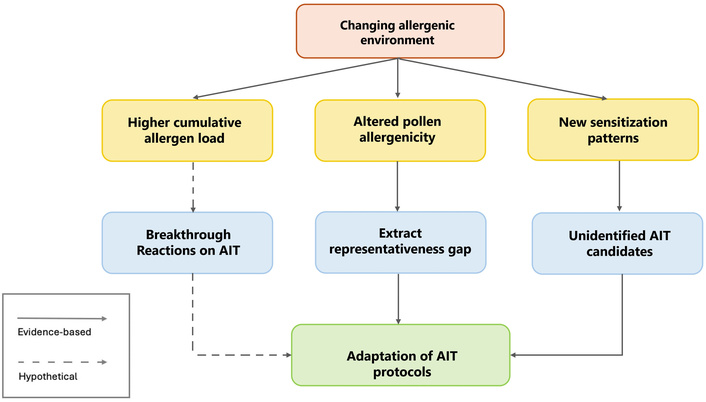
Three principal mechanisms by which climate change challenges current AIT protocols, and their respective clinical implications. Higher cumulative allergen loads risk exceeding maintenance tolerance thresholds; ozone-driven modifications to pollen protein composition create a potential gap between real-world allergenicity and extract formulations; and geographic redistribution of allergenic species generates new sensitization patterns in previously unexposed populations. Each challenge converges on the need for proactive adaptation of AIT protocols, extract standardization, and patient selection criteria.
ETSA represents the acute end of the climate-allergy spectrum. The 2016 Melbourne event, the largest and most lethal ETSA event on record, resulted in over 9,000 emergency presentations and 10 deaths within a single evening, attributable to the rupture of ryegrass pollen grains by thunderstorm outflows and the subsequent release of sub-pollen allergenic particles capable of penetrating deep into the lower airways. Critically, up to 87% of those affected reported a history of allergic rhinitis, and 58% had no prior diagnosis of asthma [8, 18]. Such events are not isolated anomalies. More than 26 ETSA events have been documented worldwide since 1983, with frequency apparently increasing over recent decades [8]. Episodes have been recorded across multiple continents, including the United Kingdom (Birmingham 1983, London 1994), Canada, the United States, and Italy— where thunderstorm-triggered asthma linked to Parietaria and olive pollen has been documented—in addition to the well-characterized Australian events [7, 8]. Climate change contributes to their risk through at least two mechanisms: higher annual pollen loads that prime individuals in the weeks preceding events, and greater frequency and intensity of the thunderstorm conditions that trigger pollen rupture. This convergence of biological and meteorological risk deserves specific consideration in the context of immunotherapy, as prior ryegrass sensitization has been identified as a primary susceptibility factor (Figure 2) [8, 18].
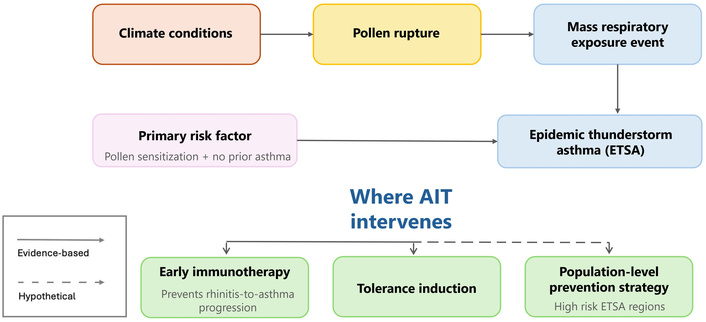
Sequential mechanism of epidemic thunderstorm asthma (ETSA) and the three levels at which allergen immunotherapy (AIT) may intervene preventively. Thunderstorm conditions, acting on a primed environment of high pollen loads and elevated ozone, cause mechanical rupture of pollen grains, releasing sub-pollen allergenic particles smaller than 5 µm capable of penetrating the lower airways. In sensitized individuals, especially those with prior pollen sensitization and undiagnosed asthma, this produces mass respiratory emergencies. AIT may interrupt this chain at three levels: preventing rhinitis-to-asthma progression through early treatment, reducing pollen-triggered airway reactivity through tolerance induction, and serving as a population-level prevention strategy in regions with high ETSA risk.
The epidemiological and biological changes described above do not merely redefine the context in which allergic disease occurs; they directly challenge the assumptions underlying current immunotherapy protocols. The following section examines the principal ways in which each of these climate-driven shifts translates into specific implications for AIT.
Standard AIT maintenance protocols were designed and validated under the exposure conditions prevailing at the time of their development, a scientifically sound foundation that has produced robust evidence of efficacy across decades of clinical use. What has changed is not the quality of those protocols but the environmental context in which they are now applied. As pollen seasons extend and annual loads increase—with seasons already lengthening by an average of 20 days across the Northern Hemisphere [4], patients on maintenance AIT may hypothetically be subjected to cumulative allergen exposures that exceed those on which dosing schedules were originally modelled, though direct clinical evidence confirming an impact on treatment outcomes is not yet available [9]. This is an externally imposed challenge, not an intrinsic limitation of AIT itself, and it calls not for skepticism about current protocols but for prospective evaluation of whether dosing frameworks designed for yesterday’s pollen calendars remain optimally calibrated for today’s. This reassessment should address both the number of treatment months per year, particularly relevant as pollen seasons lengthen, and the total duration of treatment in years, given that cumulative allergen exposure over a longer seasonal window may affect the maintenance of tolerance over time.
AIT extracts are standardized against the allergenic profiles of pollen collected under defined conditions: a rigorous process that has underpinned decades of safe and effective immunotherapy. However, as environmental pollutants increasingly alter the protein composition of pollen grains in the real-world environment, the field faces a new and externally driven research question: whether extract standardization frameworks, designed for a more stable allergenic environment, will need to evolve in parallel with it. A question that currently lacks direct empirical data and warrants dedicated investigation [6, 15, 17]. Characterizing the immunological differences between pollutant-exposed and unexposed pollen will be essential to determine whether, and to what extent, standardization frameworks may benefit from incorporating environmental provenance as a variable. The answer may well confirm the robustness of existing approaches; but the question deserves to be asked.
Beyond extract composition, the format of AIT delivery is itself an evolving consideration. Sublingual tablet formulations offer practical advantages in a changing world (including cold-chain independence, relevant for regions with limited infrastructure and populations newly exposed to expanding allergenic species) and some are enriched with major allergen components, potentially offering greater standardization consistency [9, 10, 19] Whether such formulations confer specific benefits in the context of pollutant-modified allergenicity has yet to be explored.
The northward expansion of allergenic plant species, combined with the emergence of new aeroallergen sensitization in previously unexposed populations, is generating a category of patients who would benefit from AIT but who are not currently identified or referred. Sensitization to novel aeroallergens in a given region may present with atypical symptom timing or unusual polysensitization patterns, complicating diagnosis and delaying the initiation of disease-modifying treatment [5, 12, 20]. It is important to note that the evidence base underpinning these observations derives predominantly from Europe, North America, and Australia. Data from Asia, the Middle East, Africa, and Latin America remain comparatively sparse, despite these regions facing some of the most rapid urbanization, air quality deterioration, and climate-driven ecological change globally [21–23]. Emerging evidence suggests that aeroallergen sensitization patterns in Asia are highly heterogeneous and evolving, and that climate-allergy interactions in low- and middle-income settings may differ substantially from those documented in high-income countries, with potentially greater vulnerability due to limited healthcare access and AIT availability [24]. Broadening the geographic scope of climate-allergy research is therefore not only scientifically necessary but an equity imperative.
Compounding this, ETSA events can precipitate acute asthma in individuals who previously had only rhinitis or subclinical sensitization, effectively converting a rhinitis patient into an asthma patient overnight [8, 18]. If AIT had been initiated earlier for rhinitis, the risk of progression might have been reduced. The climate-driven acceleration of this rhinitis-to-asthma transition strengthens the case for earlier and broader AIT prescription.
The factors described above point toward a structural increase in the burden of allergic disease that symptomatic pharmacotherapy alone is ill-equipped to address. Antihistamines, intranasal corticosteroids, and bronchodilators manage symptoms without altering the underlying immunological trajectory; a trajectory that is being driven upward by environmental forces operating at a global scale [1, 7].
AIT, by contrast, operates at the level of immune regulation, inducing the expansion of allergen-specific regulatory T cells, shifting the IgE/IgG4 balance towards blocking antibody production, and suppressing type 2 cytokine responses, mechanisms that collectively underpin long-term immunological tolerance persisting after treatment discontinuation and reducing the risk of asthma development in patients with allergic rhinitis [9, 11, 19, 25–28]. Its population-level deployment, expanding access, reducing barriers to referral, and initiating treatment earlier in the disease course, represents a rational strategy for mitigating the long-term consequences of a worsening allergenic environment. This potential reframing of AIT from an individual treatment to a public health tool - if supported by emerging evidence—would have implications for health system planning, reimbursement policy, and clinical guidelines.
Realizing this, however, requires addressing well-documented implementation barriers. Cost-effectiveness analyses consistently support AIT over long-term pharmacotherapy in moderate-to-severe allergic rhinitis [9, 25, 29], yet reimbursement remains inconsistent across health systems and access to specialist care is unevenly distributed. Expanding AIT as a population-level tool will therefore require coordinated health policy action: broader reimbursement frameworks, task-sharing models that extend prescribing beyond specialist settings, and investment in the allergy workforce in regions where sensitization patterns are rapidly shifting.
The arguments presented above are grounded in existing evidence, but they also expose the limits of that evidence. A focused research agenda is needed to address the most clinically consequential knowledge gaps at the intersection of climate change and AIT [21].
The most fundamental question is whether long-term AIT efficacy, measured by symptom scores, medication use, and quality of life, is diminishing in regions where allergen exposure has increased most substantially. Longitudinal real-world data from established AIT registries, stratified by geographic region and linked to pollen monitoring data, could begin to answer this question without requiring new interventional trials.
A second priority is the characterization of the immunological differences between ozone-modified and unmodified pollen. In vitro and ex vivo studies comparing the IgE-binding profiles and T-cell responses elicited by pollutant-exposed versus unexposed pollen would establish whether the extract representativeness gap is immunologically significant and would provide the foundation for evidence-based extract standardization reform [15, 17].
Third, the relationship between climate-driven sensitization shifts and AIT candidate identification requires epidemiological attention. Prospective surveillance of new sensitization patterns in regions experiencing rapid change in allergenic plant distribution, combined with modelling of future AIT demand, would support health system planning and resource allocation [12, 21].
Finally, the specific role of AIT in reducing ETSA susceptibility deserves formal investigation. If prior AIT reduces the severity of thunderstorm-triggered asthma, a plausible hypothesis given that ryegrass sensitization is the primary risk factor, this would constitute a compelling argument for AIT access in regions with high ETSA risk, and would justify a dedicated prospective study [8, 18].
These arguments must, however, be considered alongside important limitations and uncertainties. The evidence base linking climate change specifically to changes in AIT efficacy remains largely inferential; prospective data directly demonstrating that rising allergen loads reduce immunological outcomes in patients on maintenance therapy are not yet available [21]. Furthermore, the population-level deployment of AIT faces well-recognized structural barriers: treatment costs are substantial, adherence over multi-year protocols is variable, with real-world persistence rates frequently below 50%, and access to specialist care remains profoundly unequal across and within countries [30–32]. Even where AIT is available, patient selection is not straightforward: polysensitization, comorbidities, and individual variability in immunological response mean that not all candidates will derive equivalent benefit [33]. Finally, the hypothesis that AIT reduces ETSA susceptibility, while biologically plausible, remains unproven and should be interpreted cautiously until prospective evidence is available [8]. These limitations do not undermine the case for expanding AIT in a changing climate, but they underscore that doing so will require simultaneous investment in health system capacity, affordability, and the research infrastructure needed to translate biological rationale into clinical and public health policy.
Climate change is reshaping the conditions under which allergic sensitization occurs, under which allergic disease progresses, and under which treatment is administered. The environmental conditions under which AIT was originally developed and validated have changed substantially. It is a dynamic, deteriorating environment in which the biological assumptions underlying current immunotherapy practice are being progressively eroded.
This does not invalidate AIT; rather, it reinforces its importance as the only disease-modifying intervention available for IgE-mediated allergic disease. But its relevance can only be fully realized if clinical practice, research priorities, and health policy keep pace with environmental change.
Concretely, this requires investigating extract standardization under pollutant-modified conditions, identifying emerging sensitization patterns earlier, revisiting maintenance protocols in high-load regions, and building the evidence base for broader AIT deployment. Climate change has become an increasingly relevant factor in allergy practice, and a proportionate clinical and research response is warranted.
AIT: allergen immunotherapy
ETSA: epidemic thunderstorm asthma
NRO: Conceptualization, Writing—original draft, Writing—review & editing. The author read and approved the submitted version.
The author declares that she has no conflicts of interest.
Not applicable.
Not applicable.
Not applicable.
Not applicable.
Not applicable.
© The Author(s) 2026.
Open Exploration maintains a neutral stance on jurisdictional claims in published institutional affiliations and maps. All opinions expressed in this article are the personal views of the author(s) and do not represent the stance of the editorial team or the publisher.
Copyright: © The Author(s) 2026. This is an Open Access article licensed under a Creative Commons Attribution 4.0 International License (https://creativecommons.org/licenses/by/4.0/), which permits unrestricted use, sharing, adaptation, distribution and reproduction in any medium or format, for any purpose, even commercially, as long as you give appropriate credit to the original author(s) and the source, provide a link to the Creative Commons license, and indicate if changes were made.



Nhan Pham-Thi, Pascal Demoly
Alessandro Cinquantasei ... Marcello Albanesi
Jean-Pierre Besancenot, Laurent Mascarell
Nicolas Visez ... Romain Courault
Matthew C. Bell ... Allison J. Burbank
Jeremy Corriger ... Julien Goret


