Review


Affiliation:
1Department of Medical Biotechnology, National Biotechnology Research and Development Agency, Ogbomoso 210101, Nigeria
Email: asufem2017@gmail.com
ORCID: https://orcid.org/0000-0003-0071-0531


 ,
,
Affiliation:
2Department of Biology and Biotechnology, University of Pavia, 27100 Pavia, Italy
ORCID: https://orcid.org/0009-0009-6375-1470
Explor Neurosci. 2026;5:1006147 DOI: https://doi.org/10.37349/en.2026.1006147
Received: April 30, 2026 Accepted: August 10, 2026 Published: September 01, 2026
Academic Editor: Ryszard Pluta, Medical University of Lublin, Poland
The article belongs to the special issue Progress in Alzheimer's disease research: etiology, molecular mechanisms involved in disease progression, and advances in therapies aimed at slowing or reversing neurodegeneration
The neurodegenerative condition known as Alzheimer’s disease (AD) is defined chiefly by intraneuronal tangles, large-scale neuronal death, and dementia. Although much progress has been made in Alzheimer’s research, early diagnosis of the disease and effective treatment are difficult; conventional diagnostic tests fail to detect the pathology until there is significant neurodegeneration, and many treatments do not penetrate the blood-brain barrier and have poor target specificity. Nanotechnology has the ability to completely transform neurodegenerative disease diagnosis and treatment. Sensitive molecule detection, efficient drug targeting, and integration are possible through nanotechnology-based diagnostic tools, drug delivery mechanisms, and medicines. A great deal has been achieved in the last decade with respect to this, and favorable outcomes in the therapy of AD have been witnessed. The objective of this review is to critically assess the novel potential of nanobiomaterials for early detection and treatment of AD, highlighting their contributions to sensitive biomarker detection, targeted drug delivery, multimodal imaging, and the challenges of clinical translation.
Alzheimer’s disease (AD) is a disorder of the brain that progressively worsens thinking and memory skills, rendering a patient incapable of doing simple things. Most people who have Alzheimer’s get symptoms late in life. Specialists say over 6 million Americans, mostly over 65 years old, will have AD. AD is currently the seventh most important cause of mortality in the US and the leading cause of dementia in the aging population. Dementia is a decline in thinking, memory, and judgment, and the loss of intellectual abilities and behavior, to the extent that it affects daily living [1, 2]. Dementia ranges in severity, with the least severe level being when the functioning of a person is first impacted and the most severe level being the need to totally depend on other people for the performance of daily tasks [3].
The inability to remember recent things is the most common initial symptom [4]. Language impairment, mood changes, disorientation (as demonstrated by the ease of getting lost), loss of initiative, neglect of self-care, and behavioral disturbances are some of the symptoms that can occur as the disease advances. Individuals withdraw from their families and communities when their health is failing. Body functions slowly decline, ultimately leading to death. The cause of AD is unknown. It is associated with numerous risk factors, both environmental and genetic. An apolipoprotein E allele is the strongest genetic risk factor [5]. Head trauma history, major depression, and hypertension are some other risk factors.
The buildup of misfolded protein deposits in the cerebral cortex is one of the hallmarks of the disease process [6]. Through interference with normal cell function, these aggregates of misfolded proteins increasingly destroy neurons and corrupt synaptic connections in the brain. Cognitive testing and the patient’s history are used to reach a probable diagnosis, while blood work and imaging are used to exclude other possibilities. Many times, the early symptoms are confused with the aging process of the brain. Tissue analysis of the brain must be done to make a positive diagnosis, and this can only be done after death [7].
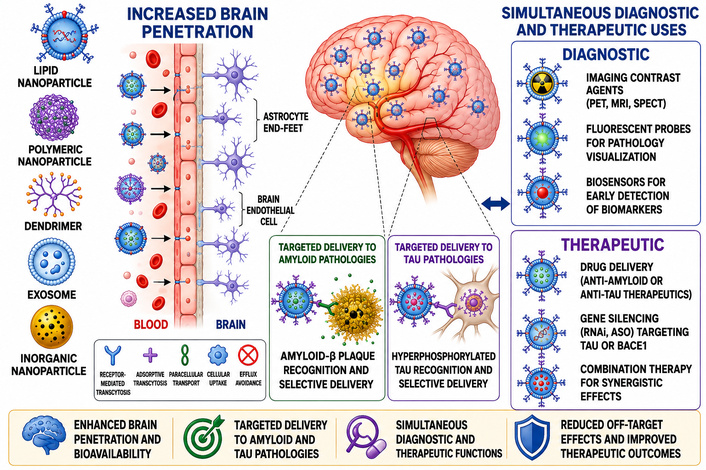
Despite significant progress in understanding the molecular pathogenesis of AD, therapeutic success has been limited. Most conventional pharmacological drugs cannot achieve appropriate concentrations in the central nervous system without causing systemic toxicity. These drawbacks have made nanotherapeutics a viable approach to AD diagnostics and treatment. Nanomaterials have distinct physicochemical qualities such as nanoscale size, surface functionalisation, and controlled release capabilities, allowing for increased brain penetration, targeted delivery to amyloid and tau pathologies, and simultaneous diagnostic and therapeutic uses. Consequently, nanotechnology-based methods have become a game-changing platform that can overcome major challenges that have impeded conventional treatments for AD.
Literature selection was done systematically to identify relevant studies, reviews, and reports relating to the title. Common databases including Scopus, Web of Science, Google Scholar, and PubMed were searched to ensure comprehensive coverage of the existing literature. Other sources, including institutional repositories and conference proceedings, were also examined to reduce bias in publication. The method employed in searching involves the keywords combination, such as nanotherapeutics, AD, and nanobiomaterials, which are relevant to the main concepts of the review. In order to optimize retrieval sensitivity and specificity, terms were modified for the entire database. The main time frame for inclusion is from 2012 to 2025; nevertheless, earlier studies were also utilized where appropriate. The criteria for inclusion were peer-reviewed articles, studies published in English, and literature on neurotherapeutics and AD. Exclusion criteria were non-English publications and duplicate reports.
It is believed that AD occurs when the brain accumulates excessive amounts of amyloid beta (Aβ) that can form intracellular neurofibrillary tangles or extracellularly as tau protein and amyloid plaques. This affects connectivity and function in neurons, leading to a decrease in brain function over time [8]. This dysfunction in protein clearance is linked to most neurodegenerative conditions, is age-dependent, and is brain-cholesterol-regulated [9].
The etiology of the majority of AD cases is still to be found, with the sole exception of one or two examples in which deterministic genetic mutations have been discovered [5]. There are some competing hypotheses that attempt to clarify the causative factor, but the Aβ hypothesis is still best recognized. The cholinergic hypothesis, the first of these theories, is the basis for most drug treatment and suggests that decreased production of the neurotransmitter acetylcholine causes AD [10].
One of the well-known characteristics of AD is loss of cholinergic neurons in the cerebral cortex and limbic system [11]. APOE4 is one of the key genes associated with risk for late-onset AD, a specific type of apolipoprotein.
According to the tau protein hypothesis, the chain reaction of disease is started by abnormalities in the tau protein. According to the theory, hyperphosphorylated tau starts forming paired helical filaments with other strands of tau. They eventually cause neurofibrillary tangles in neurons. The transport system of the neuron collapses because microtubules break down and the cell’s cytoskeleton is destroyed [12].
According to many studies, AD is a manifestation of misfolded tau and Aβ proteins that result in oxidative stress and neuroinflammation [13]. Reactive oxygen species might be the main perpetrator of the DNA damage that is accumulated in AD brains [14].
Sleep disturbance is among the potential risk factors for inflammation in AD. Before 2020, it was presumed that sleep disturbance was the result of AD; however, evidence has been increasing to indicate that this relationship may be reciprocal [15].
AD disturbs the cellular balance of bio-metals such as ionic copper, iron, and zinc, although it is not known whether this is a result of or caused by the protein alterations [16]. Smoking is among the main risk factors for AD. Late-onset AD is an indicator of the innate defense system’s systemic dysfunction. Exposure to air pollution could play a part in the progression of AD.
According to the “retrogenesis” medical hypothesis, the brains of Alzheimer’s patients undergo a process of neurodegeneration that occurs in the reverse direction from demyelination and axon loss (white matter) and ends in grey matter loss, as occurs in the process of neurodevelopment during fetal life, which initiates at neurulation and concludes at myelination [17]. Similarly, it is understood that individuals who have AD experience deteriorating cognition progressively in a converse way compared to that of infants. A theory among others holds that deterioration of oligodendrocytes with advancing age and associated myelin produces damage to the axon that, in turn, causes hyperphosphorylation of tau and amyloid formation [18].
The BBB plays a significant part in the movement of macromolecules into and from the brain neuronal system. Therefore, being aware of the structural and functional characteristics of the BBB is essential for maximizing drug delivery to the brain. Chemical diffusion between the brain and blood is blocked by this defensive unit component, which is made up of fixed vascular endothelial cell layers with tight junctions and other supporting elements [19]. Depending on whether they are hydrophobic or hydrophilic, endothelial cells use a range of transport proteins to carry out transport. Preclinical trials have shown that a range of nanocarriers can cure AD effectively. By encapsulating the drugs that inhibit AD, the carriers are capable of passing through the BBB [20, 21]. Figure 1 below shows the nanocarrier transport mechanisms across the BBB.
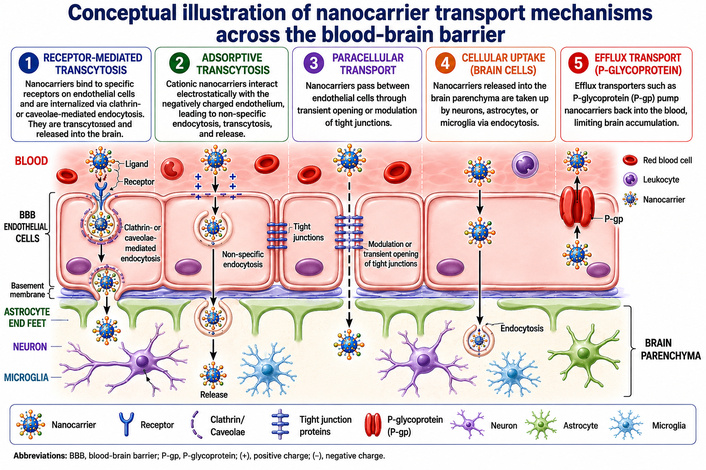
Conceptual illustration of nanocarrier transport mechanisms across the blood-brain barrier. The figure emphasises receptor-mediated and adsorptive transcytosis, paracellular transport, cellular uptake, and efflux. These mechanisms are responsible for the therapeutic and theranostic delivery of nanoparticle-based systems to amyloid-rich brain regions in Alzheimer’s patients.
Nanotechnology has transformed the management of AD. Recently, nanotechnological breakthroughs have the potential to provide excellent diagnostic and therapeutic options [22]. Also, biocompatible nanomaterials with increased magnetic and optical properties, such as those of polymeric, lipidic, and metallic origin, can serve as ideal agents for early diagnosis of AD [23]. Furthermore, depending on the material’s properties, the nanoparticles (NPs) themselves can function as a therapeutic or diagnostic agent (primarily magnetic and plasmonic NPs) [24].
Various small-sized nanocarriers have been employed to effectively and safely deliver commercially available drugs that have been FDA-licensed [25] for the treatment of brain diseases like AD and brain cancer. While there is no treatment for AD yet, anti-AD drugs can alleviate clinical symptoms but not stop or reverse the disease’s progression. The most viable way of administering these proposed drugs into the affected region of the AD brain is believed to be NP-functionalized nanomedicine. Nanomedicines are able to easily interact with proteins and compounds within and outside cells because of their very small dimensions [26]. The core structures of NP-functionalized nanomedicines offer protection, prolonged blood circulation, and drug conjugation or encapsulation [27].
The ability to target a cell, for example, Aβ in cells, allows nanomedicines to directly deliver a therapy to the area of interest at a specific dose. Nanomedicines can improve patient compliance by using lower doses and/or reduced dosing frequency [28]. In AD therapy, nanomedicines might be more helpful than other conventional drug delivery systems for the brain in spite of some clinical issues. A few advantages are improved support, biocompatibility, biodegradability, and regulated administration [28]. Table 1 illustrates the comparative summary of various nanobiomaterials used in AD.
Comparative summary of nano-biomaterials for Alzheimer’s disease.
| Nano-biomaterial | Primary application | Key advantages | Major limitations | BBB penetration | Overall translational promises | References |
|---|---|---|---|---|---|---|
| Quantum dots | Imaging and diagnosis | Strong optical properties, high sensitivity, resistance to photobleaching | Neurotoxicity, oxidative stress, Ca2+ elevation, unclear long-term safety | Yes (very small size) | Moderate for diagnostics; limited for therapy | [29–31] |
| Metallic nanoparticles | Drug delivery, imaging, theranostics | Versatile functionalization, multifunctionality, imaging compatibility | Oxidative stress, lysosomal dysfunction, chronic toxicity concerns | Yes | Moderate, constrained by safety concerns | [32–36] |
| Dendrimers | Targeted drug delivery, imaging | Highly controlled structure, surface functionalization, CNS targeting | Early-stage development, limited clinical validation | Yes | High potential with further validation | [37–39] |
| Carbon nanotubes | Drug delivery and bioimaging | Electrical and mechanical strength, structural uniqueness | Inflammation, DNA damage, free radical generation | Yes | Low to moderate, mainly experimental | [37, 40, 41] |
| Polymeric nanoparticles | Therapeutic drug delivery | Biodegradable, non-toxic, stable, protects drugs from degradation | Formulation-dependent performance | Yes | High, clinically favorable | [37, 42] |
| Liposomes | Drug delivery | High biocompatibility, low toxicity, versatile drug loading | Microglial uptake, formulation stability issues | Yes | High, well-established system | [43] |
| Polymeric micelles | Drug solubilization and delivery | Amphiphilic nature, enhanced solubility, targeted delivery | Dependence on size and shell composition | Yes | Moderate to high | [37, 44] |
This table illustrates how nano-biomaterial platforms used in Alzheimer’s disease differ in terms of diagnostic capability, therapeutic efficiency, and biological safety. While polymeric nanoparticles, liposomes, and micelles offer better biocompatibility and translational practicality for long-term drug delivery, quantum dots and metallic nanoparticles exhibit remarkable imaging and theranostic potential. These comparisons highlight that effective nanotherapeutic and theranostic strategies for Alzheimer’s disease rely on combining diagnostic functionality with safe and targeted therapeutic performance across BBB constraints and amyloid-centered pathology, rather than prioritising a single material property. BBB: blood-brain barrier; CNS: central nervous system.
AD is responsible for 4 out of 5 dementia cases globally, making it one of the most prevalent neurodegenerative illnesses among the elderly. Lipoic acid, a naturally occurring mitochondrial molecule with substantial anti-inflammatory and antioxidant qualities able to lessen oxidative stress, is an example of how NPs may enhance the efficacy of AD therapy [45]. Their design makes them non-toxic, biodegradable, and target-specific. Endocytosis, comprising pinocytosis, phagocytosis, and receptor-mediated endocytosis, is the main mechanism for delivering NPs; the most well-known of these is receptor-mediated endocytosis.
Several antioxidant activities have been discovered from the biological trace element selenium. Sialic acid-modified selenium-NPs synthesized with the help of B6 peptide were synthesized recently by Yin et al. [46]. In cerebral endothelial cells and adrenal medulla cells of rats, these NPs demonstrated enhanced cellular absorption and facilitated bioavailability [46].
Curcuma longa rhizome, which is grown in the whole region of South Asia and particularly in China and India, is utilized in curcumin production. Herbal medicine has traditionally used curcuminoids in the cure of many diseases. According to recent studies, curcumin has an essential role in the control of AD. It is mostly a multi-target-directed drug, an important diagnostic agent, and an enhancer of lifetime nutraceuticals [47], according to Chen et al. [47]. There have been some nano-formulations that are theragnostic drugs capable of improving curcumin’s and other bioactive molecules’ pharmacokinetic profiles such that therapeutic and diagnostic limitations can be resolved.
Curcumin and other nutrients are more effectively delivered in the brain by using nanocarriers to carry them across the BBB [48]. Erosion or degradation mechanisms and dissemination are used to carry the combination drug to the target site. Some of the most commonly used NPs include dendrimers, liposomes, polymeric NPs, and micro- and nano-emulsions. The hydrophilicity or hydrophobicity of polymeric NPs is characterized by the nature of the component that constitutes the outermost layer. They can be delivered to the target site through endothelial cell transcytosis or receptor-mediated endocytosis.
Cheng et al. [49] used polyvinylpyrrolidone and a polyethylene glycol-polylactic acid co-block polymer to develop an ultra-stable nanocurcumin that penetrated the BBB well and had a mean residence time in the brain about sixfold higher than free curcumin. In contrast to its free state, nanocurcumin subsequently improved cue memory in contextual fear conditioning tests of Tg2576 mice [49].
An NP-based treatment coated with Aβ1-42 monoclonal antibodies restores the lost memory of an experimental AD animal fully. Both hydrophobic and hydrophilic biopharmaceuticals, like small molecules, peptides, proteins, and RNAs, can be encapsulated in liposomes, biodegradable delivery nanosystems, with no alteration in their properties. The special phospholipid bilayer structures of therapeutic biomolecules, which resemble biological membranes, allow them to penetrate the brain rapidly. Liposomes are among the most researched and therapeutically approved nanostructured transporters due to their lengthy history, low toxicity, and the capacity to transport both lipophilic and hydrophilic.
According to Fox et al. [50], dendrimers find an array of uses in the biomedical sciences, including gene transfection, contrast agents for imaging, cargo and medication delivery, and antibacterial activities. Dendrimers PAMAM3, 4, and 5 have been shown in experiments to inhibit the formation of amyloid plaques. Due to their hydrolytic properties, they are different from other types of aggregated proteins. This implies that PAMAM dendrimers possess the capacity to eradicate harmful clusters of proteins and suppress amyloid aggregation [51]. The PAMAM dendrimers can lessen the optimal amount of amyloid formation in three ways: (a) they connect peptides; (b) they build up dendrimers, which trap the fibrils’ free ends; and (c) they aid in the fibrils’ breakdown.
AD has been presumed to be a continuous biological process recognizable via a range of biomarkers. Aβ and p-tau positron emission tomography (PET), Aβ42 level in cerebrospinal fluid (CSF), Aβ42/Aβ40 ratio in CSF, and total tau (t-tau) and p-tau181 levels in CSF are a few of the established AD pathology biomarkers. Screening for AD in blood would be a huge step towards early intervention and minimal impact on society because of the limitations of PET and CSF [52].
Nevertheless, blood-based biomarkers (e.g., Aβ and p-tau) are yet to be validated and standardized further before they can be applied in the clinical environment. Blood-based biomarkers can be utilized in specialized memory clinics for individuals with cognitive impairment, although CSF or PET confirmation of the data is still necessary, according to the Alzheimer’s Association guidelines for the use of blood biomarkers in AD [53].
In the AD brain, p-tau is a critical constituent of neurofibrillary tangles. CSF p-tau181 is the best-characterized soluble p-tau and is among the most extensively studied [54]. Like Aβ, p-tau181 has been quantified in recent years by a variety of newly developed highly sensitive assays (e.g., Simoa). Comparing AD patients with cognitively normal controls and other dementia patients without AD, plasma p-tau181 was found to be considerably greater in AD patients in some studies [55]. Additionally, tau-PET and worsening cognitive function in AD patients are positively correlated with plasma p-tau181. It was also revealed that p-tau 181 can be an AD blood-based biomarker because it was able to predict AD pathology eight years before post-mortem. There are numerous lines of evidence suggesting that neuroinflammation contributes to AD. A variety of biomarkers related to neuroinflammation have been evaluated in AD, including GFAP, sTREM2, YKL-40, and S100 calcium-binding protein B (S100B).
The term “theragnosis” is used to describe the incorporation of therapeutic and imaging/diagnostic abilities in one system. The therapeutic and imaging/diagnostic agents are administered in just one injection, and an integrated system is used for diagnosis, treatment, and monitoring therapeutic response instantaneously [56].
Multipurpose nano-systems known as “theragnostic” NPs combine therapeutic and diagnostic functionalities from one NP that is both biocompatible and biodegradable. They are optimally suited to cure more specific diseases. In addition to being non-toxic to human beings, therapeutic NPs must be able to: (1) selectively and quickly accumulate at the site of disease; (2) determine the disease’s physiological and biochemical features; (3) electively deliver the needed dose of drug or drugs without damaging healthy organs and (4) metabolize into non-toxic byproducts or removed from the body in a matter of hours [57].
NPs’ therapeutic and diagnostic qualities can be combined into only one theragnostic device. The multipurpose NPs are expected to reduce costs and risks while increasing drug discovery. Progress in polymerization and emulsification techniques allowed NPs with hydrophobic and hydrophilic surfaces to be formulated. This enables a variety of active compounds to be placed into them, such as a hydrophobic contrast agent and a hydrophilic drug agent, and vice versa [57].
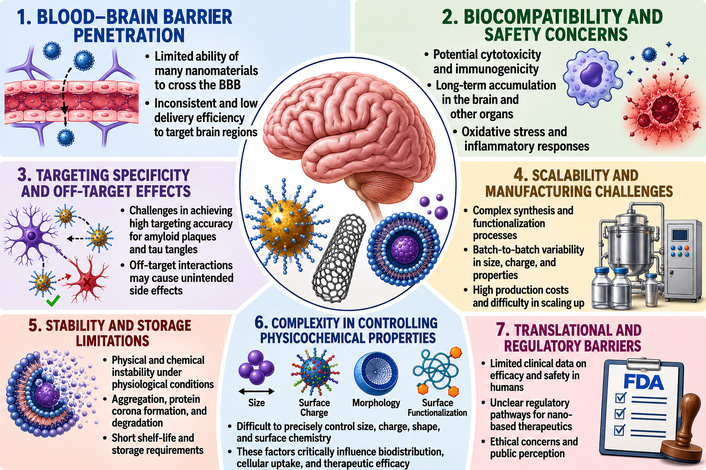
Although the development of nanobiomaterials for early diagnosis and treatment of AD has come a long way, there remain a number of challenges that will hinder their successful clinical translation. The delivery of nanobiomaterials across the BBB is a major concern, as it is essential for their efficient and reproducible delivery to the brain. While there are many targeting strategies, patient and disease stage variations in BBB permeability can constrain therapeutic efficacy. The chemical and physical characteristics of the NPs, such as size, surface charge, shape, and composition, also play a major role in the biodistribution, clearance, and cellular uptake, making the optimization difficult [26].
Another significant drawback is the biocompatibility and toxicity of nanobiomaterials in the long-term [58]. There are some inorganic NPs that have the potential to deposit in the brain or peripheral organs, resulting in oxidative stress, inflammation, or immune activation. Chronic toxicity, biodegradability, and metabolic pathway studies are still incomplete, especially in humans. Further, the manufacture of large quantities of nanobiomaterials that are stable, consistent, and functional is technically challenging and poses regulatory issues to commercialization.
The complexity and heterogeneity of AD make the design of effective nanobiomaterial-based diagnostics and therapeutics even more complex [59]. There is poor translation of promising findings to clinical success, and most preclinical studies are conducted in animals that do not fully mimic the multifactorial nature of human AD. Furthermore, there is a lack of consensus on how NPs are characterized, dosed, and evaluated in studies, which would make it difficult to compare them.
Guidelines to support the regulatory pathways of nanomedicines are still being developed and are less established when applied to nanobiomaterials-containing products. Limited clinical uptake may also be due to ethical issues, production expense, and accessibility. Overcoming these drawbacks will be crucial to fully leveraging the potential of nanobiomaterials in the precision diagnostic and personalized therapy of AD. Figure 2 below shows the challenges and limitations of nanomaterials for AD treatment.
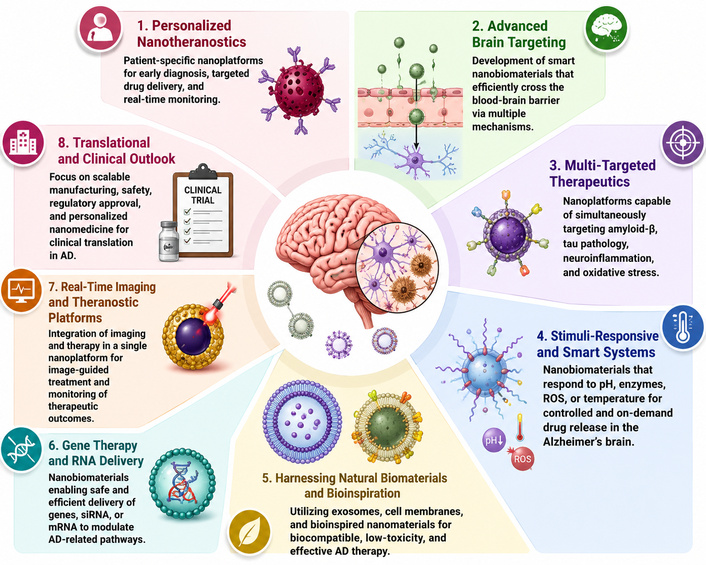
The rapid development of nanobiomaterials is creating new opportunities in the diagnosis and treatment of neurodegenerative diseases, especially AD at an early stage. Even though nanoscale diagnostic and therapeutic systems have achieved significant advancement in their development, a number of obstacles still lie on the way to the full implementation of the technologies into clinical practice. Subsequent studies will probably be aimed at enhancing the accuracy, safety, and scaling of nanobiomaterial-based systems as well as incorporating recent technologies, including artificial intelligence, multimodal imaging, and personalized medicine.
A multifunctional nanoplatform, with the ability to simultaneously diagnose and treat, is also one of the most promising future directions known as theranostic systems. Such nanosystems can be designed to sense early pathological biomarkers in AD, e.g., Aβ plaques, tau protein deposits, and also administer targeted therapeutic agents. The future of surface functionalization and ligand engineering will also improve the selectivity of NPs to these pathological subgroups and allow the detection of a disease earlier and more precisely before a lot of neurons are damaged.
The other important area of future development is to overcome the obstacles that the BBB poses, and this factor is a significant impediment to effective delivery of drugs to the central nervous system. Nanobiomaterials with improved permeability, receptor-mediated targeting, or stimuli-responsive properties can be greatly useful in the delivery of therapeutic molecules into brain tissue. Indicatively, NPs that can sense changes in pH levels, enzymatic activity, or oxidative stress in the diseased brain microenvironment can enable controlled and localized drug delivery, which would result in reduced systemic toxicity and enhanced therapeutic efficacy.
Nanobiomaterials will be further useful in the future in conjunction with sophisticated imaging modalities in emerging diagnostic technologies. NPs that are designed as contrast agents in methods like magnetic resonance imaging and PET have the potential to increase the sensitivity of early detection of Alzheimer’s. Moreover, nanosensors are built into minimally invasive biosensing systems that can provide information on disease biomarkers in biological fluids like blood or cerebral spinal fluid in real-time. These innovations may aid in the development of point-of-care diagnostic equipment that will be used to provide early intervention and disease surveillance.
The integration of nanotechnology with computational and data-driven methods is likely to improve the development of this area even further. Machine learning algorithms can be used to help improve the design of NPs, forecast biological reactions, and choose the most effective therapeutic combinations. Such computational plans might greatly reduce the time needed to optimize NPs and improve the efficiency of translation of laboratory studies to clinical practice.
The clinical implementation of nanobiomaterials will, however, rely on overcoming important safety, regulatory, and manufacturing issues. The long-term toxicity, biodistribution, and immunogenicity of nanomaterials are also critical issues that should be taken into thorough consideration with preclinical and clinical trials. Furthermore, standardized guidelines to synthesize NPs, characterize them, and control their quality will be necessary to achieve reproducibility and regulatory acceptance.
In the future, neuroscientists, materials scientists, clinicians, and bioengineers will have to work together in an interdisciplinary manner to achieve the potential of nanobiomaterials in research around Alzheimer’s. With the growth of technological development of new technologies, nanobiomaterials-based solutions can help improve the paradigm of Alzheimer’s diagnosis and treatment, changing clinical practice towards earlier diagnosis of the disease, targeted treatment for users, and ultimately more successful disease control. Figure 3 below shows the future perspectives of nanobiomaterials on AD treatment.
AD has been among the most difficult neurodegenerative diseases partly because of its complicated pathophysiology as well as the challenge of identifying the prevalence of the disease at its initial stages. The traditional methods of diagnosis usually detect the condition when much neuronal damage has already happened, making the therapies used to treat the condition less effective. In this regard, nanobiomaterials have come up as a promising platform that has the potential to revolutionize the initial diagnosis and the treatment of AD by taking advantage of their special physicochemical and functional characteristics.
Recent progress in nanotechnology has facilitated the creation of very sensitive nanoscale biosensors that are able to detect critical pathological biomarkers like Aβ peptides, tau proteins, and neuroinflammatory mediators in biological fluids at incredibly low concentrations. These technologies have the potential to allow earlier and more accurate diagnosis that is necessary to initiate interventions before neuroinflammation has occurred and becomes irreversible. Meanwhile, nanobiomaterials are also being considered as novel drug delivery systems that have the potential to circumvent one of the greatest barriers to neurological therapy, the BBB. Designed NPs may be employed to refine targeted delivery of therapeutics to the brain-impacted area, enhance drug stability and bioavailability, and reduce systemic side effects.
In addition to the delivery of drugs, multifunctional nanoplatforms are also undergoing development to combine diagnostic and therapeutic features, which are yielding theranostic systems capable of detecting, monitoring, and treating a disease simultaneously. These combined approaches can help to enhance the effectiveness and accuracy of AD management considerably. However, even with the impressive advancements in the same sphere, there are a number of challenges. The problems associated with long-term safety, biocompatibility, mass production, and regulatory acceptance need to be carefully overcome to make the full realization of clinical translation possible.
Overall, the intersection of nanotechnology, neuroscience, and biomedical engineering is paving new opportunities as it relates to the fight against Alzheimer’s. Further interdisciplinary studies and stringent clinical testing will be essential in converting nanobiomaterial-based innovations into safe, effective, and accessible diagnostic and curative instruments, which in the end would revolutionize the landscape of AD treatment.
AD: Alzheimer’s disease
Aβ: amyloid beta
BBB: blood-brain barrier
CSF: cerebrospinal fluid
NPs: nanoparticles
PET: positron emission tomography
During the preparation of this work, the authors used ChatGPT to generate the figures and the graphical abstract. After using the tool/service, the authors reviewed and modified the images using Adobe software, and take full responsibility for the content of the publication.
AOA: Conceptualization, Writing—original draft, Writing—review & editing, Visualization. PAO: Writing—review & editing. Both authors read and approved the submitted version.
The authors declare that they have no conflicts of interest.
Not applicable.
Not applicable.
Not applicable.
Not applicable.
Not applicable.
© The Author(s) 2026.
Open Exploration maintains a neutral stance on jurisdictional claims in published institutional affiliations and maps. All opinions expressed in this article are the personal views of the author(s) and do not represent the stance of the editorial team or the publisher.
Copyright: © The Author(s) 2026. This is an Open Access article licensed under a Creative Commons Attribution 4.0 International License (https://creativecommons.org/licenses/by/4.0/), which permits unrestricted use, sharing, adaptation, distribution and reproduction in any medium or format, for any purpose, even commercially, as long as you give appropriate credit to the original author(s) and the source, provide a link to the Creative Commons license, and indicate if changes were made.



View: 421
Download: 18
Times Cited: 0
Atif Salim Khatib ... Daniya Tasnim
Octavio García ... Jesús Antonio Villegas-Piña
Graziella Martins Guimarães ... Márcia Maria de Souza
Zsolt G. Venkei, Masha G. Savelieff