Review


Affiliation:
Department of Internal Medicine, Hypertension, University of Alabama at Birmingham, Huntsville Regional Medical Campus, Huntsville, AL 35801, USA
ORCID: https://orcid.org/0009-0000-4437-9719

 ,
Affiliation:
Department of Internal Medicine, Hypertension, University of Alabama at Birmingham, Huntsville Regional Medical Campus, Huntsville, AL 35801, USA
ORCID: https://orcid.org/0009-0008-9351-6183
,
Affiliation:
Department of Internal Medicine, Hypertension, University of Alabama at Birmingham, Huntsville Regional Medical Campus, Huntsville, AL 35801, USA
Email: tdudenbostel@uabmc.edu
ORCID: https://orcid.org/0000-0003-3260-8363

Explor Med. 2026;7:1001433 DOI: https://doi.org/10.37349/emed.2026.1001433
Received: November 30, 2025 Accepted: May 21, 2026 Published: October 29, 2026
Academic Editor: Peter W. de Leeuw, Maastricht University Medical Center, The Netherlands
The article belongs to the special issue Drug Adherence in Hypertension
Hypertension is one of the leading causes of death worldwide, and has been increasing in prevalence. A subset of hypertensive patients has resistant hypertension: blood pressure above goal despite taking three or more antihypertensive medications. While the diagnosis of true resistant hypertension requires medication adherence, many studies have found suboptimal adherence or complete nonadherence in resistant hypertensive patients. There are many factors that affect medication adherence, some more prevalent in the treatment of resistant and refractory hypertension, such as complex and expensive medication regimens. The greatest hurdle in preventing nonadherence is accurately measuring and monitoring adherence. There are various methods of monitoring medication adherence, both directly and indirectly, including questionnaires, pill counting, and blood plasma or urinary testing. These methods vary substantially in accuracy and common usage. This review covers the factors that affect adherence in resistant hypertensive patients and the methods used to assess adherence in these patients.
Hypertension (HTN) affects more than 1 billion adults, and its prevalence is increasing globally [1]. In the United States alone, there are currently 119 million adults with HTN, nearly half of the adult population [2]. Additionally, HTN is often underdiagnosed and undertreated. According to the World Health Organization, an estimated 46% of adults who have HTN do not know that they are hypertensive, and only 42% of adults with HTN are diagnosed and treated [1]. More critically, only 1 in 5 adults has controlled blood pressure (BP) levels [1], which means that 80% have uncontrolled BP levels. Uncontrolled HTN is therefore the most important preventable risk factor for cardiovascular, cerebrovascular, and renal disease [3]. Patients with resistant or refractory HTN are at an even higher risk for target organ damage. Apparent treatment-resistant HTN (aRHTN) is defined as “having BP above target levels while using 3 or more antihypertensive medications of different classes at their maximum tolerated doses, with one being a diuretic” [3]. Patients who have BP below target levels while using ≥ 4 antihypertensives are also considered to have aRHTN. This is referred to as controlled aRHTN [3]. Importantly, aRHTN includes not only true resistant HTN but also patients in whom true resistance to treatment has not been confirmed. This includes patients with pseudo-resistance, unrecognized secondary HTN, nonadherence, white coat effect, inaccurate BP measurement, or therapeutic inertia as outlined in the guidelines [3].
Refractory HTN is a rare phenotype of antihypertensive treatment failure defined as uncontrolled BP despite the use of 5 or more antihypertensive medications, including a long-acting thiazide-like diuretic [4].
The prevalence of resistant HTN has been increasing in recent decades [5]. Currently, 12–18% of hypertensive patients in the United States are considered to have resistant HTN [3]. The distinction between HTN, aRHTN, and refractory HTN is based on the number of antihypertensive medications patients have been prescribed and whether or not BP levels are uncontrolled. Therefore, determination of adherence is required to diagnose a patient appropriately and to rule out “pseudo-resistance” [3].
Furthermore, poor adherence can significantly increase the risk of negative cardiovascular outcomes in patients when compared to patients with optimal adherence [6]. This underscores that adherence to antihypertensive medication is essential to preventing adverse cardiovascular outcomes [3].
In recent years, interest in medication nonadherence has increased significantly as it has been recognized as a public health concern that can negatively affect patient outcomes and increase treatment costs [7]. Nonadherence refers to the failure of an individual to follow a prescribed therapeutic regimen. There is a multitude of risk factors for nonadherence in hypertensive patients that are even more common in patients with aRHTN. Pill burden, higher likelihood of adverse or drug-drug reactions with multi-drug regimens, fears of side effects, costs, forgetfulness or cognitive impairment, poor communication or practitioner inertia with insufficient follow-up on initiation, implementation, and the discontinuation of medications, and management of HTN through multiple providers are all more likely to contribute to nonadherence in patients with aRHTN [3].
Properly identifying nonadherence remains a constant challenge for practitioners. Data show that physicians recognize nonadherence in less than half of patients who were not refilling their medications based on pharmacy records [8]. The high rate of nonadherence in hypertensive patients and the low rate of detection by practitioners make accurate diagnosis of aRHTN difficult. Furthermore, despite the requirement to assess adherence prior to an aRHTN diagnosis, a large proportion of patients are diagnosed with aRHTN despite being nonadherent [9, 10].
Nonadherence also significantly increases healthcare costs. It is estimated that the total cost of additional hospital and outpatient care from nonadherence is over $230 billion in the United States and Europe per year [11]. This is especially concerning for both HTN and aRHTN, as HTN has some of the highest avoidable costs among chronic conditions. It is estimated that for adherent patients, every USD spent on antihypertensive medications saves $3–$13 of cost from additional emergency department visits and hospitalizations alone [12].
In this review, we will focus on factors that affect adherence in patients with resistant and refractory HTN, methods used to assess adherence in these patients, and strategies to improve adherence.
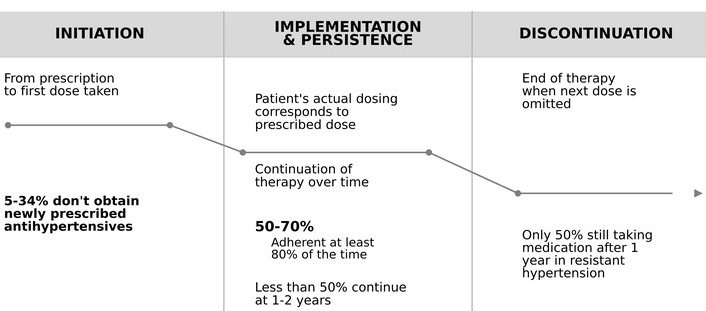
The CDC defines medication nonadherence as “when a patient does not take a prescribed medicine or follow the provider’s instructions for taking the medicine” [13]. A more comprehensive approach and definition were provided in a consensus statement in 2012 [14], which acknowledged that “medication adherence to medication represents a complex and multifaceted process, and understanding and improving it are an urgent imperative in the present and future health care landscape, considering the increase in multimorbidity and population aging” [15]. The authors further defined medication adherence as “a process characterized by 3 major components: the initiation, the implementation and persistence, and the discontinuation of medications (Figure 1). Initiation is the time from prescription until the first dose of the medication is taken” [15]. Implementation refers to the extent to which a patient’s actual dosing corresponds to the prescribed dose. Lastly, discontinuation refers to the end of therapy, when the next dose to be taken is omitted, and the treatment is discontinued afterward. The distinction between these three components is important because research suggests that failure to obtain the first medication during initiation may be common [16].
Proper initiation of antihypertensive medications is vital for ensuring adherence. Among patients with HTN, 12% of patients never fill their first prescription [17].
An analysis of e-prescribing data and filled claims from the US showed that the primary nonadherence rate, defined as the proportion of patients who do not fill a newly prescribed medication, was 24% [16]. Factors associated with nonadherence to e-prescription were non-formulary medication, compared with preferred medication, and residence in a low-income ZIP code [16].
A systematic review of initial medication nonadherence by Cooke et al. [18] in 2022 summarized evidence on the contributing factors, prevalence, and solutions to initial medication nonadherence. The authors found that 5–34% of patients who are prescribed antihypertensives do not obtain their newly prescribed medications. Factors associated with failure to begin treatment include “patient demographics, beliefs or perceptions about medications, costs or financial barriers, and clinical characteristics, such as a new HTN diagnosis or higher comorbid disease burden” [18].
Implementation refers to the degree to which a patient’s actual dosing corresponds to the prescribed regimen. Assessment of complete implementation is done using methods that provide a complete dosing history and evaluate consistent daily medication intake [14].
Surprisingly, the initiation and implementation of newly prescribed medications are only successful in 50–70% (at least 80% of the time) of patients, and less than half of these patients continue to take their medications one to two years after the initial prescription, which is referred to as persistence. Persistence represents the duration from treatment initiation to the last dose taken before discontinuation and is a critical component of long-term BP control [12]. Higher persistence has been associated with higher initial BP [19].
Discontinuation refers to the end of drug therapy, when the next dose to be taken is omitted, and the treatment is discontinued [18]. Persistence also refers to the time from initiation and implementation to the last dose before discontinuation. Persistence is low and a major issue in aRHTN, with only 50% of patients still taking their prescribed medication after 1 year [14].
Patients with aRHTN on 3 or more antihypertensive medications can be, depending on the number of agents they are taking, completely adherent, partially adherent, or nonadherent to medications.
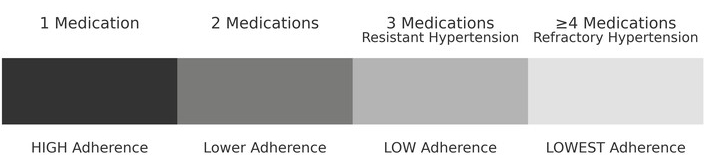
Multiple studies have indicated that poor adherence is common in patients with aRHTN. It is well established that adherence declines as the number of medications and the complexity of the dosing regimen increase (Figure 2) [20]. Nonadherence increases with the number of prescribed antihypertensive agents in a near-linear fashion, from 10% when a patient is on a single medication to around 70–80% in those prescribed six medications [20].
The global prevalence of medication nonadherence in patients with aRHTN varies from 3.3% to 86.1% in individual studies [21]. This wide range is likely due to broad differences in study methodologies, particularly in how adherence is indexed and measured [21, 22].
In a systematic review and meta-analysis of studies that had analyzed adherence in patients with aRHTN, Durand et al. [21] quantified the prevalence and severity of nonadherence among patients with aRHTN. This meta-analysis examined results from 24 studies that used various methods for measuring patient adherence. Studies from various clinical settings in the US, Europe, and Brazil were included. The meta-analysis consisted of over 68,000 patients with aRHTN. The authors found that the overall prevalence of nonadherence was 31%. The nonadherence rate ranged from as low as 3.3% based on pill counting to as high as 86.1% based on direct measurement of serum drug levels. The authors estimated that nearly one-third of patients with aRHTN have uncontrolled BP due to nonadherence. Of note, only 8 of the included studies measured plasma or urine medication levels, indicating that the overall prevalence of nonadherence of 31% may be an underestimation.
In a more recent systematic review and meta-analysis, Bourque et al. [22] determined the overall prevalence of nonadherence in aRHTN and the most effective methods of assessing nonadherence. By reviewing forty-two studies with over 70,000 patients, the authors found a total rate of nonadherence of 37%. Furthermore, the studies that used direct methods (such as drug level monitoring or directly observed therapy) identified a higher prevalence of nonadherence (46%) than studies relying on indirect measures (20%), highlighting that indirect methods tend to underestimate nonadherence and may misclassify patients as treatment-resistant [22]. These findings emphasize the importance of systematically evaluating adherence, preferably with direct tools when feasible, before escalating therapy or pursuing interventions in patients with presumed aRHTN.
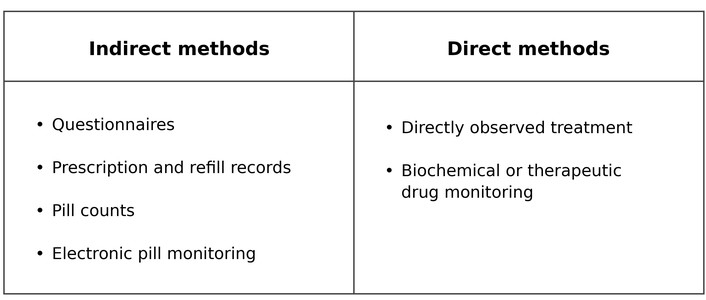
There are many methods of assessing adherence, such as clinical questionnaires, pharmacy data, pill counting, electronic pill monitoring, directly observed treatment (DOT), and serum or urine tests (Figure 3) [23]. These various methods of determining a patient’s level of drug adherence have their own advantages and disadvantages. While determining the presence or absence of antihypertensive agents in blood or urine samples is the preferred objective method to assess adherence, laboratory assays are still not often used in clinical settings [24–26]. Conversely, less accurate but widely available low-cost methods, such as patient recall, medication reconciliation, and questionnaires, are the most routinely used methods. These methods can be broadly divided into direct and indirect methods.
Questionnaires are an easy and inexpensive method of monitoring adherence [27]. The Hill-Bone Compliance Scale [28] and the Morisky Medication Adherence Scale [29] have been used by health care providers and in research settings to measure adherence in treated patients with HTN due to their low cost and convenience. However, questionnaires are not as accurate as other methods of measuring adherence and are easy to manipulate. Studies have found self-reporting questionnaires to be less accurate than pill counting and blood sample analysis [30] and the Morisky scale in particular is based on research that has since been retracted [31]. In a single-center study in a referral HTN clinic by Dudenbostel et al. [32], patients with refractory HTN and controlled aRHTN were given the Morisky 8-Item Medication Adherence Scale. In this study, patients with true refractory HTN were on more medications than those with controlled aRHTN, and, based on the Morisky Score, more adherent to their medication. A subsequent study in the same cohort, Siddiqui et al. [33] analyzed prospectively antihypertensive medication adherence determined by measuring antihypertensive medications and their metabolites by high-performance liquid chromatography-tandem mass spectrometry (HPLC-MS/MS) in urine samples of patients with refractory HTN. Interestingly, only 40% of patients with aRHTN based on 24-h ambulatory BP monitoring (ABPM) were completely adherent, 45% of patients were partially adherent and 15% of patients were completely nonadherent. In patients with apparently refractory HTN, 52.5% were confirmed as having true refractory HTN by being adherent to at least 5 medications, including chlorthalidone and a mineralocorticoid receptor antagonist. Although both studies were conducted separately in the same referral Hypertension Clinic, they demonstrate the limitations of the questionnaire.
Similar observations were made by Pandey et al. [30] in a retrospective study in 47 patients with aRHTN who had completed the Morisky 8-Item Medication Adherence Scale during the initial clinic visit and underwent antihypertensive drug testing in the serum. Nonadherence was defined as the presence of undetected serum levels of at least one prescribed antihypertensive drug by therapeutic drug monitoring. Pandey et al. [30] found that 26% of patients were considered to be nonadherent based on a low Morisky adherence score, while the actual prevalence of nonadherence was 51% by therapeutic drug monitoring. The Morisky Scale showed a low sensitivity and did not predict nonadherence.
Prescription or pharmacy records tend to overestimate adherence [21, 22]. In addition, they require comprehensive integration of all electronic pharmacy records, which may be easier in large integrated healthcare systems and more challenging for patients who often use at least 2 different outside pharmacies. Prescription records have been shown not to reflect adherence [21, 34].
Pill counting is an objective, inexpensive, yet time-consuming form of monitoring adherence. One limitation is that patients have to remember to bring their medication bottles to the clinic visit. Pills are manually counted, and adherence can be determined based on the remaining pills. Patients are typically considered adherent if they have taken 80% or more of their antihypertensive agents. However, pill counting can be misleading because it cannot confirm that medications were actually taken by the patient [35, 36].
Electronic monitoring systems are an improvement on manual pill count methods that do not rely on patient participation [37]. Several studies have found that the implementation of electronic monitoring alone can lead to better control of BP [38]. The Medication Event Monitoring System (MEMS) electronically monitors pill bottle usage. MEMS uses an electronic pill bottle cap to log every opening of the pill bottle, to potentially give a more objective and accurate assessment of antihypertensive pill usage than a traditional pill count. This method can monitor either a single medication per bottle or several pills and provide a dosing history over months or years.
MEMS has been primarily used for research purposes in the past [39]. However, new dispensers have been developed and marketed for those patients who struggle with adherence [40]. Some devices are designed to dispense four weeks of medications, making it easier for patients and caregivers to track medications. They feature a large screen in the middle with the time and upcoming alerts. At the prescribed time, the pills will be available in the easy-to-open slot window at the bottom.
Smart pill organizers take pill management further by linking MEMS to a smartphone app to provide customizable reminders and track adherence. Pills are organized by type and not by the time they are supposed to be taken, so refills of a particular medication are meant to be easier. When it’s time to take a pill, the box will illuminate with as many dots as one has to take pills from that compartment. However, electronic dispensers and smart pill organizers require all medications to be prepared and sorted into the devices, and these devices can be costly and may not be affordable for all patients. Multiple studies have found little difference between MEMS and traditional pill counting in patient adherence and BP reduction [41].
DOT is a form of monitoring adherence. DOT involves patients or study participants taking antihypertensive medications while being observed by clinicians in person or via video. A few studies have tested DOT in aRHTN.
A recent prospective observational study at a specialized HTN center by Ruzicka et al. [42] analyzed adherence in patients with aRHTN. All patients underwent standard medication reconciliation, a review of pharmacy filling records for the past 6 months, and pill count. Patients then underwent DOT with BP check and 24-h ABPM and a 1-month follow-up with repeat BP check and 24-h ABPM. After DOT, BP remained above goal in 71% of participants. In contrast, in approximately 30% of patients, systolic BP decreased by 26 ± 20 mmHg and resolved aRHTN at baseline and after 1 month. While this example of outpatient DOT in a clinical study setting demonstrates the efficacy of this method, it is difficult to implement in a busy clinic with ambulatory patients. Pio-Abreu et al. [43] tested the efficacy of DOT in patients with aRHTN and refractory HTN after several unsuccessful attempts to control BP in an outpatient setting. In addition to a low-sodium diet, 83 patients with clinically suspected aRHTN (31%) and refractory HTN (69%) underwent DOT. In this study, the investigators were able to confirm true resistant HTN in 77%, whereas refractory HTN was confirmed in only 32.5%. The average number of antihypertensive agents was reduced from 5.3 ± 1.3 at baseline to 4.5 ± 1.3 at hospital discharge, and systolic/diastolic BP was reduced to 131 ± 17 mmHg/80 ± 12 mmHg. DOT also facilitated the differentiation of the phenotypes of resistant HTN and refractory HTN in the study group. More importantly, systolic BP remained significantly lower than the last outpatient visit pre-hospital admission at 1 month, with an impressive BP reduction of 25.7 mmHg, and at 7 months with a maintained decrease of 27.3 mmHg despite a lesser number of antihypertensive classes after hospital discharge.
A more reliable method for monitoring adherence is biochemical measurement of drug levels and their metabolites in serum and urine samples with a highly sensitive HPLC-MS/MS technique [44].
It is available for research and clinical trials as well as for clinical use and may be covered by most health insurances. Studies utilizing the HPLC-MS/MS technique have shown that the degree of adherence ranges from full adherence to partial adherence to complete nonadherence [23, 45]. In patients who are otherwise considered adherent, biochemical drug monitoring provides evidence of recent intake and cannot, on its own, determine whether drug exposure is sufficient to achieve the complete antihypertensive effect. However, biochemical drug monitoring can provide objective evidence of recent intake and may reveal partial or intermittent adherence that is not detected by other methods, particularly when measurements are repeated over time. Therefore, it has been suggested that biochemical drug monitoring should become an essential part of the evaluation of patients with apparent treatment-failure phenotypes of HTN, especially when considering further treatment escalation [46].
One of the first studies that utilized HPLC-MS/MS analysis for antihypertensive medications and drug metabolites was performed by Jung et al. [45]. In this study, patients who were referred by general practitioners because of uncontrolled aRHTN were analyzed for adherence. Of a total of 375 referred aRHTN patients, 125 met the definition of aRHTN after the medication regimen was optimized, secondary causes addressed, and BP control achieved, and white coat HTN excluded. Of the remaining 76 patients, Jung et al. [45] found 40 patients (53%) to be nonadherent. Furthermore, of nonadherent patients, 30% had complete, and 70% had partial adherence; 85% of patients with partial adherence had taken less than 50% of prescribed medications. Interestingly, the authors observed that nonadherence was evenly distributed among all classes of antihypertensive medications.
Tomaszewski et al. [44] screened a total of 40 most commonly prescribed antihypertensive medications (or their metabolites) in spot urine samples, also using HPLC-MS/MS in 208 patients with HTN. Of those, 125 were new patients, 66 were followed up with aRHTN, and 17 patients were referred for renal denervation. Analysis at the time of the office visit showed that 25% of patients were completely or partially nonadherent (complete nonadherence 10.1%, partial nonadherence 14.9%). Prevalence of partial and total nonadherence was most commonly found among patients who were following up with aRHTN (28.8%) and those referred for renal denervation (23.5%), respectively. The authors found a linear relationship between the severity of HTN and the difference in measured versus prescribed antihypertensive medications.
There is a need for strategies to improve adherence to antihypertensive treatment, particularly in patients with aRHTN and refractory HTN. Emerging and innovative methods to improve adherence address key challenges in patients with aRHTN, such as forgetfulness, complex regimens, and costs. These methods include advanced pharmacological strategies, digital health technologies, integration of new technologies into care and electronic medical records, and behavioral and motivational interventions.
The choice of which classes and specific antihypertensive medications to prescribe can have an effect on adherence. Antihypertensives with longer half-lives, such as chlorthalidone, amlodipine, and certain angiotensin converting enzyme inhibitors or angiotensin receptor blockers, can keep BP under control for longer to cover a missed dose if a patient is occasionally nonadherent [47]. The pharmaceutical management of resistant HTN has been previously discussed in detail in the most recent resistant hypertensive guidelines [3].
The combination of 2 or 3 antihypertensive agents into a single pill has been shown to increase medication adherence by reducing the number of tablets a patient has to take daily. The fixed dose combination of a calcium channel blocker plus angiotensin converting enzyme inhibitor or angiotensin receptor blocker plus a diuretic in numerous dosages has become widely available as a generic. The pharmacological rationale is that BP control can be maintained and most adverse effects avoided at lower dosages by combining agents from different classes [48]. In addition, fixed-dose combinations help to reduce daily pill burden.
A systematic review and meta-analysis of 44 studies that compared single‐pill combinations with free‐equivalent combinations in patients with HTN showed that single‐pill combinations increased adherence and persistence significantly and demonstrated better BP control [49]. A subsequent meta‐analysis of 7 studies enrolling 1,918 patients showed that a low‐dose combination of 3 or 4 antihypertensive drugs was more effective in lowering BP than monotherapy, usual care, and placebo [50].
A meta-analysis of 14 randomized controlled trials, including 11,457 study participants, assessed the efficacy and safety of triple versus dual combination of BP-lowering medications [51]. Triple combination therapy significantly reduced BP and improved BP control, as expected, compared to dual combination therapy, without increasing adverse events. More importantly, for patients with uncontrolled BP on submaximal dose dual therapy, adding a third drug achieved, on average, approximately four times more BP reduction than doubling the dose of dual therapy component drugs (6.0/3.6 mmHg vs. 1.5/0.8 mmHg, respectively).
MI is a patient-centered counseling method that uses structured techniques to help people develop personal motivation for behavior change through resolving conflicts for adherence. A randomized controlled trial by Khadoura et al. [52] used MI as a goal-oriented counseling method that helps patients develop medication adherence motivation through empathetic and collaborative communication. The intervention used Motivational Interviewing Network of Trainers (MINT) principles, which were delivered by trained nurses through multiple face-to-face sessions. The intervention sessions helped patients understand their HTN views while they learned to overcome medication obstacles and build confidence in their ability to follow their treatment plans. The interviewers used reflective listening and open-ended questioning to help participants discover their personal reasons for change instead of giving them instructions. The researchers implemented MI as both a counseling method and a behavioral intervention, which aimed to convert patient uncertainty into active participation with their antihypertensive treatment.
A meta-analysis conducted by Huang et al. [53], which combined 31 studies and tested MI with patients who had HTN, showed that MI interventions led to a 4–6 mmHg systolic BP decrease and a 25–30% improvement in adherence measurements among different study groups. The treatment results became more significant when MI delivery occurred through scheduled multiple sessions with healthcare providers who received proper training. These studies demonstrated that patient-focused behavioral approaches that focus on treatment beliefs and self-confidence and treatment resistance can produce substantial improvements in BP management and medication adherence for extended periods. The research supports the implementation of patient-centered behavioral strategies in HTN treatment plans through multidisciplinary care models.
Suboptimal adherence or complete nonadherence in patients with aRHTN is common. There are many factors that affect medication adherence in aRHTN, such as complex and expensive medication regimens. The greatest hurdle to preventing nonadherence is in accurately measuring and monitoring adherence. There are various methods of monitoring medication adherence, both directly and indirectly, including questionnaires, pill counting, and blood plasma or urinary testing. These methods vary substantially in accuracy and common usage. Optimization of adherence remains a challenge and is crucial to reducing morbidity and mortality as well as health care costs in aRHTN.
ABPM: ambulatory blood pressure monitoring
aRHTN: apparent treatment-resistant hypertension
BP: blood pressure
DOT: directly observed treatment
HPLC-MS/MS: high-performance liquid chromatography-tandem mass spectrometry
HTN: hypertension
MEMS: Medication Event Monitoring System
MI: motivational interviewing
JG, DK, and TD: Conceptualization, Writing—original draft, Writing—review & editing, Visualization. All authors read and approved the submitted version.
The authors declare that they have no conflicts of interest.
Not applicable.
Not applicable.
Not applicable.
Not applicable.
Not applicable.
© The Author(s) 2026.
Open Exploration maintains a neutral stance on jurisdictional claims in published institutional affiliations and maps. All opinions expressed in this article are the personal views of the author(s) and do not represent the stance of the editorial team or the publisher.
Copyright: © The Author(s) 2026. This is an Open Access article licensed under a Creative Commons Attribution 4.0 International License (https://creativecommons.org/licenses/by/4.0/), which permits unrestricted use, sharing, adaptation, distribution and reproduction in any medium or format, for any purpose, even commercially, as long as you give appropriate credit to the original author(s) and the source, provide a link to the Creative Commons license, and indicate if changes were made.



View: 101
Download: 3
Times Cited: 0
Sameen Abbas ... Sohail Kamran
Claudio Tomasino, Marco Tomasino
Eirik Olsen ... Camilla L. Søraas
Vaia Raikou, Sotiris Gavriil
Shawna D. Nesbitt
Aaron Walsh ... Ranjit Philip
Sverre E. Kjeldsen ... Tor Ole Klemsdal