 Perspective


Affiliation:
1School of Cardiovascular and Metabolic Health, University of Glasgow, G12 8QQ Glasgow, UK
2Ateneo School of Medicine and Public Health, Ateneo de Manila University, Pasig City 1604, Philippines
Email: dominic.alfonso@doctors.org.uk
ORCID: https://orcid.org/0009-0007-9541-0801


Explor Med. 2026;7:1001432 DOI: https://doi.org/10.37349/emed.2026.1001432
Received: July 26, 2026 Accepted: September 17, 2026 Published: October 20, 2026
Academic Editor: Carlos M. Ferrario, Wake Forest School of Medicine, USA
Patients with acute heart failure show substantial variation in natriuretic and decongestive responses to loop diuretics, yet the physiological basis of this heterogeneity remains incompletely understood. Chloride status has emerged as a candidate marker of cardiorenal response, supported by associations with neurohormonal activation, diuretic efficiency and residual congestion, together with chloride-sensitive WNK signalling. Separately, the apelinergic system exerts acute renal and haemodynamic effects in humans, while experimental studies indicate that apelin-receptor signalling depends on mechanical and molecular context. No study, however, has directly tested whether chloride state modifies apelin responsiveness, and acute sodium depletion or angiotensin II exposure did not attenuate apelin responses in controlled human studies. This Perspective proposes that chloride state may modify apelin responsiveness when chloride-conditioned renal physiology coexists with persistent myocardial loading. Chloride is therefore treated as a continuous, longitudinal state variable rather than a therapeutic target or surrogate for receptor function. We also define the competing biomarker and causal interpretations, propose research measurements and plausible sensitivity thresholds, and outline a staged translational testing framework. Support would require incremental information beyond sodium and established risk measures, a reproducible mechanistic interaction, and state-dependent variation in directly measured agonist response. Confirmation could inform physiological enrichment of future apelin-agonist trials, whereas failure could retain chloride as a marker of decongestive physiology rather than an apelin-modifying mechanism.
Congestion is a principal cause of symptoms and hospitalisation in acute heart failure (HF), yet patients show substantial variation in urine output and weight loss relative to the loop-diuretic dose administered [1, 2]. To formalise this heterogeneity, Segar and colleagues [3] recently developed and externally validated the BAN-ADHF score, integrating different parameters such as blood urea nitrogen, atrial fibrillation, natriuretic peptide concentration, and other known acute decompensated HF measurements such as creatinine, diastolic blood pressure, hypertension, home diuretic use, and previous HF hospitalisation, to identify patients at risk of low diuretic efficiency [3]. The BAN-ADHF score has since been further examined in several independent trial populations, including the DAPA-RESIST trial, which used a modified version of the scoring system and suggested that it was able to identify lower weight-based loop diuretic efficiency despite comparable congestion at baseline [4]. Analyses of CLOROTIC and PUSH-AHF likewise associated higher scores with lower natriuresis and poorer clinical outcomes [5, 6]. Overall, while these studies suggest that the BAN-ADHF score could be a tool to identify patients with attenuated decongested responses, the physiological basis of the heterogeneity remains unresolved.
Among the physiological factors that may underlie this heterogeneity, chloride has emerged as a potentially informative marker of the cardiorenal response to diuresis. Hypochloraemia has been associated with neurohormonal activation and reduced loop-diuretic efficiency, while serial post-diuretic urine chloride concentrations may provide a dynamic read-out of tubular electrolyte handling during decongestion [7, 8]. Chloride status alone, however, is still unlikely to account for the full variation in treatment response [8]. Another potential determinant lies within the apelinergic system, which comprises the G-protein-coupled apelin receptor (APJ) and its two endogenous peptide ligands, apelin and Elabela [9–11]. This system has demonstrable cardiovascular and renal actions in humans, while experimental evidence indicates that apelin-receptor signalling may vary according to mechanical and physiological context [10–12].
Although no study has directly tested whether chloride state modifies apelin-receptor responsiveness, reduced tubular chloride delivery has been associated with neurohormonal activation, while persistent myocardial loading may alter the receptor’s signalling context [7, 12]. In this perspective, we therefore hypothesise that chloride state modifies apelin responsiveness during decongestion for acute HF, particularly when chloride depletion coexists with residual congestion and renal salt avidity. The proposed interaction concerns a composite physiological condition rather than isolated hypochloraemia and extends the unload-then-agonise hypothesis by incorporating chloride as a dynamic renal variable [13]. The biological basis, competing explanations for the proposed interaction, and a suggested staged programme through which this hypothesis can be tested and, if unsupported, rejected, is outlined in this perspective.
Current clinical evidence suggests that chloride status may reflect both disease severity and the physiological response to diuretic therapy in HF. In a meta-analysis of seven studies involving 6,787 patients with acute HF, hypochloraemia was found in 17% of participants, and each 1 mmol/L lower admission chloride was associated with a 6% higher risk of all-cause mortality [14]. More mechanistic evidence came from a study of 162 ambulatory patients receiving loop diuretics, in which serum chloride correlated inversely with plasma renin (r = –0.46; P < 0.001), while serum sodium provided no explanatory information, and hypochloraemia was also associated with poor diuretic response (odds ratio 7.3, 95% confidence interval [CI] 3.3–16.1) [7]. A small exploratory intervention within the same cohort, using sodium-free lysine chloride in ten patients, altered several markers of decongestion but produced inconsistent neurohormonal responses, leaving the causal contribution of chloride itself unresolved [7].
Beyond serum measurements, subsequent studies have examined urinary chloride as a more dynamic marker of tubular response during decongestion. In a study of 50 patients with acute HF, a post-diuretic urine chloride below 72 mmol/L was associated with urine output below 100 mL/h (odds ratio 39.0, 95% CI 3.8–405.0), and urine chloride remained strongly correlated with urine sodium at one hour (r = 0.87) [8]. Similarly, a separate cohort of 116 patients found that admission urine chloride below 96 mEq/L was associated with diuretic resistance, persistent congestion, and HF readmission within six months [15]. These findings support urine chloride as a potentially physiologically useful decongestive marker, although its incremental value over urine sodium remains uncertain, and the reported thresholds are not directly comparable given differences in sampling time, prior diuretic exposure, and outcome definitions across studies.
These observational findings have indeed prompted interest in whether chloride status could help improve outcomes or merely track prognosis. Current studies suggest that it plausibly is the latter. In a post-hoc analysis of ADVOR, baseline hypochloraemia occurred in 15% of 519 participants and was associated with slower decongestion, yet acetazolamide improved decongestion across the full range of chloride concentrations and prevented the reduction in serum chloride typically seen with loop diuretics alone [16]. A similar pattern emerged in the 386-patient observational ALCALOTIC subanalysis, where hypochloraemia was associated with 0.78 kg less in-hospital weight loss, while thiazide exposure was associated with greater weight loss only in normo- or hyperchloraemic patients [17]. However, the absence of chloride-stratified randomisation precludes any conclusion about treatment-effect modification [17]. A further 2026 post-hoc comparison of 55 patients found that 0.9% sodium chloride supplementation was associated with greater six-hour diuresis than glucose or no fluid, but net natriuresis did not differ significantly among groups [18]. Collectively, these studies support closer assessment of chloride during decongestion, but not routine or indiscriminate chloride replacement.
A plausible renal mechanism exists, but it operates at a compartment distinct from serum chloride. Chloride binds directly to the catalytic domain of with-no-lysine [K] kinase 1 (WNK1) and inhibits autophosphorylation [19]. When intracellular chloride falls, this inhibition is released, allowing WNK–STE20/SPS1-related proline/alanine-rich kinase (SPAK)/oxidative stress-responsive kinase 1 (OSR1) signalling [WNK–SPAK/OSR] signalling to activate sodium–potassium–chloride cotransporter 2 (NKCC2) and the sodium–chloride cotransporter (NCC) activity, thereby promoting renal sodium chloride reabsorption [19, 20]. WNK4-dependent NCC regulation is likewise chloride sensitive [20]. This pathway offers a coherent biological mechanism for chloride depletion as a driver of renal salt avidity and helps explain why chloride tracks outcomes even when correcting it does not. Establishing that serum chloride is a valid proxy for intracellular chloride signalling, however, has yet to be established.
The mechanistic inference must therefore remain compartment specific. Serum chloride, tubular chloride delivery, urinary chloride excretion and intracellular chloride are physiologically distinct, if related, parameters, and any cardiorenal model built on this mechanism must account for their behaviour across compartments rather than infer signalling status from serum chloride alone.
While chloride contributes to the cardiorenal state that shapes decongestive response, the APJ is a plausible candidate integrator as its expression and signalling extend across both the kidney and myocardium, as recent studies suggest [9, 11, 21]. In the healthy human kidney, apelin, Elabela, and the APJ are expressed throughout the nephron, with the receptor co-localising with sodium–glucose cotransporter 2 in the proximal tubule, NKCC2 in the thick ascending limb, and renin in the juxtaglomerular apparatus [9]. While co-localisation is not functional coupling, the physiology suggests it [9]. In water-deprived mice, apelin-13 reduced renal NKCC2, renin, aquaporin-2 and soluble prorenin receptor expression [21]. More importantly, a randomised, double-blind crossover study in 12 patients with chronic kidney disease and 12 matched controls found that acute [Pyr1]apelin-13 increased renal blood flow by approximately 15%, natriuresis by 20% and free-water clearance by 10% [11], collectively suggesting that human kidneys are physiologically responsive targets of apelin, albeit not generalisable to any HF phenotypes.
A plausible link between renal apelin activity and altered cardiovascular responsiveness could be in the renin-angiotensin system. In experimental HF studies, angiotensin II reduced cardiac apelin and APJ expression, while angiotensin-receptor blockade restored the axis [22]. Conversely, apelin increased angiotensin-converting enzyme 2 expression and supported the angiotensin-(1–7) counter-regulatory pathway in HF [23]. While these reciprocal findings suggest that neurohormonal activation may influence apelin biology, a controlled human study by Barnes and colleagues [24] in 2013 showed that acute sodium depletion and angiotensin II co-infusion did not attenuate apelin-induced vasodilatation or haemodynamic responses in healthy participants or in 12 patients with stable HF, indicating that the relationship is not straightforward. Within these acute experimental conditions, renin-angiotensin activation alone did not attenuate apelin responsiveness. Whether chronic chloride depletion, renal salt avidity, persistent myocardial loading or tissue remodelling modifies this response remains untested and forms part of the present hypothesis.
Against this background, direct experimental evidence for electrolyte-dependent APJ regulation is limited and is mainly neuroendocrine rather than renal or cardiac. In rats, it has been found that 48 hours of 2% sodium chloride loading or water deprivation increased APJ messenger RNA in magnocellular hypothalamic nuclei involved in fluid homeostasis [25]. Although this finding supports sensitivity of the apelin system to osmotic and volume-related states, it cannot distinguish the specific contribution of chloride from that of sodium, osmolality, or vasopressin signalling. To date, no study has directly examined whether chloride specifically regulates APJ expression or agonist signalling in humans with HF.
The myocardium provides a further setting in which receptor behaviour may depend on physiological context. Experimental studies indicate that APJ can function as a dual sensor with ligand binding activating inhibitory G-protein alpha subunit I (Gαi) signalling, while mechanical stretch can signal through a G-protein-independent, β-arrestin-dependent hypertrophic pathway [12]. Human myocardial tissue studies have also associated advanced HF with diminished myocardial apelin signalling and reported restoration after mechanical circulatory support [26]. Circulating measurements, however, remain inconsistent. A study with 202 patients with systolic HF reported lower plasma apelin than in controls [27], whereas a smaller study found modestly higher apelin but a disproportionately greater increase in copeptin, particularly among those with hyponatraemia [28]. These discordant findings may reflect heterogeneity across HF phenotype, disease stages, and analytical variation related to peptide isoform measured, sampling processing, and assay specificity [29–31]. A single circulating apelin concentration should therefore not be regarded as a direct surrogate for myocardial receptor abundance or signalling competence.
This context dependence outcomes are also apparent in pharmacological studies, however, overall clinical development of APJ agonists remains early. Acute [Pyr1]apelin-13 infusion increases cardiac index and reduces peripheral resistance in HF [10]. By contrast, a small phase 2 programme of the apelin analogue CLR325 in stable HF focused primarily on safety and tolerability, while the phase 1b AMG 986 study found the compound well tolerated but without clinically meaningful pharmacodynamic effects in the HF cohort [32, 33]. Contemporary pharmacological syntheses emphasise ligand bias, receptor reserve, disease stage and tissue context as determinants of translation [33, 34]. The translational challenge is therefore not a complete absence of biological activity but uncertainty regarding the ligand, tissue and physiological conditions required for a reproducible response in patients. This uncertainty provides a rationale for considering chloride-load state as a potential modifier of apelin responsiveness.
These renal, endocrine, cardiac, and pharmacological observations support our proposed model built on two chronic, co-occurring states (Figure 1). The first is a chloride-depleted renal state, characterised by chloride-sensitive WNK-dependent transport, enhanced tubular sodium chloride reclamation, acid-base disturbance, and neurohormonal activation [7, 19, 20]. The second is persistent myocardial load, which may alter the expression and signalling context of the APJ through sustained mechanical stress and advanced cardiac remodelling [12, 26]. Neither state is expected to stop apelin responsiveness independently. Indeed, apelin-mediated vasodilatation and haemodynamic responses remained preserved during acute sodium depletion and angiotensin II exposure, constraining the hypothesis to a chronic state in which renal chloride avidity and persistent cardiac load coexist [24]. The central hypothesis is therefore that chronic concurrence of renal chloride avidity and persistent myocardial load reduces the renal or haemodynamic response to a defined apelin agonist.
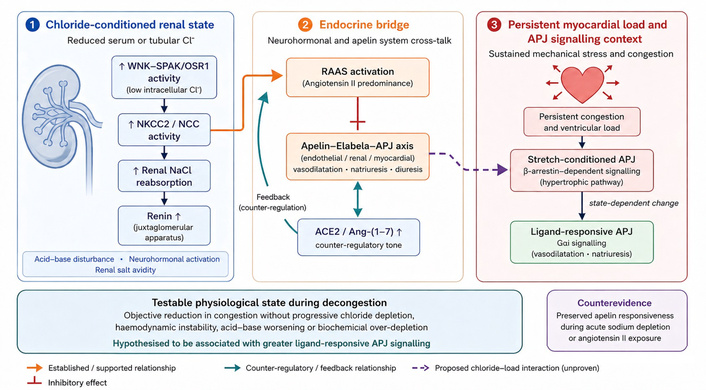
Proposed renal-cardiac state interaction modifying apelin responsiveness. Reduced serum or tubular chloride may accompany activation of WNK-SPAK/OSR1 signalling, altered acid-base balance and renin-angiotensin activation, while apelin has independent renal and haemodynamic effects. Persistent myocardial loading may alter the signalling context of APJ through stretch-related pathways. The dashed connection represents the unproven hypothesis that chronic concurrence of chloride-conditioned renal physiology and persistent myocardial load modifies the response to apelin agonism. Preserved apelin responsiveness during acute sodium depletion and angiotensin II exposure is shown as counterevidence [24]. Decongestion without progressive chloride depletion is presented as a testable physiological state, not a validated treatment target or established mechanism of restored receptor function. Figure created by the author using Adobe Illustrator. ACE2: angiotensin-converting enzyme 2; Ang: angiotensin; APJ: apelin receptor; Cl-: chloride; Gαi: inhibitory G-protein alpha subunit i; NaCl: sodium chloride; NCC: sodium–chloride cotransporter; NKCC2: sodium–potassium–chloride cotransporter 2; OSR1: oxidative stress-responsive kinase 1; RAAS: renin-angiotensin-aldosterone system; SPAK: STE20/SPS1-related proline/alanine-rich kinase; WNK: with-no-lysine kinase; ↑ increased or upregulated relative to the preceding state.
We suggest that this state may not be defined by a fixed serum chloride range, as evidence and validated thresholds as therapeutic targets are still lacking. Instead, this state should be assessed as a continuous variable, incorporating baseline concentration, change during treatment, and post-diuretic urinary chloride alongside sodium balance, acid-base status, and residual congestion. Improved receptor responsiveness must also be demonstrated directly through haemodynamic or molecular signalling measures, rather than inferred from receptor expression or circulating apelin concentrations alone. This formulation extends the unload-then-agonise hypothesis by incorporating chloride-conditioned renal physiology as a measurable modifier of apelin responsiveness [13].
The hypothesis generates four testable predictions. First, chloride trajectory may modify the association between a prespecified apelin-system measure and diuretic response after adjustment for sodium, kidney function, acid-base status, diuretic exposure and congestion. Second, any interaction will be greatest when low chloride coexists with persistent load, rather than in isolated hypochloraemia after successful decongestion. Third, isosmotic chloride manipulation will alter agonist-induced apelin-receptor signalling through an identifiable intermediate, such as WNK or renin–angiotensin signalling. Fourth, the renal or haemodynamic response to a standardised apelin challenge should differ across prespecified combinations of chloride status and residual myocardial loading. These plausible predictions, along with the current evidence base, are summarised in Table 1.
Current evidence, competing explanations and tests of the chloride-apelin hypothesis.
| Proposed relationship | Current evidence | Interpretation and principal limitation | Suggested test required to resolve uncertainty |
|---|---|---|---|
| Chloride status and impaired decongestive response | Human observational cohorts and post hoc treatment analyses associate serum and urinary chloride with diuretic response and residual congestion [7, 8, 15–18]. | Reproducible association, but causal inference remains limited. Urine chloride is strongly correlated with urine sodium, and treatment was not randomised according to chloride status. | Prospective confirmation that serum or urinary chloride provides incremental information beyond urine sodium, diuretic exposure, kidney function and residual congestion. |
| Intracellular chloride and WNK-dependent transport | Structural and cellular studies show that chloride directly inhibits WNK1 activation and that intracellular chloride modifies WNK4-dependent sodium–chloride cotransporter activity [19, 20]. | Strong mechanistic evidence for chloride-sensitive WNK signalling, but no direct evidence that circulating chloride reflects this pathway in HF. | Compartment-specific and isosmotic chloride manipulation in human renal models, with direct measurement of WNK-SPAK/OSR1 activity and sodium-chloride transport. |
| Apelin and renal salt and water handling | Human kidney localisation, experimental animal physiology and a small randomised crossover study support renal apelin activity [9, 11, 21, 26]. | Direct evidence of acute renal responsiveness to apelin in humans, but no evidence that the response depends on chloride status or generalises to congested HF. | Controlled apelin administration in HF with serial serum and urinary chloride, sodium, renal haemodynamic and decongestive measurements. |
| Electrolyte/osmotic state and APJ regulation | Rat studies show altered central APJ expression after salt loading or water deprivation, while human apelin responses remain preserved during acute sodium depletion and angiotensin II exposure [24, 25]. | The apelin system is osmotically responsive, but no study isolates chloride-specific APJ regulation in human kidney or myocardium. | Isosmotic chloride manipulation that holds sodium, osmolality, pH, and potassium constant while directly measuring agonist-induced APJ signalling. |
| Renin-angiotensin signalling and apelin biology | Experimental studies support reciprocal regulation between the renin-angiotensin and apelin systems, while controlled human studies found preserved apelin responses during acute sodium depletion and angiotensin II exposure [22–24]. | Experimental evidence supports biological interaction, but acute human renin-angiotensin activation did not attenuate apelin responsiveness. Chronic state dependence remains untested. | Longitudinal human phenotyping and chronic disease-relevant models measuring chloride status, renin-angiotensin activity and ligand-responsive apelin-receptor signalling. |
| Myocardial load and apelin-receptor signalling context | Experimental mechanosignalling studies and human myocardial expression studies link APJ biology with mechanical stress and advanced HF [12, 26]. | Direct experimental evidence that stretch can activate APJ-related signalling, but human evidence concerns myocardial expression rather than agonist responsiveness. | Stretch-controlled human cardiomyocyte experiments with direct measurement of agonist-induced Gαi and β-arrestin signalling. |
| Hypoalbuminaemia and loop-diuretic response | Hypoalbuminaemia can alter loop-diuretic pharmacokinetics, and albumin-furosemide co-administration has shown heterogeneous short-term diuretic effects across hypoalbuminaemic populations [38, 39]. | A competing determinant of apparent diuretic resistance rather than evidence for chloride biology. Direct endogenous albumin-APJ interaction is unproven [40]. | Measure albumin prospectively, account for it in the clinical interaction model, and avoid attributing albumin-related pharmacokinetic resistance to chloride. |
| Combined chloride status and myocardial load modify apelin responsiveness | No direct evidence. | Central hypothesis of this Perspective. | Require replicated clinical interaction, chloride-specific mechanistic directionality and a human agonist-by-state interaction before clinical efficacy trials. |
APJ: apelin receptor; Gαi: inhibitory G-protein alpha subunit i; HF: heart failure; NCC: sodium–chloride cotransporter; NKCC2: sodium–potassium–chloride cotransporter 2; OSR1: oxidative stress-responsive kinase 1; SPAK: STE20/SPS1-related proline/alanine-rich kinase; WNK: with-no-lysine kinase.
It is suggested that the chloride-load phenotype is treated as a research construct instead of a clinical category, as no validated chloride threshold supports therapeutic decision-making. Studies should therefore characterize chloride across compartments and over time. Serum chloride should be measured alongside sodium, bicarbonate, potassium, creatinine, albumin, and measured osmolality using standardised laboratory methods, ideally before the first protocolised intravenous loop-diuretic dose. Urinary sodium and chloride should then be assessed at a prespecified early interval, such as two hours, with cumulative urine collection through six hours, followed by repeat serum electrolytes during active decongestion. Residual congestion should be quantified using prespecified clinical, echocardiographic or invasive haemodynamic measures [8, 35]. Baseline susceptibility may additionally be characterised using the BAN-ADHF score [35], but chloride should demonstrate explanatory or predictive value beyond established risk measures and the directly measured natriuretic response.
We suggest the primary chloride exposure should remain continuous, with longitudinal change modelled explicitly. Previously reported thresholds may inform sensitivity analyses, but not treatment decisions. Serum chloride < 96 mmol/L has been used to define hypochloraemia in ADVOR and related studies [16]; post-diuretic urinary chloride < 72 mmol/L identified a low-output phenotype in one acute-HF cohort [8], and admission urinary chloride < 96 mEq/L was associated with resistance and residual congestion in another [15]. These thresholds arise from different biological compartments and sampling times and should not be treated as interchangeable. Hyponatraemia should likewise be distinguished into water-dominant and solute-depleted states using measured osmolality, urinary indices, acid-base status and clinical assessment of volume status [36, 37].
The apelin system also requires rigorous analytical characterisation. Apelin isoforms, Elabela and copeptin, should be measured separately using validated assays and prespecified procedures for sample collection, preservation and processing, given the recognised effects of peptide degradation and assay specificity on reported concentrations [29–31]. Primary analyses should use continuous, preferably log-transformed concentrations rather than unvalidated biomarker thresholds. Apelin-to-copeptin ratios may remain useful as secondary or sensitivity analyses, but should not serve as the primary exposure because variability in either component can destabilise the ratio. A prespecified causal model should distinguish confounders from potential mediators and include HF severity, kidney function, loop-diuretic exposure, sodium, bicarbonate, renin-angiotensin blockade, sodium–glucose cotransporter 2 inhibition and residual congestion. Albumin and renal function warrant particular attention because they can alter loop-diuretic pharmacokinetics independently of chloride biology.
Hypoalbuminaemia is common in HF and becomes particularly relevant in advanced disease, where inflammation, malnutrition, hepatic congestion, haemodilution, renal protein loss and protein-losing enteropathy may contribute [38]. Reduced plasma oncotic pressure may favour extravascular fluid accumulation, but does not by itself establish pharmacodynamic loop-diuretic resistance. More importantly, hypoalbuminaemia may influence diuretic response through a pathway distinct from chloride sensing. Furosemide is highly albumin-bound and reaches its luminal site of action predominantly through proximal tubular secretion; reduced albumin may therefore alter drug distribution and effective tubular delivery, although the clinical magnitude of this effect remains heterogeneous [38]. A meta-analysis of 13 prospective studies involving 422 participants across heterogeneous hypoalbuminaemic populations, rather than specifically HF, found that albumin co-administration increased short-term urine output and natriuresis on average, with larger apparent effects at albumin concentrations < 2.5 g/dL but substantial between-study heterogeneity [39]. It is therefore suggested that albumin be measured and incorporated into the analytical model as a competing determinant of diuretic response rather than interpreted as part of the chloride mechanism.
Its relationship with the apelin system, however, is less well established. An engineered apelin analogue linked to an anti-serum-albumin domain antibody retained APJ activity while exploiting albumin binding to prolong pharmacokinetic half-life [40], but this does not establish that circulating albumin concentrations regulate endogenous APJ signalling. We therefore suggest that hypoalbuminaemia is considered a competing pharmacokinetic and disease-severity pathway unless direct evidence of interaction with the apelin system further emerges.
The hypothesis should be evaluated through three sequential stages, with progression dependent on a prespecified positive result at each preceding stage (Figure 2). The first stage is suggested to determine whether a chloride-by-apelin interaction is detectable in patients before attempting therapeutic manipulation. A multicentre acute-HF cohort could enrol adults hospitalised with objective congestion who require intravenous loop diuretics. Patients in cardiogenic shock, receiving mechanical circulatory support or ongoing inotropes, or dependent on dialysis should be excluded from the initial signal-detection cohort because these conditions dominate renal and haemodynamic response. Baseline blood and timed urine should be collected before and after the first protocolised loop dose [8, 35]. The primary analysis should test whether baseline serum chloride, modelled continuously, modifies the association between baseline log-transformed [Pyr1]apelin-13 and six-hour natriuretic efficiency, defined as cumulative urinary sodium excretion per intravenous furosemide-equivalent dose. Baseline [Pyr1]apelin-13 would serve as an endocrine exposure rather than a surrogate for receptor abundance or signalling competence. Serum chloride trajectory, post-diuretic urine chloride, objective change in congestion, and alternative apelin-system measures should remain secondary analyses. The causal framework should account for baseline sodium, kidney function, loop-diuretic dose, acid-base status, congestion severity and BAN-ADHF risk, while avoiding adjustment for variables that may lie on the causal pathway. Because urinary chloride and sodium are closely correlated, any incremental contribution of chloride should be demonstrated beyond urinary sodium and reproduced in an external cohort [8]. Sample size is suggested to be based on simulation of the proposed interaction using pilot variance and correlation estimates instead of calculations designed for main treatment effects.
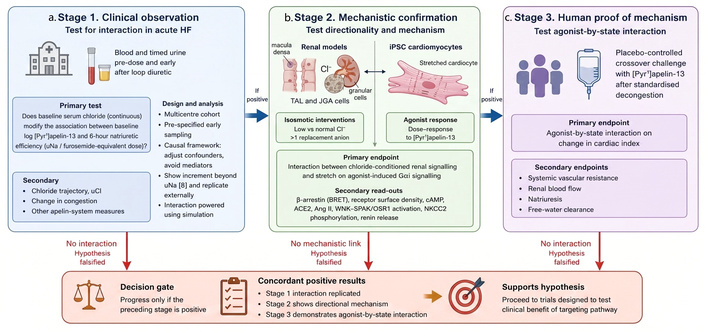
Gated translational testing framework for the chloride-apelin hypothesis. Three sequential stages evaluate whether chloride-conditioned renal physiology and persistent myocardial loading modify apelin responsiveness. (a) Stage 1 tests whether baseline serum chloride, modelled continuously, modifies the association between baseline [Pyr1]apelin-13 and six-hour natriuretic efficiency in acute HF. Secondary measures include chloride trajectory, urinary chloride, change in congestion, and other apelin-system markers; progression requires incremental value beyond urinary sodium and external replication. (b) Stage 2 tests mechanistic directionality using human thick-ascending-limb and juxtaglomerular models under isosmotic chloride manipulation, together with iPSC-derived cardiomyocytes exposed to controlled stretch. The primary endpoint is the interaction between chloride-conditioned renal signalling and myocardial stretch on agonist-induced Gαi signalling; secondary read-outs include WNK-SPAK/OSR1 activation, NKCC2 phosphorylation, renin release, β-arrestin recruitment, receptor surface density, cAMP, ACE2 and angiotensin II. (c) Stage 3 tests the agonist-by-state interaction on cardiac index during a placebo-controlled crossover [Pyr1]apelin-13 challenge after standardised decongestion, with systemic vascular resistance, renal blood flow, natriuresis and free-water clearance as secondary endpoints. Failure at any decision gate rejects the corresponding component of the hypothesis and prevents progression. Concordant positive findings across all three stages would support subsequent trials designed to test the clinical benefit of targeting the pathway. Figure created by the author using Adobe Illustrator. ACE2: angiotensin-converting enzyme 2; Ang II: angiotensin II; APJ: apelin receptor; BAN-ADHF: blood urea nitrogen, creatinine, natriuretic peptide, atrial fibrillation, diastolic blood pressure, hypertension, home diuretic use and previous HF hospitalisation score; BRET: bioluminescence resonance energy transfer; cAMP: cyclic adenosine monophosphate; Cl-: chloride; Gαi: inhibitory G-protein alpha subunit i; HF: heart failure; iPSC: induced pluripotent stem cell; JGA: juxtaglomerular apparatus; NKCC2: sodium–potassium–chloride cotransporter 2; OSR1: oxidative stress-responsive kinase 1; [Pyr1]apelin-13: pyroglutamyl apelin-13; SPAK: STE20/SPS1-related proline/alanine-rich kinase; TAL: thick ascending limb; uCl: urinary chloride; uNa: urinary sodium; WNK: with-no-lysine kinase.
A reproducible clinical interaction would justify a second stage directed at mechanism. Human thick-ascending-limb and juxtaglomerular models should undergo isosmotic low- and normal-chloride manipulation while sodium, osmolality, pH, and potassium are held constant. Chloride-specific effects are suggested to first be separated from changes in sodium, osmolality, and pH using isosmotic low- and normal-chloride conditions in human renal tubular and juxtaglomerular models. Prespecified renal read-outs may be based on known chloride-sensitive regulation of WNK signalling, such as WNK-SPAK/OSR1 activation, NKCC2 phosphorylation, and renin release [19, 20]. These renal signals may then be tested in human induced-pluripotent-stem-cell cardiomyocytes exposed to controlled mechanical stretch, either through defined mediator conditions or experimentally validated conditioned-media approaches [12]. The primary mechanistic endpoint should be the interaction between chloride-conditioned renal signalling and myocardial stretch on agonist-induced Gαi signalling across a prespecified dose-response curve. β-arrestin recruitment, receptor surface density, cyclic adenosine monophosphate, angiotensin-converting enzyme 2, and angiotensin II may remain secondary read-outs. Failure of chloride manipulation to modify apelin-receptor signalling, despite the expected activation of chloride-sensitive renal pathways, would reject the proposed mechanistic connection.
Stage 3 should proceed only after concordant clinical and mechanistic findings. The initial study should not randomise chloride replacement. A monitored, placebo-controlled crossover challenge with short-acting [Pyr1]apelin-13 after standardised decongestion would provide a more direct test, with participants characterised according to chloride trajectory and residual congestion. Participants should be clinically stable, assigned prospectively to prespecified chloride-trajectory and residual-load strata before challenge, and undergo an adequate washout between periods. Chloride and residual-load measures should be repeated immediately before each period, and crossover should proceed only if both remain within prespecified stability bounds. The primary endpoint should be the agonist-by-state interaction on change in cardiac index, while systemic vascular resistance, renal blood flow, natriuresis and free-water clearance should remain secondary physiological endpoints. These measures have previously responded to acute apelin administration in human cardiovascular and renal studies, although not within the proposed acute-HF setting [10, 11]. Failure to demonstrate a reproducible agonist-by-state interaction would reject the central hypothesis, even if chloride remained prognostically informative. Safety monitoring should focus on symptomatic hypotension, clinically important deterioration in kidney function, and excessive diuresis or free-water clearance.
The proposed model integrates findings obtained from different populations, tissues, species and experimental timescales. No study has demonstrated that chloride directly regulates the APJ in the human kidney or myocardium, and the renal, endocrine and mechanical observations may coexist without forming a causal pathway. Hypochloraemia may reflect diuretic exposure, metabolic alkalosis, dilution, impaired kidney function, reduced solute intake or more advanced HF rather than an independent biological modifier. Serum chloride, urinary chloride, tubular chloride delivery and intracellular chloride are also physiologically distinct. Circulating apelin introduces further uncertainty because reported concentrations vary according to peptide isoform, degradation, sample handling, and assay performance [29–31]. An observational interaction would therefore support effect modification but could not independently establish a renal-to-cardiac mechanism.
Three causal interpretations must therefore be kept separate. Chloride may be a biomarker of disease severity or treatment exposure, an effect modifier that identifies a physiological state with different agonist response, or a causal mediator within the pathway. Stage 1 can support only the first two interpretations because an observational interaction does not establish causation. A mediator claim requires Stage 2 evidence that chloride-specific manipulation changes an intermediate mechanism and, in turn, agonist-induced APJ signalling. If that mechanistic chain fails, chloride should remain a risk or decongestion marker even if its observational interaction is reproducible.
Existing clinical findings also constrain the hypothesis. Acetazolamide improved decongestion across baseline chloride concentrations, providing no evidence that chloride materially modified its treatment effect [16]. Acute sodium depletion and angiotensin II exposure did not attenuate apelin responsiveness, while the oral agonist AMG 986 produced no clinically meaningful pharmacodynamic effect in a small HF cohort [24, 32]. The human renal apelin study was acute, small, and did not include patients with congested HF [11]. These findings do not exclude a chronic interaction between chloride-conditioned renal physiology and myocardial loading, but they substantially restrict the conditions under which it remains plausible. The framework also provides no basis for routine hypertonic saline, sodium chloride supplementation, or correction of serum chloride to a predetermined target. If a directly measured physiological response to apelin agonism does not vary according to prespecified chloride and congestion measures, chloride should remain a marker of decongestive physiology rather than be considered a modifier of apelin responsiveness.
Chloride state may define a renal physiological context in which apelin responsiveness differs, particularly when chloride depletion coexists with persistent myocardial loading. The component relationships are biologically plausible, but their interaction remains unproven. The hypothesis should therefore be retained only if chloride adds information beyond sodium, the effect depends on residual load, and a directly measured response to apelin varies by state. If confirmed, this framework could support physiological enrichment of future apelin-agonist studies. Otherwise, chloride should remain a marker of decongestive physiology rather than be regarded as a modifier of apelin responsiveness.
APJ: apelin receptor
CI: confidence interval
Gαi: inhibitory G-protein alpha subunit i
HF: heart failure
NCC: sodium–chloride cotransporter
NKCC2: sodium–potassium–chloride cotransporter 2
OSR1: oxidative stress-responsive kinase 1
SPAK: STE20/SPS1-related proline/alanine-rich kinase
WNK1: with-no-lysine [K] kinase 1
DMA: Conceptualization, Validation, Visualization, Writing—original draft, Writing—review & editing. The author read and approved the submitted version.
The author declares that he has no conflicts of interest.
Not applicable.
Not applicable.
Not applicable.
Not applicable.
No external funding was received for preparation of this manuscript.
© The Author(s) 2026.
Open Exploration maintains a neutral stance on jurisdictional claims in published institutional affiliations and maps. All opinions expressed in this article are the personal views of the author(s) and do not represent the stance of the editorial team or the publisher.
Copyright: © The Author(s) 2026. This is an Open Access article licensed under a Creative Commons Attribution 4.0 International License (https://creativecommons.org/licenses/by/4.0/), which permits unrestricted use, sharing, adaptation, distribution and reproduction in any medium or format, for any purpose, even commercially, as long as you give appropriate credit to the original author(s) and the source, provide a link to the Creative Commons license, and indicate if changes were made.



View: 133
Download: 16
Times Cited: 0


