 Review


Affiliation:
1Department of Medicine, Faculty of Clinical Sciences, University of Ilorin Teaching Hospital, Ilorin 241102, Nigeria
Email: patrickashinze@yahoo.com
ORCID: https://orcid.org/0009-0007-9137-5498


 ,
,
Affiliation:
2Department of Medicine, Burdwan Medical College and Hospital, Department of Health and Family Welfare, Government of West Bengal, Kolkata 713104, West Bengal, India
ORCID: https://orcid.org/0000-0002-8441-0642
,
Affiliation:
1Department of Medicine, Faculty of Clinical Sciences, University of Ilorin Teaching Hospital, Ilorin 241102, Nigeria
ORCID: https://orcid.org/0009-0004-1849-0295
,
Affiliation:
3Department of Medicine, Federal Medical Centre, Bida 912101, Nigeria
ORCID: https://orcid.org/0009-0002-4459-9900
,
Affiliation:
4Department of Medicine, Faculty of Clinical Sciences, Madonna University, Elele 511101, Nigeria
ORCID: https://orcid.org/0009-0007-5043-1457
,
Affiliation:
1Department of Medicine, Faculty of Clinical Sciences, University of Ilorin Teaching Hospital, Ilorin 241102, Nigeria
ORCID: https://orcid.org/0000-0002-2466-4536
,
Affiliation:
5Department of Pharmacology and Therapeutics, Faculty of Basic Clinical Sciences, College of Medicine, University of Nigeria, Nsukka 410001, Nigeria
ORCID: https://orcid.org/0009-0001-0055-317X
,
Affiliation:
6Department of Medicine, College of Medical Sciences, Chukwuemeka Odumegwu Ojukwu University, Awka 420110, Nigeria
ORCID: https://orcid.org/0009-0002-4406-958X
,
Affiliation:
1Department of Medicine, Faculty of Clinical Sciences, University of Ilorin Teaching Hospital, Ilorin 241102, Nigeria
ORCID: https://orcid.org/0009-0004-7615-7212
,
Affiliation:
7Department of Community Medicine and Public Health, Ekiti State University Teaching Hospital, Ado Ekiti 373636, Nigeria
ORCID: https://orcid.org/0009-0002-4368-5698
,
Affiliation:
8Department of Medicine, Yeovil District Hospital, Somerset NHS Foundation Trust, BA21 4AT Yeovil, United Kingdom
ORCID: https://orcid.org/0000-0002-0347-4733
,
Affiliation:
9Department of Medicine, Kursk State Medical University, 305041 Kursk, Russia
ORCID: https://orcid.org/0009-0004-1538-4868
Explor Med. 2026;7:1001429 DOI: https://doi.org/10.37349/emed.2026.1001429
Received: April 27, 2026 Accepted: July 13, 2026 Published: September 19, 2026
Academic Editor: Hongzhou Lu, Shenzhen Third People’s Hospital, National Clinical Research Center for Infectious Diseases, China
The article belongs to the special issue Global Perspectives on the Clinical Diagnosis, Treatment, and Functional Cure of HIV Infection in the Post-ART Era
Of the approximately 40 million people living with human immunodeficiency virus (HIV) globally as of 2022, a clinically significant subset harbours multidrug-resistant (MDR) HIV-1, leaving them with few viable antiretroviral options. Ibalizumab (Trogarzo), a recombinant humanised IgG4 monoclonal antibody, received FDA approval in March 2018 as the first monoclonal antibody for HIV-1 therapy and the first agent of a novel mechanistic class approved in over a decade. This review critically appraises ibalizumab across its discovery, mechanism of action, pharmacology, clinical trial evidence, safety profile, special populations, and access considerations. A narrative review of peer-reviewed literature was conducted using PubMed and Embase, supplemented by data from ClinicalTrials.gov, FDA and European Medicines Agency (EMA) regulatory documents, and relevant conference proceedings published up to March 2026. Ibalizumab binds domain 2 (D2) of the extracellular CD4 receptor, sterically blocking post-attachment conformational changes required for co-receptor engagement without impairing MHC class II immune signalling. In the pivotal Phase III TMB-301 trial, 83% of heavily treatment-experienced adults achieved a clinically meaningful viral load reduction at week 24, while extended-access studies demonstrated durable virological suppression and sustained immunological recovery. The drug is generally well tolerated, with diarrhoea, headache, and nausea being the most frequently reported adverse events. Resistance develops rapidly when ibalizumab is used as monotherapy, underscoring the necessity of combining it with an optimised background antiretroviral regimen. Ibalizumab represents a genuine therapeutic advance for patients with MDR HIV-1 who have exhausted conventional regimens. Its unique mechanism, established efficacy, and favourable safety profile make it an indispensable salvage therapy component. Key barriers to broader uptake include intravenous administration, biweekly clinic attendance, high cost, and limited availability in resource-constrained settings. Long-acting formulations and bispecific antibody strategies offer promise for expanding its clinical reach.
HIV/AIDS has profoundly shaped the landscape of global public health since the disease’s first clinical descriptions in the early 1980s. Despite four decades of scientific progress, HIV/AIDS endures as one of the most consequential infectious pandemics in recorded history. The World Health Organization estimated that approximately 39.0 million people were living with HIV at the end of 2022 (range: 33.1 to 45.7 million), with roughly two-thirds of this population residing in the WHO African region, where healthcare infrastructure and access to treatment remain the most constrained [1, 2]. Transmission continues in every country, and several settings that had previously registered declining incidence trends are now reporting renewed upward trajectories [1].
HIV is a retrovirus that progressively dismantles the host’s adaptive immune defences by targeting CD4-positive T lymphocytes, the orchestrators of the cellular immune response. In its most advanced clinical manifestation, AIDS renders the individual profoundly vulnerable to opportunistic infections, including Pneumocystis pneumonia, disseminated tuberculosis, and invasive fungal disease, as well as AIDS-defining malignancies such as Kaposi sarcoma and certain lymphomas [1–3].
No curative intervention for HIV/AIDS currently exists. Nevertheless, the development and widespread adoption of combination antiretroviral therapy (ART) since the mid-1990s has been transformative, converting a once-fatal diagnosis into a manageable chronic condition for millions worldwide [4, 5]. The overarching goals of ART are to suppress viral replication, preserve and reconstitute immune function, reduce HIV-associated morbidity and mortality, improve quality of life, and prevent onward transmission [1].
Despite these achievements, the clinical management of HIV infection remains attended by formidable challenges. Adherence to lifelong multi-drug regimens is undermined by pill burden, dosing frequency, drug-drug interaction potential, and adverse effect profiles [5, 6]. Of particular urgency is the emergence and spread of multidrug-resistant (MDR) HIV-1, which arises from years of suboptimal drug exposure, successive treatment failure, or transmitted resistance. Patients harbouring MDR HIV-1 can rapidly exhaust all conventional treatment options, placing them at high risk of progressive immune deterioration and AIDS-related mortality [5, 6].
The pursuit of antiretroviral agents with novel mechanisms has driven extensive investigation into biologically derived agents, particularly monoclonal antibodies (mAbs) directed against host-cell entry machinery rather than viral enzymatic targets. This approach offers the theoretical advantages of high target specificity, a mechanistically distinct resistance pathway relative to small-molecule antiretrovirals, and the potential for long-acting administration [7, 8]. The clinical development of ibalizumab represents the culmination of this conceptual approach [8, 9].
Ibalizumab (Trogarzo; TaiMed Biologics), a recombinant humanised IgG4 mAb, was approved by the FDA on 6 March 2018 as the first mAb for HIV-1 treatment [8, 9]. It is indicated in combination with other antiretroviral agents for heavily treatment-experienced adults with MDR HIV-1 infection who are failing their current antiretroviral regimen [8]. In 2019, the European Medicines Agency (EMA) approved ibalizumab for adults with MDR HIV-1 in whom it is otherwise difficult to construct a suppressive antiviral regimen [10]. This review provides a comprehensive and critical appraisal of ibalizumab, synthesising the full body of evidence from its discovery through to its present and future clinical applications.
The scientific antecedents of ibalizumab can be traced to 1993, when researchers first demonstrated that a murine anti-CD4 mAb, designated mu5A8, was capable of occupying CD4 T-cell surface receptors at high concentrations in rhesus macaques without abrogating immunological competence [1, 9]. This pivotal observation established that a CD4-blocking strategy need not be irreconcilably immunosuppressive, a conceptual foundation upon which all subsequent development was built. Experiments in macaques infected with simian immunodeficiency virus (SIV) with a humanised form of the antibody subsequently demonstrated measurable CD4 modulation and suppression of viral replication [8, 9].
In the early 2000s, Tanox Inc. and TaiMed Biologics undertook the molecular engineering of a humanised antibody under the developmental designation TNX-355. Phase I human evaluation commenced in approximately 2003, providing the first safety and dose-ranging pharmacokinetic data in HIV-1-infected adults [9]. FDA authorisation for Phase III investigation followed around 2014, and the pivotal TMB-301 trial ultimately supported regulatory approval under the brand name Trogarzo in March 2018 [9]. Table 1 summarises the principal registered clinical study pipeline. An additional registered study, NCT05495204, evaluates ibalizumab use among virologically suppressed people living with HIV and has been identified for inclusion in updated versions of this table.
Clinical development pipeline of Ibalizumab, including registered study titles, phases, sponsors, and enrolment status as recorded on ClinicalTrials.gov.
| NCT number | Study title | Status | Sponsor | Phase | Start | End |
|---|---|---|---|---|---|---|
| NCT02707861 | Ibalizumab + optimised background regimen (OBR) in treatment-experienced multidrug-resistant human immunodeficiency virus-1 (MDR HIV-1) patients (TMB-301) | Completed | TaiMed Biologics Inc. | III | 2016-03 | 2018-11 |
| NCT00784147 | Dose-response study of Ibalizumab + OBR in HIV-1 patients (TMB-202) | Completed | TaiMed Biologics Inc. | IIb | 2008-08 | 2011-04 |
| NCT00089700 | TNX-355 with optimised background therapy in treatment-experienced HIV-1 | Unknown | Tanox | II | 2004-03 | — |
| NCT01056393 | Continued use of Ibalizumab — investigator-sponsored protocol (TMB-311) | Completed | Kaiser Permanente | II | 2009-11 | 2016-12 |
| NCT02028819 | Compassionate use of ibalizumab for HIV treatment | No longer available | University of Colorado | — | 2012-01 | 2014-02 |
| NCT02475629 | Ibalizumab + OBR in patients with multi-drug resistant HIV | Completed | TaiMed Biologics Inc. | III | 2015-08 | 2016-12 |
| NCT03913195 | Safety of Trogarzo™ as undiluted intravenous push or intramuscular injection | Completed | TaiMed Biologics Inc. | III | 2019-05 | 2022-10 |
| NCT01292174 | Safety study of ibalizumab subcutaneous injection in healthy volunteers | Completed | TaiMed Biologics Inc. | I | 2011-02 | 2012-09 |
| NCT05388474 | Prospective and retrospective observational study of MDR HIV outcomes with and without Ibalizumab | Recruiting | Theratechnologies | — | 2022-03 | Ongoing |
| NCT05890963 | 10E8.4/iMab bispecific antibody and VRC07-523LS in HIV-infected adults | Recruiting | David Ho | I | 2023-11 | Ongoing |
Ibalizumab is a recombinant humanised IgG4 mAb, with murine-derived complementarity-determining regions (CDRs) grafted onto a human IgG4 framework, that binds to the extracellular surface of the CD4 receptor, specifically at the interface of domain 1 (D1)–D2 [8, 11, 12]. CD4 is expressed on the surface of T helper lymphocytes and macrophages, the principal cellular targets of HIV-1. Viral entry into these cells is initiated when the gp120 surface glycoprotein of the HIV-1 envelope engages D1 of CD4, triggering a sequence of conformational rearrangements that progressively expose the co-receptor binding site and ultimately culminate in gp41-mediated membrane fusion [11, 12].
Ibalizumab’s binding epitope at the D1–D2 interface is spatially distinct from the gp120-CD4 contact site at D1. Consequently, ibalizumab does not prevent the initial attachment of gp120 to CD4. Instead, once the virus has bound to the cell surface, ibalizumab sterically occludes the downstream conformational transitions in gp120 that are essential for productive engagement with either the CCR5 or CXCR4 co-receptor, thereby arresting the entry process before membrane fusion can occur [11, 12]. This post-attachment mechanism of inhibition is characterised by an exceptionally high binding affinity for CD4, with a dissociation constant (Kd) of approximately 8.25 × 10⁻¹¹ M [11, 12].
The D2 binding site confers a crucial immunological advantage: because CD4-MHC class II interaction occurs through D1 rather than D2, ibalizumab does not interfere with antigen presentation or T-helper cell activation [11, 12]. This selectivity distinguishes ibalizumab from earlier anti-CD4 antibodies that bound D1 and produced unacceptable immunosuppression, and it is precisely what made ibalizumab the first anti-CD4 agent suitable for therapeutic use in HIV. Of additional immunological importance, ibalizumab was intentionally engineered with a human IgG4 Fc region. The IgG4 isotype has intrinsically diminished Fc-mediated effector functions compared to IgG1 or IgG3, meaning ibalizumab does not trigger antibody-dependent cellular cytotoxicity or complement-dependent cytotoxicity directed at CD4-expressing T cells. This design choice substantially reduces the risk of CD4 T-cell depletion and represents a deliberate and clinically significant safety feature [12].
Resistance to ibalizumab has been characterised at the molecular level and is associated principally with conformational alterations in the gp120 V5 loop of the viral envelope glycoprotein. Specifically, the loss of N-linked glycosylation sites within this region is believed to modify the spatial geometry of the gp120-CD4 complex in a manner that circumvents ibalizumab’s steric obstruction, permitting co-receptor engagement and viral fusion to proceed despite antibody occupancy [13]. This resistance pathway emerges with alarming rapidity, within one to two weeks, during ibalizumab monotherapy, which provides a compelling mechanistic rationale for the drug’s exclusive use in combination with a fully active optimised background therapy (OBT) [14, 15]. At the clinical level, resistance has also been documented following a single missed maintenance infusion, underscoring the importance of strict adherence to the biweekly dosing schedule [15].
Ibalizumab occupies a mechanistically distinct position relative to all other approved antiretroviral agents. CCR5 antagonists such as maraviroc block the co-receptor directly but are inactive against CXCR4-tropic (X4) variants, a limitation ibalizumab does not share because its mechanism operates upstream of co-receptor engagement regardless of tropism. Fostemsavir (Rukobia), a first-in-class attachment inhibitor that binds gp120 directly and prevents its interaction with CD4, is mechanistically related to ibalizumab as both agents act at the entry stage; notably, the two drugs are not infrequently used concurrently in heavily treatment-experienced patients with limited options [16]. Table 2 provides a comparative overview of ibalizumab alongside other mAbs currently under clinical investigation for HIV treatment. The table distinguishes between host-targeted agents such as ibalizumab, which acts on the CD4 receptor, and virus-targeted agents including broadly neutralising antibodies (bNAbs) that act directly on HIV-1 envelope glycoproteins [17, 18]. Whereas ibalizumab binds host CD4, the majority of bNAbs in clinical development, including VRC07-523LS, N6LS (lotivibart), 10-1074 (zinlirvimab), 3BNC117 (teropavimab), 10E8V4/5R, and multispecific constructs such as SAR441236, target diverse epitopes on the viral surface. A comprehensive review of bNAbs in clinical development was published in 2025 [19].
Comparative overview of monoclonal antibodies under clinical investigation for human immunodeficiency virus-1 (HIV-1) treatment, including targets, mechanisms of action, and development status.
| Monoclonal antibody | Target | Mechanism of action | Status |
|---|---|---|---|
| Ibalizumab (Trogarzo) | Domain 2 of CD4 receptor | Blocks post-attachment conformational changes required for co-receptor recruitment; preserves MHC class II immune signalling | FDA approved (2018); European Medicines Agency (EMA) approved (2019) |
| VRC01 | CD4-binding site on gp120 | Broadly neutralising antibody (bnAb); directly neutralises diverse HIV-1 strains by blocking initial gp120-CD4 engagement | Phase II |
| Leronlimab (PRO 140) | CCR5 co-receptor | Competitively antagonises HIV entry by binding multiple extracellular domains of CCR5; inactive against CXCR4-tropic variants | Phase III |
| UB-421 | Domain 1 of CD4 receptor | Blocks initial gp120-CD4 binding at domain 1; mechanistically complementary to ibalizumab but may affect MHC class II signalling | Phase III |
| Vedolizumab | α4β7 integrin receptor | Reduces gut dissemination of HIV by inhibiting infected T-cell homing to the intestinal mucosa; immune-modulating strategy | Phase II |
| Combinectin (GSK3732394) | CD4 receptor and gp41 envelope glycoprotein | Long-acting multi-domain entry inhibitor incorporating one adnectin domain targeting CD4, a second adnectin domain targeting gp41, and an enfuvirtide-analogous peptide also targeting gp41 | Phase I |
| 10E8.4/iMab (bispecific) | gp41 membrane-proximal external region (MPER) and CD4 domain 2 | Bispecific antibody integrating ibalizumab CD4 binding with 10E8.4-mediated MPER neutralisation; high breadth and resistance barrier | Phase I |
Ibalizumab is administered as an intravenous infusion, with a loading dose of 2,000 mg followed by maintenance doses of 800 mg every two weeks [8, 9]. This regimen reflects the drug’s pharmacokinetic profile: the terminal elimination half-life is approximately 64 hours, which is shorter than many other therapeutic IgG antibodies, necessitating the biweekly administration schedule to maintain adequate receptor occupancy [8, 20]. The volume of distribution is low (approximately 4.8 litres), consistent with limited extravascular distribution and predominantly intravascular confinement. The comparatively short half-life relative to other therapeutic IgG antibodies is attributable to target-mediated drug disposition (TMDD): ibalizumab binds CD4 on circulating T lymphocytes, and the antibody-CD4 complex undergoes receptor-mediated internalisation followed by lysosomal degradation, accelerating antibody clearance beyond what would be expected from Fc-mediated recycling alone. This mechanism is shared by other anti-CD4 antibodies and accounts for the necessity of the biweekly maintenance schedule [20].
Pharmacokinetic data from Phase IIb studies demonstrated dose-proportional plasma exposure across the evaluated dose range, providing the scientific basis for the approved dosing regimen [7, 21]. Receptor occupancy studies indicate that therapeutic doses maintain near-complete CD4 receptor occupancy on circulating T lymphocytes throughout the dosing interval, which is the proposed pharmacodynamic correlate of antiviral efficacy [8, 22]. Drug-drug interaction potential is considered negligible, as ibalizumab is not metabolised by cytochrome P450 enzymes and does not affect hepatic drug-metabolising pathways. This represents a meaningful pharmacological advantage for patients receiving complex multi-drug regimens [8].
The imperative to develop alternative administration routes has stimulated important pharmacokinetic investigations. A Phase III study (NCT03913195) assessed an undiluted intravenous push and intramuscular ibalizumab, finding pharmacokinetic profiles comparable to standard infusion [14, 23]. A separate Phase I study evaluated subcutaneous administration at 480 mg weekly for four consecutive weeks, achieving complete CD4 receptor occupancy for at least 14 days following the final dose [24]. These data offer a potential pathway toward extended subcutaneous dosing intervals that would substantially reduce the clinic attendance burden on patients.
Laboratory studies conducted prior to and during clinical development established ibalizumab’s broad antiviral potency against a diverse panel of primary HIV-1 clinical isolates, including strains carrying resistance mutations to all major conventional antiretroviral drug classes [25, 26]. The antibody demonstrated effective inhibition of both CCR5-tropic (R5) and X4 viral variants, a property of considerable clinical relevance given that tropism switching from R5 to X4 or dual-tropic variants is common in heavily treatment-experienced patients [12, 26]. Structural binding studies confirmed that ibalizumab’s epitope at the D1–D2 interface did not overlap with the gp120 contact site, in alignment with its post-attachment mechanism [25].
Preclinical in vivo studies in humanised mouse models provided critical proof-of-concept evidence [27, 28]. Humanised mice engrafted with human peripheral blood lymphocytes or haematopoietic stem cells and subsequently challenged with HIV-1 showed significant reductions in plasma viral RNA levels following ibalizumab treatment, with preservation of human CD4 T-cell counts compared to untreated controls [27, 28]. These models were instrumental in characterising in vivo pharmacokinetics, tissue distribution, and the durability of CD4 receptor occupancy under physiological conditions [22, 28].
Immunogenicity studies in animal models provided reassurance regarding the tolerability profile of the humanised antibody [22]. Cynomolgus monkey enhanced pre- and postnatal development (ePPND) studies identified no structural teratogenicity or reproductive toxicity. However, reversible neonatal immunosuppression was observed in infant monkeys born to ibalizumab-exposed mothers, with lymphocyte counts returning to near-normal levels by three months of age [29]. These preclinical reproductive toxicity findings have direct implications for clinical practice and are discussed further in the Special populations section.
The first-in-human Phase I studies evaluated multiple ascending intravenous doses from 0.3 to 25 mg/kg in treatment-experienced HIV-1-infected adults [7]. No dose-limiting toxicities or severe adverse events were identified at any dose level [7]. Antiviral activity was minimal at the lowest doses (0.3 and 1.0 mg/kg) but became clearly discernible at 3.0 mg/kg and above, with peak median reductions in plasma HIV-1 RNA of 0.56 log10 (3.0 mg/kg), 1.33 log10 (10 mg/kg), and 1.11 log10 (25 mg/kg) copies per mL [30]. These results established an acceptable safety profile and provided the dose-response rationale for Phase IIb advancement.
The Phase IIb TMB-202 study (NCT00784147) was a randomised dose-response evaluation of ibalizumab combined with an optimised background regimen (OBR) in 82 treatment-experienced adults over 48 weeks [30]. Results confirmed that ibalizumab in combination with OBR produced viral load suppression superior to OBR alone, with responses deepening at higher ibalizumab doses [30]. The investigator-sponsored TMB-311 continuation protocol (NCT01056393) extended follow-up of Phase IIb completers, ultimately demonstrating remarkable durability: at the final study visit, 11 of 12 evaluable participants had achieved viral loads below 200 copies/mL, all 12 had viral loads below 50 copies/mL, and patients had accumulated a mean CD4 T-cell gain of 99 cells/μL above baseline [31].
The Phase III TMB-301 trial (NCT02707861) enrolled 40 heavily treatment-experienced adults with MDR HIV-1 resistant to at least three antiretroviral drug classes who were failing their current regimen [8, 9]. Participants received ibalizumab at a loading dose of 2,000 mg IV on day 1, followed by 800 mg IV every two weeks, in combination with individually optimized OBT [8, 32].
The primary efficacy endpoint, assessed at week 24, was a viral load reduction of at least 0.5 log10 copies/mL from baseline. This threshold was achieved in 83% of participants, substantially exceeding the pre-specified regulatory benchmark [8, 32]. Approximately 43% of participants attained viral loads below 200 copies/mL, and the mean CD4 T-cell count increased by 48 cells/μL from baseline [32]. Health-economic modelling based on TMB-301 data estimated that ibalizumab with OBT conferred 0.95 additional years during which patients maintained CD4 counts above 200 cells/μL, representing a 28% improvement over OBT alone [21]. Table 3 presents a consolidated summary of key outcomes across all clinical development phases.
Summary of key clinical trial outcomes across development phases of ibalizumab.
| Phase | Patient population | Key findings | Primary outcome |
|---|---|---|---|
| Phase I | Treatment-experienced human immunodeficiency virus-1 (HIV-1)-infected adults; multiple dose-escalation cohorts (0.3–25 mg/kg IV) | No severe adverse events at any dose level. Antiviral activity minimal at 0.3 and 1.0 mg/kg; dose-related viral load reductions at higher doses: 0.56 log10 (3 mg/kg), 1.33 log10 (10 mg/kg), 1.11 log10 (25 mg/kg). PK consistent with IgG4 monoclonal antibody. | Safety established; pharmacokinetics characterised; dose-related antiviral activity confirmed; progression to Phase II justified |
| Phase IIb (TMB-202; NCT00784147) | Treatment-experienced adults with HIV-1 (n = 82); optimised background regimen (OBR) provided | 48-week randomised dose-response study. Ibalizumab + OBR superior to OBR alone. Viral suppression deepened with increasing dose. Long-term extension (TMB-311): 11/12 achieved VL < 200 copies/mL; all 12 achieved VL < 50 copies/mL; mean CD4 gain of 99 cells/μL from baseline. | Optimal dosing identified; durable viral suppression and CD4 recovery confirmed over extended follow-up |
| Phase III (TMB-301; NCT02707861) | Heavily treatment-experienced adults with multidrug-resistant (MDR) HIV-1 (n = 40; ≥ 3 drug-class resistance); failing current regimen | Loading dose 2,000 mg IV then 800 mg IV every 2 weeks plus optimised background therapy (OBT). At week 24: 83% achieved ≥ 0.5 log10 VL reduction; 43% achieved VL < 200 copies/mL; mean CD4 increase of 48 cells/μL. Modelling: 0.95 additional years with CD4 > 200 cells/μL (28% improvement over OBT alone). | Pivotal efficacy confirmed; FDA approval granted March 2018; European Medicines Agency (EMA) approval 2019 |
| Expanded access (TMB-311; NCT01056393) | Heavily treatment-experienced adults with MDR HIV-1 on continuing ibalizumab-based therapy | 48-week safety and efficacy follow-up. TEAEs predominantly mild-to-moderate: diarrhoea (24%), headache (22%), nausea, cough, rash, fatigue (6% each). No new safety signals identified. Real-world use corroborated favourable tolerability. | Long-term safety and tolerability confirmed; real-world effectiveness supports pivotal trial results |
| Observational (NCT05388474) | MDR HIV-1 patients with and without ibalizumab in real-world clinical settings | Ongoing prospective and retrospective cohort study. Common real-world adverse effects: pruritus/rash, diarrhoea, abdominal discomfort; none led to discontinuation. | Real-world evidence accumulating; outcome comparisons between ibalizumab-treated and untreated MDR cohorts anticipated |
Ibalizumab’s most compelling clinical contribution is its ability to produce meaningful viral load suppression in patients with MDR HIV-1 who have exhausted conventional treatment options [8, 9]. Across Phase I through Phase III trials, consistent and durable reductions in plasma HIV-1 RNA were observed in treatment-experienced patients, with the depth of response correlated with the extent of virological activity provided by the accompanying background regimen [30–32]. The long-term durability of virological suppression was most compellingly demonstrated in the TMB-311 extended follow-up cohort, where full viral suppression below 50 copies/mL was maintained in all evaluable participants at their last study visit [31].
Alongside virological suppression, ibalizumab treatment was associated with meaningful and progressive immunological recovery. CD4 T-cell counts rose from baseline in both Phase II and Phase III settings, with average gains of 48 to 99 cells/μL depending on the study population and duration of follow-up [21, 31, 32]. These CD4 gains carry direct clinical significance: reconstitution above 200 cells/μL is associated with a substantial reduction in the risk of AIDS-defining opportunistic infections and a demonstrable improvement in overall survival prognosis [1, 4].
Resistance to ibalizumab warrants careful clinical consideration, particularly because it emerges rapidly in the absence of combination therapy. The principal resistance mechanism involves conformational alterations in the V5 loop of the gp120 envelope glycoprotein, specifically the loss of N-linked glycosylation sites, that modify the spatial geometry of the post-attachment complex in a manner that permits co-receptor engagement despite antibody occupancy [13]. This escape can occur within one to two weeks of monotherapy exposure [14, 15]. Additionally, breakthrough viraemia has been documented following a single missed infusion under the less frequent 2,000 mg every-four-week dosing schedule, emphasising the clinical importance of strict adherence to the approved biweekly maintenance regimen and the concurrent provision of a fully active OBT [15].
The safety profile of ibalizumab, as characterised across Phase I through Phase III trials and extended access protocols, has been consistently favourable [33, 34]. The frequency of treatment-emergent adverse events was low and their severity was predominantly mild to moderate. The most common treatment-emergent adverse events were diarrhoea (24%), headache (22%), and nausea, cough, rash, and fatigue, each reported in approximately 16% of participants [33]. Real-world use data from physician office infusion centres corroborate these findings: pruritus or rash, diarrhoea, and abdominal discomfort were the principal adverse effects encountered in clinical practice, and none led to treatment discontinuation [35].
Serious adverse events documented in clinical studies included immune reconstitution inflammatory syndrome (IRIS), pyrexia, septic shock, altered mental status, pulmonary hypertension, progressive multifocal leukoencephalopathy, and cytomegalovirus viraemia [8]. It merits emphasis that many of these events are well-recognised sequelae of advanced immunodeficiency in the study population and were not directly attributable to ibalizumab. The mechanism-based immunological safety of ibalizumab, stemming from its preservation of MHC class II signalling, represents a specific and clinically meaningful advantage over earlier anti-CD4 approaches that compromised host immune function [12]. Anti-drug antibody (ADA) formation has been documented in a subset of ibalizumab-treated patients; where reported, ADA positivity has generally not been associated with reduced pharmacokinetic exposure or diminished antiviral efficacy, and its relationship to observed adverse events has not been firmly established. Continued post-marketing surveillance for ADA incidence and clinical impact remains a priority. Table 4 provides a structured summary of the adverse event profile of ibalizumab across clinical trials and post-marketing experience, while Table 5 thematically offers a comparison between Ibalizumab and conventional ART therapies [33–36].
Adverse event profile of ibalizumab based on Phase I through Phase III clinical trial data and real-world use experience.
| Category | Event/finding | Notes and clinical context |
|---|---|---|
| Common TEAEs (mild-to-moderate) | Diarrhoea (24%), headache (22%), nausea (16%), cough (16%), rash (16%), fatigue (6%) | All were mild to moderate in severity. Discontinuation attributable to adverse effects was rare. |
| Serious adverse events (SAEs) | Immune reconstitution inflammatory syndrome (IRIS), pyrexia, septic shock, altered mental status, pulmonary hypertension, progressive multifocal leukoencephalopathy, cytomegalovirus viraemia | Most SAEs reflect complications of advanced immunodeficiency rather than direct drug toxicity; direct causal attribution to ibalizumab not established. |
| Resistance | Loss of N-linked glycosylation in the V5 loop of gp120 | Emerges rapidly (1–2 weeks) with monotherapy; also documented after a single missed infusion at 2,000 mg every-4-week dosing; substantially mitigated by concurrent optimised background regimen (OBR). |
| Immunological safety | No MHC class II interference; no direct CD4-mediated immune impairment | Mechanistically superior to domain 1-targeting CD4 antibodies; preserves physiological T-helper cell function. |
| Infusion-related events | Injection-site and infusion-related reactions | Infrequent, generally self-limiting; relevant to intravenous route of administration. |
| Pregnancy (animal data) | Reversible neonatal lymphopenia in cynomolgus monkeys [enhanced pre- and postnatal development (ePPND) study]; no structural teratogenicity identified | No human reproductive data; manufacturer-mandated pregnancy registry active; effective contraception recommended during treatment. |
| Breastfeeding | Expected low transfer to breast milk (MW ~150,000 Da); probable significant GI degradation in nursing infant | Caution advised, particularly for neonates and preterm infants; human lactation data absent. |
Comparative analysis of ibalizumab and standard antiretroviral therapy (ART) across key clinical, pharmacological, and practical parameters.
| Parameter | Ibalizumab (Trogarzo) | Standard ART |
|---|---|---|
| Drug class | Monoclonal antibody; CD4 post-attachment inhibitor | Multiple classes: NRTIs, NNRTIs, PIs, InSTIs, fusion inhibitors, CCR5 antagonists |
| Mechanism | Binds CD4 domain 2; sterically blocks post-attachment co-receptor engagement; MHC class II function preserved | Targets viral enzymes (reverse transcriptase, protease, integrase) or viral entry machinery |
| Administration route | Intravenous infusion (intramuscular and subcutaneous routes under investigation) | Primarily oral; long-acting injectable formulations (cabotegravir/rilpivirine) increasingly available |
| Dosing schedule | Loading 2,000 mg IV, then 800 mg IV every 2 weeks; requires clinic attendance | Daily oral tablets; or monthly/bimonthly injections for approved long-acting regimens |
| Approved indication | Multidrug-resistant human immunodeficiency virus-1 (MDR HIV-1) in heavily treatment-experienced adults failing current ART (USA and EU) | HIV-1 treatment across naive and experienced patients (class- and guideline-dependent) |
| Efficacy in MDR HIV-1 | Established; 83% ≥ 0.5 log10 VL reduction at week 24 in pivotal trial | Substantially limited by multi-class pre-existing resistance |
| Resistance profile | V5 glycan loss in gp120; rapid as monotherapy; mitigated by optimised background regimen (OBR) combination | Complex, drug-class-specific mutational pathways; accumulation over years drives MDR phenotype |
| Long-term safety | Favourable short- and medium-term profile; long-term data accumulating | Well characterised over decades; class-specific toxicities documented (renal, cardiovascular, metabolic) |
| Adherence dynamics | Healthcare provider-administered; eliminates patient adherence burden; but requires biweekly clinic visits | Patient-administered; pill burden, frequency, and tolerability drive real-world adherence variability |
| Cost and access | High cost; no generic formulation; limited availability in low- and middle-income countries (LMICs); logistics-intensive | Variable; generic first-line agents widely available in LMICs via donor and government programmes |
Ibalizumab’s administration profile carries direct implications for clinical implementation. As an intravenous biological agent requiring healthcare provider administration, its use is confined to settings with adequate infusion capacity and cold-chain storage, a constraint discussed further in Access, affordability, and health equity section with respect to resource-limited settings. Routine monitoring during treatment should include periodic assessment of plasma HIV-1 RNA viral load and CD4 T-cell counts to confirm virological and immunological response, alongside vigilance for the infusion-related reactions and serious adverse events described in Safety and tolerability section. No specific laboratory monitoring for hepatic or renal function is mandated, given ibalizumab’s lack of hepatic metabolism and negligible drug-drug interaction potential (Pharmacokinetics and pharmacodynamics section). As intramuscular and subcutaneous administration routes mature towards regulatory approval, monitoring protocols will need to be adapted accordingly for patients transitioning between administration modalities.
Ibalizumab is not approved for use in children or adolescents under 18 years of age, reflecting the absence of paediatric safety and efficacy data [36]. The drug’s orphan drug designation for MDR HIV-1 confers an exemption from the requirements of the Paediatric Research Equity Act [37]. No dosing guidance is available, and dedicated paediatric pharmacokinetic and safety studies have not been conducted. Ibalizumab cannot be recommended in this population until such evidence is available.
No FDA pregnancy category has been assigned to ibalizumab, and the manufacturer provides no formal recommendation for its use in pregnancy [29, 38]. Pharmacokinetic studies in human pregnancy are absent, and the available clinical data are insufficient to characterise the risk of congenital anomalies associated with in utero exposure [29]. Animal reproductive toxicology studies in cynomolgus monkeys using an ePPND design identified no structural teratogenicity; however, reversible neonatal immunosuppression was observed in infants of exposed mothers, with lymphocyte counts normalising within three months [29]. In response to an FDA requirement, the manufacturer has established a pregnancy registry to collect prospective data on maternal and neonatal outcomes [36]. Women of childbearing potential receiving ibalizumab are recommended to use effective contraception throughout treatment.
No published data characterise ibalizumab transfer into human breast milk. As a large protein molecule of approximately 150,000 Da, ibalizumab is expected to achieve only very low milk concentrations, consistent with the general pharmacokinetic behaviour of therapeutic immunoglobulins [39, 40]. Significant gastrointestinal proteolytic degradation would further limit systemic absorption in the nursing infant [40]. Despite these reassuring pharmacokinetic considerations, the absence of human lactation data necessitates caution, particularly for neonates and preterm infants whose gastrointestinal barrier and immune systems are functionally immature [37].
Pharmacokinetic data from patients aged 65 years and above remain limited, deriving from only five individuals in the clinical development programme [10]. The available data suggest that ibalizumab’s pharmacokinetic profile in older adults is broadly comparable to that in the general adult population, but the very small sample precludes definitive conclusions [10]. In clinical practice, the management of elderly patients receiving ibalizumab should account for age-related changes in immune function, comorbidity burden, and polypharmacy, all of which may modulate therapeutic response and adverse event risk.
HIV/AIDS continues to be attended by a pervasive social stigma that undermines HIV testing, treatment-seeking behaviour, and adherence across all age groups, ethnic backgrounds, and socioeconomic strata [41, 42]. Patients with high stigma concerns are estimated to be 3.3 times more likely to report non-adherence to ART than those with low stigma concerns [43]. For patients requiring ibalizumab, the intersection of HIV stigma with the practical demands of biweekly intravenous infusion at a healthcare facility can create compounding barriers to sustained therapeutic engagement. Addressing HIV stigma at structural, clinical, and community levels is therefore not merely a matter of social justice but a fundamental precondition for the therapeutic success of ibalizumab.
Ibalizumab is largely absent from the therapeutic landscape of sub-Saharan Africa and other high-burden low- and middle-income country (LMIC) regions, where the global HIV epidemic is most acute [44]. Multiple interlocking factors account for this inequity: the high cost of a proprietary biologic without a generic equivalent, the infrastructural demands of intravenous cold-chain logistics and infusion clinic capacity, the paucity of diagnostic services capable of characterising MDR HIV-1, and the near-absence of structured programmes for managing treatment-resistant HIV in most LMIC health systems [35, 44].
The World Health Organization’s 95-95-95 targets for 2025 frame the global ambition within which ibalizumab must be assessed [2]. Achieving 95% viral suppression among all people receiving treatment demands that effective salvage therapies reach those with MDR HIV-1, a goal that remains aspirationally distant for the majority of the world’s treatment-failing patients [45, 46]. The HIV scientific and policy community has emphasised that injectable HIV medications must be both clinically effective and practically deliverable within resource-constrained settings if they are to contribute meaningfully to global epidemic control [44].
Obtaining meaningful informed consent for ibalizumab therapy requires transparent communication about the drug’s distinctive administration route, dosing schedule, and the evolving state of long-term safety data [32]. The overall tolerability profile observed in trials and real-world settings supports a constructive, patient-centred consent discussion in which the therapeutic benefits are weighed against the practical demands of biweekly clinic attendance [34, 35]. Clinicians bear the responsibility of ensuring that patients understand both the limitations of current long-term safety evidence and the absence of comparable alternatives for highly treatment-experienced MDR HIV-1 disease.
The single most practically limiting attribute of ibalizumab is its requirement for biweekly intravenous infusion, confining patients to healthcare settings and generating adherence and accessibility challenges [45]. Subcutaneous and intramuscular administration routes under investigation represent the most clinically consequential near-term development for ibalizumab. Phase III evaluation of intramuscular ibalizumab (NCT03913195) and Phase I data on subcutaneous administration at 480 mg weekly for four weeks, which demonstrated full CD4 receptor occupancy persisting for at least 14 days after the last dose, collectively suggest that extended-interval, self-administered formulations may be achievable [23, 24]. If validated, such formulations would transform the drug’s practical utility in community-based settings and potentially within LMIC health programmes.
A scientifically exciting frontier involves the engineering of bispecific antibodies that incorporate ibalizumab-like CD4-targeting activity alongside a second, independently neutralising specificity. The 10E8.4/iMab bispecific antibody, which combines ibalizumab’s post-attachment mechanism with 10E8.4-mediated neutralisation of the gp41 membrane-proximal external region (MPER), is currently under Phase I evaluation in combination with the bNAb VRC07-523LS (NCT05890963) [17, 23]. Separately, Combinectin (GSK3732394), a multi-domain fusion protein incorporating one adnectin domain targeting CD4, a second adnectin domain targeting gp41, and an enfuvirtide-analogous helical peptide also targeting gp41, offers a conceptually parallel multi-site entry inhibition strategy [17, 18]. These combination approaches are intended to achieve a high genetic barrier to resistance, broad cross-clade activity, and long-acting pharmacokinetics in a single agent.
Ibalizumab has not been evaluated for pre-exposure or post-exposure prophylaxis (PrEP or PEP), nor for prevention of mother-to-child transmission, and the current intravenous route renders it unsuitable for these indications in its present formulation [8]. The development of long-acting subcutaneous formulations could, in principle, create a pathway toward preventive applications in high-risk individuals unable to maintain adherence to oral PrEP. This would require dedicated clinical investigation including safety studies in HIV-negative populations and pharmacokinetic modelling of the concentrations needed to achieve prophylactic receptor occupancy [45].
Ibalizumab’s approval and clinical maturation reflect a wider evolution in HIV therapeutics toward long-acting agents, biologics, and mechanistically novel classes [45–47]. Lenacapavir, a first-in-class capsid inhibitor with a twice-yearly dosing interval, was approved for heavily treatment-experienced adults in 2022 and, alongside ibalizumab, is reshaping the salvage therapy landscape [47, 48]. The increasing pipeline of bNAbs, therapeutic vaccines, and gene-editing-based strategies collectively defines the horizon toward which HIV biomedical research is advancing [17, 18]. Ibalizumab’s role in this evolving ecosystem is as an established, clinically validated agent whose mechanistic distinctiveness and compatibility with diverse antiretroviral combinations ensure its continued relevance in the management of MDR HIV-1.
A sober assessment of the ibalizumab evidence base reveals genuine strengths alongside important limitations. The pivotal TMB-301 trial delivered statistically and clinically compelling results in a notoriously difficult-to-treat population, and the 83% virological response rate at the primary endpoint was persuasive [8, 32]. The strength of this evidence must, however, be contextualised by the trial’s design constraints: the single-arm, open-label format, necessitated by the absence of an ethical comparator arm in a population with no remaining treatment options, precludes formal estimation of effect size relative to any comparator, and the small sample (n = 40) limits statistical power for subgroup analyses and detection of infrequent adverse events [32, 49].
Long-term safety data are accumulating through the TMB-311 expanded access protocol and the ongoing observational study (NCT05388474), but comprehensive multi-year safety characterisation remains an outstanding scientific priority [23, 33]. Resistance epidemiology data are primarily derived from in vitro studies and individual clinical cases rather than systematic population-level surveillance; the real-world incidence of clinically significant ibalizumab resistance in properly supervised combination regimens requires prospective study [13–15]. From a regulatory perspective, the FDA’s granting of accelerated approval based on viral load surrogate endpoints appropriately reflected the urgency of the unmet medical need, while the scientific community broadly acknowledges that ongoing post-marketing studies will be central to the full characterisation of ibalizumab’s clinical profile [32, 49].
Ibalizumab represents a genuine and enduring advance in the antiretroviral armamentarium. As the first mAb approved for HIV-1 therapy and the first post-attachment inhibitor in clinical use, it occupies a unique and indispensable position in the management of MDR HIV-1 for patients who have exhausted all conventional treatment options [8, 9]. Its mechanism of action, sterically arresting viral entry at the post-attachment stage by targeting CD4 D2, while fully preserving CD4-mediated immune signalling, is both scientifically elegant and therapeutically effective [11, 12].
The clinical evidence, spanning Phase I dose-ranging studies through the pivotal TMB-301 trial and long-term extended access data, establishes that ibalizumab in combination with an OBR produces meaningful and durable reductions in viral load and promotes CD4 T-cell recovery in heavily treatment-experienced adults [21, 31, 32]. The safety profile is acceptable and has been consistently characterised as favourable across trial phases and real-world use, lending confidence to its application in eligible patients [33–35].
The principal challenges to ibalizumab’s broader deployment are not biological but systemic: the intravenous administration route, biweekly clinic attendance, high cost, absence of a generic formulation, and limited availability in the resource-limited settings that bear the greatest HIV burden [44, 45]. Research into long-acting subcutaneous formulations and bispecific antibody strategies incorporating ibalizumab-derived binding activity represents the most promising path toward overcoming these barriers [14, 24].
Ibalizumab’s legacy will ultimately be measured not only by the patients it has helped within the confines of academic clinical trials, but by the degree to which its development has advanced the field’s understanding of what is possible with host-directed, immunologically selective mAb therapy in HIV, and by the extent to which that knowledge translates into equitable access for all patients who need it. Below is a colourful illustration chronicling the journey of Ibalizumab, as shown in Figure 1.
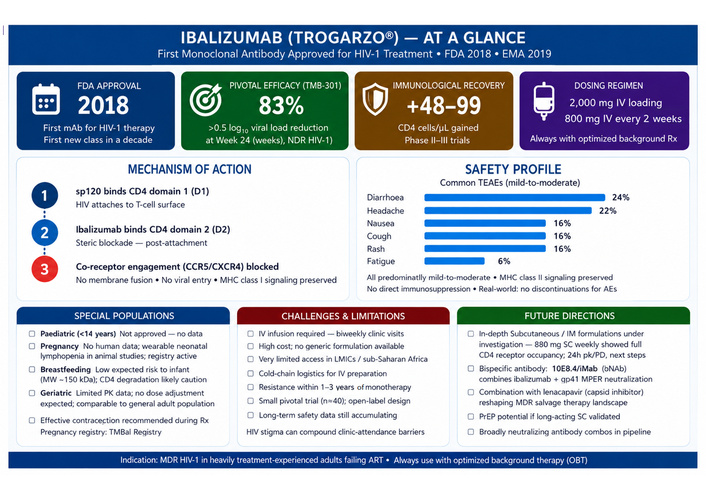
Visual summary of ibalizumab (Trogarzo): mechanism of action, pivotal efficacy, safety profile, special population considerations, limitations, and future research directions [visualised with the aid of CHAT GPT AI]. HIV: human immunodeficiency viru; LMIC: low- and middle-income country.
ADA: anti-drug antibody
AIDS: acquired immunodeficiency syndrome
ART: antiretroviral therapy
bNAbs: broadly neutralising antibodies
D1: domain 1
EMA: European Medicines Agency
ePPND: enhanced pre- and postnatal development
HIV: human immunodeficiency virus
LMIC: low- and middle-income country
mAbs: monoclonal antibodies
MDR: multidrug-resistant
OBR: optimised background regimen
OBT: optimised background therapy
R5: CCR5-tropic
X4: CXCR4-tropic
We ethically used CHAT GPT and Perplexity AI to construct the summative infographic and to proofread for errors and syntax.
The authors would like to acknowledge THE LIND LEAGUE, Nigeria for providing the invaluable resources—human resource and intellectual imbursement—to kick start, culminate and leverage this research project while also enabling our capacities.
PA: Conceptualization, Methodology, Investigation, Formal analysis, Writing—original draft, Writing—review & editing, Visualization, Project administration, Supervision. SB: Methodology, Investigation, Writing—original draft, Writing—review & editing, Validation. EA: Investigation, Writing—original draft, Writing—review & editing. EE: Investigation, Formal analysis, Writing—review & editing, Validation. NM: Investigation, Resources, Writing—review & editing. OA: Investigation, Writing—original draft, Writing—review & editing. NOC: Investigation, Formal analysis, Writing—review & editing. OJN: Investigation, Visualization, Writing—review & editing. BC: Investigation, Writing—review & editing, Validation. VA: Methodology, Validation, Writing—review & editing. AG: Supervision, Validation, Writing—review & editing. JAT: Investigation, Writing—review & editing, Validation. All authors read and approved the submitted version.
The authors declare that there are no conflicts of interest.
Not applicable.
Not applicable.
Not applicable.
Not applicable.
Not applicable.
© The Author(s) 2026.
Open Exploration maintains a neutral stance on jurisdictional claims in published institutional affiliations and maps. All opinions expressed in this article are the personal views of the author(s) and do not represent the stance of the editorial team or the publisher.
Copyright: © The Author(s) 2026. This is an Open Access article licensed under a Creative Commons Attribution 4.0 International License (https://creativecommons.org/licenses/by/4.0/), which permits unrestricted use, sharing, adaptation, distribution and reproduction in any medium or format, for any purpose, even commercially, as long as you give appropriate credit to the original author(s) and the source, provide a link to the Creative Commons license, and indicate if changes were made.



View: 442
Download: 17
Times Cited: 0
Yadessa Tegene Woldie ... Mark Spigt
Violetta Vlasova ... Konstantin Shmagel
Zhimin Huang, Xiaohui Wang
Werner Krause
Yun-Meng Yan ... Qi-Wen Yang
Yang Zhou ... Hongzhou Lu
Faisal Gunu Abdul-Samed ... Gifty Apiung Aninanya


