 Review


Affiliation:
1Department of Internal Medicine, Strasbourg University Hospitals, 67000 Strasbourg, France
2EA Mitochondria and Oxidative Stress, University of Strasbourg, 67000 Strasbourg, France
Email: emmanuel.andres@chru-strasbourg.fr
ORCID: https://orcid.org/0000-0002-7914-7616


 ,
,
Affiliation:
1Department of Internal Medicine, Strasbourg University Hospitals, 67000 Strasbourg, France
ORCID: https://orcid.org/0000-0002-9248-8407
,
Affiliation:
2EA Mitochondria and Oxidative Stress, University of Strasbourg, 67000 Strasbourg, France
3Department of Hygiene and Public Health, Strasbourg University Hospitals, 67000 Strasbourg, France
ORCID: https://orcid.org/0000-0002-5384-072X
Explor Immunol. 2026;6:1003264 DOI: https://doi.org/10.37349/ei.2026.1003264
Received: October 13, 2025 Accepted: April 29, 2026 Published: August 26, 2026
Academic Editor: Lucia Malaguarnera, Università degli Studi di Catania, Italy
The article belongs to the special issue The Nutritional Influence on Immune Functionality
Vitamin B12 (cobalamin) is an essential water-soluble micronutrient serving as a cofactor for key enzymes in one-carbon metabolism and mitochondrial energy production. Beyond its classical roles in hematopoiesis and neurological function, emerging evidence demonstrates that vitamin B12 has emerging immunometabolic roles. Through its role in methionine synthase-dependent one-carbon metabolism, cobalamin contributes to DNA synthesis, methylation reactions, and redox homeostasis—processes critical for the proliferation, differentiation, and function of both innate and adaptive immune cells. Deficiency has been associated with impaired immune responses and may contribute to altered susceptibility to infections and inflammatory disorders. Conversely, adequate cobalamin status restores methylation potential, mitochondrial bioenergetics, and redox homeostasis, potentially supporting T and B cell function and regulatory immune pathways, and modulating pro- and anti-inflammatory cytokine networks. Most evidence derives from deficient or high-risk populations, whereas immunomodulatory effects in vitamin B12-replete individuals remain uncertain. This review provides a comprehensive synthesis of mechanistic and clinical evidence, emphasizing vitamin B12 as a critical immunometabolic regulator and exploring its potential therapeutic applications in immune-mediated and inflammatory disorders.
Vitamin B12, or cobalamin, is a water-soluble corrinoid compound characterized by a cobalt-centered corrin ring. It is synthesized exclusively by certain bacteria and archaea and obtained by humans primarily from animal-derived foods or fortified supplements [1]. Within cells, cobalamin is converted into two coenzymatically active forms—methylcobalamin in the cytosol and adenosylcobalamin in mitochondria—which act as essential cofactors for methionine synthase and methylmalonyl-CoA mutase, respectively [2]. Through these enzymes, vitamin B12 integrates one-carbon metabolism with mitochondrial energy generation, lipid synthesis, and redox regulation [2–4].
Traditionally recognized for its role in erythropoiesis and neuroprotection, vitamin B12 has recently emerged as a pivotal immune-metabolic regulator. Its influence extends beyond hematologic health to encompass the differentiation, proliferation, and effector functions of immune cells [5]. Cobalamin availability shapes DNA methylation landscapes, modulates cytokine networks, and contributes to cellular resilience against oxidative and nitrosative stress. As a result, vitamin B12 links nutrient status to immune competence, providing a biochemical bridge between metabolism and immunity. Understanding these mechanistic connections offers promising insights for preventing or managing infectious, inflammatory, and autoimmune disorders.
This review aims to synthesize current evidence on the immuno-metabolic roles of vitamin B12, emphasizing the underlying biochemical mechanisms through which cobalamin influences innate and adaptive immunity, and to highlight its therapeutic implications in immune-mediated and inflammatory disorders. In this review, the terms vitamin B12 and cobalamin are used interchangeably to denote the family of compounds exhibiting vitamin B12 activity. Specific forms (methylcobalamin, adenosylcobalamin, hydroxocobalamin) are identified when mechanistic specificity is relevant.
Vitamin B12 operates at a metabolic crossroads linking the folate cycle and the methionine cycle. The cobalamin-dependent enzyme methionine synthase remethylates homocysteine to methionine, thereby sustaining the intracellular pool of S-adenosylmethionine (SAM)—the universal methyl donor for DNA, RNA, and histone methylation [3]. Through this function, vitamin B12-dependent methionine synthase activity maintains intracellular SAM availability, thereby influencing methylation-dependent regulation of gene expression, including pathways relevant to immune-cell differentiation [5]. Lymphocyte activation and clonal expansion impose high demands on nucleotide and methyl group synthesis. Adequate vitamin B12 ensures efficient thymidylate and purine production, enabling DNA replication and transcriptional reprogramming during antigen-driven proliferation [6]. In contrast, cobalamin insufficiency limits SAM availability, causing global and promoter-specific DNA hypomethylation, may influence methylation-dependent regulation of immune genes involved in T-cell differentiation and tolerance, although direct evidence for specific loci such as forkhead box P3 (FOXP3) remains limited [7]. These epigenetic perturbations could influence immune-cell differentiation and cytokine production, although direct causal links between vitamin B12 deficiency and autoimmune disease remain incompletely established.
Adenosylcobalamin serves as a cofactor for methylmalonyl-CoA mutase, which converts methylmalonyl-CoA to succinyl-CoA, a crucial intermediate in the tricarboxylic acid (TCA) cycle [3, 6, 8]. This reaction is vital for sustaining oxidative phosphorylation and ATP production in metabolically active immune cells. Macrophages, dendritic cells, and cytotoxic T lymphocytes rely on intact mitochondrial metabolism to fuel phagocytosis, antigen processing, and cytotoxic granule release [9, 10]. By supporting succinyl-CoA generation, vitamin B12 preserves the redox balance required for reactive oxygen species (ROS) formation and microbial killing, while preventing metabolic exhaustion.
In vitamin B12-deficient states, accumulation of methylmalonic acid has been proposed to interfere with mitochondrial metabolism and immune-cell bioenergetics. The alteration of the TCA cycle significantly impacts macrophage viability and function, whose antimicrobial activity depends on sustained mitochondrial energy. Vitamin B12 deficiency could also potentially impair nicotinamide adenine dinucleotide phosphate (NADPH) production by affecting the hexose monophosphate (HMP) shunt, thereby limiting this cofactor essential for the NADPH oxidase-mediated respiratory burst. Lymphocytes, which can shift toward glycolysis upon activation, are relatively less affected, explaining the cell-type specificity observed in experimental models [3, 8].
Beyond its coenzyme roles, cobalamin functions as a redox-active molecule. Vitamin B12 cycles through Cob(I–III) oxidation states, enabling it to function as a vital cofactor for methionine synthase and methylmalonyl-CoA mutase, while also acting as an antioxidant to scavenge ROS, thereby protecting cells from oxidative stress. On the other hand, hydroxocobalamin and related cobalamins interact with nitric oxide (NO) pathways and regulate nitrosative stress [11, 12]. Controlled NO levels are essential for macrophage antimicrobial defense yet detrimental when excessive, leading to tissue injury and chronic inflammation. By buffering NO and maintaining the reduced cellular glutathione pool, vitamin B12 may influence redox-sensitive pathways including nuclear factor kappa-light-chain-enhancer of activated B cells (NF-κB) and Nrf2 signaling, thereby regulating inflammatory gene expression [3, 6, 8]. This antioxidant property underscores its dual role in sustaining innate defense while preventing pathological inflammation.
Cobalamin availability profoundly influences multiple signaling networks that govern immune cell fate and function. Given the central role of nutrient sensing pathways such as mechanistic target of rapamycin (mTOR) and AMP-activated protein kinase (AMPK) in immune-cell metabolism, alterations in B12-dependent metabolism may influence these pathways indirectly [13]. Simultaneously, its redox-modulating properties attenuate NF-κB-mediated transcription of pro-inflammatory cytokines such as IL-6 and tumor necrosis factor alpha (TNF-α), while enhancing STAT5-dependent IL-2 signaling to support T cell expansion [13, 14]. Beyond these canonical pathways, vitamin B12 regulates epigenetic checkpoints through SAM-dependent methylation, influencing histone marks (H3K4me3, H3K27me3) at cytokine promoters and fine-tuning the balance between pro- and anti-inflammatory gene expression [13, 14].
By integrating one-carbon metabolism, mitochondrial energetics, and redox homeostasis, vitamin B12 orchestrates essential physiological processes that underpin immune competence and tolerance. Its deficiency disrupts these interconnected systems, leading to widespread impairment of both innate and adaptive immunity that extends well beyond traditional hematologic manifestations (Table 1; Figure 1).
| Component | Role | Immune relevance | Effect of vitamin B12 deficiency | References |
|---|---|---|---|---|
| Vitamin B12 (cobalamin) | Cofactor for methionine synthase | Maintains DNA synthesis, methylation, and energy metabolism | ↓ SAM formation, DNA hypomethylation, impaired lymphocyte proliferation | [2, 3, 6, 8] |
| Methionine | Amino acid; precursor of SAM | Required for methylation of DNA, RNA, and proteins | ↓ Methionine → defective methylation and altered gene transcription | [5, 8, 13] |
| S-adenosylmethionine (SAM) | Universal methyl donor | Regulates cytokine expression and T cell differentiation via epigenetic mechanisms | ↓ SAM → dysregulated cytokine expression, potential alteration of cytokine programs | [2, 3, 8] |
| Folate | Cofactor in one-carbon metabolism | Supports nucleotide synthesis and cell division | Deficiency → similar functional consequences as vitamin B12 deficiency | [3, 13, 14] |
Overview of biochemical roles of vitamin B12 (cobalamin) in one-carbon metabolism, energy production, and redox regulation.
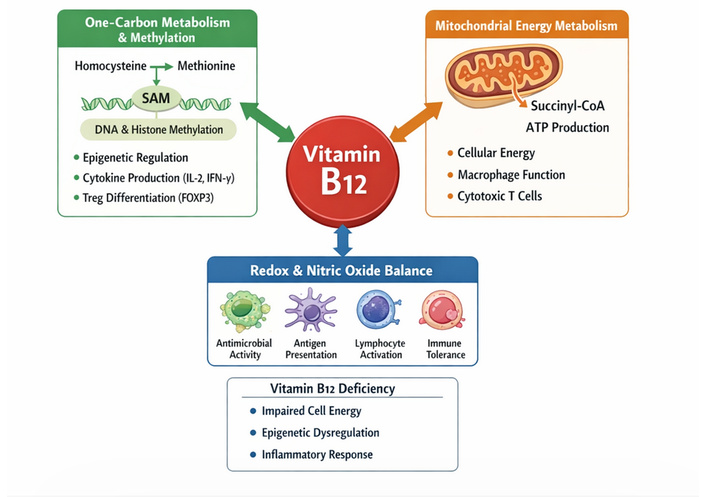
Vitamin B12 as a central integrator of one-carbon metabolism, mitochondrial function, and redox homeostasis in immune regulation [2, 3, 5, 6, 8, 13, 14]. Vitamin B12 (cobalamin) coordinates three interconnected metabolic pathways that collectively regulate innate and adaptive immune responses. One-carbon metabolism and methylation (left panel): vitamin B12 acts as a cofactor for methionine synthase, enabling the remethylation of homocysteine to methionine and sustaining intracellular SAM levels. This supports DNA, RNA, and histone methylation, thereby regulating epigenetic programming of immune-related genes involved in lymphocyte proliferation, cytokine production (e.g., IL-2, IFN-γ), and regulatory T cell (Treg) differentiation (FOXP3). Mitochondrial energy metabolism (right panel): in its adenosylcobalamin form, vitamin B12 is required for methylmalonyl-CoA mutase activity, generating succinyl-CoA for the TCA cycle. This sustains oxidative phosphorylation, ATP production, and metabolic fitness of immune cells, particularly macrophages, dendritic cells, and cytotoxic T lymphocytes, which depend on mitochondrial function for effector responses. Redox and NO balance (bottom panel): vitamin B12 functions as a redox-active molecule that scavenges ROS and modulates NO levels. By maintaining glutathione homeostasis and regulating redox-sensitive transcription factors (e.g., NF-κB, Nrf2), it fine-tunes inflammatory signaling and prevents excessive tissue damage. Integrated immune outcomes (central node): through these pathways, vitamin B12 supports antimicrobial activity, antigen presentation, lymphocyte activation, and immune tolerance. Deficiency state: vitamin B12 deficiency disrupts these processes, leading to impaired mitochondrial energy production, reduced methylation capacity, redox imbalance, dysregulated cytokine responses, and increased susceptibility to chronic inflammation and autoimmunity.
Deficiency in vitamin B12, whether due to dietary insufficiency, malabsorption, or autoimmune destruction of intrinsic factor, disrupts multiple immuno-metabolic pathways. Because cobalamin integrates one-carbon metabolism with mitochondrial function and redox regulation, its absence affects DNA synthesis, methylation, and energy homeostasis in virtually all immune cell types. The resulting imbalance manifests as impaired proliferation, altered cytokine signaling, increased oxidative stress, and loss of immune tolerance. Deficiency of vitamin B12 results in impaired methylation, reduced mitochondrial energy production, and redox disequilibrium, which together dysregulate cytokine expression and promote persistent inflammatory activation (Table 2).
| Immune cell | Vitamin B12 optimal status | Vitamin B12 deficiency | Consequences | Mechanisms | References |
|---|---|---|---|---|---|
| Macrophages | Phagocytosis, ROS, NO production | Impaired function | Reduced bacterial killing (experimental models) | Reduced mitochondrial energy; decreased adenosylcobalamin-dependent TCA cycle flux | [2, 13, 14] |
| Neutrophils | Chemotaxis, ROS generation | Impaired migration | Reduced pathogen clearance | Impaired energy metabolism; altered NADPH production via HMP shunt | [2, 14] |
| NK cells | Cytotoxicity, proliferation | Decreased activity | Reduced anti-viral/tumor responses | Altered signaling; impaired proliferation and function | [2, 13, 14] |
| Cytokines | IL-6, TNF-α, IL-10 regulation | Dysregulated | Pro-inflammatory shift | NF-κB modulation; redox-sensitive pathways | [13, 14] |
HMP: hexose monophosphate; NADPH: nicotinamide adenine dinucleotide phosphate; NF-κB: nuclear factor kappa-light-chain-enhancer of activated B cells; NK: natural killer; NO: nitric oxide; ROS: reactive oxygen species; TCA: tricarboxylic acid; TNF-α: tumor necrosis factor alpha.
Among innate immune cells, macrophages may be particularly vulnerable because their antimicrobial functions depend strongly on metabolic adaptation. Their antimicrobial activity depends heavily on mitochondrial oxidative phosphorylation and the TCA cycle. When adenosylcobalamin levels fall, conversion of methylmalonyl-CoA to succinyl-CoA slows, limiting TCA flux and ATP generation. This metabolic bottleneck reduces the availability of NADH and flavin adenine dinucleotide (FADH2) needed for oxidative phosphorylation. Indirect effects on redox metabolism, including NADPH availability, have been proposed but remain insufficiently characterized. Consequently, macrophage antimicrobial functions may be impaired through altered mitochondrial metabolism and redox imbalance [4, 9, 10]. Importantly, this phenomenon is not exclusive to macrophages, but is most apparent in them because their effector functions are energy-intensive and closely tied to mitochondrial output. Neutrophils and dendritic cells, which rely more on glycolysis for acute responses, exhibit subtler mitochondrial defects. Experimental data suggest that altered cobalamin availability may influence macrophage inflammatory polarization. Supplementation reverses this profile, promoting M2-like, tissue-repairing characteristics [14].
Neutrophils from B12-deficient individuals display reduced chemotaxis and deformability, partly due to impaired actin polymerization caused by low ATP and altered methylation of cytoskeletal regulatory proteins [15–17]. NK cells exhibit diminished cytotoxicity and IFN-γ release, reflecting both decreased energy availability and suppressed IL-12 signaling [14].
The apparent contradictions in IL-10 modulation reflect the context-dependent nature of immune responses to vitamin B12 status. In deficiency, an early compensatory increase in IL-10 may arise as part of an anti-inflammatory feedback mechanism aimed at counterbalancing elevated pro-inflammatory cytokines such as TNF-α and IL-6 [12]. The relationship between vitamin B12 status and IL-10 production appears context-dependent and requires further investigation. Conversely, during supplementation or repletion, IL-10 levels rise again, reflecting the restoration of regulatory signaling through NF-κB inhibition and normalization of redox balance, rather than a simple compensatory response [13, 14]. In essence, the direction of IL-10 change depends on the immune context: it rises as a brake during deficiency-driven inflammation and rises again upon repletion as a sign of restored homeostasis. These temporally and mechanistically distinct effects illustrate how vitamin B12 dynamically tunes immune regulation, influencing both the initiation and resolution phases of inflammation.
Adaptive immunity requires coordinated DNA synthesis, methylation, and energy metabolism. Cobalamin deficiency disrupts these processes, altering both T and B cell responses (Table 3).
| Cell type | Function | Effect of vitamin B12 deficiency | References |
|---|---|---|---|
| CD8+ T cells | Cytotoxic response | Reduced numbers; altered CD4+/CD8+ ratio. CD8+ cells depend strongly on mitochondrial oxidative metabolism and one-carbon flux for cytotoxic granule synthesis and proliferation. | [11, 12] |
| CD4+ T cells | Helper function; Th1/Th2 balance | Shift to Th2; reduced IFN-γ, increased IL-4 & IL-10. CD4+ helper cells can partially compensate via glycolytic reprogramming, resulting in less pronounced quantitative loss. | [11, 12] |
| Treg (FOXP3+) cells (added) | Immune tolerance; FOXP3-dependent suppression | Impaired methylation-dependent stability of FOXP3 expression → impaired Treg differentiation → loss of peripheral tolerance; disproportionately affected due to constitutive methylation-dependence of FOXP3 expression. | [11, 12, 17] |
| B cells | Antibody synthesis | Decreased IgG & IgA; impaired germinal center formation. | [12, 17] |
Impact of vitamin B12 deficiency on lymphocyte subsets and humoral immunity. FOXP3: forkhead box P3; Treg: regulatory T cell.
Cobalamin deficiency leads to lymphopenia, especially affecting CD8+ cytotoxic T cells, while CD4+ helper cells are relatively spared [11]. This selective vulnerability arises because CD8+ cells rely heavily on oxidative phosphorylation and one-carbon flux to sustain cytotoxic granule synthesis and proliferation. Their mitochondrial dependence makes them more sensitive to decreased succinyl-CoA and ATP. CD4+ cells can partially shift toward glycolysis, preserving their numbers but with functional alterations. Mechanistically, vitamin B12 deficiency limits SAM production, causing DNA and histone hypomethylation at promoters of key T cell transcription factors. Hypomethylation of IFN-γ and IL-4 promoters leads to dysregulated cytokine balance. Among Tregs, FOXP3+ Tregs are disproportionately affected because their differentiation and suppressive function are critically dependent on stable FOXP3 promoter methylation, which requires adequate SAM availability. Because Treg biology depends on stable epigenetic regulation of FOXP3 expression, disturbances in one-carbon metabolism could theoretically affect regulatory T-cell homeostasis; however, direct evidence linking vitamin B12 deficiency to FOXP3 methylation in humans remains limited [7, 18]. Consequently, Treg numbers decline and peripheral tolerance is compromised. While other CD4+ subsets (Th1, Th2, Th17) are also influenced by methylation changes, the FOXP3+ Treg population appears uniquely sensitive because FOXP3 expression is constitutively methylation-dependent and cannot be easily compensated by alternative transcriptional pathways. Furthermore, reduced methylation of FOXP3 impairs Treg differentiation, diminishing immune tolerance and predisposing to autoimmunity [11, 12, 14].
Vitamin B12 supports Th1 polarization by enhancing IFN-γ and IL-2 production via STAT4 and T-bet activation. Deficiency shifts differentiation toward Th2 and Th17 phenotypes, increasing IL-4, IL-5, and IL-17A levels [12]. This Th2 bias weakens antimicrobial defense and promotes allergic or autoimmune tendencies. Restoration of vitamin B12 rebalances Th1/Th2 differentiation through methylation-dependent transcriptional control of cytokine genes.
In B cells, vitamin B12 deficiency reduces proliferation, germinal-center formation, and immunoglobulin synthesis. Experimental models show decreased serum IgG and IgA, impaired class-switch recombination, and weaker antibody responses to vaccines [17]. The mechanism involves defective nucleotide synthesis, diminished energy for antibody secretion, and altered methylation of immunoglobulin gene promoters. Vitamin B12 repletion restores both quantitative and qualitative antibody responses.
Cobalamin deficiency causes hyperhomocysteinemia, as methionine synthase activity declines and homocysteine remethylation falters. Elevated homocysteine exerts pro-oxidant and pro-inflammatory effects: it generates ROS, activates NF-κB, and stimulates release of IL-1β, IL-6, and TNF-α [9]. At the same time, it disrupts endothelial NO synthase (eNOS) coupling, leading to nitrosative stress and vascular inflammation. Hydroxocobalamin acts as a physiological NO scavenger; its depletion allows uncontrolled NO accumulation and peroxynitrite formation. These reactive species damage cellular proteins, DNA, and lipids, perpetuating chronic inflammation and impairing immune signaling. Restoration of cobalamin normalizes NO metabolism, re-establishes redox balance, and limits inflammatory gene transcription.
Cobalamin plays a dual role in the gut ecosystem—both as a microbial nutrient and as a determinant of host-microbe symbiosis. Deficiency alters microbial composition, favoring pro-inflammatory taxa such as Enterobacteriaceae while reducing beneficial Bifidobacterium and Lactobacillus species [10, 15]. These changes promote intestinal inflammation, barrier dysfunction, and systemic immune activation. Mechanistically, microbial competition for vitamin B12 affects production of short-chain fatty acids (SCFAs), especially butyrate, which regulates Treg differentiation and IL-10 expression. Thus, vitamin B12 indirectly influences peripheral immune tolerance through microbiota-derived metabolites [7]. Experimental studies indicate that vitamin B12 availability influences microbial composition and ecological competition, while microbiota-derived SCFAs regulate T-cell responses and immune tolerance [19–21]. Whether vitamin B12 supplementation reproducibly restores microbiome diversity in humans remains uncertain.
Altered cobalamin metabolism has been reported in autoimmune diseases, including systemic lupus erythematosus, although whether deficiency contributes to disease pathogenesis or reflects inflammatory activity remains unresolved [22, 23]. While causality remains debated, mechanistic studies indicate that vitamin B12 deficiency contributes to loss of immune tolerance through epigenetic dysregulation. Impaired methylation-dependent stability of FOXP3 expression reduces Treg numbers, while aberrant methylation of cytokine genes enhances autoreactive Th17 responses [16]. However, disentangling cause from consequence presents a genuine challenge. Chronic inflammation itself suppresses expression of transcobalamin II, impairing cellular uptake of vitamin B12 and creating a vicious cycle: deficiency worsens inflammation, and inflammation deepens deficiency [19–21, 24]. This bidirectional relationship is consistent with findings in rheumatoid arthritis and lupus, where low vitamin B12 correlates with disease activity rather than simply reflecting nutritional insufficiency (Table 4). Mendelian randomization analyses, while still limited for this specific question, provide a potential avenue to establish directionality; preliminary data suggest that genetically predicted low vitamin B12 bioavailability is associated with elevated inflammatory markers, supporting a causal contribution of deficiency to immune dysregulation. Nonetheless, supplementation in the context of active inflammation may be insufficient to reverse immune dysfunction without concurrent treatment of the underlying disease, underscoring the importance of integrated management.
| Condition | Immune effect | Mechanism/Observations | References |
|---|---|---|---|
| Autoimmune diseases (multiple sclerosis, rheumatoid arthritis, systemic lupus erythematosus) | Reduced Treg numbers, impaired tolerance | FOXP3 hypomethylation; dysregulated Th1/Th2 balance | [4, 19, 20, 23] |
| Immunosenescence/Aging | Reduced T cell repertoire, decreased NK activity, poor vaccine response | Deficient vitamin B12 → impaired proliferation, elevated homocysteine | [4, 19, 21, 23–25] |
| Infectious diseases | Increased susceptibility to bacterial and viral infections | Impaired macrophage activation, reduced interferon production | [4, 19–21, 23, 25] |
| Chronic inflammatory diseases (diabetes, atherosclerosis) | Endothelial inflammation, oxidative stress | Elevated homocysteine; impaired nitric oxide (NO) metabolism | [4, 19–21, 23, 25] |
| Dysbiosis/Gut immune dysregulation | Altered SCFA production, Treg differentiation | Reduced beneficial microbiota, increased pro-inflammatory taxa | [21, 24–27] |
Summary of major clinical conditions associated with vitamin B12 deficiency and immunological consequences. FOXP3: forkhead box P3; NK: natural killer; SCFA: short-chain fatty acid; Treg: regulatory T cell.
Aging is characterized by immunosenescence and chronic low-grade inflammation (inflammaging). Vitamin B12 deficiency, common in older adults due to gastric atrophy or malabsorption, exacerbates these processes. It contributes to telomere shortening, reduced T cell repertoire diversity, and elevated homocysteine levels, all of which impair immune responsiveness [4, 23]. Mechanistically, inadequate methylation accelerates DNA damage and compromises mitochondrial biogenesis. As with autoimmunity, the direction of causality is not always clear: aging-related chronic inflammation may itself impair transcobalamin II-mediated vitamin B12 uptake, creating a feedback loop in which inflammaging further depletes functional cobalamin status. This compounds the nutritional deficiency that is already prevalent in elderly individuals, suggesting that screening for vitamin B12 insufficiency should be routine in aging populations rather than triggered solely by overt symptoms. Vitamin B12 deficiency is common in older adults and may contribute to impaired immune responsiveness through effects on lymphocyte function, mitochondrial metabolism and inflammation [24, 25]. Maintaining optimal cobalamin status therefore supports immune resilience in aging populations.
Restoration of vitamin B12 status represents not only a correction of a nutritional deficiency but also a targeted immuno-metabolic intervention. Through its role in one-carbon metabolism, mitochondrial function, and redox balance, cobalamin supplementation can recalibrate immune homeostasis. This section summarizes the mechanistic rationale, clinical evidence, and formulation-specific considerations for vitamin B12 therapy in immune modulation.
Three principal forms of cobalamin are employed clinically, each with distinct biochemical properties and therapeutic advantages [2]. Cyanocobalamin is a stable synthetic derivative that requires intracellular conversion to the active coenzymes, methylcobalamin and adenosylcobalamin, to exert its metabolic functions. Hydroxocobalamin, a naturally occurring form, is characterized by high plasma retention, efficient tissue uptake, and potent NO-scavenging activity, which enables it to neutralize reactive nitrogen species such as peroxynitrite; these properties make it the preferred choice for parenteral therapy due to its prolonged half-life and dual metabolic and redox benefits [2, 25]. Methylcobalamin and adenosylcobalamin are the biologically active coenzymes that directly serve as cofactors for methionine synthase and methylmalonyl-CoA mutase, respectively, facilitating DNA synthesis, methylation reactions, and mitochondrial energy production. Methylcobalamin, in particular, is increasingly applied in neuro-immunologic conditions for its combined epigenetic and antioxidant effects, supporting neural repair and modulating immune signaling [26]. Collectively, these pharmacologic distinctions underscore the importance of selecting the appropriate cobalamin form based on therapeutic goals, whether correcting systemic deficiency, modulating immune responses, or targeting neuroinflammatory processes.
Vitamin B12 supplementation exerts multifaceted restorative effects on immune and metabolic functions. Re-establishment of methylation capacity occurs as intracellular cobalamin pools are replenished, reactivating methionine synthase and regenerating SAM, which normalizes DNA and histone methylation, represses pro-inflammatory gene expression, and enhances regulatory pathways [2, 25]. In lymphocytes, this translates into restored FOXP3 promoter methylation and expansion of functional Treg populations [2, 23, 27]. Mitochondrial and bioenergetic recovery is mediated by adenosylcobalamin-dependent activation of methylmalonyl-CoA mutase, restoring TCA cycle flux and oxidative phosphorylation; in macrophages, this supports phagocytosis and antigen processing, while in T cells it reinforces proliferation, differentiation, and memory formation [25]. Redox and NO modulation is achieved through hydroxocobalamin’s high affinity for NO, which neutralizes excess NO and peroxynitrite, protecting mitochondrial enzymes and DNA from nitrosative damage and improving endothelial function, while reducing pro-inflammatory cytokines such as IL-6 and TNF-α [2]. Finally, cytokine and signaling normalization occurs as supplementation rebalances immune mediators: IL-1β, IL-6, and TNF-α decrease, whereas IL-2, IFN-γ, and IL-10 recover, reflecting restored regulatory and effector signaling; concurrent reactivation of mTOR and STAT5 pathways shifts immune cells from catabolic to anabolic states, promoting efficient renewal and functional competence [2].
Some clinical and experimental studies suggest potential benefits of vitamin B12 supplementation across a range of immune-related conditions, though the most robust evidence relates to deficient populations. Experimental and clinical observations suggest that vitamin B12-related methylation pathways may influence inflammatory responses during viral infection [23]. In humans, low serum vitamin B12 is associated with heightened susceptibility and severity of respiratory infections, particularly among elderly or malnourished individuals [26]. Hydroxocobalamin has also been explored as an adjunct therapy in sepsis, where its NO-scavenging properties may stabilize hemodynamics and dampen inflammatory cascades, although large controlled trials are lacking.
In autoimmune and inflammatory disorders such as rheumatoid arthritis and multiple sclerosis, some studies report that vitamin B12 supplementation improves fatigue, reduces systemic inflammatory markers, and partially restores Treg/Th17 balance [13]. Mechanistically, methylcobalamin restores DNA methylation at FOXP3 and IL-17A promoters, reinforcing immune tolerance and regulatory network integrity. Neuroinflammatory conditions also benefit from vitamin B12’s dual neuroprotective and immuno-regulatory effects; in peripheral neuropathies and neurodegenerative diseases, supplementation enhances axonal repair, reduces microglial activation, and, in combination with folate and vitamin B6, optimizes remethylation and mitigates homocysteine-induced oxidative stress in neural and immune tissues [16].
Among aging populations, correcting vitamin B12 deficiency restores NK cell activity, lowers homocysteine, improves vaccine responsiveness, and is associated with reduced infection rates and inflammatory biomarkers [28], underscoring its role in counteracting immunosenescence. Collectively, these findings support integration of routine vitamin B12 assessment, using serum vitamin B12 or holotranscobalamin measurements, and targeted supplementation into comprehensive strategies for maintaining immune competence in individuals with chronic inflammation, autoimmune disorders, or recurrent infections, ensuring that correction of deficiency complements standard immunomodulatory or antimicrobial therapies.
Vitamin B12 (cobalamin) stands at the crossroads of metabolism and immunity, orchestrating cellular mechanisms essential for both energy production and immune competence. As a cofactor for methionine synthase and methylmalonyl-CoA mutase, it links cytosolic one-carbon metabolism to mitochondrial oxidative pathways, thereby integrating epigenetic regulation, bioenergetic efficiency, and redox homeostasis. By sustaining SAM-dependent DNA and histone methylation, cobalamin modulates cytokine gene expression and T cell differentiation; by enabling succinyl-CoA generation, it supports mitochondrial ATP production in metabolically active immune cells; and through the NO-scavenging activity of hydroxocobalamin, it preserves redox balance and controls inflammatory signaling. Deficiency in vitamin B12 disrupts these interconnected processes, resulting in impaired lymphocyte proliferation, abnormal cytokine polarization, diminished phagocytic capacity, and loss of immune tolerance—culminating clinically in heightened susceptibility to infections, chronic inflammation, and a greater risk of autoimmune disorders.
Recent research has redefined vitamin B12 as more than a hematologic factor, positioning it as a central immunometabolic regulator that integrates metabolic, epigenetic, and inflammatory signaling. Its deficiency not only induces anemia but also perturbs systemic immune tone by disrupting methionine and SAM pools, thereby altering cytokine networks and mitochondrial function. Restoration of adequate cobalamin status normalizes one-carbon flux, re-establishes balanced cytokine expression, and enhances mitochondrial resilience, forming the biochemical basis for improved immune homeostasis. Clinical evidence increasingly supports the immunomodulatory benefits of vitamin B12 supplementation: it strengthens macrophage and T cell effector functions in infectious diseases, promotes FOXP3-dependent immune tolerance and cytokine downregulation in autoimmunity, and mitigates immunosenescence while improving vaccine responsiveness in aging populations. Collectively, these findings underscore the rationale for integrating vitamin B12 evaluation and targeted supplementation into both preventive and therapeutic strategies for immune-mediated disorders.
A unifying concept emerging from recent evidence is that cobalamin operates as an immunometabolic sensor, translating cellular energetic and methylation states into immune regulatory signals. Through its coenzyme-dependent roles in methionine and mitochondrial metabolism, vitamin B12 links metabolic sufficiency to immune equilibrium. When cobalamin levels are adequate, efficient energy production and methylation processes maintain immune vigilance while restraining excessive inflammation. Conversely, deficiency induces metabolic stress and DNA hypomethylation, triggering compensatory activation of pro-inflammatory pathways such as NF-κB, IL-6, and TNF-α, which collectively drive immune dysregulation. In this way, vitamin B12 status dynamically governs the continuum between immune activation and tolerance—an essential homeostatic axis influencing resilience against infection, the pace of immunosenescence, and the progression of chronic inflammatory disease.
Several critical directions for future research emerge from current insights into cobalamin biology. Mechanistic studies employing high-resolution epigenomic profiling are needed to delineate vitamin B12-dependent methylation signatures within distinct immune subsets such as Tregs, Th17 cells, and macrophages. Well-designed randomized controlled trials should further differentiate the outcomes of replacement therapy in deficient individuals from those of immunomodulatory supplementation in normocobalamin states. Mendelian randomization analyses are particularly warranted to disentangle the causal contribution of vitamin B12 status to immune-mediated disease from reverse causation due to inflammation-driven depletion. Integrative systems biology approaches combining metabolomics, methylomics, and microbiome analyses may elucidate how cobalamin modulates the host-microbe-immune interface. Finally, the development of next-generation cobalamin analogs or delivery systems targeting mitochondrial or redox pathways represents a promising avenue to enhance the precision and therapeutic efficacy of vitamin B12-based interventions in inflammatory and autoimmune diseases.
Vitamin B12 exemplifies the intricate molecular interplay between nutrition and immunity. Beyond its classical role in hematopoiesis, cobalamin functions as a master integrator of metabolic flux, redox regulation, and immune signaling, orchestrating the cellular processes that preserve immune competence and tolerance. Recognizing this multidimensional role transforms vitamin B12 from a basic nutrient into a strategic modulator of immunologic resilience. Ensuring optimal cobalamin status, therefore, transcends the prevention of deficiency—it becomes a proactive approach to counteracting chronic inflammation, metabolic stress, and immune dysregulation that characterize modern disease landscapes.
AMPK: AMP-activated protein kinase
FOXP3: forkhead box P3
HMP: hexose monophosphate
mTOR: mechanistic target of rapamycin
NADPH: nicotinamide adenine dinucleotide phosphate
NF-κB: nuclear factor kappa-light-chain-enhancer of activated B cells
NK: natural killer
NO: nitric oxide
ROS: reactive oxygen species
SAM: S-adenosylmethionine
SCFAs: short-chain fatty acids
TCA: tricarboxylic acid
TNF-α: tumor necrosis factor alpha
Treg: regulatory T cell
AI-Assisted Work Statement: During the preparation of this work, author(s) used ChatGPT for assistance in generating Figure 1. After using the tool, author(s) reviewed and edited the content as needed and take(s) full responsibility for the content of the publication.
The authors wish to sincerely thank the patients and clinicians of the Strasbourg B12 research group (CARE B12) at the Hôpitaux Universitaires de Strasbourg (HUS, France) for their invaluable contributions to this study.
EA: Conceptualization, Investigation, Writing—original draft, Writing—review & editing. NLV: Conceptualization, Investigation, Writing—original draft, Writing—review & editing. TL: Validation, Writing—review & editing, Supervision. All authors read and approved the submitted version.
The authors declare no conflict of interest.
Not applicable.
Not applicable.
Not applicable.
Not applicable.
Not applicable.
© The Author(s) 2026.
Open Exploration maintains a neutral stance on jurisdictional claims in published institutional affiliations and maps. All opinions expressed in this article are the personal views of the author(s) and do not represent the stance of the editorial team or the publisher.
Copyright: © The Author(s) 2026. This is an Open Access article licensed under a Creative Commons Attribution 4.0 International License (https://creativecommons.org/licenses/by/4.0/), which permits unrestricted use, sharing, adaptation, distribution and reproduction in any medium or format, for any purpose, even commercially, as long as you give appropriate credit to the original author(s) and the source, provide a link to the Creative Commons license, and indicate if changes were made.



View: 727
Download: 24
Times Cited: 0
Yuko Tanaka ... Tohru Sakai
Hebe Mendez, Ger Rijkers
Beatriz Elina Martínez-Carrillo ... Ana Laura Guadarrama-López


