 Commentary


Affiliation:
1Higher Institute of Sport and Physical Education of Ksar-Said, University of Manouba, Manouba 2010, Tunisia

Affiliation:
1Higher Institute of Sport and Physical Education of Ksar-Said, University of Manouba, Manouba 2010, Tunisia
ORCID: https://orcid.org/0000-0003-1351-8717
 ,
,
Affiliation:
2Faculty of Medical Sciences, UM6P Hospitals, Mohammed VI Polytechnic University, Benguerir 43150, Morocco
3International Institute of Sport Sciences (2I2S), 35000 Rennes, France
ORCID: https://orcid.org/0000-0001-8160-3871
,
Affiliation:
4Sport Sciences Research Centre, Rey Juan Carlos University, 28933 Madrid, Spain
5Institute of Health and Sport Sciences, Faculty of Health Sciences, Universidad Francisco de Vitoria, 28223 Madrid, Spain
ORCID: https://orcid.org/0000-0002-5785-984X
,
Affiliation:
3International Institute of Sport Sciences (2I2S), 35000 Rennes, France
Email: hassane.zouhal@gmail.com
ORCID: https://orcid.org/0000-0001-6743-6464

Explor Immunol. 2026;6:1003265 DOI: https://doi.org/10.37349/ei.2026.1003265
Received: November 06, 2025 Accepted: August 07, 2026 Published: August 26, 2026
Academic Editor: Federico Greco, Università Campus Bio-Medico di Roma, Italy; Calogero Caruso, University of Palermo, Palermo, Italy
Obesity is a multifactorial metabolic disorder associated with increased risk of several malignancies and systemic immune dysfunction. Epidemiological evidence indicates that excess adiposity increases the risk of cancers across multiple anatomical sites, including the endometrium, kidney, pancreas, and colon [1]. Mechanistically, hypertrophic adipose tissue becomes metabolically and immunologically active, secreting pro-inflammatory cytokines such as interleukin-6 (IL-6) and tumor necrosis factor-α (TNF-α), thereby sustaining chronic low-grade inflammation [2, 3]. This inflammatory environment promotes tumor progression, disrupts immune surveillance, and contributes to metabolic disturbances including insulin resistance and dyslipidemia [4].
Within this context, leptin, an adipocyte-derived hormone, has emerged as a central regulator at the interface between metabolism and immunity. While leptin is primarily known for its role in appetite regulation and energy homeostasis, it also exerts significant immunomodulatory effects through leptin receptors (Ob-R) expressed on immune cells. In obesity, chronic hyperleptinemia combined with leptin resistance leads to impaired intracellular signaling, ultimately contributing to immune dysfunction [5, 6] (Figure 1).
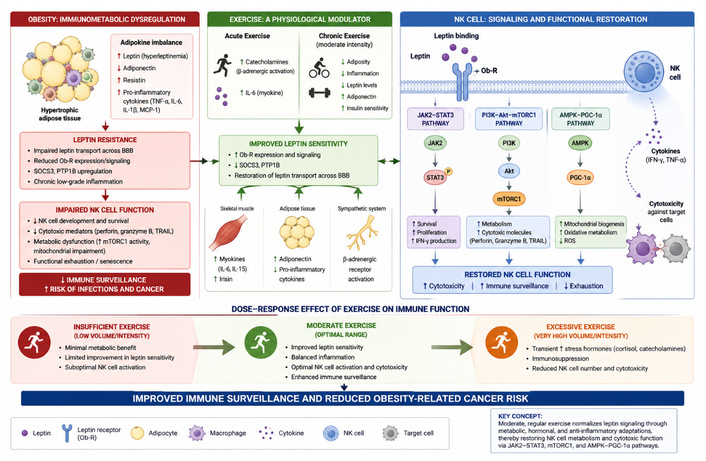
Exercise restores leptin sensitivity and natural killer (NK) cell function in obesity: an integrative mechanistic model. This conceptual model illustrates the bidirectional interactions between adiposity, leptin signaling, and NK cell function, and how physical exercise modulates this axis. In obesity, adipose tissue expansion leads to chronic hyperleptinemia and the development of leptin resistance. This state is characterized by impaired leptin receptor (Ob-R) signaling, including reduced activation of the Janus kinase 2/signal transducer and activator of transcription 3 (JAK2–STAT3) pathway and dysregulation of phosphoinositide 3-kinase/protein kinase B/mammalian target of rapamycin complex 1 (PI3K–Akt–mTORC1) signaling. These alterations result in defective NK cell metabolism, reduced mitochondrial function, decreased expression of cytotoxic mediators (e.g., perforin, TRAIL), and an overall exhausted NK cell phenotype, contributing to impaired immune surveillance and increased cancer risk. Physical exercise acts as a central modulatory stimulus. Through reductions in adiposity and systemic inflammation, exercise improves leptin sensitivity and partially restores downstream signaling pathways. Exercise may also shift the adipokine profile toward a more anti-inflammatory state, including increased adiponectin signaling. Adiponectin can counterbalance leptin-driven pro-inflammatory effects and may indirectly support NK cell metabolic fitness by improving systemic insulin sensitivity, reducing inflammatory stress, and promoting more favorable immunometabolic conditions. Concurrently, exercise activates AMP-activated protein kinase (AMPK) and peroxisome proliferator-activated receptor gamma coactivator 1-alpha (PGC-1α), promoting mitochondrial biogenesis and metabolic flexibility in NK cells. β-adrenergic signaling and exercise-induced cytokines (e.g., IL-6) further enhance NK cell mobilization and activation. Importantly, the effects of exercise are dose-dependent. Moderate, regular exercise optimizes immunometabolic adaptations, leading to restoration of NK cell cytotoxicity and improved immune surveillance. In contrast, insufficient exercise provides limited benefits, while excessive or prolonged high-intensity exercise may transiently suppress immune function. Overall, the model highlights exercise as a key integrative factor capable of restoring leptin signaling and reprogramming NK cell function within the broader context of obesity-related immune dysregulation.
Natural killer (NK) cells, a key component of innate immunity, are particularly sensitive to leptin dysregulation. These cells play a crucial role in early defense against tumors and infections through their cytotoxic activity and cytokine production. However, obesity-induced leptin resistance impairs NK cell function by disrupting critical signaling pathways, notably Janus kinase 2/signal transducer and activator of transcription 3 (JAK2–STAT3) and phosphoinositide 3-kinase/protein kinase B/mammalian target of rapamycin complex 1 (PI3K–Akt–mTORC1). This results in reduced NK cell proliferation, impaired cytotoxic mediator expression (e.g., perforin, TRAIL), and metabolic exhaustion [7].
A recent review has comprehensively described the mechanisms linking leptin signaling to NK cell dysfunction in obesity [7]. Building upon this foundation, the present commentary proposes that physical exercise represents a critical, yet underexplored, modulatory component of the leptin–NK cell axis. Specifically, we introduce an integrative immunometabolic framework in which exercise acts as a physiological regulator capable of restoring leptin sensitivity, reprogramming NK cell metabolism, and enhancing immune surveillance.
Leptin regulates NK cell development, survival, and function through multiple intracellular pathways. Under physiological conditions, leptin binding to Ob-R activates JAK2–STAT3 signaling, promoting transcription of genes involved in cell proliferation and cytotoxicity. In parallel, the PI3K–Akt–mTORC1 pathway supports cellular metabolism and effector function [8]. In obesity, persistent hyperleptinemia induces leptin resistance, characterized by reduced receptor sensitivity and increased expression of suppressor of cytokine signaling 3 (SOCS3). This leads to impaired JAK2 phosphorylation and downstream STAT3 activation, resulting in diminished NK cell responsiveness. Concurrently, dysregulation of mTORC1 signaling alters cellular bioenergetics, limiting glycolytic capacity and mitochondrial function. These alterations collectively contribute to an exhausted NK cell phenotype with reduced antitumor activity [8]. Murine studies using Ob-R-deficient (db/db) mice confirm that Ob-R deficiency significantly reduces NK cell numbers and function across tissues [5]. These findings suggest that obesity-induced leptin resistance compromises NK-mediated immune surveillance and may contribute to increased cancer susceptibility [7]. Importantly, leptin does not act in isolation. Other adipokines, such as adiponectin, and inflammatory mediators further modulate immune responses, highlighting the complexity of obesity-related immune dysregulation. These alterations appear reversible following significant weight reduction or lifestyle interventions combining diet and exercise (Figure 1).
Physical exercise is a potent regulator of both metabolic and immune homeostasis. Regular exercise reduces adiposity, improves insulin sensitivity, and modulates adipokine secretion. Notably, exercise decreases circulating leptin levels and improves leptin sensitivity, even in the absence of substantial weight loss [9].
At the immune level, exercise influences NK cell dynamics through both acute and chronic adaptations. Acute exercise induces transient mobilization of NK cells into circulation via catecholamine and IL-6-mediated mechanisms, enhancing cytotoxic activity. Chronic training, in contrast, may promote sustained improvements in NK cell function over time [10–12], although recent evidence suggests that effects on resting circulating NK cell counts and NK cell activity are heterogeneous and not consistently significant across clinical populations [13].
Mechanistically, Figure 2 presents the integrative pathway showing that exercise restores leptin signaling to enhance NK cell metabolic fitness and cytotoxic function via JAK2–STAT3 and mTORC1 pathways. In addition, exercise activates AMP-activated protein kinase (AMPK) and peroxisome proliferator-activated receptor gamma coactivator 1-alpha (PGC-1α), promoting mitochondrial biogenesis and metabolic flexibility. This metabolic reprogramming counteracts NK cell exhaustion and restores immune competence [10–12]. Importantly, the effects of exercise appear to be dose-dependent. Moderate, regular exercise optimizes immunometabolic responses, whereas excessive or prolonged high-intensity exercise may transiently suppress immune function. This highlights the need for precise exercise prescription (Figure 1).
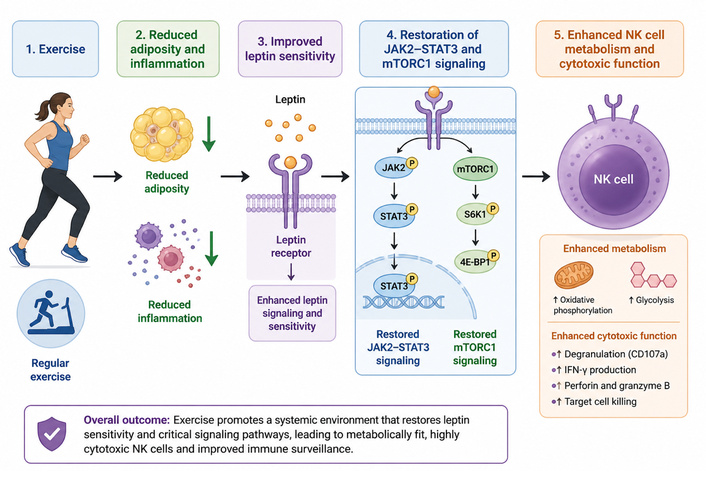
Exercise-induced restoration of leptin signaling enhances natural killer (NK) cell metabolism and cytotoxicity.
Recent advances in immunometabolism emphasize the central role of cellular bioenergetics in immune function. In obesity, chronic inflammation and leptin resistance drive metabolic dysfunction in NK cells, characterized by impaired glycolysis and mitochondrial activity.
Exercise acts as a systemic modulator that redefines this metabolic landscape. Through activation of AMPK and PGC-1α pathways, exercise enhances mitochondrial efficiency, promotes oxidative metabolism, and restores signaling pathways suppressed in obesity. Additionally, β-adrenergic signaling contributes to NK cell mobilization and activation during exercise [14].
This integrated framework highlights a dynamic interplay between metabolic signals, hormonal regulation, and immune function. By restoring leptin sensitivity and improving cellular metabolism, exercise reestablishes NK cell-mediated immune surveillance and may reduce obesity-associated cancer risk.
From a translational perspective, integrating exercise into strategies targeting obesity-related immune dysfunction represents a promising non-pharmacological approach. Future research should aim to define optimal exercise prescriptions based on intensity, frequency, and duration to maximize immunological benefits while avoiding potential immunosuppression.
Furthermore, clinical studies are needed to evaluate exercise as an adjunct intervention in obese individuals at high risk of cancer or undergoing treatment. The identification of biomarkers reflecting exercise-induced immunometabolism adaptations will be essential for personalized interventions.
Finally, multi-omics approaches, including transcriptomics and metabolomics, may provide deeper insight into the molecular mechanisms linking exercise, leptin signaling, and NK cell function.
This commentary extends current understanding of the leptin-NK cell relationship in obesity by proposing exercise as a central modulatory component of this axis. By integrating metabolic, hormonal, and immune pathways, we highlight a novel conceptual framework in which exercise restores leptin sensitivity, reprograms NK cell metabolism, and enhances immune surveillance.
This integrative perspective provides a foundation for future research and supports the development of targeted exercise-based strategies to mitigate obesity-related immune dysfunction.
AMPK: AMP-activated protein kinase
IL-6: interleukin-6
JAK2–STAT3: Janus kinase 2/signal transducer and activator of transcription 3
NK: natural killer
Ob-R: leptin receptors
PGC-1α: peroxisome proliferator-activated receptor gamma coactivator 1-alpha
PI3K–Akt–mTORC1: phosphoinositide 3-kinase/protein kinase B/mammalian target of rapamycin complex 1
JK: Conceptualization, Writing—original draft, Writing—review & editing. ABA: Writing—review & editing. KA: Writing—review & editing. JDC: Writing—review & editing. HZ: Conceptualization, Writing—original draft, Writing—review & editing. All authors read and approved the submitted version.
Hassane Zouhal, who is the Guest Editor of Exploration of Immunology, had no involvement in the decision-making or the review process of this manuscript. The other authors declare no conflicts of interest.
Not applicable.
Not applicable.
Not applicable.
Not applicable.
Not applicable.
© The Author(s) 2026.
Open Exploration maintains a neutral stance on jurisdictional claims in published institutional affiliations and maps. All opinions expressed in this article are the personal views of the author(s) and do not represent the stance of the editorial team or the publisher.
Copyright: © The Author(s) 2026. This is an Open Access article licensed under a Creative Commons Attribution 4.0 International License (https://creativecommons.org/licenses/by/4.0/), which permits unrestricted use, sharing, adaptation, distribution and reproduction in any medium or format, for any purpose, even commercially, as long as you give appropriate credit to the original author(s) and the source, provide a link to the Creative Commons license, and indicate if changes were made.



View: 706
Download: 27
Times Cited: 0


