 Perspective


Affiliation:
1Department of Physical Education and Sport Sciences, Faculty of Humanities and Social Sciences, University of Kurdistan, Sanandaj 6617715175, Iran
ORCID: https://orcid.org/0000-0002-3423-8303

 ,
,
Affiliation:
1Department of Physical Education and Sport Sciences, Faculty of Humanities and Social Sciences, University of Kurdistan, Sanandaj 6617715175, Iran
Email: a.saeidi@uok.ac.ir
ORCID: https://orcid.org/0000-0003-2458-6256
 ,
,
Affiliation:
2Department of Sport Sciences, Faculty of Sport Sciences, Hakim Sabzevari University, Sabzevar 9617976487, Iran
ORCID: https://orcid.org/0000-0002-4590-8018
,
Affiliation:
3Department of Biological Sciences, College of Science, King Faisal University, Al-Ahsa 36362, Saudi Arabia
ORCID: https://orcid.org/0000-0003-2288-089X
,
Affiliation:
4Faculty of Medical Sciences, UM6P Hospitals, Mohammed VI Polytechnic University, Benguerir 43150, Morocco
5International Institute of Sport Sciences (2I2S), 35000 Rennes, France
ORCID: https://orcid.org/0000-0001-8160-3871
,
Affiliation:
6Department of Family and Community Medicine, College of Medicine, King Faisal University, Al Hofuf 36362, Saudi Arabia
ORCID: https://orcid.org/0000-0001-6035-1230
,
Affiliation:
5International Institute of Sport Sciences (2I2S), 35000 Rennes, France
Email: hassane.zouhal@gmail.com
ORCID: https://orcid.org/0000-0001-6743-6464
Explor Immunol. 2026;6:1003263 DOI: https://doi.org/10.37349/ei.2026.1003263
Received: April 27, 2026 Accepted: July 16, 2026 Published: August 19, 2026
Academic Editor: Jixin Zhong, Huazhong University of Science and Technology, China
The article belongs to the special issue Physical Activity and Immune System in Chronic Diseases: Mechanisms and Insights
Obesity is a major global health challenge, now recognized as a complex metabolic and inflammatory disorder characterized by excess adiposity and chronic low-grade inflammation. Adipose tissue functions as an endocrine organ, secreting adipokines that regulate metabolism and immune responses. Among these, Isthmin-1 (ISM1) has recently emerged as a novel adipokine with important metabolic and anti-inflammatory roles. ISM1 is widely expressed in adult tissues and is associated with central adiposity and metabolic dysfunction. It enhances glucose uptake via an insulin-independent PI3K/Akt pathway through integrin αVβ5 activation, promoting GLUT4 translocation. ISM1 also regulates lipid metabolism by inhibiting lipogenesis and stimulating fatty acid oxidation. Additionally, it exerts anti-inflammatory effects by suppressing NF-κB signaling and promoting macrophage polarization toward an anti-inflammatory phenotype. Exercise is known to improve adipokine profiles, insulin sensitivity, and inflammation, but its effects on ISM1 remain unexplored. This represents a critical gap in the literature. Understanding how different exercise modalities influence ISM1 could reveal new mechanisms underlying exercise benefits and support its potential as a biomarker or therapeutic target in obesity and metabolic disorders.
Obesity remains one of the most pressing global health challenges of the 21st century, with its prevalence steadily increasing across both developed and developing nations [1]. Beyond its visible phenotype, obesity is now well-recognized as a complex metabolic and inflammatory disorder, characterized by excessive accumulation of adipose tissue and a state of chronic low-grade inflammation [2]. Far from being a passive energy store, adipose tissue functions as an active endocrine organ, secreting a wide array of bioactive molecules known as adipokines. These adipokines play pivotal roles in energy metabolism, glucose homeostasis, appetite regulation, and immune signaling. Among the recently identified adipokines, ISM1 has emerged as a novel and intriguing molecule with multifaceted roles in metabolic regulation and inflammation [2, 3]. ISM1 is a secreted protein encoded by a gene located on chromosome 20 [3]. Although initially recognized for its role in embryonic development, recent studies have demonstrated its widespread expression in adult tissues including the lung, brain, immune system, and notably, adipose tissue [4]. Its classification as an adipokine is supported by findings that link circulating levels of ISM1 with central adiposity and metabolic dysfunction [4]. Functionally, ISM1 appears to exert pleiotropic effects on glucose and lipid metabolism, as well as immune regulation. Elevated serum ISM1 levels have been associated with adverse metabolic phenotypes, including higher insulin resistance, elevated fasting glucose, and increased triglyceride concentrations [4]. Interestingly, ISM1 reduces blood glucose levels via a novel insulin-independent mechanism. It enhances glucose uptake in adipocytes and muscle cells by activating the PI3K/Akt signaling pathway, independently of the insulin receptor [5]. This mechanism involves direct binding of ISM1 to the integrin αVβ5 receptor on the cell surface, leading to GLUT4 translocation and improved glucose clearance [5]. These properties position ISM1 as a candidate therapeutic target for insulin resistance and type 2 diabetes, especially in cases where traditional insulin therapy fails to elicit optimal responses. Moreover, ISM1 has been shown to influence hepatic lipid metabolism by suppressing lipogenesis and promoting fatty acid oxidation. This occurs through inhibition of SREBP-1c expression and potential activation of PPARα, both mediated via PI3K/Akt signaling [6].
To enhance scientific precision, it is critical to delineate the molecular crosstalk linking ISM1-mediated signaling to cellular immunity and lipid homeostatic pathways. Upon secretion, ISM1 activates the intracellular PI3K/Akt signaling cascade independently of the classic insulin receptor. In skeletal muscle and adipose tissues, this downstream Akt phosphorylation is a critical driver for GLUT4 translocation, yet its regulatory reach extends significantly into the immune-metabolic axis. Within the adipose tissue microenvironment, sustained activation of PI3K/Akt signaling by ISM1 plays a pivotal role in modulating chronic inflammation by steering macrophage polarization. Specifically, this cascade suppresses the pro-inflammatory nuclear NF-κB pathway, thereby promoting a phenotypic switch from classically activated, TNF-alpha-secreting M1 macrophages to alternatively activated, IL-10-secreting M2 macrophages [7]. This shift from a pro-inflammatory to an anti-inflammatory immune profile directly alters downstream lipid metabolism pathways. The M2 macrophage-dominant microenvironment reduces local adipose tissue lipolysis by downregulating hormone-sensitive lipase (HSL) activity, effectively curbing the excessive release of toxic free fatty acids into the circulation [8, 9]. Simultaneously, enhanced Akt signaling upregulates mitochondrial fatty acid oxidation and preserves triglyceride storage capacity in a controlled manner, preventing ectopic lipid deposition in hepatic and muscular tissues. By integrating PI3K/Akt activation, M1/M2 macrophage polarization, and lipid metabolic regulation into a single homeostatic loop, ISM1 emerges as a sophisticated orchestrator of immunometabolic health.
Beyond its metabolic roles, ISM1 has also garnered attention for its anti-inflammatory properties. Recent studies suggest that ISM1 can suppress key pro-inflammatory cytokines by inhibiting the NF-κB signaling pathway [10]. Furthermore, ISM1 has been shown to enhance IL-4 signaling, a hallmark anti-inflammatory cytokine pathway that induces macrophage polarization toward the M2 (anti-inflammatory) phenotype [11]. This dual mechanism of reducing pro-inflammatory signals while enhancing anti-inflammatory responses underscores the potential of ISM1 as a regulator of immune-metabolic crosstalk in obesity [12]. Given the central role of chronic inflammation in the pathogenesis of obesity-related metabolic disorders, identifying adipokines like ISM1 that mediate or modulate these pathways is of paramount importance. Obesity alters the adipokine profile by increasing pro-inflammatory mediators such as resistin, visfatin, and leptin, while reducing anti-inflammatory adipokines like adiponectin [13].
Exercise, particularly structured aerobic and resistance training, has been consistently shown to reverse these alterations by reducing visceral adiposity, enhancing insulin sensitivity, and improving the inflammatory profile of adipose tissue [14]. Exercise not only reduces the volume of adipose tissue but also improves its functional quality. For instance, by enhancing insulin sensitivity, exercise indirectly increases adiponectin levels, which in turn improves glucose and lipid metabolism and reduces systemic inflammation [14, 15]. Additionally, exercise has been shown to lower circulating levels of resistin and leptin, both of which are pro-inflammatory adipokines associated with insulin resistance and cardiovascular risk [16, 17]. Given the emerging evidence on the anti-inflammatory and metabolic regulatory roles of ISM1, it is plausible to hypothesize that exercise training may modulate ISM1 levels, similar to its effects on other adipokines. However, to date, no human or animal study has systematically investigated the impact of exercise interventions on circulating ISM1 concentrations.
This represents a significant gap in the literature, particularly considering the potential of ISM1 to serve as a biomarker for metabolic health or even a therapeutic target in obesity and related disorders. Understanding how different exercise modalities (aerobic, resistance, or combined training) influence ISM1 expression could open new avenues for non-pharmacological interventions aimed at improving metabolic and inflammatory outcomes in at-risk populations.
To provide a clearer clinical and mechanistic trajectory, we propose a directional hypothesis for exercise-induced ISM1 regulation, drawing logical parallels with established adipokines. In obesity, elevated baseline serum ISM1 levels may represent a pathological compensatory response to severe insulin resistance, closely mimicking the hyperleptinemia observed in states of leptin resistance [18]. Consequently, we hypothesize that chronic, structured exercise training will lead to a significant reduction in visceral adiposity and a concurrent improvement in systemic insulin sensitivity [19, 20]. These adaptations in adipose tissue distribution and metabolic health are expected to drive a long-term down-regulation of baseline circulating ISM1 levels [6]. Therefore, the anticipated decline in circulating ISM1 serves as a direct consequence of these exercise-induced metabolic improvements [21]
Conversely, because ISM1 promotes glucose uptake via an insulin-independent PI3K/Akt pathway, acute bouts of exercise might stimulate transient, localized spikes in ISM1 expression to facilitate skeletal muscle glucose clearance during energy crises. This dual-directional modulation—restoring homeostatic baseline levels chronically while activating therapeutic clearance acutely—positions ISM1 as a highly dynamic, modality-dependent target for metabolic rehabilitation.
Crucially, the dual nature of ISM1—characterized by its elevated presence in adverse metabolic phenotypes alongside its intrinsic capability to enhance glucose uptake—presents an intriguing physiological paradox that warrants reconciliation. This apparent contradiction can be convincingly explained through the lens of a compensatory upregulation mechanism, frequently observed in early-to-mid stages of metabolic syndrome. Much like the hyperinsulinemia and hyperleptinemia that characterize insulin and leptin resistance, we propose that chronic obesity triggers a state of systemic ‘ISM1 resistance’ [12]. In this scenario, the adipose tissue hypersecretes ISM1 as a desperate, protective feedback mechanism to overcome declining insulin sensitivity and to suppress low-grade systemic inflammation through its independent PI3K/Akt signaling pathway [6]. Furthermore, a clear distinction must be made between chronically elevated circulating ISM1, which signals advanced metabolic stress, and its potential for localized, tissue-specific autocrine/paracrine actions that preserve skeletal muscle glucose clearance. Acknowledging this compensatory paradigm transitions ISM1 from a mere marker of metabolic dysfunction to a highly viable, dynamic therapeutic target, wherein targeted interventions like exercise might restore tissue sensitivity and rescue the body from this chronic hypersecretory trap.
To transcend a purely descriptive narrative and establish a true conceptual framework, we propose a central mechanistic hypothesis: structured exercise training serves as a primary upstream physiological stimulus that orchestrates a tissue-specific adaptive loop, positioning ISM1 as a critical compensatory defense against metabolic collapse. In the pathological state of obesity, chronic low-grade inflammation and lipotoxicity disrupt canonical insulin receptor signaling, leading to a profound failure of GLUT4 translocation in skeletal muscle and adipose tissue. We hypothesize that exercise training—specifically through the distinct mechanical stress of resistance exercise and the metabolic demands of aerobic or concurrent protocols—triggers an alternative, non-canonical pathway that stimulates the synthesis and secretion of ISM1, though this mechanism operates through distinct, tissue-specific regulatory axes depending on the exercise modality, volume, and duration.
Specifically, on a tissue-specific level, we propose that skeletal muscle and adipose tissue exhibit divergent yet complementary ISM1 dynamics. Within skeletal muscle, the intense mechanical tension of resistance exercise and the rapid energetic crises induced by high-intensity interval training (HIIT) serve as potent local triggers. These high-threshold modalities stimulate contraction-induced, non-canonical cascades that enhance local muscle sensitivity to circulating ISM1, accelerating non-insulin-dependent GLUT4 translocation directly within the active myofibers. Conversely, white adipose tissue acts as the primary endocrine engine for ISM1 synthesis and systemic release. We hypothesize that prolonged aerobic protocols and long-term concurrent training actively remodel visceral and subcutaneous fat depots, directly alleviating lipotoxicity and chronic inflammation, which in turn upregulates adipocyte-specific ISM1 expression and restores its baseline systemic availability [22]. Furthermore, a critical distinction must be made between acute temporal responses and chronic phenotypic adaptations. Acutely, a single bout of exercise—characterized by transient energetic stress and muscle contraction—is hypothesized to provoke a rapid, immediate secretory spike of ISM1 into circulation. This acute surge acts as a metabolic first-responder, bypassing compromised canonical insulin signaling to provide immediate, post-exercise glucose clearance [23]. Chronically, however, regular habitual training leads to permanent structural and immunometabolic adaptations. Sustained chronic exercise training does not merely prompt transient spikes; rather, it remodels the adipose tissue microenvironment, resulting in a stabilized, enhanced baseline of circulating ISM1 that chronically suppresses systemic immunometabolic stress and maintains long-term glycemic stability [24].
Once released into circulation, ISM1 preferentially binds to its cell-surface targets, bypassing the compromised insulin receptor to directly activate the intracellular PI3K/Akt signaling cascade [12]. This exercise-induced ISM1 signaling axis effectively rescues GLUT4 translocation, thereby restoring non-insulin-dependent glucose clearance in insulin-resistant states [6, 12]. Crucially, we propose that this ISM1-mediated Akt activation does not operate in isolation but rather participates in a sophisticated crosstalk with downstream energy-sensing networks orchestrated by exercise. We hypothesize that the intracellular signaling cascade initiated by ISM1 acts synergistically with the transient activation of adenosine monophosphate-activated protein kinase (AMPK) during exercise [25]. This convergence may optimize the activation of peroxisome proliferator-activated receptor gamma coactivator 1-alpha (PGC-1α), a master regulator of mitochondrial biogenesis. Through this cooperative mechanism, ISM1 could amplify exercise-induced mitochondrial remodeling, enhancing oxidative capacity and mitigating mitochondrial dysfunction in insulin-resistant tissues [26]. Furthermore, while chronic overnutrition in obesity pathologically hyperactivates the mechanistic target of rapamycin (mTOR) pathway, leading to insulin receptor substrate degradation, the precise, acute induction of ISM1 via exercise offers a controlled therapeutic window. By maintaining cellular energy balance and cross-regulating mTOR dynamics through Akt, ISM1 may help restore physical metabolic homeostasis without fueling the chronic, low-grade inflammatory state characteristic of nutrient overload [27]. Concurrently, we hypothesize that the repetitive anti-inflammatory signaling induced by regular exercise training acts synergistically with ISM1 to suppress macrophage polarization from the pro-inflammatory M1 phenotype toward the anti-inflammatory M2 phenotype within visceral fat depots, mitigating systemic immunometabolic stress [4, 28]. By formulating this dual-action hypothesis—where exercise leverages ISM1 to simultaneously circumvent insulin receptor signaling and suppress systemic immunometabolic stress—this perspective provides a conceptual blueprint for future experimental validation, shifting the paradigm from simple adipokine observation to targeted mechanistic exploitation (Figure 1).
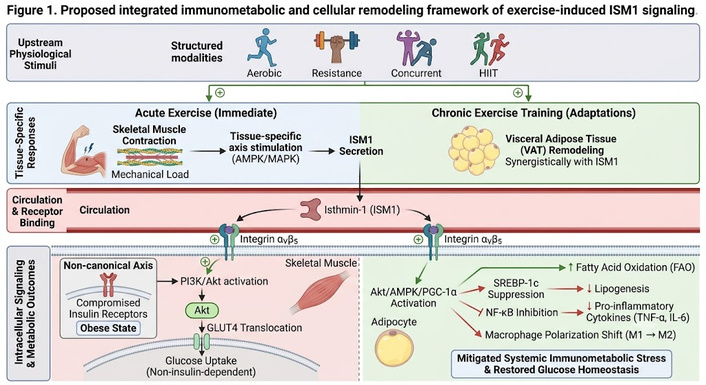
The proposed integrated immunometabolic and cellular remodeling framework of exercise-induced ISM1 signaling. Structured exercise modalities (aerobic, resistance, concurrent, and high-intensity interval training [HIIT]) act as primary upstream physiological stimuli. (Left) Acute exercise contraction and mechanical load stimulate immediate tissue-specific axes, triggering the secretion of ISM1. Once in circulation, ISM1 preferentially binds to integrin ανβ5 targets on skeletal muscle and adipocytes, directly activating the intracellular PI3K/Akt signaling cascade. This non-canonical axis effectively bypasses compromised insulin receptors in the obese state to rescue GLUT4 translocation and restore non-insulin-dependent glucose uptake. (Right) Concurrently, regular chronic exercise training induces phenotypic adaptations by remodeling visceral adipose tissue depots. This structural remodeling operates synergistically with ISM1 to suppress NF-κB signaling, downregulate pro-inflammatory cytokines (TNF-α, IL-6), and promote anti-inflammatory M2 macrophage polarization. This dual-action pathway simultaneously enhances fatty acid oxidation, inhibits lipogenesis via SREBP-1c suppression, and mitigates systemic immunometabolic stress. ISM1: Isthmin-1.
In conclusion, ISM1 stands at a critical intersection of metabolic regulation, adipose tissue inflammation, and exercise physiology. To transition these mechanistic insights into actionable clinical practice, future research directions must prioritize robust, randomized controlled trials that systematically evaluate the dose-response relationships of specific exercise modalities—including aerobic, resistance, and concurrent training protocols—on circulating and tissue-specific ISM1 dynamics in diverse human cohorts. Clarifying how parameters like training intensity, volume, and duration differentially regulate the proposed ISM1 compensatory loop will be essential. From a clinical perspective, ISM1 holds immense potential to serve as a novel, non-invasive biomarker for tracking the therapeutic efficacy of lifestyle interventions in obesity and metabolic disorders. Characterizing individual ISM1 baseline profiles could pave the way for personalized exercise prescription, allowing clinicians to screen for ‘metabolic non-responders’ and tailor physical activity to maximize non-insulin-dependent glucose clearance. Ultimately, unravelling the precise immunometabolic behavior of ISM1 will not only deepen our understanding of adipokine-muscle crosstalk but also refine exercise-based rehabilitation strategies in the global fight against metabolic syndrome.
ISM1: Isthmin-1
mTOR: mechanistic target of rapamycin
During the preparation of this work, the author(s) used Gemini (Google AI) in order to improve the language clarity of the mechanistic hypothesis and to assist in the conceptual design of Figure 1. After using this tool/service, the author(s) reviewed and edited the content as needed and take(s) full responsibility for the scientific accuracy, interpretation, and integrity of the publication.
AR: Data curation, Writing—original draft. AS: Conceptualization, Writing—original draft, Writing—review & editing, Supervision. KH: Conceptualization, Writing—review & editing, Supervision. MNALN: Data curation, Writing—review & editing. KA: Data curation. AA: Writing—original draft, Writing—review & editing. HZ: Conceptualization, Writing—review & editing, Supervision. All authors read and approved the submitted version.
Hassane Zouhal, who is the Guest Editor of Exploration of Immunology, had no involvement in the decision-making or the review process of this manuscript. The other authors declare no conflicts of interest.
Not applicable.
Not applicable.
Not applicable.
Not applicable.
Not applicable.
© The Author(s) 2026.
Open Exploration maintains a neutral stance on jurisdictional claims in published institutional affiliations and maps. All opinions expressed in this article are the personal views of the author(s) and do not represent the stance of the editorial team or the publisher.
Copyright: © The Author(s) 2026. This is an Open Access article licensed under a Creative Commons Attribution 4.0 International License (https://creativecommons.org/licenses/by/4.0/), which permits unrestricted use, sharing, adaptation, distribution and reproduction in any medium or format, for any purpose, even commercially, as long as you give appropriate credit to the original author(s) and the source, provide a link to the Creative Commons license, and indicate if changes were made.



View: 964
Download: 29
Times Cited: 0
Francisco Pitanga
Marios Hadjicharalambous ... Nikolaos Zaras
Mehran Alipour ... Hassane Zouhal


