 Review


Affiliation:
Genetic Engineering and Biotechnology Research Institute (GEBRI), City of Scientific Research and Technological Applications (SRTA-City), New Borg El-Arab City 21934, Alexandria, Egypt
ORCID: https://orcid.org/0000-0001-5027-3478


Explor Foods Foodomics. 2026;4:1010197 DOI: https://doi.org/10.37349/eff.2026.1010197
Received: August 08, 2026 Accepted: September 14, 2026 Published: October 27, 2026
Academic Editor: Yutang Wang, Federation University Australia, Australia
The article belongs to the special issue Nutrition in Health and Disease
Nutrition influences metabolic homeostasis through interactions among dietary patterns, gut microbial function, metabolite production, cellular stress, and immune regulation. However, the factors determining whether nutritional exposures support metabolic resilience or contribute to disease progression remain incompletely understood. This review synthesizes human and experimental evidence on how dietary patterns shape gut microbial function and metabolite production and how these microbial outputs relate to oxidative balance, proteostasis, and inflammatory signaling. It distinguishes microbial composition from functional activity, association from causation, and mechanistic plausibility from clinical relevance. Although current evidence supports functional roles for diet–microbiota interactions and microbial metabolites in metabolic regulation, reported effects vary across individuals and biological contexts. Methodological heterogeneity, limited longitudinal evidence, and incomplete translation of experimental findings constrain mechanistic interpretation in humans. Precision nutrition may help address this variability by integrating dietary assessment with microbiome function, metabolomics, metabolic phenotyping, and immune profiling. Its clinical value will depend on biomarkers and reproducible biological signatures that improve prediction and inform interventions beyond established dietary principles. Progress will require longitudinal studies, including controlled interventions, that link multi-omics profiles to meaningful metabolic and clinical outcomes.
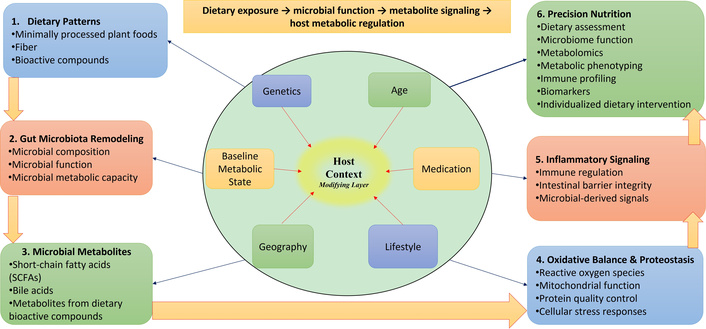
Dietary patterns are associated with obesity, type 2 diabetes, cardiovascular disease, and other metabolic disorders, although the biological basis of these associations remains incompletely understood [1, 2]. The substantial clinical and public health burden of these disorders underscores the relevance of clarifying how dietary exposures relate to metabolic health. Their effects extend beyond individual nutrients to interactions among dietary exposure, the gut microbiota, host metabolism, cellular stress, and immune regulation [3, 4]. Similar dietary exposures may therefore be associated with different metabolic responses across individuals.
Dietary intake can modify microbial composition, activity, and metabolite production [5, 6]. Microbial metabolites can affect intestinal barrier function, energy metabolism, immune responses, and inflammatory signaling, providing potential links between diet and host physiology [7, 8]. These responses vary with host characteristics, habitual diet, metabolic state, disease stage, and experimental conditions [9]. Microbial compositional changes therefore require cautious interpretation when their functional and host effects remain uncertain.
Metabolic dysfunction involves interacting changes in microbial activity, redox balance, cellular stress, proteostasis, and inflammatory signaling [10, 11]. The temporal sequence and relative contributions of these processes remain uncertain [12]. Human studies also vary in dietary assessment, participant characteristics, baseline metabolic status, intervention duration, and analytical methods [13, 14]. Experimental models provide mechanistic insight but may not fully reflect human disease. These limitations complicate interpretation of associations and attribution of specific metabolic effects to individual pathways.
This narrative review examines evidence linking dietary patterns, particularly fiber-rich and plant-based or minimally processed dietary patterns, with gut microbial composition and activity, microbial metabolites, oxidative balance, proteostasis, inflammatory signaling, and metabolic outcomes. Particular attention is given to insulin sensitivity and glucose and lipid homeostasis across different host and biological contexts.
The review evaluates these relationships according to the type and strength of available evidence, distinguishing microbial composition from activity and association from causation [15–17]. Figure 1 summarizes the relationships examined, from dietary and host determinants to microbial responses and metabolic outcomes.
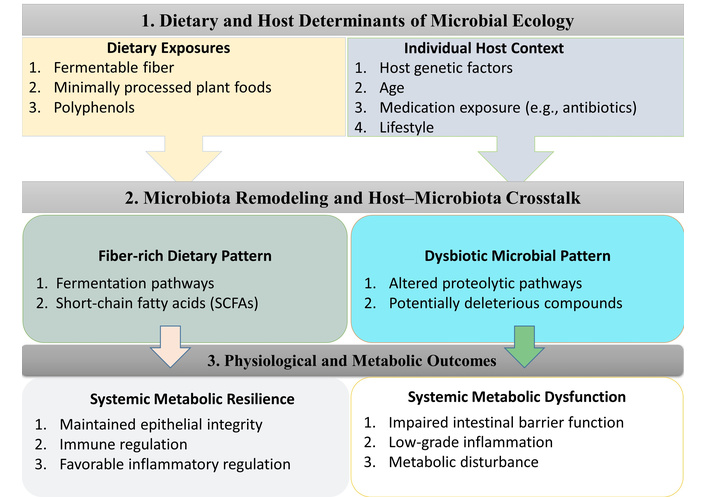
Dietary and host determinants of gut microbial ecology and metabolic outcomes. Dietary exposures, including fermentable fiber, minimally processed plant foods, and polyphenols, together with host factors such as genetic background, age, medication exposure, and lifestyle, influence gut microbial composition and function. Fiber-rich diets support microbial fermentation and short-chain fatty acid (SCFA) production, whereas altered microbial function may increase proteolytic activity and potentially deleterious metabolites. These microbial changes are associated with epithelial integrity, immune regulation, inflammation, and metabolic homeostasis.
Previous reviews have examined components of the diet–microbiota–metabolism axis, including microbial metabolites, cardiometabolic outcomes, and precision nutrition [6, 9, 15, 17]. However, these processes are often addressed separately. This review considers them within a common evidence base, focusing on how microbial activity relates to oxidative balance, proteostasis, inflammatory signaling, and metabolic regulation, while identifying limitations that currently constrain interpretation of biomarkers and mechanistic findings in clinical and precision nutrition research.
Dietary patterns shape gut microbial ecology and link nutritional exposure with host metabolism. Macronutrients, micronutrients, fiber, and bioactive compounds influence microbial composition, metabolic capacity, and host–microbe interactions. Human cohorts, controlled interventions, and experimental models show diet-associated differences in microbial diversity and function [5, 6, 9, 18]. Responses vary with host and environmental context, including lifestyle, medication exposure, and baseline metabolic state [19]. Microbial changes therefore reflect dietary exposure within a specific host context rather than a uniform shift toward beneficial or harmful states.
Fermentable dietary fiber provides a well-characterized example of nutrient-driven microbial regulation. Fibers that escape upper gastrointestinal digestion are metabolized into short-chain fatty acids (SCFAs), which influence epithelial integrity, immune regulation, and metabolic signaling [20–22]. Responses vary with microbial function, dietary background, and host characteristics [23]. Bacterial abundance alone is insufficient to define functional effects; microbial activity, metabolite production, and host responses are needed to interpret dietary effects.
Overall dietary patterns also shape microbial function and metabolic potential. Higher intake of minimally processed plant foods is associated with greater microbial functional diversity and enrichment of pathways involved in metabolite production and metabolic regulation [24]. Dietary patterns characterized by refined grain products and ultra-processed foods have been associated with altered microbial profiles and gastrointestinal or metabolic disturbances [25, 26]. These associations are difficult to separate from physical activity, medication exposure, and other factors affecting both the microbiome and metabolic health [27]. Current evidence supports diet-associated microbial changes but does not establish that specific microbial shifts independently initiate metabolic dysfunction.
Micronutrients and food-derived bioactive compounds provide additional routes through which diet may influence microbial and host biology. Polyphenols and related compounds can undergo microbial transformation, generating metabolites that influence host signaling and metabolic regulation [28, 29]. Experimental evidence supports these interactions, but differences in bioavailability, dose, exposure duration, microbial background, and host metabolism limit translation to human physiology [30]. Individual compounds are therefore best interpreted within the broader microbial and host context.
Microbial changes alone do not demonstrate metabolic improvement or deterioration. They may reflect dietary adaptation, altered host metabolic states, or processes associated with disease progression [31]. Their relevance depends on whether they alter microbial function and metabolite production in ways that affect metabolic homeostasis. Functional microbiome analysis should therefore be considered alongside metabolomics and measures of host metabolic response.
Current evidence indicates that dietary exposure influences gut microbial composition and function and alters microbial activity and metabolite production [32]. Which functional microbial features reliably predict favorable metabolic responses across populations remains unclear. Interpretation is limited by differences in dietary assessment, microbiome methods, population characteristics, and environmental context [32, 33]. Longitudinal studies integrating dietary assessment, functional microbiome profiling, metabolomics, and metabolic phenotyping are needed to distinguish diet-associated microbial adaptation from changes accompanying metabolic disturbance [32, 33].
Diet-induced microbial changes generate metabolites that link dietary substrates with host metabolism, epithelial function, cellular adaptation, and immune regulation [34, 35]. Their effects depend on substrate availability, microbial metabolic capacity, tissue exposure, and host physiological state [36]. Metabolite abundance alone does not establish biological benefit or harm; downstream host effects must also be considered.
Short-chain fatty acids (SCFAs), particularly acetate, propionate, and butyrate, are major products of microbial carbohydrate fermentation. They contribute to epithelial integrity, immune regulation, and metabolic signaling [37, 38]. Experimental evidence links SCFA signaling to glucose and lipid regulation and inflammatory pathways through host receptors and related mechanisms [39]. Responses vary with fiber type, baseline microbiota, and host characteristics [20, 23]. SCFA-producing taxa or related signatures therefore do not, alone, establish metabolic benefit. SCFAs, particularly butyrate, may also influence cellular energy sensing and autophagy through AMP-activated protein kinase (AMPK)- and mechanistic target of rapamycin (mTOR)-related pathways, although these effects remain context dependent [19–21].
Experimental evidence indicates that brain SCFAs can induce acyl-CoA synthetase short-chain family member 2 (ACSS2) and modulate the peroxisome proliferator-activated receptor gamma (PPARγ)–tryptophan hydroxylase 2 (TPH2) axis in a model of depressive-like behavior, illustrating a specific neurobiological effect of microbial metabolites [40].
Microbial metabolism also transforms bile acids, amino acids, and dietary bioactive compounds into molecules that influence metabolic signaling and cellular responses [41, 42]. Their effects depend on exposure, tissue distribution, receptor availability, and host metabolic state, which may differ between experimental models and humans [43]. Individual metabolites are therefore best interpreted within the broader host–microbial context.
Microbial metabolites intersect with oxidative regulation and proteostasis, which depends on coordinated control of reactive oxygen species, mitochondrial function, protein folding, repair, and degradation [44]. Microbiota-derived metabolites may influence redox regulation and cellular stress responses, although their contribution to human metabolic dysfunction remains uncertain [45]. Nutritional imbalance and metabolic overload can increase oxidative pressure and disrupt protein quality control [46, 47]. Whether impaired proteostasis contributes to the development of metabolic dysfunction or reflects established metabolic stress remains unresolved.
Altered metabolite profiles may contribute to metabolic dysfunction, reflect compensatory responses, or accompany established metabolic disturbance [48, 49]. Their temporal sequence and relative contributions remain uncertain. Association alone does not establish a metabolite as a mechanistic driver or therapeutic target; stronger inference requires evidence linking exposure to biological activity and measurable host outcomes.
Microbial metabolites represent an important interface between dietary exposure and host metabolic regulation, but clinical interpretation remains limited by incomplete causal validation, heterogeneous dietary and metabolomic methods, population differences, and limited longitudinal intervention data [50]. Integrating dietary assessment, functional microbiome profiling, metabolomics, and host phenotyping may help distinguish metabolite changes associated with adaptive responses from those accompanying metabolic disturbance.
Inflammatory signaling links metabolic disturbance with altered tissue function and immune regulation. Persistent nutrient excess, altered microbial activity, and cellular stress may shift physiological immune responses toward low-grade inflammation and impaired metabolic control [51, 52]. Inflammation may accompany metabolic dysfunction or contribute to its progression, supporting a bidirectional relationship rather than a single causal sequence [53].
Dietary patterns are associated with inflammatory and metabolic responses, although effects vary with dietary exposure and host context. Mediterranean-style and microbiota-targeted interventions have been associated with more favorable cardiometabolic or immune profiles in selected human studies [54–57]. Responses are also influenced by adiposity, physical activity, medication exposure, and baseline metabolic status.
Altered microbial function and intestinal barrier integrity may modify host exposure to microbial-derived signals that engage immune pathways [58, 59]. Lipopolysaccharide (LPS) from Gram-negative bacteria has been implicated in inflammatory pathways relevant to metabolic dysfunction [7, 8]. However, whether circulating LPS accurately reflects biologically active gut-derived endotoxin and contributes causally to metabolic inflammation in humans remains uncertain [7, 8]. Barrier disruption may also promote innate immune activation [8]. In humans, microbial and inflammatory changes may precede, follow, or accompany one another, while dietary, environmental, and disease-related factors complicate causal interpretation.
Inflammatory signaling intersects with oxidative and cellular stress pathways and is associated with insulin resistance, mitochondrial disturbances, and altered insulin signaling [60, 61]. Persistent inflammatory activity may further affect mitochondrial function and metabolic regulation [62]. Although these interactions are supported by experimental evidence, their temporal sequence and initiating role in human metabolic disease remain uncertain.
Inflammatory activity is associated with impaired insulin sensitivity, altered lipid metabolism, obesity-related complications, and cardiovascular dysfunction [63, 64]. Inflammatory markers, however, may reflect different processes across tissues and disease stages. Tissue context, nutritional environment, and individual susceptibility therefore limit interpretation of circulating inflammatory measures as indicators of specific disease mechanisms.
For precision nutrition, the relevant question is whether inflammatory changes represent modifiable processes associated with metabolic improvement. An inflammatory biomarker associated with metabolic dysfunction should not be assumed to be a causal or modifiable driver of disease progression [65]. Changes following dietary intervention may also reflect altered microbial function, energy balance, adiposity, or other metabolic effects. Longitudinal human studies and controlled nutritional interventions are therefore needed to determine whether inflammatory changes precede, accompany, or follow metabolic improvement [65, 66].
Inflammation is best considered one component linking dietary exposure, microbial activity, cellular stress, and metabolic responses rather than an isolated endpoint. Precision nutrition will require integration of dietary exposure with functional microbiome measures, immune responses, metabolic phenotypes, and clinically relevant outcomes [66]. Table 1 summarizes these relationships and the principal interpretive limitations relevant to precision nutrition.
Critical synthesis of the diet–microbiota–inflammation–metabolic axis.
| Biological domain | Evidence | Interpretive limitation | Relevance to precision nutrition |
|---|---|---|---|
| Dietary exposure | Refined carbohydrates, saturated fats, and ultra-processed foods are associated with inflammatory and metabolic abnormalities, whereas fiber-rich and plant-based patterns are generally associated with more favorable profiles. [54–57] | Associations vary with adiposity, physical activity, medication exposure, baseline metabolic status, and other host factors. | Interpret dietary effects within host and metabolic context. |
| Microbial function and barrier integrity | Altered microbial function and intestinal barrier integrity may modify exposure to microbial-derived immune signals. [58, 59] | Microbial changes may precede, follow, or accompany inflammation; directionality remains uncertain in humans. | Functional microbiome and barrier measures may complement inflammatory assessment. |
| Microbial-derived inflammatory signals | LPS from Gram-negative bacteria has been implicated in inflammatory pathways relevant to metabolic dysfunction. Barrier disruption may increase exposure to microbial-derived molecules. [7, 8, 60] | Circulating LPS does not necessarily reflect biologically active gut-derived endotoxin, and its causal contribution to metabolic inflammation in humans remains uncertain. | Circulating LPS should not be interpreted as a standalone marker of gut-derived inflammation. |
| Inflammation and cellular stress | Nutrient excess and metabolic overload can increase reactive oxygen species and impair mitochondrial function; inflammatory signaling may further affect mitochondrial activity and insulin signaling. [61, 62] | Experimental evidence supports these interactions, but their temporal sequence and initiating role in human disease remain uncertain. | Interpret inflammatory measures alongside oxidative, mitochondrial, and metabolic measures. |
| Metabolic and cardiovascular outcomes | Persistent inflammatory activity is associated with impaired insulin sensitivity, altered lipid metabolism, obesity-related complications, and cardiovascular dysfunction. [63, 64] | Inflammatory markers may represent different processes across tissues and disease stages. | Consider tissue context and metabolic phenotype when interpreting biomarkers. |
| Biomarker interpretation | Inflammatory changes after dietary intervention may accompany changes in microbial function, energy balance, adiposity, or other metabolic processes. [65] | Association does not establish that a biomarker drives disease progression or represents a modifiable target. | Evaluate biomarkers against functional and clinically relevant metabolic outcomes. |
| Clinical evidence | Longitudinal human studies and controlled nutritional interventions are needed to determine whether inflammatory changes accompany or contribute to metabolic improvement. [65, 66] | No consistent initiating inflammatory pathway has been established across individuals or disease contexts. | Clinical application requires reproducible biomarkers and evidence of meaningful metabolic benefit. |
Evidence supports links among dietary exposure, microbial function, inflammatory signaling, cellular stress, and metabolic outcomes, but does not establish a uniform causal sequence. Interpretation depends on host phenotype, tissue context, metabolic status, and clinical outcomes. These limitations favor context-specific precision nutrition over reliance on individual biomarkers.
Similar dietary exposures can produce different metabolic responses, reflecting variation in metabolic phenotype, gut microbial function, genetic background, environmental exposure, and inflammatory susceptibility [67, 68]. Precision nutrition seeks to identify biological features that modify dietary responses.
Multi-omics approaches can characterize this variability by integrating microbiome function, metabolite profiles, host molecular responses, and clinical phenotypes [69, 70]. Molecular resolution alone, however, does not establish clinical value. Useful signatures should be reproducible, biologically interpretable, and improve prediction beyond established clinical measures. Many reported associations remain exploratory and require confirmation in independent populations and controlled nutritional interventions [71].
Biomarkers may support individualized dietary strategies by linking mechanistic findings with measurable responses. Proposed predictors include microbial signatures, metabolomic profiles, inflammatory indicators, and markers of metabolic stress. Circulating LPS may warrant evaluation as a marker of microbial–host inflammatory responses, although its specificity and clinical utility remain uncertain [72, 73]. Clinical application requires reproducibility, predictive accuracy, and added value beyond conventional risk assessment [74].
Microbiome composition alone does not establish biological activity or metabolic effects. Interpretation requires consideration of functional capacity, metabolite production, and host responses [75]. Predictive signatures may vary across populations and disease stages [76]. Precision nutrition should therefore refine established dietary strategies rather than replace them with inadequately validated individualized recommendations.
Clinical translation remains constrained by methodological variation, inconsistent analytical approaches, limited longitudinal evidence, and uncertain benefits of biomarker-guided interventions beyond established approaches [77]. In multi-omics studies, statistical significance does not necessarily indicate biological importance or clinical usefulness [78].
Future studies should incorporate baseline characterization and controlled dietary exposures, followed by repeated longitudinal assessment of microbiome function, metabolite profiles, and metabolic phenotypes. Findings should be evaluated against clinically meaningful outcomes and validated in independent populations [79]. Clinically useful precision nutrition will require rigorous intervention studies demonstrating benefits beyond established dietary guidance [80]. These requirements are summarized in Table 2.
Evidence-to-translation matrix of nutrition–microbiota–host pathways.
| Biological axis | Evidence strength | Causal confidence | Human translation | Major confounders | Current evidence supports | Key evidence gap |
|---|---|---|---|---|---|---|
| Dietary patterns and microbiota function [2, 6, 9, 15, 17, 20, 24, 50] | Moderate–strong | Moderate for microbiota changes; low–moderate for metabolic effects | Moderate | Baseline microbiota, habitual diet, medications, lifestyle | Dietary patterns can modify microbial composition and function in a context-dependent manner. | Functional microbial features that reliably predict metabolic benefit. |
| Microbial metabolites and host metabolism [34–39, 42] | Strong mechanistic; moderate human | Moderate for selected pathways; limited for disease progression | Moderate | Substrate availability, microbial capacity, tissue exposure, host phenotype | Microbial metabolites can modulate host metabolic and immune pathways. | Reproducible, clinically meaningful effects in humans. |
| Microbial metabolites and oxidative balance [45, 48, 49] | Moderate mechanistic | Low–moderate in humans | Limited–moderate | Tissue exposure, redox state, metabolic context, experimental model | Microbial metabolites can influence redox regulation and cellular oxidative balance. | Whether these effects translate into sustained metabolic benefit. |
| Proteostasis and metabolic resilience [44, 46, 47, 49] | Moderate mechanistic | Low | Limited | Disease stage, tissue specificity, cellular stress context | Oxidative and cellular stress can disrupt protein quality control and proteostasis. | Whether proteostatic dysfunction precedes metabolic dysfunction and can be modified. |
| Oxidative stress and inflammation [51–53, 60–65] | Strong biological and experimental | Moderate for interaction; low for temporal direction | Moderate | Adiposity, tissue context, disease stage, comorbidities | Oxidative and inflammatory pathways interact in metabolic dysfunction. | Directionality of the relationship and its therapeutic relevance. |
| Dietary patterns and inflammatory signaling [51–53, 56, 57] | Moderate observational/intervention | Low–moderate | Moderate | Energy balance, adiposity, microbiota, physical activity, medications | Dietary patterns can modify inflammatory profiles. | Whether specific inflammatory changes mediate metabolic benefit. |
| Microbiota and inflammatory signaling [58–65] | Moderate mechanistic | Low–moderate in humans | Limited–moderate | Barrier integrity, microbial ecology, tissue context, disease stage | Microbial activity and metabolites can influence barrier and immune signaling associated with metabolic inflammation. | Whether these changes causally contribute to metabolic dysfunction in humans. |
| Multi-omics and individualized response [67–73, 75, 77–79] | Emerging–moderate | Low–moderate | Limited | Cohort composition, analytical pipelines, batch effects, model overfitting, population heterogeneity | Multi-omics profiling can characterize heterogeneity in dietary and metabolic responses. | Reproducible predictive signatures across populations and interventions. |
| Biomarkers and intervention selection [72–80] | Emerging | Low without prospective validation | Limited | Confounding, reverse causality, measurement variability | Candidate biomarkers can characterize dietary response and metabolic state. | Predictive value and benefit beyond established dietary approaches. |
The matrix summarizes evidence strength, causal confidence, and translational maturity across dietary, microbial, metabolic, inflammatory, and precision-nutrition pathways. Evidence is generally stronger for associations and mechanistic plausibility than for causality or clinical translation. Interpretation is constrained by host and environmental heterogeneity, methodological variation, tissue specificity, reverse causality, and limited longitudinal intervention data.
Nutrition-mediated metabolic regulation reflects interactions among dietary exposure, microbial function, metabolite signaling, oxidative balance, proteostasis, and immune regulation. These systems must adapt while maintaining regulatory control. Persistent disturbance may contribute to metabolic dysfunction, but current evidence does not establish when individual pathways become causal or how their contributions vary across disease stages. Heterogeneity in diet, host biology, and microbial function further limits interpretation of human evidence [67, 68].
Microbial profiles, metabolite patterns, oxidative markers, and inflammatory measures can characterize metabolic states but do not establish disease-driving mechanisms. Observational and experimental evidence supports plausible pathways, whereas causal direction and therapeutic relevance remain uncertain. Stronger inference requires assessment of temporal relationships, disease progression, and responses to targeted interventions.
Precision nutrition may address variation in dietary response through integrated assessment of diet, microbiome function, metabolomics, metabolic phenotyping, and immune responses. Molecular complexity alone does not establish clinical value [69–71]. Candidate biomarkers and functional signatures, including microbial-derived inflammatory measures such as circulating LPS, require reproducible measurement, predictive accuracy, and clinical validation before informing dietary decisions beyond established approaches [72–74, 81]. For clinical practice, established dietary recommendations should remain the primary basis of nutritional management, supported by assessment of dietary adherence, metabolic phenotype, and clinically validated outcomes. Microbiome, metabolomic, and inflammatory measures may provide complementary information but should not be used as standalone decision tools; their interpretation should remain integrated with the clinical context and established risk assessment.
Clinical translation depends on distinguishing biological signals from actionable determinants of dietary response. Precision nutrition will become clinically relevant when biological stratification reproducibly improves dietary decisions and clinical outcomes beyond established recommendations [75–80].
LPS: lipopolysaccharide
SCFAs: short-chain fatty acids
RMR: Conceptualization, Investigation, Visualization, Writing—original draft, and Writing—review & editing. The author read and approved the submitted version.
The author declares no conflicts of interest.
Not applicable.
Not applicable.
Not applicable.
Not applicable. No datasets were generated for this review.
Not applicable.
© The Author(s) 2026.
Open Exploration maintains a neutral stance on jurisdictional claims in published institutional affiliations and maps. All opinions expressed in this article are the personal views of the author(s) and do not represent the stance of the editorial team or the publisher.
Copyright: © The Author(s) 2026. This is an Open Access article licensed under a Creative Commons Attribution 4.0 International License (https://creativecommons.org/licenses/by/4.0/), which permits unrestricted use, sharing, adaptation, distribution and reproduction in any medium or format, for any purpose, even commercially, as long as you give appropriate credit to the original author(s) and the source, provide a link to the Creative Commons license, and indicate if changes were made.



View: 67
Download: 8
Times Cited: 0
Sevara Anvarova ... Gulchekhra Narimova
Melvin Bernardino ... Abigail Fantolgo


