 Original Article


Affiliation:
1Neuroendocrinology Department, Republican Specialized Scientific-Practical Medical Center of Endocrinology named after acad. Ya.Kh. Turakulov, Tashkent 100012, Uzbekistan
Email: sevaraanvarova243@gmail.com
ORCID: https://orcid.org/0009-0001-6866-6760


 ,
,
Affiliation:
1Neuroendocrinology Department, Republican Specialized Scientific-Practical Medical Center of Endocrinology named after acad. Ya.Kh. Turakulov, Tashkent 100012, Uzbekistan
2Endocrinology Department, Tashkent State Medical University, Tashkent 100109, Uzbekistan
ORCID: https://orcid.org/0000-0002-3041-0268
,
Affiliation:
3Diabetology Department, Republican Specialized Scientific-Practical Medical Center of Endocrinology named after acad. Ya.Kh. Turakulov, Tashkent 100012, Uzbekistan
ORCID: https://orcid.org/0000-0002-4921-4494
,
Affiliation:
1Neuroendocrinology Department, Republican Specialized Scientific-Practical Medical Center of Endocrinology named after acad. Ya.Kh. Turakulov, Tashkent 100012, Uzbekistan
ORCID: https://orcid.org/0000-0002-2756-7897
,
Affiliation:
2Endocrinology Department, Tashkent State Medical University, Tashkent 100109, Uzbekistan
ORCID: https://orcid.org/0000-0002-8104-5037
,
Affiliation:
1Neuroendocrinology Department, Republican Specialized Scientific-Practical Medical Center of Endocrinology named after acad. Ya.Kh. Turakulov, Tashkent 100012, Uzbekistan
ORCID: https://orcid.org/0009-0006-5327-4322
,
Affiliation:
3Diabetology Department, Republican Specialized Scientific-Practical Medical Center of Endocrinology named after acad. Ya.Kh. Turakulov, Tashkent 100012, Uzbekistan
ORCID: https://orcid.org/0000-0002-4708-0306
,
Affiliation:
4Department of Medical Sciences, Kazan Federal University, Jizzakh 130100, Uzbekistan
ORCID: https://orcid.org/0009-0001-8479-6629
,
Affiliation:
1Neuroendocrinology Department, Republican Specialized Scientific-Practical Medical Center of Endocrinology named after acad. Ya.Kh. Turakulov, Tashkent 100012, Uzbekistan
ORCID: https://orcid.org/0000-0002-1831-3633
Explor Foods Foodomics. 2026;4:1010179 DOI: https://doi.org/10.37349/eff.2026.1010179
Received: May 20, 2026 Accepted: July 08, 2026 Published: July 23, 2026
Academic Editor: Yutang Wang, Federation University Australia, Australia
The article belongs to the special issue Nutrition in Health and Disease
Aim: Dysregulated eating behavior is closely linked to metabolic dysfunction and may represent a behavioral pathway connecting neuroendocrine signaling to insulin resistance. Oxytocin has emerged as a potential regulator of feeding behavior and food-related reward processing, but the mechanisms linking endogenous oxytocin to metabolic health remain unclear. This study examined whether eating psychopathology mediates the association between circulating oxytocin concentrations and insulin resistance.
Methods: In this cross-sectional study, 99 adults with varying metabolic obesity phenotypes completed validated assessments of eating behavior, including emotional eating, external eating, and global eating psychopathology (Eating Disorder Examination Questionnaire, EDE-Q). Plasma oxytocin concentrations and metabolic parameters were measured under standardized conditions. Associations were evaluated using correlation and regression-based mediation analyses with bootstrap estimation (5,000 resamples), adjusted for age and body mass index.
Results: Lower oxytocin concentrations were significantly associated with higher eating psychopathology, particularly emotional and external eating. Eating psychopathology was positively associated with insulin resistance (HOMA-IR). Mediation analysis demonstrated a significant indirect association between oxytocin and HOMA-IR through eating psychopathology (ab = −0.181; 95% CI [−0.353, −0.064]), whereas the direct effect was not significant. Similar patterns were observed for emotional and external eating. Because analyses were cross-sectional, the identified mediation pathway represents a statistical indirect association rather than evidence of causality.
Conclusions: Lower endogenous oxytocin concentrations were associated with greater eating psychopathology and higher insulin resistance. These findings suggest that behavioral pathways may contribute to the observed association between oxytocin and metabolic dysfunction. However, the cross-sectional design precludes causal inference, and the observed mediation should be interpreted as a statistical association rather than a mechanistically established pathway.
Obesity and metabolic disorders represent major global public health challenges. Current estimates indicate that approximately one-quarter of the world’s adult population meets diagnostic criteria for metabolic syndrome, a condition characterized by the clustering of central obesity, insulin resistance, dyslipidemia, and hypertension. The prevalence of obesity has increased substantially worldwide over recent decades, contributing to rising rates of type 2 diabetes, cardiovascular disease, non-alcoholic fatty liver disease, and premature mortality. Increasingly, these conditions are recognized as complex disorders arising from interactions among biological, behavioral, and neuroendocrine factors. Beyond classical metabolic pathways, growing evidence highlights the role of central neuropeptides in the regulation of appetite, food-related behavior, energy homeostasis, and glucose metabolism [1–3].
Oxytocin, a hypothalamic neuropeptide traditionally associated with social and reproductive functions, has emerged as a potential regulator of feeding behavior and metabolic homeostasis. Experimental and clinical studies suggest that oxytocin influences food intake, particularly hedonic and reward-driven eating, through central mechanisms involving hypothalamic and mesolimbic pathways [4–6]. In humans, altered circulating oxytocin concentrations have been associated with obesity, food-related reward processing, and susceptibility to maladaptive eating behaviors, including emotional and reward-driven eating patterns [5, 7–10].
In addition to its effects on eating behavior, accumulating evidence suggests that oxytocin may contribute to glucose regulation and insulin sensitivity. Experimental administration studies have demonstrated that intranasal oxytocin can improve postprandial glucose handling, β-cell responsivity, and glucose tolerance in healthy individuals [11]. However, findings in populations with metabolic disease have been less consistent. In a recent randomized crossover study, acute intranasal oxytocin administration did not significantly improve glucose tolerance in men with type 2 diabetes [12]. Observational studies have further reported associations between circulating oxytocin concentrations and obesity, impaired glucose tolerance, and other markers of metabolic dysfunction [13]. Collectively, these findings indicate that the relationship between oxytocin signaling and metabolic health is complex and incompletely understood.
At the same time, disordered eating behaviors—particularly emotional, externally driven, and reward-related eating—are strongly associated with adverse metabolic outcomes, including insulin resistance, visceral adiposity and broader metabolic dysregulation [14–19]. These behavioral patterns may represent an important interface between neuroendocrine signaling and metabolic health. Nevertheless, previous studies have largely examined these relationships separately or in pairs, without comprehensively integrating oxytocin, disordered eating behaviors, and metabolic outcomes within a unified analytical framework [19].
Recent work from our group demonstrated significant associations between endogenous oxytocin concentrations, eating psychopathology, and metabolic dysfunction, including non-linear relationships between oxytocin levels and metabolic risk markers across obesity phenotypes [20]. Collectively, these findings raise the possibility that behavioral pathways may partially account for the observed association between oxytocin signaling and metabolic health.
Among the various manifestations of metabolic dysfunction, insulin resistance was selected as the primary outcome because it represents a central pathophysiological mechanism linking obesity, type 2 diabetes, cardiovascular disease, and related metabolic complications [1–3]. Unlike obesity itself, which primarily reflects body size and adiposity, insulin resistance captures a functional metabolic abnormality that may arise through both biological and behavioral pathways. Given the established associations between maladaptive eating behaviors and impaired insulin sensitivity, Homeostatic Model Assessment of Insulin Resistance (HOMA-IR) was considered a particularly relevant outcome for evaluating whether eating psychopathology mediates the relationship between endogenous oxytocin concentrations and metabolic health [15–19].
Understanding whether eating psychopathology represents an intermediate pathway linking oxytocin to metabolic dysfunction has important implications for both pathophysiology and intervention. If behavioral mechanisms partially account for this relationship, targeting maladaptive eating patterns could represent a clinically relevant strategy for reducing metabolic risk associated with altered neuroendocrine regulation.
The present analysis was performed using a cohort that has been described previously in a study examining non-linear associations between endogenous oxytocin, leptin, eating behavior, and metabolic obesity phenotypes [20]. The current investigation addresses a distinct research question by evaluating eating psychopathology as a potential mediator of the association between oxytocin concentrations and insulin resistance.
Accordingly, the primary objective of this study was to examine whether eating psychopathology statistically mediates the relationship between endogenous plasma oxytocin concentrations and insulin resistance in adults with varying metabolic obesity phenotypes. We hypothesized that lower oxytocin concentrations would be associated with greater eating psychopathology, which in turn would be associated with higher insulin resistance, consistent with a behaviorally mediated association.
This cross-sectional observational study examined whether disordered eating behavior statistically accounted for the association between endogenous plasma oxytocin concentrations and markers of metabolic dysfunction. Data were obtained from a clinical cohort of adults assessed at the Republican Specialized Scientific-Practical Medical Center of Endocrinology named after Academician Ya. Kh. Turakulov (Tashkent, Uzbekistan) between March and June 2025. The study followed the Strengthening the Reporting of Observational Studies in Epidemiology (STROBE) guidelines [21].
All individuals meeting eligibility criteria during the recruitment period were invited to participate. This recruitment approach was intended to minimize investigator-driven selection and to reflect the clinical spectrum of metabolic obesity phenotypes encountered in routine endocrinology practice.
Adults aged 18–65 years with a body mass index (BMI) ≥ 18.5 kg/m2 were eligible for inclusion. This range was selected to capture the full spectrum of adiposity without restricting the sample to obesity alone. Exclusion criteria included pregnancy or lactation; known psychiatric or neurological disorders; use of medications affecting appetite or metabolism (including corticosteroids, antidepressants, glucagon-like peptide-1 receptor agonists, or metformin); diagnosed diabetes mellitus or other endocrine diseases; and inability to complete study procedures. Participants with previously diagnosed psychiatric disorders were excluded based on medical history and clinical records. However, formal screening instruments for depression or anxiety were not administered. Consequently, subclinical affective symptoms cannot be excluded and may represent a source of residual confounding. This limitation has been acknowledged in the Discussion.
The final analytic sample comprised 99 participants (mean age 38.94 ± 10.40 years; 76.8% female; median BMI 32.10 kg/m2, interquartile range [IQR] 23.35–38.10 kg/m2). The study protocol was approved by the Local Bioethics Committee of the Republican Specialized Scientific-Practical Medical Center of Endocrinology (Protocol No. 2/2025, 12 February 2025). All participants provided written informed consent in accordance with the Declaration of Helsinki (2013 revision).
All measurements were obtained between 08:00 and 10:00 a.m. after an overnight fast. Body weight and height were measured using a calibrated Seca® scale and stadiometer, and BMI was calculated as weight (kg) divided by height squared (m2). Waist circumference was measured midway between the lower rib margin and the iliac crest. Metabolic indices included the HOMA-IR, calculated as fasting glucose (mmol/L) × fasting insulin (μU/mL) / 22.5; the Hepatic Steatosis Index (HSI), calculated as 8 × (ALT/AST) + BMI + 2 for females, without inclusion of the diabetes component because individuals with diabetes were excluded; and the Visceral Adiposity Index (VAI), calculated using sex-specific equations described by Amato et al. [22].
Plasma oxytocin concentrations were quantified using a competitive ELISA kit (Catalog No. E-EL-0029, Elabscience®, Wuhan, China). Prior to assay, plasma samples underwent solid-phase extraction using C18 cartridges (Waters, Milford, MA, USA). Briefly, 1 mL plasma was acidified with 1% trifluoroacetic acid (TFA), loaded onto preconditioned C18 columns, washed with 0.1% TFA, and eluted with 60% acetonitrile in 0.1% TFA. Eluates were evaporated under nitrogen and reconstituted in assay buffer before analysis. Oxytocin concentrations were measured according to the manufacturer’s instructions using a competitive ELISA format. The assay sensitivity was 9.38 pg/mL, with a detection range of 15.63–1,000 pg/mL. According to the manufacturer, intra-assay and inter-assay coefficients of variation ranged from 3.25–5.23% and 4.34–5.28%, respectively, and no significant cross-reactivity with oxytocin analogues was observed. All samples were analyzed in duplicate and concentrations were determined using a four-parameter logistic standard curve.
Leptin concentrations were measured as part of the broader metabolic phenotyping protocol. However, leptin was not included in the primary mediation model because the study hypothesis focused specifically on eating psychopathology as a behavioral pathway linking oxytocin and insulin resistance. Analyses involving adipokine-mediated pathways were considered beyond the scope of the present investigation.
Routine biochemical parameters, including fasting glucose, HbA1c, lipid profile, ALT, AST, and gamma-glutamyl transferase (GGT), were analyzed using a HITACHI 902 automated analyzer. Serum insulin concentrations were measured using electrochemiluminescence on a Cobas e 411 analyzer (Roche Diagnostics, Germany).
Eating behavior was assessed using validated self-report instruments administered under standardized conditions. The Eating Disorder Examination Questionnaire (EDE-Q 6.0) was used to evaluate eating psychopathology across four subscales (dietary restraint, eating concern, shape concern, and weight concern), yielding a global score ranging from 0 to 6. The EDE-Q global score served as the primary mediator in all analyses. For descriptive subgroup comparisons, participants were stratified using an EDE-Q Global score ≥ 2.3 to identify elevated eating disorder psychopathology. This threshold has previously demonstrated good screening performance for probable eating disorders in community samples [23]. The Dutch Eating Behavior Questionnaire (DEBQ) was used to assess emotional eating, external eating, and restrained eating. Emotional eating and external eating subscales were included as secondary mediators in sensitivity analyses. The Eating Behavior Assessment for Obesity (EBA-O) was used to screen for maladaptive eating patterns, although these data were not incorporated into the primary mediation models. The EDE-Q, DEBQ, and EBA-O were scored according to published scoring procedures. These instruments have demonstrated acceptable-to-excellent internal consistency in previous validation studies, with reported Cronbach’s α values generally ranging from 0.88 to 0.95. In the present study, questionnaire total and domain scores were entered into the analytical dataset; item-level responses were retained on paper forms but were not digitized, and therefore sample-specific internal consistency coefficients could not be recalculated. Participants completed all questionnaires independently, and responses were reviewed by trained staff when necessary to ensure completeness.
Statistical analyses were performed using Python version 3.11 (Python Software Foundation, Wilmington, DE, USA). Data management and statistical analyses were conducted using the pandas, NumPy, SciPy, statsmodels, and scikit-learn libraries, and figures were generated using Matplotlib.
Continuous variables were assessed for normality using the Shapiro–Wilk test and visual inspection of histograms. Variables with non-normal distributions were summarized as medians and interquartile ranges (IQRs), whereas normally distributed variables were summarized as means and standard deviations. Group comparisons were performed using the Mann–Whitney U test or independent-samples t-test, as appropriate. Associations between continuous variables were evaluated using Spearman correlation coefficients.
Mediation analyses were conducted using regression-based path models following contemporary mediation methodology [24]. The indirect effect was estimated as the product of the exposure–mediator (path a) and mediator–outcome (path b) coefficients. Given the cross-sectional design, mediation analyses were interpreted as statistical models of indirect association rather than evidence of causal mediation. The primary mediation model evaluated the pathway oxytocin → EDE-Q global score → HOMA-IR. Secondary mediation models examined oxytocin → EDE-Q → HSI, oxytocin → EDE-Q → VAI, oxytocin → emotional eating → HOMA-IR, and oxytocin → external eating → HOMA-IR. All models were adjusted for age and BMI. Continuous variables included in mediation analyses were standardized prior to model fitting to facilitate comparison of effect sizes across pathways and outcomes.
Covariates were selected a priori based on biological plausibility and prior evidence identifying age and overall adiposity (BMI) as common determinants of circulating oxytocin concentrations, eating behavior, and insulin resistance. Given the modest sample size, adjustment was intentionally restricted to these prespecified covariates to reduce the risk of model overfitting rather than including a broader set of lifestyle and psychosocial variables.
Ordinary least squares regression models were used to estimate path coefficients. Indirect effects were evaluated using percentile bootstrap confidence intervals based on 5,000 resamples. An indirect effect was considered statistically significant when the 95% confidence interval excluded zero. Models in which direct and indirect effects operated in opposite directions were interpreted as inconsistent mediation (suppression), consistent with established mediation theory [25]. Model assumptions were evaluated through inspection of residual distributions and assessment of multicollinearity using variance inflation factors.
Moderated mediation analysis was performed to assess whether the indirect association between oxytocin and HOMA-IR through eating psychopathology varied across levels of adiposity. BMI was included as a continuous moderator of both the exposure–mediator and mediator–outcome pathways. Interaction terms (oxytocin × BMI and mediator × BMI) were incorporated into regression models, and the index of moderated mediation was estimated using bootstrap resampling (5,000 iterations). A non-significant index indicated no evidence that the indirect association differed across BMI levels.
Sample size adequacy for the primary mediation analysis was evaluated using a simulation-informed power assessment. The assessment assumed a standardized exposure–mediator path coefficient of a = −0.734 and a conservative mediator–outcome path coefficient of b = 0.45, corresponding to an anticipated indirect effect of approximately ab = −0.330. Statistical power was evaluated at a two-sided significance level of α = 0.05 using 5,000 simulation iterations. Under these assumptions, approximately 40 participants were estimated to provide 80% power to detect the primary indirect effect, consistent with established methodological recommendations regarding sample size requirements for mediation analyses [26]. The final sample of 99 participants substantially exceeded this requirement.
Sensitivity analysis was conducted using the E-value framework to evaluate the robustness of the primary indirect effect to potential unmeasured confounding [27]. The E-value represents the minimum strength of association that an unmeasured confounder would need to have with both the exposure and the outcome to fully explain away the observed effect.
The study sample comprised 99 participants. Overall baseline characteristics of the cohort have been reported previously using the same participant sample [20]. To avoid duplication of previously published descriptive data, the present analysis focuses on subgroup comparisons according to eating psychopathology severity relevant to the mediation analyses. Participants were therefore stratified into lower EDE-Q (score < 2.3; n = 33) and higher EDE-Q (score ≥ 2.3; n = 66) symptom burden groups using a threshold previously employed in normative EDE-Q studies. This threshold has not been formally validated in Uzbek clinical populations and was used solely for descriptive comparisons; all primary analyses treated EDE-Q scores as a continuous variable.
Participants with higher EDE-Q scores exhibited a markedly less favorable anthropometric and metabolic profile compared to those with lower scores (Table 1). Specifically, the high EDE-Q group was characterized by greater adiposity, higher insulin resistance, and elevated markers of metabolic dysfunction. Glycemic indices and circulating leptin concentrations were also higher in this group.
Clinical, metabolic, and behavioral characteristics according to eating psychopathology severity (low vs high EDE-Q).
| Variable | Low EDE-Q (n = 33) | High EDE-Q (n = 66) | p-value |
|---|---|---|---|
| Age (years) | 38.24 ± 9.10 | 39.29 ± 11.03 | 0.63 |
| BMI (kg/m2) | 22.40 (20.30–23.96) | 36.50 (31.68–42.07) | < 0.001 |
| Waist circumference (cm) | 77.58 ± 14.34 | 106.52 ± 19.62 | < 0.001 |
| Oxytocin (pg/mL) | 137.00 (121.10–147.00) | 29.00 (18.57–41.12) | < 0.001 |
| Leptin (pg/mL) | 387.90 (350.50–416.60) | 1,175.20 (1,156.65–1,187.50) | < 0.001 |
| HOMA-IR | 1.60 (1.40–1.80) | 4.59 (3.50–6.21) | < 0.001 |
| HSI | 30.30 (29.14–33.00) | 48.95 (43.48–55.81) | < 0.001 |
| VAI | 1.25 (1.18–1.44) | 4.49 (3.42–5.42) | < 0.001 |
| Glucose (mmol/L) | 4.90 (4.70–5.10) | 5.40 (4.94–6.08) | < 0.001 |
| HbA1c (%) | 4.90 (4.80–5.10) | 5.35 (4.50–5.80) | < 0.001 |
| EDE-Q Global | 1.00 (0.90–1.00) | 3.80 (3.39–4.04) | < 0.001 |
| EE | 0.60 (0.50–0.60) | 2.04 (1.47–2.95) | < 0.001 |
| EX | 1.00 (0.90–1.00) | 3.00 (2.50–3.50) | < 0.001 |
| RE | 1.30 (1.20–1.30) | 3.00 (2.32–3.58) | < 0.001 |
Participants were stratified using an EDE-Q global score threshold of 2.3 for descriptive purposes only. This threshold was not used in mediation analyses and has not been formally validated in Uzbek clinical populations. Values are presented as mean ± standard deviation or median (interquartile range), as appropriate. Group comparisons were performed using the Mann–Whitney U test due to non-normal distribution of variables. EDE-Q: Eating Disorder Examination Questionnaire; BMI: body mass index; HOMA-IR: Homeostatic Model Assessment of Insulin Resistance; HSI: Hepatic Steatosis Index; VAI: Visceral Adiposity Index; EE: emotional eating; EX: external eating; RE: Restrained eating.
In contrast, plasma oxytocin concentrations were substantially lower among participants with elevated eating psychopathology. Behavioral measures confirmed clear separation between groups, with higher emotional, external, and restrained eating scores in the high EDE-Q group.
Spearman correlation analyses demonstrated significant associations between oxytocin, eating behavior measures, and metabolic indices. Oxytocin concentrations were inversely correlated with EDE-Q global score (r = −0.611, p < 0.001) and HOMA-IR (r = −0.419, p < 0.001), while EDE-Q global score was positively correlated with HOMA-IR (r = 0.580, p < 0.001). Additional correlations are presented in Table S1, while the overall correlation structure among neuroendocrine, behavioral, and metabolic variables is visualized in Figure S1. These findings demonstrate a consistent pattern linking lower oxytocin levels, greater eating psychopathology, and adverse metabolic profiles. Subgroup comparisons reflect stratification based on the mediator variable and are presented for descriptive purposes.
Key group differences in oxytocin concentrations, insulin resistance, and adiposity are visualized in Figure S2. Oxytocin concentrations demonstrated a right-skewed distribution, consistent with previous studies of circulating oxytocin. Visual inspection of the distributions (Figure S2) indicated that the marked difference between EDE-Q groups reflected a broad shift in oxytocin concentrations across the groups rather than being attributable to a single extreme observation. Accordingly, non-parametric statistical methods were used throughout subgroup analyses.
Consistent with EDE-Q classification, participants in the higher EDE-Q symptom burden group demonstrated significantly higher scores across all EBA-O domains, including food addiction, night eating, binge eating, sweet eating, and hyperphagia (Table S2).
The primary mediation model examined whether disordered eating psychopathology, assessed by the EDE-Q global score, mediated the association between plasma oxytocin concentrations and insulin resistance (HOMA-IR), after adjustment for age and BMI. All continuous variables were standardized prior to analysis (Figure 1).
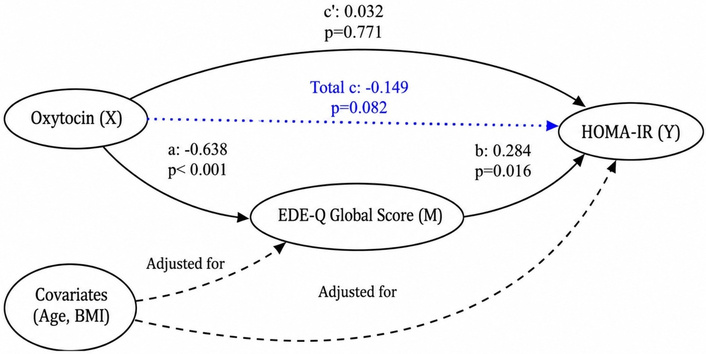
Mediation model of the association between plasma oxytocin, disordered eating behavior, and insulin resistance. Standardized regression coefficients are shown. Higher oxytocin concentrations were associated with lower EDE-Q global scores (path a: β = −0.638, p < 0.001), which in turn were associated with higher HOMA-IR (path b: β = 0.284, p = 0.016). The total effect of oxytocin on HOMA-IR was not statistically significant (β = −0.149, p = 0.082), and the direct effect after inclusion of the mediator was small and non-significant (β = 0.032, p = 0.771), consistent with an inconsistent mediation (suppression) pattern. Models were adjusted for age and body mass index.
Higher oxytocin concentrations were significantly associated with lower EDE-Q global scores (path a: β = −0.638, SE = 0.073, p < 0.001; 95% bootstrap CI [−0.836, −0.464]), indicating that lower oxytocin levels were related to greater eating psychopathology. In turn, higher EDE-Q global scores were significantly associated with higher HOMA-IR after adjustment for oxytocin and covariates (path b: β = 0.284, SE = 0.116, p = 0.016; 95% bootstrap CI [0.104, 0.511]).
The total effect of oxytocin on HOMA-IR was negative but did not reach statistical significance (path c: β = −0.149, SE = 0.085, p = 0.082). After inclusion of the mediator, the direct effect of oxytocin on HOMA-IR was small and non-significant (path c′: β = 0.032, SE = 0.111, p = 0.771; 95% bootstrap CI [−0.129, 0.203]).
The indirect effect of oxytocin on HOMA-IR through EDE-Q global score was statistically significant (ab = −0.181; 95% bootstrap CI [−0.353, −0.064]), supporting a statistically mediated association. The direct and indirect effects were opposite in sign, consistent with inconsistent mediation (suppression). Because suppression complicates the interpretation of proportion-mediated effect sizes, the mediation results were interpreted primarily on the basis of the indirect effect estimate and its bootstrap confidence interval.
The mediator model explained 58.6% of the variance in EDE-Q global score, while the outcome model including the mediator explained 47.9% of the variance in HOMA-IR. Full path coefficients are presented in Table 2, and the bootstrap distribution of the indirect effect is shown in Figure 2.
Primary mediation analysis: oxytocin → EDE-Q global score → HOMA-IR.
| Path | β | SE | p-value | 95% CI | R2 | |
|---|---|---|---|---|---|---|
| a | Oxytocin → EDE-Q Global | −0.638 | 0.073 | < 0.001 | [−0.836, −0.464] | 0.586 |
| b | EDE-Q Global → HOMA-IR | 0.284 | 0.116 | 0.016 | [0.104, 0.511] | — |
| c | Oxytocin → HOMA-IR (total) | −0.149 | 0.085 | 0.082 | — | 0.445 |
| c′ | Oxytocin → HOMA-IR (direct) | 0.032 | 0.111 | 0.771 | [−0.129, 0.203] | 0.479 |
| ab | Indirect effect via EDE-Q | −0.181 | 0.075 | — | [−0.353, −0.064] | — |
Standardized regression coefficients (β) are presented. All models were adjusted for age and body mass index. Indirect effects were estimated using percentile bootstrap confidence intervals based on 5,000 resamples. EDE-Q: Eating Disorder Examination Questionnaire; HOMA-IR: Homeostatic Model Assessment of Insulin Resistance.
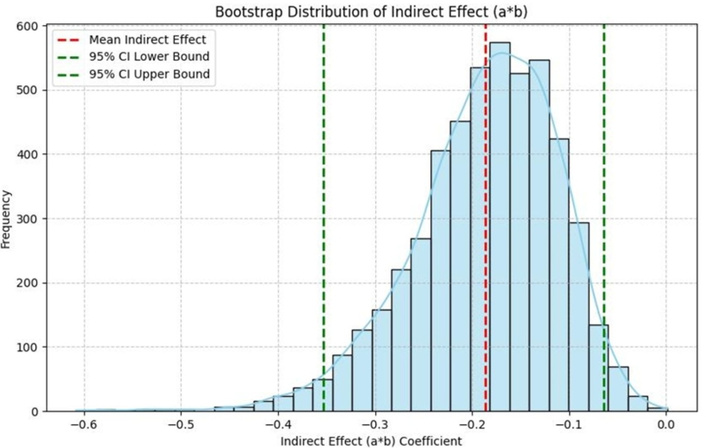
Bootstrap distribution of the indirect effect (ab) for the mediation model. Histogram of bootstrap estimates (5,000 resamples) of the indirect effect of oxytocin on HOMA-IR through EDE-Q global score. The red dashed line indicates the mean indirect effect (ab = −0.181), and green dashed lines indicate the 95% confidence interval (−0.353 to −0.064). The confidence interval does not include zero, supporting a statistically significant indirect effect.
To evaluate the consistency of the primary findings across alternative behavioral and metabolic pathways, a series of pre-specified secondary mediation analyses were conducted, and the results are summarized in Table 3.
Secondary mediation analyses.
| Model | Mediator | Outcome | Indirect effect (ab) | 95% CI | Significance |
|---|---|---|---|---|---|
| 1 | EDE-Q Global | VAI | −0.073 | [−0.136, −0.006] | Yes |
| 2 | EDE-Q Global | HSI | 0.022 | [−0.127, 0.222] | No |
| 3 | Emotional eating | HOMA-IR | −0.101 | [−0.196, −0.022] | Yes |
| 4 | External eating | HOMA-IR | −0.117 | [−0.227, −0.025] | Yes |
Indirect effects (ab) were estimated using bootstrap resampling (5,000 iterations). Models were adjusted for age and body mass index. EDE-Q: Eating Disorder Examination Questionnaire; HOMA-IR: Homeostatic Model Assessment of Insulin Resistance; VAI: Visceral Adiposity Index.
First, the mediation model was extended to alternative metabolic outcomes. The indirect effect of oxytocin on the VAI through EDE-Q global score was statistically significant (ab = −0.073; 95% bootstrap CI [−0.136, −0.006]), with 56.2% of the total effect mediated through disordered eating indicating that higher oxytocin concentrations were associated with lower visceral adiposity through reduced eating psychopathology. In contrast, the indirect effect for the HSI was not significant (ab = 0.022; 95% bootstrap CI [−0.127, 0.222]), and the proportion mediated was 54.6%, though the wide confidence interval precludes a firm conclusion.
Second, alternative behavioral mediators were examined. Both emotional eating and external eating demonstrated significant mediation effects in the relationship between oxytocin and insulin resistance. The indirect effect via emotional eating was significant (ab = −0.101; 95% bootstrap CI [−0.196, −0.022]), as was the indirect effect via external eating (ab = −0.117; 95% bootstrap CI [−0.227, −0.025]). These findings indicate that multiple dimensions of eating behavior contribute to the association between oxytocin and metabolic dysfunction.
Across all models, indirect effects were consistently negative, reflecting a pattern in which higher oxytocin concentrations were associated with lower levels of maladaptive eating behavior and, in turn, more favorable metabolic profiles. However, the magnitude and statistical significance of mediation varied depending on the specific behavioral and metabolic pathways examined.
Taken together, these secondary analyses support the robustness of the primary finding and suggest that the observed mediation is not limited to a single behavioral construct, but reflects a broader pattern linking oxytocin, eating behavior, and metabolic outcomes.
The robustness of the primary mediation findings was evaluated using complementary analytical approaches.
Moderated mediation analysis was conducted to assess whether the indirect effect varied across levels of adiposity, with BMI included as a continuous moderator of both the exposure–mediator and mediator–outcome paths. The index of moderated mediation was not statistically significant (IMM = 0.049; 95% bootstrap CI [−0.060, 0.192]), indicating no evidence that the magnitude of the indirect effect differed across BMI levels.
Sensitivity to unmeasured confounding was assessed using the E-value framework for the primary indirect effect. The estimated E-value was 1.64, with a lower confidence bound of 1.32. These values indicate that an unmeasured confounder associated with both plasma oxytocin concentrations and HOMA-IR by risk ratios of approximately 1.32 each could shift the confidence interval to include the null. Accordingly, the E-value analysis suggests only modest robustness to unmeasured confounding. Variables not measured in the present study, including physical activity, sleep quality, chronic psychological stress, and dietary composition, may plausibly contribute to the observed associations and cannot be excluded as alternative explanations. The E-value analysis therefore quantifies, rather than resolves, the potential impact of residual confounding.
Additional sensitivity analyses demonstrated that the findings were not driven by influential observations or the choice of bootstrap estimation method. Exclusion of one observation with a standardized residual greater than 3 yielded a directionally consistent indirect effect (ab = −0.155). Furthermore, bias-corrected and accelerated (BCa) bootstrap confidence intervals (95% CI [−0.378, −0.070]) were consistent with the primary percentile bootstrap estimates.
Taken together, these analyses support the stability of the observed indirect effect across alternative analytical specifications and sensitivity analyses. However, residual confounding cannot be excluded, and the findings should be interpreted as evidence of a statistically robust association rather than confirmation of a causal mediation pathway.
In this study, we investigated whether disordered eating behavior statistically accounted for the association between endogenous plasma oxytocin concentrations and metabolic dysfunction. The primary finding was that eating psychopathology, assessed by the EDE-Q global score, significantly mediated the relationship between oxytocin and insulin resistance. Specifically, lower oxytocin concentrations were associated with greater eating-related psychopathology, which in turn was associated with higher HOMA-IR. After accounting for eating behavior, the direct association between oxytocin and insulin resistance was no longer evident, while the indirect effect remained significant.
This pattern is consistent with an inconsistent mediation (suppression) model, indicating that behavioral factors statistically account for the observed association between oxytocin and metabolic outcomes rather than an independent direct effect.
Oxytocin is increasingly recognized as a regulator of feeding behavior, acting through hypothalamic and mesolimbic pathways involved in satiety, reward processing, and stress-related eating [4–7]. Experimental and clinical studies have demonstrated that oxytocin administration reduces food intake, particularly hedonic and reward-driven consumption, and modulates neural responses to food-related stimuli [8, 9]. However, such studies evaluate the effects of exogenous oxytocin exposure and should not be interpreted as direct evidence that naturally occurring differences in endogenous circulating oxytocin exert identical physiological effects.
The present findings align with this neurobehavioral framework. The strong inverse associations between oxytocin and both global eating psychopathology and specific behavioral domains (emotional and external eating) suggest that lower oxytocin levels may be linked to dysregulated eating patterns. These behavioral alterations, in turn, are known to contribute to adverse metabolic profiles, including insulin resistance and visceral adiposity [15–19].
Importantly, the mediation analysis extends prior correlational evidence by indicating that eating behavior may represent a key intermediate pathway linking oxytocin to metabolic dysfunction. Rather than supporting a direct metabolic effect of endogenous circulating oxytocin, the present findings suggest that behavioral mechanisms may represent one pathway through which oxytocin concentrations are associated with metabolic risk. This interpretation is consistent with emerging models that conceptualize metabolic disorders as the result of interacting neuroendocrine and behavioral processes [1–3, 5, 6].
Previous studies have independently linked altered circulating oxytocin concentrations to obesity, increased caloric intake, reward-related eating, and dysregulated eating behavior [5, 7–9, 20, 21], while separate lines of research have demonstrated associations between maladaptive eating patterns and metabolic dysfunction, including insulin resistance and visceral adiposity [15–19]. Experimental studies have further suggested that oxytocin may influence glucose homeostasis directly. For example, intranasal oxytocin administration improved postprandial glucose handling and β-cell responsivity in healthy men, whereas similar benefits were not observed in men with type 2 diabetes, suggesting that metabolic responsiveness to oxytocin may differ according to disease state [11, 12]. Observational studies have likewise reported associations between circulating oxytocin concentrations and obesity, impaired glucose tolerance, insulin resistance, and other metabolic abnormalities [13, 19, 20]. However, these behavioral and metabolic domains have largely been investigated independently.
The present study integrates these findings within a unified analytical framework by demonstrating that eating psychopathology statistically accounts for a substantial proportion of the observed association between endogenous oxytocin concentrations and insulin resistance. These results also extend our previous work demonstrating significant associations between endogenous oxytocin concentrations, eating psychopathology, and metabolic dysfunction across metabolic obesity phenotypes, including evidence of non-linear relationships between oxytocin levels and metabolic risk markers [20]. Importantly, our findings suggest that the association between oxytocin and metabolic dysfunction may not operate solely through direct metabolic mechanisms but may also involve behavioral pathways related to eating regulation.
Taken together, these findings support the hypothesis that eating psychopathology represents a plausible behavioral pathway linking oxytocin signaling and metabolic health. At the same time, the heterogeneity of findings across experimental, observational, and clinical studies suggests that the relationship between oxytocin and metabolic dysfunction is unlikely to be explained by a single mechanism. Rather, direct metabolic effects, behavioral influences, compensatory neuroendocrine responses, and potential non-linear associations may all contribute to the observed relationships. Because the present study is cross-sectional, these pathways should be interpreted as statistically inferred associations rather than mechanistically established causal processes.
Although the present study was not designed to establish clinical thresholds for oxytocin concentrations, the findings may have implications for understanding the behavioral pathways linking neuroendocrine signaling and metabolic dysfunction. Participants with higher eating psychopathology exhibited both lower circulating oxytocin concentrations and greater insulin resistance, and mediation analyses suggested that eating psychopathology statistically accounted for a substantial proportion of the observed oxytocin–HOMA-IR association. These findings support the concept that behavioral factors may represent an important interface between neuroendocrine regulation and metabolic health. However, circulating oxytocin concentrations are not currently suitable for clinical risk stratification or diagnosis, and the cross-sectional design precludes conclusions regarding causality. Future longitudinal and interventional studies are needed to determine whether oxytocin-related pathways have potential relevance for metabolic risk reduction.
A notable feature of the mediation results warrants careful interpretation. The indirect effect of oxytocin on HOMA-IR through eating psychopathology was negative in direction (lower oxytocin → higher EDE-Q → higher HOMA-IR; ab = −0.181), whereas the direct effect of oxytocin on HOMA-IR after accounting for the mediator was positive in direction, although small and statistically non-significant (c′ = 0.032, p = 0.771). This pattern—where the direct and indirect effects carry opposite signs—constitutes what is formally described as inconsistent mediation, or statistical suppression [24]. Such findings indicate that the relationship between exposure and outcome may be more complex than can be captured by a single linear pathway and therefore merit careful consideration.
First, the suppression pattern may reflect genuine biological complexity. It is possible that oxytocin is associated with insulin resistance through both behaviorally mediated and behaviorally independent mechanisms. The indirect pathway identified in the present study is consistent with evidence that oxytocin modulates reward processing, satiety signaling, and hedonic feeding behavior, thereby influencing dietary intake and downstream metabolic outcomes [5–7, 9]. Experimental studies have additionally demonstrated oxytocin receptor expression in adipose tissue, pancreatic β-cells, and other peripheral metabolic tissues, supporting the possibility of metabolic actions that are not fully captured by measures of eating behavior alone [6, 10, 11]. However, because the residual direct effect observed in the present study was small and statistically non-significant, our findings do not provide evidence for an adverse direct metabolic effect of oxytocin. Rather, they suggest that behaviorally mediated and behaviorally independent pathways may operate in different directions, resulting in a suppression pattern when both are included within the same model.
Second, the observed suppression pattern may partly reflect non-linearity in the relationship between oxytocin and metabolic dysfunction. In previous work, we reported non-linear associations between endogenous oxytocin concentrations and metabolic risk markers across obesity phenotypes [20]. To further explore the present findings, we conducted an exploratory restricted cubic spline analysis with adaptive knot placement and bootstrap resampling. Adjustment for eating psychopathology substantially attenuated the non-linear association between oxytocin and HOMA-IR, suggesting that eating behavior accounted for a considerable proportion of the observed curve shape (Figure S3). Under such circumstances, conventional linear mediation models may incompletely characterize the underlying exposure–outcome relationship, potentially producing suppression-like patterns when a strongly associated mediator is included. Although exploratory, these findings raise the possibility that non-linearity contributes to the observed inconsistent mediation pattern and should be examined in larger studies using flexible modeling approaches.
Third, methodological explanations should also be considered. Mediation analyses rely on strong assumptions regarding causal structure and the absence of unmeasured confounding [24, 27]. If eating psychopathology is influenced by both oxytocin and unmeasured factors that also affect insulin resistance—such as chronic psychological stress, sleep disturbance, inflammatory burden, physical activity, dietary composition, or hypothalamic–pituitary–adrenal axis dysregulation—then conditioning on the mediator may introduce bias into estimates of the direct effect. Such bias is a recognized limitation of mediation analyses involving complex behavioral mediators and cannot be excluded in the present cross-sectional design.
Finally, the suppression pattern may partly reflect sampling variability. The present study included 99 participants, and simulation studies have demonstrated that sign reversal in mediation models may occur more frequently in modestly sized samples when the mediator and outcome share substantial unexplained variance [26]. In addition, the clinical composition of the cohort and the predominance of female participants may limit generalizability and contribute to instability in estimation of the residual direct effect. Therefore, the direction of the direct effect should be interpreted cautiously and regarded as hypothesis-generating rather than confirmatory.
Taken together, we do not interpret the sign-reversed direct effect as evidence that higher oxytocin independently increases insulin resistance. Rather, the findings suggest that eating psychopathology accounts for a substantial component of the observed association between oxytocin and metabolic dysfunction, while the residual direct pathway remains uncertain and may reflect a combination of biological complexity, non-linearity, residual confounding, and sampling variability. The most robust finding remains the significant negative indirect effect through eating psychopathology, supported by bootstrap confidence intervals excluding zero. Accordingly, the present results should be interpreted as evidence of a statistically mediated association rather than confirmation of a causal biological pathway.
The observed mediation effect was consistent across multiple analyses. Secondary mediation models demonstrated similar indirect effects when alternative behavioral mediators (emotional and external eating) were considered, suggesting that the pathway is not specific to a single questionnaire construct but reflects a broader behavioral phenotype.
Sensitivity analyses further supported the robustness of the findings. The indirect effect remained stable after exclusion of a potentially influential observation, and bias-corrected and accelerated bootstrap confidence intervals were consistent with percentile estimates. In addition, moderated mediation analysis indicated no evidence that the magnitude of the indirect effect varied across levels of adiposity, suggesting that the pathway operates consistently across the BMI spectrum in this sample.
The E-value analysis suggested modest-to-moderate robustness to unmeasured confounding, although residual confounding cannot be excluded and the observed associations remain potentially vulnerable to unmeasured behavioral and lifestyle factors [27].
These findings have several potential implications. First, they support the concept that behavioral pathways may play a central role in linking neuroendocrine signaling to metabolic health [5, 6, 14, 15]. If confirmed in longitudinal or interventional studies, this would suggest that targeting eating behavior may be an effective strategy for modifying metabolic risk associated with altered oxytocin signaling.
Second, individuals with lower oxytocin levels may represent a subgroup characterized by increased susceptibility to maladaptive eating patterns, particularly emotionally and externally driven eating. This raises the possibility that behavioral interventions targeting these patterns could have downstream metabolic benefits.
Finally, these results contribute to the growing interest in oxytocin signaling as a potential target for future metabolic interventions [5, 6, 9]. However, the present study evaluated endogenous circulating oxytocin concentrations rather than pharmacological oxytocin administration. Consequently, the findings should not be interpreted as evidence that oxytocin-based therapies would necessarily produce similar effects. Instead, they suggest that behavioral mechanisms may represent one pathway through which endogenous oxytocin concentrations are associated with metabolic health.
Several limitations should be acknowledged. First, the cross-sectional design precludes causal inference, and the temporal sequence between oxytocin, eating behavior, and metabolic outcomes cannot be definitively established. Accordingly, the observed mediation pattern should be interpreted as a statistical association rather than confirmation of a causal pathway.
Second, the study population was recruited from a single tertiary endocrinology center in Uzbekistan, and women comprised 76.8% of the cohort. This may limit the generalizability of the findings to men, community-based populations, and populations with different cultural, dietary, and healthcare backgrounds. Sex differences in oxytocin physiology, eating behavior, body composition, and metabolic regulation have been reported previously, and the present study was not sufficiently powered to perform reliable sex-stratified mediation analyses. Consequently, the observed associations should not be assumed to apply equally across sexes. Replication in larger, multicenter cohorts with more balanced sex representation is required. In addition, reproductive factors that may have contributed to interindividual variability in circulating oxytocin concentrations, including menstrual cycle phase, menopausal status, and hormonal contraceptive use, were not assessed. These unmeasured sources of biological variability may have contributed to interindividual differences in oxytocin concentrations and should be considered in future studies.
Third, the sample size was modest, which may limit the precision of estimates, particularly for secondary analyses, moderation analyses, and effect size measures. The direction of the residual direct effect observed in the mediation model should therefore be interpreted cautiously.
Fourth, although oxytocin concentrations were measured following solid-phase extraction to improve analytical specificity, peripheral oxytocin assessment remains subject to assay-dependent variability and methodological heterogeneity. As a result, direct comparisons with studies employing alternative measurement techniques, including liquid chromatography–tandem mass spectrometry (LC–MS/MS), should be interpreted cautiously. Furthermore, circulating oxytocin concentrations should be interpreted as peripheral biomarkers and may not directly reflect central oxytocinergic activity. Accordingly, the present findings cannot establish whether the observed associations originate from central or peripheral oxytocin pathways.
Eating behavior was assessed using self-report questionnaires, which may introduce reporting bias. The EDE-Q threshold used for descriptive subgroup analyses was derived from normative studies conducted in predominantly Western populations and has not been validated in Uzbekistan. However, because all primary analyses treated EDE-Q as a continuous variable, the principal findings do not depend on this classification threshold. Because formal assessments of depression and anxiety were not performed, residual confounding by subclinical affective symptoms cannot be excluded. This is particularly relevant given the established relationships among mood symptoms, emotional eating, and metabolic health. In addition, information on physical activity, dietary habits, sleep quality, smoking status, psychological stress, and socioeconomic status was not collected. Although the mediation models were adjusted a priori for age and BMI, residual confounding by these unmeasured lifestyle and psychosocial factors cannot be excluded. Furthermore, although BMI was included as a prespecified covariate to estimate associations independent of overall adiposity, alternative causal structures in which BMI lies partly along the pathway linking oxytocin, eating behavior, and metabolic outcomes cannot be excluded.
Although the present cohort has been reported previously in analyses of non-linear oxytocin–metabolic associations, the current study addresses a distinct research question using a different analytical framework. Nevertheless, replication in independent cohorts will be necessary to establish the reproducibility of the observed mediation effects.
Finally, although multiple sensitivity analyses were conducted, including assessment of influential observations and E-value analysis, residual confounding cannot be excluded. Variables not measured in the present study, including physical activity, sleep quality, dietary composition, and chronic psychological stress, may have influenced the observed associations. Future longitudinal studies incorporating objective behavioral and lifestyle measures are needed to strengthen causal inference and clarify the independent contribution of oxytocin-related pathways to metabolic dysfunction.
Leptin was measured as part of the metabolic characterization of the cohort and was significantly associated with eating psychopathology and metabolic dysfunction. However, the present study was designed to evaluate a behavioral mediation hypothesis rather than adipokine-mediated mechanisms. Given the known biological interactions between oxytocin and leptin signaling pathways, future studies with larger sample sizes should examine whether leptin acts as an additional mediator, moderator, or parallel pathway linking oxytocin to metabolic dysfunction.
In conclusion, the present findings are consistent with a behaviorally mediated association between plasma oxytocin concentrations and insulin resistance. Lower oxytocin concentrations were associated with maladaptive eating behavior and adverse metabolic profiles, supporting the concept that behavioral pathways may partially link neuroendocrine signaling to metabolic dysfunction. These findings underscore the importance of integrating psychological and biological perspectives in metabolic health research.
BMI: body mass index
DEBQ: Dutch Eating Behavior Questionnaire
EBA-O: Eating Behavior Assessment for Obesity
EDE-Q: Eating Disorder Examination Questionnaire
HOMA-IR: Homeostatic Model Assessment of Insulin Resistance
HSI: Hepatic Steatosis Index
TFA: trifluoroacetic acid
VAI: Visceral Adiposity Index
The supplementary materials for this article are available at: https://www.explorationpub.com/uploads/Article/file/1010179_sup_1.pdf.
The authors would like to acknowledge the clinical staff of the Republican Specialized Scientific-Practical Medical Center of Endocrinology for their assistance in data collection and patient management.
SA: Conceptualization, Methodology, Formal analysis, Investigation, Data curation, Visualization, Writing—original draft, Writing—review & editing. ZK: Investigation, Resources, Data curation, Writing—review & editing. AA: Formal analysis, Data curation, Visualization, Writing—review & editing. DK: Investigation, Resources, Data curation, Writing—review & editing. KN: Investigation, Validation, Data curation, Writing—review & editing. AK: Investigation, Data curation, Writing—review & editing. AS: Investigation, Data curation, Writing—review & editing. DU: Investigation, Data curation, Project administration, Writing—review & editing. GN: Methodology, Supervision, Validation, Writing—review & editing. All authors have read and approved the final manuscript.
The authors declare that they have no conflicts of interest.
The study was conducted in accordance with the Declaration of Helsinki (2013 revision) and approved by the Local Bioethics Committee of the Republican Specialized Scientific-Practical Medical Center of Endocrinology (Protocol No. 2/2025, 12 February 2025).
All participants provided written informed consent prior to inclusion in the study.
Not applicable.
The datasets generated and/or analyzed during the current study are not publicly available due to institutional regulations and the presence of potentially identifiable clinical information. Data may be made available from the corresponding author upon reasonable request and with permission of the Institutional Review Board of the Republican Specialized Scientific-Practical Medical Center of Endocrinology.
Not applicable.
© The Author(s) 2026.
Open Exploration maintains a neutral stance on jurisdictional claims in published institutional affiliations and maps. All opinions expressed in this article are the personal views of the author(s) and do not represent the stance of the editorial team or the publisher.
Copyright: © The Author(s) 2026. This is an Open Access article licensed under a Creative Commons Attribution 4.0 International License (https://creativecommons.org/licenses/by/4.0/), which permits unrestricted use, sharing, adaptation, distribution and reproduction in any medium or format, for any purpose, even commercially, as long as you give appropriate credit to the original author(s) and the source, provide a link to the Creative Commons license, and indicate if changes were made.



View: 1035
Download: 24
Times Cited: 0
Melvin Bernardino ... Abigail Fantolgo


