 Review


Affiliation:
1Laboratorio de Cromatografía para Agroalimentos, IBAM CCT Mendoza - CONICET, Mendoza 5500, Argentina
2Cátedra de Química Analítica, Facultad de Ciencias Agrarias, Universidad Nacional de Cuyo, Mendoza 5500, Argentina
ORCID: https://orcid.org/0000-0002-8581-6644

 ,
,
Affiliation:
1Laboratorio de Cromatografía para Agroalimentos, IBAM CCT Mendoza - CONICET, Mendoza 5500, Argentina
3Cátedra de Enología, Facultad de Ciencias Agrarias, Universidad Nacional de Cuyo, Mendoza 5500, Argentina
ORCID: https://orcid.org/0009-0009-0844-6692
,
Affiliation:
1Laboratorio de Cromatografía para Agroalimentos, IBAM CCT Mendoza - CONICET, Mendoza 5500, Argentina
ORCID: https://orcid.org/0009-0001-7085-0727
,
Affiliation:
1Laboratorio de Cromatografía para Agroalimentos, IBAM CCT Mendoza - CONICET, Mendoza 5500, Argentina
2Cátedra de Química Analítica, Facultad de Ciencias Agrarias, Universidad Nacional de Cuyo, Mendoza 5500, Argentina
Email: acamargo@fca.uncu.edu.ar
ORCID: https://orcid.org/0000-0001-9749-8842

Explor Foods Foodomics. 2026;4:1010175 DOI: https://doi.org/10.37349/eff.2026.1010175
Received: February 12, 2026 Accepted: May 10, 2026 Published: July 06, 2026
Academic Editor: Noureddine Benkeblia, University of Life Sciences, Jamaica
The article belongs to the special issue Food Authenticity and Emerging Challenges of Novel Food
Beyond the importance of organic seeds as key inputs in sustainable food production systems, when assessing the scientific evidence supporting their agronomic performance, commercialization, and quality/compositional characterization, several critical gaps remain. Aspects such as defining organic, agroecological and conventional seeds, regulatory frameworks, and compositional characteristics are frequently addressed in a fragmented manner in the literature. Discussing the implications of organic seed production, together with clarifying terms that are often used indiscriminately, is essential to ensure appropriate standards and product quality. At the same time, research-driven methodologies for control and data generation play a crucial role in overcoming challenges related to certification and traceability, particularly in the seed sector. Nevertheless, current evidence on organic seeds remains limited and largely exploratory, with variable results across studies and a strong influence of confounding factors (genetic, regional, climate). This situation complicates the identification of universal markers and the development of robust classification models. To address these limitations, this review integrates and reflects on the state-of-the-art knowledge on organic seed production, including agronomic, regulatory, and market traits. In addition, we synthesize major analytical approaches to assess organic seed authentication, highlighting the potential of intrinsic compositional features through fingerprinting strategies using elemental, isotopic, and metabolomic profiles as complementary tools from the traditionally used techniques based on physicochemical and physiological parameters (e.g., vigour, germination, purity). The remaining challenge lies in connecting academic research and practical application. While holistic approaches, such as omics, provide insights into seed composition and marker discovery, their use is restricted to laboratory settings due to the need for costly instrumentation and complex data processing. Advancing this field requires translating these findings into accessible tools by using the identified markers that support regulatory frameworks, which finally promote agronomic practices and market expansion, also ensuring transparency in the organic seed sector.
Organic food production is a growing economic niche predicted to reach US$4,602 million by 2028, according to the International Market Analysis Research and Consulting (IMARC Group). This trend is supported by consumers’ awareness of sustainability and health concerns, reflected in self-conscious dietary choices, even when food products represent a higher cost compared to non-organic foods [1]. Regarding its definition, organic foods refer to those produced from the practices along the food chain which prioritize biodiversity, biocontrol and bioresilience, avoiding the use of synthetic fertilizers and pesticides among other considerations [1]. To properly trace the origin of organic foods, farmers need to comply with regulations to certify their products. Certified labelling helps differentiate consumer products and monitor their identity. The International Federation of Organic Agriculture Movements (IFOAM) is one of the international institutions that establishes organic standards and regulations, along with regional organizations such as the European Union, and the Organic Materials Review Institute in the USA [2]. Organic foods differ from foods conventionally obtained not only in their production form but also in other characteristics. Consumers have alleged that organic products offer organoleptic and nutritional benefits, and there is even a perceived notion of safety associated with this type of food [1, 3]. However, scientific evidence still argues on those properties. Beyond this debate, organic foods are considered high-quality products implying that several strategies need to be done to assure their integrity, and to promote an unbiassed competitive market. In this regard, it has been proposed that farming practices, fertilization, and pest control treatments have an impact on the composition of organic crops against their conventionally grown counterparts [4]. Therefore, beyond checking the presence (or not) of synthetic chemicals from pesticides and fertilizers, intrinsic differences, among the signature elemental and secondary metabolites profiles, can serve to classify plant-origin foods according to their production systems. Numerous analytical techniques and methodologies have been developed for organic foods authentication, especially leveraging advanced instrumental resources such as mass spectrometry and omics sciences.
Notably, an area that requires prompt attention in terms of implementing and refining analytical verification techniques is the discrimination and characterization of organic agricultural inputs, such as seeds. It is important to distinguish between the different types of seeds currently available on the market. In addition to certified organic seeds, there are seeds derived from agroecological practices that are not formally certified, conventionally produced seeds without chemical treatments, and conventionally produced seeds treated with chemical inputs (e.g., seed coating or pelleting) to enhance storage stability and viability. Although the use of certified organic seeds represents the ideal scenario for organic production systems, in practice, other types of seeds are frequently used. This situation is partly explained by regulatory frameworks, which in some cases allow the use of non-organic seeds (particularly untreated ones) when equivalent organic material is not commercially available in terms of species, variety, or quantity. As a result, seed origin and production practices may vary considerably within systems intended to be organic, complicating their differentiation and control [5, 6]. So, controlling the integrity of seeds and organic farming inputs involves a multiplicity of factors, such as safety, nutritional and functional quality, among others [7, 8].
Existing studies tend to address key aspects of organic seed systems, such as the diversity of seed types used in practice, regulatory frameworks, market trends, and their compositional and health implications, in a fragmented manner. In the present review, we integrate these dimensions into a comprehensive framework, combining conceptual clarification, current production and regulatory contexts, and a synthesis of the available evidence on compositional and characters differences between organic and conventional seeds. Furthermore, this review emphasizes the potential of intrinsic compositional features, including elemental, isotopic, and metabolomic profiles, as complementary tools for differentiating production systems. The present article is not intended to be a fully systematic review, however, we included a representative overview of the current state of knowledge. For this purpose, targeted searches were conducted primarily in Google Scholar using combinations of relevant keywords, such as, organic food authenticity, organic seed authenticity, seed analysis, organic vs. conventional system authentication, organic seed production, organic seeds, organic food analysis, and food authentication. We mainly focused on studies published during the last decade, reflecting the most recent developments in analytical tools and organic production systems. But earlier publications were also included to provide basic concepts or methodological frameworks relevant to the topic, particularly considering that the analytical validation of organic seed authenticity remains an emerging research area. Studies were selected based on their relevance to organic seed production, compositional characterization, analytical differentiation of production systems, and traceability approaches. While analytical approaches for organic food authentication have been widely explored, their application to seeds remains relatively underdeveloped. Moreover, previous studies on seeds have primarily focused on physicochemical and physiological parameters (e.g., germination, vigour, purity), here we highlight the need to incorporate compositional fingerprinting strategies to address questions of origin and production system differentiation, setting a basis for advancing analytical strategies aimed at the evaluation and differentiation of organic seeds.
Defining organic seeds involves not only a series of criteria and guidelines that encompass this term but also relates to an agricultural movement of practices led by sustainability. It must be emphasized that the term seed is associated with any planting, or propagation material, including plant seeds, bulbs, tubers, flower cuttings or plant grafts [9].
Dr. Fernandez, in her sourcebook of organic seeds and sustainable agriculture [10] presents a series of principles that detail the use of organic seeds, conditions, genetic and biological diversity implications and banned practices. Certified organic seeds can prove their origin and traceability, but as presented in the previous section, agroecological seeds can also meet the organic seeds’ requirement (in terms of how they have been obtained), although no certification is provided to assure their origin. By contrast, conventionally grown seeds are referred to as those not complying with the principles presented in the following paragraphs.
Working with organic seeds means using seeds produced under organic (or at least sustainable) conditions, for a minimum of one generation, in the case of annual crops, and two generations in the case of biennial and perennial crops [11]. Therefore, organic seeds must be produced following ecological farming actions, such as using organic inputs, controlling pests, and managing fertilization without toxic chemicals, favouring biodiversity and living soil, natural resources conservation, and proper water management. All of these, assuring an appropriate use of genetic materials and seed quality (germination rate, vigour, purity, resistance to pests and diseases). Accumulation of heavy metals and other pollutants is strictly banned, so alkaline steel by-products, rock phosphate and sewage sludge are not allowed. Also, hormones and antibiotics are normally prohibited. Nutrient recycling, rotations and controlled manure are encouraged, as well as bio-originated fertilizers, whereas chemically produced biocides are avoided. The production scheme should favour natural cycles and soil protection, preventing erosion, salinization, and contamination of the ground and water layers. Genetically speaking, organic seeds must be diverse, and certified organic when possible and/or when regulations require so. Hybrid propagation materials are banned, therefore genetically modified seeds or those contaminated with GMOs are discouraged. Seeds should also be produced from an organic environment for several generations (one for annual crops, at least two growing seasons for perennials). All these requirements provide certain benefits to producers, not only because of the possibility of achieving organic certification/labelling, and thus having more profitable products, but also because competitiveness and fair trade are stimulated. Certain practices, including the use of patented seeds or genetic materials, and buying from multinational or big monopoly companies, are disfavoured; in contrast to the incentive of producers to have greater control/management of their organic inputs and crops, and the exchange between local producers [10]. An important drawback of organic systems is the time needed for growing crops for seed production, which is generally longer than that for conventional crops harvested for grain, resulting in a higher risk of predators and plant diseases attacking the crop during seed maturation. Therefore, for pest management the promotion of natural enemies and biological pest control practices are encouraged. Non-synthetic control can also be used, such as lures, traps and repellent plants and flowers. Mulches and nets can also serve as pest control. For weed control, mulching with plant residues and other biodegradable materials, livestock grazing and hand weeding coupled with mechanical cultivation can be useful actions, as well as crop rotation [11, 12].
Organic manures, vermicompost, and biofertilizers are among the most important inputs for seed production, assuring a proper nutrient quality of the crops. Livestock manure, crop residues, poultry manure, oil cakes, compost and other farm waste can be used to meet the nutrient requirements of crops and improve yields. Biofertilizers, on the other side, can help fix unavailable elemental N, bound phosphate and decomposed plant residues into available forms. The latter consists of natural fertilizers containing carrier-based microorganism e.g., rhizobium, azolla, azotobacter, azospirillum, mycorrhizae and phosphobacteria [11, 12].
The previous considerations are synthesized from the minimum standards of the IFOAM, however, each region/country can modify and accept other practices and standards that meet their regulatory requirements.
All in all, the definition of organic seeds remains complex, and is often inconsistent across different references, as it encompasses not only regulatory criteria but also broader sustainability-oriented agricultural practices. In this section, information from multiple sources has been integrated to harmonize concepts. This approach highlights that organic seeds should not be viewed merely as inputs for organic production systems, but in the same way as products, whose own production must comply with sustainability principles. This ensures a common understanding and avoids the underestimation of the agronomic and regulatory requirements associated with the term “organic seeds”.
The global organic food market is continuously growing and attracting agro-producers to consider this system for their crops. The last report from the IFOAM and FiBL [13] shows consolidated data until 2022, while data from the last few years are still being collected. Since data collection began in 2000, the organic market has nearly octuple, increasing from 15 billion to nearly 135 billion euros by 2022, while the global organic farming area has grown more than fivefold, reaching 96 million hectares (Figure 1). Of these, Australia (53.0 million hectares), India (4.7 million hectares) and Argentina (4.1 million hectares) have the highest organic land farming areas. There are 188 countries that adopt organic activities, and notably, the top organic producer countries vs. the top organic consuming countries clearly differentiate regionally. India, Uganda and Thailand highlight having the biggest number of organic food producers, whereas high-income countries like Switzerland, Denmark and Austria show the highest consumption of organic products per capita. Regarding land use, grasslands/grazing areas made up over two-thirds of organic farmland (67.6 million hectares), with a 25.5% increase. Arable land, at 15.1 million hectares (15.6%), is mainly used for cereals, fodder, oilseeds, textiles, and pulses. Permanent crops covered 6.6% (6.2 million hectares), growing by 0.8%, with key crops being nuts, olives, coffee, grapes, and cocoa.
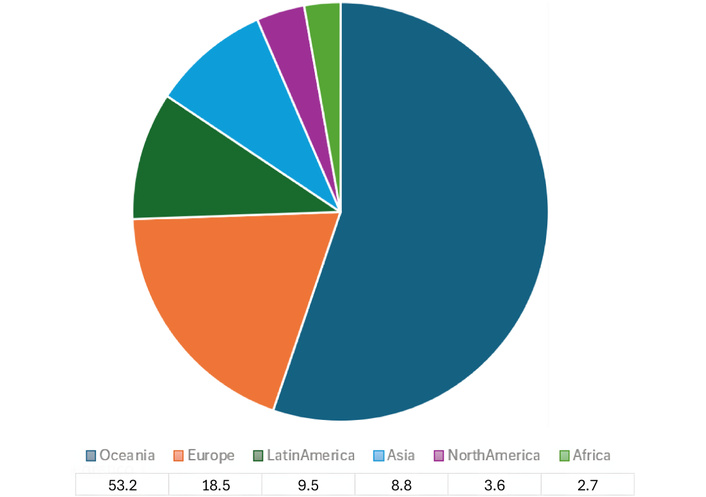
Distribution of organic land (millions of hectares). Adapted from: Willer H., Trávniček J. and Schlatter B. (Eds.) (2024). The World of Organic Agriculture 2024. Research Institute of Organic Agriculture FiBL [13].
As for the organic seed market, reports and data are scarcer. Estimations on the commercial profits derived from the seed market vary; some approximations mentioned approximately USD 54 billion in 2023 for the global seed market [14], a higher value than those reported in 2021 [15], and increase since 1996. What is clear is that the seed market is continuously growing, largely driven by the rise of genetically modified seeds (GMO), which account for almost 50% of the global seed market [15].
Concerning the organic seeds market size, estimations account for USD 3.90 billion in 2023 of profits and are expected to increase to USD 11.20 billion by 2033 [16]. The European organic seed market was valued at around 300 million euros in 2019. Projections on the organic seed market indicate a growing trend as the EU Organic Regulations require the use of organic seeds for organic farming from 2036, not allowing other types of inputs, so on average, the amount of organic seed needed to be produced for reaching 100% organic seed is 6-fold from the actual amount of organic seed produced [17]. Growing demand, consumers’ and producers’ environmental awareness, and farmers changing to organic crops and more strict regulations from governments predict the increasing market of organic seeds globally.
From a general perspective, more governments are advancing agroecological policies through targeted initiatives and programs with defined goals, while regional trends show growing progress driven by strategic actions. According to the IFOAM and FiBL data sources, there are currently 75 countries or territories with fully implemented organic regulations, and 14 regions are in the process of developing and implementing guidelines towards organic legislation [13]. The European Union (EU) and the United States (USA) have been implementing organic agricultural regulations for a long time, and they have well-established standards and norms for achieving a sustainable, agriculture-driven system. Concerning organic seed policies, the EU leads the progressive implementation of organic seed regulations, serving as an example to other countries following similar approaches. The EU Organic Regulation 2018/848 brings notable changes to certification and internal control systems (ICS) in organic farming. The organic standards in the EU state that all propagation material has to be organic, meaning that organic production requires the use of organic seed. This implies that the seed/variety is not produced by genetic engineering, or other breeding techniques regarded as endangering the integrity of the organic produce. However, if at the time of purchase, it is proved there is no stock of organic seed for the variety, a system of derogations makes it possible for farmers to use untreated conventional seeds when suitable organic varieties are not available. The 2018 modifications to the EU regulations imply a plan to phase out these derogations and achieve 100% organic seed use by 2036. These are not only important for European countries, but updates have a worldwide impact, affecting nearly two million organic farmers already certified [10, 18, 19]. To successfully achieve the EU goal a number of strategies need to be carried out. The IFOAM - Organics International, in collaboration with the Research Institute of Organic Agriculture FiBL, IFOAM Organics Europe, and leading experts in the field, have formulated guidance to assess and elucidate the implications and significant modifications introduced by the new EU Organic Regulation for producer groups worldwide since 2021. Furthermore, science-based policies need to be implemented to ensure seed supply (which has been in short supply) and to identify the problems for which organic seeds are difficult to produce, whether it is their genetics, pest or disease resistance, farmer management, time of production, among others [18].
Studies comparing organic and conventional food production systems have assessed a variety of factors such as crop yields, agronomic conditions, farming practices, and product quality, including nutritional and functional value, organoleptic characteristics, and shelf-life. A common debate in sustainable agricultural production is associated with low yield production. Extensive evidence shows that organic practices do not always result in significantly lower crop productivity than chemical-assisted farming. Equivalent yields are reported for many different organic or agroecological models, therefore supporting the shifting from conventional systems assuring economic profits and a suitable food supply [10]. Nevertheless, in some cases organic yields can be 10% lower than traditional, with greater gaps in intensive farming regions like Europe. This difference in the production yields is often related to suboptimal conditions like disease, nutrient limitations, or water deficits, affecting organic and conventional systems differently, despite lower yields, organic profits can be 2.4 times higher with lower costs and risks [20, 21]. Little evidence is found in terms of organic seed yields; some authors have reported that organic management for seed production of lettuce seeds [22] and green beans [23] do not affect significantly seeds production yield, however the genotypes and other factors (climate, soil, region, weed control and field management) can affect the final number among the same species.
Scientifically validated claims regarding differences between production systems are still under debate and investigation; although, growing evidence indicates that certain nutrients and vitamins—such as ascorbic acid and other antioxidant compounds—tend to be present at higher levels in organically grown vegetables. There is also a trend towards lower protein content but of higher quality in some organic vegetables and cereal crops [1, 24, 25].
One notable characteristic that sets organic plant-based foods apart is their higher content of secondary metabolites compared to products grown using conventional agricultural practices [7, 26]. In response to external threats and stressors, when no protection systems like pesticides or synthetic chemical treatments are used, plants develop a greater quantity of secondary metabolites as a natural defence mechanism. Studies have shown that organic farming systems differ in phosphorus and nitrogen levels compared to conventional methods. These differences are thought to significantly influence various metabolic pathways in plants, ultimately impacting the phytochemical metabolite profiles of organically grown produce [20, 26–28]. The accumulation of specific organic molecules and secondary metabolites, such as phenolic compounds, ascorbate, tocopherols, proline, polyamines, carotenoids, and glucosinolates, is vital for plant growth under stress. These compounds support signalling, water balance, and ROS scavenging, with defects leading to stress sensitivity. They also benefit human health, having an important role in modulating oxidative stress and systemic inflammation, key processes in the development of chronic diseases. Consequently, organic vegetable production can be seen as a sustainable strategy for sourcing bioactive compounds with nutraceutical potential [20]. Several studies have explored compositional differences between organic and conventional seeds across different crops, most focusing on antioxidant compounds. Doria et al., 2012 [29] evaluated not only bioactive metabolites but also anti-nutrients, in common bean seeds, highlighting variability linked to cultivation conditions. Similarly, Taie et al., 2008 [30] reported that organic and bio-organic fertilization influenced the accumulation of isoflavonoids, flavonoids, and phenolic acids in soybean seeds, also reporting changes in antioxidant activity. Radulescu et al., 2020 [31], observed differences in phytochemical profiles and antioxidant properties between organic and conventional grape seeds, while Alvites-Misajel et al., 2019 [32] described variations in fatty acid composition and antioxidant activity in chia seeds depending on the production system. Additional studies like the ones from Lima et al., 2008 [33] and Gupta-Elera et al., 2012 [34], also reported higher levels of phenolics and antioxidant compounds under organic management, in zucchini seeds and blueberry seeds, respectively. More recently, Amarowicz et al., 2024 [35] demonstrated that fertilization strategies significantly influence phenolic content and antioxidant potential in rapeseeds. Overall, these studies suggest that organic management can modulate phytochemicals’ quali-quantitative profile and other compositional aspects, though the magnitude and direction of these effects vary among species and experimental conditions [29–31, 33, 34, 36]. Reported compositional differences between organic and conventional seeds are summarized in Table 1, highlighting the main biochemical trends described in the literature.
Compositional differences between organic and conventional seeds.
| Compositional parameter | Trend* in organic seeds/produce | Possible explanation | Examples of crops reported |
|---|---|---|---|
| Phenolic compounds | Often higher | Increased plant stress response and activation of secondary metabolism in absence of synthetic pesticides | Common bean, soybean, grape, blueberry, zucchini, chia, rapeseed |
| Antioxidant compounds (ascorbate, tocopherols) | Often higher | Enhanced antioxidant defence mechanisms in plants exposed to biotic and abiotic stress | Various vegetable seeds |
| Carotenoids and secondary metabolites | Often higher | Activation of metabolic pathways related to stress tolerance and signalling | Vegetable and oilseed crops |
| Glucosinolates and defence metabolites | Potentially higher | Plant defence responses in low-input systems; nitrogen metabolism possibly implicated | Brassicaceae crops |
| Protein content | Sometimes lower but with higher quality | Differences in nitrogen availability and fertilization sources | Cereals and legumes |
| Mineral composition | Variable differences | Differences in soil management and nutrient availability | Various crops |
| Yield-related traits | Often similar or slightly lower | Differences in nutrient availability and pest pressure | Lettuce seeds, green bean seeds |
*: Based on reported comparisons, variations may occur depending on crop genotype, soil conditions, climate, and management practices.
It is important to consider, beyond the reported differences originated from the production systems, that variations cannot be attributed exclusively to the production system. Multiple factors may influence seed and vegetable composition, including environmental conditions, such as soil characteristics and climate, plant genotype or cultivar, and the duration that the land has been cultivated using organic methods. These factors can also affect metabolic pathways and chemical profiles, for example stress induction from UV exposure has been shown to enhance flavonols such as quercetin and kaempferol, which play a key role in photoprotection and antioxidant defence [36, 37]. These make interpretation complex and variable and should be taken with caution when conclusions are made.
Another critical point to discuss about the consistency of the differences linked to agro-production systems is that evidence remains limited. Even though all points to increasing amounts of phenolic compounds, antioxidant activity, and certain bioactive metabolites under organic systems, this claim cannot be fully proved. Trends in results often depend on crop type, fertilization regime, and specific experimental design, which add variability due to different analytical techniques, sample size, and environmental conditions. What is more, differences are moderate and their statistical and biological significance is not always clearly established. Notably, although higher levels of bioactive compounds and vitamins in organic seeds are frequently associated with potential health benefits, these effects remain mostly inferential since few studies have validated such advantages through in vivo assays using these matrices. Therefore, further standardized studies and biological validation are required to confirm their functional claims.
As noted in previous sections, farming practices, fertilization regimes, and pest control treatments influence organic products composition [4]. Control analysis for classifying organic materials often assesses the presence of pesticides (or their metabolites) and/or the occurrence of any anthropogenic synthetic chemicals that might contaminate the vegetable matrix. A misunderstanding commonly spread is that organic produce has “zero” pesticides’ residues, however, evidence shows differently. Even though organic farming and cultivation ban the use of synthetic pesticides; its products are susceptible to chemical contamination, already present (and/or nearby) in the soil, air or water, but chemical levels are significantly lower in organic crops than those found in conventionally grown produce, including lower levels of insecticides and multi-residue pesticides [36]. Thus, pesticide analysis, while being a requirement to ensure the safe use of seeds, is not entirely sufficient to serve as a comprehensive indicator of the overall quality of these inputs.
On the other hand, intrinsic differences (particularly in elemental signatures and secondary metabolite profiles) can be used to classify plant-based foods according to their production system. Several analytical methodologies have been developed to accurately characterize and verify organic certifications. The traditional approach to characterizing food matrices, which relies on determining one or a few chemical compounds and comparing the values of these analytes to those of an authentic product, is helpful in cases such as detecting adulteration or determining contaminant levels. However, when studying a food's history, such as geographic indications or when evaluating the origin and integrity of organic products, a different approach is needed. Thus, technologies such as spectroscopic, isotopic, genomic and metabolomic have emerged to detect those anomalies that classical methods cannot resolve, at the same time following environmental care guidelines, providing a rapid and more global response regarding foods’ composition [38]. All of these need to be complemented with multivariate statistical analysis for classification purposes [4].
Particularly, the use of agroecological or organic seeds is essential as a primary input for implementing sustainable cropping systems. But ensuring the organic status of these products remains a challenge, requiring greater efforts and the consideration of multiple factors such as sanitary, nutritional, and functional quality [7, 8]. In this context, traceability is primarily supported by certification schemes and documentary records [39–41], which, while essential, provide limited information on the intrinsic characteristics of seeds. This limitation highlights the need to complement conventional traceability frameworks with validated analytical approaches capable of linking chemical and compositional fingerprints to production systems and ensuring the integrity of organic seed inputs [5, 6]. First, these tools should enable a comprehensive characterization of the seeds by analysing and identifying the treatments and practices they have undergone, with a focus on changes in metabolite patterns and chemical markers that distinguish seed origins. Secondly, they should assess the impact of using these inputs on the attributes that add value to the resulting crops. Consequently, we can obtain specific and objective information about seeds, identifying metabolite patterns and/or detecting the presence of chemical markers that characterize each production system and differentiate them based on certain properties.
Validated analytical methodologies are necessary to reliably define and quantify (where possible) robust parameters that effectively discriminate between samples or treatments. The selection of indicative parameters/markers (the analytical target) for distinguishing high-quality products from fraud must be meticulous and grounded in scientific evidence, ensuring accuracy, repeatability, and reliability of the results.
Quality markers/parameters can be categorized into threshold, binary, interval, and fingerprint markers. Binary, threshold, and interval markers are particularly useful for detecting adulteration or the presence of non-compliant components in food products. In contrast, fingerprint markers, derived from comprehensive chemical or spectral profiles, are more suitable for traceability and for differentiating products according to their production system. Thus, fingerprints, from non-targeted methods, are evaluated using statistical or machine learning algorithms and can be classified as linear or non-linear [42]. In some cases, a single quality marker is enough to distinguish between two products. But in certain circumstances, it is necessary to complement the information with additional markers to ensure accurate differentiation. Regardless, having more than one marker always enhances the data and contributes to the unequivocal classification of the food’s origin.
Given that a wide variety of compound classes can be evaluated for their potential use as quality/integrity markers, the selection of the most suitable compound class(es) to study relies on the specific context and requirements for distinguishing the food product in question [43]. Regarding organic products, and more specifically organic seeds, quality/integrity markers progressively include spectral imaging, macro-component content (e.g., fatty acid composition, moisture levels), and seed weight, resulting from physicochemical and basic analysis, moving into more detailed profiles, sensory-related odours, secondary metabolite and elemental profiles. Even specific markers can be found such as phytochemicals, including phenolic compounds, vitamins, fatty acids, and isotopic ratio analysis providing precise tools for classification.
Based on the wide range of analytical approaches described in the literature, Table 2 summarizes the main analytical techniques applied to seed characterization and their potential relevance for organic seed authentication, while Table 3 sums up reported analytical targets and markers, as well as the corresponding analytical techniques serving to organic seeds evaluation.
Comparison table for the different analytical techniques with potential application for organic seeds evaluation.
| Techniques | Analytical method | Analytical principle | Advantages | Limitations | Sensitivity | Specificity | Applicability for organic seed authentication |
|---|---|---|---|---|---|---|---|
| Physicochemical analysis/physiological seed quality | Physicochemical and seed testing methods (germination, seed mass, moisture, purity tests) | Physical tests (visual and/or other organoleptic characterization) and physiological seed parameters assessment | Simple (almost no sample preparation), standardized, low cost; widely used in seed certification | Limited discriminatory power for production systems; influenced by environmental and varietal factors | ↑ | ○ | Useful for evaluating seed quality and viability but insufficient alone for distinguishing organic vs. conventional seeds |
| Imaging and optical sensing techniques (X-ray, thermal imaging, hyperspectral imaging, machine vision) | Spatial and spectral images formed from electromagnetic radiation incidence over seed tissues, reflecting structural and compositional features | Rapid, non-destructive; capable of detecting internal defects and seed structure; compatible with machine learning classification | Requires specialized instrumentation and calibration models; classification often indirect | ↑↑ | ◎ | Promising screening tools; hyperspectral imaging has shown potential for distinguishing organic seeds in some crops | |
| Electronic nose technologies | Detection of volatile organic compounds using sensor arrays | Rapid detection of volatile fingerprints; minimal sample preparation | Sensor drift and environmental sensitivity; requires calibration models | ↑↑ | ◎ | Potential complementary tool for seed classification based on volatile signatures | |
| Isotopic and elemental analysis | Stable isotope analysis (IRMS) | Measurement of stable isotope ratios (eg, 15N/14N) based on mass-to-charge separation of ionized molecules | Strong link of isotopic signatures to agronomic practices (eg, fertilization); high reproducibility | Influenced by geographic and climatic factors; requires expensive instrumentation | ↑↑↑ | ◉ | One of the most promising approaches for distinguishing organic and conventional production systems |
| Elemental profiling (ICP-MS, ICP-OES, AAS) | Quantification of macro- and trace elements based on the interaction of atoms/electromagnetic energy in atomic spectroscopy techniques | Multi-element capability; high sensitivity; suitable for fingerprinting approaches reflecting soil composition, fertilization, and environmental inputs | Elemental composition influenced by soil type and geography; requires specialized use | ↑↑↑ | ◎ | Useful as complementary markers for classification of farming systems | |
| Spectroscopic methods | Spectroscopic techniques (NIR, MIR, Raman, NMR) | Measurement of molecular vibrational or magnetic properties generating chemical fingerprints of food matrices | Rapid, non-destructive; minimal sample preparation; suitable for high-throughput screening | Requires chemometric modelling; spectral overlap may reduce specificity | ↑↑↑ | ◎ | Effective for fingerprint-based classification and preliminary authentication screening |
| Mass spectrometry techniques (MALDI-TOF, DART-MS) | Ionization and detection of molecules based on mass-to-charge ratio to generate molecular profiles | High molecular specificity; suitable for proteomic and metabolomic profiling | Instrument cost and complexity; often requires advanced data processing | ↑↑↑↑ | ◉ | Useful for identifying molecular markers associated with production systems | |
| Chromatographic and omics approaches | LC-MS, GC-MS, metabolomics, proteomics | Separation and identification of metabolites or proteins generating comprehensive molecular fingerprints | High analytical resolution; enables biomarker discovery and pathway analysis | Expensive instrumentation; complex data interpretation | ↑↑↑↑ | ◉ | Highly suitable for discovering discriminative markers of organic production systems |
Sensitivity scale: ↑ low, ↑↑ moderate, ↑↑↑ high, ↑↑↑↑ very high. Specificity scale: ○ low, ◎ moderate, ◉ high.
Analytical targets (markers/parameters) found in literature for potentially distinguishing organic seeds and the analytical techniques and instrumentation used for obtaining them.
| Seed tests | Analytical techniques and instrumentation | Quality markers/Quality features | References |
|---|---|---|---|
| Physicochemical analysis/Physiological seed quality | |||
| Seed viability and vigour | Machine vision | Seed size, colour, shape, texture | Rahman & Cho, 2016 [44] |
| Seed germination | Multi and hyperspectral imaging | Seed mass | Teles et al., 2019 [43] |
| Seed variety | Soft X-ray imaging | Lipids, proteins, and carbohydrates content | Shrestha et al., 2016 [51] |
| Purity | Thermal imaging | Moisture percentage | Caramês et al., 2025 [50] |
| Tetrazolium tests | Electronic nose | Spatial and spectral information of seeds | |
| Chemical composition | Moisture analyzer | Simple/complex odours associated with volatiles from seeds | |
| Moisture content | Titration techniques | Number of germinated seeds | |
| Proximal analysis | Physicochemical analysis | Physiological traits | |
| Disease presence | |||
| Damage by insects | |||
| Isotopic and elemental analysis | |||
| Stable isotope ratios | Isotope Ratio Mass Spectrometry (IRMS) | 15N/14N | Laursen et al., 2013 [57] |
| Macro-elements profiling | Inductively Coupled Plasma–Mass Spectrometry (ICP-MS) | 13C/12C | Westermann et al., 2011 [63] |
| Trace elements analysis | Inductively coupled plasma optical emission spectrometry (ICP-OES) | 18O/16O | Laursen et al., 2014 [58] |
| Rare elements analysis | Neutron-activation analysis | Macro-elements profiling (Na, N, K, P, S) | Ferrari et al., 2008 [61] |
| Trace-elements (Fe, Cu, Mn, Zn) | Fattobene et al., 2024 [62] | ||
| Rare elements analysis (Br, Cs, Eu, K, Rb) | Mihailova et al., 2014 [59] | ||
| Rossi et al., 2007 [60] | |||
| Spectroscopic methods | |||
| Seed variety | Nuclear Magnetic Resonance (NMR) | Metabolic Markers/fingerprinting (phytochemicals) | Terskikh & Kermode, 2011; Terskikh et al., 2005 [69, 96] |
| Seed origin | Fluorescence | 1H NMR analysis | Radulescu et al., 2021 [76] |
| Oil, proteins, and carbohydrates content | Raman | 13C NMR analysis | Gordillo-Delgado et al., 2012 [77] |
| Moisture content | Non-chromatographic mass spectrometry | Polyaromatic hydrocarbons and heterocycles compounds | Borges Lopes et al., 2021 [77] |
| Physical and chemical seeds characteristics | MALDI-TOF-MS: Matrix-Assisted Laser Desorption/Ionization Time-Of-Flight Mass Spectrometry | Spatial and spectral information of seeds | Consonni et al., 2018 [70] |
| DART-MS: Direct Analysis in Real Time Mass Spectrometry | |||
| Infrared spectroscopy | |||
| Near infrared (NIR) | |||
| Mid infrared (MIR) | |||
| Fourier transform infrared (FT-IR) | |||
| Chromatographic and omics analysis | |||
| Exploratory untargeted metabolome/lipidome/proteome analysis | LC-MS and LC-MS/MS | Metabolites/proteins/lipids fingerprint | Oliveira et al., 2024 [87] |
| Targeted metabolome/lipidome/proteome analysis | GC-MS and GC-MS/MS | Metabolic profiling (phytochemicals) | Röhlig & Engel, 2010 [91] |
| Omics | Metabolites/proteins/lipids identification and markers (VOCs, phenolic compounds, vitamins) | Liang et al., 2023 [88] | |
| Metabolomics | Bonte et al., 2014 [88] | ||
| Lipidomics | Varunjikar et al., 2023 [90] | ||
| Proteomics | |||
Assessing the certification or approval of organic seeds using validated analytical methods, supported by robust evidence of discriminative marker reliability represents a relatively novel approach in the field of food analysis. This can be seen in the few bibliographic references on the matter. However, there is more substantial evidence of the use of these methods and techniques in other classifications’ studies, such as geographic indications of origin and adulteration detection. The basic principles of the analytical techniques can be easily translated to different kinds of analytical purposes, hence in the following sections we present the analytical techniques that can be used to assess the quality and integrity parameters of organic products, with a particular emphasis on their application in the study of organic seeds.
Seed quality is crucial for crop development and yield, with high-quality seeds directly enhancing productivity. Factors such as seed health, germination capacity, and physiological traits, including disease resistance, chemical composition, insect infestation, and the presence of weed seeds or other plant varieties, influence seed quality [44]. Several detection methods have been proposed to assess these features of seeds, and advantageously, most of them consist of non-destructive and rapid tests that address macro characteristics, and physiological distinctions of seeds.
While these methods alone may not be sufficient to distinguish organically produced seeds, the parameters and insights they provide regarding seed quality are highly valuable and widely used in the agri-food sector. Every buyer and seller include quality information in seed lots, typically covering germination capacity, seed mass, purity, viability, and/or vigour, and in some cases physicochemical composition (especially fat and moisture content) [45, 46]. Hence, a comprehensive study on seed classification based on production methods should also consider these parameters.
Traditional seed testing methods are compiled within the International Seed Testing Association (ISTA) which sets global standards for seed sampling and quality testing to ensure uniformity in seed evaluation.
Physical purity is a simple visual test looking for differentiating original seeds from undesirable materials, such as dirt, leaves, little sticks, abnormal seeds, and weed seeds. Chemical composition, even though not always considered in seed testing, can be an influential parameter in seed quality, especially when dealing with oil producing seeds or seeds used for their protein content. Proximal analysis carried out by classical “wet chemistry” methods is the standard procedure.
Other traditional seed tests consist of determining the seed mass by simply weighing a subsample of seeds (normally a common parameter is 1,000 seeds weight), and the seeds moisture, expressed in percentage on a wet weight basis. The latter is associated with seed features like maturity, longevity and vigour, or heat, insects, and pathogens damage. Most seed testing labs worldwide follow ISTA's recommended gravimetric method, which determines seed moisture by drying samples at a specific temperature and time based on the crop. Lately, other non-destructive techniques have been used like the moisture meters based on the indirect water content measurement, typically relying on the electrical resistance or conductance of moisture within the seed [45].
Seed health is also an important parameter to consider when evaluating quality. It refers to the absence of seed-borne pests’ infestation/infection due to microorganisms or insects. The microscopic examination of disease patterns or damage caused by external biological agents in seeds is a way to achieve this distinction, requiring specialized expertise. Though the advancement of spectroscopic and chemical imaging techniques has significantly streamlined this process [45].
Finally, genetic and physiological quality are most required in seeds certifications. Assuring that genotype characteristics influence crop disease resistance, environmental adaptation and a uniform, homogeneous population, whereas physiological traits like the seeds’ viability, germination and vigour guarantee good seedling emergence and crop establishment in the field [45]. The most common tests are the germination ratio (counting the number of germinated seeds from a pooled sample under controlled lab conditions), and vigour (same procedure but in field conditions) [47], as well as the tetrazolium test (using topographic evaluation with 2,3,5-triphenyltetrazolium bromide or chloride to identify live embryo structures essential for germination through colour indication). But as with other seed tests, the previous has been improved and accelerated by the implementation of chemical imaging.
In terms of classification purposes, employing a traditional approach, Teles et al., 2019 [43] evaluated the physiological and sanitary seed quality. This analysis includes seed health evaluation, seed moisture content, seed mass, germination, first count, field emergence and accelerated ageing. The latter parameters served to differentiate characteristics from organic vs. conventional lettuce, coriander, sweet pepper and snap bean seeds, showing a slight difference in yields for some species (in support of conventional ones), germination and vigour were similar in both systems.
As for the technical specifications of the emerging technologies used for seed testing based on imaging and optical sensing, they generate a form of visualization based on different physicochemical phenomena. Different electromagnetic waves interact with the seed’s components, and from that interaction an image is generated, providing spectral and compositional information. Another form of working consists of sensing some optical or physical property featured by the components of the seeds [48]. Soft X-ray imaging utilizes electromagnetic waves in the range of 1 to 100 nm offering low penetration power, can reveal internal voids, defects, and insect damage for quality control in a rapid 3–5 second scan [44].
Other types of chemical imaging include thermal imaging, which maps radiation patterns of an object into visible images, quickly assess seed quality, detect diseases, and monitor water stress in plants. Multispectral and Hyperspectral imaging, which cover spectral ranges from 400 nm (visible) to 2,500 nm (near-infrared), provide detailed spatial and spectral information, enabling the assessment of both the exterior and internal composition of agricultural products, classification of seeds and detection of internal defects. On the other hand, machine vision or computer-generated image processing is an AI-based technique simulating human vision, assessing external features like size, shape, color, and texture, enabling seed classification, variety identification, and disease detection [44, 48, 49].
Lately, integrating spectral, thermal, fluorescence, X-ray, and magnetic resonance imaging provides reliable alternatives to traditional methods, and instruments like the Videometer Lab® can assist in purity analysis as well as chemical composition, by detecting seeds from other varieties, inert matter, and defective seeds, also employing chemometrics to distinguish fat, water carbohydrates and protein content in seeds [45] (Figure 2).
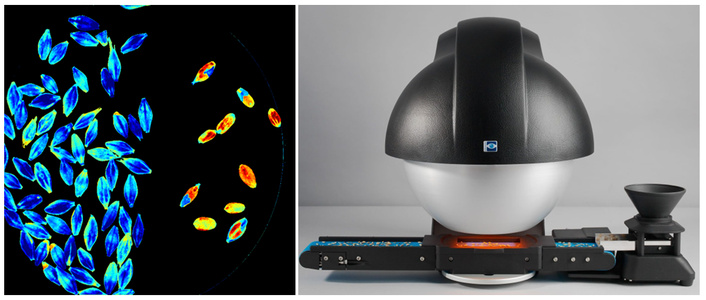
VideometerLab Autofeeder® (right), and seeds differentiation based on multispectral imaging (left). Taken from Videometer without modification. © 2025 Videometer [95].
Not only is visual data useful for quality assessment, but volatile compounds particularly linked to specific vegetable species and varieties can serve as classification markers, too. Electronic noses are equipped with sensor arrays such as metal-oxide semiconductors (MOS) and piezoelectric sensors that can detect odours at parts-per-million (ppm) to parts-per-billion (ppb) levels. Their effectiveness in food quality control, including seed purity analysis and microbial pathogen detection stems from their ability to distinguish subtle differences in volatile compounds [44].
The differentiation of organic seeds from conventional ones is a representative example of the application of these technologies. Authors have resorted to non-destructive technologies such as hyperspectral imaging, particularly NIR spectra selection, to discriminate organic brown rice kernels, which represent the edible grain fraction of the rice seeds [50], and to analyse tomato seeds [51]. Not exactly used for reproducing material, maize characterization was carried out by multispectral imaging leading to the remote classification of organic crops from those which are not [52]. As classification tools, extensive references can be found on spectral imaging for variety differentiation and seed health, though it would be interesting to see how these technologies evolve integrating AI-tools and chemometrics for organic certification purposes.
Different C/N ratios between organic and conventional fertilizers promote diverse biological pathways in plants. This results in varied metabolic signatures stable isotopic ratio, elemental distribution, and nutrient profile [4]. Stable isotope analysis is one of the analytical strategies used for classification purposes. It is based on the measurement of light elements H, C, N, O and S isotopes (hydrogen (1H) possess three naturally occurring isotopes: 1H, 2H, and 3H. Oxygen has 16O, 17O and 18O. Nitrogen has 14N and 15N. Carbon has three isotopes: 12C, 13C, and 14C). Isotopes are atoms of the same element, with the same number of electrons but a different number of neutrons. The analytical methods used for stable isotope analysis include Isotope Ratio Mass Spectrometry (IRMS), Multi Collector–Inductively Coupled Plasma–Mass Spectrometry (MC-ICP-MS), and Thermal Ionization Mass Spectrometry (TIMS). Isotopes serve to provide information about a plant’s history and origin. H and O isotopic data from food (specifically from organic matter) link to the H and O isotopes from water, indicating information of its geographic origin. N and C isotopes deliver climate and agricultural practices data, and S isotopes are affected by geology and certain anthropogenic effects [53]. One of the most notable stable isotopes analysis for organic products evaluation consists of δ15N. There is a common assumption that a vegetable 15N/14N ratio (δ15N) reflects the nitrogen content of the land in which the plant has grown, in turn showing the fertilization strategies implemented (especially their nitrate content), which are different between organic and conventional farming. Manure-derived nitrogen, typically found in organic fertilization management, shows higher δ15N values due to the preferential volatilization of 14N-depleted ammonia. In contrast, synthetic nitrogen fertilizers have δ15N values near zero, as they originate from atmospheric nitrogen with minimal fractionation. Thus, conventionally grown plants tend to have lower δ15N values than organically grown ones [54].
Fertilization practices not only become reflected in isotopic ratios, but also in elemental composition. Other agricultural actions, like irrigation and pest control, can also affect elemental composition in plants. Elemental profile is referred to macro-elements (sodium, potassium, calcium), trace elements (for example selenium, copper, zinc and iron), rare earth elements or other elements at low concentration (e.g., gold) [55]. Elemental profiling has traditionally been performed using Atomic Absorption Spectroscopy (AAS), although Inductively Coupled Plasma techniques (ICP-MS and ICP-OES) are now widely used for multi-element analysis. These methods are based on the atomization and excitation of these atoms using high-energy sources, followed by the detection of element-specific signals. In ICP techniques, a high-temperature plasma (7,000–8,000 K) generates free atoms and ions, enabling sensitive and simultaneous multi-element determination. Among these, ICP-MS offers the highest sensitivity and broadest analytical range, with rapid detection of trace elements and isotopes [53, 56].
Considering the elemental composition of vegetables, those nutrients from soil which result bioavailable and mobilized will constitute the mineral content of vegetables [53]. Given that synthetic fertilizers clearly have a different composition than organic fertilization strategies, like manure, nutrient release varies in rate and extent between farming practices, affecting crop chemical composition. In this line, to the moment, evidence suggests there are differences in the Mn, Ca, Cu and Zn levels between crops cultivated under organic and conventionally systems possibly attributed to the presence of elevated levels of arbuscular mycorrhizal fungi (AMF) in ‘organic soils’ [54]. Moreover, inorganic fertilizers and pesticides often contain heavy metals and have higher concentrations of rare-earth elements, like La, Ce, Th, and Yb, leading to increased levels of these elements in the soil, hence affecting the composition of plants and seeds [4].
Concerning organic seeds discrimination based on isotopic and/or elemental analysis, references are starting to prove the methods’ utility to assess the integrity and quality of products [57, 58], discussed and proved the potential of multi-isotopic analysis for the evaluation of organic vegetables, including faba beans, wheat and barley, differentiating them from conventionally grown ones [59, 60]. Mihailova et al., 2014, and Rossi et al., 2007 [59, 60], have also considered isotopic analysis for discrimination endings of farming practices, in these cases the N isotopic signature was aimed at recognizing fertilization choices and their agronomical impact. Tomato seeds were also compared regarding their organic or conventional origin [61], showing that elements such as Br, Cs, Eu, Fe, K, Mo, Na, Rb and Sm, analyzed by INAA (Instrumental Neutron Activation Analysis) classified samples according to the crop management chosen. Elemental analysis also served to characterize organic wheat grains and its milling products [62], as well as common beans [63], both using ICP-OES.
To further expand the analytical possibilities for studying plant composition and element dynamics, there are new technologies worth mentioning like radioisotope-based imaging techniques. For example, Suzui et al., 2019 [64], highlight the use of radiotracers to monitor the uptake, transport, and distribution of elements within living plants in real time, showing element kinetics at the whole-plant level. Although it is still scarcely applied to seeds, these approaches show potential for investigating nutrient allocation, storage, and translocation processes.
Despite the increasing application of isotopic and elemental approaches for food authentication, their use in seeds remains limited. Further studies are required to validate their robustness under real production conditions. In particular, factors such as seed processing and post-harvest treatments, including coating or pelleting, may alter the elemental composition and potentially interfere with analytical signatures. Seed treatments are widely used to improve storage stability and germination performance. They often involve mineral or chemical inputs that could influence elemental profiles over time in conventionally produced seeds [55, 65]. In organic seeds, treatments and coatings are emerging as new strategies to improve seeds and seedlings’ health, so no exact knowledge can be linked to the impact of treatments on their mineral/isotopic profile. Moreover, the storage and conditioning processes applied before sowing may introduce additional variability that is rarely considered in current studies. Therefore, future research should consider these factors and evaluate the temporal stability of isotopic and elemental markers in seeds, ensuring their reliability for production system discrimination.
In this section, molecular spectroscopic methods (apart from imaging analysis) will be discussed. Spectroscopic techniques provide structural, physicochemical and composition properties from food staff based on the interaction of electromagnetic radiation with the components of its matrix. This information derives from reading samples at a specific wavelength or frequency detected in the emitted or absorbed energy spectrum [66]. Since spectroscopic techniques are intended to be used as classification tools, their use is extensively linked to chemometrics methods.
UV–Vis spectroscopy (200–800 nm) is widely used in food authentication, although its application in organic food monitoring is limited, with few studies such as organic coffee analysis coupled with chemometrics [67]. Fluorescence spectroscopy is a non-destructive and highly sensitive technique based on the emission of light by molecules after excitation, providing compound-specific signals [53]. Despite of these benefits, organic seeds verification has not harness from this method. Vegetable oils from seeds have been analyzed to assess their authenticity by this method, for example examining the organic and conventional soybean oils fluorescence spectra, showing the method efficiency in determining pigments degradation and fatty acid oxidation [68].
Nuclear Magnetic Resonance (NMR) analysis is another spectroscopic method hugely spread among authenticity analysts. It is used for identifying the carbon-hydrogen structures of molecules according to electromagnetic radiation absorption. NMR provides molecular fingerprints and enables structural elucidation of food compounds [66, 67]. This technique has been crucial in tracing organic components in food samples, based on their unique metabolic profiles. Particularly, proton nuclear magnetic resonance (1H NMR) has been mostly used in the field of food composition analysis, allowing structural information on a wide range of molecular compounds [67]. Seeds metabolite profiling by NMR has been addressed in numerous studies for various authentication issues [69], mostly for variety distinction and geographical denomination, and there is even a study of the impact of farming practices on coffee beans from 1H NMR data and OPLS-DA classification method [70].
Vibrational spectroscopy is based on the interaction of infrared radiation with molecular bonds, generating characteristic spectral fingerprints. Mid-infrared (MIR) reflects fundamental molecular vibrations, while near-infrared (NIR) arises from overtone and combination bands [53, 71]. Raman spectroscopy, in turn, is based on inelastic light scattering, providing complementary vibrational information. These techniques are often coupled with Fourier Transform (FT), and give rapid, non-destructive analysis. Combined with chemometric tools such as PCA and PLS-DA, they are widely used for sample classification and authentication [71, 72]. There are plenty applications of vibrational spectroscopic analysis used for food authentication, predicting adulteration and geographical origin, varieties of oils, wine, honey among others [71]. These methods has been used for various purposes such as the study of genotypes, like in cotton seeds [56], assessed by NIR and Raman spectroscopy and chemometrics; seeds viability, in corn seeds by FT-NIR and Raman [73], and in soybean also by FT-NIR [74], and even the presence of disease pathogens like mycotoxins and toxigenic fungi has been detected in cereals using vibrational techniques [75]. Notably, Infrared spectroscopy and chemometrics in organic food analysis has been extensively used [67] serving to characterize organic from conventional vegetables like tomato, potato, and asparagus, however for organic seeds distinction only grape seeds have been analyzed, using FTIR and Raman techniques combined with multivariate analysis to find patterns in red grape berry parts (skin, seeds and pulp) differentiating grape variety and vineyard type (organic and conventional) [76]; and rice using photoacoustic technique to differentiate [77]. The quality of coffee samples by Raman spectroscopy [78] has also been monitored, but a proper distinction between farming practices in seeds is still an application that requires further development for these techniques.
Non-chromatographic mass spectrometry techniques also offer an effective approach for food classification. By facilitating and making methods more practical, since the chromatographic step is avoided, these methods constitute independent techniques for elemental or molecular profiling and imaging. They encompass for example Matrix-assisted laser desorption/ionization Time-of-Flight Mass Spectrometry (MALDI-TOF-MS) and Ambient Mass Spectrometry techniques such as Direct Analysis in Real Time (DART-MS) [53]. Mass spectrometry is an analytical technique widely used to identify and characterize compounds based on their mass. The sample needs first to be ionized, and the resulting charged particles are then separated in mass analysers and finally detected to generate a characteristic profile. Different ionization methods can be used, such as MALDI, which uses laser energy, or DART, which allows direct analysis of samples with minimal preparation, both corresponding to soft ionization methods, simplifying sample analysis [79]. MALDI-MS has especially yielded valuable information about organic vs. conventional classification of vegetables like cabbage and carrots [80], showing this method’s potential in providing proteomic data to identify the metabolic pathways implicated in different agronomic production systems. Different seed processes and properties, and how they determine their composition were also studied, e.g., seed germination and metabolism in soybean seeds [81], and the distinction of seed genotype variety from grape seeds’ proteins [82]. In line with this review, hemp seeds, considering them as functional foods and nutraceutical sources, were investigated by MALDI-TOF in search of the bioactive protein profile to discriminate samples according to their origin and variety [83].
These analytical technologies, although they have recently been used in the study of organic foods, and their use in seed research is even newer, demonstrate great promise for delivering fingerprint profiles and markers that differentiate sample origins, also showing rapid, practical structural and compositional information that can be easily integrated into industrial processes.
Chromatographic methods are useful to isolate single organic compounds from a mixture of organic substances. A large number of compounds from diverse chemical nature can be found in the food matrix including carbohydrates, lipids, amino acids and proteins, organic and nucleic acids, inorganic compounds, vitamins and other low-molecular weight compounds (contaminants, drugs, additives, etc.). During chromatography, compounds with similar chemical background (for example lipids and fatty acids), can be separated from each other and analyzed from their interaction with the chromatographic system. As a result, chemical fingerprints from the chromatographic information is generated helping differentiate and authenticate foods [71, 84, 85]. High resolution instruments, like High Performance Liquid Chromatography (HPLC and its sophistications as Ultra High-Performance Liquid Chromatography UHPLC or UPLC) and Gas Chromatography (GC), coupled to detectors such as UV-Vis, Fluorescence and especially Mass Spectrometry, are now popular to address food control. In particular, LC-MS and GC-MS (or LC-MS/MS, GC-MS/MS when Tandem Mass Spectrometry is used) are important analytical methodologies convenient for obtaining fingerprint patterns and compositional information to characterize food products. Compounds such as carbohydrates, vitamins, proteins, fatty acids, amino acids, phenolic compounds, and pigments are typically analyzed by LC, while GC is used to the analysis of naturally volatile or semi-volatile molecules [53]. Conveniently, these technologies have evolved as important analytical tools to developed metabolomic and proteomic analysis, for studying metabolites and metabolic information, and protein profile or proteome, respectively. These omics sciences aim to analyze biological samples in a holistic and comprehensive manner, capturing a broad spectrum of molecular information [85].
From all the omics approaches, as noted by Dadwal et al., 2026 [86], metabolomics enables the assessment of metabolic pathways and chemical diversity, providing information to current gaps in organic food composition and supporting quality assurance and traceability. Metabolomics studies can be divided into targeted and untargeted strategies: targeted metabolomics focuses on quantitative analysis of known compounds, while untargeted metabolomics gives a global and exploratory view of the metabolome, allowing the discovery of new markers and metabolic pathways’ changes. In this context, LC–MS-based metabolomics is widely used due to its high sensitivity and broad metabolite coverage, whereas NMR-based approaches offer robust, reproducible profiling with lower sensitivity but minimal sample preparation.
Whether fingerprinting profiles or specific metabolites/proteins markers, from targeted or non-targeted analysis, they have responded several organic food authentication issues, especially showing a high capability to respond the influence of farming practices in plants and vegetables [54, 67]. For seeds, these chromatographic methods along with mass spectrometry were used for pinto beans (Phaseolus vulgaris L.) agroecological, organic and conventional discrimination through the volatile organic compounds profile [87]; for assessing peanuts transcriptomic and metabolomic analysis, resulting in the distinction of organic farming from conventional on the expression of fatty acids and lipids [88]; for the metabolite profiling of wheat submitted to organic and conventional farming [89]; for the proteomic analysis of soybean seeds from different production systems and genetically modified [90]; and maize kernels metabolite profiles were evaluated in terms of the influence of input system (organic vs. conventional) [91].
From the previous analytical methodologies different metabolite markers have emerged as possible discriminative compounds for organic tracing, mostly phytochemicals, as they result from the plant secondary metabolism as stress-reactant defence molecules. Since there are indications about the drift in the metabolic pathways of organically grown plants as a response to stress susceptibility, secondary metabolites quali-quantitative profile can be affected [26]. A chemical family that deserves special discussion in terms of possibly serving as a marker for organic food discrimination is phenolic compounds. The previous phenomenon in which the lack of synthetic pesticides in organic farming increases the plants’ exposure to stress, is hypothesized to end up varying phenolic content among organically grown crops [36, 92, 93]. Inorganic N availability, influenced by fertilizer type, can also affect plant biosynthesis, leading to different phenolic compound production in organic crops. In addition, organically produced plants having longer ripening periods may favour the production of secondary metabolites in this time, resulting in higher concentrations of phytochemicals in organic plants. All in all, evidence indicates that organically grown crops have a higher content of phenolic compounds, although the genetic effect, geography and other factors are also important, so this conclusion cannot be generalised, and rather a specific class of phenolic compounds fingerprint/profile would be more consistent as markers than the whole phenolic compounds content [54].
To reflect on this section, chromatographic and omics approaches enhance our understanding of complex biological systems, enabling their applications in fields such as food authentication and quality control, especially leveraging its use for markers discovery in the organic seeds market. Specially, untargeted metabolomics highlights from all the available analytical approaches discussed in the previous sections, driving the identification of phytochemical markers for differentiating organic and conventional products. It provides both exploratory and mechanistic insights. However, these approaches require advanced instrumentation, complex workflows, and extensive data processing due to the large datasets generated. Moreover, even when discriminatory markers are identified, their interpretation must consider potential confounding factors, as metabolic profiles are strongly influenced by environmental and other stress conditions. Therefore, while metabolomics represents a powerful tool for authentication, careful experimental design, data interpretation, and biological validation are essential to ensure robust and meaningful conclusions.
Classification and discriminative studies need chemometrics methods, especially when non-targeted approaches have been used in the experiments and large data is generated, to collect and process the data, reduce the number of variables and to manage the information statistically so patterns and markers can be visualized and differentiated among the diverse type of samples. Multivariate statistical analysis is the most common chemometric strategy employed, whether used for exploratory data analysis, data description/visualization, classification and pattern recognition, and regression and prediction. Classification methods in multivariate data analysis can be supervised or unsupervised. Unsupervised methods, like Principal Components Analysis (PCA) and Hierarchical Clustering Analysis (HCA), identify patterns without prior class knowledge. Supervised methods, such as Linear Discriminant Analysis (LDA), Partial Least Square (PLS) regression, and artificial neural networks (ANN) as non-linear approach, require a training phase to build predictive models for classifying unknown samples [85]. For exploratory data analysis unsupervised methods comply the role, but for classification purposes supervised analysis are used. In food authentication, especially for organic food classification, PLS-DA and OPLS-DA have shown promising results [67], however more advancements will be necessary to compliment spectroscopic analysis such as multivariate calibration methods, as well as the consideration of implementing neural artificial networking and machine learning approaches for large data processing and management in the fingerprinting of complex samples.
About recent trends, beyond conventional chemometric approaches, in metabolomics latest articles network-based strategies have emerged, such as molecular networking. While supervised and unsupervised methods organize data and enable statistical classification, molecular networking gives an additional structural dimension by grouping metabolites based on MS/MS spectral similarity. This allows the identification of chemically related families and the discovery of compound classes associated with specific agri-foods [94]. In parallel, the development of automated data processing workflows has enhanced the handling, annotation, and reproducibility of large-scale metabolomics datasets, supporting more robust and scalable authentication strategies.
While organic seeds offer advantages in quality, resistance, and compositional traits, addressing limitations of their use and expansion requires scientifically supported strategies. In this context, advanced analytical tools play a key role in characterizing seed intrinsic composition, and identifying markers for differentiating production systems. Reference on that matter, evidencing the methodologies capabilities to evaluate organic seeds characteristics, though in their early stages, they clearly point the path to follow. Most studies so far have been exploratory or focused on sample classification, but predictive models assigning unknown samples to known classes need more information to support their suitability for organic tracking. Furthermore, among the analytical approaches discussed, we must emphasize omics-based techniques, isotopic analysis, and elemental profiling as the most promising tools for organic seed fingerprinting. In particular, LC-MS/MS metabolomics offers a comprehensive view of chemical profiles, while isotopic and elemental techniques provide indicators linked to agricultural practices. However, their practical use is still limited for their high-cost instrumentation, and trained personnel requirements. The complexity of large datasets generated by these techniques also poses challenges in data interpretation. Moreover, it is almost impossible to have a single and global marker to discriminate samples, and especially considering different species and confounding factors which can affect fingerprints and markers. So, a multi-analysis approach would be the ideal strategy for classification of food samples according to their origin. Additionally, the significance of the presence of chemical markers in one product (and their absence in another), suggesting the potential to use them as quality/integrity indicators, must be examined by analyzing different samples (for example, different organic seeds of the same genotype but from different producers and geographical locations) serving as the basis for the construction of the statistical models. In this context, we can provide a conceptual analytical workflow (Figure 3) as a possible framework for a comprehensive evaluation of organic seeds. Preliminary analyses focusing on seed quality parameters, such as viability, germination, and physicochemical characteristics, as well as pesticide residue screening, may serve as initial steps to verify minimum requirements for seed use in agricultural production and certification/inspection studies. To explore the intrinsic compositional differences between production systems, more integrative profiling approaches should be considered, as already discussed. The large datasets generated by these techniques can then be interpreted using chemometric and multivariate statistical tools, enabling the identification of compositional patterns and the development of classification models capable of differentiating organic and conventional seeds.
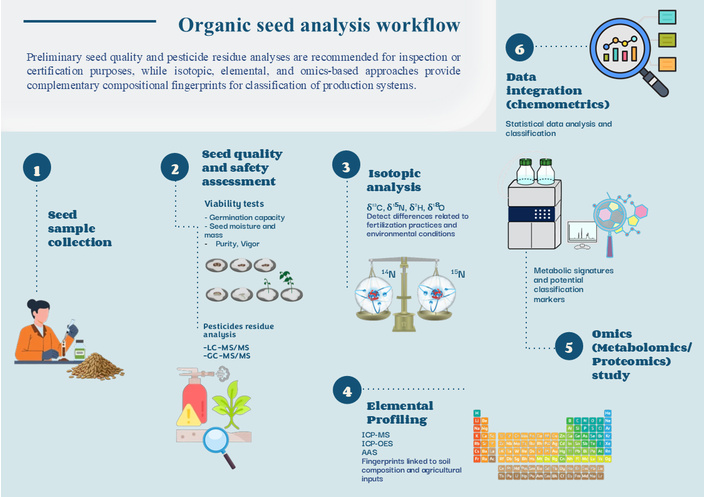
Schematic workflow including the analytical steps for organic seeds comprehensive analysis.
To sum up, the future of organic foods, and organic seeds, is highly dependent on scientific-based actionable strategies to assure market regulation and farmers’ guidance and control. Upcoming research should focus on reinforcing the claims and validating markers across different species and geographical origins, integrating multi-omics approaches with machine learning tools to improve predictive accuracy and biological interpretation. But translating the analytical advances we discussed into real authentication systems will require simplifying and standardizing methodologies to be implemented beyond academic research. A possible strategy could be the development of rapid screening tools, supported by validated methodologies, reference databases and regulatory frameworks (e.g., once specific markers are elucidated from metabolomics, use those markers in rapid qualitative on-site test to check their presence). This will be essential to shorten the gap between experimental research and routine application. Fraud and prohibited farming practices are around the corner when dealing with value-added products of high demand, so analytical technologies need to be in line with this trend to comply with demands, assuring transparency in the organic seed market and the integrity of sustainable food systems.
DAR: Conceptualization, Investigation, Writing—original draft, Writing—review & editing, Funding acquisition. FPA: Conceptualization, Writing—review & editing. RFB: Writing—review & editing. ABC: Validation, Writing—review & editing, Supervision, Funding acquisition. All authors read and approved the submitted version.
The authors declare that they have no conflicts of interest.
Not applicable.
Not applicable.
Not applicable.
Not applicable.
The authors would like to thank the Universidad Nacional de Cuyo, Mendoza Argentina (Grant SIIP UNCuyo 2022 06/A007-T1; Grant SIIP UNCuyo 2025 Investigadores Noveles 80020240200036UN; Grant Fortalecimiento en Cs y Técnica UNCuyo 2025 06/80020240400061UN), and the Consejo Nacional de Investigaciones Científicas y Técnicas (CONICET Argentina) (Grant PIP 11220200101692CO). The funders had no role in study design, data collection and analysis, decision to publish, or preparation of the manuscript.
© The Author(s) 2026.
Open Exploration maintains a neutral stance on jurisdictional claims in published institutional affiliations and maps. All opinions expressed in this article are the personal views of the author(s) and do not represent the stance of the editorial team or the publisher.
Copyright: © The Author(s) 2026. This is an Open Access article licensed under a Creative Commons Attribution 4.0 International License (https://creativecommons.org/licenses/by/4.0/), which permits unrestricted use, sharing, adaptation, distribution and reproduction in any medium or format, for any purpose, even commercially, as long as you give appropriate credit to the original author(s) and the source, provide a link to the Creative Commons license, and indicate if changes were made.



View: 1632
Download: 34
Times Cited: 0
Anushi Madushani Wijethunga, Chijioke Emenike
Bernhard Thalhamer ... Wolfgang Buchberger
Yanmei Zhu ... Haiyan Fu
Adindu O. Onyeodili ... Raquel P.F. Guiné


