 Mini Review


Affiliation:
1Department of Neurorehabilitation, Casa di Cura “Villa Verde”, 73100 Lecce, Italy
2Department of Engineering for Innovation, University of Salento, 73100 Lecce, Italy
Email: gverrienti@villaverde.lecce.it
ORCID: https://orcid.org/0000-0003-3477-7195


Explor Neuroprot Ther. 2026;6:1004165 DOI: https://doi.org/10.37349/ent.2026.1004165
Received: February 24, 2026 Accepted: June 12, 2026 Published: July 23, 2026
Academic Editor: Rafael Franco, Universidad de Barcelona, Spain
The article belongs to the special issue Therapeutic Targets for Neuroprotection in Ischemic Stroke
Stroke remains a leading cause of long-term disability worldwide, and selective serotonin reuptake inhibitors (SSRIs), beyond their established role in treating post-stroke depression, have been investigated for potential neurorestorative effects through modulation of neuroplasticity, cortical excitability, and synaptic remodeling. This narrative mini-review summarizes the current clinical evidence on the use of SSRIs for motor recovery, cognitive recovery, and global functional outcomes after stroke. Early small-scale studies, particularly with fluoxetine, suggested improvements in motor performance and neurophysiological markers of plasticity, generating interest in a possible disease-modifying role. However, subsequent large multicenter randomized controlled trials failed to demonstrate benefits on global functional outcomes and instead reported an increased risk of adverse events, including fractures, falls, seizures, and hyponatremia. Evidence for other SSRIs remains limited, heterogeneous, and largely inconclusive. The observed discrepancy between mechanistic plausibility and neutral clinical outcomes may reflect limitations in outcome sensitivity, patient heterogeneity, differences in stroke subtypes, and suboptimal alignment between biological targets and clinical endpoints. Overall, current data do not support the routine use of SSRIs as neurorestorative agents in non-depressed stroke patients. Future research should focus on biomarker-guided patient selection, optimized timing of intervention, and the use of domain-specific outcome measures more closely aligned with neuroplasticity mechanisms, in order to clarify whether serotonergic modulation may have a selective, context-dependent role in post-stroke recovery.
Stroke remains one of the leading causes of long-term disability worldwide, frequently resulting in persistent motor, cognitive, sensory, and functional impairments [1–3]. Despite advances in acute management and secondary prevention, a substantial proportion of stroke survivors experience residual deficits that significantly compromise independence, quality of life, and social participation. Motor impairments such as hemiparesis and spasticity often coexist. Cognitive dysfunction affecting attention and executive functions is also common. Language disturbances and sensory deficits may further contribute. Together, these impairments result in complex and multifactorial disability profiles. Consequently, optimizing neurorehabilitation strategies remains a major clinical priority. While selective serotonin reuptake inhibitors (SSRIs) are primarily prescribed for post-stroke depression (PSD), increasing attention has been directed toward their potential role in promoting neurological recovery independent of mood improvement [4, 5].
Beyond their antidepressant properties, SSRIs modulate serotonergic neurotransmission, which plays a critical role in neuroplasticity, cortical excitability, and synaptic remodeling [6, 7]. Experimental and clinical evidence suggests that serotonergic enhancement may facilitate motor relearning, improve cognitive recovery, and influence interhemispheric balance after brain injury [8]. These observations have led to the hypothesis that SSRIs might act not only as psychotropic agents but also as pharmacological modulators of post-stroke neural reorganization. However, the extent to which these neurobiological effects translate into meaningful functional improvement remains a matter of ongoing investigation.
This updated mini-review synthesizes the current clinical evidence on the rehabilitative effects of SSRIs after stroke, with a focus on motor, cognitive, and overall functional outcomes, beyond their traditional use for PSD. Clarifying the potential disease-modifying role of SSRIs in stroke recovery is essential to inform clinical decision-making and optimize individualized rehabilitation strategies. A better understanding of the balance between potential functional benefits and safety considerations may help define their appropriate timing, patient selection, and therapeutic positioning within comprehensive post-stroke care pathways.
The theoretical rationale for SSRI use in stroke rehabilitation is grounded in neuroplasticity [9, 10]. These mechanisms can be broadly categorized into (i) molecular effects, such as brain-derived neurotrophic factor (BDNF) upregulation, (ii) cellular processes (neurogenesis and synaptogenesis), and (iii) network-level modulation (cortical excitability and interhemispheric balance), reflecting the multi-level impact of serotonergic modulation on post-stroke brain recovery.
Specifically, as shown in Figure 1, SSRIs may act through several mechanisms, often in combination; in particular, experimental and translational studies suggest that SSRIs may:
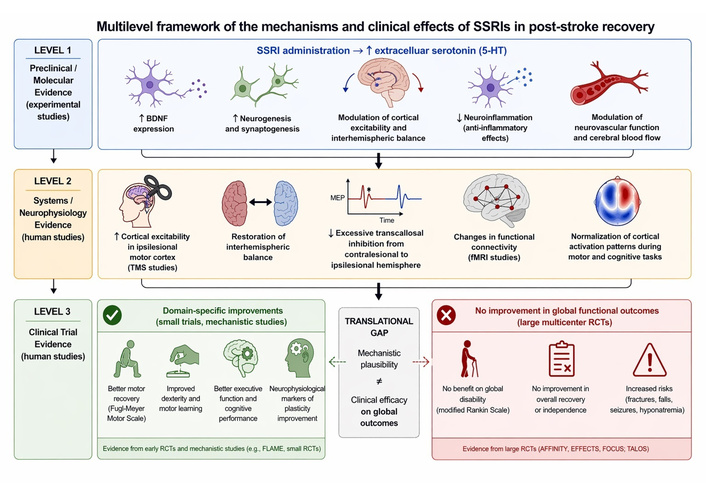
Multilevel framework linking molecular mechanisms, systems-level neurophysiology, and clinical outcomes of selective serotonin reuptake inhibitor therapy in post-stroke recovery. This figure summarizes the multilevel effects of selective serotonin reuptake inhibitors across experimental, neurophysiological, and clinical domains in post-stroke recovery. At the preclinical level (Level 1), these agents increase extracellular serotonin, promoting neuroplastic processes including upregulation of brain-derived neurotrophic factor, enhanced neurogenesis and synaptogenesis, modulation of cortical excitability, reduction of neuroinflammation, and regulation of neurovascular function. At the systems level in humans (Level 2), these mechanisms are associated with increased cortical excitability in the ipsilesional hemisphere, improved interhemispheric balance, reduced transcallosal inhibition, and reorganization of functional connectivity, with partial normalization of activation patterns during motor and cognitive tasks. At the clinical level (Level 3), smaller studies report domain-specific improvements in motor and cognitive functions and in markers of plasticity. However, large randomized controlled trials show no benefit on global functional outcomes, alongside an increased risk of adverse events. Overall, the figure highlights a translational gap between robust mechanistic and neurophysiological effects and the lack of efficacy on global clinical outcomes. This figure represents an original conceptual synthesis developed by the author based on the literature discussed in references [6–23]. The graphical layout was generated and refined using ChatGPT (OpenAI), while the scientific content, interpretation, and conceptual framework were defined by the author.
enhance neurogenesis and synaptogenesis [6];
modulate functional neuroplasticity in humans [14];
modulate cortical excitability and interhemispheric balance [15];
reduce neuroinflammation [16];
influence neurovascular regulation and cerebral blood flow dynamics [17, 18];
increase extracellular serotonin (5-HT), which influences cortical network reorganization.
These mechanisms represent those most commonly reported in the literature; however, additional biological pathways cannot be excluded, and the full spectrum of SSRI-mediated effects on post-stroke neural recovery remains an area of ongoing investigation.
Of particular interest is the modulation of excitatory-inhibitory balance between hemispheres. After stroke, disruption of transcallosal pathways and local inhibitory circuits often leads to an imbalance in interhemispheric interactions, whereby the unaffected hemisphere exerts excessive inhibitory influence over the lesioned hemisphere through heightened transcallosal inhibition. This maladaptive hyperexcitability of the contralesional motor cortex may further suppress activity in the ipsilesional motor cortex, limiting cortical reorganization and constraining motor recovery [10, 19]. In this context, serotonergic modulation is thought to be able to influence the interhemispheric disequilibrium at multiple levels. For instance, by enhancing 5-HT availability, SSRIs can modulate intracortical inhibition within the affected motor cortex [20] and may facilitate long-term potentiation-like plasticity through serotonergic mechanisms [15]. Experimental studies using transcranial magnetic stimulation and functional neuroimaging have shown that SSRIs can reduce excessive interhemispheric inhibition, normalize cortical excitability thresholds, and promote more symmetrical recruitment of motor networks during task performance [10, 19]. These effects may create a more permissive neurophysiological environment for motor relearning, particularly when combined with task-specific rehabilitation [21–23].
Importantly, serotonergic modulation does not act in isolation but interacts with broader plasticity mechanisms, including BDNF signaling, synaptic remodeling, and changes in network connectivity. By rebalancing excitatory-inhibitory dynamics and enhancing adaptive plasticity, SSRIs may help shift post-stroke reorganization from maladaptive compensation toward more efficient functional restoration.
Taken together, these mechanisms provide a plausible biological framework supporting SSRI use in post-stroke rehabilitation independently of depressive symptomatology, reinforcing the rationale for investigating their role as neuromodulatory agents rather than solely as antidepressants. However, despite strong biological plausibility, the clinical translation of these mechanisms into meaningful functional recovery remains controversial, underscoring the need for targeted clinical trials specifically designed to capture domain-specific and neuroplasticity-driven outcomes.
This narrative, non-systematic mini-review aims to provide an updated synthesis of the available clinical evidence regarding the potential role of SSRIs in promoting post-stroke recovery beyond their established effects on mood.
A literature search was performed using the PubMed/MEDLINE database up to February 2026. PubMed/MEDLINE was selected as the primary database due to its comprehensive coverage of biomedical literature. The search strategy included combinations of the following keywords: “selective serotonin reuptake inhibitor”, “SSRI”, “fluoxetine”, “sertraline”, “citalopram”, “escitalopram”, “fluvoxamine” AND “stroke”, “cerebrovascular diseases”, “cerebral ischemia”, “neuroplasticity”, “motor recovery”, “cognitive recovery”, AND “rehabilitation”.
Relevant studies were selected based on their clinical relevance to the topic. Priority was given to randomized controlled trials (RCTs), particularly large multicenter studies, as well as stroke-specific clinical investigations. Smaller mechanistic and exploratory studies were included to support the biological rationale and to contextualize domain-specific findings. Only articles published in English were considered. Additional references were identified through manual screening of the reference lists of selected articles.
Given the narrative nature of this review, no formal systematic review protocol or meta-analysis was applied. The evidence is therefore presented in a structured and interpretive manner, taking into account differences in study design, patient populations, treatment timing, and outcome measures. While no formal study quality scoring or risk-of-bias assessment was performed, greater weight was given to higher-quality evidence to support a balanced and transparent interpretation of the available data. Due to the narrative nature of this review, study selection was not performed by duplicate independent reviewers, and no quantitative synthesis was planned.
Based on the available literature identified through the above-described approach, the translation of the biological rationale supporting SSRI use in post-stroke recovery into consistent clinical benefit remains complex.
Over the past two decades, several SSRIs—including fluoxetine (FLX), citalopram (CTP), escitalopram (ESC), and, to a lesser extent, sertraline (SRT) and fluvoxamine (FLV)—have been investigated for their potential to enhance neurological recovery beyond mood stabilization. Early mechanistic and small-scale clinical studies generated enthusiasm by demonstrating improvements in motor performance, cognitive domains, and neurophysiological markers of plasticity. However, the positive findings reported by early studies should be interpreted cautiously because of their relatively small sample sizes, selected populations, and potential susceptibility to type I error and publication bias. In contrast, subsequent large multicenter RCTs yielded neutral results on global functional outcomes and highlighted relevant safety concerns.
This divergence between biological plausibility, domain-specific improvements, and large-scale pragmatic trial outcomes has reshaped the current clinical perspective. The field has progressively shifted from asking whether SSRIs broadly improve post-stroke recovery to identifying which specific agents, patient subgroups, timing strategies, and outcome domains may derive meaningful benefit. The following sections critically examine the evidence for individual SSRIs, beginning with FLX, the most extensively studied compound in this context. A structured summary of the available clinical evidence on individual SSRIs for post-stroke recovery is provided in Table 1.
Summary of clinical evidence on individual SSRIs for post-stroke recovery.
| SSRI | Study [Ref] | SD/SAM/SS | ToI | D&D | Primary endpoint | FU | Main efficacy findings | Safety findings | Interpretation | Level of evidence |
|---|---|---|---|---|---|---|---|---|---|---|
| FLX | FLAME [24] | RCT; n = 118; moderate-severe ischemic stroke | Subacute phase (~5–10 days post-stroke) | 20 mg/day for 3 months | FMMS | 90 days | Improved motor recovery; higher proportion with mRS 0–2 | Generally well tolerated; no major safety signal reported | Early evidence of motor improvement in selected patients | Moderate |
| Smaller RCTs [25–29] | Small RCTs, mechanistic studies; n < 100 per study; mainly ischemic stroke | Early or very early post-stroke | Short-term (days–weeks) | NIHSS, motor learning, neurophysiology | Short-term | Improved motor/executive function; enhanced cortical plasticity markers | Limited reporting; generally mild adverse events | Suggests neuroplastic effects but low-certainty evidence | Low | |
| AFFINITY [30], EFFECTS [31], FOCUS [32] | Multicenter RCTs; n > 5,000 total; ischemic and hemorrhagic stroke | Early post-stroke (initiation within 2–15 days post-stroke) | 20 mg/day for 6 months | mRS (6–12 months) | 6–12 months | No improvement in global functional outcome (mRS) | Increased fractures, falls, seizures, and hyponatremia | No improvement on global disability; consistent adverse effects | High | |
| CTP | TALOS [33] | RCT; n = 642; ischemic stroke | Early subacute phase | 20 mg/day for 6 months | mRS, cognition, stroke recurrence | 6 months | No improvement in global disability, cognition, or recurrence | No major safety concerns reported | No evidence of improvement in global outcomes | High |
| Smaller RCTs [19, 34, 35] | Small clinical and mechanistic studies; n = 172 (pooled); ischemic stroke | Early or single-dose administration | Short-term/variable | Motor performance, cortical excitability | Short-term | Improved dexterity and motor cortex modulation | Limited safety reporting | Possible neurophysiological effects; low-quality evidence | Low | |
| ESC | Jorge et al. [36] | RCT; small to moderate sample (n = 104); post-stroke patients | Early post-stroke | Short-term administration | Cognitive function scales | Short–medium term | Improved global cognitive performance independent of mood | No significant adverse safety signal | Potential cognitive improvement | Moderate |
| Cao et al. [37], EMOTION trial [38] | RCTs; n ≈ 450 pooled; acute ischemic stroke | Early post-stroke (within days to weeks) | ESC 10–20 mg/day; up to 3–6 months | Emotional symptoms, neurological outcomes, stress-related biomarkers | 3–6 months | Reduced post-stroke depressive/emotional symptoms; improvement in selected neurological outcomes and lower plasma copeptin levels | Generally well tolerated; no major safety concerns reported | Potential benefits on emotional recovery and selected neurological/stress-related outcomes | Moderate | |
| Others (SRT & FLV) | No RCTs evaluating stroke are available | Not applicable | Not applicable | Not applicable | Not applicable | Not applicable | Not applicable | Not applicable | Evidence insufficient for recommendation | Not applicable |
SSRIs: selective serotonin reuptake inhibitors; SD/SAM/SS: study design/sample/stroke subtype; ToI: timing of initiation; D&D: dose & duration; FU: follow-up; FLX: fluoxetine; CTP: citalopram; ESC: escitalopram; SRT: sertraline; FLV: fluvoxamine; FLAME: FLX for Motor Recovery After Acute Ischemic Stroke; RCT: randomized controlled trial; FMMS: Fugl-Meyer Motor Scale; mRS: modified Rankin Scale; NIHSS: National Institutes of Health Stroke Scale.
One of the most influential studies focused on FLX was the FLAME (Fluoxetine for Motor Recovery After Acute Ischemic Stroke) trial by Chollet et al. [24], which demonstrated that early administration of this compound (20 mg/day for 3 months) significantly improved motor recovery in patients with moderate-to-severe ischemic stroke. Improvement was measured using the Fugl-Meyer Motor Scale (FMMS) [39], with benefits observed in both upper and lower limb subscores. A higher proportion of patients achieved functional independence (0–2) on the modified Rankin Scale (mRS) [40] at 90 days in the FLX group.
Other smaller trials reported supportive findings:
He et al. [26] showed improved neurological outcomes on the National Institutes of Health Stroke Scale (NIHSS) [41] and better functional outcomes after ischemic stroke, while a subsequent study reported a reduction in long-term stroke recurrence with FLX treatment [25];
Mikami et al. [27] found reduced disability at 1 year following 3 months of antidepressant treatment (including FLX), independent of mood effects;
Jorge et al. [28] demonstrated long-term improvements in executive function after short-term antidepressant therapy;
Pariente et al. [29] showed that even a single dose of FLX modulated sensorimotor cortex activation during motor tasks.
Collectively, these findings suggested that FLX might enhance neuroplasticity and facilitate motor and cognitive recovery. These early findings, however, were derived from relatively small and selected populations, raising concerns about potential overestimation of treatment effects. For instance, three large multicenter RCTs—namely the AFFINITY [30], the EFFECTS [31], and the FOCUS [32] trial—substantially altered the interpretation of earlier findings. According to these studies, routine administration of FLX (20 mg daily for 6 months) did not improve global functional outcomes measured by the modified mRS at 6 or 12 months.
Moreover, increased adverse events (higher rates of bone fractures, increased falls, increased seizures, hyponatremia) were consistently observed. Thus, while early targeted studies suggested motor benefits, large pragmatic trials failed to confirm improvement in global disability and raised safety concerns.
CTP has also been evaluated for its potential role in post-stroke rehabilitation. In the TALOS trial conducted by Kraglund et al. [33], which enrolled 642 patients treated for six months, no significant benefit was observed with respect to global functional outcome as measured by the mRS, risk of stroke recurrence, or cognitive outcomes.
Conversely, smaller trials suggested potential benefits:
Savadi Oskouie et al. [34] reported improved neurological recovery when CTP was started within one week after stroke in non-depressed patients;
Zittel et al. [35] demonstrated enhanced dexterity after a single CTP dose in chronic stroke;
Acler et al. [19] showed that serotonergic modulation reduced maladaptive motor cortex excitability, possibly facilitating motor recovery.
These contrasting findings suggest that CTP may exert neurophysiological effects not fully captured by global functional scales. Overall, evidence for CTP remains inconclusive, with signals of neurophysiological modulation but no demonstrated impact on clinically meaningful outcomes.
ESC has shown evidence of cognitive benefits independent of mood; Jorge et al. [36] demonstrated improvements in global cognitive functioning compared with placebo and problem-solving therapy. Additional studies [37, 38] reported potential benefits on neurological outcomes and stress-related biomarkers in patients with acute stroke.
SRT and FLV have been less extensively studied for rehabilitation-specific outcomes. Current evidence does not support routine use of these agents for functional recovery beyond mood regulation.
One of the most critical interpretive challenges in the literature on SSRIs for post-stroke recovery lies in the apparent discrepancy between domain-specific improvements and the absence of benefit on global disability scales [24, 29–32, 42–44]. Across early mechanistic and smaller randomized studies, SSRIs were associated with measurable gains in motor subscores, executive function, dexterity, and neurophysiological indices of cortical reorganization. In contrast, large multicenter pragmatic trials consistently failed to demonstrate superiority over placebo on global functional endpoints, most assessed using the mRS. Recent meta-analyses have generally confirmed the absence of significant benefits of SSRIs on global functional outcomes. Overall, pooled evidence aligns more closely with the neutral findings of large multicenter RCTs than with the positive signals observed in smaller exploratory and mechanistic studies [45, 46]. This divergence raises important methodological and conceptual considerations. The mRS, while widely accepted as a robust and clinically meaningful endpoint in stroke trials, is inherently broad and ordinal, capturing overall disability rather than specific domains of recovery [47–49]. Its strength lies in measuring global independence [47]; however, it may lack sensitivity to detect subtle but biologically relevant improvements in motor control, cortical excitability, or higher-order cognitive functions [50, 51]. Thus, reliance on mRS as a sole primary endpoint may underestimate domain-specific and mechanistically relevant therapeutic effects.
In contrast, earlier mechanistic trials frequently employed more granular outcome measures, such as the FMMS, detailed neuropsychological batteries, transcranial magnetic stimulation parameters, and functional neuroimaging metrics. These tools are specifically designed to capture neuroplastic adaptations and localized functional changes, which may precede—or not necessarily translate into—detectable shifts in global disability categories.
Thus, the heterogeneity of findings may reflect, at least in part, a mismatch between the hypothesized mechanism of action of SSRIs and the outcome measures selected to evaluate their clinical impact. Importantly, stroke etiology may also influence treatment response. Most available evidence derives from ischemic stroke populations, while data on hemorrhagic stroke remain limited. Differences in underlying pathophysiology, including mechanisms of injury and patterns of recovery, may partly explain heterogeneity in SSRI effects across studies.
If SSRIs primarily modulate cortical excitability, enhance synaptic plasticity, and facilitate motor relearning in targeted domains, their effects may be diluted when assessed using broad composite scales that integrate mobility, self-care, cognition, and social participation into a single ordinal score. Furthermore, spontaneous recovery trajectories, rehabilitation intensity, and comorbidity burden may overshadow modest pharmacologically mediated gains when large heterogeneous populations are studied. Additional factors potentially contributing to this discrepancy include variability in rehabilitation intensity, differences in lesion location and size, heterogeneity in stroke subtype, and uncertainty regarding the optimal dose–duration relationship of serotonergic modulation. Within this context, the apparent contradiction between biological plausibility and clinical inefficacy may therefore be more methodological than pharmacological.
From a clinical standpoint, current evidence does not support the routine use of SSRIs as neurorestorative agents in non-depressed stroke patients. Similar to other classes of antidepressants [52–54], SSRIs have not consistently demonstrated a meaningful benefit on global functional outcomes. Large, high-quality RCTs have not demonstrated improvement in global functional outcomes and have consistently identified increased risks, including fractures, falls, seizures, and hyponatremia. These safety signals are particularly relevant in an already vulnerable population characterized by advanced age, polypharmacy, and frailty.
Nevertheless, it would be premature to conclude that serotonergic modulation lacks any rehabilitative relevance. A more nuanced interpretation suggests that potential benefits may be confined to specific subgroups and clinical contexts. Signals of potential efficacy have been suggested in settings such as early subacute ischemic stroke, particularly in patients with moderate motor deficits. Under these conditions—where a “window of enhanced plasticity” may exist—serotonergic augmentation could exert a permissive effect on experience-dependent reorganization. However, these observations should be considered hypothesis-generating rather than evidence-based conclusions.
The above-reported observations underscore the need to move beyond the binary question of whether SSRIs globally improve stroke outcomes and instead adopt a precision-medicine framework. Future research should prioritize the identification of biomarkers capable of stratifying responders from non-responders. Candidate markers include genetic polymorphisms affecting serotonergic transmission [55–57], BDNF levels [58–60], patterns of structural and functional connectivity on neuroimaging [9, 61], and electrophysiological measures of cortical excitability [62, 63]. Integrating such biomarkers into trial design could enable enriched trial designs, allowing for more precise patient selection and reducing the dilution of treatment effects in heterogeneous populations.
Equally critical is the optimization of treatment timing and duration. The neurobiological processes underlying post-stroke plasticity are temporally dynamic, suggesting that the therapeutic window for serotonergic modulation may be limited [64, 65]. Determining whether short-term early administration is superior to prolonged exposure, and whether therapeutic benefits plateau or adverse effects accumulate over time, remains an unresolved question.
Moreover, future trials should incorporate domain-specific primary endpoints aligned with mechanistic hypotheses, rather than relying exclusively on global disability scales. Hierarchical or composite outcome strategies, combining sensitive motor and cognitive measures with clinically meaningful functional endpoints, may provide a more comprehensive assessment of therapeutic impact. Stratification by stroke subtype, particularly ischemic versus hemorrhagic etiologies, also warrants systematic investigation, as underlying pathophysiology and plasticity patterns differ substantially.
In summary, current meta-analytic evidence and large multicenter RCTs do not support the routine use of SSRIs as neurorestorative agents in non-depressed stroke patients. However, the discrepancy between biological plausibility, domain-specific improvements, and neutral global functional outcomes highlights a critical need for methodological refinement rather than definitive abandonment of the concept. A shift toward biomarker-driven patient selection, mechanistically aligned endpoints, and temporally optimized intervention strategies may ultimately clarify whether serotonergic modulation holds a targeted, context-dependent role within precision neurorehabilitation paradigms. Collectively, these observations support a precision neurorehabilitation framework in which serotonergic modulation may be relevant only in biologically selected subgroups rather than as a universal therapeutic strategy.
BDNF: brain-derived neurotrophic factor
CTP: citalopram
ESC: escitalopram
FLV: fluvoxamine
FLX: fluoxetine
FMMS: Fugl-Meyer Motor Scale
mRS: modified Rankin Scale
NIHSS: National Institutes of Health Stroke Scale
PSD: post-stroke depression
RCTs: randomized controlled trials
SRT: sertraline
SSRIs: Selective Serotonin Reuptake Inhibitors
During the preparation of this work, the author used ChatGPT (OpenAI, 2023; https://chatgpt.com/) to generate the brain icon in Figure 1. After utilizing the tool, the authors reviewed and edited the content as necessary and take full responsibility for the final content of the publication.
GV: Conceptualization, Data curation, Investigation, Methodology, Writing—original draft, Writing—review & editing, Project administration. The author read and approved the submitted version.
The author declares that there are no conflicts of interest.
Not applicable.
Not applicable.
Not applicable.
Not applicable.
Not applicable.
© The Author(s) 2026.
Open Exploration maintains a neutral stance on jurisdictional claims in published institutional affiliations and maps. All opinions expressed in this article are the personal views of the author(s) and do not represent the stance of the editorial team or the publisher.
Copyright: © The Author(s) 2026. This is an Open Access article licensed under a Creative Commons Attribution 4.0 International License (https://creativecommons.org/licenses/by/4.0/), which permits unrestricted use, sharing, adaptation, distribution and reproduction in any medium or format, for any purpose, even commercially, as long as you give appropriate credit to the original author(s) and the source, provide a link to the Creative Commons license, and indicate if changes were made.



View: 1261
Download: 18
Times Cited: 0
Said Hachimi-Idrissi
Shafiq Dexter B. Abou Zaki, Johnny K. Lokin
Yang Yang ... Yi Li
Lidija Radenovic
Renata Murguiondo-Pérez ... Antonio Ibarra
Poppy Kristina Sasmita ... Bernadus Bernardino Bramantyo


