Original Article


Affiliation:
Foundation University Islamabad, Islamabad 44000, Pakistan
Email: ayesharwp@gmail.com
ORCID: https://orcid.org/0009-0004-2188-2783


 ,
,
Affiliation:
Foundation University Islamabad, Islamabad 44000, Pakistan
Affiliation:
Foundation University Islamabad, Islamabad 44000, Pakistan
Explor Neuroprot Ther. 2026;6:1004164 DOI: https://doi.org/10.37349/ent.2026.1004164
Received: November 18, 2025 Accepted: July 06, 2026 Published: July 22, 2026
Academic Editor: Jinwei Zhang, Chinese Academy of Sciences, China
The article belongs to the special issue Neuroprotection in Pediatric Neurological Disorders: from Rare Diseases to Perinatal Brain Injury
Aim: Cerebral palsy (CP), a prevalent pediatric neurological disorder, involves significant motor and sensory impairments requiring long-term, multifaceted management. Action observation therapy (AOT), a novel neurorehabilitation approach, activates the mirror neurons through task observation. Evidence for AOT remains inconclusive for CP despite promising results in other populations. The study aimed to investigate the effects of AOT on functional performance, specifically mobility and balance, in spastic CP.
Methods: 28 spastic CP children, eligible based on the Gross Motor Function Classification System (GMFCS) and Modified Ashworth Scale (MAS), were randomly assigned to an experimental group receiving video-based AOT plus task-oriented physiotherapy or to a control group receiving the same task-oriented physiotherapy protocol with therapist demonstration but without video-based action observation. Both groups received an 8-week play-based, task-oriented physiotherapy program. The experimental group additionally received video-based AOT before performing the tasks, whereas the control group received therapist demonstration without video-based observation. Functional outcomes were assessed at baseline and after the intervention using the Pediatric Balance Scale (PBS) and the Gross Motor Function Measure-88 (GMFM-88). Within- and between-group differences were analyzed using the Wilcoxon Signed-Rank test and the Mann-Whitney U test, respectively.
Results: Both groups showed significant within-group improvements in PBS and GMFM-88 scores after the intervention (p < 0.05). However, post-intervention comparisons did not show a significant difference between the experimental and control groups. The play-based format appeared to support engagement and functional gains in both groups.
Conclusions: AOT led to clinical improvements without a statistically significant dominance over the conventional approach, suggesting AOT might be more beneficial with increased dosage or multimodal approaches (ClinicalTrials.gov identifier: NCT06672328).
Cerebral palsy (CP)—A group of neurological disorders attributed to the non-progressive disturbances of the developing fetal or infant brain [1]. Despite its non-degenerative nature, CP manifests as motor and sensory impairments, often accompanied by cognitive and communicative challenges, necessitating multidisciplinary, lifelong management. In a study conducted in 2023, CP was ranked as the third most common neurological disorder of the pediatric population in Pakistan, after behavioral disorders and epilepsy [2]. In contrast to this, the global prevalence in high-income countries is 1.6/1,000 live births [3]. This disparity may be attributed to the infrastructural differences relative to maternal and neonatal healthcare services, diagnostic tools, and rehabilitative facilities.
The etiology of CP is multifactorial, with risk factors ranging from pre-conception to antenatal and postnatal periods [4]. Such an array of origins manifests across a whole spectrum of neurological, motor, and sensory dysfunctions, including spasticity, ataxia, dyskinesia, and hypotonia, each of which is further classified topographically [5]. Spastic CP, accounting for 80% of the cases globally, frequently embodies associated gait, balance, and postural impairments [6]. Knowing the etiology is crucial for proper management and prognosis. Earlier identification of disorders, especially in the pediatric population, gives more leverage to utilize the brain’s neuroplasticity during the early neurodevelopmental window. A proactive approach towards diagnosis always helps counter the complications in the long run [7].
In general, impairments are exhibited in muscle tone, gross and fine motor functions, balance and coordination, reflexes, and posture, among others. Associative conditions include oromotor dysfunction, visual and hearing difficulties, sensory impairments, and seizures [8]. Such deficits increase fall risk, hinder proper gait and ability to perform activities of daily living (ADLs), and lead to decreased functional performance and quality of life (QoL) [9]. Mobility limitation in CP is visible as difficulty in walking, transitioning between positions such as sit to stand, and maintaining correct static and/or dynamic posture. Children with CP often experience even simple daily tasks as physically demanding and difficult [10, 11].
CP management involves a multidisciplinary team ranging from neurologists to physical therapists, speech therapists, and nutritionists. Early diagnosis and intervention are crucial to utilize the neuroplasticity of the infant brain and early childhood to maximize the functional gains [12]. Previous research has brought attention to the utility of action observation therapy (AOT) across a range of neurological populations, including post-stroke patients and patients with Parkinson’s disorder. However, its clinical integration into pediatric neurorehabilitation, exclusively for children with CP, remains underexplored. AOT is a relatively novel and emerging approach rooted in the principles of the mirror neuron system. First described in the early 1990s, researchers have now reached a basic agreement regarding the involvement of mirror neurons, located in different brain regions including the premotor and parietal cortices, in the perception of motor actions, human speech discrimination, and imitative responses [13]. AOT involves structured observation of goal-directed actions followed by their execution and repetition. This sequence stimulates neural circuits involved in motor planning and imitation, facilitating motor learning even in the absence of voluntary initiation.
How mirror neurons work can be understood through the action of yawning. When you see someone yawn, the mirror neurons in your brain get activated and start interpreting the motor task behind the action, and you feel the urge to yawn. This is termed the motor system’s ability to “reflect” observed actions and recruit the same neural pathways to produce a similar response [14]. The same neural firing occurs during the mere observation as when performing it, enabling the motor system to become more responsive and receptive over time.
A typical AOT session consists of the following phases [15]:
Observation phase: The patient watches short clips of the task to be performed (e.g., picking up a cup). These actions are intended to engage the mirror neurons.
Execution phase: The patient is asked to perform the task as shown before. This step is for reinforcing motor learning.
Repetition phase: The steps are repeated several times to promote motor memory.
The sessions are 15–30 minutes long, with a frequency of 3–5 times a week for several weeks, depending on the protocol [16].
The heterogeneity in delivery modes for AOT, spanning from therapist-led, parent-delivered to video-based, and virtual reality-enhanced formats, provides flexibility but also poses obstacles to widespread implementation and standardization [17–20]. As for the CP populations to be specific, AOT has been investigated both as a stand-alone treatment and in conjunction with other strategies such as Constraint Induced Movement Therapy (CIMT) or RP (repeated practice) for upper and lower limb impairments, with the majority of the studies focusing on the upper limb [20–22]. Studies that targeted the lower limb have reported significant improvements with the use of AOT [23, 24].
Given these considerations, this study aims to investigate the effectiveness of AOT in improving functional performance, specifically balance and mobility, in children with spastic CP. By contributing empirical evidence to the field of pediatric neurorehabilitation, this research seeks to evaluate AOT’s potential to enhance functional independence and inform future clinical protocols.
This study was carried out as a non-blinded prospective randomized controlled trial for children with spastic CP (ERC no. FF/FUMC/215-484/Phy/24, trial registration: NCT06672328).
Participants were recruited from local rehabilitation and special education institutions in Rawalpindi, namely the Park View Colony and Gulshanabad branches of the Sedum Special Education School and Rehabilitation Centre.
Participants were eligible if the following criterion, based on clinical assessment, was fulfilled: spastic CP children aged between 4 and 12 years, Gross Motor Function Classification System (GMFCS) levels I to III, and spasticity on Modified Ashworth Scale (MAS) ranging from 0 to 2. Furthermore, the inclusion criteria required the participants to have the ability to follow simple verbal commands and perform sit-to-stand movements with or without assistance. Exclusion criteria included one or more of these conditions: orthopedic surgeries within the past 6 months, co-morbid neurological or musculoskeletal disorders such as spinal atrophy, osteogenesis imperfecta, any recent seizure attacks, visual or hearing impairments, and/or knee contractures, all of which could hinder the exercises.
The sample size of 26 was determined using the OpenEpi tool based on an RCT with a similar patient cohort and task-oriented training, which was then increased to 30 to account for an anticipated attrition rate of < 10–15%.
Once the children were screened for eligibility, they were randomly allocated to either the experimental or control groups using a sealed envelope randomization method. When enrollment started, the children were asked to pick one opaque sealed envelope prepared by a non-assessor, which determined their group allocation. Due to the nature of the intervention, blinding the assessor was not feasible; therefore, the use of validated measures was prioritized to minimize observer bias.
The protocol spanned across eight weeks with 3–4 sessions per week, each lasting 30–40 minutes. Both study groups received conventional physiotherapy comprising stretching and strengthening exercises along with play-based goal-specific activities focused on functional and transitional tasks. The experimental group additionally received the AOT component, which involved watching videos of those goal-specific tasks performed by a healthy individual before execution. The protocol was categorized into four progressive phases: 1) trunk activities in sitting, 2) lift-off phase, 3) standing activities, and 4) turning activities. Each phase was tailored to children’s capabilities. The four phases were designed to challenge balance, mobility, and postural control. The progression from Phase 1 focused on trunk control and core stability, along with coordination, to Phases 2 and 3, focusing on transitional movements, and ended with Phase 4 involving weight shifting and directional changes, ultimately promoting transfer of learned motor tasks to everyday living. All activities were play-based to enhance engagement and motivation (Table 1).
Intervention details for study groups.
| Intervention details for study groups | ||
|---|---|---|
| Conventional exercises | Stretching exercises: T.A. Stretch (10 sec hold, 5 REPS), SLR (10 sec hold, 5 REPS), Adductor Stretch (10 sec hold, 5 REPS) | |
| Strengthening exercises: Bridging (5 REPS), Abdominal Curls (5 REPS), Knee Isometrics (5 REPS), Back Isometrics (3 REPS) | ||
| Phase 1(Bean Bag Slide) | Push the bean bag forward | Lean forwards—1 set of 10 REPS |
| Pull the bean bag towards yourself | Lean backwards—1 set of 10 REPS | |
| Slide the bean bag left and right | Lean sideways—1 set of 10 REPS | |
| Pick up the bean bag with your opposite hand | Rotate sideways in sitting—1 set of 10 REPS | |
| Toss the bean bag in the basket | Lift off from chair in mid extension—1 set of 10 REPS | |
| Phase 2(Sit-stand and Tap) | Playing tap while sitting | Seated marches—1 set of 10 REPS |
| Sitting unsupported | 30 sec | |
| Sit to Stand when the music starts | Lift off from high sitting—1 set of 10 REPS | |
| Sit to Stand when the music starts | Standing up from high sitting—1 set of 10 REPS | |
| Standing unsupported | 30 sec | |
| Phase 3(Straight Rope) | Stand on a rope with eyes closed | Standing with eyes closed—10 sec |
| Join your feet on the rope | Standing with feet together—10 sec | |
| Stand with one foot in front of the other | Tandem standing with each foot 5 times | |
| Stand on one foot on the rope | Weight shift sideways—5 REPS each foot 30 sec | |
| Stepping up and down a stool | Placing alternate foot on the stool—5 to 8 times | |
| Phase 4(Clock Tower and Tower Building) | Step to the right at 3 o’clock | Turning 90 degrees (within 20 sec) |
| Step to 6 o’clock | Turning 180 degrees (within 20 sec) | |
| Step to the right and reach 12 o’clock | Turning 360 degrees (within 20 sec) | |
| Wave goodbye | Turning to look behind | |
| Pick up the blocks | Retrieving objects from the table in the sitting room | |
| Pick up the blocks | Retrieving objects from the floor | |
| Collect the scattered blocks and build a tower | Reaching forward with an outstretched arm, 3 to 4 inches | |
| Intensity & Frequency | Duration: 8 weeksFrequency: 30–40-minute sessions for 3–4 days/week, depending on the participant’s responsiveness and motivation for the exercises on a given day.Adequate rest between each exercise was given to all participants. | |
| Tailoring & Modification | Each phase typically lasted for 2 weeks, with increasing sets for each exercise over time. However, the progression of each phase was done according to the individual child’s ability.No modifications had to be made during the study for either group. | |
The children in the experimental group sat at a distance of one meter from the screen in a calm and quiet environment. The videos were composed of a repetition of the tasks performed by the same assessor as the control group, as mentioned in Table 1. The videos were watched by the children for the same duration as was demonstrated to the children in the control group. Following the video observation, they executed the observed actions. In contrast, the control group practiced the same tasks under a physiotherapist’s demonstration without video observation. All exercises were carried out under the supervision of a physiotherapist to make sure they were performed safely and correctly.
The following outcome measures were utilized in the study for eligibility screening and to assess the outcomes: MAS, GMFCS, Pediatric Balance Scale (PBS), and Gross Motor Function Measure-88 (GMFM-88).
GMFCS: A widely used, valid, and reliable classification system to predict gross motor function in children with CP was used to screen participants for eligibility in the study. It has demonstrated high interrater (G = 0.93) and test-retest (G = 0.79) reliability [25].
MAS: A validated tool used for the assessment of muscle tone, which is also used to assess eligibility for inclusion in the study. With a strong reliability score (ICC > 0.8), it has been widely used in multiple conditions, including stroke and CP [26].
PBS: The primary outcome tool to assess functional balance in school-aged children, demonstrating excellent reliability (ICC 0.98–0.99) [27]. With a total score of 56 points, higher scores indicate good balance capabilities, and lower scores indicate impaired balance [27].
GMFM-88: Used to evaluate gross motor skills in CP children by rehab specialists, validated with high reliability (ICC 0.95–1.00), covering five dimensions of motor function, i.e., A—lying and rolling, B—sitting, C—crawling and kneeling, D—standing, and E—walking, running and jumping. It consists of 88 items on an ordinal scale of 0 to 4 [28, 29]. This scale was the primary outcome measure to assess motor function.
The study was conducted in compliance with the Declaration of Helsinki following ethical approval from the Ethical Review Committee of Foundation University Medical College (ERC No. FF/FUMC/215-484/Phy/24) and trial registration on ClinicalTrials.gov (NCT06672328). Guardians of the participants gave informed consent and were well aware of the study timeline, procedures, and right to withdraw their child at any stage. Data collected were kept anonymous, and access to the data remains restricted to the core research team only.
A self-structured questionnaire was used to document the demographic data and disease-related questions. The Screening tools, i.e., MAS and GMFCS, were applied to ensure eligibility of all participants for inclusion in the study. Baseline measurements for the selected participants were taken a day before the intervention through the scales: the PBS for balance and the GMFM-88 scale for mobility. Post-intervention measurements were taken on the following day after the final session for the 8th week. Pre- and post-measurement data were then used to proceed with the data analysis.
Statistical analysis was performed using SPSS version 21. Descriptive statistics included mean ± SD for continuous variables and frequency with percentages for categorical variables. The Shapiro-Wilk test confirmed the non-normal distribution of data, necessitating the use of non-parametric tests. The Mann-Whitney U test compared between-group differences, while the Wilcoxon Signed-Rank test analyzed within-group statistics. The statistical significance was set at p < 0.05.
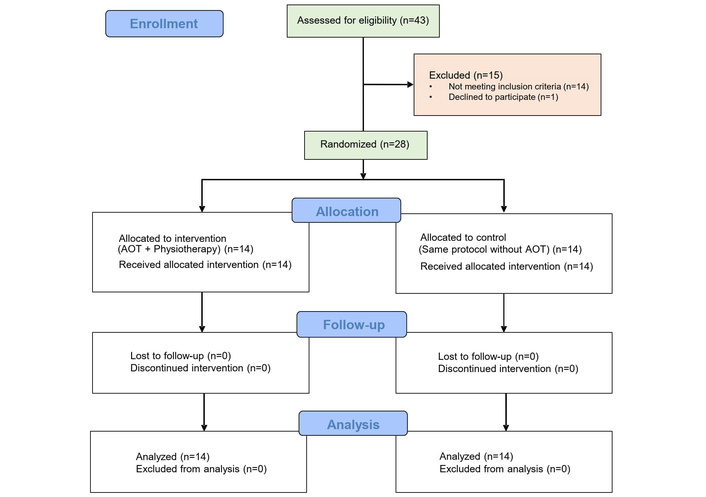
From September 16th, 2024, to March 25th, 2025, out of the total 43 children screened for eligibility, 28 met the inclusion criteria and were randomly allocated to either the experimental (n = 14) or control (n = 14) groups. The intervention protocol was successfully delivered in both groups. There were no drop-outs during the study (see Figure 1).
The baseline demographic information of the enrolled participants has been displayed in the table below. The key demographic variables include the prevalence of age, gender, spastic CP subtype, and GMFCS levels among the participants (see Table 2).
Key demographic data for both groups.
| Parameters | AOT group | Control group |
|---|---|---|
| Age in years (mean ± SD) | 4.71 ± 2.2 | 4.43 ± 1.83 |
| Gender, male/female (n, %) | 6 (42.9)/8 (57.1) | 6 (42.9)/8 (57.1) |
| Spastic CP subtype (n, %) | ||
| Spastic monoplegia | 2 (14.3%) | 4 (28.6%) |
| Spastic diplegic | 9 (64.3%) | 7 (50.0%) |
| Spastic hemiplegic | 3 (21.4%) | 3 (21.4%) |
| GMFCS level (I/II/III) | 3/8/3 | 6/6/2 |
AOT: action observation therapy; CP: cerebral palsy; GMFCS: Gross Motor Function Classification System.
A similar gender distribution across both study groups, showing a similar male (43%) to female (57%) ratio in both arms. In the distribution of spastic CP subtypes across both study groups, monoplegia spastic CP was the most prevalent subtype in the experimental group, while diplegic spastic CP was more prevalent in the control group. For GMFCS levels, the majority of the children were GMFCS level II in the experimental group, and an equal number of children were GMFCS level I and II in the control group.
The Mann-Whitney U test was applied for between-group analysis. The results indicated that there was no statistically significant difference between the study groups post-intervention for the scales PBS (p = 0.068) and GMFM-88 (p = 0.154). However, the post-intervention scores for PBS displayed a trend favoring the AOT strategy, but it did not surpass the statistical significance threshold of p > 0.05. This suggested a clinically significant improvement, if not statistically significant, in balance (see Table 3).
Between-group analysis for study groups.
| Variable | Group | Median (IQR*) | p-value |
|---|---|---|---|
| PBS total pre | AOT group | 39.50 (26–44) | 0.269 |
| Control group | 43 (33.75–45.25) | ||
| GMFM-88 total pre | AOT group | 91.61 (81.83–93.16) | 0.382 |
| Control group | 91.99 (88.20–94.26) | ||
| PBS total post | AOT group | 48 (35.25–49.50) | 0.068 |
| Control group | 50 (44.25–52.25) | ||
| GMFM-88 total post | AOT group | 94.79 (86.75–96.53) | 0.154 |
| Control group | 96.91 (93.59–97.87) |
AOT: action observation therapy; GMFM-88: Gross Motor Function Measure-88; PBS: Pediatric Balance Scale; *IQR: interquartile range.
The Wilcoxon Signed-Rank test was used to analyze within-group statistics. Firstly, in the experimental group that received an AOT-based protocol, the PBS had an increase in median scores from 39.5 to 48, which indicates a marked improvement in the domain of balance, indicating a statistically significant change (p = 0.001). Similarly, for mobility, the GMFM-88 scores had an increase from a median score of 91.61 at baseline measurements to a score of 94.79 at post-intervention, demonstrating an increase in mobility levels from the baseline measurement. The improvement was statistically significant at a p-value of 0.002 (see Table 4).
Within-group analysis for the experimental group.
| Variable | Time point | Experimental group median (IQR*) | p-value |
|---|---|---|---|
| PBS total | Pre | 39.50 (26–44) | 0.001 |
| Post | 48 (35.25–49.50) | ||
| GMFM-88 total | Pre | 91.61 (81.83–93.16) | 0.002 |
| Post | 94.79 (86.75–96.53) |
GMFM-88: Gross Motor Function Measure-88; PBS: Pediatric Balance Scale; *IQR: interquartile range.
The control group received the same game-based physiotherapy protocol except for the AOT component. The median scores for PBS had an increase from 43 to 50 (p = 0.001), indicating improved balance post-intervention. Similarly, the median scores of GMFM-88 improved from a score of 91.99 to 96.91 after 8 weeks of intervention, with a p-value of 0.001. These scores confirmed a statistically significant increase in mobility, similar to the results of the experimental group (see Table 5).
Within-group analysis for the control group.
| Variable | Time point | Control group median (IQR*) | p-value |
|---|---|---|---|
| PBS total | Pre | 43 (33.75–45.25) | 0.001 |
| Post | 50 (44.25–52.25) | ||
| GMFM-88 total | Pre | 91.99 (88.20–94.26) | 0.001 |
| Post | 96.91 (93.59–97.87) |
GMFM-88: Gross Motor Function Measure-88; PBS: Pediatric Balance Scale; *IQR: interquartile range.
Overall, the results indicated that both study groups benefited from the positive effects of exercise, irrespective of the inclusion of AOT as an intervention. Both approaches were easily applicable and beneficial in the present study. The structured protocol for both groups was likely the reason that contributed to the notable gains in functional performance for the CP children. These changes support the therapeutic importance of goal-specific training in the neurorehabilitation regimens, especially for the pediatric population.
This study primarily aimed at evaluating the effects of AOT on functional performance in children with CP, gauged under the two domains of balance and mobility. While AOT and its potential efficacy on different neurological disorders have gained increased attention, evidence of its effectiveness in CP remains contradictory. In the present investigation, between-group analysis did not reveal a statistically significant difference; both groups demonstrated within-group improvements after intervention. These findings supported the notion that both therapeutic approaches were beneficial for the children.
All 28 children recruited in the study showed improvement in functional performance in both domains of balance and mobility, but the difference between the therapeutic approaches was not statistically significant enough to establish superiority. The complete adherence and no dropouts were likely facilitated by the play-based format of the exercise protocol. Continued guidance, instructions, and assistance to the children throughout the protocol ensured they understood the game tasks. It is also critical to acknowledge that the children’s emotions and mood states occasionally affected how involved they were in treatment sessions. These incidents were rare and had little impact on the overall intervention procedure, but they did occasionally provide slight difficulties in keeping the focus and flow of the session.
The findings in the current study are consistent with previous studies and indicate that the benefits of AOT may be on par with the conventional approaches, but the superiority remains inconclusive. Existing literature has reported variable results, which may offer some context for better understanding our results. Consistent with our findings, Kirkpatrick et al. [20] have conducted a randomized controlled trial on parent-delivered AOT in children with unilateral CP. The researchers discovered no statistically significant difference between RP alone and AOT paired with RP. Despite the differences in the modes of delivery—home-based versus physiotherapist-led—both techniques produced improvements. This implies that the repetition of functional tasks itself may be the primary contributor to reported benefits.
A 2020 study found that combining AOT with Whole-Body Vibration (WBV) for children with spastic CP improved gross motor function and gait measurements [22]. The combined intervention group outperformed the control group, implying that AOT can be more effective when combined with other techniques. In contrast, the current study assessed AOT as a stand-alone intervention, which may have limited its overall effectiveness. A 2019 meta-analysis on AOT in individuals with brain damage demonstrated significant improvement in upper and lower limb function, particularly upper limb activity (p < 0.001) [30]. However, the substantial heterogeneity in sample characteristics and intervention techniques created a significant hurdle to standardizing AOT protocols. The authors emphasized the relevance of personalized and condition-specific AOT applications, which aligns with our findings, especially considering our focus on balance and mobility in a heterogeneous group of children with CP.
Other studies have reported favorable outcomes with AOT. Jeong and Lee [23] discovered that AOT greatly enhanced gross motor function and reduced ankle stiffness in children with spastic CP. Their more intensive protocol (five sessions per week of one hour each) may explain the better results compared to our shorter, less frequent sessions. This discrepancy shows that intervention intensity is critical to maximizing the effects of AOT. Having a similar stance regarding the importance of intensity, Simon-Martinez et al. [21] investigated the effects of AOT paired with CIMT throughout a 9-day intensive training period. Although the between-group analysis was not statistically significant, the AOT group displayed a slightly higher post-intervention score (p = 0.02).
A recent study in 2024 recruited spastic diplegic CP and found significant gains in lower limb Gross Motor Function using an AOT-based protocol [24]. Although the intervention design was similar to ours, differences in participant characteristics and outcome measures are likely to have influenced the findings. Their emphasis on lower-limb mobility using a subscale of the GMFM contrasts with our more comprehensive assessment of balance and mobility using the GMFM-88 and PBS. This broader scope may have resulted in more nuanced but less noticeable gains in our sample. It is important to mention that AOT may influence neuroplasticity in ways that behavioral or functional assessments alone may not fully account for. Post-MRI scans reported in a 2024 review evaluating the efficacy of AOT in upper limb function in CP children revealed increased activation of the frontal and parietal areas of the brain when involved in hand-object interaction tasks (p < 0.001), which supported the notion of AOT enhancing neural engagement [24].
To summarize, AOT holds promise as an intervention for CP children, but its effectiveness highly depends on factors such as intervention intensity, combination with other treatments, and population-specific modifications. It is especially hard to yield good results with a “one size fits all” protocol, particularly in the pediatric population. Several limitations of this study should be acknowledged. First, the inclusion of participants across various types of spastic CP and a broad range of GMFCS levels may have produced heterogeneity in responsiveness to the intervention, potentially influencing the uniformity of the results. Secondly, as discussed earlier, a few participants exhibited a limited attention span, leading to lengthened sessions and minor difficulty in adherence to the protocol, as expected in managing the pediatric population. Due to the nature of the intervention, it was only right to let the administrator of the intervention be the assessor; however, to minimize observer bias, it was prioritized to use the validated tools only, i.e., PBS and GMFM-88. It is of equal importance to acknowledge that the sample size was small due to the involvement of a specific subgroup. The smaller sample facilitated intensive care and accurate data collection as it involved the pediatric population. However, such results provide the foundation for large-scale research in the future.
Future research should focus on refining AOT techniques, determining optimal dosage and duration, and using neuroimaging or other objective tools to better understand its impact. Standardizing these characteristics will be critical to establishing AOT as a reliable, evidence-based therapy in pediatric neurorehabilitation.
The study provides valuable insights into the functional benefits of AOT for patients with CP. While the clinical improvements suggest responsiveness towards treatment for both approaches, AOT did not provide an augmented benefit over training without AOT in enhancing functional performance.
AOT: action observation therapy
CIMT: Constraint Induced Movement Therapy
CP: cerebral palsy
GMFCS: Gross Motor Function Classification System
GMFM-88: Gross Motor Function Measure-88
MAS: Modified Ashworth Scale
PBS: Pediatric Balance Scale
RP: repeated practice
The authors would like to express their sincere gratitude to all children and their families who participated in this study for their cooperation and trust.
AI: Conceptualization, Project administration, Data curation, Formal analysis, Writing—original draft, Writing—review & editing. FAS: Supervision, Conceptualization, Project administration. SS: Supervision, Conceptualization, Project administration, Writing—review & editing. All authors read and approved the submitted version.
The authors declare no conflict of interest.
The study was conducted in compliance with the Declaration of Helsinki following ethical approval from the Ethical Review Committee of Foundation University Medical College (ERC No. FF/FUMC/215-484/Phy/24) and trial registration on ClinicalTrials.gov (NCT06672328).
All guardians of the children involved provided informed consent to inclusion of their wards in the study.
Not applicable.
All data remain confidential to date and may be obtained upon request from the corresponding author.
No funding was received for this study.
© The Author(s) 2026.
Open Exploration maintains a neutral stance on jurisdictional claims in published institutional affiliations and maps. All opinions expressed in this article are the personal views of the author(s) and do not represent the stance of the editorial team or the publisher.
Copyright: © The Author(s) 2026. This is an Open Access article licensed under a Creative Commons Attribution 4.0 International License (https://creativecommons.org/licenses/by/4.0/), which permits unrestricted use, sharing, adaptation, distribution and reproduction in any medium or format, for any purpose, even commercially, as long as you give appropriate credit to the original author(s) and the source, provide a link to the Creative Commons license, and indicate if changes were made.


View: 1173
Download: 35
Times Cited: 0
Licia Lugli ... Alberto Berardi