 Original Article


Affiliation:
1Department of Sports Medicine and Science, Graduate School, Konkuk University, Seoul 05029, Republic of Korea
2Department of Gerontology, AgeTech-Service Convergence Major, Graduate School of East-West Medical Science, Kyung Hee University, Yongin 17104, Republic of Korea
ORCID: https://orcid.org/0009-0005-4021-1237

 ,
,
Affiliation:
1Department of Sports Medicine and Science, Graduate School, Konkuk University, Seoul 05029, Republic of Korea
ORCID: https://orcid.org/0009-0007-8038-8701
,
Affiliation:
2Department of Gerontology, AgeTech-Service Convergence Major, Graduate School of East-West Medical Science, Kyung Hee University, Yongin 17104, Republic of Korea
ORCID: https://orcid.org/0009-0007-6699-932X
,
Affiliation:
2Department of Gerontology, AgeTech-Service Convergence Major, Graduate School of East-West Medical Science, Kyung Hee University, Yongin 17104, Republic of Korea
ORCID: https://orcid.org/0009-0007-7053-4621
,
Affiliation:
1Department of Sports Medicine and Science, Graduate School, Konkuk University, Seoul 05029, Republic of Korea
3Physical Activity and Performance Institute, Konkuk University, Seoul 05029, Republic of Korea
Email: parkhy1980@konkuk.ac.kr
ORCID: https://orcid.org/0000-0002-9901-7624

Explor Med. 2026;7:1001421 DOI: https://doi.org/10.37349/emed.2026.1001421
Received: January 25, 2026 Accepted: May 27, 2026 Published: July 29, 2026
Academic Editor: Carlos M. Ferrario, Wake Forest School of Medicine, USA
Aim: Hypertension and obesity frequently coexist and increase cardiovascular risk through vascular dysfunction, autonomic imbalance, and metabolic dysregulation. This study investigated the effects of an 8-week mat Pilates program on body composition, blood pressure, vascular function, autonomic nervous system activity, and health-related physical fitness in obese men with elevated or stage 1 hypertension.
Methods: Twenty-three men with elevated or stage 1 hypertension and a body mass index (BMI) ≥ 25 kg/m2 were initially recruited and randomly assigned to a control group (CON) or an experimental group (EXP). After withdrawal or loss to follow-up, 20 participants completed the study and were included in the final analysis (CON, n = 10; EXP, n = 10). The EXP performed mat Pilates three times per week for eight weeks, while CON maintained their usual lifestyle. Outcomes were assessed before and after the intervention.
Results: Significant group × time interaction effects were observed for body weight, BMI, fat mass, hemodynamic variables, vascular indices, selected heart rate variability measures, and health-related physical fitness. Lean body mass and percent body fat improved significantly within the EXP, although the corresponding interaction effects were not significant. Overall, the EXP showed more favorable changes than the CON in several cardiometabolic and fitness-related outcomes.
Conclusions: An 8-week mat Pilates program was associated with favorable changes in body composition, blood pressure and vascular function, autonomic nervous system indices, and health-related physical fitness in obese men with elevated or stage 1 hypertension. However, because body weight and fat mass also decreased and the sample size was small, these findings should be interpreted cautiously. This study cannot determine whether the changes resulted from the Pilates intervention itself, concurrent body composition changes, or their combined effects. Trial registration: KCT0010502; https://cris.nih.go.kr/cris/index/index.do.
Hypertension is one of the most important modifiable risk factors for cardiovascular disease, and even elevated blood pressure or stage 1 hypertension can increase long-term cardiovascular risk if not properly managed [1, 2]. The 2017 American College of Cardiology/American Heart Association guideline lowered the diagnostic threshold for hypertension to systolic blood pressure (SBP) ≥ 130 mmHg or diastolic blood pressure (DBP) ≥ 80 mmHg and classified SBP 120–129 mmHg with DBP < 80 mmHg as elevated blood pressure [3, 4]. In Korea, hypertension has become increasingly prevalent, rising from approximately 3 million affected individuals in 2002 to more than 10 million in 2019 [5]—and is strongly associated with cardiovascular and renal complications such as coronary artery disease, stroke, heart failure, and chronic kidney disease [2]. Obesity frequently coexists with elevated blood pressure and contributes to hypertension through sympathetic activation, endothelial dysfunction, arterial stiffness, systemic inflammation, and adverse changes in body composition [6, 7]. Therefore, early lifestyle-based interventions that simultaneously target body composition, vascular function, and autonomic regulation may be particularly important for individuals with obesity and early-stage hypertension [4, 7].
Regular exercise is recommended as a first-line non-pharmacological strategy for blood pressure management [4]. Exercise may reduce blood pressure through several interacting mechanisms, including improved endothelial function and nitric oxide bioavailability, reduced arterial stiffness, favorable changes in body composition, and improved autonomic balance [8–10]. However, the magnitude and pathway of these adaptations may differ according to exercise modality, because aerobic, resistance, mind-body, and circuit-based exercise programs impose different combinations of metabolic, hemodynamic, muscular, respiratory, and autonomic stimuli [10–12].
Mat Pilates may be a suitable exercise modality for obese adults with elevated or stage 1 hypertension because it is low-impact, adaptable, and combines controlled breathing, postural alignment, core stabilization, flexibility, and repeated muscular activation [7, 13]. These characteristics may be clinically relevant for individuals with obesity or early hypertension who require an exercise program that can provide sufficient physiological stimulus while minimizing excessive orthopedic or cardiovascular burden [7, 14]. Previous studies have reported that Pilates training can improve blood pressure, body composition, vascular function [7], nitric oxide-related responses, inflammatory or oxidative profiles [15], and autonomic modulation in clinical or cardiometabolic populations [12, 16].
A mat Pilates program incorporating a circuit-like structure, in which repeated postures are performed continuously at a controlled rhythm and moderate intensity, may provide combined muscular endurance and cardiorespiratory stimuli while maintaining the breathing control and low-impact characteristics of Pilates [11, 13, 14]. From a mechanistic perspective, repeated dynamic muscle contractions may increase blood flow and shear stress, thereby supporting endothelial function and nitric oxide bioavailability [8, 17], while controlled breathing and focused movement may contribute to parasympathetic modulation and reduced sympathetic predominance [12, 16]. Therefore, this type of circuit-structured mat Pilates program may plausibly influence body composition, blood pressure, vascular function, and autonomic nervous system activity through overlapping but partly distinct physiological pathways [7, 12, 15].
Blood pressure regulation is closely influenced by the interaction between vascular function and autonomic nervous system regulation, rather than by a single mechanism [18]. The sympathetic nervous system and parasympathetic nervous system are key components of autonomic regulation; hypertension is often accompanied by autonomic nervous system dysfunction, typically characterized by increased sympathetic nervous system activity and reduced parasympathetic nervous system tone [9]. These alterations may contribute to cardiovascular abnormalities such as elevated plasma norepinephrine levels, increased vascular tone, and decreased heart rate variability (HRV) [19–21]. HRV is widely used as a non-invasive clinical indicator of autonomic nervous system function [6], and exercise-induced improvements in HRV may reflect a shift toward improved autonomic balance [21]. Previous studies have shown that exercise interventions can improve HRV and reduce sympathetic predominance in obese or hypertensive populations [19, 22, 23]. For instance, Kim et al. [23] reported that 12 weeks of combined aerobic and resistance training improved HRV and reduced psychological stress in obese women, while Park et al. [22] found that aerobic training enhanced parasympathetic activity and suppressed sympathetic activation in middle-aged obese women. Similarly, Edwards et al. [19] observed that a 12-week lifestyle intervention improved blood pressure via increased parasympathetic modulation in individuals with elevated blood pressure.
At the same time, vascular function is also a central determinant of blood pressure regulation because endothelial-dependent vasodilation and arterial stiffness influence peripheral vascular resistance and arterial load [24–26]. Therefore, simultaneous assessment of vascular and autonomic outcomes can help determine whether blood pressure changes following exercise are accompanied by vascular adaptation, autonomic adaptation, or both [9, 26]. This integrated approach is particularly relevant in obesity-related early hypertension, where endothelial dysfunction, arterial stiffness, sympathetic predominance, and reduced parasympathetic activity may coexist and interact [9, 26].
Although Pilates has been increasingly investigated as a therapeutic exercise modality, much of the existing evidence has been derived from female populations, including women with obesity, hypertension, diabetes, or other health conditions [7, 12, 27]. In Korea, obesity and hypertension represent particularly important cardiometabolic concerns in men, as national survey data have shown a marked increase in obesity prevalence among Korean men and a higher prevalence of hypertension in men than in women [28–30]. Nevertheless, evidence regarding the effects of Pilates-based exercise in obese men with elevated or stage 1 hypertension remains limited [31]. Therefore, focusing on male participants in the present study was clinically relevant and addressed an underexplored population in Pilates-based cardiovascular research. Therefore, the present study aimed to investigate the effects of an 8-week mat Pilates exercise program on body composition, blood pressure and vascular function, autonomic nervous system activity, and health-related physical fitness in obese men with elevated or stage 1 hypertension.
This study was approved by the Institutional Review Board of Konkuk University (Approval No. 7001355-202401-HR-750). Prior to participation, all subjects were informed in detail about the study’s objectives, procedures, and potential risks, and each provided written informed consent in accordance with the principles of the Declaration of Helsinki. The study was also registered with the clinical research information service (CRIS), Republic of Korea (KCT0010502; https://cris.nih.go.kr/cris/index/index.do).
A priori power analysis using G*Power (version 3.1) indicated that a total sample size of 22 participants would be required to achieve a statistical power of 0.90 (1-β = 0.90) at an alpha level of 0.05, assuming an effect size of f = 0.43, converted from the eta squared for the group × time interaction in high frequency (HF) power (η2 = 0.156) reported in a previous study by Park et al. [22] using a 2 (group) × 2 (time) repeated-measures design. Participants were recruited from the local community in Seoul, Republic of Korea. To allow for potential attrition, 23 obese adult males with elevated or stage 1 hypertension were initially recruited. Of these, 11 participants were allocated to the control group (CON), and 12 participants were allocated to the experimental group (EXP). During the intervention period, one participant in the CON was lost to follow-up because contact could not be maintained, and two participants in the EXP withdrew for personal reasons. Therefore, 10 participants in each group completed the intervention and were included in the final analysis.
Inclusion criteria included: (1) adults classified as having elevated or stage 1 hypertension, defined as a SBP of 120–139 mmHg or a DBP of 80–89 mmHg; (2) a body mass index (BMI) ≥ 25 kg/m2; (3) absence of regular exercise participation in the previous six months; and (4) absence of chronic metabolic or cardiovascular disorders. A BMI threshold of ≥ 25 kg/m2 was used because it corresponds to the criterion for obesity in Asian populations based on the Asia-Pacific classification [32, 33]. This criterion was also relevant because excess body weight is closely associated with elevated blood pressure, vascular dysfunction, autonomic imbalance, and cardiometabolic risk. Therefore, this study specifically focused on obese men with elevated or stage 1 hypertension as a comorbid risk population that may benefit from a low-impact exercise intervention.
Participants were excluded if they had (1) cerebrovascular, cardiovascular, or endocrine diseases within the past six months; (2) took medications or functional supplements that could influence the study outcomes within the past month; (3) participated in any hypertension management programs within the past three months; (4) were smokers or substance users (including alcohol abuse); or (5) were otherwise deemed ineligible by the investigator.
After baseline assessments, participants were randomly assigned to either the CON or EXP using a computer-generated random number sequence. The randomization sequence was generated before group allocation, and participants were assigned to groups according to the predetermined sequence. The flow of participant recruitment, allocation, and analysis is illustrated in Figure 1 (CONSORT flow chart).
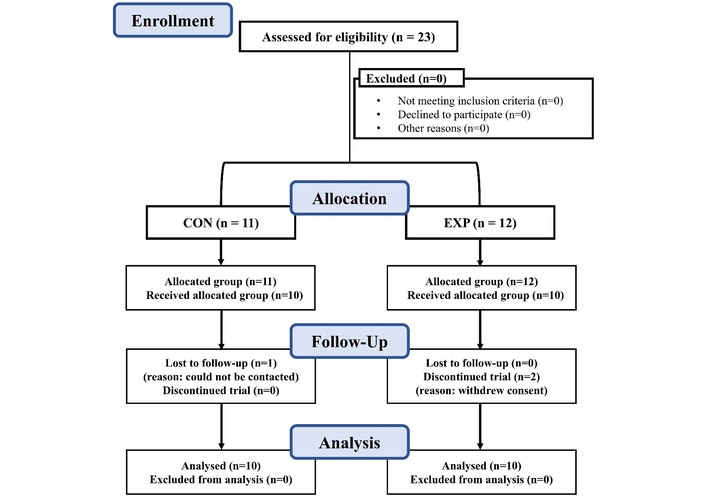
CONSORT flow diagram of participant recruitment, allocation, and analysis. CON: control group; EXP: experimental group.
This study employed a pre- and post-test randomized controlled design. The EXP participated in a structured 8-week mat Pilates program, while the CON maintained their usual routines. All variables were measured before and after the 8-week intervention, including body composition, blood pressure, vascular function, autonomic nervous system activity, and health-related physical fitness. Pre-intervention assessments were performed within 2 days before the intervention, and post-intervention assessments were performed within 2 days after completion of the 8-week intervention.
The mat Pilates intervention was adapted from the protocol described by Jung et al. [34]. The program included 25 mat-based exercises targeting whole-body movement, core stabilization, upper- and lower-limb activation, flexibility, and postural control. The detailed exercise sequence is presented in Table 1. All exercise sessions were conducted individually and in person under the supervision of a researcher. Each session lasted approximately 50–60 min and was performed three times per week for eight weeks. Exercises were executed continuously at a rhythm of 120 beats per minute, maintaining 2 min per posture with 4–10 seconds for transition between movements. Exercise intensity was set at 50–60% of the participant’s maximal heart rate (HRmax), corresponding to a rate of perceived exertion (RPE) of 10–14 on Borg’s 20-point scale [34]. To monitor exercise intensity during the intervention, participants were regularly asked to report their RPE throughout each session, and a researcher ensured that the perceived intensity remained within the target range.
Mat Pilates exercise programs.
| No. | Mat Pilates program | Time |
|---|---|---|
| 1 | Roll down & Up | 20 sec × 6 reps, 2 min |
| 2 | Biceps | 2 sec × 60 reps, 2 min |
| 3 | Arm Circles | 8 sec × 14 reps, 2 min |
| 4 | Teaser | 8 sec × 14 reps, 2 min |
| 5 | Rolling like a Ball | 8 sec × 14 reps, 2 min |
| 6 | Spine Twist & Arm Extension | 8 sec × 14 reps, 2 min |
| 7 | Mermaid | 8 sec × 14 reps, 2 min |
| 8 | Cobra | 8 sec × 14 reps, 2 min |
| 9 | Swimming | 30 sec × 4 reps, 2 min |
| 10 | Double Kicks & Arm Circles | 10 sec × 11 reps, 2 min |
| 11 | Swan & Rest Position | 10 sec × 11 reps, 2 min |
| 12 | Cat | 10 sec × 11 reps, 2 min |
| 13 | Thigh Stretching | 10 sec × 11 reps, 2 min |
| 14 | Hug a Tree | 8 sec × 14 reps, 2 min |
| 15 | Squat | 10 sec × 11 reps, 2 min |
| 16 | Row | 10 sec × 11 reps, 2 min |
| 17 | Saw | 8 sec × 14 reps, 2 min |
| 18 | Hip Pull | 10 sec × 11 reps, 2 min |
| 19 | The Hundred | 6 sec × 20 reps, 2 min |
| 20 | Lats Pull Three Ways | 4 sec × 28 reps, 2 min |
| 21 | Leg Arc & Circle | 8 sec × 5 reps & 6 sec × 12 reps, 2 min |
| 22 | Scissor | 8 sec × 15 reps, 2 min |
| 23 | Helicopter | 8 sec × 14 reps, 2 min |
| 24 | Side Leg Pull (right) | 4 sec × 23 reps, 20 sec × 1 rep, 2 min |
| 25 | Side Leg Pull (left) | 4 sec × 23 reps, 20 sec × 1 rep, 2 min |
Body composition was assessed using a multi-frequency bioelectrical impedance analyzer (Inbody 770, Inbody Co., Seoul, Korea) after overnight fasting (≥ 8 hours) and avoidance of vigorous activity for 48 hours. Participants voided prior to testing and wore light clothing without metallic accessories. Variable measures included height, body weight, BMI, lean body mass, fat mass, and percent body fat.
The resting blood pressure, SBP, and DBP were measured twice in the sitting position after a minimum of 5 min of rest using an automatic sphygmomanometer (UM-102, A&D Medical, Tokyo, Japan). The average value was used for analyses and calculation of mean arterial pressure (MAP = DBP × 2/3 + SBP × 1/3), pulse pressure (PP = SBP – DBP), and double product [DP = heart rate (HR) × SBP/100].
Arterial stiffness was assessed using an arteriosclerosis testing device (VP-1000 Plus, Omron, Tokyo, Japan), which simultaneously measures brachial and ankle pulse waveforms and blood pressures to determine brachial-ankle pulse wave velocity (baPWV) and ankle-brachial index (ABI). Participants rested in a supine position for at least 30 min in a quiet room before measurement. Cuffs were placed around both upper arms and ankles according to the manufacturer’s instructions, and the device automatically recorded pulse waveforms and blood pressures [25]. baPWV was automatically calculated from the pulse transit time between the brachial and ankle arterial waveforms and the estimated path length between the recording sites. ABI was determined by dividing the ankle systolic pressure by the brachial systolic pressure.
Endothelial-dependent vasodilation was measured noninvasively using a Doppler ultrasound system (UNEXEF38G, Unex, Tokyo, Japan) to assess flow-mediated dilation (FMD). After 30 min of rest, the right brachial artery diameter was measured 3–5 cm above the elbow. A cuff was inflated to suprasystolic pressure for 5 min and then deflated [24]. The maximal and resting diameters were recorded, and FMD was calculated using the following equation: FMD (%) = [(Maximal diameter – Resting diameter)/Resting diameter] × 100.
Autonomic regulation was assessed by HRV using a HR monitor (Polar V800, Polar Electro, Kempele, Finland) [35]. Participants abstained from alcohol and strenuous activity for 48 hours prior to testing. After 30 min of rest in a quiet room, participants sat comfortably with a chest-worn HR sensor, and RR intervals were recorded for 15 min. HRV data were analyzed using Kubios HRV software (version 3.3.1, Kuopio, Finland). Time-domain parameters included SDNN (standard deviation of NN intervals), RMSSD (root mean square of successive differences), and pNN50 (percentage of NN intervals differing by > 50 ms). Frequency-domain measures included low frequency (LF), HF, and the ratio of LF to HF (LF/HF) [21].
Handgrip strength was measured using a digital dynamometer (T.K.K. 5001, TAKEI, Tokyo, Japan). Participants performed two maximal trials with each hand while maintaining a 45° arm angle, and the best score was recorded to the nearest 0.1 kg [36].
Abdominal muscular endurance was evaluated by a 60-second sit-up test. Participants lay supine with knees bent at 90°, arms crossed over the chest, and feet stabilized by an assistant. The total number of correctly performed sit-ups within 60 seconds was recorded [37, 38].
Flexibility was assessed using the sit-and-reach test (T.K.K. 5403, Flexion-D, Tokyo, Japan) [38]. Participants sat barefoot with legs extended and feet flat against the box, then reached forward slowly with both hands, holding the maximal position for 3 seconds. The highest of two trials was recorded to the nearest 0.1 cm [39].
Static balance was measured using the one-leg stand test with eyes closed. Participants stood on one leg with hands on hips and eyes closed, maintaining balance as long as possible. Time (seconds) was recorded until posture was lost [37].
Cardiorespiratory fitness was determined using a cycle ergometer (Aerobike 75XLIII, Konami, Tokyo, Japan) following a ramp protocol (15 W/min). Participants pedaled at 50 rpm until reaching 75% of their age-predicted HRmax [40]. Peak oxygen uptake (VO2peak) was estimated from the attained workload using the manufacturer’s regression equation: VO2 (mL·min–1) = 9.386 × workload (W) + 289.6.
All data were analyzed using SPSS Statistics 30.0 (IBM Corp., Armonk, NY, USA). Descriptive statistics were expressed as mean ± standard deviation. The normality and homogeneity of variance were verified using the Shapiro-Wilk test. To evaluate the effects of group (CON vs. EXP), time (pre vs. post), and their interaction, a two-way repeated-measures analysis of variance (ANOVA) was conducted. When significant interactions or main effects were detected, paired t-tests were used for within-group comparisons. The level of statistical significance was set at p < 0.05.
Baseline characteristics of the participants are summarized in Table 2. No significant between-group differences were observed in demographic variables, body composition indices, or resting blood pressure at baseline. Thus, the CON and EXP were comparable before the 8-week intervention, supporting the appropriateness of subsequent between-group comparisons.
Baseline characteristics of participants.
| Variables | CON (n = 10) | EXP (n = 10) | p-value |
|---|---|---|---|
| Age (yrs) | 38.40 ± 7.66 | 38.00 ± 8.79 | 0.915 |
| Height (cm) | 175.12 ± 4.69 | 177.89 ± 3.58 | 0.156 |
| Body weight (kg) | 83.73 ± 8.84 | 87.55 ± 11.29 | 0.411 |
| BMI (kg/m2) | 26.09 ± 2.73 | 27.73 ± 3.77 | 0.280 |
| Lean body mass (kg) | 58.51 ± 5.82 | 59.52 ± 4.71 | 0.673 |
| Fat mass (kg) | 21.92 ± 6.46 | 23.06 ± 8.92 | 0.645 |
| Percent body fat (%) | 25.76 ± 7.29 | 26.82 ± 7.01 | 0.645 |
| SBP (mmHg) | 135.40 ± 8.12 | 136.50 ± 6.50 | 0.742 |
| DBP (mmHg) | 84.00 ± 9.85 | 85.20 ± 5.53 | 0.741 |
Note. Values are expressed as mean ± standard deviation. The p-values indicate the differences between the two groups at baseline, determined by an independent t-test. CON: control group; EXP: experimental group; BMI: body mass index; SBP: systolic blood pressure; DBP: diastolic blood pressure.
Changes in body composition are presented in Table 3. After the 8-week intervention, the EXP showed overall favorable changes in body composition, whereas the CON showed minimal changes. Significant group × time interaction effects were observed for body weight, BMI, and fat mass, indicating that the reductions in these variables were more pronounced in the EXP than in the CON. Lean body mass and percent body fat improved significantly only in the EXP; however, no significant interaction effects were observed for these variables. Therefore, the mat Pilates intervention appeared to be more clearly associated with between-group differences in body weight, BMI, and fat mass, whereas the changes in lean body mass and percent body fat should be interpreted more cautiously as within-group improvements in the EXP.
Changes in body composition before and after the 8-week intervention.
| Variables | CON (n = 10) | EXP (n = 10) | p (ηp2) value | ||||||
|---|---|---|---|---|---|---|---|---|---|
| Pre | Post | p-value | Pre | Post | p-value | Time | Group | Inter | |
| Body weight(kg) | 83.73 ± 8.84 | 83.61 ± 10.29 | 0.832 | 87.55 ± 11.29 | 84.94 ± 10.45 | 0.003* | 0.005†(0.364) | 0.577(0.018) | 0.009†(0.322) |
| BMI(kg/m2) | 26.09 ± 2.73 | 26.06 ± 3.12 | 0.870 | 27.73 ± 3.77 | 26.86 ± 3.48 | 0.003* | 0.005†(0.366) | 0.417(0.037) | 0.007†(0.335) |
| Lean body mass(kg) | 58.51 ± 5.82 | 58.97 ± 5.86 | 0.199 | 59.52 ± 4.71 | 60.34 ± 4.45 | 0.034* | 0.013†(0.296) | 0.616(0.014) | 0.440(0.034) |
| Fat mass(kg) | 21.92 ± 6.46 | 22.01 ± 6.21 | 0.814 | 23.06 ± 8.92 | 21.23 ± 8.02 | 0.016* | 0.027†(0.245) | 0.957(0.000) | 0.016†(0.283) |
| Percent body fat(%) | 25.76 ± 7.29 | 25.17 ± 6.41 | 0.343 | 26.82 ± 7.01 | 25.22 ± 6.82 | 0.011* | 0.011†(0.308) | 0.858(0.002) | 0.208(0.086) |
Note. Values are expressed as mean ± standard deviation. Statistical significance was determined by two-way repeated-measures ANOVA. BMI: body mass index; CON: control group; EXP: experimental group; Inter: interaction. * p < 0.05 significantly different between pre- and post-test; † p < 0.05 significant main effect or interaction.
Changes in blood pressure and vascular function are shown in Figure 2. After the 8-week intervention, the EXP demonstrated favorable changes in blood pressure-related variables, whereas the CON showed minimal or inconsistent changes. Significant group × time interaction effects were observed for HR, SBP, DBP, MAP, and DP, indicating that the reductions in these hemodynamic variables were more pronounced in the EXP than in the CON. In contrast, PP did not show a significant interaction effect, suggesting that the intervention-related changes were more evident in resting HR, blood pressure, and myocardial workload indices than in PP.
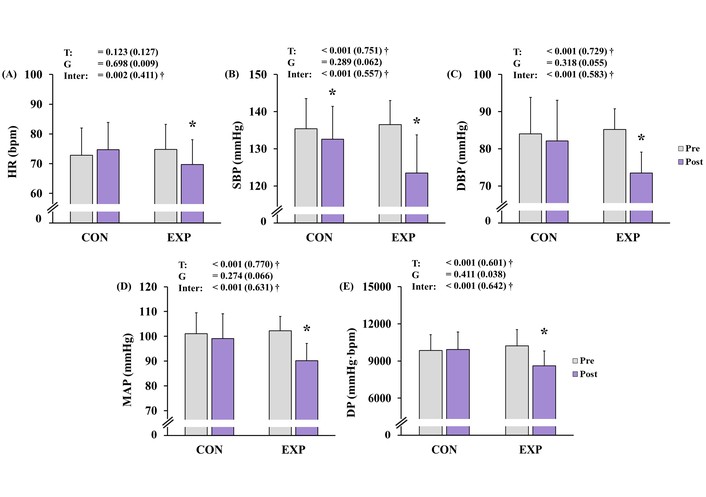
Changes in blood pressure variables before and after the 8-week intervention. Values are expressed as mean ± standard deviation. (A) HR, heart rate; (B) SBP, systolic blood pressure; (C) DBP, diastolic blood pressure; (D) MAP, mean arterial pressure; (E) DP, double product. CON: control group; EXP: experimental group; T: time; G: group; Inter: interaction. Values in parentheses indicate partial eta squared (ηp2). † p < 0.05 indicates a significant interaction and/or main effect; * p < 0.05 indicates a significant difference between pre- and post-test values.
Changes in vascular function are shown in Figure 3. Vascular function also improved more clearly in the EXP. Significant group × time interaction effects were observed for baPWV, ABI, and FMD. Specifically, the EXP showed a reduction in baPWV and increases in ABI and FMD after the intervention, whereas the CON showed little change. These findings suggest that the mat Pilates intervention was associated with improvements in arterial stiffness and endothelial-dependent vascular function.
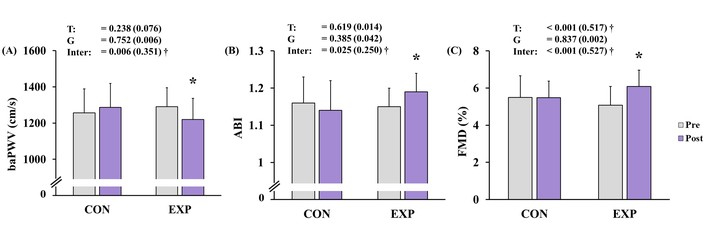
Changes in vascular function before and after the 8-week intervention. Values are expressed as mean ± standard deviation. (A) baPWV, brachial-ankle pulse wave velocity; (B) ABI, ankle-brachial index; (C) FMD, flow-mediated dilation. CON: control group; EXP: experimental group; T: time; G: group; Inter: interaction. Values in parentheses indicate partial eta squared (ηp2). † p < 0.05 indicates a significant interaction and/or main effect; * p < 0.05 indicates a significant difference between pre- and post-test values.
Changes in autonomic nervous system function are presented in Table 4. After the 8-week intervention, the EXP showed favorable changes in several HRV indices, whereas the CON showed minimal or opposite changes. Significant group × time interaction effects were observed for pNN50, LF, HF, and LF/HF. In particular, the increases in pNN50 and HF, together with the decrease in LF/HF in the EXP, suggest improved parasympathetic modulation and autonomic balance. Although RMSSD increased significantly within the EXP, the interaction effect was not significant, and SDNN showed no significant change. Overall, the mat Pilates intervention appeared to improve selected HRV indices related to autonomic regulation.
Changes in autonomic nervous system function before and after the 8-week intervention.
| Variables | CON (n = 10) | EXP (n = 10) | p (ηp2) value | ||||||
|---|---|---|---|---|---|---|---|---|---|
| Pre | Post | p-value | Pre | Post | p-value | Time | Group | Inter | |
| SDNN(ms) | 29.67 ± 12.78 | 27.63 ± 12.22 | 0.432 | 29.98 ± 10.72 | 37.76 ± 21.07 | 0.113 | 0.274(0.066) | 0.403(0.039) | 0.069(0.172) |
| RMSSD(ms) | 28.84 ± 14.86 | 27.71 ± 14.81 | 0.725 | 22.81 ± 7.73 | 31.10 ± 15.78 | 0.043 | 0.147(0.113) | 0.817(0.003) | 0.061(0.182) |
| pNN50(%) | 11.72 ± 14.73 | 5.76 ± 7.58 | 0.238 | 4.65 ± 4.11 | 11.08 ± 10.17 | 0.041* | 0.932(0.000) | 0.806(0.003) | 0.035†(0.224) |
| LF(ms2) | 358.76 ± 217.35 | 408.08 ± 207.53 | 0.039* | 438.57 ± 205.82 | 393.96 ± 189.78 | 0.004* | 0.844(0.002) | 0.723(0.007) | < 0.001†(0.469) |
| HF(ms2) | 279.63 ± 140.21 | 269.39 ± 120.89 | 0.412 | 266.92 ± 106.43 | 313.97 ± 117.26 | 0.004* | 0.047†(0.202) | 0.770(0.005) | 0.004†(0.380) |
| LF/HF | 1.45 ± 0.93 | 1.72 ± 1.12 | 0.021* | 1.75 ± 0.92 | 1.31 ± 0.62 | 0.004* | 0.270(0.067) | 0.882(0.001) | < 0.001†(0.552) |
Note. Values are expressed as mean ± standard deviation. Statistical significance was determined by two-way repeated-measures ANOVA. SDNN: standard deviation of NN intervals; RMSSD: root mean square of successive differences; pNN50: percentage of NN intervals differing by > 50 ms; LF: low frequency; HF: high frequency; LF/HF: ratio of LF to HF; CON: control group; EXP: experimental group; Inter: interaction; ηp2: partial eta squared. * p < 0.05 significantly different between pre- and post-test; † p < 0.05 significant main effect or interaction.
Changes in health-related physical fitness are presented in Table 5. After the 8-week intervention, the EXP showed improvements across all fitness components, whereas the CON showed minimal changes or a decline in VO2peak. Significant group × time interaction effects were observed for grip strength, sit-up performance, sit-and-reach, one-leg stand with eyes closed, and VO2peak, indicating greater improvements in the EXP than in the CON. Overall, the mat Pilates intervention appeared to improve multiple domains of health-related physical fitness in obese men with elevated or stage 1 hypertension.
Changes in health-related fitness before and after the 8-week intervention.
| Variables | CON (n = 10) | EXP (n = 10) | p (ηp2) value | ||||||
|---|---|---|---|---|---|---|---|---|---|
| Pre | Post | p-value | Pre | Post | p-value | Time | Group | Inter | |
| Grip strength(kg) | 39.37 ± 5.07 | 39.56 ± 4.09 | 0.832 | 34.47 ± 6.92 | 39.09 ± 7.44 | < 0.001* | < 0.001†(0.525) | 0.324(0.054) | < 0.001†(0.484) |
| Sit-up(n) | 32.20 ± 10.45 | 31.10 ± 10.74 | 0.302 | 29.30 ± 9.60 | 34.20 ± 8.99 | 0.020* | 0.074(0.167) | 0.982(0.000) | 0.008†(0.333) |
| Sit & reach(cm) | 5.41 ± 7.01 | 4.72 ± 7.58 | 0.100 | 0.67 ± 7.65 | 6.09 ± 6.85 | 0.002* | 0.002†(0.430) | 0.604(0.015) | < 0.001†(0.558) |
| One leg stand eyes closed (sec) | 13.00 ± 2.49 | 12.90 ± 2.28 | 0.780 | 11.80 ± 1.81 | 16.00 ± 2.00 | < 0.001* | < 0.001†(0.760) | 0.320(0.055) | < 0.001†(0.777) |
| VO2peak(mL/kg/min) | 37.13 ± 7.37 | 34.84 ± 6.14 | 0.013* | 34.06 ± 5.24 | 37.74 ± 6.13 | < 0.001* | 0.206(0.087) | 0.976(0.000) | < 0.001†(0.638) |
Note. Values are expressed as mean ± standard deviation. Statistical significance was determined by two-way repeated-measures ANOVA. VO2peak: peak oxygen uptake; CON: control group; EXP: experimental group; Inter: interaction; ηp2: partial eta squared. * p < 0.05 significantly different between pre- and post-test; † p < 0.05 significant main effect or interaction.
The main finding of the present study was that an 8-week mat Pilates exercise program was associated with favorable changes in body composition, blood pressure and vascular function, autonomic nervous system regulation, and health-related physical fitness in obese men with elevated or stage 1 hypertension. Compared with the CON, the exercise group showed clearer improvements in body weight, BMI, fat mass, blood pressure-related variables, arterial stiffness, endothelial function, selected HRV indices, and multiple components of health-related physical fitness. These findings support our hypothesis that a mat Pilates program designed with a circuit-like structure may provide sufficient physiological stimulus to improve cardiometabolic and functional outcomes in this population. However, because body weight and fat mass also decreased during the intervention, the cardiovascular and autonomic improvements should be interpreted as the combined result of the exercise stimulus and concurrent body composition changes, rather than as effects of Pilates training alone.
The improvement in body composition may be partly explained by the structure of the exercise program. The present mat Pilates program required participants to perform repeated postures continuously at a controlled rhythm and moderate intensity [34], which may have increased total muscular work and energy expenditure while preserving the low-impact characteristics of Pilates [14]. This format differs from a purely flexibility-oriented Pilates approach and may provide a combined muscular endurance and cardiorespiratory stimulus [14, 41]. Previous evidence indicates that Pilates training can reduce body weight, BMI, and body fat percentage in adults with overweight or obesity [42]. In addition, systematic reviews have reported that Pilates may improve cardiorespiratory fitness and physical performance in adult populations [43]. In addition, mat Pilates has been shown to reduce body fatness in individuals with elevated blood pressure [7]. Therefore, the reductions in body weight, BMI, and fat mass observed in the exercise group may reflect the combined effects of repeated muscular activation, moderate-intensity continuous movement, and the feasibility of a low-impact exercise modality for obese individuals [7, 14].
The reductions in blood pressure-related variables may have resulted from both exercise-induced cardiovascular adaptations and improvements in body composition. Exercise training can lower blood pressure through several interacting mechanisms, including improved endothelial function, increased nitric oxide bioavailability, reduced arterial stiffness, improved autonomic balance, and decreased sympathetic activity [4, 44, 45]. In the present study, the reductions in body weight and fat mass may also have contributed to the blood pressure improvements [46, 47]. Obesity-related hypertension is closely associated with sympathetic activation, endothelial dysfunction, increased vascular tone, renin-angiotensin-aldosterone system activation, and insulin resistance [46, 47]. Thus, the blood pressure changes observed in the exercise group should not be attributed solely to the Pilates intervention itself. Rather, they likely reflect the combined influence of the structured exercise stimulus and concurrent reductions in adiposity. This interpretation is important because it avoids overestimating the independent effect of Pilates training and acknowledges the potential role of weight and fat loss as contributing mechanisms.
The improvements in vascular function provide a plausible physiological pathway linking the intervention to blood pressure reduction. In the exercise group, baPWV decreased, whereas ABI and FMD increased, suggesting favorable changes in arterial stiffness and endothelial-dependent vasodilation. Repeated dynamic muscle contractions during exercise can increase blood flow and shear stress, which may stimulate endothelial nitric oxide production and improve vascular responsiveness [44]. Improved endothelial function may reduce peripheral vascular resistance and contribute to better blood pressure regulation [26, 44]. These findings are consistent with previous evidence showing that mat Pilates improved arterial stiffness, vascular function, nitric oxide-related responses, and body fatness in individuals with elevated blood pressure [7]. In the present study, vascular improvements may have been promoted by repeated moderate-intensity muscular activation, reduced vascular tone, and improved endothelial responsiveness [45]. At the same time, the reduction in body weight and fat mass may also have reduced arterial load and obesity-related vascular stress [46, 48]. Therefore, the vascular findings should be interpreted as potentially resulting from both exercise-related shear-stress stimulation and body composition improvement.
The changes in autonomic nervous system function further suggest that the intervention may have influenced blood pressure regulation through multiple pathways. The exercise group showed increases in pNN50 and HF and a decrease in LF/HF, indicating a shift toward greater parasympathetic modulation and improved sympathovagal balance [21]. Hypertension and obesity are commonly associated with autonomic dysfunction, including increased sympathetic predominance and reduced parasympathetic activity [9, 47, 49]. Several features of mat Pilates may be relevant to autonomic regulation, including controlled breathing, focused movement, postural control, and moderate-intensity repeated muscle activation [12, 43]. Controlled breathing and mindful movement may support vagal modulation [50], while improvements in fitness and body composition may reduce sympathetic drive [47]. Previous studies have reported that Pilates training can improve indices of cardiac autonomic modulation in hypertensive or clinical populations [12]. However, the autonomic findings in the present study should be interpreted with caution because not all HRV indices changed significantly. RMSSD improved within the exercise group, but the interaction effect was not significant, and SDNN did not show a significant change. Therefore, the intervention appears to have improved selected HRV indices rather than producing a uniform enhancement of all autonomic parameters.
The improvements in health-related physical fitness may also help explain the broader cardiometabolic effects observed in this study. The exercise group improved in muscular strength, muscular endurance, flexibility, balance, and VO2peak, indicating that the circuit-structured mat Pilates program provided a multidimensional functional stimulus. These findings are consistent with previous studies reporting that Pilates can improve muscular performance, flexibility, functional capacity, and cardiorespiratory fitness [14, 41, 43]. The improvement in VO2peak is particularly meaningful because cardiorespiratory fitness is closely related to cardiovascular health and may contribute to blood pressure control through improved vascular function, enhanced autonomic regulation, and reduced myocardial workload [4, 44, 45, 51]. Thus, the improvement in physical fitness should not be viewed as an isolated outcome. Instead, it may represent one of the pathways through which the intervention contributed to improvements in blood pressure, vascular function, and autonomic regulation [44, 45, 51].
Taken together, the present findings suggest that circuit-structured mat Pilates may influence cardiometabolic health through interconnected mechanisms. Repeated moderate-intensity movement may increase muscular work and energy expenditure, contributing to reductions in body weight and fat mass [42, 43]. These body composition changes may reduce obesity-related sympathetic activation, vascular load, and neurohormonal stress [46, 47]. Simultaneously, repeated dynamic contractions may enhance endothelial shear stress and vascular responsiveness, while controlled breathing and focused movement may support parasympathetic modulation [44, 50, 52]. Improvements in cardiorespiratory fitness may further reinforce these adaptations by supporting vascular and autonomic regulation [44, 45, 51]. Therefore, the benefits observed in this study likely reflect an integrated response involving body composition, hemodynamic regulation, vascular function, autonomic balance, and physical fitness.
Despite these encouraging outcomes, several limitations should be acknowledged. First, the sample size was small (n = 20), with only 10 participants per group completing the study, and was slightly below the a priori target sample size, potentially reducing statistical power for detecting smaller effects and limiting the generalizability of the findings. Second, participants were all obese men with elevated or stage 1 hypertension, which limits the generalizability of the findings to women, older adults, individuals with normal blood pressure, or patients with more severe hypertension. Third, because body weight, BMI, and fat mass improved in the exercise group, this study cannot determine whether the improvements in blood pressure, vascular function, and autonomic regulation were caused by the Pilates program itself, by body composition changes, or by their combined effects. This limitation should be considered when interpreting the cardiovascular and autonomic outcomes. Fourth, although participants were instructed to maintain their usual dietary intake and habitual physical activity during the study period, these factors were not strictly controlled or objectively monitored, which could have influenced body composition and cardiometabolic outcomes. Fifth, VO2peak was estimated using an indirect method rather than measured directly with gas analysis, potentially affecting the accuracy of cardiorespiratory fitness assessment. Finally, the short 8-week intervention period and absence of follow-up preclude conclusions regarding long-term sustainability of the observed effects.
In conclusion, an 8-week circuit-structured mat Pilates exercise program was associated with improvements in body composition, blood pressure and vascular function, autonomic nervous system regulation, and health-related physical fitness in obese men with elevated or stage 1 hypertension. These findings suggest that mat Pilates may be a feasible low-impact exercise strategy for improving cardiometabolic health in this population. However, because the intervention also produced meaningful changes in body composition, the cardiovascular and autonomic improvements should be interpreted as potentially resulting from both the exercise stimulus and concurrent reductions in body weight and fat mass. Future studies with larger samples, both sexes, longer follow-up periods, and stricter control of diet and habitual physical activity are needed to clarify the independent and combined effects of Pilates training and body composition changes on vascular-autonomic adaptation and blood pressure regulation.
ABI: ankle-brachial index
ANOVA: analysis of variance
baPWV: brachial-ankle pulse wave velocity
BMI: body mass index
CON: control group
CRIS: clinical research information service
DBP: diastolic blood pressure
DP: double product
EXP: experimental group
FMD: flow-mediated dilation
HF: high frequency
HR: heart rate
HRmax: maximal heart rate
HRV: heart rate variability
LF: low frequency
LF/HF: ratio of low frequency to high frequency
MAP: mean arterial pressure
pNN50: percentage of NN intervals differing by > 50 ms
PP: pulse pressure
RMSSD: root mean square of successive differences
RPE: rate of perceived exertion
SBP: systolic blood pressure
SDNN: standard deviation of NN intervals
VO2peak: peak oxygen uptake
ηp2: partial eta squared
YS, HYP: Conceptualization. YS, SL: Data curation, Visualization. YS, HYP, BGJ: Formal analysis. YS: Methodology, Writing—original draft, Funding acquisition. BGJ, DYJ: Validation, Investigation. HYP: Supervision. YS, HYP, BGJ, DYJ: Writing—review & editing. All authors read and approved the submitted version.
The authors declare that they have no conflicts of interest.
This study was approved by the Institutional Review Board of Konkuk University (IRB No. 7001355-202401-HR-750) and registered with the CRIS, Republic of Korea (KCT0010502; https://cris.nih.go.kr/cris/index/index.do). Written informed consent was obtained from all participants prior to their inclusion in the study, in accordance with the Declaration of Helsinki.
Informed consent to participate in the study was obtained from all participants.
Not applicable.
The datasets used and/or analyzed during the current study are available from the corresponding author on reasonable request.
This work was supported by the Ministry of Education of the Republic of Korea and the National Research Foundation of Korea (2023S1A5B5A17089900). The funder had no role in study design, data collection and analysis, decision to publish, or preparation of the manuscript.
© The Author(s) 2026.
Open Exploration maintains a neutral stance on jurisdictional claims in published institutional affiliations and maps. All opinions expressed in this article are the personal views of the author(s) and do not represent the stance of the editorial team or the publisher.
Copyright: © The Author(s) 2026. This is an Open Access article licensed under a Creative Commons Attribution 4.0 International License (https://creativecommons.org/licenses/by/4.0/), which permits unrestricted use, sharing, adaptation, distribution and reproduction in any medium or format, for any purpose, even commercially, as long as you give appropriate credit to the original author(s) and the source, provide a link to the Creative Commons license, and indicate if changes were made.



View: 1088
Download: 24
Times Cited: 0


