Review


Affiliation:
1Department of Medical Laboratory Science, Edo State University, Uzairue 300212, Nigeria
ORCID: https://orcid.org/0000-0002-8431-3033

 ,
,
Affiliation:
2Department Of Medical Laboratory Science, University of Ilorin, Ilorin 240003, Nigeria
ORCID: https://orcid.org/0009-0002-1612-7199
,
Affiliation:
3Department of Research, Global Health Focus, Kigali 4285, Rwanda
4Department of Public Health, Daffodil International University, Dhaka 1216, Bangladesh
5Department of Public Health, Faculty of Medicine and Health Sciences, Hormuud University, Mogadishu 204, Somalia
Email: okesanya@ghfocus.org
ORCID: https://orcid.org/0000-0002-3809-4271

Explor Med. 2026;7:1001422 DOI: https://doi.org/10.37349/emed.2026.1001422
Received: April 01, 2026 Accepted: June 16, 2026 Published: August 04, 2026
Academic Editor: Lindsay A. Farrer, Boston University School of Medicine, USA
Antimicrobial resistance has intensified the search for alternatives to conventional antibiotics, particularly against multidrug-resistant bacterial pathogens that increasingly compromise treatment outcomes in hospitals and community settings. This narrative review examines bacteriophage therapy as an alternative for combating multidrug-resistant bacteria. Recent literature is discussed thematically, with emphasis on original studies, clinical datasets, translational experiments, and regulatory documents. The current evidence base consists predominantly of compassionate-use reports, small cohorts, and early-phase trials, including CRISPR-enhanced and inhaled phage platforms, which report safety observations, compartment-specific responses, and microbiome effects in individual studies. Mechanistic considerations discussed in the review include route-specific delivery, phage–host ecological interactions, resistance trade-offs, and phage–antibiotic synergy. While microbiological and clinical responses have been reported in individual studies, no confirmatory randomized trial has demonstrated clinical efficacy for any phage therapy indication. Manufacturing, standardization, and regulatory pathways for scaled deployment also remain unresolved. Regulatory developments in Europe, the United Kingdom, the United States, and Australia remain heterogeneous and predominantly access-based or compassionate-use-based rather than approval-based. Specific technical challenges include incomplete standardization of susceptibility testing and the need for robust monitoring of immune neutralization, endotoxin burden, and long-term ecological effects. Routine clinical adoption of phage therapy will ultimately depend on outcomes of adequately powered confirmatory trials, alongside resolution of manufacturing, regulatory, and standardization challenges.
Antimicrobial resistance (AMR) continues to outpace classic small-molecule antibiotic innovation. Global surveillance systems across over 100 countries and millions of laboratory-confirmed diagnoses report increasing resistance across a wide range of pathogen–antibiotic combinations [1]. The 2024 update of the World Health Organization (WHO) Bacterial Priority Pathogens List explicitly re-centers attention on high-burden, hard-to-treat phenotypes (notably multiple Gram-negative “critical group” threats) and frames research and development (R&D) prioritization as a global policy tool rather than a static list [2–4]. In this context, bacteriophage therapy is experiencing renewed interest as an alternative currently under scientific and clinical investigation. However, it remains largely restricted to compassionate-use settings, with available evidence predominantly derived from case reports, small cohorts, and early-phase trials. Confirmatory evidence from adequately powered randomized controlled trials is absent, and standardization of manufacturing, pharmacological characterization, and regulatory frameworks remains at an early stage [5, 6].
Recently, 2026 clinical data have produced early findings regarding phage therapy in two areas. First, microbiome-targeted CRISPR-armed phage therapeutics reported a first in-human study in the March 2026 randomized, placebo-controlled Phase 1 SNIPR001 trial [7]. Second, in January 2026, a prospective pilot study reported preliminary findings on inhaled phage therapy for multidrug-resistant (MDR) Klebsiella pneumoniae ventilator-associated pneumonia in a critical care setting [8]. However, regulatory frameworks for phage therapy remain fragmented, jurisdiction-specific, and largely access-based rather than approval-based. In Europe, the European Directorate for the Quality of Medicines & HealthCare pre-published a dedicated “Phage therapy medicinal products (5.31)” chapter in the European Pharmacopoeia (Supplement 11.6), providing a framework for phage product definition, production controls, and risk-based quality testing [9, 10]. In addition, the European Medicines Agency (EMA) issued a draft guideline on quality aspects of phage therapy medicinal products, clarifying expectations for active substance and finished product quality documentation, including considerations spanning genetically modified and synthetic-genome phages [11]. In the UK, the Medicines and Healthcare products Regulatory Agency published extensive guidance in November 2025, explicitly noting no marketing authorizations for bacteriophage medicinal products in the UK at the date of publication while mapping pathways for investigational use and “specials” supply [2]. In the United States, the U.S. Food and Drug Administration (FDA) enables access via Investigational New Drug (IND) and expanded access mechanisms, with updated operational guidance on expanded access pathways relevant to individual-patient use [12].
Importantly, the modern regulatory and clinical landscape of phage therapy is also informed by countries with long-standing therapeutic phage experience, particularly Poland and Georgia, where bacteriophage applications have persisted for decades through dedicated clinical and research institutes [13, 14]. These programmes have historically contributed observational clinical experience, phage banking infrastructure, personalized phage matching strategies, and practical approaches to compassionate-use implementation despite operating outside conventional Western drug-approval paradigms. Furthermore, regulatory innovations resembling the Belgian “magistral preparation” model are increasingly being explored or adapted in other European jurisdictions, including Portugal, where individualized phage compounding frameworks and hospital-based preparation strategies are being discussed as potential pathways for controlled therapeutic access [15, 16]. The inclusion of these international experiences is important because they collectively illustrate that phage therapy governance is not evolving through a single harmonized pathway, but rather through multiple parallel models that integrate historical therapeutic practice, adaptive manufacturing, and country-specific regulatory flexibility. These examples further reinforce the argument that future global phage governance will likely require hybrid frameworks capable of accommodating both standardized industrial production and personalized magistral-style therapeutic preparation [17].
Novel contributions and differentiators of this review relative to typical 2020–2024 narratives are threefold. First, it synthesizes 2025–2026 controlled or comparator-inclusive human datasets into testable translational hypotheses about where phage therapy is most likely to yield reproducible benefit: (i) localized delivery with tract-restricted kinetics, (ii) ecology-aware selection to steer resistance trade-offs, and (iii) decolonization as a prevention strategy rather than salvage only [7, 18]. Second, it highlights that while the biological basis of phage-bacterial interactions is reasonably established, the primary translational barrier is increasingly recognized across recent literature as platform governance encompassing regulatory frameworks, manufacturing standardization, product update mechanisms, and the clinical deployment of evolving biological agents within reproducible and scalable frameworks [19]. Third, it discusses potential methodological pathways that may improve future clinical trial design: phage pharmacology endpoints (recovery, neutralization, susceptibility drift) [20, 21]; standardized phagograms/EOP metrics [17]; and adaptive cocktail update protocols aligned with emerging pharmacopeial and regulatory scaffolding [22].
This review was conducted to synthesize recent scientific and translational evidence on bacteriophage therapy, with emphasis on clinical development, experimental validation, and emerging regulatory frameworks. The aim was to collate and analyze studies addressing the therapeutic application, clinical feasibility, and translational pathways of phage therapy, particularly in the context of MDR bacterial infections. This review did not aim to identify all eligible studies exhaustively but rather to synthesize the most relevant and recent evidence to inform thematic interpretation of the field.
A structured literature search was conducted across four electronic databases: PubMed, Scopus, Web of Science (WoS), and Google Scholar. The search covered studies published between January 2020 and March 2026, reflecting the period of rapid advancement in clinical phage therapy research, translational development, and evolving regulatory frameworks. The search strategy combined Medical Subject Headings (MeSH) and free-text keywords using Boolean operators (“AND”, “OR”) to maximize both sensitivity and specificity of article retrieval. The principal Boolean search string used was:
(“bacteriophage therapy” OR “phage therapy” OR “clinical phage treatment” OR “phage therapeutics”) AND (“clinical trial” OR “clinical application” OR “multidrug-resistant infections” OR “antimicrobial resistance” OR “phage pharmacology” OR “phage development”)
This search string was adapted as appropriate for the indexing structure, syntax, and search requirements of each database searched. In addition to peer-reviewed literature, targeted grey literature searches were conducted to identify relevant regulatory and institutional documents. Grey literature sources included official websites and repositories of regulatory agencies, public health organizations, institutional phage therapy programs, and international scientific bodies, including the EMA, European Pharmacopoeia, United States FDA, and national phage therapy centres. These searches focused on regulatory guidelines, technical reports, consensus statements, clinical program updates, and institutional publications relevant to phage therapy development, manufacturing, and implementation. Backward reference tracking of included studies and relevant review articles was also performed to identify additional sources not captured through database searching.
Studies were included if they met the following criteria:
Published between 2020 and March 2026.
Available in English.
Addressed therapeutic applications of bacteriophages in humans or clinically relevant experimental models.
Reported primary data, including clinical trials, cohort studies, case series, translational experiments, manufacturing or regulatory frameworks, or microbiological investigations relevant to therapeutic phage use.
Priority was given to original research articles, including clinical trials, observational studies, experimental investigations, and regulatory or policy documents that provided primary empirical or translational evidence. Grey literature, such as institutional reports and official regulatory guidance documents, was also included when it offered critical insights into manufacturing standards, clinical implementation, or governance frameworks for phage therapy. Review articles, editorials, and commentaries were also considered, particularly when they synthesized emerging evidence or provided conceptual context; however, they were assigned lower analytical priority compared with primary studies and were used mainly to support interpretation and identify additional relevant sources.
For this review, phage therapy was defined as the therapeutic use of strictly lytic bacteriophages for the treatment of bacterial infections. This definition encompasses naturally occurring phages, genetically engineered phages, and synthetic-genome phages produced through bacterial propagation systems. Temperate or lysogenic phages were considered primarily in discussions of biosafety and horizontal gene transfer risks rather than as therapeutic candidates. Phage-derived antibacterial agents, such as endolysins, were included only when their discussion was necessary to clarify translational mechanisms or regulatory considerations relevant to phage-based therapeutic platforms.
Studies identified through the search were screened for relevance to the objectives of the study based on their titles and abstracts. Articles considered potentially relevant were further screened at the full-text level, and inclusion of articles was guided by the eligibility criteria, with priority given to studies demonstrating clinical applicability, translational relevance and meaningful addition to the current understanding of phage therapy. No formal risk-of-bias tool was applied because of the heterogeneous and narrative design of the review. Given the narrative nature of this review, study selection was also guided by relevance to the review objectives and contribution to thematic understanding of the field, rather than exhaustive or protocol-driven inclusion. A structured data extraction process was subsequently undertaken using a standardized data-charting framework developed for this review. For each included study, relevant information was systematically extracted. To enhance consistency and reduce errors, extracted information was cross-checked against the original full texts before synthesis. Data were then organized into evidence tables and grouped according to recurring domains. Extracted data were summarized and synthesized under consistent thematic headings derived from the included studies, enabling structured comparison and identification of recurring patterns within the phage-therapy literature. Through this narrative thematic synthesis, evidence from clinical trials, experimental investigations, and policy-related sources was integrated to provide a coherent overview of current developments and to highlight emerging research directions, translational feasibility signals, and regulatory progress shaping the future implementation of bacteriophage therapy.
Operational definitions are critical because phage therapy is frequently proposed for “unmet clinical needs”, yet the meaning of “unmet need” varies depending on the MDR, extensively drug-resistant (XDR), or pandrug-resistant (PDR) classification of the pathogen and the anatomical site of infection. A widely accepted framework defines MDR as acquired non-susceptibility to at least one agent in three or more antimicrobial classes, while XDR and PDR organisms represent progressively higher levels of resistance with increasingly limited remaining therapeutic options [10]. The 2024 WHO BPPL update provides a practical map of where phage therapy is most strategically aligned with global priorities: carbapenem-resistant Acinetobacter baumannii and resistant Enterobacterales phenotypes appear in the “critical group”, while Pseudomonas aeruginosa and methicillin-resistant Staphylococcus aureus remain high-priority threats [23]. Importantly, the BPPL frames these targets not only as drug development priorities but also as systems problems, requiring infection prevention and control, diagnostics, surveillance, and equitable access, conditions that directly influence how and whether phage therapy can be deployed at scale [5].
WHO’s 2025 global antibiotic resistance surveillance synthesis (GLASS) reports resistance prevalence and trend analyses drawn from more than 23 million bacteriologically confirmed infections across multiple syndromes, with 104 countries reporting data in 2023 and resistance rising in more than 40% of monitored pathogen–antibiotic combinations between 2018 and 2023 [1, 24]. These surveillance characteristics matter for phage therapy because they argue for region-specific phage libraries or hospital-adapted cocktails and surrogate endpoints linked to pathogen ecology (e.g., bloodstream vs. respiratory vs. gut colonization) rather than one-size-fits-all “infection cure” metrics [8]. At the population level, burden prediction emphasizes the need for interventions beyond classical antibiotics; global analyses point to substantial increases in AMR-attributable and AMR-associated mortality (with the largest increases among older adults) by 2050, motivating both treatment and prevention paradigms, including microbiome decolonization approaches now emerging in 2026 engineered-phage trials [25].
Beyond human medicine, bacteriophages are also being explored in agriculture, aquaculture, livestock farming, and food safety applications as part of broader antimicrobial stewardship and “One Health” strategies. Experimental and commercial phage preparations have been investigated for reducing bacterial pathogens in poultry, cattle, swine production systems, aquaculture environments, and food-processing chains, particularly against Salmonella, Escherichia coli, Campylobacter, and Listeria species [26, 27]. These applications are relevant to clinical phage therapy because they illustrate large-scale ecological deployment of phages, challenges of resistance evolution under field conditions, environmental dissemination, manufacturing scalability, and regulatory adaptation across sectors. The agricultural experience also reinforces the concept that phage therapy is not solely a salvage clinical intervention but part of a broader ecosystem of precision antimicrobial technologies aimed at reducing antibiotic selection pressure across human, animal, and environmental interfaces [28, 29].
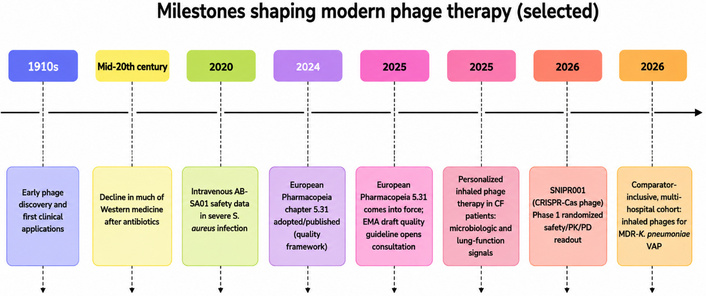
Phages were identified more than a century ago and were applied clinically early in the 20th century, but their use in much of Western medicine waned after antibiotics became widely available (Figure 1) [30]. Modern analyses emphasize that historical failures were not simply “phages don’t work” but reflected inconsistent product quality, weak bacterial diagnosis/typing, unclear dosing, limited understanding of phage biology, and uncontrolled clinical contexts, which are exactly the domains now being repaired via pharmacopeial standards, structured trials, and genomics-enabled selection [31]. A key critical point is that phage therapy is not a single technology. It is a family of approaches whose success depends on the match between phage and bacterial strain, including receptor availability; accessible bacterial density and spatial structure, especially biofilms; pharmacokinetics shaped by route of administration; and evolutionary trajectories of phage resistance that can be harmful or therapeutically leveraged [32, 33].
Phages are viruses that infect bacteria and replicate within them, often causing bacterial lysis when progeny are released [34]. While phage therapy has been documented, it is not sufficient to establish efficacy or characterize in vivo pharmacokinetic and pharmacodynamic behavior [35]. The European Pharmacopoeia’s phage chapter explicitly defines phage therapy medicinal products as preparations of naturally occurring or genetically modified phages used to treat or prevent infections and emphasizes that products may contain one phage or mixtures and may be delivered via different routes and dosage forms [22]. This definition describes the diversity of product forms, not clinical equivalence across routes, since route-specific efficacy data remain limited. Precision is double-edged. High specificity can reduce microbiome disruption (a major advantage supported by multiple modern datasets), but it also increases logistical demands: the clinical workflow must (i) identify the causative strain(s), (ii) test susceptibility (“phagogram”), and (iii) manufacture or select a matching product rapidly enough for the clinical timeline [36]. The field’s publishability risk is that mechanistic precision outpaces clinical operationalization, yielding impressive case reports but fragile generalizability [37].
Recent human studies conducted between 2024 and 2026 generated context-specific observations on how the route of administration and the anatomical compartment of infection may influence bacteriophage pharmacokinetics, biodistribution, and therapeutic outcomes. In the gastrointestinal tract, which has been explored primarily within the context of bacterial decolonization strategies, findings from the 2026 Phase I clinical trial of SNIPR001 revealed that administered phages were recovered in stool samples at dose-proportional concentrations. Importantly, systemic dissemination was minimal, as little to no phage was detected in plasma or urine [7]. Furthermore, a recent review of isolated clinical studies noted that individual trials reported no major disruption to commensal microbial communities in the specific pathogens and populations studied. These findings, however, derive from small trials targeting single pathogens and cannot be generalized to gastrointestinal phage therapy broadly [38].
Findings from the 2024 ELIMINATE Phase II Part 1 clinical trial, which evaluated LBP-EC01, a CRISPR-Cas3-enhanced phage cocktail targeting Escherichia coli, documented route-dependent pharmacokinetic behavior under the conditions of this trial, with both intraurethral and intravenous administration producing distinct exposure profiles. Intraurethral administration produced high local phage concentrations in urine. When combined with intravenous administration, systemic exposure increased in a dose-dependent manner. The study also reported that higher intravenous doses were associated with increased adverse events, an observation specific to this trial context [39]. The lower respiratory tract represents another frontier for phage therapy, particularly in the management of chronic pulmonary colonization and ventilator-associated infections caused by MDR pathogens. The datasets published in 2025 and 2026 have documented nebulized or inhaled phage delivery for targeting infections within the lungs as a delivery approach in a small number of early studies [40, 41]. In individual case reports and small cohorts, inhaled phage formulations have been associated with reductions in bacterial density in sputum and, in some cases, complete microbiological eradication. Across the cohorts reported thus far, no major safety signals have been identified, though the cohorts are too small to characterize the safety profile definitively [42].
Comparator-inclusive studies that include “non-targeted phage controls” are scientifically valuable because they disentangle true target engagement from non-specific immunomodulatory or placebo-associated effects, an experimental design feature that deserves wider adoption and is illustrated in the recent VAP pilot [8]. In this context, a “non-targeted phage control” refers to a bacteriophage preparation that has been experimentally confirmed to lack infectivity or lytic activity against the target bacterial strain under study, typically due to receptor incompatibility, host-range mismatch, or absence of productive adsorption [8]. Importantly, such controls should not simply consist of unrelated or non-lytic phages without validation, as phage structural components themselves may still trigger immune or biological responses independent of antibacterial activity [43, 44]. Appropriate validation criteria, therefore, include demonstration of absent plaque formation, lack of bacterial killing in vitro, and confirmation that the control phage does not replicate within the target strain under the experimental conditions used. The use of such validated non-targeted comparators may improve mechanistic interpretation of phage studies by clarifying whether observed effects are attributable to genuine bacterial targeting rather than non-specific biological exposure to phage particles [6].
A common observation across compartmental reports is that phage activity appears to depend on physical and ecological access to bacterial targets. However, the currently available data are insufficient to establish that phage therapy behaves in a consistently compartment-specific manner, as it has not been confirmed in controlled trials [45, 46]. Whether optimization of delivery strategies will translate into clinically meaningful benefit remains an open question; no current dataset provides confirmatory evidence of clinical efficacy in any anatomical compartment [46].
Bacteria can evolve resistance during phage exposure via receptor mutation, adsorption blocking, restriction-modification systems, CRISPR immunity, or broader physiological shifts [32, 41]. Although bacteriophage resistance is often viewed as a limitation of phage therapy, in some clinical cases, phage-resistant isolates have been reported to show fitness trade-offs that benefit treatment. For example, the 2024 Belgian observational study involving more than 100 clinical phage therapy cases documented the emergence of phage-resistant bacterial isolates in some patients; however, several of these strains demonstrated restored susceptibility to certain antibiotics and reduced virulence characteristics [10]. Similarly, findings from a 2025 cystic fibrosis cohort treated with inhaled phage therapy using a trade-off selection strategy showed that phages targeting bacterial receptors linked to efflux pumps, lipopolysaccharide (LPS), and type IV pili drove evolutionary changes that reduce antibiotic resistance or attenuate virulence [41]. Resistance evolution is treated inconsistently in current clinical studies, sometimes as a failure mode, sometimes as a “feature”. As a methodological proposal, not an established practice, resistance could be approached as a measurable response variable and monitored prospectively. The 2024 Belgian observational cohort reported operationalization of susceptibility testing and combined antibiotic use in increasing eradication probability, which could suggest that resistance monitoring should be co-designed with antibiotic co-therapy, not isolated from it [10]; whether resistance monitoring and antibiotic co-therapy should be co-designed in future protocols is a question for prospective studies.
The EMA draft guideline explicitly anticipates phage products that include chemically/genetically modified phages and even phages with synthetic genomes, indicating that regulators now treat “engineering” as an expected axis of future phage therapeutics rather than an edge case [11]. By early 2026, the most clinically advanced engineered bacteriophage platforms are CRISPR-armed or CRISPR-enhanced phages designed to improve precision and antibacterial potency. The SNIPR001 CRISPR-Cas phage cocktail demonstrated the feasibility of oral administration, confinement of phage activity to the gastrointestinal tract, preservation of the gut microbiome, and a directional reduction of target E. coli in stool [7]. Similarly, the LBP-EC01 CRISPR-Cas3–enhanced phage cocktail established dosing parameters for uncomplicated urinary tract infections and showed rapid bacterial reduction with symptom resolution while also revealing tolerability limits at higher systemic exposure [39]. Supporting these clinical developments, preclinical work validated the engineered SNIPR001 concept, demonstrating that modified phages can reduce E. coli burden, influence resistance evolution, and outcompete wild-type phages in experimental systems [47]. Engineering is not a guarantee of clinical advantage; it shifts the risk surface. CRISPR payloads may improve specificity and reduce off-target microbiome effects, but they also introduce gene-therapy-like concerns (classification, comparability, and control of genetic constructs) [4]. The EMA draft explicitly notes that genetic manipulation may reclassify products under ATMP/gene-therapy-like frameworks, implying that developers must plan for regulatory complexity early rather than retrofitting compliance late [11].
However, genetically engineered phages are not easily accommodated within conventional genetically modified organism (GMO) regulatory frameworks because they differ fundamentally from many static genetically modified products used in agriculture or biotechnology. Therapeutic phages are self-replicating biological agents capable of dynamic interaction with bacterial hosts, ecological adaptation, and evolutionary change during clinical deployment [14]. In addition, phage therapy frequently involves personalized cocktails, adaptive phage updating, strain-specific targeting, and continuous reformulation, features that challenge regulatory assumptions of product stability and fixed composition underlying traditional GMO oversight systems [15, 16]. Existing GMO frameworks were largely designed for stable engineered organisms with predictable environmental behavior, whereas engineered phages may require simultaneous consideration of antimicrobial pharmacology, microbiome effects, horizontal gene transfer risk, evolutionary dynamics, and individualized manufacturing practices [48]. Consequently, emerging regulatory discussions increasingly suggest that engineered phages may require hybrid governance models integrating elements of biologics regulation, gene-therapy oversight, environmental biosafety assessment, and adaptive manufacturing control rather than relying exclusively on conventional GMO legislation [16].
The European Pharmacopoeia introduces “adapted product” concepts and defines phage adaptation (training) as directing phages to evolve against clinical isolates to increase potency, with constraints on how adapted products relate to preceding requirements. In clinical cohorts, adaptation appears as a pragmatic response to resistance emerging during treatment or as pre-adaptation before administration [9]. Phage training introduces a regulatory paradox: while adaptive evolution can enhance therapeutic effectiveness, it challenges the traditional “fixed product” paradigm that underpins the regulation of conventional biologics. A pragmatic and scientifically defensible pathway is to classify trained phages as within-platform variants rather than entirely new biological products [49]. Under this model, changes would be managed through predefined comparability frameworks—including genomic identity thresholds, verification of the absence of harmful genes, and standardized potency assays. Such an approach aligns with pharmacopeial quality principles and reflects ongoing regulatory discussions on post-authorization change management, offering a feasible route for integrating adaptive phage optimization into clinical development and manufacturing systems [11, 21].
Beyond regulatory adaptation, future research should also prioritize systematic phage training strategies as a means of reducing therapeutic failure associated with bacterial resistance evolution during treatment [50]. An additional consideration in therapeutic phage optimization is the intrinsic trade-off between desirable phage growth traits, as therapeutically effective phages are generally expected to combine rapid adsorption, high infectivity, short latent periods, broad host-range compatibility, strong replication efficiency, and prolonged environmental stability [51]. However, these characteristics do not always co-occur biologically, since enhancement of one fitness trait may compromise another. For example, phages selected for broader host range or improved adsorption efficiency may exhibit reduced burst size, diminished replication efficiency, or lower environmental stability, while highly virulent fast-replicating phages may impose selective pressures that accelerate bacterial resistance emergence [52]. These evolutionary and physiological constraints are increasingly recognized as major challenges in phage engineering and training programs. In this context, phage training strategies incorporating pre-registered receptor targets and prospective quantification of evolutionary trade-offs may improve bacterial suppression by selecting for enhanced adsorption efficiency, expanded host-range compatibility, delayed resistance emergence, or resistance mutations associated with bacterial fitness costs [53, 54]. Such approaches may be particularly valuable in chronic and high-burden infections where rapid bacterial adaptation can compromise therapeutic durability. Nevertheless, despite growing experimental interest, standardized clinical frameworks for evaluating trained phages, including their reproducibility, evolutionary stability, long-term safety, and translational applicability, remain insufficiently developed and require further investigation through controlled translational studies [46, 53]. Consequently, future translational strategies will likely require multi-objective optimization approaches integrating adaptive training, receptor-target diversification, cocktail design, and engineered genomic modification to balance infectivity, stability, evolutionary robustness, and sustained therapeutic efficacy rather than maximizing a single phage characteristic in isolation.
The pharmacopeial framework recognizes that phage therapy medicinal products can be administered through multiple routes and dosage forms and therefore emphasizes that additional quality and safety assessments may be required depending on the route of administration and formulation, including evaluations of microbiological purity and pyrogenicity [22]. Emerging clinical evidence further demonstrates that the delivery route significantly influences both therapeutic efficacy and safety outcomes. For instance, a 2026 ICU pilot study employing twice-daily nebulized phage therapy for 14 days showed that aligning in vitro phage activity with the infecting pathogen was associated with substantial microbiological clearance without therapy-related adverse events [8]. Similarly, in a 2025 cystic fibrosis cohort, nebulized phage administration at doses of approximately 1 × 10¹⁰ PFU was well tolerated and resulted in reductions in sputum bacterial density alongside signals of improved lung function (ppFEV1) [41]. In contrast, studies evaluating oral, tract-restricted delivery demonstrated effective recovery of functional phages in stool with minimal systemic exposure, supporting a safety-focused approach for targeted gastrointestinal decolonization [7]. Route of administration may represent an area where phage therapy could offer advantages over conventional antibiotics, particularly when localized delivery is feasible—but only if formulation science is not treated as secondary. Inhaled delivery demands aerosol stability, particle size control, and clinically validated devices; inconsistent nebulizer choice has historically been a confounder, and even in modern cohorts, it can remain non-standardized, requiring explicit viability validation [41, 55]. In contrast, intravenous delivery maximizes systemic reach but increases exposure to endotoxin/impurity risks and potential immune neutralization, strengthening the argument that many indications (especially respiratory) should prioritize localized delivery unless bacteremia/organ dissemination is the primary target [56].
A recurring observation across modern datasets is not phage monotherapy but phage + antibiotic co-therapy under a logic of synergy and/or evolutionary steering [57]. In the Belgian 100-case cohort, eradication was less likely when no concomitant antibiotics were used, while in vitro synergy was documented in most evaluated cases [10]. In the 2025 CF cohort, the phage selection strategies were designed to promote resistance trade-offs associated with antibiotic resistance or virulence, suggesting that bacterial evolution may be leveraged as a complementary therapeutic strategy [41]. However, synergy is often reported but rarely standardized. High-impact studies should pre-register synergy definitions (time-kill synergy, EOP-based synergy, biofilm endpoints), stratify by antibiotic class, and treat synergy as a mechanistic endpoint rather than a post hoc narrative [58].
The inclusion of a non-targeted phage arm in a 2026 ICU pilot represents an interesting design feature: it helps test whether phage presence itself (independent of lytic matching) contributes to outcomes, strengthening causal inference even in non-randomised pilots [8]. Preliminary findings suggested that the intervention may be feasible for adaptation within intensive care practice; however, its interpretability is limited by key methodological constraints. These include a small sample size, single-centre design and lack of randomization, all of which restrict generalizability and increase the risk of selection bias. In addition, the open-label nature of the study may introduce performance and assessment bias, particularly for clinically subjective outcomes, thereby limiting the strength of efficacy conclusions [8].
Clinical evidence through 2026 suggests that phage therapy can be delivered via multiple routes with acceptable safety in several contexts, but efficacy signals remain heterogeneous, and controlled trials are still comparatively rare versus case reports and small cohorts [5]. Modern opinion and review work cautions that high-profile failures and inconsistent outcomes reflect unresolved basic science gaps and a regulatory framework not yet optimized for adaptive biological agents [59]. In real-world clinical practice, phage therapy is most often applied when MDR pathogens create therapeutic dead ends, positioning it largely as a salvage or compassionate treatment strategy, particularly for ESKAPE pathogens and chronic or device-associated infections [60]. Evidence from large datasets shows that many requests for personalized phage therapy do not result in treatment, often due to limited phage availability, lack of suitable bacterial targets, or practical clinical constraints. This highlights the impact of publication bias, which can overrepresent successful cases [10].
Clinical evidence generated between 2020 and 2026 illustrates the diverse infection types and delivery strategies which have been investigated using bacteriophage therapy (Table 1). However, the evidence remains exploratory and hypothesis-generating. The lack of confirmatory multicentre randomized evidence demonstrating that bacteriophage therapy improves clinical outcomes means phage therapy cannot yet be recommended for routine clinical practice [5]. One of the earliest modern datasets, the 2020 intravenous AB-SA01 study in severe Staphylococcus aureus infections, primarily established safety and dosing feasibility in critically ill patients, with efficacy conclusions precluded by its single-arm design [56]. Observational evidence subsequently extended the scope of phage therapy investigation; for example, a 2024 Belgian cohort analysis of 100 consecutive bacteriophage therapy cases reported clinical improvement and pathogen clearance across difficult-to-treat infections while emphasizing the importance of concomitant antibiotic therapy and rigorous quality-control processes in phage production [10].
Comparing key 2020–2026 clinical trials and high-value clinical datasets.
| Authors and Year | Indication/pathogen focus | Design & size | Route/dosing (high-level) | Key results (selected) | Critical notes | Evidence level (CEBM) | Strength of evidence |
|---|---|---|---|---|---|---|---|
| Petrovic Fabijan et al. (2020)[56] | Severe S. aureus infection incl. endocarditis/septic shock | Single-arm, non-comparative under expanded access; n = 13 | IV phage cocktail AB-SA01 adjunct to antibiotics | No adverse reactions reported; dosing rationale suggested for further trials | GMP-quality preparation and pre-specified safety primary outcome strengthen translational credibility within early-phase evidence; however, single-arm design and small n (13) preclude efficacy inference and limit PK/PD generalization; immune neutralization not assessed, leaving a relevant safety dimension uncharacterized; salvage population further restricts external validity. | Level 4—Single-arm non-comparative; safety/PK primary | Uncontrolled—structured |
| Pirnay et al. (2024)[10] | Difficult-to-treat infections, multiple pathogens | Retrospective observational; n = 100 BT cases (subset from > 1,000 requests) | Personalized products; various routes; often + antibiotics | Clinical improvement 77.2%; eradication 61.3%; eradication ~70% less likely without antibiotics; 15 adverse events (7 suspected ADR) resolved | Consecutive case ascertainment substantially mitigates the success bias typical of retrospective phage cohorts and strengthens face validity of pooled outcomes; linkage to QC and production metrics adds methodological transparency uncommon in this literature; however, retrospective observational design, patient heterogeneity, variable routes/products, and uncontrolled concomitant therapies preclude causal inference, particularly for the antibiotic synergy signal. | Level 4—Retrospective observational cohort | Uncontrolled—structured |
| Kim et al. (2024)[39] | uUTI due to E. coli with history of drug-resistant UTI | Randomized open-label dosing study; ITT n = 39 | Intraurethral + IV LBP-EC01 + TMP-SMX; multiple IV dose regimens tested | No serious AEs; 46% with AEs (more with higher IV dosing); rapid E. coli reduction and symptom resolution by day 10 in evaluable patients | Engineered phage with robust PK characterization and randomized dose-ranging design represents a methodological advancement over compassionate-use studies in the field; tolerability boundaries identified at higher systemic exposure provide actionable safety information for future trials; however, open-label design introduces observer bias risk for symptom resolution endpoints; absence of placebo or standard-of-care comparator limits efficacy inference; co-administration of TMP-SMX confounds attribution of microbiological response to phage activity specifically. | Level 2—Randomized uncontrolled phase II dose-ranging trial | Randomized uncontrolled—dose-ranging |
| Chan et al. (2025)[41] | CF adults with MDR/PDR P. aeruginosa | Compassionate cohort; n = 9 | Nebulized single phage or cocktails; receptor/trade-off selection strategy | Median sputum Pseudomonas decrease (104 CFU/mL); ppFEV1 improvement signal; no adverse events; microbiome not altered | Evolutionary trade-off phage selection and pre-specified multi-endpoint measurement (sputum density, ppFEV1, microbiome) represent methodological advances over earlier case series; however, compassionate-use design, small n (9), salvage population, and patient-specific regimens preclude efficacy inference. | Level 4—Compassionate-use case series | Uncontrolled, structured |
| Petersen et al. (2026)[7] | Gut E. coli colonization in healthy volunteers (decolonization rationale for HSCT risk reduction) | Randomized, placebo-controlled, double-blind; n = 36 | Oral BID × 7 days; escalating doses (108–1012 PFU/dose) | No grade 3–4 AEs; no SAEs in treated groups; phage recovered in stool; microbiome stable; 78% reduction in E. coli vs placebo at day 14 (NS) | Randomized placebo-controlled double-blind design with healthy-volunteer cohort and pre-specified safety, PK, and microbiome endpoints represents the most methodologically rigorous phage therapy trial design to date in the field; CRISPR-Cas3-armed engineered phage with structured PK characterization across five orders of magnitude in dose offers an unusually complete biological profile for a first-in-human study; however, the 78% reduction in E. coli at day 14 did not reach statistical significance, limiting interpretation of pharmacodynamic activity; healthy-volunteer design does not characterize drug behaviour in the immunocompromised target population (HSCT recipients), and the gap between asymptomatic colonisation reduction and clinical infection prevention requires dedicated efficacy trials. | Level 2—Randomized placebo-controlled double-blind phase 1 dose-escalation trial | Controlled, exploratory |
| Gorodnichev et al. (2026)[8] | ICU VAP with MDR K. pneumoniae | Prospective open-label non-randomized with comparator groups; n = 21 (3 × 7) | Inhaled phage cocktail BID ×14 days (targeted vs non-targeted vs no phage) + antibiotics | Eradication at day 14: 86% targeted vs 57% antibiotics-only vs 0% non-targeted; no therapy-related AEs | Inclusion of a non-targeted phage control arm is rare in phage therapy literature and provides a methodological control for non-specific effects of phage administration that pure phage-vs-no-phage designs cannot; comparative design with concurrent controls represents a meaningful step up from single-arm case series; however, non-randomized allocation introduces selection bias risk between arms; very small per-arm sample size (n = 7) produces wide confidence intervals around the headline percentages, and the 0% eradication in the non-targeted arm cannot be cleanly attributed to phage mismatch without controlling for between-arm differences; open-label design adds observer bias risk. | Level 3—Prospective non-randomised controlled study with concurrent comparator arms | Controlled, exploratory |
| Paul et al. (2021)[61] | Abdominal infection with vancomycin-resistant E. faecium | Case report | IV magistral preparation with two enterococcal phages | Clinical improvement correlated with CRP reduction and no associated clinical AEs | Illustrates the feasibility of magistral pharmacy-prepared phage products as a regulatory pathway for individualized therapy in paediatric salvage settings; however, single-patient observation with no comparator cannot distinguish phage-attributable improvement from antibiotic effect, surgical management, supportive care, or natural disease trajectory; generalisability to other patients is precluded by the inherent limitations of single-case evidence. | Level 5—Single case report | Uncontrolled, exploratory |
| Rodriguez et al. (2022)[62] | Refractory MRSA chronic rhinosinusitis | Case report | Systemic + intranasal phage + antibiotics | Reported successful treatment of refractory CRS using combined systemic and topical phage therapy administered alongside antibiotics | Illustrates the use of compartment-targeted dual delivery (systemic + intranasal) for an anatomically defined infection site, demonstrating the feasibility of combined delivery strategies in difficult-to-treat upper airway infections; however, single-patient observation with concomitant oritavancin administration cannot distinguish phage-attributable improvement from antibiotic effect or natural disease fluctuation. | Level 5—Single case report | Uncontrolled, exploratory |
| Tan et al. (2021)[63] | MDR lung infection due to carbapenem-resistant A. baumannii | Case report | Nebulized personalized phage + antibiotics | Reported clinical improvement | Documents nebulised delivery of a personalised single-phage preparation matched to patient isolate in a critically complex patient profile (elderly, ventilator-dependent, multiple comorbidities); reports phage-resistance evolutionary trade-off in recovered isolates; however, dual concomitant antibiotic administration (tigecycline + polymyxin E) confounds attribution; single-phage (non-cocktail) approach carries elevated resistance risk; high endotoxin level in the preparation, acknowledged by the authors, raises preparation-quality concerns. | Level 5—Single case report | Uncontrolled, exploratory |
Evidence levels in this table follow the Oxford Centre for Evidence-Based Medicine (CEBM) Levels of Evidence (https://www.cebm.ox.ac.uk/resources/levels-of-evidence/ocebm-levels-of-evidence). Strength of evidence is graded within each tier based on the presence of a comparator arm (‘controlled’ vs ‘uncontrolled’), randomization, and the degree of methodological structure of the study (pre-specified outcomes, protocol-driven enrolment, regulatory framework, and quality verification of the intervention). ‘Structured’ studies have pre-specified outcomes and formal protocols; ‘exploratory’ studies do not. The body of evidence summarized below is predominantly hypothesis-generating; routine clinical adoption should await confirmatory randomized trials. MDR: multidrug-resistant; PDR: pandrug-resistant; GMP: Good Manufacturing Practice; QC quality control; PK/PD: pharmacokinetics and pharmacodynamics.
However, the retrospective design prevents attribution of outcomes to phage therapy alone. More structured investigations have also emerged, including the ELIMINATE Phase II (Part 1) dosing study, which showed signals of rapid bacterial reduction while also identifying tolerability limits at higher systemic exposure [39]. In respiratory infections, a compassionate-use case series of nine adults with cystic fibrosis colonized with MDR or pan-drug-resistant Pseudomonas aeruginosa reported that personalized inhaled phage therapy, which was associated with reductions in sputum bacterial density and signals of improved lung function without major safety concerns [41]. Additionally, a comparative non-randomised pilot study produced preliminary signals of response in ventilator-associated pneumonia caused by MDR Klebsiella pneumoniae [8], and individual case reports have described phage therapy in vancomycin-resistant Enterococcus faecium abdominal infection [61], methicillin-resistant Staphylococcus aureus chronic rhinosinusitis [62], and carbapenem-resistant Acinetobacter baumannii pulmonary infection [63]. Across these reports, serious adverse events directly attributable to phage therapy remain uncommon, and tract-restricted delivery strategies appear particularly favorable from a systemic safety perspective [7, 64]. Nevertheless, safety interpretations remain constrained by small cohort sizes, heterogeneous study designs, and inconsistent adverse-event reporting, especially in retrospective and compassionate-use settings [10]. Emerging analyses also highlight two critical safety dimensions that warrant greater attention in future trials and reviews: immune neutralization, where antibody responses may reduce effective phage exposure during repeated or systemic administration, and impurity or endotoxin control, which has become a central quality requirement—particularly for intravenous formulations—requiring strict testing and dosing thresholds often adjusted according to patient weight and administration parameters [10, 41, 60]. Collectively, these findings illustrate the breadth of clinical contexts in which phage therapy has been explored, alongside the need for larger controlled trials, standardized endpoints, and harmonized regulatory frameworks to firmly establish its long-term clinical effectiveness and safety profile. Taken together, the current evidence base is hypothesis-generating rather than practice-changing, and routine adoption should await confirmatory multicentre randomized trials.
Regulatory frameworks for bacteriophage therapy remain heterogeneous and provisional, with individual jurisdictions developing distinct approaches to accommodate the unique biological and manufacturing characteristics of phage-based therapeutics (Table 2). In the European Union, the European Pharmacopoeia general chapter 5.31 provides a dedicated quality framework for phage therapy medicinal products (PTMPs). This guidance requires the use of well-characterized host cell banks and phage seed stocks; mandates the exclusion of phages containing known or potential detrimental genetic elements—such as AMR determinants, toxins, or lysogeny modules unless scientifically justified; and emphasizes standardized potency testing (e.g., plaque assays) together with route-specific microbiological quality and pyrogenicity controls [9]. Complementing this framework, the EMA released a draft guideline in October 2025 outlining regulatory expectations for quality documentation within marketing authorization applications, with public consultation scheduled until 30 April 2026, reflecting an early step toward developing quality expectations within the European Union regulatory framework, though the guideline remains in draft form and its final scope and requirements are not yet established [11].
Comparing regulatory statuses and guidance by region.
| Region | Current access pathway(s) emphasized | Key 2024–2026 updates | Implications for clinical development and research |
|---|---|---|---|
| European Union | Pharmacopeial standards + evolving EMA guidance; national pathways vary | Ph. Eur. 5.31 framework for production/control; EMA draft quality guideline with consultation through Apr 30, 2026 | Supports harmonized quality language; still requires clear clinical trial pathways and comparability methods for updates. |
| UK | Biological medicine classification; IMP clinical trials; “specials” for unlicensed supply | MHRA regulatory considerations document (Nov 2025) + industry-facing guidance; “no MA granted” statement at publication | Clearer navigation for developers highlights that licensing evidence standards remain unmet and that “specials” transfer liability to prescribers. |
| US | IND development + expanded access | FDA expanded access criteria and submission guidance maintained/updated; IND framework guidance accessible | Strong pathway for trials and compassionate use; still lacks phage-specific pharmacopeial monograph comparable to Ph. Eur. 5.31. |
| Belgium | Magistral preparations with API monograph + centralized QC | 2018 framework (phage APIs as inputs into magistral preparations) remains a global reference model; a large 100-case dataset was published in 2024 | Demonstrates the feasibility of regulated personalization and QC auditing; highlights scalability/availability constraints (many requests not treated). |
| Australia | Special Access Scheme (SAS) for unapproved therapeutics; evolving GMP proportionality | SAS guidance updated Oct 2024; consultation on GMP exemptions for certain phage manufacture in late 2025 | Pathway supports clinical access; publishability depends on consistent QC and prospective registries/trials rather than ad hoc use. |
| France (historical + evolving) | Temporary authorization approaches described in the literature; evolving national initiatives | Literature notes ATUn-type recommendations historically; 2026 conference/industry signals suggest GMP platform initiatives. | Evidence for structured national manufacturing is emerging, but peer-reviewed regulatory documentation is less centralized than UK/European Union channels. |
Ph. Eur.: European Pharmacopoeia; EMA: European Medicines Agency; IND: Investigational New Drug; GMP: Good Manufacturing Practice; MHRA: Medicines and Healthcare products Regulatory Agency; QC: quality control.
In the United Kingdom, regulatory guidance from the Medicines and Healthcare products Regulatory Agency (MHRA) published in November 2025 notes that no bacteriophage medicinal products had yet received full marketing authorization at the time of publication. However, the framework clarifies that phage therapeutics can be regulated as biological medicines and, in certain circumstances, as gene therapy medicinal products when genetic modifications contribute directly to therapeutic function. The guidance also outlines existing access pathways, including investigational medicinal products within clinical trials and the use of unlicensed “specials” for patient-specific treatment [2]. Similarly, in the United States, the FDA regulates bacteriophage products through established pathways for investigational biologics, including IND applications and expanded access programs. Expanded access mechanisms allow the use of investigational phage therapy in cases of serious or life-threatening disease where no comparable alternatives exist and clinical trial participation is not feasible, provided that potential benefits justify associated risks [21].
In Australia, clinical access is provided through existing exceptional use mechanisms, where the Therapeutic Goods Administration provides clinical access through the Special Access Scheme (SAS), enabling physicians to prescribe unapproved therapeutic products for individual patients. Updated guidance released in October 2024 clarifies the operational framework for such access [65]. In addition, the Therapeutic Goods Administration initiated a consultation between October and November 2025 exploring possible Good Manufacturing Practice (GMP) exemption models for certain bacteriophage manufacturing contexts and subsequently announced its intention to introduce a time-limited three-year GMP exemption for small batch and personalised bacteriophage therapy products, while maintaining full GMP requirements for large-scale manufacturers [66]. Regulatory discussions in some jurisdictions have begun to engage with the fundamental question of whether phages should be considered medicines and the more complex challenge of how to regulate a dynamic biological platform. Contemporary European and UK policy discussions have begun to acknowledge post-manufacturing variability, adaptive “training” of phages, and the development of genetically modified phage constructs as regulatory considerations rather than anomalies [11, 67]. A key unresolved challenge remains the regulatory management of rapidly updateable phage cocktails, particularly in response to evolving MDR pathogens. Developing approval mechanisms that allow timely updates without requiring full de novo licensing for each modification represents an unresolved regulatory challenge without established precedent in current biologics frameworks [19].
While the European Union has not yet established a marketing authorization pathway specific to phage therapy products [9], the United Kingdom currently has no fully approved bacteriophage product, relying instead on established access pathways for clinical use [2]. This is similar in the United States; phage therapy remains investigational and is accessed primarily through regulatory mechanisms such as clinical trial authorizations and expanded access programs, reflecting the absence of an approved product rather than a defined regulatory pathway [21]. In contrast, Australia provides clinical access through exceptional use mechanisms while full product approval pathways remain undefined, a more intermediate approach where patients can access personalized use of phage therapy through established schemes while still maintaining regulatory oversight [65, 66]. Across all four jurisdictions, clinical access is consistently limited to serious or life-threatening cases where conventional treatments have failed, reflecting access-based rather than approval-based regulatory positioning [68]. However, the lack of alignment between these regulatory frameworks highlights a fundamental trade-off between regulation and accessibility. The lack of global harmonization poses challenges for multicentre trials and broader clinical development, with regulators themselves identifying limited cross-jurisdictional awareness and engagement as barriers requiring coordinated international action [69].
Since 2024, manufacturing and quality control (QC) have received increasing attention as critical components for enabling interpretable and reproducible phage therapy trials [22]. The European Pharmacopoeia Chapter 5.31 outlines expectations for phage therapy medicinal products (PTMPs), including the establishment of well-defined bacterial host cell banks, controlled phage seed lots, genomic safety assessment, standardized potency testing, impurity control, microbiological quality testing, and route-dependent pyrogenicity assessment [9].
The major manufacturing and QC considerations currently discussed in regulatory guidance and representative programs are summarized in Table 3.
Key manufacturing and quality control (QC) elements in contemporary phage therapy frameworks.
| Manufacturing/QC component | Key regulatory or operational considerations | Illustrative examples/Reported practices | References |
|---|---|---|---|
| Host cell banks | Use of validated production hosts organized into master and working cell banks | Structured cell-banking systems reported in the Belgian compassionate-use program | [10] |
| Phage seed stocks | Controlled phage seed lots with genomic characterization and traceability | Seed-lot systems aligned with Ph. Eur. 5.31 expectations | [9] |
| Genomic safety screening | Screening for toxin genes, antimicrobial resistance determinants, lysogeny modules, and prophage contamination | The Belgian cohort screened both phages and production hosts against virulence and resistance databases | [10] |
| Potency testing | Standardized plaque assays or equivalent functional assays for titre determination | Clinical preparations generally ranged from ~106 to 1010 PFU/mL, depending on formulation and route | [8, 10, 39, 41] |
| Impurity and endotoxin control | Control of host-cell impurities, pyrogenicity testing, and endotoxin thresholds for systemic administration | Median endotoxin level of 5 EU/mL and weight-adjusted endotoxin thresholds reported in the Belgian program | [5, 10] |
| Microbiological quality/Sterility | Sterility requirements for sterile PTMPs and microbiological specifications for non-sterile formulations | Regulatory guidance from Ph. Eur. and EMA draft framework | [9, 11] |
| Stability testing | Stability evaluation for shelf life, storage, and transport conditions | EMA draft guidance includes structured stability assessment procedures | [11] |
| Change-control and platform reproducibility | Defined procedures for post-manufacturing updates and comparability management | Proposed platform-based lifecycle protocols permitting adaptive phage updates within validated manufacturing frameworks | [11, 19, 21, 35] |
Ph. Eur.: European Pharmacopoeia; EMA: European Medicines Agency.
The Belgian 100-case cohort provides an illustrative example of how these regulatory principles may operate within a regulated programme, reporting batch-level QC metrics including an average phage titre of approximately 8.34 × 10⁹ PFU/mL, a mean pH of ~7.32, zero detectable bioburden, and a median endotoxin level of 5 EU/mL, alongside defined limits for prophage contamination and weight-adjusted endotoxin thresholds for magistral preparations [10]. These findings demonstrate that European Pharmacopoeia 5.31 expectations are technically achievable under well-resourced conditions, although substantial heterogeneity in QC practice persists globally.
At the same time, the field faces what has been described as a “platform paradox”. The therapeutic strength of phage therapy lies in its capacity for tailored phage selection, adaptive training, and rapid updating of phage cocktails to match evolving MDR bacterial ecologies. However, these adaptive features challenge the traditional comparability logic used in biologics regulation, where products are expected to remain largely fixed over time [70]. A partial precedent exists in seasonal influenza vaccines, whose composition is updated annually under structured regulatory oversight. However, phage therapy presents additional complexity because products may require patient-specific adaptation even for the same pathogen. The EMA draft guideline on phage therapy quality aspects, therefore, introduces structured sections addressing active substance characterization, reference standards, stability evaluation, and post-authorization change management, signaling an attempt to manage controlled product evolution rather than treating variability as a regulatory anomaly [11]. Nevertheless, the long-term regulatory feasibility of such adaptive frameworks remains uncertain.
Regulatory approaches remain heterogeneous and largely provisional across jurisdictions [65, 68]. Current frameworks acknowledge that PTMPs may contain single or multiple bacteriophages, including naturally occurring or genetically engineered variants, delivered through diverse dosage forms and clinical routes. Consequently, clear reporting of phage identity, composition, mixture ratios, and route-specific exposure characteristics is increasingly recognized as essential for cross-study comparability and pharmacological interpretation [19, 22]. Finally, stability testing and structured change-control systems are increasingly emphasized as essential components of phage therapy product development. Proposed platform-based lifecycle approaches aim to maintain fixed and validated manufacturing processes while allowing controlled updates of phage compositions within predefined regulatory boundaries defined by genomic safety, potency specifications, and impurity thresholds. Such approaches may eventually support rapid adaptation to evolving bacterial resistance landscapes, although their practical regulatory implementation remains to be established [19, 35].
Ethically, phage therapy sits at the intersection of compassionate care and experimental medicine. The UK’s “specials” framing, for example, explicitly places responsibility on prescribers and underscores that unlicensed supply is not a substitute for evidence-generating trials [2]. The Belgian experience demonstrates both the promise and inequity risks of personalization: more than a thousand requests can yield a small fraction of treated cases due to phage availability, matching constraints, or logistics—meaning access can be structurally filtered by geography, laboratory capacity, and institutional networks [10]. Experiences from countries with long-standing therapeutic phage infrastructures, particularly Poland and Georgia, further illustrate both the opportunities and ethical complexities associated with personalized phage access. Dedicated phage institutes in these countries have historically relied on individualized phage matching, adaptive phage selection, and compassionate-use implementation outside conventional Western approval systems, thereby contributing important practical experience in balancing urgent clinical need against incomplete regulatory standardization [13, 14]. Similarly, the Belgian “magistral preparation” framework and related European discussions on personalized phage compounding raise broader ethical questions regarding equitable access, institutional responsibility, quality assurance, and how highly individualized biologic therapies should be governed across healthcare systems with unequal technical capacity [15, 16].
A stewardship-based critique is that phage therapy should not be framed only as “the next antibiotic.” Unlike antibiotics, phages can potentially be deployed to reshape ecological trajectories through resistance steering, decolonization, and outbreak containment strategies within hospitals. However, this also raises broader governance questions: what constitutes an ethically acceptable basis for microbiome editing, even when targeted, and how should potential long-term ecological consequences be monitored? [71, 72] Recent ethical analyses have argued that because bacteriophage therapy frequently operates within a space between compassionate use and experimental intervention, its deployment requires precautionary governance frameworks emphasizing proportionality, informed consent, case-by-case ethical justification, and post-treatment surveillance, particularly where efficacy evidence remains incomplete according to conventional regulatory standards [72]. The concept of bacteriophage therapy as an “Ethically Justified Medical Therapy” has therefore been proposed to support situations in which severe MDR infections may justify carefully controlled therapeutic use despite incomplete formal approval pathways. 2026 tract-restricted CRISPR-phage trials provide an initial starting point through extended follow-up observations and early microbiome stability signals, but broader societal consent models, ecological surveillance systems, and governance frameworks for long-term microbiome manipulation remain underdeveloped [35, 73]. Importantly, as phage therapy increasingly moves toward adaptive, personalized, and potentially ecology-modifying interventions, future ethical governance will likely require hybrid frameworks integrating compassionate access, manufacturing oversight, microbiome stewardship, long-term ecological monitoring, and equitable international access mechanisms rather than relying solely on conventional pharmaceutical approval paradigms [5, 16, 74].
Several authors have proposed future directions for phage therapy, though these remain hypotheses, not established trajectories. It has been argued that future studies should move toward treating phage pharmacokinetics and pharmacodynamics (PK/PD) as measurable biological systems rather than empirical dosing practices [20]. Recent clinical datasets, including the SNIPR001 and LBP-EC01 trials, reported parameters such as phage recovery at target compartments, biodistribution patterns, and pharmacodynamic signals reflected by reductions in bacterial load in stool or urine while also identifying tolerability thresholds associated with systemic exposure [7, 39]. These reports are early-phase studies and do not establish standardized methodology. A framework that could be considered is the development of standardized “phage pharmacology panels” in future trials which could incorporate functional phage recovery at infection sites, quantitative bacterial load trajectories, host immune or neutralization responses, and dynamic changes in phage susceptibility (e.g., phagogram or efficiency-of-plating shifts) [30].
Second, evolutionary steering of bacterial resistance trade-offs has been described, though these remain context-dependent therapeutic phenomena requiring prospective validation. In a personalized inhaled phage therapy in cystic fibrosis reported that selecting phages targeting bacterial receptors associated with efflux systems, LPS structures, or type-IV pili may reduce bacterial load while promoting evolutionary trade-offs that weaken antibiotic resistance or virulence [41]. The Belgian retrospective cohort also reported instances of antibiotic resensitization and attenuated virulence among phage-resistant bacterial isolates [10]. It has been suggested in the literature that future trial designs could prospectively quantify such evolutionary endpoints—for example, by pre-specifying receptor targets and monitoring shifts in minimum inhibitory concentrations or virulence phenotypes over the course of treatment [32, 75].
Third, a concept that has been discussed in the literature is the use of “hospital-adapted phage cocktails”, in which regional or hospital-level phage libraries are updated periodically based on local epidemiological surveillance, with rapid phagogram testing used to match patients to appropriate phage combinations. This is conceptually an intermediate model between fixed commercial cocktails and fully bespoke patient-specific therapy. A 2026 pilot study of MDR Klebsiella pneumoniae ventilator-associated pneumonia [8] may be used to support such an approach, though the study is a small, single-centre pilot and was not designed to establish efficacy; the signal it reports is hypothesis-generating rather than confirmatory.
Finally, the SNIPR001 randomized Phase I trial reported that orally administered phages were associated with reduced intestinal Escherichia coli colonization with effects largely restricted to the gastrointestinal tract and preservation of overall microbiome structure [7]. This is a single early-phase study and does not establish efficacy for any decolonization indication, but it has been discussed in the literature as a basis for considering whether phage-based decolonization could be examined in future trials, particularly in immunocompromised populations such as patients undergoing hematopoietic stem-cell transplantation or receiving treatment for hematologic malignancies. Such trials would need to link pharmacodynamic decolonization endpoints with clinically meaningful outcomes—including bloodstream infection incidence, antimicrobial exposure reduction, and microbiome resilience—while also monitoring potential risks such as horizontal gene transfer [7].
Phage therapy has been discussed in recent years as one of several biologically targeted strategies under investigation for MDR bacterial infections. The evidence reviewed here, spanning 2020 to March 2026, consists predominantly of case reports, small cohorts and early-phase trials. No confirmatory randomized trial evidence has demonstrated clinical efficacy for any phage therapy indication. The field is not yet in a position to alter routine clinical practice. Within this early evidence base, microbiological or clinical response has most often occurred when phage delivery was matched to the infected compartment, phage susceptibility was confirmed, and antibiotics were co-administered. Whether these factors are causal determinants of response or correlates of selection cannot be determined from the available studies. Clinically, the most discussed indications include MDR infections such as Acinetobacter baumannii, Pseudomonas aeruginosa, and Klebsiella pneumoniae, as well as chronic wounds and diabetic foot infections, which are often characterized by mixed-species persistent bacteria and biofilm formation. It has also been used in biofilm-associated device infections, where the effectiveness of conventional antibiotics is often limited. In addition, engineered phages, hospital-adapted cocktails, and microbiome-targeted decolonization platforms have also been discussed in the literature as conceptual directions, though none have been validated in confirmatory clinical trials. Current regulatory frameworks remain heterogeneous across jurisdictions, with most pathways access-based or compassionate-use-based rather than approval-based.
To address current limitations in drawing definitive conclusions regarding clinical efficacy, well-designed multicentre randomized controlled trials capable of providing robust and generalizable evidence are required. This will need to be accompanied by efforts to standardize key methodological variables across studies, including participant characteristics, study design, phage intervention parameters (such as type, dosage, and route of administration), outcome measures, and study quality assessment—and by harmonized regulatory frameworks suited to the specific characteristics of phage products rather than treating each case as an isolated experimental intervention. Though the field has some positive signals, it still needs to solve key translational challenges and regulatory hurdles with future research focusing on standardized phagograms to improve susceptibility profiling, scalable manufacturing in line with GMP requirements, endotoxin control, adaptive product regulation, and improved characterization of pharmacology and immune responses. Routine clinical adoption of phage therapy will ultimately depend on outcomes of adequately powered confirmatory trials that have not yet been conducted.
AMR: antimicrobial resistance
EMA: European Medicines Agency
FDA: Food and Drug Administration
GMO: genetically modified organism
GMP: Good Manufacturing Practice
LPS: lipopolysaccharide
MDR: multidrug-resistant
PDR: pandrug-resistant
QC: quality control
XDR: extensively drug-resistant
The author acknowledges the use of Paperpal (https://paperpal.com/), an AI-powered academic tool, for language editing and academic paraphrasing to enhance the clarity and readability of the manuscript. The use of AI tools was strictly limited to linguistic refinement; all intellectual content, scientific interpretations, data analysis, and conclusions are entirely the authors’ own.
POO: Conceptualization, Investigation, Writing—original draft. TSF: Conceptualization, Investigation, Writing—original draft. OJO: Writing—original draft, Writing—review & editing. All authors have read and approved the final manuscript.
The authors declare that they have no conflicts of interest.
Approval from the ethics committee was not required.
Not applicable.
Not applicable.
Data sharing does not apply to this article, as no datasets were generated or analyzed during the current study.
The authors have not received any funding for this study.
© The Author(s) 2026.
Open Exploration maintains a neutral stance on jurisdictional claims in published institutional affiliations and maps. All opinions expressed in this article are the personal views of the author(s) and do not represent the stance of the editorial team or the publisher.
Copyright: © The Author(s) 2026. This is an Open Access article licensed under a Creative Commons Attribution 4.0 International License (https://creativecommons.org/licenses/by/4.0/), which permits unrestricted use, sharing, adaptation, distribution and reproduction in any medium or format, for any purpose, even commercially, as long as you give appropriate credit to the original author(s) and the source, provide a link to the Creative Commons license, and indicate if changes were made.