 Original Article


Affiliation:
1The HLA and Chronic Diseases Research Groups, Brain Sciences Center, Department of Veterans Affairs Health Care System, Minneapolis, MN 55417, USA
2Department of Neuroscience, University of Minnesota Medical School, Minneapolis, MN 55455, USA
3Department of Psychiatry and Behavioral Sciences, University of Minnesota Medical School, Minneapolis, MN 55455, USA
Email: lmjames@umn.edu
ORCID: https://orcid.org/0000-0001-9021-0690


 ,
Affiliation:
1The HLA and Chronic Diseases Research Groups, Brain Sciences Center, Department of Veterans Affairs Health Care System, Minneapolis, MN 55417, USA
2Department of Neuroscience, University of Minnesota Medical School, Minneapolis, MN 55455, USA
4Institute for Health Informatics, University of Minnesota Medical School, Minneapolis, MN 55455, USA
ORCID: https://orcid.org/0000-0003-4412-725X
Explor Immunol. 2026;6:1003271 DOI: https://doi.org/10.37349/ei.2026.1003271
Received: April 23, 2026 Accepted: August 19, 2026 Published: October 21, 2026
Academic Editor: Roberto Paganelli, G. d’Annunzio University, Italy
The article belongs to the special issue Immunogenetics of Chronic Illnesses
Aim: To determine predicted binding affinities of peptides from Porphyromonas gingivalis (P. gingivalis) proteins and identify those binding with high-affinity to human leukocyte antigen (HLA) molecules.
Methods: We evaluated in silico binding affinities of all possible linear 9-mer and 15-mer peptides of 13 P. gingivalis proteins with 334 HLA alleles; strong predicted binding affinity (IC50 < 50 nM) was considered a “hit”.
Results: Predicted binding affinity of HLA molecules and P. gingivalis proteins varied substantially. We identified 798 unique 15-mer peptides that were predicted to bind strongly to Class II HLA molecules and did not overlap with any 15-mers of 83,607 human proteins and, thus, may be suitable candidates for P. gingivalis vaccine development.
Conclusions: Individual differences in HLA shape the adaptive immune system response to P. gingivalis and other antigens via variability in binding affinity, a crucial first step in mounting immune system responses aimed at neutralization or elimination of non-self antigens, assuming host immunocompetency otherwise. Various preventive and therapeutic strategies aimed at reducing the burden of P. gingivalis are under investigation; the current findings document specific HLA-peptide combinations that may be a useful starting point for ongoing efforts toward P. gingivalis vaccine development.
P. gingivalis is a gram-negative bacterium that is widely implicated in the oral disease periodontitis [1]; however, the influence of P. gingivalis and its virulence factors extends well beyond damage to oral tissue [2]. P. gingivalis has been designated a keystone pathogen due to its ability to impair innate host immune defenses and reshape normal symbiotic microbiota into a dysbiotic state that contributes to a sustained inflammatory response in the absence of bacterial clearance [3, 4]. Various translocation mechanisms including degradation of the epithelial barrier, invasion of epithelial and endothelial cells, and dissemination via the blood permit systemic circulation of P. gingivalis periodontal pathogens and virulence factors with corresponding systemic implications [5–7]. To that end, mounting evidence suggests that P. gingivalis is a strong risk factor for Alzheimer’s dementia and other conditions, including cardiovascular disease, rheumatoid arthritis, and various neurodegenerative disorders [6–14].
P. gingivalis produces several virulence factors, including gingipains and fimbriae, proteins that are involved in adhesion, tissue degradation, and disruption of immune system responses [15, 16]. Gingipains, the primary P. gingivalis virulence factors, are cysteine proteases that are essential for P. gingivalis survival and pathogenicity, playing critical roles in host colonization, inactivation of host defenses, iron and nutrient acquisition, and tissue destruction [17]. They comprise arginine gingipain-A (RgpA) and -B (RgpB) and lysine-specific gingipain (Kgp). Fimbriae are hair-like appendages that promote bacterial motility, adhesion, and invasion [16, 18]. They comprise several types of major (or long) fimbriae (FimA) and minor (or short) fimbriae (Mfa). These and other virulence factors (e.g., glycolipid lipopolysaccharide) subvert innate immune system responses aimed at elimination of P. gingivalis [19, 20], rendering P. gingivalis mostly resistant to the innate immune system responses targeting them and prompting activation of adaptive immune system responses as a secondary line of defense [17].
The adaptive immune system utilizes lymphocytes (T and B cells) to attack specific pathogens and establish immunological memory to hasten immune response in the event of future exposure to that pathogen. Human leukocyte antigens (HLAs) are key to adaptive immunity. HLAs are cell-surface glycoproteins that play a critical role in presentation of peptides from bacterial proteins and other foreign antigens to T cells to promote their elimination. HLA-I (encoded by HLA-A, -B, -C genes) are expressed in all nucleated cells and bind short peptides (mostly 9-mer) of endogenous proteins for presentation to cytotoxic CD8+ T cells to signal destruction of infected cells. HLA-II (encoded by the HLA-DPB1, DQB1 and DRB1 genes) is expressed in professional antigen-presenting cells (APCs; e.g., macrophages, dendritic cells) and binds longer peptides (mostly 15-mer) of exogenous proteins for presentation to CD4+ helper T cells to stimulate B cell-mediated antibody production and enhance the activation of CD8+ T cells. Unlike the non-specific innate immune system responses, HLA-mediated adaptive immunity is highly specific to each foreign antigen encountered and rests on high-affinity binding of HLA molecules with foreign antigen peptides. HLA is extremely polymorphic [21] and most of the variability is localized in the binding groove [22–24], the region that binds peptides for transport to the cell surface for T cell presentation. Consequently, HLA molecules differ with regard to the repertoire of antigens that are suitable for high-affinity binding; that is, an interaction between a given HLA molecule and a given antigen peptide determines the adaptive immune system response such that strong, high-affinity HLA-peptide binding enhances immune responses targeting their elimination relative to the weak, low-affinity HLA-peptide binding, which is ineffective. The mechanisms of HLA-mediated antigen presentation to T lymphocytes are discussed in detail elsewhere [25, 26].
The strongly bound peptide-HLA (pHLA) complex moves to the surface and engages CD8+ (pHLA-I complex) and CD4+ (pHLA-II complex) T cells by attaching to their αβ T-cell receptor (TCR) [27–30]. Remarkably, a single pHLA-I complex is sufficient to activate a single CD8+ T-cell [31] with a bond lasting ~1 min [31, 32], leading to serial engagement of ~200 TCRs [33]. The pHLA-I/TCR occupancy correlates well with the release of interferon (IFN)-γ by the activated T cell [33], documenting the dependence of the latter on the former. The number of pHLA-I complexes on the cell surface can vary from a few to a few thousand, depending on the cell and the peptides involved [34]. Given that (a) a single pHLA-I complex can successfully engage ~200 TCRs, and that (b) these engagements are functionally active, it follows that the overall T-cell activation initiated by a single APC can be very high and successful in eliminating infected cells by various killing mechanisms [35].
With respect to CD4+ T cell engagement, high-affinity-bound pHLA-II complexes traffic to the APC plasma membrane where they remain very stable. Such pHLA-II complexes can last very long (half-life of t1/2 > 150 h) [36]. Importantly, this pHLA-II half-life determines the in vivo immunogenicity of the bound epitope [36]. In summary, the degree of binding affinity of a peptide to an HLA-II molecule ultimately determines the magnitude of the biological effect of this pHLA-II complex, most probably due to the long time that an antigen is presented for CD4+ T cell engagement. pHLA-II complexes activate CD4+ T cells by binding to their TCR. This effect is extremely sensitive, since a single pHLA-II complex is sufficient to activate a CD4+ T cell [37]. This high sensitivity of CD4+ engagement and the associated long life of pHLA-II presentation [36] result in very strong and long-acting CD4+ T-cell activation. Although a unique role of the HLA-II system is to initiate, by the activation of CD4+ T cells, the production of antibodies by B cells against foreign antigens [38–40], an additional important role of CD4+ T cells is to augment the function of CD8+ T cells, with respect to both their cytotoxic action and the establishment of memory T-cells [41]. Finally, in addition to the binding of pHLA complex, successful activation and clonal expansion of CD8+ and CD4+ T cells in the presence of a pathogen requires the presence on APC surface of co-stimulatory signals B7.1 and B7.2, interfacing the combined action of innate and adaptive immune systems in pathogen elimination [42–47].
In summary, high-affinity pHLA binding is a necessary but not sufficient condition for a successful adaptive immunity, for which immunocompetency and well-functioning native immunity mechanisms are assumed. Conditions of immunosuppression (e.g., by the administration of immunosuppressant drugs, HIV infection, etc.) would compromise the mounting of an effective adaptive immunity. This is also true for P. gingivalis, which has been shown to suppress adaptive immunity for immunoevasion [48].
Both HLA Class I and Class II have been implicated in periodontitis [49–54]. Although several bacteria are associated with periodontitis, P. gingivalis is well-established as a major, primary contributor [15, 55, 56]. Compared to the wealth of literature evaluating HLA variation with regard to periodontal disease, relatively few studies have evaluated HLA with respect to P. gingivalis specifically. One recent study identified higher titres of anti-P. gingivalis antibodies related to specific HLA-DRB1 alleles in patients with rheumatoid arthritis [57]. P. gingivalis has adopted several immune evasion strategies [58, 59], including suppression of adaptive immunity [48]. Notwithstanding potential adaptive immune evasion, strong HLA-peptide binding of P. gingivalis proteins would be expected to induce an immune response aimed at pathogen elimination and reduce the development of periodontitis and systemic disease sequelae. Here we evaluated in silico the predicted binding affinity of 334 HLA alleles with proteins involved in P. gingivalis and identified specific epitopes characterized by high-affinity binding.
Thirteen proteins of P. gingivalis involved in its pathogenicity and structure were tested and are shown in Table 1. Their amino acid (AA) sequences were retrieved from the UniProt database (https://www.uniprot.org/) on December 25, 2025, and are given in Table S1.
The 13 P. gingivalis proteins tested with 142 human leukocyte antigen (HLA)-I alleles and 192 HLA-II alleles.
| Number | Protein | UniProt ID | Amino acid (AA) | HLA-I | HLA-II | ||
|---|---|---|---|---|---|---|---|
| N (9-mer) | N tested (142 HLA-I alleles) | N (15-mer) | N tested (192 HLA-II alleles) | ||||
| 1 | Minor fimbrium subunit Mfa1 | B2RHG1 | 563 | 555 | 78,810 | 549 | 105,408 |
| 2 | Minor fimbrium anchoring subunit Mfa2 | B2RHG2 | 324 | 316 | 44,872 | 310 | 59,520 |
| 3 | Minor fimbrium tip subunit Mfa3 | B2RHG3 | 446 | 438 | 62,196 | 432 | 82,944 |
| 4 | Minor fimbrium tip subunit Mfa4 | B2RHG4 | 333 | 325 | 46,150 | 319 | 61,248 |
| 5 | Minor fimbrium subunit Mfa5 | B2RHG5 | 1,228 | 1,220 | 173,240 | 1,214 | 233,088 |
| 6 | Gingipain R2 (RgpA) | B2RKU0 | 736 | 728 | 103,376 | 722 | 138,624 |
| 7 | Lys-gingipain (Kgp) | B2RLK2 | 1,723 | 1,715 | 243,530 | 1,709 | 328,128 |
| 8 | Gingipain R1 (RgpB) | B2RM93 | 1,703 | 1,695 | 240,690 | 1,689 | 324,288 |
| 9 | Major fimbrium subunit FimA | B2RH54 | 383 | 375 | 53,250 | 369 | 70,848 |
| 10 | Major fimbrium subunit FimB | A0PA81 | 303 | 295 | 41,890 | 289 | 55,488 |
| 11 | Major fimbrium subunit FimC | B2RH57 | 453 | 445 | 63,190 | 439 | 84,288 |
| 12 | Major fimbrium subunit FimD | B2RH58 | 670 | 662 | 94,004 | 656 | 125,952 |
| 13 | Major fimbrium subunit FimE | B2RH59 | 550 | 542 | 76,964 | 536 | 102,912 |
| Total | - | - | - | 9,311 | 1,322,162 | 9,233 | 1,772,736 |
We investigated a total of 334 HLA common alleles [60], including 142 HLA-I alleles (Table S2; N = 41, 72, 29 of genes A, B, C, respectively) and 192 HLA-II alleles (Table S3; N = 41, 35, 116 of genes DPB1, DQB1, DRB1, respectively). Allele population frequencies are from [60].
Predicted binding affinities were obtained for antigen peptides using the Immune Epitope Database (IEDB) NetMHCpan (ver. 4.1 BA) tool [61, 62]; accessed on January 7, 2026. More specifically, we used the sliding window approach [63–65] to test all possible linear 9-mer and 15-mer peptides for HLA-I and HLA-II predictions, respectively; the method is illustrated in Figure 1 for 9-mer and 15-mer peptides of the Gingipain R1 protein. Peptides of 9- and 15-mer length were tested because these are the dominant peptide lengths for binding to HLA-I [66, 67] and HLA-II molecules [67–69], respectively. DPB1 and DQB1 alleles were paired with highly frequent alpha chains, namely DPA*01:03 and DQA*01:01, respectively. For each pair of pHLA molecules tested, this tool gave, as an output, the IC50 of the predicted binding affinity; the smaller the IC50, the stronger the binding affinity. An IC50 value of < 50 nM was regarded as strong [70–73] and was called a “hit”. Given a protein of N AA length and a peptide length of k AA, there are N-k + 1 binding affinity predictions returned by the prediction tool. The numbers of 9-mer (HLA-I) and 15-mer (HLA-II) peptides tested for each protein are given in Table 1.
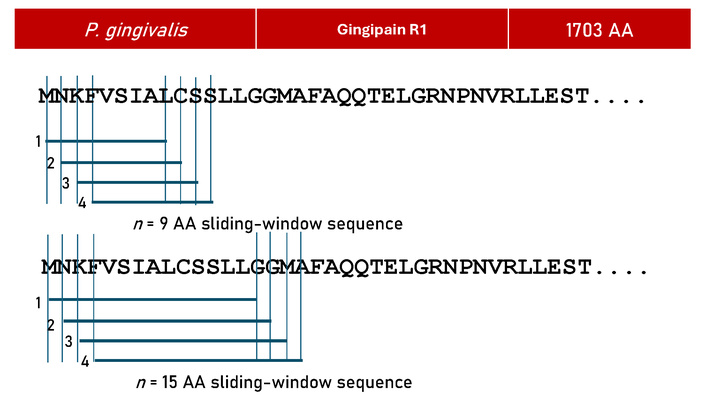
Schematic diagram illustrating the 9- and 15-mer sliding window approach for testing all linear 9- and 15-mer peptides of the Gingipain R1 (RgpB) protein of P. gingivalis exhaustively. The full amino acid (AA) sequence of this protein is given in Table S1. The same approach was used for all 13 P. gingivalis proteins (Table 1).
Standard statistical methods (e.g., Pearson and Spearman correlations) were used to analyze the data using the IBM-SPSS statistical package (version 31). All P-values reported are 2-sided, and statistical significance was set at P < 0.05.
The number of hits per HLA and protein is shown in Table 2. It can be seen that 249 of the 334 alleles tested (74.6%) showed at least one hit, whereas the remaining 85/334 (25.4%) alleles (Table 3) showed no hit for any protein. Figure 2 shows the normalized (Z-score) variation of hits across proteins and alleles.
Number of hits (cases with predicted IC50 < 50 nM) per human leukocyte antigen (HLA) allele and P. gingivalis protein.
| Number | Allele | FimB | Mfa2 | Mfa4 | FimA | Mfa1 | FimC | Mfa3 | RgpA | FimE | FimD | RgpB | Mfa5 | Kgp | Hits |
|---|---|---|---|---|---|---|---|---|---|---|---|---|---|---|---|
| 1 | A*01:01 | 1 | 1 | 0 | 1 | 0 | 0 | 1 | 0 | 2 | 1 | 2 | 0 | 1 | 10 |
| 2 | A*02:01 | 5 | 2 | 4 | 2 | 4 | 5 | 1 | 5 | 8 | 5 | 14 | 8 | 20 | 83 |
| 3 | A*02:02 | 7 | 4 | 5 | 6 | 5 | 9 | 7 | 9 | 15 | 7 | 21 | 18 | 23 | 136 |
| 4 | A*02:05 | 3 | 1 | 5 | 4 | 4 | 7 | 5 | 9 | 9 | 6 | 18 | 7 | 18 | 96 |
| 5 | A*02:06 | 5 | 3 | 4 | 6 | 4 | 7 | 5 | 9 | 13 | 7 | 23 | 11 | 26 | 123 |
| 6 | A*02:17 | 0 | 0 | 2 | 0 | 1 | 1 | 0 | 0 | 2 | 0 | 0 | 0 | 0 | 6 |
| 7 | A*02:30 | 5 | 2 | 4 | 2 | 4 | 5 | 1 | 5 | 8 | 5 | 14 | 8 | 20 | 83 |
| 8 | A*02:35 | 4 | 3 | 3 | 2 | 3 | 4 | 1 | 4 | 7 | 3 | 10 | 6 | 17 | 67 |
| 9 | A*02:63 | 7 | 4 | 5 | 6 | 5 | 9 | 7 | 9 | 15 | 7 | 21 | 18 | 23 | 136 |
| 10 | A*02:77 | 5 | 2 | 4 | 2 | 4 | 5 | 1 | 5 | 8 | 5 | 14 | 8 | 20 | 83 |
| 11 | A*03:01 | 0 | 2 | 1 | 2 | 1 | 1 | 0 | 2 | 0 | 2 | 3 | 2 | 5 | 21 |
| 12 | A*03:02 | 0 | 2 | 2 | 2 | 2 | 2 | 0 | 2 | 0 | 1 | 4 | 4 | 5 | 26 |
| 13 | A*03:81 | 0 | 2 | 1 | 2 | 1 | 1 | 0 | 2 | 0 | 2 | 3 | 2 | 5 | 21 |
| 14 | A*11:01 | 0 | 2 | 4 | 3 | 3 | 2 | 4 | 3 | 4 | 7 | 7 | 8 | 10 | 57 |
| 15 | A*11:02 | 0 | 2 | 4 | 3 | 3 | 2 | 4 | 3 | 4 | 7 | 7 | 8 | 10 | 57 |
| 16 | A*23:01 | 1 | 0 | 2 | 2 | 2 | 0 | 3 | 1 | 0 | 3 | 2 | 3 | 6 | 25 |
| 17 | A*24:02 | 1 | 0 | 2 | 2 | 1 | 0 | 4 | 0 | 0 | 2 | 2 | 3 | 6 | 23 |
| 18 | A*24:03 | 4 | 3 | 3 | 3 | 4 | 1 | 6 | 4 | 4 | 5 | 8 | 9 | 13 | 67 |
| 19 | A*25:01 | 0 | 0 | 0 | 0 | 0 | 0 | 0 | 1 | 0 | 0 | 1 | 0 | 0 | 2 |
| 20 | A*26:01 | 1 | 0 | 0 | 0 | 0 | 0 | 1 | 1 | 0 | 2 | 2 | 1 | 1 | 9 |
| 21 | A*26:08 | 1 | 0 | 0 | 0 | 0 | 0 | 0 | 1 | 0 | 0 | 1 | 1 | 1 | 5 |
| 22 | A*26:12 | 1 | 0 | 0 | 0 | 0 | 0 | 0 | 1 | 0 | 2 | 1 | 2 | 0 | 7 |
| 23 | A*29:01 | 2 | 0 | 1 | 2 | 2 | 1 | 2 | 5 | 4 | 7 | 12 | 3 | 12 | 53 |
| 24 | A*29:02 | 2 | 0 | 1 | 2 | 2 | 1 | 2 | 5 | 4 | 7 | 12 | 3 | 12 | 53 |
| 25 | A*30:01 | 0 | 2 | 3 | 6 | 8 | 9 | 1 | 1 | 4 | 8 | 5 | 8 | 12 | 67 |
| 26 | A*30:02 | 0 | 1 | 2 | 3 | 0 | 2 | 2 | 0 | 1 | 3 | 4 | 3 | 9 | 30 |
| 27 | A*31:01 | 1 | 0 | 5 | 1 | 2 | 3 | 2 | 6 | 2 | 3 | 7 | 5 | 9 | 46 |
| 28 | A*32:01 | 2 | 2 | 1 | 1 | 1 | 3 | 0 | 2 | 3 | 2 | 2 | 2 | 3 | 24 |
| 29 | A*33:01 | 0 | 1 | 0 | 0 | 0 | 0 | 5 | 4 | 0 | 2 | 3 | 0 | 3 | 18 |
| 30 | A*33:03 | 1 | 1 | 1 | 1 | 2 | 1 | 4 | 6 | 1 | 3 | 5 | 2 | 5 | 33 |
| 31 | A*34:01 | 1 | 0 | 0 | 0 | 0 | 0 | 0 | 0 | 0 | 1 | 1 | 1 | 0 | 4 |
| 32 | A*34:02 | 0 | 1 | 1 | 1 | 1 | 1 | 2 | 2 | 1 | 5 | 2 | 2 | 2 | 21 |
| 33 | A*36:01 | 0 | 0 | 0 | 0 | 0 | 0 | 0 | 0 | 0 | 0 | 1 | 0 | 0 | 1 |
| 34 | A*68:01 | 4 | 4 | 3 | 3 | 7 | 4 | 5 | 8 | 5 | 10 | 10 | 13 | 13 | 89 |
| 35 | A*68:02 | 3 | 4 | 3 | 5 | 8 | 6 | 4 | 10 | 5 | 8 | 15 | 11 | 15 | 97 |
| 36 | A*68:37 | 4 | 4 | 3 | 3 | 7 | 4 | 5 | 8 | 5 | 10 | 10 | 13 | 13 | 89 |
| 37 | A*74:01 | 0 | 0 | 0 | 0 | 0 | 0 | 0 | 0 | 0 | 0 | 1 | 0 | 1 | 2 |
| 38 | A*74:03 | 0 | 0 | 0 | 0 | 0 | 0 | 0 | 0 | 0 | 0 | 1 | 0 | 1 | 2 |
| 39 | A*80:01 | 0 | 0 | 1 | 0 | 0 | 1 | 0 | 1 | 1 | 1 | 2 | 1 | 2 | 10 |
| 40 | B*07:02 | 2 | 0 | 3 | 0 | 0 | 1 | 0 | 3 | 1 | 2 | 4 | 5 | 5 | 26 |
| 41 | B*07:04 | 1 | 0 | 0 | 0 | 0 | 1 | 0 | 0 | 1 | 1 | 0 | 1 | 2 | 7 |
| 42 | B*07:05 | 2 | 0 | 3 | 1 | 1 | 2 | 0 | 5 | 2 | 2 | 10 | 8 | 11 | 47 |
| 43 | B*08:01 | 0 | 1 | 0 | 1 | 0 | 0 | 1 | 0 | 0 | 0 | 0 | 3 | 2 | 8 |
| 44 | B*14:01 | 0 | 0 | 0 | 0 | 0 | 0 | 0 | 0 | 0 | 0 | 0 | 0 | 1 | 1 |
| 45 | B*14:02 | 0 | 0 | 0 | 0 | 0 | 0 | 0 | 0 | 0 | 0 | 0 | 0 | 1 | 1 |
| 46 | B*15:01 | 2 | 1 | 1 | 1 | 2 | 3 | 2 | 4 | 1 | 2 | 5 | 6 | 11 | 41 |
| 47 | B*15:03 | 6 | 6 | 6 | 9 | 7 | 11 | 8 | 18 | 10 | 15 | 31 | 26 | 45 | 198 |
| 48 | B*15:07 | 0 | 0 | 0 | 0 | 1 | 1 | 0 | 1 | 0 | 0 | 1 | 0 | 2 | 6 |
| 49 | B*15:16 | 0 | 0 | 0 | 0 | 1 | 1 | 0 | 0 | 0 | 0 | 0 | 0 | 0 | 2 |
| 50 | B*15:17 | 2 | 6 | 8 | 9 | 6 | 9 | 9 | 13 | 6 | 14 | 27 | 14 | 30 | 153 |
| 51 | B*15:35 | 0 | 0 | 0 | 0 | 0 | 1 | 0 | 0 | 0 | 0 | 0 | 2 | 2 | 5 |
| 52 | B*18:01 | 0 | 0 | 0 | 0 | 0 | 1 | 0 | 0 | 1 | 1 | 4 | 1 | 6 | 14 |
| 53 | B*27:05 | 0 | 2 | 0 | 1 | 0 | 1 | 1 | 1 | 1 | 0 | 1 | 2 | 0 | 10 |
| 54 | B*27:07 | 2 | 1 | 2 | 1 | 1 | 2 | 3 | 3 | 2 | 3 | 4 | 4 | 4 | 32 |
| 55 | B*27:08 | 0 | 0 | 0 | 0 | 0 | 1 | 0 | 0 | 0 | 0 | 0 | 0 | 0 | 1 |
| 56 | B*35:01 | 3 | 1 | 4 | 3 | 3 | 3 | 5 | 7 | 5 | 5 | 13 | 8 | 13 | 73 |
| 57 | B*35:02 | 2 | 0 | 1 | 1 | 1 | 1 | 0 | 1 | 1 | 0 | 5 | 4 | 5 | 22 |
| 58 | B*35:03 | 1 | 0 | 0 | 0 | 1 | 0 | 0 | 0 | 1 | 0 | 1 | 3 | 1 | 8 |
| 59 | B*35:08 | 1 | 0 | 0 | 0 | 1 | 0 | 2 | 1 | 2 | 0 | 5 | 4 | 5 | 21 |
| 60 | B*35:17 | 2 | 0 | 1 | 0 | 1 | 0 | 1 | 2 | 2 | 2 | 8 | 4 | 7 | 30 |
| 61 | B*37:01 | 0 | 0 | 0 | 0 | 0 | 0 | 1 | 0 | 0 | 0 | 0 | 0 | 0 | 1 |
| 62 | B*39:01 | 1 | 0 | 1 | 0 | 1 | 2 | 0 | 0 | 1 | 0 | 0 | 2 | 0 | 8 |
| 63 | B*39:02 | 0 | 2 | 0 | 0 | 2 | 1 | 1 | 1 | 2 | 2 | 1 | 3 | 1 | 16 |
| 64 | B*39:05 | 0 | 0 | 0 | 0 | 0 | 0 | 0 | 0 | 1 | 0 | 0 | 0 | 0 | 1 |
| 65 | B*39:06 | 0 | 0 | 0 | 1 | 0 | 1 | 0 | 0 | 0 | 1 | 1 | 1 | 0 | 5 |
| 66 | B*39:24 | 0 | 0 | 1 | 0 | 1 | 2 | 0 | 0 | 1 | 0 | 0 | 1 | 1 | 7 |
| 67 | B*40:01 | 1 | 2 | 0 | 1 | 4 | 2 | 1 | 1 | 4 | 3 | 2 | 1 | 1 | 23 |
| 68 | B*40:02 | 0 | 3 | 1 | 1 | 2 | 2 | 0 | 3 | 3 | 4 | 1 | 2 | 1 | 23 |
| 69 | B*41:01 | 1 | 2 | 2 | 3 | 1 | 2 | 1 | 3 | 2 | 2 | 6 | 1 | 4 | 30 |
| 70 | B*41:02 | 0 | 3 | 1 | 1 | 2 | 2 | 2 | 4 | 4 | 3 | 1 | 2 | 1 | 26 |
| 71 | B*42:02 | 1 | 0 | 0 | 0 | 0 | 0 | 0 | 0 | 1 | 1 | 1 | 0 | 1 | 5 |
| 72 | B*44:02 | 0 | 1 | 1 | 0 | 0 | 0 | 1 | 0 | 2 | 0 | 1 | 2 | 1 | 9 |
| 73 | B*44:03 | 0 | 1 | 1 | 0 | 0 | 0 | 1 | 1 | 2 | 0 | 1 | 2 | 1 | 10 |
| 74 | B*44:04 | 0 | 0 | 0 | 0 | 0 | 0 | 0 | 0 | 0 | 0 | 0 | 1 | 0 | 1 |
| 75 | B*44:07 | 0 | 1 | 1 | 0 | 0 | 0 | 1 | 1 | 2 | 0 | 1 | 2 | 1 | 10 |
| 76 | B*44:27 | 0 | 1 | 1 | 0 | 0 | 0 | 1 | 0 | 2 | 0 | 1 | 2 | 1 | 9 |
| 77 | B*45:01 | 0 | 0 | 0 | 2 | 1 | 0 | 0 | 1 | 2 | 0 | 2 | 1 | 2 | 11 |
| 78 | B*47:01 | 0 | 0 | 0 | 0 | 0 | 0 | 0 | 0 | 0 | 0 | 0 | 0 | 1 | 1 |
| 79 | B*48:01 | 0 | 0 | 0 | 0 | 0 | 0 | 0 | 0 | 0 | 0 | 0 | 1 | 0 | 1 |
| 80 | B*49:01 | 0 | 0 | 0 | 0 | 0 | 1 | 0 | 0 | 0 | 0 | 0 | 0 | 0 | 1 |
| 81 | B*50:01 | 0 | 0 | 1 | 0 | 1 | 0 | 0 | 2 | 1 | 1 | 1 | 0 | 1 | 8 |
| 82 | B*50:02 | 0 | 0 | 0 | 1 | 0 | 0 | 0 | 1 | 0 | 0 | 1 | 0 | 1 | 4 |
| 83 | B*53:01 | 0 | 0 | 0 | 0 | 0 | 0 | 0 | 1 | 2 | 0 | 4 | 4 | 2 | 13 |
| 84 | B*54:01 | 1 | 0 | 1 | 1 | 0 | 2 | 3 | 4 | 0 | 0 | 6 | 4 | 9 | 31 |
| 85 | B*55:01 | 0 | 0 | 0 | 0 | 0 | 0 | 1 | 1 | 0 | 0 | 1 | 0 | 1 | 4 |
| 86 | B*56:01 | 0 | 0 | 0 | 0 | 0 | 0 | 1 | 1 | 0 | 0 | 3 | 1 | 5 | 11 |
| 87 | B*57:01 | 0 | 0 | 0 | 1 | 1 | 0 | 0 | 1 | 3 | 0 | 2 | 3 | 0 | 11 |
| 88 | B*57:02 | 0 | 0 | 0 | 1 | 0 | 2 | 0 | 1 | 1 | 0 | 1 | 1 | 0 | 7 |
| 89 | B*57:03 | 0 | 0 | 0 | 2 | 1 | 2 | 0 | 3 | 2 | 0 | 5 | 1 | 1 | 17 |
| 90 | B*58:01 | 1 | 0 | 1 | 2 | 4 | 3 | 0 | 2 | 3 | 2 | 7 | 3 | 8 | 36 |
| 91 | B*81:01 | 1 | 0 | 0 | 0 | 0 | 0 | 0 | 0 | 0 | 0 | 0 | 1 | 1 | 3 |
| 92 | C*01:02 | 0 | 0 | 0 | 2 | 0 | 0 | 1 | 3 | 0 | 0 | 5 | 1 | 1 | 13 |
| 93 | C*02:02 | 1 | 1 | 1 | 1 | 0 | 0 | 0 | 0 | 0 | 0 | 1 | 1 | 1 | 7 |
| 94 | C*02:10 | 1 | 1 | 1 | 1 | 0 | 0 | 0 | 0 | 0 | 0 | 1 | 1 | 1 | 7 |
| 95 | C*03:02 | 1 | 7 | 3 | 7 | 7 | 8 | 4 | 7 | 3 | 7 | 16 | 12 | 20 | 102 |
| 96 | C*03:03 | 2 | 4 | 3 | 4 | 4 | 4 | 2 | 6 | 2 | 6 | 18 | 11 | 16 | 82 |
| 97 | C*03:04 | 2 | 4 | 3 | 4 | 4 | 4 | 2 | 6 | 2 | 6 | 18 | 11 | 16 | 82 |
| 98 | C*05:01 | 1 | 1 | 1 | 0 | 0 | 0 | 1 | 1 | 1 | 0 | 3 | 2 | 4 | 15 |
| 99 | C*06:02 | 0 | 0 | 0 | 0 | 0 | 0 | 0 | 1 | 0 | 1 | 1 | 2 | 0 | 5 |
| 100 | C*07:01 | 0 | 0 | 0 | 0 | 0 | 0 | 0 | 0 | 0 | 0 | 1 | 0 | 0 | 1 |
| 101 | C*07:02 | 0 | 0 | 0 | 0 | 1 | 0 | 0 | 0 | 0 | 1 | 0 | 0 | 1 | 3 |
| 102 | C*08:01 | 0 | 1 | 1 | 0 | 0 | 0 | 0 | 1 | 0 | 0 | 0 | 1 | 0 | 4 |
| 103 | C*08:02 | 0 | 1 | 1 | 0 | 0 | 0 | 1 | 1 | 1 | 0 | 0 | 1 | 0 | 6 |
| 104 | C*08:03 | 0 | 1 | 1 | 0 | 0 | 0 | 0 | 1 | 0 | 0 | 0 | 1 | 0 | 4 |
| 105 | C*12:02 | 1 | 2 | 2 | 2 | 1 | 1 | 1 | 1 | 0 | 1 | 5 | 4 | 6 | 27 |
| 106 | C*12:03 | 1 | 6 | 3 | 4 | 4 | 6 | 2 | 5 | 2 | 6 | 13 | 9 | 17 | 78 |
| 107 | C*14:02 | 2 | 4 | 3 | 5 | 7 | 6 | 8 | 4 | 7 | 6 | 13 | 13 | 24 | 102 |
| 108 | C*15:02 | 1 | 2 | 1 | 0 | 1 | 0 | 1 | 0 | 1 | 3 | 4 | 4 | 4 | 22 |
| 109 | C*15:04 | 1 | 3 | 1 | 1 | 2 | 2 | 2 | 1 | 1 | 2 | 5 | 4 | 6 | 31 |
| 110 | C*15:05 | 0 | 0 | 0 | 0 | 0 | 0 | 0 | 0 | 0 | 0 | 0 | 1 | 0 | 1 |
| 111 | C*15:06 | 0 | 4 | 1 | 0 | 1 | 0 | 0 | 0 | 0 | 1 | 3 | 4 | 4 | 18 |
| 112 | C*15:09 | 1 | 3 | 1 | 1 | 2 | 2 | 2 | 1 | 1 | 2 | 5 | 4 | 6 | 31 |
| 113 | C*16:01 | 2 | 9 | 4 | 9 | 4 | 7 | 4 | 10 | 3 | 9 | 21 | 11 | 25 | 118 |
| 114 | C*16:02 | 0 | 4 | 1 | 2 | 1 | 2 | 0 | 1 | 1 | 1 | 5 | 6 | 8 | 32 |
| 115 | C*16:04 | 1 | 7 | 1 | 3 | 2 | 2 | 1 | 4 | 1 | 4 | 7 | 8 | 10 | 51 |
| 116 | C*17:01 | 0 | 2 | 1 | 1 | 0 | 1 | 0 | 1 | 0 | 1 | 3 | 1 | 3 | 14 |
| 117 | DPB1*01:01 | 0 | 0 | 6 | 0 | 0 | 0 | 0 | 0 | 0 | 0 | 6 | 0 | 6 | 18 |
| 118 | DPB1*02:01 | 0 | 1 | 16 | 1 | 0 | 0 | 0 | 6 | 9 | 3 | 18 | 6 | 25 | 85 |
| 119 | DPB1*02:02 | 0 | 1 | 18 | 1 | 1 | 0 | 0 | 6 | 9 | 6 | 19 | 6 | 26 | 93 |
| 120 | DPB1*03:01 | 0 | 5 | 5 | 2 | 4 | 0 | 6 | 3 | 0 | 1 | 1 | 0 | 0 | 27 |
| 121 | DPB1*04:01 | 0 | 0 | 16 | 0 | 0 | 0 | 0 | 6 | 5 | 2 | 14 | 6 | 18 | 67 |
| 122 | DPB1*06:01 | 0 | 0 | 0 | 0 | 0 | 0 | 3 | 0 | 0 | 0 | 0 | 0 | 0 | 3 |
| 123 | DPB1*104:01 | 0 | 5 | 5 | 2 | 4 | 0 | 6 | 3 | 0 | 1 | 1 | 0 | 0 | 27 |
| 124 | DPB1*124:01 | 0 | 5 | 5 | 2 | 4 | 0 | 6 | 3 | 0 | 1 | 1 | 0 | 0 | 27 |
| 125 | DPB1*126:01 | 0 | 0 | 16 | 0 | 0 | 0 | 0 | 6 | 5 | 2 | 14 | 6 | 18 | 67 |
| 126 | DPB1*14:01 | 0 | 4 | 1 | 0 | 3 | 0 | 5 | 0 | 0 | 0 | 0 | 0 | 0 | 13 |
| 127 | DPB1*15:01 | 0 | 0 | 10 | 0 | 0 | 0 | 0 | 0 | 5 | 1 | 6 | 0 | 11 | 33 |
| 128 | DPB1*16:01 | 0 | 0 | 3 | 0 | 0 | 0 | 0 | 0 | 4 | 0 | 1 | 0 | 1 | 9 |
| 129 | DPB1*20:01 | 0 | 5 | 2 | 0 | 0 | 0 | 4 | 0 | 0 | 0 | 0 | 0 | 0 | 11 |
| 130 | DPB1*23:01 | 0 | 0 | 16 | 0 | 0 | 0 | 0 | 6 | 5 | 2 | 14 | 6 | 18 | 67 |
| 131 | DPB1*33:01 | 2 | 8 | 36 | 6 | 8 | 5 | 8 | 28 | 28 | 22 | 42 | 18 | 66 | 277 |
| 132 | DPB1*34:01 | 0 | 0 | 3 | 0 | 0 | 0 | 0 | 0 | 2 | 0 | 6 | 1 | 11 | 23 |
| 133 | DPB1*35:01 | 0 | 2 | 0 | 0 | 0 | 0 | 0 | 0 | 0 | 0 | 0 | 0 | 0 | 2 |
| 134 | DPB1*39:01 | 0 | 0 | 16 | 0 | 0 | 0 | 0 | 6 | 5 | 2 | 14 | 6 | 18 | 67 |
| 135 | DPB1*40:01 | 0 | 0 | 1 | 0 | 0 | 0 | 0 | 0 | 0 | 0 | 6 | 0 | 10 | 17 |
| 136 | DPB1*41:01 | 0 | 0 | 1 | 0 | 0 | 0 | 0 | 0 | 6 | 0 | 1 | 3 | 1 | 12 |
| 137 | DPB1*46:01 | 0 | 1 | 16 | 1 | 0 | 0 | 0 | 6 | 9 | 3 | 18 | 6 | 25 | 85 |
| 138 | DPB1*47:01 | 0 | 1 | 18 | 1 | 1 | 0 | 0 | 6 | 9 | 6 | 19 | 6 | 26 | 93 |
| 139 | DPB1*71:01 | 2 | 8 | 36 | 6 | 8 | 5 | 8 | 28 | 28 | 22 | 42 | 18 | 66 | 277 |
| 140 | DPB1*72:01 | 0 | 0 | 16 | 0 | 0 | 0 | 1 | 8 | 6 | 7 | 19 | 6 | 24 | 87 |
| 141 | DPB1*81:01 | 0 | 1 | 16 | 1 | 0 | 0 | 0 | 6 | 9 | 3 | 18 | 6 | 25 | 85 |
| 142 | DPB1*91:01 | 0 | 5 | 2 | 0 | 0 | 0 | 4 | 0 | 0 | 0 | 0 | 0 | 0 | 11 |
| 143 | DRB1*01:01 | 46 | 33 | 26 | 56 | 62 | 67 | 45 | 71 | 80 | 66 | 150 | 124 | 205 | 1,031 |
| 144 | DRB1*01:02 | 7 | 11 | 0 | 12 | 3 | 14 | 10 | 33 | 4 | 19 | 19 | 32 | 48 | 212 |
| 145 | DRB1*01:03 | 1 | 4 | 0 | 4 | 0 | 0 | 0 | 0 | 0 | 0 | 0 | 0 | 3 | 12 |
| 146 | DRB1*01:11 | 21 | 11 | 6 | 16 | 9 | 26 | 14 | 27 | 14 | 23 | 24 | 39 | 79 | 309 |
| 147 | DRB1*01:18 | 48 | 36 | 32 | 67 | 75 | 81 | 54 | 96 | 96 | 86 | 162 | 141 | 214 | 1,188 |
| 148 | DRB1*01:20 | 39 | 28 | 20 | 65 | 64 | 60 | 51 | 83 | 73 | 66 | 105 | 113 | 137 | 904 |
| 149 | DRB1*01:24 | 24 | 13 | 9 | 19 | 14 | 29 | 20 | 33 | 15 | 28 | 39 | 51 | 97 | 391 |
| 150 | DRB1*01:29 | 24 | 14 | 8 | 22 | 21 | 34 | 21 | 40 | 25 | 27 | 53 | 62 | 110 | 461 |
| 151 | DRB1*03:01 | 13 | 0 | 0 | 0 | 0 | 9 | 2 | 16 | 5 | 9 | 24 | 10 | 22 | 110 |
| 152 | DRB1*03:04 | 13 | 0 | 0 | 0 | 0 | 9 | 2 | 16 | 5 | 9 | 24 | 10 | 22 | 110 |
| 153 | DRB1*03:05 | 2 | 1 | 0 | 0 | 0 | 0 | 0 | 0 | 1 | 0 | 0 | 0 | 0 | 4 |
| 154 | DRB1*03:11 | 17 | 6 | 9 | 2 | 7 | 36 | 11 | 24 | 11 | 22 | 31 | 28 | 27 | 231 |
| 155 | DRB1*03:13 | 13 | 0 | 0 | 0 | 0 | 9 | 2 | 16 | 5 | 9 | 24 | 10 | 22 | 110 |
| 156 | DRB1*03:15 | 5 | 0 | 0 | 0 | 1 | 0 | 0 | 8 | 4 | 8 | 11 | 8 | 14 | 59 |
| 157 | DRB1*04:01 | 7 | 6 | 16 | 15 | 7 | 11 | 17 | 3 | 28 | 8 | 8 | 17 | 17 | 160 |
| 158 | DRB1*04:02 | 0 | 2 | 0 | 4 | 0 | 0 | 0 | 0 | 0 | 0 | 0 | 5 | 0 | 11 |
| 159 | DRB1*04:03 | 0 | 0 | 0 | 0 | 0 | 0 | 0 | 0 | 0 | 0 | 0 | 2 | 0 | 2 |
| 160 | DRB1*04:04 | 1 | 13 | 8 | 14 | 11 | 13 | 20 | 10 | 12 | 7 | 13 | 28 | 20 | 170 |
| 161 | DRB1*04:05 | 3 | 4 | 1 | 3 | 6 | 6 | 19 | 6 | 17 | 2 | 13 | 6 | 19 | 105 |
| 162 | DRB1*04:06 | 0 | 0 | 0 | 0 | 0 | 0 | 0 | 0 | 0 | 0 | 0 | 2 | 0 | 2 |
| 163 | DRB1*04:07 | 0 | 0 | 0 | 0 | 0 | 0 | 1 | 0 | 4 | 0 | 0 | 0 | 0 | 5 |
| 164 | DRB1*04:08 | 4 | 8 | 13 | 14 | 9 | 6 | 16 | 3 | 18 | 8 | 6 | 19 | 16 | 140 |
| 165 | DRB1*04:10 | 1 | 8 | 2 | 1 | 0 | 4 | 13 | 1 | 0 | 0 | 5 | 8 | 3 | 46 |
| 166 | DRB1*04:44 | 0 | 8 | 4 | 4 | 0 | 0 | 7 | 1 | 0 | 2 | 1 | 9 | 2 | 38 |
| 167 | DRB1*04:53 | 0 | 3 | 0 | 0 | 0 | 0 | 0 | 0 | 0 | 0 | 0 | 4 | 0 | 7 |
| 168 | DRB1*04:56 | 0 | 7 | 4 | 4 | 0 | 0 | 9 | 0 | 0 | 0 | 1 | 14 | 2 | 41 |
| 169 | DRB1*04:72 | 2 | 0 | 5 | 0 | 0 | 9 | 14 | 0 | 16 | 3 | 4 | 12 | 8 | 73 |
| 170 | DRB1*07:01 | 24 | 10 | 8 | 6 | 27 | 29 | 8 | 27 | 34 | 16 | 36 | 48 | 70 | 343 |
| 171 | DRB1*08:01 | 6 | 0 | 0 | 0 | 0 | 0 | 7 | 0 | 0 | 0 | 0 | 0 | 0 | 13 |
| 172 | DRB1*08:02 | 0 | 3 | 0 | 2 | 0 | 0 | 4 | 0 | 1 | 0 | 0 | 4 | 2 | 16 |
| 173 | DRB1*08:03 | 0 | 3 | 0 | 0 | 0 | 0 | 3 | 0 | 0 | 0 | 0 | 0 | 0 | 6 |
| 174 | DRB1*08:04 | 0 | 6 | 2 | 9 | 5 | 7 | 11 | 8 | 11 | 22 | 4 | 20 | 8 | 113 |
| 175 | DRB1*08:24 | 0 | 1 | 0 | 2 | 0 | 0 | 3 | 0 | 4 | 6 | 8 | 3 | 5 | 32 |
| 176 | DRB1*08:30 | 0 | 4 | 0 | 0 | 0 | 0 | 3 | 0 | 0 | 2 | 0 | 2 | 4 | 15 |
| 177 | DRB1*08:36 | 0 | 3 | 0 | 0 | 0 | 0 | 3 | 0 | 0 | 0 | 0 | 0 | 0 | 6 |
| 178 | DRB1*09:01 | 11 | 9 | 2 | 2 | 12 | 15 | 10 | 17 | 18 | 5 | 26 | 21 | 49 | 197 |
| 179 | DRB1*09:02 | 0 | 0 | 0 | 0 | 0 | 0 | 0 | 0 | 1 | 0 | 0 | 4 | 2 | 7 |
| 180 | DRB1*10:01 | 25 | 21 | 25 | 45 | 44 | 37 | 40 | 48 | 50 | 60 | 85 | 84 | 152 | 716 |
| 181 | DRB1*11:01 | 7 | 7 | 0 | 12 | 13 | 0 | 23 | 6 | 15 | 12 | 21 | 33 | 29 | 178 |
| 182 | DRB1*11:02 | 0 | 5 | 5 | 20 | 18 | 35 | 17 | 13 | 26 | 37 | 8 | 24 | 15 | 223 |
| 183 | DRB1*11:03 | 1 | 3 | 0 | 15 | 15 | 26 | 20 | 14 | 29 | 34 | 15 | 33 | 15 | 220 |
| 184 | DRB1*11:04 | 10 | 8 | 8 | 18 | 12 | 24 | 23 | 15 | 27 | 37 | 28 | 49 | 20 | 279 |
| 185 | DRB1*11:06 | 0 | 3 | 0 | 3 | 0 | 0 | 0 | 0 | 0 | 3 | 0 | 1 | 0 | 10 |
| 186 | DRB1*11:07 | 0 | 0 | 0 | 0 | 0 | 0 | 0 | 2 | 0 | 0 | 4 | 6 | 5 | 17 |
| 187 | DRB1*11:08 | 3 | 4 | 3 | 4 | 8 | 2 | 18 | 2 | 14 | 13 | 8 | 17 | 11 | 107 |
| 188 | DRB1*11:10 | 7 | 7 | 0 | 12 | 13 | 0 | 23 | 6 | 15 | 12 | 21 | 33 | 29 | 178 |
| 189 | DRB1*11:11 | 0 | 0 | 0 | 4 | 4 | 0 | 5 | 1 | 6 | 7 | 5 | 7 | 6 | 45 |
| 190 | DRB1*11:12 | 7 | 7 | 0 | 12 | 13 | 0 | 23 | 6 | 15 | 12 | 21 | 33 | 29 | 178 |
| 191 | DRB1*11:13 | 5 | 6 | 16 | 21 | 12 | 34 | 16 | 21 | 26 | 36 | 15 | 29 | 20 | 257 |
| 192 | DRB1*11:14 | 4 | 6 | 16 | 22 | 25 | 25 | 29 | 23 | 26 | 49 | 34 | 45 | 39 | 343 |
| 193 | DRB1*11:19 | 0 | 4 | 0 | 0 | 0 | 0 | 4 | 1 | 0 | 0 | 0 | 2 | 4 | 15 |
| 194 | DRB1*11:27 | 0 | 0 | 0 | 0 | 0 | 0 | 1 | 0 | 2 | 6 | 4 | 1 | 2 | 16 |
| 195 | DRB1*11:28 | 7 | 7 | 0 | 12 | 13 | 0 | 23 | 6 | 15 | 12 | 21 | 33 | 29 | 178 |
| 196 | DRB1*11:29 | 7 | 7 | 0 | 12 | 13 | 0 | 23 | 6 | 15 | 12 | 21 | 33 | 29 | 178 |
| 197 | DRB1*11:37 | 0 | 0 | 0 | 3 | 0 | 0 | 5 | 0 | 6 | 6 | 11 | 11 | 9 | 51 |
| 198 | DRB1*11:42 | 11 | 9 | 18 | 31 | 21 | 48 | 34 | 29 | 36 | 54 | 42 | 57 | 43 | 433 |
| 199 | DRB1*11:46 | 10 | 8 | 8 | 18 | 12 | 24 | 23 | 15 | 27 | 37 | 28 | 49 | 20 | 279 |
| 200 | DRB1*11:49 | 7 | 7 | 0 | 12 | 13 | 0 | 23 | 6 | 15 | 12 | 21 | 33 | 29 | 178 |
| 201 | DRB1*11:54 | 0 | 0 | 0 | 0 | 0 | 0 | 0 | 0 | 0 | 1 | 0 | 0 | 0 | 1 |
| 202 | DRB1*11:58 | 10 | 8 | 8 | 18 | 12 | 24 | 23 | 15 | 27 | 37 | 28 | 49 | 20 | 279 |
| 203 | DRB1*11:62 | 7 | 7 | 0 | 12 | 13 | 0 | 23 | 6 | 15 | 12 | 21 | 33 | 29 | 178 |
| 204 | DRB1*11:65 | 0 | 5 | 5 | 20 | 18 | 35 | 17 | 13 | 26 | 37 | 8 | 24 | 15 | 223 |
| 205 | DRB1*11:74 | 7 | 7 | 0 | 12 | 13 | 0 | 23 | 6 | 15 | 12 | 21 | 33 | 29 | 178 |
| 206 | DRB1*11:84 | 1 | 3 | 0 | 4 | 5 | 0 | 4 | 2 | 8 | 12 | 2 | 5 | 0 | 46 |
| 207 | DRB1*12:01 | 0 | 5 | 3 | 2 | 0 | 3 | 0 | 0 | 0 | 0 | 0 | 0 | 4 | 17 |
| 208 | DRB1*12:02 | 0 | 4 | 4 | 2 | 6 | 3 | 0 | 3 | 3 | 0 | 2 | 0 | 3 | 30 |
| 209 | DRB1*12:03 | 0 | 5 | 6 | 8 | 6 | 11 | 0 | 11 | 4 | 2 | 9 | 0 | 20 | 82 |
| 210 | DRB1*12:16 | 0 | 5 | 0 | 0 | 5 | 1 | 2 | 3 | 5 | 7 | 0 | 0 | 6 | 34 |
| 211 | DRB1*13:01 | 0 | 5 | 5 | 20 | 18 | 35 | 17 | 13 | 26 | 37 | 8 | 24 | 15 | 223 |
| 212 | DRB1*13:02 | 4 | 6 | 16 | 22 | 25 | 25 | 29 | 23 | 26 | 49 | 34 | 45 | 39 | 343 |
| 213 | DRB1*13:03 | 2 | 0 | 0 | 0 | 0 | 0 | 3 | 0 | 0 | 0 | 0 | 0 | 0 | 5 |
| 214 | DRB1*13:05 | 7 | 7 | 0 | 12 | 13 | 0 | 23 | 6 | 15 | 12 | 21 | 33 | 29 | 178 |
| 215 | DRB1*13:07 | 0 | 0 | 0 | 3 | 0 | 0 | 5 | 0 | 6 | 6 | 11 | 11 | 9 | 51 |
| 216 | DRB1*13:11 | 10 | 8 | 8 | 18 | 12 | 24 | 23 | 15 | 27 | 37 | 28 | 49 | 20 | 279 |
| 217 | DRB1*13:12 | 2 | 0 | 0 | 0 | 0 | 0 | 2 | 0 | 0 | 0 | 0 | 0 | 0 | 4 |
| 218 | DRB1*13:14 | 7 | 7 | 0 | 12 | 13 | 0 | 23 | 6 | 15 | 12 | 21 | 33 | 29 | 178 |
| 219 | DRB1*13:21 | 6 | 6 | 0 | 3 | 14 | 3 | 17 | 10 | 15 | 12 | 28 | 18 | 22 | 154 |
| 220 | DRB1*13:23 | 4 | 6 | 16 | 22 | 25 | 25 | 29 | 23 | 26 | 49 | 34 | 45 | 39 | 343 |
| 221 | DRB1*13:26 | 0 | 0 | 0 | 0 | 0 | 0 | 0 | 0 | 2 | 4 | 0 | 0 | 0 | 6 |
| 222 | DRB1*13:33 | 0 | 0 | 0 | 0 | 0 | 0 | 4 | 0 | 0 | 0 | 0 | 0 | 0 | 4 |
| 223 | DRB1*13:50 | 7 | 7 | 0 | 12 | 13 | 0 | 23 | 6 | 15 | 12 | 21 | 33 | 29 | 178 |
| 224 | DRB1*13:61 | 0 | 3 | 0 | 4 | 8 | 12 | 3 | 0 | 5 | 6 | 0 | 1 | 1 | 43 |
| 225 | DRB1*13:66 | 2 | 0 | 0 | 0 | 0 | 0 | 6 | 0 | 0 | 7 | 0 | 0 | 1 | 16 |
| 226 | DRB1*13:96 | 1 | 5 | 13 | 3 | 14 | 19 | 15 | 2 | 18 | 36 | 3 | 9 | 15 | 153 |
| 227 | DRB1*13:97 | 4 | 6 | 16 | 22 | 25 | 25 | 29 | 23 | 26 | 49 | 34 | 45 | 39 | 343 |
| 228 | DRB1*14:01 | 0 | 4 | 10 | 0 | 5 | 10 | 1 | 0 | 0 | 0 | 0 | 0 | 3 | 33 |
| 229 | DRB1*14:02 | 0 | 3 | 1 | 0 | 0 | 1 | 6 | 0 | 4 | 6 | 0 | 3 | 5 | 29 |
| 230 | DRB1*14:03 | 0 | 3 | 0 | 0 | 0 | 0 | 4 | 0 | 0 | 0 | 0 | 0 | 4 | 11 |
| 231 | DRB1*14:04 | 0 | 3 | 5 | 0 | 1 | 8 | 0 | 0 | 0 | 0 | 0 | 0 | 3 | 20 |
| 232 | DRB1*14:06 | 0 | 5 | 1 | 5 | 6 | 14 | 9 | 3 | 10 | 20 | 1 | 10 | 4 | 88 |
| 233 | DRB1*14:07 | 0 | 0 | 0 | 0 | 0 | 0 | 1 | 0 | 0 | 0 | 0 | 0 | 1 | 2 |
| 234 | DRB1*14:12 | 0 | 4 | 0 | 4 | 4 | 2 | 0 | 1 | 4 | 10 | 0 | 3 | 0 | 32 |
| 235 | DRB1*14:32 | 0 | 6 | 13 | 15 | 8 | 25 | 8 | 17 | 27 | 18 | 12 | 9 | 18 | 176 |
| 236 | DRB1*14:38 | 0 | 0 | 4 | 0 | 0 | 0 | 0 | 0 | 0 | 0 | 0 | 0 | 0 | 4 |
| 237 | DRB1*14:54 | 0 | 4 | 10 | 0 | 5 | 10 | 1 | 0 | 0 | 0 | 0 | 0 | 3 | 33 |
| 238 | DRB1*15:01 | 12 | 10 | 0 | 6 | 0 | 4 | 9 | 16 | 14 | 8 | 9 | 15 | 19 | 122 |
| 239 | DRB1*15:02 | 2 | 3 | 0 | 0 | 3 | 1 | 2 | 5 | 10 | 11 | 6 | 1 | 17 | 61 |
| 240 | DRB1*15:03 | 4 | 5 | 0 | 4 | 0 | 2 | 0 | 5 | 7 | 4 | 3 | 8 | 7 | 49 |
| 241 | DRB1*15:06 | 12 | 10 | 0 | 6 | 0 | 4 | 9 | 16 | 14 | 8 | 9 | 15 | 19 | 122 |
| 242 | DRB1*15:07 | 3 | 6 | 0 | 4 | 0 | 1 | 0 | 7 | 6 | 2 | 2 | 9 | 7 | 47 |
| 243 | DRB1*15:15 | 5 | 5 | 0 | 4 | 9 | 4 | 14 | 9 | 6 | 7 | 9 | 11 | 21 | 104 |
| 244 | DRB1*15:37 | 2 | 3 | 0 | 0 | 0 | 0 | 0 | 4 | 4 | 0 | 0 | 4 | 1 | 18 |
| 245 | DRB1*16:01 | 8 | 5 | 0 | 1 | 5 | 6 | 13 | 10 | 7 | 4 | 6 | 7 | 16 | 88 |
| 246 | DRB1*16:02 | 12 | 5 | 2 | 0 | 10 | 11 | 11 | 11 | 16 | 4 | 8 | 12 | 27 | 129 |
| 247 | DRB1*16:04 | 3 | 3 | 0 | 0 | 3 | 0 | 5 | 2 | 4 | 0 | 4 | 3 | 4 | 31 |
| 248 | DRB1*16:05 | 3 | 3 | 0 | 0 | 0 | 0 | 4 | 3 | 4 | 0 | 4 | 3 | 9 | 33 |
| 249 | DRB1*16:09 | 9 | 5 | 0 | 4 | 7 | 4 | 14 | 11 | 8 | 4 | 8 | 4 | 18 | 96 |
| Total hits | - | 725 | 792 | 856 | 1,095 | 1,118 | 1,296 | 1,442 | 1,472 | 1,719 | 1,814 | 2,487 | 2,620 | 3,490 | 20,926 |
List of the 85 human leukocyte antigen (HLA) alleles without hits for any of the 13 P. gingivalis proteins.
| Number | Allele | Number | Allele | Number | Allele |
|---|---|---|---|---|---|
| 1 | A*30:04 | 31 | DPB1*105:01 | 61 | DQB1*05:11 |
| 2 | A*66:01 | 32 | DPB1*11:01 | 62 | DQB1*06:01 |
| 3 | B*13:02 | 33 | DPB1*13:01 | 63 | DQB1*06:02 |
| 4 | B*14:03 | 34 | DPB1*17:01 | 64 | DQB1*06:03 |
| 5 | B*15:09 | 35 | DPB1*19:01 | 65 | DQB1*06:04 |
| 6 | B*15:10 | 36 | DPB1*26:01 | 66 | DQB1*06:07 |
| 7 | B*15:18 | 37 | DPB1*28:01 | 67 | DQB1*06:08 |
| 8 | B*15:24 | 38 | DPB1*30:01 | 68 | DQB1*06:09 |
| 9 | B*18:09 | 39 | DPB1*49:01 | 69 | DQB1*06:11 |
| 10 | B*27:02 | 40 | DPB1*55:01 | 70 | DQB1*06:14 |
| 11 | B*27:04 | 41 | DPB1*85:01 | 71 | DQB1*06:15 |
| 12 | B*27:10 | 42 | DQB1*02:02 | 72 | DQB1*06:18 |
| 13 | B*38:01 | 43 | DQB1*03:01 | 73 | DQB1*06:19 |
| 14 | B*44:05 | 44 | DQB1*03:02 | 74 | DQB1*06:22 |
| 15 | B*48:07 | 45 | DQB1*03:03 | 75 | DQB1*06:27 |
| 16 | B*51:01 | 46 | DQB1*03:04 | 76 | DQB1*06:32 |
| 17 | B*51:02 | 47 | DQB1*03:05 | 77 | DRB1*03:02 |
| 18 | B*51:07 | 48 | DQB1*03:10 | 78 | DRB1*03:41 |
| 19 | B*51:09 | 49 | DQB1*03:14 | 79 | DRB1*04:11 |
| 20 | B*52:01 | 50 | DQB1*03:17 | 80 | DRB1*04:17 |
| 21 | B*58:02 | 51 | DQB1*03:19 | 81 | DRB1*14:05 |
| 22 | B*59:01 | 52 | DQB1*03:23 | 82 | DRB1*14:23 |
| 23 | C*04:01 | 53 | DQB1*03:25 | 83 | DRB1*14:27 |
| 24 | C*07:04 | 54 | DQB1*04:01 | 84 | DRB1*14:44 |
| 25 | C*07:19 | 55 | DQB1*04:02 | 85 | DRB1*14:68 |
| 26 | C*18:01 | 56 | DQB1*04:03 | - | - |
| 27 | DPB1*04:02 | 57 | DQB1*05:01 | - | - |
| 28 | DPB1*05:01 | 58 | DQB1*05:02 | - | - |
| 29 | DPB1*09:01 | 59 | DQB1*05:03 | - | - |
| 30 | DPB1*10:01 | 60 | DQB1*05:06 | - | - |
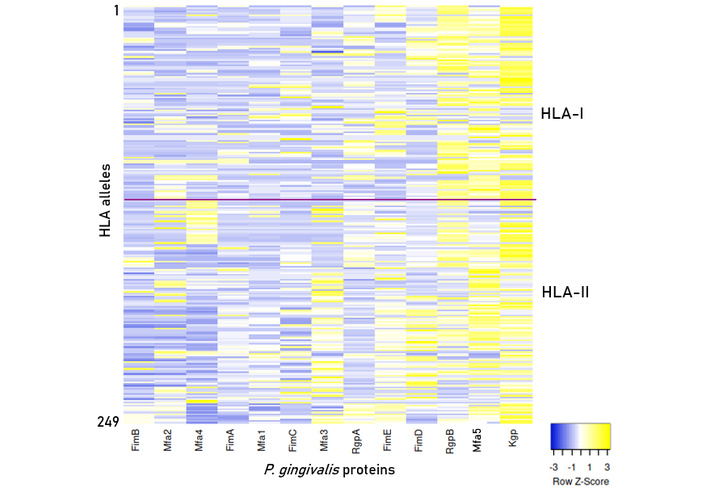
Normalized heatmap to illustrate the data in Table 2. The scale represents Z-scores across rows (protein), from low (blue) to high (yellow). HLA: human leukocyte antigen.
The frequency distribution of hits per protein is shown in Figure 3. It can be seen that number of hits per protein varied substantially, reflecting the higher chance for hits in proteins with longer AA sequences (Table 1). Indeed, there was a high correlation between the number of hits and the number of AAs (Figure 4 Pearson r = 0.931, P < 0.001, N = 13 proteins).
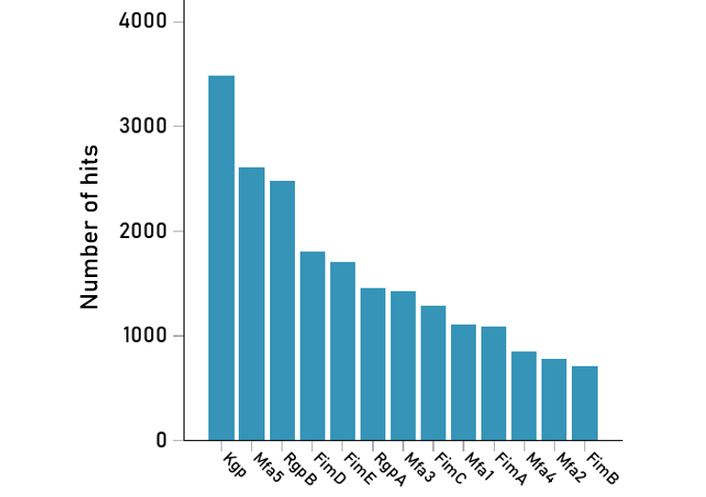
Frequency distribution of hits (predicted best IC50 < 50 nM) for the 13 P. gingivalis proteins tested with 249 human leukocyte antigen (HLA)-I/II alleles that showed at least one hit. Plotted data are from the bottom row (in bold) in Table 2.
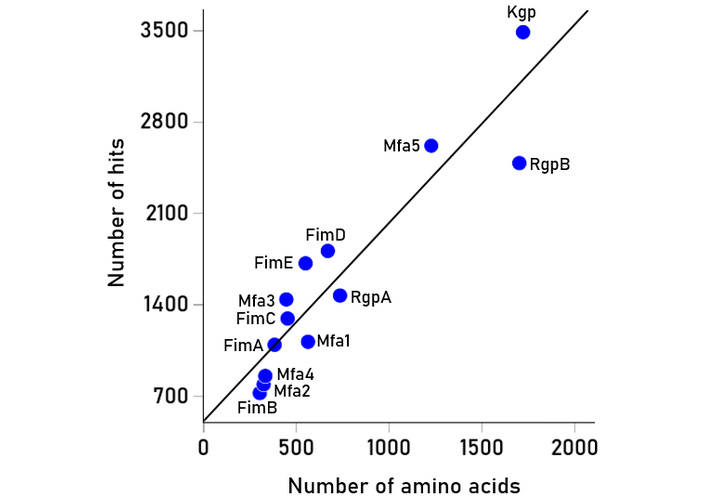
Scatterplot of number of hits vs. length of amino acid sequence of the 13 P. gingivalis proteins to illustrate the linear dependence of the former on the latter.
The 13 columns of hits per allele across the 249 alleles in Table 2 constitute the “immunogenetic profiles” of the 13 P. gingivalis proteins. We computed and evaluated all possible pairwise Pearson correlations (
Pearson correlations between immunogenetic profiles of 13 P. gingivalis proteins (N = 249 alleles).
| Protein | FimB | FimA | FimC | FimD | FimE | Mfa1 | Mfa2 | Mfa3 | Mfa4 | Mfa5 | RgpA | Kgp | RgpB |
|---|---|---|---|---|---|---|---|---|---|---|---|---|---|
| FimB | |||||||||||||
| FimA | 0.788 | ||||||||||||
| FimC | 0.773 | 0.880 | |||||||||||
| FimD | 0.699 | 0.912 | 0.904 | ||||||||||
| FimE | 0.814 | 0.924 | 0.878 | 0.902 | |||||||||
| Mfa1 | 0.818 | 0.944 | 0.866 | 0.888 | 0.933 | ||||||||
| Mfa2 | 0.832 | 0.875 | 0.778 | 0.758 | 0.841 | 0.869 | |||||||
| Mfa3 | 0.728 | 0.893 | 0.757 | 0.864 | 0.869 | 0.882 | 0.816 | ||||||
| Mfa4 | 0.43 | 0.579 | 0.588 | 0.631 | 0.677 | 0.574 | 0.53 | 0.479 | |||||
| Mfa5 | 0.875 | 0.949 | 0.857 | 0.898 | 0.929 | 0.937 | 0.886 | 0.912 | 0.568 | ||||
| RgpA | 0.890 | 0.887 | 0.876 | 0.846 | 0.893 | 0.886 | 0.863 | 0.76 | 0.657 | 0.905 | |||
| Kgp | 0.899 | 0.849 | 0.787 | 0.772 | 0.869 | 0.876 | 0.867 | 0.746 | 0.665 | 0.899 | 0.938 | ||
| RgpB | 0.882 | 0.872 | 0.802 | 0.811 | 0.899 | 0.896 | 0.845 | 0.772 | 0.676 | 0.921 | 0.939 | 0.962 |
All P-values were highly statistically significant, ranging from 1.65 × 10–141 to 1.31 × 10⁻¹². These values Bonferroni-corrected for 78 multiple comparisons, ranged from 1.28 × 10–139 to 1.01 × 10⁻¹⁰.
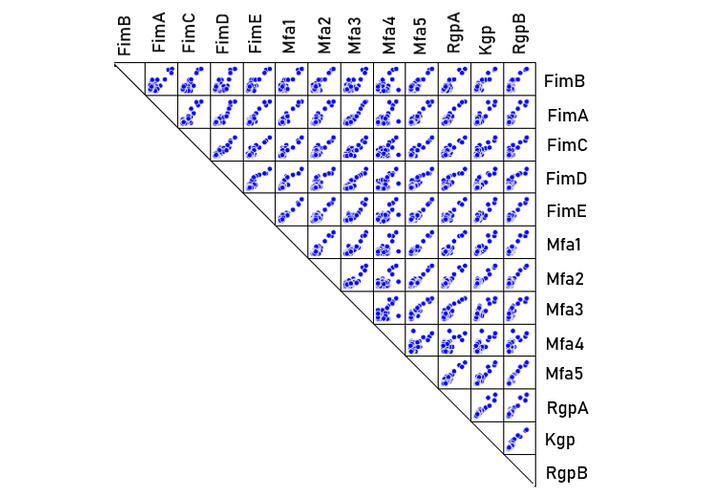
Scatterplots of pairs of immunogenetic profiles between all 78 pairs of P. gingivalis proteins. The correlation for each pair is given in Table 4. See text for details.
The number of hits per HLA Class and gene is given in Table 5. It can be seen that alleles of all HLA-I genes had high percentages of hits (A > C > B), for an overall hit percentage of 81.7%. By contrast, HLA-II alleles had an overall hit percentage of 69.3%, with DRB1 gene leading (92.2%), DPB1 gene following (63.4%), and DQB1 gene totally absent. The frequency distribution of hits per HLA allele is shown in Figure 6. It can be seen that the distribution tends to exponential, with a few alleles having a lot of hits; for example, DRB1*01:18, DRB1*01:01, DRB1*01:20 and DRB1*10:01 have more than 600 hits. Alleles with zero hits were also observed in other genes, with lowest occurrence in gene A of HLA-I (4.9%) and gene DRB1 of HLA-II (7.8%). The promiscuity of HLA-II alleles (candidates for vaccine development) are given in Table S4.
Number of hits per gene and human leukocyte antigen (HLA) class.
| Class | Gene | N alleles tested | N alleles with hits | N alleles without hits |
|---|---|---|---|---|
| HLA-I | A | 41 | 39 (95.1%) | 2 (4.9%) |
| B | 72 | 52 (72.2%) | 20 (27.8%) | |
| C | 29 | 25 (86.2%) | 4 (13.8%) | |
| Total | 142 | 116 (81.7%) | 26 (18.3%) | |
| HLA-II | DPB1 | 41 | 26 (63.4%) | 15 (36.6%) |
| DQB1 | 35 | 0 (0.0%) | 35 (100%) | |
| DRB1 | 116 | 107 (92.2%) | 9 (7.8%) | |
| Total | 192 | 133 (69.3%) | 59 (30.7%) |
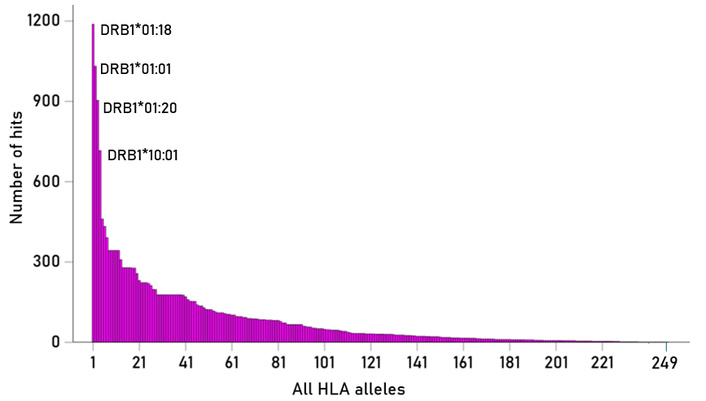
The number of hits for each human leukocyte antigen (HLA)-I/II allele is plotted, ranked from high to low. The 4 alleles names had the highest number of hits.
The 249 rows of hits per protein across the 13 proteins in Table 2 constitute the “protein profiles” of a given allele. We computed and evaluated all possible pairwise Pearson correlations (
We further investigated the association between 15-mer peptides and HLA-II alleles to identify peptides suitable for development of vaccines against P. gingivalis. Indeed, we identified 798 unique 15-mer peptides (Table S5) that bound with predicted high-affinity binding to 133 HLA-II molecules in 6,343 pHLA-II combinations (Table S6) where it can be seen that there were frequently multiple hits for the same protein-allele combinations. It should be noted that 770/798 (96.5%) of these peptides were associated with alleles of the DRB1 gene (Table S5) which, unlike the DPB1 and DQB1 genes, possesses the same alpha chain. The frequency distribution of unique 15-mer, strongly binding peptides is illustrated in Figure 7A, and their association with specific HLA-II alleles is illustrated in Figure 7B.
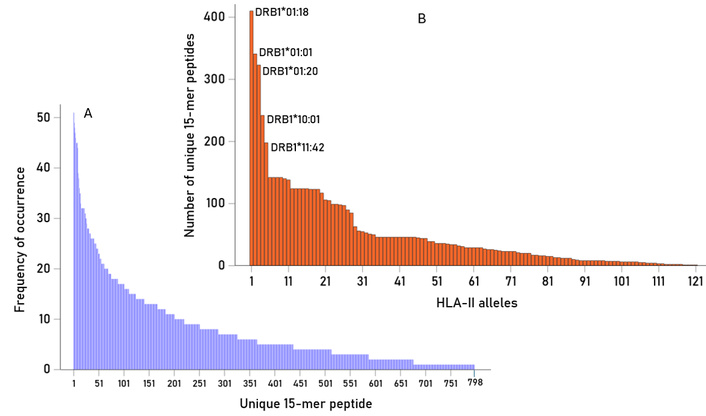
Unique 15-mer peptides. (A) Frequency of occurrence of the 798 unique peptides, ranked from high to low. (B) Number of unique peptides per human leukocyte antigen (HLA)-II allele strongly binding to them. See text for details.
We tested for possible overlap of the 798 unique 15-mer peptides with other human proteins by comparing them against the human proteome dataset version 24.1, provided by The Human Protein Atlas (The Human Protein Atlas. Accessed on October 22, 2025. https://www.proteinatlas.org/about/download#protein_atlas_data), comprising a total of 83,607 human proteins. We did not find any matches. This suggests that potential vaccines based on those peptides are not likely to cause autoimmune adverse effects.
P. gingivalis is a key pathogen implicated in periodontal disease, a common condition in adults that not only affects oral health but also contributes to systemic diseases [6, 7]. As with other pathogens, the human immune system targets P. gingivalis and other invading organisms via interacting innate and adaptive immune system responses. Local inflammatory responses initiated by the innate immune system are aimed at preventing the bacteria from further invasion. If successful, the infection is resolved, and homeostasis of the microbial biofilm and periodontal health is maintained. In parallel, the adaptive immune system is activated as a second line of defense, for which HLA, the focus of the present paper, is critical. The HLA system plays a central role in immune system responses to various invaders, including bacteria, viruses, and cancer, with both Class I and II contributing to highly specific adaptive immune system responses aimed at pathogen neutralization, if not elimination. Successful resolution of infection via HLA hinges on binding affinity between an HLA molecule and P. gingivalis peptides as an initial step that permits presentation of the HLA-peptide complex to lymphocytes to facilitate immune responses against antigenic peptides. In contrast, insufficient binding affinity hinders clearance of the infection, the result of which includes dysbiosis of the biofilm, tissue damage, and chronic inflammation that may extend beyond local periodontal effects to impact distant organs [19]. Thus, prevention of P. gingivalis propagation and dissemination is important, and HLA plays a major role in natural defenses against it.
HLA-peptide binding affinity is at the very core of the adaptive immune system response targeting P. gingivalis. Here we found that of the ~3 million HLA-P. gingivalis peptide combinations tested across the 13 proteins, 20,926 were associated with high-affinity binding “hits”. Those hits spanned both HLA classes and all of the HLA genes with the exception of DQB1, possibly due to its testing paired with only one alpha chain (DQA*01:01). Similarly, the hits for DPB1 alleles could be underestimated, given that only one alpha chain was used for pairing (DPA*01:03). Approximately 75% of the alleles tested had at least one high-affinity hit for P. gingivalis peptides; some alleles (i.e., DRB1*01:18, DRB1*01:01) had over 1,000 hits across the 13 P. gingivalis proteins tested. Alleles with higher frequency hits have more opportunities to initiate adaptive immune system responses targeting P. gingivalis compared to alleles with few hits; individuals possessing alleles with higher frequency hits are presumably less likely to have periodontitis related to P. gingivalis due to enhanced ability to neutralize or eliminate the bacteria. This stands in marked contrast to the 85 alleles that did not have any high-affinity binding hits with any of the P. gingivalis proteins. Since each individual possesses 12 HLA alleles (two for each gene) that code for HLA glycoproteins that bind and present peptides to T cells, the lack of protection against P. gingivalis by those alleles with no high-affinity hits may be offset by other alleles an individual possesses, depending on the individual’s HLA composition. To our knowledge, this is the first study to evaluate high resolution in silico HLA binding affinity en masse with P. gingivalis proteins. Several prior studies that have evaluated HLA with regard to periodontitis have documented both protective and susceptibility HLA alleles [49, 50, 74]; however, periodontitis is linked to several bacterial species [75] and HLA-periodontitis associations are not necessarily attributable to P. gingivalis. Indeed, a recent study found that antibody levels against two bacteria associated with periodontitis, Aggregatibacter actinomycetemcomitans and P. gingivalis, were associated with different HLA alleles [76], leading the authors to emphasize the genetic variation in the immune system response to pathogens associated with periodontitis. Here we show that the genetic variation in immune system response extends to different proteins of the same pathogen.
With respect to the 13 proteins tested, all 13 proteins were characterized by high-affinity hits although there was considerable variation in the total number of high-affinity binding hits for each protein. For instance, Kgp had ~5x as many high-affinity hits across alleles as FimB (Kgp: 3,490 vs. FimB: 725). Proteins associated with a greater number of high-affinity hits across alleles are more likely to bind with a variety of HLA proteins to stimulate adaptive immune responses. Here, gingipains Kgp, RgpB, and minor fimbriae Mfa5, the longest proteins, had the most hits. Gingipains, the primary virulence factors of P. gingivalis, play a major role in every aspect of infection, including attachment and colonization, tissue invasion, and evasion of innate immune defenses [17]. Thus, HLA that bind and neutralize gingipains are likely to reduce their potential virulence. Similarly, HLA binding with Mfa5, one of the minor fimbriae proteins involved in adhesion to host cells, is likely to disrupt attachment and invasion via adaptive immune system responses targeting the Mfa5 protein. Relative to other Mfa proteins, Mfa5, an ancillary tip protein, is structurally distinct [77]. It is unclear to what extent those structural differences influence differences in HLA binding; however, it has been recognized that Mfa5 antibodies (which are produced as a result of high-affinity HLA-II binding) may hinder establishment and proliferation of P. gingivalis, thereby preventing colonization and chronic inflammation that has been associated with periodontitis as well as systemic diseases [77].
P. gingivalis has been implicated in numerous systemic diseases, including Alzheimer’s disease (AD), rheumatoid arthritis, and heart disease, among others [78]. Both direct bacterial invasion and indirect mechanisms tied to inflammatory responses contribute to systemic effects associated with P. gingivalis. Notably, P. gingivalis also interacts synergistically with several common viruses that are implicated in AD and other systemic diseases [79]. P. gingivalis can survive unbound in the cytoplasm and spread to neighboring cells, pass to and infect oral epithelial cells and endothelial cells of blood vessels, and translocate and disseminate to other organs via the bloodstream and other pathways [5, 10, 80–82]. Indeed, P. gingivalis is among the most abundant species found in coronary and femoral artery tissues from patients with atherosclerosis [83] and serum and synovial fluid of patients with rheumatoid arthritis [84]. Moreover, P. gingivalis DNA and gingipain antigens have been identified in the brain and cerebrospinal fluid of individuals with AD and shown to correspond with AD pathology [11]. Substantial additional evidence implicates P. gingivalis in AD and other neurodegenerative conditions, including Parkinson’s disease and multiple sclerosis via neuroinflammation and oxidative stress [10, 82]. The extensive research linking P. gingivalis to systemic diseases highlights the importance of prevention and/or intervention for oral health as well as systemic health.
Conventional therapies to combat P. gingivalis include antimicrobial antiseptics (e.g., chlorhexidine) and antibiotics; however, limitations of these approaches, including concern about antibiotic resistance [85, 86], have given way to alternative strategies. Several novel therapeutic approaches targeting P. gingivalis, discussed elsewhere [82], have shown promise in pre-clinical studies, including various nano-medicine based approaches, gingipain inhibitors, and peptide-based strategies targeting gingipain and other P. gingivalis peptides. Development of vaccines represents another promising avenue for preventing P. gingivalis-related disease with considerable recent and ongoing P. gingivalis vaccine development research underway, particularly targeting FimA, gingipains, and outer membrane proteins [87–89]. The selection of immunogenic antigens is of paramount importance for vaccine development. An important consideration with regard to selection of immunogenic antigens for vaccines is individual HLA-II composition since binding affinity of HLA-II molecules varies across antigens. Production of antibodies, whether from natural immunity or vaccination, depends on HLA Class II-antigen binding as an initial step. That is, the adaptive immune response depends on the interaction between host HLA and P. gingivalis protein peptides. Here we identified immunogenic 15-mer peptide sequences and provided the corresponding HLA to which they bound with high-affinity. Several 15-mer sequences were characterized by high binding affinity for multiple HLA alleles, potentially reflecting promising candidates for future vaccine development, an avenue for future study. Since the peptides did not overlap with any of the human proteome, the risk of autoimmunity is expected to be reduced. It is worth noting that similar immunoinformatic approaches have been used as the in recent multi-epitope P. gingivalis vaccine design efforts, albeit limited to identification of epitopes that bind with DRB1*0101 [90]. Identification of candidate epitopes in silico is a promising initial step in P. gingivalis vaccine development that narrows the scope of antigens to those predicted to bind with high-affinity and elicit an immune response [91, 92], setting the stage for in vitro and in vivo studies evaluating the safety and efficacy of peptide-based vaccines.
The key innovation of our study lies in the exhaustive testing of all possible linear epitopes of the standard 15-AA length for HLA-II presentation, thus screening for the most promising peptides to be evaluated further by in vitro, ex vivo, and in vivo methods for vaccine development. And the key discovery is the identification of 798 15-mer peptides that are exclusively non-self, since they were not found in proteins of the human connectome, making them safe against autoimmune untoward effects. Notably, 770 of those peptides were associated with HLA-II DRB1 gene, the alleles of which all possess a constant alpha chain and hence are the same in all individuals. Naturally, more steps would be required to use those peptides in development of vaccines against P. gingivalis. Such steps would include, but not be limited to: (1) determining/confirming in vitro their binding affinities [91, 92] to the associated DRB1 alleles, (2) evaluating the capacity of specific pHLA-II complexes to elicit adequate CD4+ engagement and proliferation, (3) possible pairing the peptide with a suitable adjuvant, (4) assessing for adequate production of neutralizing antibodies against P. gingivalis, (5) evaluating protection against P. gingivalis infection in vaccinated animals, and (6) assessing in those animals the occurrence of adverse effects before considering running clinical trials in humans.
Finally, it should be emphasized that the use of such vaccines would be for prophylactic purposes, not for a therapeutic effect, given the various known mechanisms of immune evasion by P. gingivalis [48, 58, 93] which would be expected to appreciably reduce a robust antibody production.
The hits for DPB1 and DQB1 genes are possibly underestimated, given that only one alpha chain was used for pairing, namely DPA*01:03 and DQA*01:01, respectively. Although both of these specific alpha chains are very frequent, DP and DQ alpha chains can vary substantially, especially among different ethnicities and among different alpha-beta chain combinations, making practically infeasible the exhaustive testing of all possible DPA/DPB and DQA/DQB combinations.
AA: amino acid
APCs: antigen-presenting cells
HLAs: human leukocyte antigens
pHLA: peptide-human leukocyte antigen
TCR: T-cell receptor
The supplementary tables for this article are available at: https://www.explorationpub.com/uploads/Article/file/1003271_sup_1.pdf.
The contents do not represent the views of the U.S. Department of Veterans Affairs or the United States Government.
LMJ: Conceptualization, Investigation, Funding acquisition, Writing—original draft, Writing—review & editing. MS: Data curation, Software, Writing—review & editing. APG: Data curation, Formal analysis, Visualization, Funding acquisition, Writing—original draft, Writing—review & editing. All authors read and approved the submitted version.
Apostolos P. Georgopoulos, who is the Editorial Board Member and Guest Editor of Exploration of Immunology, and Lisa M. James, who is the Guest Editor of Exploration of Immunology, had no involvement in the decision-making or the review process of this manuscript. Matthew Sanders declares no conflicts of interest.
This article does not contain any studies with human participants performed by any of the authors.
Not applicable.
Not applicable.
All data used were retrieved from freely accessible websites and, as such, are publicly and freely available (http://tools.iedb.org/mhci/). Other datasets that support the findings of this study are available from the corresponding author upon reasonable request.
Partial funding for this study was provided by the University of Minnesota (the American Legion Brain Sciences Chair and the Kunin Chair in Women’s Healthy Brain Aging) and the U.S. Department of Veterans Affairs. The funders had no role in study design, data collection and analysis, decision to publish, or preparation of the manuscript.
© The Author(s) 2026.
Open Exploration maintains a neutral stance on jurisdictional claims in published institutional affiliations and maps. All opinions expressed in this article are the personal views of the author(s) and do not represent the stance of the editorial team or the publisher.
Copyright: © The Author(s) 2026. This is an Open Access article licensed under a Creative Commons Attribution 4.0 International License (https://creativecommons.org/licenses/by/4.0/), which permits unrestricted use, sharing, adaptation, distribution and reproduction in any medium or format, for any purpose, even commercially, as long as you give appropriate credit to the original author(s) and the source, provide a link to the Creative Commons license, and indicate if changes were made.



View: 60
Download: 5
Times Cited: 0
Ata Shirizadeh ... Ghasem Solgi


