 Original Article


Affiliation:
Department of Dairy Research, Institute of Technology of Agricultural Products, Hellenic Agricultural Organization – DIMITRA, Katsikas, 45221 Ioannina, Greece
Email: jsam@otenet.gr
ORCID: https://orcid.org/0000-0002-4921-5649


 ,
,
Affiliation:
Department of Dairy Research, Institute of Technology of Agricultural Products, Hellenic Agricultural Organization – DIMITRA, Katsikas, 45221 Ioannina, Greece
Explor Foods Foodomics. 2026;4:1010187 DOI: https://doi.org/10.37349/eff.2026.1010187
Received: April 19, 2026 Accepted: July 27, 2026 Published: September 02, 2026
Academic Editor: Xianhua Liu, Tianjin University, China
Aim: Animal streptococci surviving thermization of raw milk prior to traditional Greek cheese processing may include both harmless and potentially harmful strains with multiple antibiotic resistances. Therefore, the aims of this study were to biotype and evaluate the antibiotic resistance and primary technological and safety properties of wild streptococci occurring in Greek sheep milk before and after mild thermization.
Methods: Sixteen Streptococcus isolates previously isolated from two raw/thermized (65oC; 30 s) counterpart milks of native Epirus sheep breeds and identified by 16S ribosomal RNA (rRNA) gene sequencing were biochemically characterized using conventional methods (phenotypic tests, sugar fermentation patterns, API 20 STREP and API ZYM profiles) and assessed for susceptibility to eight antibiotics by the disk diffusion method, and for their milk acidification capacity, bacteriocin activity, enzymatic activity profiles, and biogenic amine (BA) formation in vitro.
Results: Tetracycline-resistant (57% of the total 7 isolates) Streptococcus parauberis and ciprofloxacin-resistant Streptococcus gallolyticus subsp. pasteurianus (1 isolate) and Streptococcus lutetiensis (2 isolates) strains occurring in raw milk were not recovered post-thermally. Instead, thermization selected for a tetracycline-resistant (50% of the total 6 isolates) thermophilic group previously genotyped as Streptococcus equinus, herein biotyped as Streptococcus pneumoniae. None of the Streptococcus isolates was resistant to ampicillin, chloramphenicol, erythromycin, gentamycin, penicillin, or vancomycin, or β-hemolytic, or produced histamine and tyramine. The milk acidifying activity rate (final skimmed milk pH 4.79 to 5.47 after growth at 37oC for 6 h, gradually decreasing to 22oC for a total of 48 h) of the isolates was species-dependent and increased in the order S. equinus > S. gallolyticus > S. lutetiensis > S. parauberis.
Conclusions: Except for the two bacteriocin-producing and α-galactosidase-positive S. lutetiensis antilisterial strains (KFM 55 and KFM 60), which show promise, all animal streptococci derived from Epirus sheep milk should be considered a priori unsafe for inclusion in complex natural cheese starter cultures because they belong to pathogenic, mastitis-causing species or subspecies. The two promising S. lutetiensis strains require further safety evaluations for streptococcal virulence and antibiotic resistance genes, mainly to ciprofloxacin, before their commercial use as natural cheese starters.
Thermization is the oldest and most commonly used empirical strategy to improve the microbiological quality of raw milk (RM) with minimum collateral heat damage to milk components and restricted undesirable changes in the flavor of milk and milk products compared to pasteurization [1, 2]. Unlike pasteurization (72oC for 15 s or equivalent at 63oC for 30 min), thermization is not precisely defined by law but generally describes a wide range of subpasteurization (< 72oC) treatments of RM (57 to 68oC for 5 s up to 30 min, but usually for 10 to 20 s) which do not cause complete inactivation of alkaline phosphatase [2–4]. However, even mild thermization treatments markedly reduce the counts of spoilage, mainly psychrotrophic gram-negative bacteria (i.e., Pseudomonas and Enterobacteriaceae), and inactivate low counts or few cells of naturally occurring pathogenic (Salmonella, Escherichia coli, Yersinia enterocolitica, Staphylococcus aureus, Listeria monocytogenes) bacteria, without fully suppressing the technological RM microbiota primarily consisting of lactic acid bacteria (LAB) [2, 3, 5, 6].
Altogether, the above beneficial effects explain why thermization is empirically preferred to pasteurization in the manufacture of traditional cheeses, either on the basis of national Protected Designation of Origin (PDO) cheese specifications [3] or to extend the keeping quality of milk during chilled storage prior to further processing [4], as it happens in many Greek dairies [5]. The milder the thermization treatment, the lesser the negative impact of heat on milk quality (e.g., denaturation of whey proteins, loss of vitamins, inactivation of lipoprotein lipase and other enzymes involved in milk and cheese flavor development) [2, 3] and the higher the survival of the RM biota in thermized milk (TM), and thus, the greater the natural starter and non-starter LAB diversity in the resultant TM cheeses [4, 5]. However, the technological benefits of thermization are contradicted by certain safety concerns, mainly its ineffectiveness against bacterial spores, and the possibility that some gram-positive, non-sporulating pathogens remain viable [3, 4].
Moreover, unavoidably, thermization selects for thermoduric RM bacterial contaminants, mainly Enterococcus and Streptococcus. This natural selective survival of enterococci and animal streptococci in TM [5, 6], or their potential prevalence in RM cheeses [7] or in natural starter cultures (NSCs) derived from RM for use in traditional cheese production [8, 9] should be a concern because of the controversial nature and role of these LAB genera in foods [10, 11]. Indeed, numerous strains of Streptococcus and Enterococcus of animal, fecal, or clinical origin are opportunistic pathogens; they are virulent and antibiotic resistant (AR), can cause β-hemolysis, mastitis in ruminants and many different healthcare-associated infections in humans, and hence, may compromise the safety of RM/TM cheeses and other dairy products [12–14]. In particular, certain species, or several strains within a species, of the thermophilic Streptococcus equinus/Streptococcus bovis (SESB) complex and of the mesophilic, pyogenic S. uberis group bearing virulence genes and multidrug resistance in response to veterinary treatments on farms [15, 16] can be transferred to RM from teat-infected animals [17] and may survive in TM cheese to cause infection.
On the other hand, certain species or subspecies of the SESB complex, as for instance Streptococcus gallolyticus subsp. macedonicus, S. infantarius, and Streptococcus lutetiensis, comprise multi-functional, safe and promising strains for dairy fermentations [18–21]. However, despite their beneficial role in artisan cheeses, none of the above streptococci is Generally Recognized as Safe (GRAS) or included in the Qualified Presumption of Safety (QPS) list of species, likewise the genus Enterococcus entirely [12, 22]; a complete safety evaluation at the strain level is a prerequisite for their potential use in (dairy) foods, according to the current EFSA [22] recommendations. In this context, a novel strategy described by Chessa et al. [8] to develop a freeze-dried NSC by keeping the entire LAB biota of Sardinian sheep RM resulted in a mixture of 33 distinct genotypes belonging to eight non-QPS species, E. faecium, E. durans, E. faecalis, S. gallolyticus subsp. macedonicus, S. equinus, S. lutetiensis, S. oralis, S. salivarius, and one QPS species, Lacticaseibacillus paracasei. Although all genotypes were considered safe for applying that complex NSC in cheese production [9], different RMs from sheep or other domestic animals may contain virulent or multidrug resistant (MDR) Enterococcus, Streptococcus or other non-QPS LAB strain contaminants, rendering the resultant NSC concentrates unsafe for use.
Indeed, two RM batches from native Epirus sheep breeds displaying inherent antilisterial activity mainly attributed to safe, enterocin-producing E. faecium/E. durans strains also contained E. faecalis strains harboring virulence (gelE, ace) genes [23]. Furthermore, controversial Streptococcus parauberis strains [14] were prevalent in one RM batch, suggesting that teat-infected sheep with subclinical mastitis were milked [23]. Because 14 distinct Enterococcus spp. strain biotypes, including those with single or multiple enterocin gene activity, became prevalent (83.7%) in the above milks post-thermally [6], evaluation of enterococci was prioritized in order to select the most suitable, antagonistic, antibiotic susceptible and safe strains for inclusion in a complex NSC; the isolation of vancomycin-resistant E. faecalis biotype 3B strains from TM was concerning [24]. Meanwhile, the increased survival (8.6%) in TM (65oC; 30 s) of potentially harmful thermophilic streptococci as opposed to the major declines of lactococci and mesophilic streptococci (22.8%) and leuconostocs (42.7%) [6], required further investigations. However, unlike enterococci and lactococci [5, 24], published data referring to the biochemical, molecular and technological characterization of streptococci found in milk of Greek native sheep breeds are very limited. In particular, no previous study has phenotypically characterized Streptococcus species from Epirus sheep milk for both safety and technological traits. Therefore, in this study, animal streptococci that coexisted with autochthonous enterococci in native Epirus breed sheep milk before or after thermization [24] were biotyped, biochemically evaluated for primary technological and safety properties, and their phenotypic AR was assessed. The final aim was to select candidate strains for inclusion in novel complex NSCs or as adjuncts in future traditional cheese-making studies.
Sixteen autochthonous Streptococcus spp. isolates originating from two batches of sheep milk of native Epirus breeds before (KFM isolates) and after (KTM isolates) thermization (65oC; 30 s), and previously identified at the species level by 16S ribosomal RNA (rRNA) gene sequencing [23], were selected for further study (Table 1).
Animal streptococci from Epirus sheep milk included in this study1.
| Species | Raw milk isolates | Thermized milk isolates | Closest relative strain in BLAST (Accession no.) | 16S rRNA gene seq. similarity (%) | Alternative genotypic species identification |
|---|---|---|---|---|---|
| Streptococcus parauberis | KFM 32KFM 33KFM 54KFM 41 | MT579801MT597919MT579786MN758826 | 100100100100 | ||
| Streptococcus parauberis | KFM 34KFM 35KFM 42 | CP025420CP025420CP025420 | 100100100 | ||
| Streptococcus equinus | KFM 5 | KTM 2, KTM 5, KTM 8, KTM 9, KTM 16 | MF429207 | 100 | |
| Streptococcus gallolyticus | KFM 26 | CP050959 | 99.93 | Streptococcus pasteurianus (MK330581; 99.93%) | |
| Streptococcus lutetiensis | KFM 55 | LS483348 | 100 | ||
| Streptococcus lutetiensis | KFM 60 | LS483403 | 100 | Streptococcus infantarius (MK330572; 100%) |
Two clinical Enterococcus strains were used as reference controls in the AR tests: Enterococcus faecalis ATCC 29212TM [25], a quality control strain defined by the Clinical and Laboratory Standards Institute (CLSI) [26], and Enterococcus faecium 315VR, a virulent, MDR human isolate primarily serving as a vancomycin-resistant control strain [27]. Additionally, two basic NSC strains, Streptococcus thermophilus ST1 and the wild, nisin A-producing (NisA+) Lactococcus lactis subsp. cremoris M78 [27–29] were included in the present biochemical assays, as specified in the Results.
All sheep milk isolates and the control strains were resuscitated by transferring 0.1 mL of frozen (–30oC) working stock cultures with 20% (w/v) glycerol, in 10 mL MRS broth (Neogen Culture Media, Lab M, Heywood, UK), incubated at 30oC for 24 h, and then subcultured twice, as above. Particularly the thermophilic Streptococcus isolates of the SESB complex [20] were also resuscitated and subcultured in 10 mL M17 broth (Merck, Darmstadt, Germany), incubated at 37oC for 24 h to ensure their optimal recovery and growth. The second subculture of all isolates was streaked for growth on MRS agar (Neogen) or M17 agar (Biolife, Italiana, S.r.l., Milano, Italy) at 30oC or 37oC for 48–72 h, to check and ensure purity by transferring one single colony to new 10 mL MRS or M17 tubes, incubated as above, for use in the experiments.
All autochthonous sheep milk isolates were rechecked for their Gram-positive and catalase-negative reactions and basic phenotypic traits: microscopic appearance, CO2 production from glucose, NH3 production from arginine, growth at 10oC and 45oC, growth in 4% and 6.5% NaCl, and growth on Kanamycin Aesculin Azide (KAA) agar (Neogen). Next, all isolates were tested for acid production from 13 basic (key) sugars, L-arabinose, cellobiose, galactose, lactose, maltose, mannitol, melibiose, raffinose, ribose, sorbitol, sucrose, trehalose, and xylose (Sigma-Aldrich Chemie GmbH, Steinheim, Germany), in pre-sterilized 96-well mini-plates (Sarstedt AG & Co. KG, Nümbrecht, Germany) to identify them biochemically at the species, in comparison with their 16S rRNA species identification (Table 1). The mini-plates were incubated at 30oC for 72 h or at 37oC for 48 h for the mesophilic and thermophilic isolates, respectively; the positive sugar fermentation readings were based on the color change of the bromocresol purple indicator to yellow due to acid production. The biochemical discrimination and identification of animal Streptococcus spp. was based on the sugar fermentation patterns tabulated in Bergey’s Manual of Systematic Bacteriology [11].
Additionally, all 16 Streptococcus sheep milk isolates (Table 1) were identified by the API 20 STREP biochemical method, according to the manufacturer’s instructions (BioMerieux, Marcy l’Etoile, France). This commercialized id-kit detects for 10 key taxonomic sugar fermentation reactions and 10 key enzymatic activities within the genus Streptococcus and related coccoid LAB genera, mainly Enterococcus; a positive or negative β-hemolysis reaction of each strain is required as an additional external test to generate its 7-digit API 20 STREP identification code. According to Sioziou et al. [23] and Samelis et al. [6], all streptococcal isolates in Table 1 were not β-hemolytic, but were α-hemolytic. Therefore, the hemolysis test was not repeated during this study.
However, in the course of this study, safety evaluation of Streptococcus spp. by biochemical tests was extended to biogenic amine (BA) formation, an undesirable trait for the selection of autochthonous starter or adjunct LAB strains. Therefore, all sheep milk isolates were tested for their in vitro ability to produce histamine and tyramine by using the improved BA screening method of Bover-Cid and Holzapfel [30]. BA production was recorded by the color change of the improved BA broth from yellowish to blue or purple, using E. faecalis ATCC 29212TM and E. faecium 315VR as tyramine-positive controls, as described by Tsanasidou et al. [27].
All Streptococcus sheep milk isolates were tested for susceptibility to eight common antibiotics, according to the CLSI [26] protocol using the Kirby-Bauer disk diffusion method (μg per disk): ampicillin (AMP; 10), chloramphenicol (CHL; 30), ciprofloxacin (CIP; 5), erythromycin (ERY; 15), gentamicin (GEN; 10), penicillin G (PEN; 10 units per disk), tetracycline (TET; 30), and vancomycin (VAN; 30), as described by Tsanasidou et al. [27]. For comparative purposes, the AR testing of the present isolates was conducted together with all Enterococcus spp. strain biotypes co-isolated from the same RM/TM samples using the same agar media and reagents [24]. Briefly, commercial antibiotic disks (BioMaxima SA, Lublin, Poland) were used. Two M17 agar plates were spread-inoculated with 100 μL of fresh (24-h) M17 broth cultures of each tested isolate, the inocula were left to absorb for 5–10 min, and then 4 different antibiotic disks were placed over the cell lawn on each plate. All plates were incubated at 37oC overnight. On the next morning, the diameter of the inhibition zones formed around each disk, including the diameter (6-mm) of the disk, as specified by CLSI [26], was measured with a micrometer (model D15, Mitutoyo, Kanagawa, Japan). The above process was repeated using a series of new fresh cultures, and the mean of the two independent replicate measurements of AR zone for each disk was calculated. M17 agar was used for the AR tests because streptococci and enterococci grow abundantly on this medium exclusively containing lactose, the primary sugar fermented by LAB in milk and dairy products, instead of glucose. However, the AR of some strains was further tested comparatively on Mueller-Hinton agar (Oxoid CM0337, Oxoid Ltd., Basingstoke, UK) medium [26] to account for potential media effects on the size and clarity of the inhibition zones. The results were interpreted according to the breakpoints recommended by CLSI [26] for streptococci and enterococci. As indicated in Sheep milk isolates, reference strains and culture conditions, the CLSI quality control strain E. faecalis ATCC 29212TM (i.e., penicillin-resistant) and the MDR strain E. faecium 315VR served as positive controls.
All Streptococcus sheep milk isolates were further tested for their ability to ferment milk in pure culture in vitro compared with the NSC strains S. thermophilus ST1 and Lc. lactis M78. The acidifying activity rate was evaluated by measuring the pH declines (ΔpH) of inoculated (1% v/v) 10% reconstituted skimmed milk (RSM; Neogen) cultures in triplicate 10-mL tubes for each strain grown at 37°C for 6 h, shifted to 30°C for up to 24 h, and finally to 22°C for an additional 24 h, in simulation of the gradual temperature reductions of fresh curds during traditional cheese processing. The pH of all RSM cultures was measured by direct immersion of the glass electrode of a 3510 digital pH meter (Jenway, Essex, UK) in the milk. During incubation and before each pH measurement, the clotting strength and the uniformity of the curd, if any, were recorded macroscopically. Moreover, to check whether the temperature shifting from 37oC (simulating the cheese milk curdling/fermentation step) to 22oC (simulating the cheese ripening step) retarded the acidifying activity of the isolates, particularly the members of the thermophilic SESB complex (Table 1), additional RSM cultures inoculated as above were incubated at the optimal growth temperature for each species (i.e., 30oC, 48 h for S. parauberis; 37oC, 24 h for the SESB complex), and the final RSM pH values and clotting strength were recorded as above and compared. Finally, it should be noted that screening for the milk acidifying activity of the Streptococcus isolates during this study was limited to pH measurements; the titratable acidity for the strains potentially selected as natural starters should be measured in real cheese milks.
Fresh (37oC; 24 h) MRS broth cultures of all sheep milk isolates were streaked on M17 and MRS agar plates. Following growth at 37oC for 48 h, all plates were screened for direct antagonistic activity against the target strain Listeria monocytogenes no.10 by the simple agar overlay technique [23]. For the Streptococcus spp. isolates causing inhibition halos, bacteriocin activity was tested further by using well diffusion assays: filter-sterilized MRS culture (37oC; 24 h) cell-free supernatants (CFS) were assayed directly or after adjustment to pH 6.2, heating at 100oC for 5 min, and treatment with 1 mg/mL of proteinase K and trypsin (Sigma Aldrich Chemie GmbH, Steinheim, Germany) at 37oC for 3 to 24 h, as described for enterococci by Sioziou et al. [23].
Finally, the two selected antilisterial strains S. lutetiensis KFM 55 and KFM 60 [23] were assayed for 19 constitutive enzymes in their cell biomass using the API ZYM semi-quantitative method, according to the manufacturer instructions (BioMerieux) and in direct comparison with the basic NSC strains S. thermophilus ST1 and Lc. lactis M78. Selection was made in view of their potential suitability for inclusion in NSCs or use as protective adjunct strains in future cheese making studies.
The basic phenotypic/biochemical differentiating characteristics of the autochthonous Streptococcus sheep milk isolates are presented in Table 2. First, it was noted that the nine thermophilic, arginine-negative Streptococcus sheep milk isolates molecularly assigned to the non-QPS species S. equinus, S. gallolyticus, and S. lutetiensis were not salt tolerant because all failed to grow in 6.5% salt (Table 2). Likewise, the mesophilic, arginine-positive S. parauberis isolates did not grow in 6.5% salt (biotype I) or grew with delay (biotype 2). Of note, all streptococcal isolates with cells forming long chains were S. equinus. This animal-associated species was subdominant in RM1 (KFM 5), but it prevailed in TM1 post-thermally (Table 1). In contrast, consistent with its mesophilic nature (Table 2), S. parauberis was not isolated from TM2, despite it prevailed in RM2 [23]. S. parauberis RM isolates formed two distinct biotypes, I and II, with the biotype I isolates failing to produce acid from cellobiose and sorbitol (Table 2). Notably, all three biotype II isolates (KFM 34, KFM 35, and KFM 42) matched one strain genotype in BLAST, too (Table 1), while all seven isolates shared the (key) sugar fermentation reactions with the species S. parauberis [11]. On the other hand, the basic sugar fermentation profiles of the single KFM 26 isolate from RM1 and both KFM 55 and KFM 60 isolates from RM2 were identical (Table 2), despite their 16S rRNA gene identification as two separate species of the SESB complex, S. gallolyticus and S. lutetiensis, respectively (Table 1). All differed from the RM/TM group genotyped as S. equinus (Table 1) by their inability to ferment cellobiose and melibiose (Table 2).
Phenotypic and biochemical characteristics of the Epirus sheep milk isolates.
| Species | Streptococcus parauberis | Streptococcus equinus | Streptococcus gallolyticus | Streptococcus lutetiensis | |
|---|---|---|---|---|---|
| Biotype | I | II | |||
| No. isolates1 | 4 | 3 | 6 | 1 | 2 |
| Cell shape | CP/CSC | CP/CSC | CLC | CP | CP/CSC |
| NH3 from arginine | + | + | – | – | – |
| Growth at: | |||||
| 10oC | + | + | – | – | – |
| 45oC | – | – | + | + | + |
| 4.0% salt | + | + | +/(+) | – | –/(+) |
| 6.5% salt | – | +d | – | – | – |
| Growth on KAA agar | – | – | (+)/– | (+) | + |
| Fermentation of: | |||||
| L-Arabinose | – | – | – | – | – |
| Cellobiose | – | + | – | + | + |
| Galactose | + | + | + | + | + |
| Lactose | + | + | + | + | + |
| Maltose | + | + | + | + | + |
| Mannitol | – | – | – | – | – |
| Melibiose | – | – | – | + | + |
| Raffinose | – | – | +/–* | + | + |
| Ribose | + | + | – | – | – |
| Sorbitol | – | + | – | – | – |
| Sucrose | + | + | + | + | + |
| Trehalose | + | + | +/–* | + | + |
| Xylose | – | – | – | – | – |
Symbols: +: all isolates were positive; –: all isolates were negative; (+): weak reaction; ++: strong positive reaction; +d: delayed reaction. CP: cocci in pairs; CSC: cocci in short chains; CLC: cocci in long chains. The asterisk attached to the ‘minus’ symbol in the S. equinus column refers to strain KTM 16 in Table 1 that was the only of the six isolates that showed a negative fermentation reaction with raffinose and trehalose. 1 The number of isolates for each species and biotype correspond with the number of the coded isolates as grouped in Table 1.
Therefore, to discriminate the present sheep milk isolates of the SESB complex at, and within, the species, it was necessary to use additional, more specific biochemical identification tools. For this purpose, all Streptococcus isolates were tested by the API 20 STREP method and their 7-digit id-codes generated according to the manufacturer’s instructions, were submitted to the Veterinary Laboratory, Food Hygiene Department, Ministry of Agriculture, Athens, for validating their identification using the apiwebTM software; the results are presented in Table 3. Based on the recorded codes, only the S. gallolyticus KFM 26 strain genotype underwent an excellent identification; its previous 16S rRNA-based assignment to this species (Table 1) was extended to the subspecies pasteurianus [31] by the API 20 STREP method (Table 3). Additionally, a very good identification within the SESB complex as S. bovis biotype I/II was recorded for the two thermophilic isolates previously identified as S. lutetiensis (KFM 55) and/or S. lutetiensis/S. infantarius (KFM 60) by 16S rRNA gene sequencing (Table 1). This result was considered valid because the above two species were extracted and raised as novel species after a double sequential reclassification of the heterogeneous SESB complex [32, 33]. Specifically, the former S. infantarius subsp. coli [32] was raised to S. lutetiensis sp. nov. [33], the latter differing, among others, from S. infantarius subsp. infantarius in being β-glucosidase and esculin-positive [32]. Therefore, according to their positive esculin (β-glucosidase) hydrolysis reaction (Table 3), both KFM 55 and KFM 60 strains clearly belong to S. lutetiensis (formerly S. bovis biotype II.1) [33].
API 20 STREP-based identification and biotyping of the Streptococcus isolates from raw or thermized sheep milk (compared to the genomic identification in Table 1)1.
| Test | Reaction/Enzymes | Streptococcus parauberis | Streptococcus equinus | Streptococcus gallolyticus | Streptococcus lutetiensis | |
|---|---|---|---|---|---|---|
| Biotype | I (4) | II (3) | (6) | (1) | (2) | |
| VP | Acetoin production | + | + | – | + | + |
| HIP | Hydrolysis (hipuric acid) | + | + | – | – | – |
| ESC | β-glucosidase hydrolysis | – | – | – | + | + |
| PYRA | Pyrolidonyl arylamidase | – | – | – | – | – |
| αGAL | α-galactosidase | – | – | + | + | + |
| βGUR | β-glucuronidase | – | – | – | + | – |
| βGAL | β-galactosidase | – | – | + | + | – |
| PAL | Alkaline phosphatase | – | + | – | – | – |
| LAP | Leucine aminopeptidase | + | + | + | + | + |
| ADH | Arginine dihydrolase | + | + | – | – | – |
| RIB | D-ribose (acidification) | + | + | – | – | – |
| ARA | L-arabinose (acidification) | – | – | – | – | – |
| MAN | D-mannitol (acidification) | – | – | – | – | – |
| SOR | D-sorbitol (acidification) | – | +/(+) | – | – | – |
| LAC | D-lactose (acidification) | + | + | + | + | + |
| TRE | D-trehalose (acidification) | + | + | + | + | + |
| INU | Inulin (acidification) | – | + | –/(+)** | – | – |
| RAF | D-raffinose (acidification) | – | – | + | + | + |
| AMD | Starch (acidification) | – | –/+* | + | – | + |
| GLYG | Glycogen (acidification) | – | – | + | – | + |
| βHEM | β-hemolysis | – | – | – | – | – |
| API code | 3043410 | 30636303063631* | 02504530250473** | 5650450 | 5240453 | |
| API-ID | S. agalactiae Acceptable | S. uberis Uncertain | S. pneumoniae Good/Very good | S. gallolyticus pasteurianus Excellent | S. equinus (S. bovis I/II) Very good | |
1 The number of isolates (in brackets) corresponds with the isolate codes as grouped for each species in Table 1. * Isolate KFM 35 of S. parauberis-biotype II was starch-positive; ** Isolates KTM 2, KTM 8 and KTM 9 of S. equinus gave a weak positive acidification reaction with inulin.
In contrast, the 16S rRNA identification of the KFM 5 isolate and thereby of the five TM isolates sharing this strain biotype as S. equinus (Table 1) was not consistent with their very good or good identification as Streptococcus pneumoniae by the API 20 STREP method (Table 3). Likewise, there was a discrepancy between the molecular identification of S. parauberis biotypes I and II by the 16S rRNA method using BLAST (Table 1) and their ‘acceptable’ or ‘uncertain’ identifications as Streptococcus agalactiae and S. uberis, respectively, using the API 20 STREP id-database (Table 3).
Lastly, regarding cheese milk safety, none of the non-hemolytic Streptococcus spp. sheep milk isolates biotyped in Tables 2 and 3 were found to produce histamine or tyramine in improved BA broth, unlike the two virulent control strains E. faecalis ATCC 29212TM and E. faecium 315VR, which were confirmed to produce tyramine when tyrosine was added as a precursor in BA broth (data not shown).
The phenotypic AR profiles of the 16 Streptococcus spp. isolates originating from two sheep milk batches of native Epirus breeds before and after thermization are presented comparatively to the AR profiles of the two Enterococcus control strains in Table 4.
Antibiotic susceptibility of the Streptococcus sheep milk isolates.
| Strain code (biotype) | Antibiotic tested (μg/disc) | |||||||
|---|---|---|---|---|---|---|---|---|
| AMP 10 | CHL 30 | CIP 5 | ERY 15 | GEN 10 | PEN10U | TET 30 | VAN 30 | |
| Control strains | ||||||||
| E. faecium 315VR** | R (6.0) | I (16.1) | R (6.0) | R (6.0) | R (6.0) | R (6.0) | R (9.4) | R (7.6) |
| E. faecalis ATCC 29212TM | S (20.6) | S (22.0) | I (19.1) | I (16.8) | I (9.4) | R (12.7) | I (15.1) | I (16.1) |
| Sheep milk isolates | ||||||||
| S. parauberis KFM 41 (biotype I) | S (24.0) | S (22.7) | R (15.3) | S (25.5) | S (18.2) | S (28.0) | R (12.9) | S (20.1) |
| S. parauberis biotype I (three remaining isolates) | S (26.5 ± 1.2) | S (23.6 ± 3.14) | I (18.9 ± 2.4) | S (23.6 ± 1.9) | S (14.1 ± 0.6) | S (27.5 ± 1.1) | S (27.0 ± 0.4) | S (21.0 ± 1.1) |
| S. parauberis KFM 34 (biotype II) | S (23.8) | S (23.2) | I (18.8) | S (21.7) | S (12.4) | S (22.7) | R (14.8) | S (20.6) |
| S. parauberis KFM 35 (biotype II) | S (28.6) | S (25.9) | S (24.6) | S (26.8) | S (13.1) | S (26.1) | R (15.0) | S (25.3) |
| S. parauberis KFM 42 (biotype II) | S (24.2) | S (22.4) | R (15.1) | S (25.2) | S (17.4) | S (28.5) | R (14.0) | S (20.6) |
| S. equinus KFM 5 | S (34.1) | S (27.0) | S (21.6) | S (27.0) | S (18.3) | S (29.7) | R (13.8) | S (22.2) |
| S. equinus KTM 8 | S (28.2) | S (23.9) | I (19.3) | S (24.9) | S (13.1) | S (27.6) | R (17.0) | S (17.5) |
| S. equinus KTM 9 | S (25.2) | S (25.2) | I (19.0) | S (25.6) | S (12.1) | S (26.4) | R (18.0) | S (18.1) |
| S. equinus (three remaining isolates) | S (27.4 ± 1.0) | S (25.8 ± 1.2) | S (21.0 ± 1.5) | S (26.0 ± 1.4) | S (13.1 ± 2.6) | S (25.5 ± 3.4) | S/I (22.7 ± 5.8) | S (19.1 ± 1.0) |
| S. gallolyticus KFM 26 | S (25.3) | S (27.0) | R (13.8) | I (19.4) | S (22.7) | S (26.0) | I (21.1) | S (20.7) |
| S. lutetiensis KFM 55 | S (19.5) | S (24.4) | R (12.1) | S (25.0) | S (12.8) | S (25.9) | S (27.8) | S (23.0) |
| S. lutetiensis KFM 60 | S (21.4) | S (25.3) | R (13.4) | S (21.2) | S (16.8) | S (29.6) | S (28.7) | S (24.4) |
AMP: ampicillin; CHL: chloramphenicol; CIP: ciprofloxacin; ERY: erythromycin; GEN: gentamicin; PEN: penicillin; TET: tetracycline; VAN: vancomycin. The numbers next to the antibiotics indicate μg per disk, or units per disk for penicillin. S (susceptible), I (intermediate), R (resistant); the numbers in brackets indicate the inhibition zone size (mm) as the mean of two independent measurements for each strain versus each antibiotic disk; SD values (n = 2) for the AR zones of each strain singly are not shown for table simplification.
As anticipated, the vanA+ E. faecium 315VR strain was MDR whereas the CLSI quality control E. faecalis ATCC 29212TM was resistant to penicillin but partially susceptible to most of the remaining antibiotics tested, including vancomycin (Table 4). Because AR is strain-dependent, every RM/TM isolate found resistant to at least one of the tested antibiotics is tabulated separately; otherwise, the remaining antibiotic susceptible or of intermediate sensitivity isolates within each species are combined by averaging the diameter of their mean inhibition zones.
Contrary to our anticipation, all Streptococcus isolates from sheep milk before or after thermization had restricted ARs (Table 4). Specifically, the RM2 S. parauberis biotype I isolates were susceptible to all antibiotics tested, except for KFM 41 that was resistant to ciprofloxacin and tetracycline, while all RM2 biotype II isolates were resistant only to tetracycline, and one of them (KFM 42) to ciprofloxacin similarly to KFM 41 above. S. equinus KFM 5 from RM1 was strongly resistant to tetracycline, too. However, from the five S. equinus isolates from TM1, two were close to the CLSI breakpoint (≤ 18 mm) and another two were of intermediate sensitivity to tetracycline (Table 4). None of the six S. equinus isolates were resistant to ciprofloxacin, but it is worthy of noting that the two tetracycline-resistant isolates (KTM 8, KTM 9) from TM1 were of intermediate sensitivity to ciprofloxacin as well. Conversely, S. gallolyticus subsp. pasteurianus and S. lutetiensis strain biotypes represented by the raw sheep milk isolates KFM 26 and KFM 55 = KFM 60, respectively, were fully resistant to ciprofloxacin, but susceptible or partially susceptible (i.e., KFM 26) to tetracycline and the remaining six antibiotics tested. None of the 16 Streptococcus sheep milk isolates of the S. uberis group or the SESB complex exhibited multidrug resistance (i.e., resistance to ≥ 3 antibiotic classes). Instead, all showed a remarkably high susceptibility to ampicillin, chloramphenicol, erythromycin, gentamycin, and mainly penicillin and vancomycin (Table 4).
The above AR profiles of the Streptococcus spp. isolates were confirmed for total eight representative isolates resistant to tetracycline and/or ciprofloxacin when tested on M17 agar plates (Table 4), which were also tested on Mueller-Hinton agar, the reference CLSI agar for disk diffusion AR testing [26]; the results are summarized in Table S1. Generally, the antibiotic inhibition zones on Mueller-Hinton agar (containing no glucose or lactose, but starch plus beef dehydrated infusion and casein hydrolysate) were similar, in some cases smaller, than those formed by the same strain on M17 agar; however, the AR profile of each representative strain was not critically altered. Most discrepancies were minor and noted with ciplofloxacin (Table S1). In fact, the most prominent and thus critical difference was the resistance of S. equinus KFM 5 to ciprofloxacin on Mueller-Hinton agar, whereas it was sensitive on the respective M17 agar plates (Table 4). To address this discrepancy, the AR testing on M17 agar was repeated particularly for this strain and confirmed that ciprofloxacin caused a large (22.9 mm) inhibitory zone on its cell lawn as all antibiotics (> 21 mm) did, except for tetracycline (14.8 mm) to which S. equinus KFM 5 was resistant on both agar media. Further tests are needed to clarify this medium-dependent AR discrepancy.
When inoculated (1% v/v) in heat-sterilized (121oC; 5 min) RSM (initial pH 6.78) and grown at 30oC for 48 h, the mesophilic S. parauberis biotype I and II isolates (Table 2) reduced the pH to 4.99 ± 0.02 (ΔpH 1.79) and 5.09 ± 0.04 (ΔpH 1.69), respectively; this slightly higher milk acidifying capacity of the biotype I isolates resulted in a firmer curd compared to the biotype II isolates which gave a softer unstable curd that was flowed by inverting the tube. It is worth noting that the RSM cultures of all S. parauberis isolates remained non-clotted (pH > 5.2) after the first 24 h, requiring at least a 42-h incubation period at 30oC to curdle the milk. Conversely, the six thermophilic S. equinus isolates (Table 2) were the best acidifiers among the sheep milk streptococci in this study since their RSM culture pH fell to 4.80 ± 0.02 (ΔpH 1.98) and the skimmed milk was curdled firmly at 37oC for 24 h. Both S. lutetiensis KFM 55 and KFM 60 strains were relatively less aciduric (pH 4.89 ± 0.09; ΔpH 1.89) and formed a softer curd than the S. equinus isolates in RSM. S. gallolyticus KFM 26 was the least acidifying strain (pH 5.34 ± 0.08; ΔpH 1.44) following growth in RSM at 37oC for 24 h (data not tabulated).
From the above findings, it became evident that the gradual acidifying activity of the Streptococcus sheep milk isolates was primarily dependent on the species, less so on each strain within a species, and strongly on the growth temperature, as indicated by the kinetic acidification results presented separately for each isolate in Table 5. Indeed, the S. equinus isolates were the strongest, and the S. parauberis isolates were the weakest RSM acidifiers during the first 6 h at 37oC, with the S. lutetiensis and S. gallolyticus isolates being of intermediate rapid acidification capacity. Surprisingly, based on the second-term ΔpH values during incubation, retardation of the acidifying activity of all S. parauberis isolates was similar (0.16 to 0.29 pH units) with that of the thermophilic SESB isolates (0.16 to 0.27 pH units) following shifting of the incubation temperature from 30oC to 22oC after the first 24 h (Table 5). Therefore, all S. parauberis failed to reduce the final RSM pH < 5.2 and curdle the milk when growth was completed at 22oC, instead of 30oC and above. Neither of the two S. lutetiensis strains curdled the RSM under the shifting incubation temperature conditions (Table 5), as both did so slowly at 37oC for 24 h. Only S. equinus isolates managed firm RSM curds at 22oC thanks to their superior milk acidification rate at 37oC and then at 30oC, while S. gallolyticus KFM 26 was the only raw sheep milk strain likely favored by the growth temperature shifting (Table 5).
Acidifying activity of the Streptococcus spp. isolates from Epirus sheep milk isolates, in comparison with the basic NSC strains, in reconstituted skim milk (RSM) at gradually decreasing incubation temperatures1.
| Species | Isolate code | Shifting incubation (temperature/time) conditions | |||||
|---|---|---|---|---|---|---|---|
| 37oC for an initial 6 h | 30oC for an additional 18 h | 22oC for an additional 24 h | |||||
| RSM pH | Milk curd2 | RSM pH | Milk curd | RSM pH | Milk curd | ||
| Streptococcus parauberis (Biotype I) | KFM 32 | 6.17 | – | 5.45 | – | 5.22 | – |
| KFM 33 | 6.20 | – | 5.47 | – | 5.29 | – | |
| KFM 54 | 6.23 | – | 5.64 | – | 5.35 | – | |
| KFM 41 | 6.56 | – | 5.68 | – | 5.44 | – | |
| Streptococcus parauberis (Biotype II) | KFM 34 | 6.45 | – | 5.63 | – | 5.47 | – |
| KFM 35 | 6.50 | – | 5.63 | – | 5.43 | – | |
| KFM 42 | 6.40 | – | 5.61 | – | 5.45 | – | |
| Streptococcus equinus | KFM 5 | 5.76 | – | 4.96 | ++ | 4.79 | ++ |
| KTM 2 | 5.86 | – | 5.21 | + | 5.05 | ++ | |
| KTM 5 | 5.82 | – | 5.19 | + | 5.02 | ++ | |
| KTM 8 | 5.86 | – | 5.23 | + | 5.04 | ++ | |
| KTM 9 | 5.89 | – | 5.22 | + | 5.05 | ++ | |
| KTM 16 | 5.90 | – | 5.24 | + | 5.03 | ++ | |
| Streptococcus gallolyticus | KFM 26 | 6.04 | – | 5.28 | (+) | 5.01 | + |
| Streptococcus lutetiensis | KFM 55 | 6.16 | – | 5.36 | – | 5.19 | – |
| KFM 60 | 6.17 | – | 5.51 | – | 5.35 | – | |
| Basic NSC strains | |||||||
| S. thermophilus ST1 | 4.99 | ++ | 4.08 | ++ | 4.00 | ++ | |
| Lc. lactis/cremoris M78 | 5.48 | –/(+) | 4.66 | ++ | 4.46 | ++ | |
1 Each pH value is the mean of two RSM replicates; the initial pH of RSM was 6.78. 2 Type of milk curd: ++: hard, strong milk clotting; +: soft, moderate milk clotting; (+): partially and weakly clotted milk; –: no evidence of milk clotting/curd formation.
Meanwhile, the primary starter S. thermophilus ST1 grew abundantly in RSM, managing a ΔpH value as high as 1.79 after 6 h at 37oC, which increased further to 2.70 pH units after 24 h at 30oC and resulted in strong curd formation early during incubation. The NisA+ costarter Lc. lactis M78 was a remarkably slower milk acidifier than ST1 but faster and stronger than all Streptococcus sheep milk isolates (Table 5).
All S. parauberis sheep milk isolates and mainly S. gallolyticus KFM 26 and both S. lutetiensis KFM 55 and KFM 60 strains inhibited growth of L. monocytogenes no. 10 on the MRS agar (initial pH 5.7 ± 0.1) overlays (i.e., all six S. equinus isolates were unable to grow in/on MRS media and thus could not be tested accordingly). However, none of the present S. parauberis, S. equinus, and S. gallolyticus strains could inhibit Listeria growth in the respective M17 agar (initial pH 7.2 ± 0.2; containing 0.5% lactose instead of 2% glucose) overlays. As previously noted [23], S. lutetiensis KFM 55 and KFM 60 were the only streptococcal raw sheep milk isolates that showed a clear bacteriocin-like antilisterial activity on M17 agar overlays (Figure 1A; the non-active KFM 26 strain is illustrated in Figure 1B for comparison). Next, the direct antilisterial activity of both S. lutetiensis strains was retained in their filter-sterilized acidic (pH 4.5–4.7) CFS after growth in MRS broth at 37oC for 24 h (Figure 1C), as well as after the acidic CFS was neutralized at pH 6.2 and boiled at 100oC for 5 min, but it was lost after treatment with proteolytic enzymes, proteinase K and trypsin (Figure 1D). Thus, strains KFM 55 and KFM 60 excreted a heat-resistant antilisterial peptide in MRS broth, most likely a class II bacteriocin. Further studies are needed to find out whether strains KFM 55 and KFM 60 possess one or more known or novel streptococcal bacteriocin gene/s in their genome and whether the active peptide/s can be produced in situ in sheep milk during cheese making or enrichment of the milk with glucose and possibly additional nutrients present in MRS is a prerequisite for bacteriocin formation by S. lutetiensis.
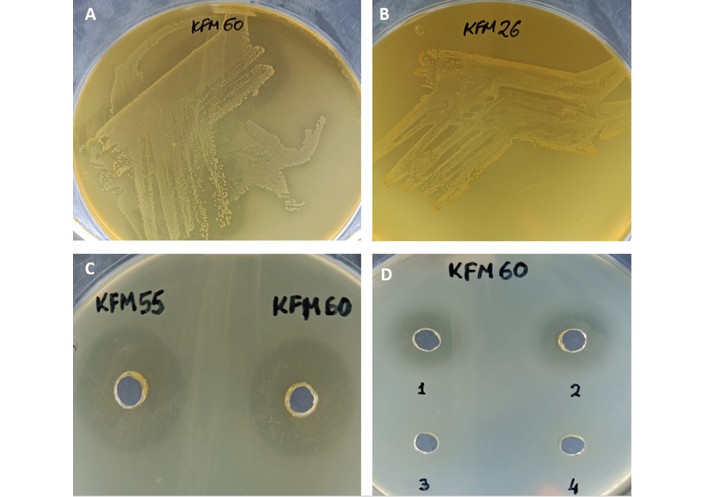
Bacteriocin-mediated activity of the Streptococcus lutetiensis KFM 55 and KFM 60 raw sheep milk strains against Listeria monocytogenes no.10. (A) Direct in vitro antilisterial activity of the streaked KFM 60 strain on M17 agar overlayed with a listerial cell lawn and incubated at 30oC overnight; (B) no activity by S. gallolyticus KFM 26; (C) listerial growth inhibition by the filter-sterilized MRS (37oC; 24 h) cell-free supernatants (CFS; pH 4.6–4.7) of strains KFM 55 and KFM 60 in the MPCA well diffusion assays; (D) wells opened in a solidified MPCA plate pre-seeded with listerial cells were filled with 80 μL of the neutralized (pH 6.2) CFS of the KFM 60 strain before (well 1) or after (well 2) heating at 100oC for 5 min, or after treatment with proteinase K (well 3) and trypsin (well 4). KFM 55 gave similar results, not illustrated.
Based on the AR and biochemical identification results, and particularly on the API 20 STREP records closely relating most strain biotypes of sheep milk streptococci with the pathogenic species S. agalactiae, S. uberis, S. pneumoniae, and S. gallolyticus subsp. pasteurianus (Tables 2–4), only the two bacteriocin-producing S. lutetiensis KFM 55 and KFM 60 strains were further evaluated for their entire enzymatic activity profiles. Major species-dependent variations in the API ZYM profiles of the two S. lutetiensis and the two NSC strains, S. thermophilus ST1 and Lc. lactis M78 were noted (Table 6).
Enzymatic activity profiles of selected strains isolated from raw sheep milk of native Epirus breeds with the highest potential for inclusion in natural starter cultures1.
| Strain | Streptococcus thermophilus ST1 | Lactococcus lactis M78 | Streptococcus lutetiensis KFM 55 | Streptococcus lutetiensis KFM 60 |
|---|---|---|---|---|
| Alkaline phosphatase | 0 | 40 | 10 | 20 |
| Esterase (C4) | 20 | 20 | 0 | 0 |
| Esterase lipase (C8) | 0 | 30 | 0 | 0 |
| Lipase (C14) | 0 | 0 | 0 | 0 |
| Leucine arylamidase | 40 | 40 | 40 | 40 |
| Valine arylamidase | 10 | 30 | 5 | 5 |
| Cystine arylamidase | 10 | 30 | 0 | 0 |
| Trypsin | 0 | 0 | 0 | 0 |
| α-chymotrypsin | 0 | 20 | 0 | 0 |
| Acid phosphatase | 30 | 40 | 40 | 40 |
| Naphthol-AS-BI-phosphohydrolase | 10 | 40 | 20 | 20 |
| α-galactosidase | 0 | 0 | 40 | 40 |
| β-galactosidase | 30 | 0 | 0 | 0 |
| β-glucuronidase | 0 | 0 | 0 | 0 |
| α-glucosidase | 0 | 40 | 5 | 0 |
| β-glucosidase | 0 | 0 | 0 | 0 |
| N-acetyl-β-glucosaminidase | 0 | 0 | 0 | 0 |
| α-mannosidase | 0 | 0 | 0 | 0 |
| α-fucosidase | 0 | 0 | 0 | 0 |
The reactions were graded from 0 (negative) to 5 (strongly positive) based on the change in the color intensity after the addition of the ZYM A & ZYM B reagents in each well. Activity (approximate values) was expressed as arbitrary units of substrate hydrolyzed; 0: negative (similar to the first well-control); 1: liberation of 5 nmol; 2: 10 nmol; 3: 20 nmol; 4: 30 nmol; 5: 40 nmol or more (Samelis and Kakouri [24] 2025). Liberation of 20 to 40 nmol or more was considered a clearly positive enzymatic reaction. The basic starter strains S. thermophilus ST1 and Lc. lactis M78 were tested for comparison.
Specifically, both S. lutetiensis isolates displayed very strong α-galactosidase activity, which was absent in both NSC strains ST1 and M78, which, however, displayed strong β-galactosidase and α-glucosidase activity, respectively (Table 6). Actually, these were the most prominent API ZYM differences between the four strains as far as the crucial glycolytic enzyme system for milk fermentation is concerned. On the other hand, similarly to ST1 and M78, both S. lutetiensis strains displayed strong leucine arylamidase and acid phosphatase, and moderate napthol-AS-BI-phosphohydrolase activity. However, unlike M78, both S. lutetiensis strains lacked esterase (C4), esterase-lipase (C8), or valine and cystine arylamidase activities, which were also weak or absent in ST1. Moreover, both S. lutetiensis strains lacked α-chymotrypsin activity moderately possessed by M78, but not by ST1. Also, although both of them displayed a weak to moderate alkaline phosphatase activity in the API ZYM kit (Table 6), they should be considered negative as they were in the API 20 STREP id-kit (Table 3), which is more reliable for this particular enzymatic test [24]. Finally, no strain showed lipase (C14), trypsin, β-glucuronidase, β-glucosidase, N-acetyl-β-glucosaminidase, α-mannosidase, and α-fucosidase activities (Table 6).
Except for their phenotypic resistance or intermediate susceptibility to ciprofloxacin (68.8%) and tetracycline (50%), the increased (> 22 mm inhibition zones) sensitivity of all mesophilic or thermophilic animal streptococci from raw or thermized sheep milk to all antibiotics tested (Table 4) was positive for cheese safety. This finding correlates well with the absence of the gelE, hyl-like or cytolysin genes from all Streptococcus RM isolates, primarily from S. equinus and the other two thermophilic members of the SESB complex [23], which can survive in TM [6]. It is also consistent with the findings reported by Özkan et al. [20] regarding the beneficial properties of S. gallolyticus, S. lutetiensis and S. infantarius Turkish cheese isolates, including the susceptibility of all, except for one, to ampicillin, chloramphenicol, penicillin, and vancomycin. Likewise, Morandi et al. [34] detected two subdominant S. equinus strains in an Italian RM cheese susceptible to all antibiotics (i.e., ciprofloxacin, erythromycin, penicillin, tetracycline, vancomycin) tested herein, too; however, both Italian S. equinus strains were resistant to streptomycin, which was not among the antibiotics tested in the present study. Conversely, 43% and 24% of the S. lutetiensis isolates from clinical mastitis of dairy cows in China were resistant to tetracycline and erythromycin [16].
Similarly, S. parauberis field isolates from clinical bovine mastitis cases in China were highly resistant to erythromycin (90.9%), followed by tetracycline (45.5%), chloramphenicol (36.4%) and clindamycin (27.3%); of note, the S. uberis co-isolates were highly resistant to tetracycline (81.3%) and clindamycin (62.5%), while both species were susceptible to ampicillin [15]. Earlier, Pitkälä et al. [35] found subclinical isolates of S. uberis from Finish bovine milk to be resistant to oxytetracycline (40.6%) and erythromycin (15.6%). All of them were susceptible to β-lactam antibiotics, and two subdominant isolates of S. parauberis isolates were susceptible to all antibiotics tested [35]. Of note, four S. uberis RM cheese strains were susceptible to all antibiotics tested (with the exception of streptomycin), including tetracycline; however, three and one of them were found to possess the tetM and tetL genes, respectively, despite all of them were phenotypically sensitive to tetracycline [34].
Overall, the high variability in virulence gene profiles of field strains of the two Streptococcus groups, S. uberis/parauberis [15] and the SESB complex [20] primarily associated with mastitis in ruminants is a serious concern. Additional streptococcal virulence genes (asa1, mrp, sly, bay, bca, speG, scpB, ssa) were tested for the SESB complex and the species S. lutetiensis in particular [16, 20]. Also, the virulence genes (sua, pauA, skc, gapC, hasC) specific to the pyogenic S. uberis group [15] differ from the Enterococcus-specific virulence genes tested by Sioziou et al. [23].
Streptococcus-specific virulence genes were not tested by Sioziou et al. [23] or in this study because, as mentioned, according to the API 20 STREP data in Table 3: All S. parauberis sheep milk isolates biochemically identified as S. agalactiae (biotype I) or S. uberis (biotype II), and all S. equinus sharing a high biochemical similarity with S. pneumoniae, were a priori considered unwanted strains resembling closely-related pathogenic species causing mastitis [17, 35–37], irrespective none of them was MDR (Table 4) or β-hemolytic (Table 3) [6, 23]. In other words, the potential inclusion of any of the above non-QPS Streptococcus field isolates in complex NSCs is restricted by their genotypic and primary phenotypic assignment to major LAB species associated with clinical mastitis [37, 38], especially to S. agalactiae and S. uberis with a pooled global prevalence of 9% each amongst the most important pathogens present in the milk of the world [39]. The above restriction also applies to the single S. gallolyticus subsp. pasteurianus KFM 26 raw sheep milk isolate, the only strain biotype studied herein that exhibited β-glucuronidase activity (Table 3).
In summary, as it was concluded by Özkan et al. [20], dairy scientists should be conscious to claim that strains of non-QPS species within the SESB complex associated with many diseases are actually beneficial. However, when certain safe strains of this major group prevail in traditionally fermented dairy (cheese) products, they deserve to be evaluated differently from similar strains of clinical origin. Amongst the non-QPS sheep milk Streptococcus isolates of this study, only the two S. lutetiensis strains were likely to deserve further attention and a positive view. The species is highly controversially associated with clinical mastitis of dairy cows [16]. However, different S. lutetiensis strains were members of the beneficial technological LAB biota in Turkish Beyaz [40] and Tulum [41] cheeses, or showed high acid and diacetyl/acetoin production in milk after 24 h at 30–40oC [42]. Moreover, unidentified class I and II bacteriocins predicted in the genomes of ruminal S. lutetiensis strains were confirmed by SDS-PAGE, showing promise as novel antimicrobial peptides [43]. Therefore, recent data about S. lutetiensis are in accordance with our present findings regarding the strong bacteriocin- mediated antilisterial activity (Figure 1), strong acetoin production and beneficial enzymatic activities of the S. lutetiensis KFM 55 and KFM 60 strains, including their α-galactosidase and leucine aminopeptidase activities (Tables 3 and 6). However, on the other hand, the resistance of these strains to ciprofloxacin, a fluoroquinolone, is a safety concern, especially for potential human consumption and precludes their free use as natural starter or adjunct culture constituents in traditional cheese technologies.
According to the literature, the most promising, autochthonous starter or adjunct LAB candidates should possess strong to moderate acid phosphatase, aminopeptidase, esterase, esterase/lipase and high glycolytic (α-galactosidase and/or β-galactosidase, or α-glucosidase) activities, and should lack undesired activities, such as β-glucoronidase and β-glucosidase considered to be potential mediators of colon carcinogenesis [44, 45]. However, this negative health-associated consideration has been contradicted in recent reviews: A beneficial, multi-functional role for at least the β-glucosidase activity of many LAB species, especially Lactiplantibacillus plantarum, in food fermentation and human health is concluded by Paventi et al. [46], supporting the application of Lp. plantarum H25, a strong-positive strain for β-glucosidase activity [27], as an aromatic adjunct in traditional Galotyri PDO cheese products [28]. Nevertheless, neither the two selected bacteriocin-producing S. lutetiensis strains nor the two primary NSC strains S. thermophilus ST1 and Lc. lactis M78 were β-glucosidase-positive (Table 6), whereas the only β-glucoronidase-positive, potentially harmful sheep milk isolate was assigned to S. gallolyticus subsp. pasteurianus KFM 26 (Table 3).
On the other hand, the superiority of the cheese starter strain S. thermophilus ST1 to strongly acidify the RSM within less than 6 h at 37oC (Table 5) was primarily attributed to its positive reaction for β-galactosidase, i.e., the main enzyme responsible for lactose breakdown to glucose and galactose during milk fermentation. Accordingly, the faster and stronger RSM acidification by all S. equinus isolates and S. gallolyticus KFM 26 (Table 5) corroborates their β-galactosidase-positive reaction in the API 20 STREP compared to all S. parauberis and S. lutetiensis isolates, which gave a negative reaction (Table 3). In particular, the weaker milk acidifying activity of the S. parauberis isolates is consistent with the fact that all of them were negative for β-galactosidase, α-galactosidase, β-glucosidase, and β-glucuronidase; their α-glucosidase activity, not included in the API 20 STREP kit (Table 3), should be tested in future studies.
Meanwhile, the lack of α-galactosidase in both NSC strains ST1 and M78 (Table 6), and in all strain biotypes of the E. faecium/E. durans group and E. faecalis that coexisted in both sheep RM/TM counterparts [24] makes α-galactosidase activity exhibited by S. lutetiensis a potentially major biotechnological advantage. Whereas the negative lipolytic and low proteolytic (valine and cystine arylamidase) activities of S. lutetiensis strains may be replaced by the bioprotective Lc. lactis strain (M78 = M104) genotype [29] and selected E. faecium/E. durans adjunct strains [27] with respect to their in situ metabolic performance in cheese milk and dairy foods overall. Thus, the prominent differences in the API ZYM profiles of the S. lutetiensis KFM 55 and KFM 60 strains might be complementary to those of the NSC strains S. thermophilus ST1 and Lc. lactis subsp. cremoris M78 (Table 6), as well as of the adjunct strains E. faecium KE82 (entA/entB/entP producer) [47] and Lp. plantarum H25 [28].
To this end and relative to the natural presence of controversial, potentially beneficial S. lutetiensis strains in Greek RMs from native small ruminant breeds, a very recent (available online 1 May 2026) comprehensive study by Zoumpopoulou et al. [48] on the LAB ecology of eight RM samples of the Lesvos breed identified two S. lutetiensis (1.7%) along with four S. macedonicus (3.4%) strains as subdominant members of the total LAB biota (117 isolates) dominated by Enterococcus spp. (73; 62.4%) followed by thermophilic lactobacilli (27; 23.1%) and mesophilic lactobacilli of the Lacticaseibacillus casei/paracasei/rhamnosus group (11; 9.4%). Of note, two strains of the latter probiotic group possessed bacteriocin-mediated antilisterial activity and two probiotic S. macedonicus strains anti-streptococcal activity. Conversely, none of the two S. lutetiensis strains originating from one sample of Lesvos breed sheep milk produced bacteriocin; however, one of them, S. lutetiensis 307, exhibited more than one probiotic properties, including proteolytic activity, bile salt hydrolase (BSH) activity, high survival in the presence of 1% bile salts, and good survival under GIT (pH 2.5) conditions [48]. Finally, both S. lutetiensis strains found in Lesvos raw sheep milk were resistant to gentamicin, kanamycin and streptomycin; but, consistent with the KFM 55 and KFM 60 Epirus milk strains, both were susceptible to ampicillin, chloramphenicol, erythromycin, tetracycline and vancomycin, while resistance to ciprofloxacin was not tested for the LAB isolates from Lesvos breed sheep milk by Zoumpopoulou et al. [48].
Collectively, based on the present results and preceding discussion, further in situ validation studies are required to assess the actual milk acidification activity and other potentially complementary enzymatic activities, as well as potential probiotic activities, of the two novel antilisterial-bacteriocin-producing S. lutetiensis KFM 55 and KFM 60 strains from Epirus sheep milk in real cheese fermentation and ripening trials.
Finally, it should be noted that the present study has certain limitations. First, the number of animal streptococci tested was small, originating from two sheep milk batches, which limits the strain variability at or within the species level. These sample size limitations further preclude the present results from being generalized to all native sheep breed milks produced in Epirus or other Greek regions. Second, biotyping supported by 16S rRNA gene identification only was insufficient to fully resolve the species and subspecies heterogeneity within the SESB complex, potentially leading to culture-dependent strain misidentifications. Culture-independent approaches are considered more suitable and powerful to map the complex microbial (LAB) ecology of sheep milk, particularly when it is raw. Whole-genome sequencing of promising or probably unsafe Streptococcus strains is needed.
Despite S. lutetiensis is a non-QPS species of the SESB complex that causes mastitis, selected aciduric or antagonistic strains of S. lutetiensis from artisanal cheeses lacking streptococcal virulence and AR genes have been proposed as starters or adjuncts. In alignment, the antibiotic susceptible (except ciprofloxacin) S. lutetiensis KFM 55 and KFM 60 strain biotypes from RM of native Epirus sheep breeds possess beneficial fermentative and enzymatic activities in vitro and antilisterial bacteriocin activity. The structural, either known or novel, bacteriocin gene/s or other antagonistic mechanism underlying the in vitro bacteriocin-mediated activity against L. monocytogenes has yet to be elucidated, along with a complete safety evaluation of these strains. Although both lack β-hemolytic activity and the vanA, vanB, gelE, hyl or cyl genes and are not MDR, the possibility of possessing other virulence genes associated with the SESB complex and the species S. lutetiensis in particular remains. Therefore, until their safety status is fully clarified, the inclusion of the phenotypically ciprofloxacin-resistant S. lutetiensis KFM 55 and KFM 60 strains in complex NSCs for commercial use in traditional Greek cheeses is hampered. Whole-genome sequencing and in situ cheese trials are required before recommending these strains for commercial NSC development.
AR: antibiotic resistant
BA: biogenic amine
CFS: cell-free supernatants
CLSI: Clinical and Laboratory Standards Institute
GRAS: Generally Recognized as Safe
KAA: Kanamycin Aesculin Azide
LAB: lactic acid bacteria
MDR: multidrug resistant
NSCs: natural starter cultures
PDO: Protected Designation of Origin
QPS: Qualified Presumption of Safety
RM: raw milk
rRNA: ribosomal RNA
RSM: reconstituted skimmed milk
SESB: Streptococcus equinus/Streptococcus bovis
TM: thermized milk
The supplementary table for this article is available at: https://www.explorationpub.com/uploads/Article/file/1010187_sup_1.pdf.
The authors wish to thank Vasiliki Zafeiropoulou and Maria Mavropoulou, Veterinary Laboratory, Food Hygiene Department, Ministry of Agriculture, Athens, Greece, for identifying the API 20 STREP code numbers of the present Streptococcus isolates with the apiwebTM software, not available in our laboratory.
JS: Conceptualization, Formal analysis, Methodology, Validation, Resources, Data curation, Project administration, Writing—original draft, Writing—review & editing, Investigation, Visualization. AK: Formal analysis, Validation, Writing—review & editing. Both authors read and approved the submitted version.
The authors declare that they have no conflicts of interest.
Not applicable.
Not applicable.
Not applicable.
Data are contained within the article. Raw data will be made available on request.
Not applicable.
© The Author(s) 2026.
Open Exploration maintains a neutral stance on jurisdictional claims in published institutional affiliations and maps. All opinions expressed in this article are the personal views of the author(s) and do not represent the stance of the editorial team or the publisher.
Copyright: © The Author(s) 2026. This is an Open Access article licensed under a Creative Commons Attribution 4.0 International License (https://creativecommons.org/licenses/by/4.0/), which permits unrestricted use, sharing, adaptation, distribution and reproduction in any medium or format, for any purpose, even commercially, as long as you give appropriate credit to the original author(s) and the source, provide a link to the Creative Commons license, and indicate if changes were made.



View: 489
Download: 12
Times Cited: 0


