Review


Affiliation:
School of Biotechnology and Bioinformatics, D. Y. Patil deemed to be University, Navi Mumbai 400614, Maharashtra, India

Affiliation:
School of Biotechnology and Bioinformatics, D. Y. Patil deemed to be University, Navi Mumbai 400614, Maharashtra, India
ORCID: https://orcid.org/0000-0003-2627-6171
 ,
,
Affiliation:
School of Biotechnology and Bioinformatics, D. Y. Patil deemed to be University, Navi Mumbai 400614, Maharashtra, India
ORCID: https://orcid.org/0000-0003-2603-4447
,
Affiliation:
School of Biotechnology and Bioinformatics, D. Y. Patil deemed to be University, Navi Mumbai 400614, Maharashtra, India
Email: sac007s@gmail.com
ORCID: https://orcid.org/0000-0003-1321-721X

Explor Foods Foodomics. 2026;4:1010188 DOI: https://doi.org/10.37349/eff.2026.1010188
Received: February 14, 2026 Accepted: July 24, 2026 Published: September 04, 2026
Academic Editor: Celestino Santos-Buelga, University of Salamanca, Spain
Inulin is a naturally occurring water-soluble fructan-type polysaccharide composed primarily of β (2→1)-linked D-fructose units, typically terminated by a glucose residue. Inulin is widely used as a functional ingredient due to its technological and health-promoting benefits. This review provides a comprehensive, up-to-date evaluation of inulin, focusing on its structural characteristics, physicochemical properties, extraction techniques, and applications in food. Conventional and emerging green extraction methods, such as microwave-assisted, ultrasound-assisted, and enzyme-assisted methods, are compared with respect to efficiency, yield, and sustainability. The functionality of inulin as a fat replacer, sugar substitute, and texturizing agent is critically examined, particularly with respect to its degree of polymerization. In addition, the prebiotic and immunomodulatory effects of inulin are addressed, emphasizing its role in modulating gut microbiota and associated health outcomes. Advanced analytical techniques, such as Fourier transform infrared spectroscopy (FTIR), nuclear magnetic resonance (NMR), X-ray diffraction (XRD), and thermogravimetric analysis and differential scanning calorimetry (TGA-DSC), are also discussed to determine the structure-function relationships of inulin. This review summarizes recent advances and identifies key research gaps to support the effective, targeted use of inulin in functional foods and health applications.
Functional foods have received increased attention owing to their immune-stimulating and nutritional properties. The additives include dietary fibers, antioxidants, polyphenols, vitamins, and minerals, which are generally fortified or increased in functional foods. One such component is inulin, a soluble dietary fiber with diverse health benefits like enhanced mineral absorption and improved gut health. In functional foods, up to 50% of fat and sugar can be substituted with inulin, maintaining excellent nutritional, textural, and storage properties [1]. Generally, the terminal end of linear fructans (polysaccharides) consists of a single glucose residue, called a fructosyl residue, with a [β (2→1)] linkage [2]. It is obtained from the roots of Jerusalem artichokes, chicory, yacon, asparagus, leeks, onions, bananas, wheat, garlic, and dahlias. Sucrose is the primary component used in the synthetic formation of inulin-type fructans [3].
Inulin is a fructan-type carbohydrate and can be an oligo- or polysaccharide depending on the degree of the fructose chain length. It consists of β-D-fructofuranosyl residues, linked by β (2→1) glycosidic bond, often terminated with an α-D-glucopyranosyl residue bound through [α (1→2) linkage] [4]. Figure 1 represents the chemical structure of inulin. Such fructose chains vary in length from two to sixty residues. Oligofructose is an alternate designation when there are fewer than ten fructose residues [5]. GFn, with G being the glucosyl part, F the fructosyl part, and n being the number of fructoses joined by [β (2→1) linkage] glycosidic bonds, represents the general designation, a polydisperse mixture of compounds with an identical chemical basic structure [6].
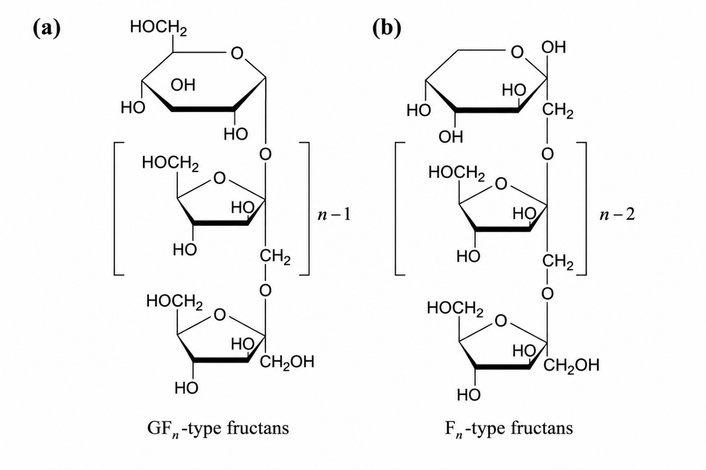
Chemical structure of inulin. (a) GFn-type fructans, composed of β (2→1)-linked fructose units terminated with a glucose residue via an α (1→2) linkage; (b) Fn-type fructans lacking the terminal glucose residue. Reprinted from [7]. © 2025 by the authors. CC BY 4.0.
Inulin derived from plants consists of 2–100 fructose units. The chain length influences the water solubility of inulin produced from plants [8]. Although some inulin molecules consist of branches linked by β (2→6) links, inulin is usually linear. According to the degree of polymerization (DP), inulin-type fructans can be divided into fructooligosaccharides (FOS) (DP ≤ 10) and inulin (DP > 10) [9]. Microbial inulin has a molecular weight (MW) over 10^6 Da, while the MW of plant-derived inulin is below 10^4 Da with a DP between 2 and 60. It is not yet known if they differ in their physiological properties [10]. The plant source, time of harvest, growing season, climate, and period of storage following harvest are the primary factors influencing the DP value, which is crucial because it affects the product’s functionality [11].
There are over 36,000 plant species capable of synthesizing inulin. It is part of the monocotyledons and dicotyledons families [12]. The amount consumed through food varies widely depending on the consumption models and the region of origin [13]. The most common botanical families with inulin are Compositae, Liliaceae, Asparagaceae, Gramineae, and Amaryllidaceae. Inulin is naturally present in a variety of plant sources, particularly in certain plant families [14]. Another common type includes chicory and Jerusalem artichokes, both of which are members of the Compositae botanical family. They are commonly used for industrial extraction based on plant species [6]. As shown in Table 1, the comparison of different inulin sources based on their plant parts, inulin content, and DP highlights chicory as one of the most widely used commercial sources of inulin.
Inulin in plant sources.
| Plant source | Plant part | Inulin content(%, fresh weight) | Degree of polymerization | References |
|---|---|---|---|---|
| *Jerusalem artichoke | Tuber | 16–20 | 2–35 | [15–17] |
| Chicory roots | Roots | 14–90 | 7–15 | [15, 18–20] |
| Dahlia | Tuber | 42 | 13–23 | [19, 21] |
| Garlic | Bulb | 9–17 | 36 | [22, 23] |
| Jicama | Tuber | 21 | 36 | [24, 25] |
| **Agave | Leaves | 48–78 | 25–34 | [26, 27] |
| Onion | Bulb | 2–4 | 4.1 | [28] |
| Yacon | Tuber | 2–4 | 2–10 | [29, 30] |
* The reported values represent ranges described in the cited studies and may vary depending on cultivar, processing conditions, extraction method, and the basis of calculation. ** Reported inulin content obtained under different ultrasound-assisted extraction conditions.
The functional and physicochemical properties of inulin, including its melting point, gelation properties, glass transition temperature, and gel strength, are dependent on its DP and branching [31]. Inulin is a white powder with no smell. Oligofructose is colorless, contains 75% dry matter, and is a powder or viscous syrup. It has a favorable chemical composition and can be obtained in high purity. It has a bland taste with little aftertaste. Inulin can be mixed with other compounds without affecting their flavor because it has no effect on them, resulting in a mix with 10% of the sweetness of sugar. Inulin, although less viscous with low solubility (only 10% in water at a given temperature), has a high ability to substitute for fats in food preparations because it forms a particle gel with a microscopic, spreadable structure that can be produced from its mixture with water or other liquid components. Inulin can partially replace fats in food formulations because it forms a creamy gel structure. However, it cannot fully replicate all functional properties of fats, such as flavor release, aeration, and crispness. At higher concentrations, inulin may adversely affect texture and may also cause gastrointestinal discomfort in sensitive individuals [31].
The physicochemical properties of inulin, including its solubility, are influenced by several factors such as its source, chemical composition, functional groups, chain length, and DP [32]. At room temperature, short-chain inulin (low MW and DP values less than 10) is freely miscible in water; however, as the chain length increases, solubility decreases rapidly. Solubility of native inulin, as a function of temperature, generally increases from 6% (at 10°C) to a range of 33–35% (at 90°C). However, when the temperature is increased above a certain limit, solubility increases due to the breaking of intermolecular hydrogen bonding and the formation of crystalline regions [1, 32, 33]. “The solubility of inulin depends on the solvent,” Gupta et al. (2019) [32]. Inulin is slightly soluble or insoluble in alcohols, such as methanol, ethanol, and propanol [1, 32]. However, inulin exhibits distinct physicochemical properties that influence its behavior in different solvent systems [1, 32, 34].
Inulin also exhibits gelation at higher concentrations, forming a gel structure upon shearing that depends on the chain-length distribution and concentration. Additionally, the formation of water-insoluble inulin fragments may contribute to the gel's structural characteristics [33]. Inulin also has a higher concentration, which gives it gelling ability, depending on the normal chicory inulin concentration (> 25%), long-chain inulin concentration (> 15%), or longer-chain inulin. The inulin can also be sheared using a homogenizer/rotor-stator mixer after it has fully dissolved in water or an aqueous solvent. When inulin is sheared in water, it forms a white, creamy gel matrix that can be added to water-containing foods to replace up to 100% of the fat [35].
The gelling property of inulin can be considerably affected by the inulin concentration, the total amount of dry matter, and the shearing conditions (temperature, time, speed, and pressure), as well as the type of shearing device used. Within the pH range 4 to 9, the gelling property of inulin is independent of pH. Inulin exhibits gel-forming properties and can contribute to gel formation at relatively high concentrations [33].
The interaction between the dissolved inulin molecules normally leads to the formation of inulin gels. Additionally, a previous study showed that undissolved microcrystals coexist with gels. The strength of the gels can be enhanced by the interaction of the microcrystals with the solvent and inulin particles, forming a discontinuous structure [31, 34]. In comparison to its lower-molecular-weight counterparts, high-molecular-weight inulin displays significantly superior gelation properties. The low DP also raises the possibility that it will not form a gel [36].
The sweetness and DP of inulin are strongly correlated. Short-chain inulin fractions, otherwise called FOS, are good sugar substitutes in reduced-calorie foods. These have a mild sweetness, approximately 30–35% that of sucrose. Inulin-type fructans and short-chain FOS possess functional properties that make them suitable for use as fat and sugar replacers and texture modifiers in food products [37, 38]. On combining with high-intensity sweeteners such as aspartame and acesulfame, these fractions serve as bulking agents. These enhance mouthfeel and optimize formulations [39–41]. On the other hand, long-chain inulin primarily contributes to gelling and texturizing properties rather than flavor enhancement. It is poorly soluble and has little sweetness [42]. Inulin is particularly suitable for products focused on glycemic control and weight management. It offers about 1.5 kcal/g and encourages prebiotic effects [14, 32, 42, 43]. Short-chain inulin has more monosaccharides and disaccharides, so the physicochemical properties of inulin sweeteners depend mainly on DP: the lower the DP, the sweeter the sweeteners [1]. Inulin is widely used in food processing for its excellent moisture-attracting properties [44]. Inulin lacks a distinct melting point; instead, it undergoes thermal degradation at elevated temperatures (typically above 135–160°C), depending on its DP and moisture content.
Temperature and concentration are the factors that influence the viscosity of the inulin solution. Viscosity increased without forming a gel as concentrations increased from 1% to 10%. Inulin solubility enhances when the temperature exceeds 80°C; as a result, its viscosity also decreases. Lin et al. (2024) [19] found that the viscosity of inulin obtained from artichokes, chicory roots, and asparagus decreased at high temperatures, highlighting its excellent physicochemical properties and potential future applications in the food industry. Moreover, the increased capacity for water binding in long-chain inulin results in higher viscosity at higher concentrations. Fat-mimicking gels can be formed from long-chain inulin by raising the concentration to a sufficient level (above 10–20%) [37].
Being partially hydrolyzable in a very acidic environment via β (2→1) bonding between fructose molecules, inulin can hydrolyze and decompose in high-temperature, solid-acid systems, albeit remaining stable at 100°C. The main factors influencing inulin stability are pH, temperature, dry matter concentration, and processing duration. Although inulin is relatively stable at pH > 4.0, acid-induced hydrolysis of β (2→1) links can occur under acidic conditions (pH < 4.0), particularly at high temperatures and during extended processing durations [45]. Water content is deemed insignificant for inulin stability, even in high-temperature and high-acid environments. The high hygroscopic nature of inulin can bind free water, reduce water activity, and thereby improve food shelf life [40]. Table 2 represents the physicochemical and functional properties of inulin.
Physicochemical and functional properties of inulin.
| Property | Low DP (FOS, DP ≤ 10) | High DP (Inulin, DP > 10) | Food/Health implications | References |
|---|---|---|---|---|
| Solubility | Highly soluble in water | Moderately soluble | Improved mouthfeel & suitable for beverages, and also used in semi-solid foods | [46–49] |
| Gel-forming ability | No gel formation | Forms gel | Fat replacement in low-fat foods | [50, 51] |
| Sweetness | Slightly sweet | No sweetness | Sugar replacement | [47–49] |
| Viscosity | Low viscosity | High viscosity | Texture and fat mimetic effect & promote gut health | [46, 51] |
DP: degree of polymerization; FOS: fructooligosaccharides.
There are three major steps in the conventional process for extracting inulin: extraction, purification, and drying [52, 53]. Before the extraction for surface area optimization, inulin-rich materials are cleaned, dried, and mechanically pre-treated (pulped or sliced) [36]. Based on Azwanida et al. (2015) [54], solvent selection is an important factor in extracting bioactive compounds from plant materials, and different solvents such as water, ethanol, methanol, and their mixtures may be considered depending on the extraction objectives. The process was performed using a hot plate with magnetic stirring at 250 rpm for 24 hours at room temperature, after the burdock root powder was mixed with each of the above solvents in a 1:10 active: total solvent mass ratio. The extraction process was performed in a flask immersed in a water bath attached to a reflux apparatus for 60 min in boiling water, as described by Temkov et al. (2015) [55], who used distilled water as the solvent. For the purification process, the solution after extraction was concentrated, and then 5% Ca(OH)2 at 50–60 ºC for 30 min was added to remove impurities (pectin, protein, and cell wall materials). By this method, the pH of the solution rose from 5–6 to 10–12. The solution was centrifuged at 4,000 rpm for 15 min, and the precipitate was removed. The yellow supernatant was mixed with 10% phosphoric acid (pH 8–9) at 60°C for 2–3 h. The method was repeated twice. In the next step, to remove the colored material, the solution was mixed with activated carbon at 40°C for 30 min. The treated solution was filtered (Whatman No. 1) and dried by rotary evaporation [56, 57].
The extraction process can be influenced by several factors, including temperature, extraction time, pH, and the solid-to-liquid (S/L) ratio [1, 52, 58]. Depending on the plant used and the processing conditions, these parameters should be further optimized [32]. It is known that the solubility of inulin increases significantly with higher temperatures. In contrast to near-neutral pH, inulin hydrolyzes more quickly at acidic pH (pH < 4.0), particularly when combined with high temperatures and extended processing or storage times [45]. As noted in that study, hydrolysis reduces DP and triggers Maillard reactions that can hinder subsequent purification steps [59]. The conventional method was necessary due to the greater use of inulin. This method has now shifted to several non-traditional ones. The current method for extracting inulin has been replaced with many non-traditional approaches.
The ultrasonic extraction technique increases the efficiency of polysaccharide extractions by taking the physical effects of ultrasound on cell walls to damage cells and release polysaccharide molecules [33, 60]. A practical approach to extracting active compounds from plants is UAE. According to response surface methodology, some factors that could be optimized for inulin and phenolic compounds are sonication time (10–40 min), sonication temperature (40–70°C), and solid/solvent ratio (1:20–1:40 g/mL). For ultrasound-assisted water extraction, the best sonication time is 36.65 min, the temperature is 55.48°C, and the solid-to-water ratio is 1:35 g/mL. These conditions maximize the recovery of inulin and total phenolic compounds while minimizing IC50 [61].
MAE uses solvents heated in contact with a sample, thereby partitioning analytes from the sample matrix into the solvent. The ability to quickly heat a sample and solvent system is its key advantage. The use of closed vessels enables extraction at higher temperatures, thereby accelerating the diffusion of target analytes from the sample matrix. For MAE of inulin, the optimal solid-to-solvent ratio typically ranges from 1:10 to 1:40 (g/mL), depending on the raw materials. The average extraction time is 15–30 min, using 10–30 mL of solvent. Heated volumes are 10 times lower than conventional extraction methods [62]. MAE has increased heating speed, shortened extraction time, reduced temperature differences, requires less equipment, and yields larger quantities than conventional methods [63]. The variables influencing the extraction ratios of inulin from Dahlia tubers by MAE from an aqueous environment were extraction time (3–37 min), temperature (23–57°C), and concentration (0.016–0.184 g/mL). The highest inulin was 90% at 40°C, 20 min, and 0.1 g/mL [64]. MAE conditions, particularly power and extraction time, should be carefully controlled to minimize possible structural changes in inulin [44].
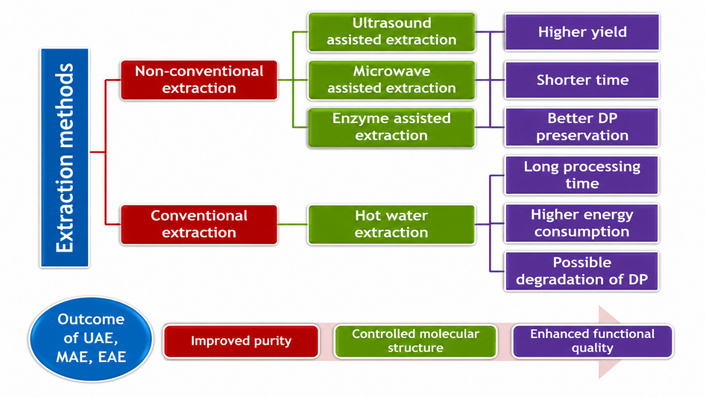
Enzyme-assisted extraction is a technique that uses specific enzymes, such as cellulase, pectinase, and inulinase, to break down plant cell walls and release inulin. Since the aforementioned method uses moderate process conditions to prevent structural damage and preserve the biological activity of the extractable chemical, it is generally considered relatively innocuous for the isolated components [65]. Jiang et al. (2017) [66] used a S/L ratio of 1:20 and set the enzyme temperature to 54°C. The composite enzyme was a 1:8 mixture of papain and pectinase. The extraction lasted 40 min, yielding 73.30% Chrysanthemum inulin. Domingo found that the best conditions for extracting inulin from Cynara cardunculus using pectinase are a pH of 4.5 and an enzyme-to-substrate ratio of 7.5 U:1 g. The extraction time should be 2 hours at 50 ℃. The inulin yield was 35.30% ± 0.85%, which is 38.16% higher than that obtained by traditional hot-water extraction [67]. Figure 2 summarizes the different methods used for inulin extraction.
The inulin content is measured by the difference between total carbohydrate sugar and reducing sugar. Total carbohydrate was determined using the phenol-sulfuric acid method [61], while reducing sugar was determined separately using DNS (3,5-dinitrosalicylic acid reagent) [61].
Fourier transform infrared spectroscopy (FTIR) and X-ray diffraction (XRD) were used to elucidate and characterize the structure of the extracted inulin [68]. FTIR helps to determine the purity and molecular identity of the extracted polysaccharide. FTIR helps demonstrate the structural and functional relationships between the hydroxyl groups in inulin and hydrogen bonding and water retention, which improve texture and stabilize the gel. FTIR research confirms the structural integrity and functional group properties of chicory inulin. According to earlier research, chicory inulin can enhance the physicochemical, textural, and sensory characteristics of low-fat yogurt formulations [18]. The structure of inulin samples was qualitatively determined by XRD analysis. XRD analysis helps to determine differences in the crystalline and amorphous characteristics of inulin samples with varying DP. The technique provided insights into the structure and crystallinity of the polymer matrix. The study found that high DP inulin has more ordered crystalline structures due to better chain alignment, whereas low DP inulin is mostly amorphous. This relationship between structure and function affects solubility, gel strength, and texture of inulin in different food products [69].
Differential scanning calorimetry (DSC) analysis helps determine differences in the glass transition and melting behavior of low- and high DP inulin extract powders, while thermogravimetric analysis (TGA) helps demonstrate the thermal stability and crystallization behavior of high- and low DP inulin. High DP inulin showed a broader thermal transition due to stronger chain interactions and a more heterogeneous crystalline nature, whereas low DP inulin exhibited greater molecular mobility. Thermal analysis showed that the high DP inulin powder exhibits distinct melting events and degradation behavior compared to low DP inulin [69]. The study reported that DSC analysis indicated that inulin-fortified gluten-free bread exhibited an increased gelatinization temperature, reduced starch crystallinity & improved thermal behavior due to interactions between inulin, starch, and water within the bread matrix [70].
Inulin and oligofructoses, however, are known to be largely unaffected by the process of hydrolysis or absorption by the upper part of the gastrointestinal tract (GIT). In fact, as mentioned above, they cause fermentation by the gut microflora. On the other hand, a proper prebiotic should possess certain qualities, such as resistance to hydrolysis or absorption in the upper part of the GIT, leading to fermentation by gut microflora and promoting beneficial bacteria present in the colon [71]. Inulin is increasingly added to various foods to stimulate the growth of bifidobacteria in the human gut, as reported in previous research [72, 73]. Inulin is increasingly added to various foods to stimulate the growth of bifidobacteria in the human gut, particularly in dairy products [74].
Inulin has also been used as a prebiotic in low-fat prebiotic desserts and various dairy products. Inulin, used as a prebiotic, reduces both fat and sugar content by 12% without affecting consumer acceptability [74]. Since inulin is fermented in various regions of the large intestine, with short-chain inulin being fermented in the proximal colon compared to long-chain inulin, which is fermented in a relatively distal colonic part, there have been a few nutritional studies that recommend a combination of short- and long-chain inulin for enhanced fermentability or prebiotic activity. A 50:50 combination of short- and long-chain inulin offers several additional advantages for enhancing probiotic activity, including boosting gas reduction while maintaining probiotic properties.
As stated in [72, 75], prebiotics may provide health benefits, including improved mineral bioavailability and potential support for bone health. By enhancing the valorization of intestinal microflora enzymes, such as lactobacilli and bifidobacteria, these prebiotics provide a range of health-related benefits to individuals. A greater percentage of these prebiotics can be utilized to add the desired functionality to foodstuffs [76]. For instance, short-chain prebiotics effectively enhance crispness and browning in a product, as they have properties similar to those of sugars. In contrast, long-chain prebiotics are proposed as substitutes for fats in a product.
The health benefits of minerals depend on the body’s ability to absorb them effectively and efficiently [52]. The prebiotic capability of inulin enhances the bioavailability of minerals such as calcium, magnesium, and iron [40, 77]. Short-chain fatty acids (SCFAs) increase mucosal growth and surface area for the absorption of minerals by promoting colonic fermentation. They also lower luminal pH by producing acidic compounds, thereby improving solubility and facilitating paracellular diffusion [40, 52]. As such, the ion-exchange and calcification reactions, facilitated by the acidic pH, enhance bioavailability and subsequent mineralization.
Inulin and oligo-fructose enhance mineral absorption. The colonic fermentation of inulin yields SCFAs and organic acids, which in turn reduce the pH of the large intestine. Calcium must be ionized before it can be absorbed, whether it is present in food as a free mineral or as a complex with other components. The pH enhances calcium bioavailability. It stimulates calcium absorption by passive diffusion in the small and proximal portions of the large intestine. The ion-exchange mechanism also enables SCFAs to affect calcium absorption [78]. Inulin and oligofructose increase transcellular active calcium transport by modulating the vitamin D receptor and enhancing calbindin D9k. Rising butyrate yield or polyamine formation can also favor mineral incorporation. Cell proliferation and intestinal absorption can also be stimulated by inulin and oligofructose. Among others, the study by Abed et al. (2016) [79] observed that chicory inulin, a soluble fiber, can facilitate calcium absorption, enhance bone mineral density, and mitigate the effects of osteoporosis. Moreover, the production of lactic acid and SCFAs during inulin fermentation can facilitate a decrease in intestinal pH, increased solubility of water-soluble mineral salts, and increased absorption of copper, magnesium, zinc, and calcium ions by the organism. In contrast to common fibrous components, which have high phytic acid concentrations, inulin has been observed to facilitate mineral absorption, particularly calcium ions [80].
Inulin increases the functionality of the GIT, the growth of beneficial bacteria, the prevention of harmful bacteria, the motility of the intestines, the prevention of constipation and diarrhea, and the augmentation of the host’s tolerance. Inulin also supports beneficial gut bacteria in producing SCFAs and other metabolites. These SCFAs and other metabolites enhance the activity of bacterial enzymes and the production of end products [33]. Dose levels play an important role in inulin gastrointestinal tolerance in humans; tolerant levels vary among different individuals. In tolerant humans, excess inulin and FOS can trigger mild to moderately intense gastrointestinal symptoms despite being safe and tolerated products in the human body. The rapid fermentation of non-absorbed fructans in the colon increases gas and osmotic pressure, leading to symptoms such as bloating, flatulence, abdominal pain, and diarrhea [13, 81, 82]. Healthy humans can safely consume up to 40 g of inulin daily, but gastrointestinal symptoms may vary [82, 83].
Diabetics, as well as obese and overweight individuals with health conditions, should not exceed a daily inulin dose of 20–25 g. Not more than 10 g/day for those with peritoneal dialysis [84]. A fermentable fiber supplement, such as inulin, taken at 5–15 g/day helps preserve a normal gut microbiota balance in the elderly. However, high doses can provoke gastrointestinal disturbances in some vulnerable individuals, especially in those with irritable bowel syndrome, ulcerative colitis, or food allergies [13, 82]. Well-tolerated moderate inulin dietary supplements, ranging from 2 to 10 grams daily, are generally harmless in pediatric cases. More at varying levels. While initial inulin consumption may cause constipation or loose bowel movements, a regular inulin dose helps maintain bowel regularity while preserving the normal balance of the gut microbiota. Inulin supplementation was reported to increase fat-free (non-adipose) mass in obese pediatric patients, whereas adiposity and fat mass were not significantly affected [82, 85].
High triglyceride levels can be reduced by consuming inulin. In post-absorptive conditions, inulin and FOS decrease blood levels of very low-density lipoprotein (VLDL) and triglycerides [86]. Inhibiting triglyceride formation, thereby lowering lipogenesis and colonic fermentation of SCFAs, inulin, and oligofructose decreases cholesterol by suppressing triglyceride formation [6]. Acetate is converted to cholesterol in the liver after being taken in by the colon mucosal lining. Enzymes involved in cholesterol and triglyceride synthesis were inhibited by propionates, thereby increasing lipogenesis. Hence, the acetate: propionate ratio determines the triglyceride-lowering activity. Compared to fiber-free diets, 1–5% chicory extract and 5% inulin have been shown to decrease cholesterol, lipids, and bile secretion. Prebiotics may influence gut microbiota and are associated with metabolic health, including lipid metabolism [87].
Inulin has been researched as a dietary strategy to enhance glycemic control. Preclinical studies have reported that they reduce hyperglycemia by reshaping the gut microbiota, increasing SCFA production—mainly propionate—improving insulin sensitivity, and decreasing inflammation [52, 88–91]. Therefore, the consumption of inulin has been studied in very few studies, which suggest its impact on glycemia and insulinemia. Inulin’s zero glycemic index makes it highly desirable for diabetics. Thus, inulin, as well as FOS, has been shown to be useful for stabilizing glycemic response and to have potential effects on lipid metabolism by binding bile salts in the small intestine [92].
Inulin and gut microbiota interact mutually. Gut bacteria ferment inulin to produce the corresponding metabolites. Likewise, the gut microbiome responds to inulin treatment, exhibiting significant structural alterations. Inulin treatment promotes the growth of certain beneficial bacteria, including those that produce SCFAs, such as Bifidobacterium spp. [93]. SCFAs can act locally in the intestine, serve as energy sources for intestinal mucosal cells to promote barrier function and maintain mucosal immunity, and serve as an energy substrate for colonic cells [94, 95]. Inulin also promotes an increase in the abundance of bacteria of the genera Phascolarctobacterium, Blautia, Akkermansia, Ruminococcus, and the family Lachnospiraceae, which are also responsible for SCFAs production [96–98].
Inulin can regulate the metabolism of glucose, lipids, and amino acids, as well as exert intestinal immune and systemic immunomodulatory effects. Its intestinal metabolites also exert beneficial functions. Therefore, inulin can improve the symptoms of many diseases, such as metabolic syndrome, IBD, and chronic kidney disease (CKD), associated with intestinal inflammation and intestinal dysbiosis, as well as allergic diseases and tumors related to immune imbalance [99].
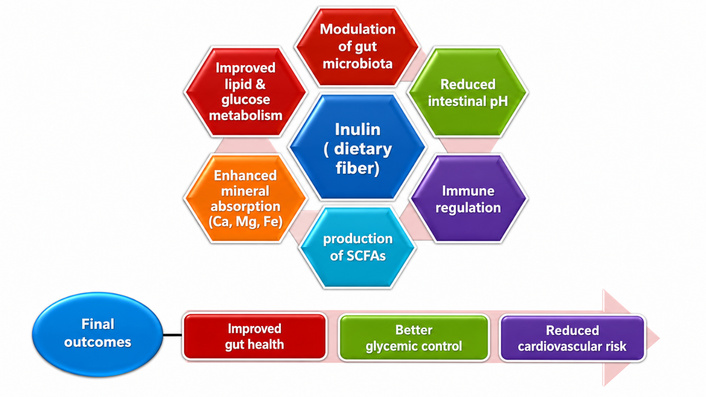
Many immune cell types, including T cells, innate lymphoid cells (ILCs), and macrophages, are present in the intestinal lamina propria [100]. Several studies have shown that the role of inulin in regulating immune cell activation and cytokine secretion largely depends on its intestinal metabolites, such as SCFAs [101]. More importantly, SCFAs can also enter the circulation and regulate immune cell function in other tissues [102]. Several recent studies have shown that SCFAs are critical factors in balancing adaptive immunity and immune tolerance [93, 103]. SCFAs produced by inulin fermentation maintain immune homeostasis by suppressing excessive innate responses and stimulating specific adaptive immunity [99]. The health benefits of inulin are presented in Figure 3.
Inulin is a mixture of polymers of fructose with a DP, usually enriched in long-chain products. Due to its particulate gel-forming properties when mixed with water, inulin alters the texture and provides a fat-like mouthfeel to meals. Fat replacers may be combined; examples include those based on lipids, proteins, and carbohydrates. Fat replacers can also be used in meal replacements, meat products, sauces, and soups to produce low-fat products with a luscious and creamy mouthfeel and a water-controlled texture [104, 105]. Sausage fat, texture, and appearance can be reduced by adding inulin. Fructan analysis was used to assess the heat- and processing-stability of inulin [106]. Another study has demonstrated that fermented chicken sausages using inulin as a fat substitute remain stable for 45 days when stored at 4°C without loss of physicochemical, microbiological, or sensory properties [107]. Fat substitution and acceptable flavor can be achieved with a combination of 15% inulin in biscuits [108].
Low-fat dairy products benefit from inulin’s improved mouthfeel properties. Long-chain inulin makes low-fat yogurt smoother. Because inulin has a slight sweet or bland flavor and no effect on viscosity, its low concentration does not alter food properties [77]. Inulin modifies the texture of dairy products due to its distinct properties. Inulin modifies the texture and flavor of dairy products. The extent of polymerization determines the properties of inulin. Oligofructose, the short-chain, has a sweet taste that is less soluble compared to the original short-chain fructose. The sweet nature of inulin enhances its mouthfeel. The original inulin has higher viscosity and solubility than the long-chain inulin, according to [109].
Inulin-type fructans are appropriate sugar substitutes. FOS and oligofructose are superior sugar replacers to inulin-type prebiotics of higher MW and longer chains, which are less soluble. These shorter-chain oligomers are much more soluble than sucrose. They behave like glucose syrup or sugar and have a sweetness of 35–55% sucrose. Inulin from dahlia tubers can be extracted with hot water, obtaining an 8–10% sugar that is slightly sweet. Other processing procedures are available for making a high-quality sugar substitute. Through inulin enzymatic hydrolysis, a powder or an oligofructose syrup is produced, containing free sugars. Sucrose FOS produces a good-tasting inulin-like prebiotic. Most of the oligofructose syrups and powders are less sweet than table sugar. Mixing with powerful sweeteners is a way of obtaining the required sweetness. This oligofructose synergizes with powerful sweeteners, therefore making it useful in food. Thus, it enhances the sweetness of powerful sweeteners and suppresses their aftertaste. Inulin and strong sweeteners have been used collectively to replace sugar. It masks the sweetness and the aftertaste of acesulfame-K and aspartame. It is therefore apparent that customers who use FOS or oligofructose are using something more than just sugar. Of course, free sugars contribute to the sweetness of inulin-type prebiotics. Inulin and FOS have attracted interest in the food industry for their potential prebiotic and health-promoting properties [110].
The technical and dietary advantages of inulin make it a suitable choice for use as an essential ingredient in a diet, primarily providing dual benefits: enhanced organoleptic qualities and nutritional attributes [111]. As a fiber constituent, inulin primarily improves taste and texture. In breakfast cereals and bakery items, inulin offers significant improvement as compared to alternative fibers. Supplementing baked products with inulin not only helps retain moisture but also keeps them fresh longer while improving crispiness. Its solubility enables the integration of fiber into aqueous media, including drinks, dairy products, thickened beverages, and table spreads. A study conducted with institutionalized adults who received inulin in thickened beverages found increased fiber intake, improved bowel movements, and a 13% increase in weighted stool frequency [112].
Inulin is a carbohydrate-based fat substitute or dietary fiber that exhibits prebiotic properties, hence making it a helpful addition to food as it gels with water. Lactic acid bacteria in yogurt starter cultures ferment it in the colon and not in the small intestine. This supports the development of beneficial bacteria, enhances calcium and magnesium absorption, supports immune function, and reduces cholesterol and blood lipids. In addition, the fermentation of inulin may produce SCFAs such as acetate, propionate, and butyrate, which colon cells prefer as energy sources. Inulin imparts a fat-like mouthfeel and texture to water-based foods, such as dairy. Adding inulin as a fat substitute did not affect PH (P > 0.05). Fat substitutes did not inhibit the culturing of yogurt starter microorganisms. Storage reduced the PH of yogurt significantly. Higher inulin concentrations reduced color score and appeal. Yogurt’s sensory acceptability was maintained when inulin was added at low levels (1%), but as the inulin level increased, the yogurt’s taste, smell, and overall acceptability decreased [113].
Akın et al. (2007) [114] also showed that the inulin did not affect the sensory properties of prebiotic ice cream. The low-fat ice cream became denser than the control due to reduced fat content and the incorporation of inulin. The reduction of fat content affected the yellowness (b*) of the low-fat ice creams, but the incorporation of inulin did not affect the redness (a*) of low-fat ice creams. The low-fat ice cream containing inulin showed a significant reduction in melting resistance compared to the control ice cream.
The melting profile of inulin-free low-fat ice cream was similar to that of ice cream containing inulin. Inulin-containing samples were much softer than inulin-free low-fat ice cream samples [115]. Inulin had no influence on the taste of probiotic ice cream (P > 0.05). Meanwhile, inulin increased viscosity, the time to first dripping, and the complete melting time, but did not affect taste [114]. Inulin lowered freezing-point depression and modified texture and rheology of ice cream, improving its chewiness, flow consistency, and pseudoplasticity. These quality changes may have been due to competition for water, interaction between inulin and milk protein, or both factors [116]. The addition of 2.5% and 5% inulin to low-fat ice cream enhanced its characteristics, including texture, body, and flavor (P < 0.01). Low-fat ice cream containing 2.5% or 5% inulin could melt more evenly, enhancing its texture. Texture could be one of the factors that gives low-fat ice cream with 2.5% and 5% inulin a better body. As a fat substitute, inulin alters physical properties, including texture, and sensory attributes, including “smoothness,” which is related to “hardness” [117].
In aqueous solutions, inulin produces particle gels with a creamy, fat-like consistency. Depending on the inulin concentration (dry matter content), the thermodynamic characteristics and melting transitions of these inulin gels change [35]. Heat-treated sausages could leverage their heat stability for use as both a fat substitute and a probiotic [103]. As a fat substitute, such as inulin, will help stabilize sausage filling, which would otherwise experience increased water loss during heat treatment, thereby affecting its sensory attributes. Also, inulin can be used to replace fats in foods without altering their palatability. In chicken sausages, adding 3% garlic-containing inulin gels decreased fat content from 13.67% (control) to 4.47–4.85%. Garlic inulin was concluded to be beneficial in enhancing taste and acceptability; thus, it can be applied as a substitute for fat [118].
Textural, rheological, and sensorial attributes of bread are more significant in terms of technology than others. Inulin at 5.7% concentration did not affect the taste of white bread as a fat substitute, as reported in studies. Inulin, with its strong water-binding properties, has great potential to improve bread technology. Inulin acts as a protective agent for proteins, preventing ice crystal recrystallization in dough during freezing. Hydrogen bonding in inulin, along with its hydrophobic interactions with proteins, helps retain gluten. For example, frozen dough with 2.5% long-chain inulin showed a protective effect for gluten proteins compared with bread containing 5% short-chain inulin. Previous inulin has a higher density in gluten. In gluten-free bread dough, long-chain inulin can replace gluten due to its gel-forming properties, potentially enhancing bread technology [119]. Through reduced starch gelatinization and reduced water absorption, inulin could interact with disulfide bridges and CO2 retention in dough. Another crucial component for controlling staling rate is inulin inoculum, which partially shifts water [120]. Table 3 summarizes the application of inulin in food products.
Inulin in food products.
| Food products | Functions of inulin | Interpretation/Mechanism | References |
|---|---|---|---|
| Low-fat yogurt | Fat replacer, texture improver | Inulin forms a gel-like structure that mimics fat texture, improving creaminess, viscosity, and mouthfeel in low-fat yogurt. | [18] |
| Ice cream | Fat replacer, texture improver, stabilizer | Inulin forms a microcrystalline gel network that mimics the creamy sensation of fat, improving body, smoothness, and mouthfeel in reduced-fat ice cream. It also increases viscosity, improves melting stability, & reduces ice crystal growth through water binding capacity. | [121] |
| Cheese | Fiber enrichment, texture improver, moisture retainer | Inulin interacts with the cheese protein matrix and binds water, improving softness, creaminess, and moisture retention. | [122] |
| Bread | Texture improver, fiber enrichment, anti-staling agent, glycemic response reducer | Inulin increases water absorption and dough viscosity through hydrogen bonding with water and starch components. It improves crumb softness and delays staling by reducing starch retrogradation during storage. It also slows carbohydrate digestion and glucose absorption, contributing to a lower glycemic response. | [123] |
| Biscuits & cakes | Sugar replacer, texture modifier, moisture retainer | Inulin provides partial sweetness similar to sugar due to fructose residues while increasing water binding capacity in batter systems. Different degree of polymerization (DP) influence viscosity, batter aeration, softness, and final texture of cakes and biscuits. It also helps retain moisture and improve product stability during storage. | [49] |
| Meat sausage | Fat replacer and water-binding agent, texture improver | Inulin forms a microcrystalline gel network with high water-holding capacity, improving emulsion stability, texture, juiciness, and reducing cooking loss in reduced-fat meat. | [124] |
| Beef burger | Rheological modifier and fat mimetic | Inulin with different degrees of polymerization enhances viscosity and gel formation, mimicking the lubricating and structural properties of fat in meat matrices. | [51] |
| Fermented beverages | Prebiotic and probiotic stabilizer | Inulin acts as a fermentable substrate for probiotic microorganisms, enhancing bacterial viability, metabolic activity, and storage stability. | [125] |
Inulin is a valuable natural ingredient in the food sector. Inulin, sourced from chicory, Jerusalem artichoke, dahlia, and garlic, exhibits excellent prebiotic activity, enhances lipid metabolism and mineral absorption, promotes glycemic control, and offers gut-health benefits, owing to its unique fructan structure and several physicochemical properties. Modern extraction techniques, such as microwave-assisted, ultrasound-assisted, and enzyme-assisted methods, significantly enhance yield, purity, and efficiency compared to conventional processes. Its bioactive compounds extend shelf life, inhibit lipid oxidation, and reduce microbial spoilage in meat and other food matrices, such as dairy products and bakery products, making it a promising natural alternative to synthetic preservatives. Recent studies suggest a synergistic effect when inulin and garlic are combined, particularly in prebiotic, antimicrobial, and functional food applications. Their integration can enhance nutritional value, improve textural quality, and offer natural preservation benefits, also increasing shelf life by inhibiting spoilage microorganisms.
DP: degree of polymerization
DSC: differential scanning calorimetry
FOS: fructooligosaccharides
FTIR: Fourier transform infrared spectroscopy
GIT: gastrointestinal tract
MAE: microwave-assisted extraction
MW: molecular weight
S/L: solid-to-liquid
SCFAs: short-chain fatty acids
UAE: ultrasound-assisted extraction
VLDL: very low-density lipoprotein
XRD: X-ray diffraction
SSS: Conceptualization, Investigation, Writing—original draft, Writing—review & editing. AD, NP, and SKS: Conceptualization, Investigation, Project administration, Software, Supervision, Validation, Visualization, Writing—review & editing. All authors read and approved the submitted version.
The authors declare that they have no conflicts of interest.
Not applicable.
Not applicable.
Not applicable.
Not applicable.
Not applicable.
© The Author(s) 2026.
Open Exploration maintains a neutral stance on jurisdictional claims in published institutional affiliations and maps. All opinions expressed in this article are the personal views of the author(s) and do not represent the stance of the editorial team or the publisher.
Copyright: © The Author(s) 2026. This is an Open Access article licensed under a Creative Commons Attribution 4.0 International License (https://creativecommons.org/licenses/by/4.0/), which permits unrestricted use, sharing, adaptation, distribution and reproduction in any medium or format, for any purpose, even commercially, as long as you give appropriate credit to the original author(s) and the source, provide a link to the Creative Commons license, and indicate if changes were made.



View: 1297
Download: 33
Times Cited: 0