Original Article


Affiliation:
1Bioprocesses & Bioproducts Research Group, Food Research Department, School of Chemistry, Autonomous University of Coahuila, Saltillo 25280, Coahuila, Mexico
ORCID: https://orcid.org/0009-0007-4649-0964

 ,
,
Affiliation:
2CIICyT - Centro de Investigación e Innovación Científica y Tecnológica, Universidad Autónoma de Coahuila, Saltillo 25070, Coahuila, Mexico
Email: Paola.melendez@uadec.edu.mx
ORCID: https://orcid.org/0000-0003-3970-2862
 ,
,
Affiliation:
1Bioprocesses & Bioproducts Research Group, Food Research Department, School of Chemistry, Autonomous University of Coahuila, Saltillo 25280, Coahuila, Mexico
ORCID: https://orcid.org/0000-0001-6535-2558
,
Affiliation:
3Faculty of Professional Studies Zona Huasteca, Universidad Autónoma de San Luis Potosí, Ciudad Valles 78290, San Luis Potosí, Mexico
ORCID: https://orcid.org/0000-0002-5866-2678
,
Affiliation:
4Toxicology Laboratory, School of Chemistry, Autonomous University of Coahuila, Saltillo 25280, Coahuila, Mexico
ORCID: https://orcid.org/0000-0002-8385-6191
,
Affiliation:
1Bioprocesses & Bioproducts Research Group, Food Research Department, School of Chemistry, Autonomous University of Coahuila, Saltillo 25280, Coahuila, Mexico
ORCID: https://orcid.org/0000-0001-5092-1404
,
Affiliation:
5Laboratory of Nanobiosciences, School of Chemistry, Autonomous University of Coahuila, Saltillo 25280, Coahuila, Mexico
ORCID: https://orcid.org/0000-0002-7457-5371
,
Affiliation:
1Bioprocesses & Bioproducts Research Group, Food Research Department, School of Chemistry, Autonomous University of Coahuila, Saltillo 25280, Coahuila, Mexico
Email: alberto_ascaciovaldes@uadec.edu.mx
ORCID: https://orcid.org/0000-0001-6595-863X
Explor Foods Foodomics. 2026;4:1010186 DOI: https://doi.org/10.37349/eff.2026.1010186
Received: October 01, 2025 Accepted: July 26, 2026 Published: September 02, 2026
Academic Editor: Yutang Wang, Federation University Australia, Australia
Aim: This study aimed to analyze the entrapment processes of polyphenols using sodium alginate and gelatin for the development of potential food supplements and to evaluate biological properties.
Methods: Entrapment beads containing pomegranate peel polyphenols were prepared by ionic gelation with sodium alginate and calcium chloride to achieve the optimal concentrations, while the gelatin gums were made artisanally according to the manufacturer’s recipe. To characterize the supplements, total polyphenol content, entrapment efficiency, antioxidant capacity, and prebiotic, antimicrobial, and hemolytic activities were assessed.
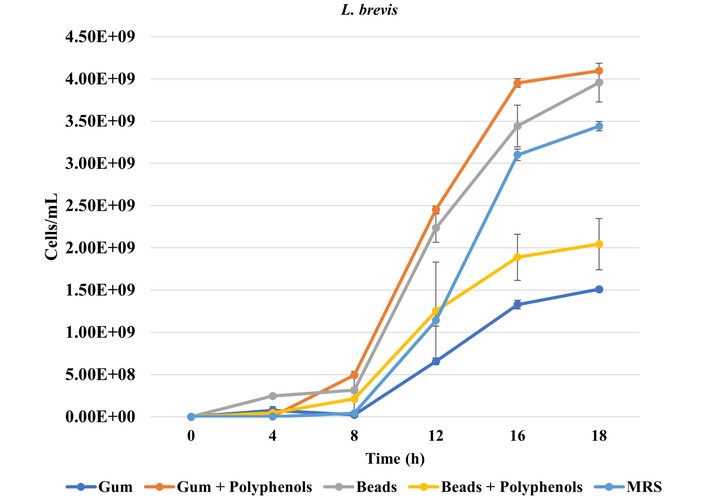
Results: After the entrapment processes, the polyphenol content was 22.03 ± 0.39 mg/L for alginate beads and 67.00 ± 0.76 mg/L for gums, with entrapment efficiencies of 2.20% and 6.70%, respectively. Regarding biological activities, the antioxidant activity was 77.92% acid 2,2-azino-bis(3-etilbenzotiazolina-6-sulfónico) (ABTS) and 50.06% 1,1-diphenyl-2-picrylhydrazyl (DPPH) for alginate beads, and 39.66% for ABTS and 22.60% DPPH for gums. For prebiotic activity, gums with polyphenols favored the growth of Levilactobacillus brevis (4.10 × 10⁹ cells/mL) and Lacticaseibacillus paracasei (2.49 × 10⁹ cells/mL) strains.
Conclusions: These findings suggest that it is possible to develop food supplements with biological properties using naturally occurring bioactive compounds from non-conventional sources through entrapment processes, although process optimization is necessary.
Over the last few decades, evidence has shown that poor nutrition, as reflected in human health, is linked to an unhealthy daily diet and to risk factors for the most prevalent diseases in Mexico, such as cardiovascular diseases, diabetes mellitus, and several types of cancer [1]. Poor nutrition also leads older adults to have a weakened immune system, incomplete healing, and slower surgical recovery [2].
As chronic degenerative diseases have risen, people have become more health-conscious, and consequently, the demand for dietary supplements has been increasing since the 1970s [3]. Dietary supplements are complex and concentrated mixtures of active compounds with pharmacological properties [4].
Supplements can be standardized, meaning that the concentration of bioactive compounds is consistent across batches [5]. Generally, dietary supplements, like drugs, are provided in dosage forms (e.g., capsules or tablets); however, they are not intended to treat or prevent specific diseases [6]. Dietary supplements are primarily used to correct nutritional deficiencies and maintain the recommended intake of specific essential nutrients [7].
Bioactive compound studies have been extensively incorporated into various food matrices without compromising their antioxidant, antimicrobial, antiviral, and prebiotic properties. Ellagitannins are compounds studied in vitro and found in pomegranate by-products, with the highest concentrations in the peel. Reports indicate that these compounds exhibit diverse bioactivities, including antioxidant, anticancer, anti-inflammatory, antibacterial, and hepatoprotective effects [8–10]. However, strategies are needed to incorporate ellagitannins into foods to benefit both consumers and the industry, enabling consumers to take advantage of the biological activities demonstrated in experiments.
Entrapment technology, widely used in the food industry due to its low cost and flexibility, is an effective means of protecting bioactive food ingredients from deterioration [11]. Wall materials commonly used to form entrapment include hydrocolloids (gum arabic, alginate, chitosan, pectin), carbohydrates (modified starch, maltodextrin, cyclodextrins), cellulose, proteins (casein, whey protein, gelatin, soy protein), and lipids (hydrogenated vegetable oils, phospholipids, mono- and triglycerides) [12]. Alginate is a non-toxic, versatile, and inexpensive hydrogel. The name generally refers to a family of polyanionic copolymers derived from marine algae [13]. Sodium alginate is a linear copolymer of β-D-mannuronic acid (M) residues bonded to α-L-guluronic acid (G) with 1,4-glycosidic bonds, which is non-toxic, versatile, and inexpensive [14]. Alginate capsules or beads can be prepared by ionic gelation externally or internally. In both cases, use a Ca2+ source. In external gelation, Ca2+ ions diffuse from an external source into the alginate solution at neutral pH. In contrast, in internal gelation, an insoluble calcium salt is already present within the droplets prior to gelation [15–17].
In the supplement market, consumers are seeking food matrices that appeal to all ages, such as gummies, which have emerged as an option for the confectionery industry and have become a preferred vehicle for moms to supplement themselves and their families in recent years. Gummy candy manufacturing uses a gelatin base; the gelling agent determines the gel structure. The most used hydrocolloids in gummy formulations are pectin, starch, agar, and gelatin. All require heating gelatin, typically during the cooking phase of the prepared mixture. This product’s formulation requires sugar, which contributes to its flavor and consistency.
Therefore, this study aimed to analyze methods for encapsulating bioactive compounds, such as polyphenols (using alginate and gelatin), for the development of potential dietary supplements and to evaluate their biological potential.
Inorganic gelation encapsulated sodium alginate as a matrix [18] (Figure 1). Sodium alginate (W201502-1 kg, Sigma-Aldrich) and calcium chloride (4901-1 kg, Sigma-Aldrich) solutions were prepared at different concentrations to determine the concentration that would give the supplement the greatest rigidity (Table 1). Sodium alginate was weighed (1.5, 2.0, and 2.5 g) and then transferred to a beaker containing 100 mL of distilled water. The mixture was magnetically stirred for 10 min and allowed to stand for 24 h to eliminate all bubbles. CaCl2 solutions were prepared at concentrations of 0.005 M, 0.012 M, 0.050 M, and 1.080 M. After that, tests were conducted with a standard concentration of 2.5% sodium alginate, with CaCl2 concentrations of 1.08 M, 0.50 M, 0.20 M, 0.12 M, and 0.05 M.
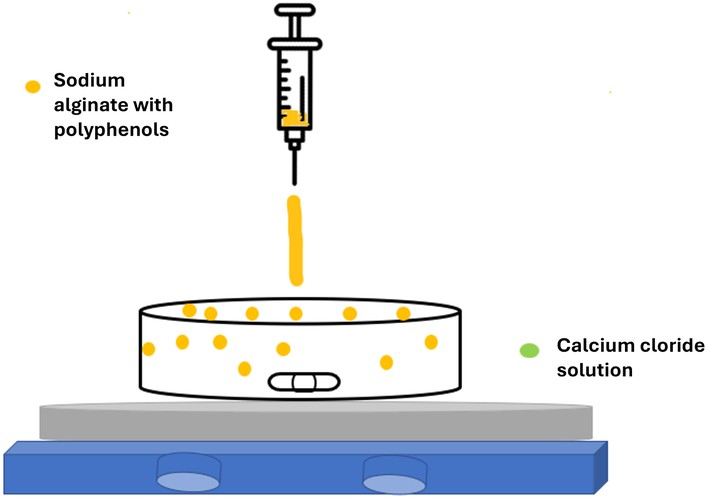
Entrapment of pomegranate peel polyphenols by ionic gelation. Schematic diagram based on [19].
Concentrations of encapsulants tested.
| Material | Concentrations | |
|---|---|---|
| First test | Second test | |
| Sodium alginate | 1.5 g2.0 g2.5 g | 2.5% |
| Calcium chloride (CaCl2) | 0.005 M, 0.012 M, 0.050 M, 1.080 M | 1.08 M0.50 M0.20 M0.12 M0.05 M |
2.5 g of sodium alginate was placed in a beaker with 90 mL of water and magnetically stirred for 10 min. The mixture was then allowed to stand at room temperature for 24 h. After the specified time had elapsed, 100 mg of pomegranate peel polyphenols extracted by the ultrasonic/microwave method [20] were weighed, placed in a 10 mL conical tube, and sonicated for 5 min. Then, the polyphenol solution was mixed with the alginate mixture, stirred gently with a spatula for 5 min, placed in an agitator for 5 min, and finally ultrasonicated for 30 min. It was then left to stand for 30 min until all bubbles were eliminated.
The entrapment equipment was a Buchi Model 390 (Switzerland); the sodium alginate solution with polyphenols was agitated, and solutions of CaCl2 concentrations were prepared. The operating conditions were: 400 μm nozzle; 0.63 bar air pressure to supply the inlet solution to the nozzle; 600 Hz vibration frequency used to break the laminar liquid; 370 V used to create an electrostatic field between the nozzle and the hardener solution to avoid coalescence of the microdroplets; 15 cm distance between the nozzle and the hardener solution.
Bead formation was repeated at a 1.5% alginate concentration using 0.12 M, 0.24 M, and 0.50 M alginate solutions, with the same procedure used to prepare the alginate solutions containing polyphenols and CaCl2.
Subsequently, at the end of entrapment, the resulting beads were weighed, and drying kinetics were carried out for 4 h, sampling every 30 min until constant weight, in a desiccator at 40°C. Two additional drying tests were performed for each CaCl2 concentration under the same drying conditions.
The bead elaboration process was repeated using 1.5% alginate at 0.12 M, 0.24 M, and 0.50 M, following the same procedure for preparing the alginate solution with polyphenols and CaCl2. Finally, the drying process was repeated using an oven at 37°C for 2 h to visually assess the homogeneity of the beads’ coloration, shape, and texture. The experiments were conducted in triplicate using a completely randomized design.
Gummy preparation followed the methodology of [21] with modifications. Process stages: 1) mixing of solids: gelatin (Jello-Mexico), sweetener sucrose (S7903-1 kg, Sigma Aldrich), and citric acid (251275-500 g, Sigma Aldrich); 2) addition of water at 90°C; 3) addition of pomegranate peel polyphenols at a concentration of 1,000 mg/L. To find a gum with a resistant consistency, five formulations were prepared, as shown in Table 2.
Formulations of gummies with polyphenols.
| Formula | #1 | #2 | #3 | #4 | #5 |
|---|---|---|---|---|---|
| Gelatin (g) | 13 | 22 | 36 | 29 | 12 |
| Water 90°C (mL) | 240 | 220 | 222 | 240 | 90 |
| Citric acid (mL) | 10 | 1 | 9 | 4.5 | 1.5 |
| Sucrose (g) | 45 | 45 | 45 | 45 | 18.75 |
Performed tests were to dilute the gelatin gums and the alginate beads before evaluating the biological properties in vitro. The polyphenol-containing gelatin gums (1.5 g) were diluted in water at 40°C, then vortexed for 5 min. The diluted alginate beads (3 g) were suspended in 3% sodium citrate (71497-250 g, Sigma Aldrich); both dilutions were performed at room temperature for 15 min.
The content of condensed and hydrolyzable polyphenols in pomegranate peel extracts was quantified using the HCl-Butanol and Folin-Ciocalteu methods [22], respectively. The experiment was performed in triplicate for each treatment. As reference standards, catechin (condensed tannins, 0–1,000 mg/L; 43412-10 mg, Sigma Aldrich) and gallic acid (hydrolyzable tannins, 0–500 mg/L; 27645-250 g, Sigma Aldrich) were used in a calibration curve for each family. The total polyphenol content was calculated as the sum of hydrolyzable and condensed polyphenols.
The entrapment efficiency was performed according to a previously described study [23] using the following equation (Equation 1):
TPCe is the total phenol content encapsulated in beads, while TPCi is the total phenol content in the initial extract solution used for entrapment.
The assay was performed according to the method of [24] with slight modifications. ABTS+ was formed by mixing an acid 2,2-azino-bis(3-etilbenzotiazolina-6-sulfónico) (ABTS) stock solution (7 mM; A1888-1 g, Sigma Aldrich) and potassium persulfate (2.45 mM; 216224-100 g, sigma Aldrich) in distilled water. The mixture was then kept at room temperature in the dark for 12–16 h. The assay was performed on 2,000 μL of cells. The reaction was initiated by mixing 100 μL of the sample solution or diluted Trolox (238113-1 g, Sigma Aldrich) with 900 μL of diluted ABTS+ (absorbance 0.7 at 734 nm). The absorbance decrease was measured at 734 nm after 1 min incubation of each cell. The scavenging effect was expressed as percent radical scavenging activity using the following equation (Equation 2):
The method used for DPPH radical scavenging activity is based on [25], with some modifications. Both alginate beads and gummies were diluted, as mentioned above. The DPPH (D9132-1 g, Sigma Aldrich) solution was prepared in methanol at a concentration of 60 mM. The reading blank used was methanol (1779337-1 L, Sigma Aldrich). 7 μL of each sample and 193 μL of DPPH radical were placed in a 96-well microplate. The samples were capped and incubated for 30 min to protect them from light. Subsequently, absorbance was measured at 517 nm using an Epoch microplate spectrophotometer (BioTek, Winooski, VT, USA). The DPPH radical scavenging effect was expressed as shown in the following equation (Equation 3):
The stimulation of probiotic bacteria growth by phenolic compounds present in dissolved gummies and alginate beads was evaluated using the methodology described in [26]. The prebiotic bacterial strains Levilactobacillus brevis and Lacticaseibacillus paracasei, belonging to the strain collection of the Food Research Department of the Autonomous University of Coahuila, were used. These bacterial strains were activated in a Man Rogosa Sharpe (MRS) culture medium (50729-500 g, Difco) and incubated at 37°C for 24 h. On the day of the experiment, the exponentially growing bacterial culture was diluted in sterile saline (S9888-1 kg, Sigma Aldrich) to a final concentration of 1.5 × 10⁸ colony-forming units per milliliter (CFU/mL). The experiments were carried out in MRS broth (50503-500 g, Difco) without glucose and supplemented with 3% of the previously diluted gummies and alginate beads. Each well was inoculated with 4.17 µL of each bacterial suspension (1.5 × 10⁸ CFU/mL) and serial dilutions of the gummies and beads treatments, along with blanks and glucose as a positive control. Bacterial growth was monitored every 4 h for 18 h.
The antimicrobial activity of alginate gummies and beads against pathogens such as Escherichia coli (ATCC 29425) and Salmonella typhi (ATCC 6539) was determined according to [27] with some modifications. Bacteria were inoculated on Soya Trypticasein agar (54441-500 g, Difco), and an inoculum adjustment was made to McFarland standards (1.5 × 10⁸ CFU/mL). Once the agar had solidified, holes of approximately 7 mm were drilled, and 50 μL of each dilution was added to each well in triplicate, in addition to adding water as a negative control and antibiotic (Tetracycline; T3258-5 g, Sigma Aldrich) as a positive control. The plates were incubated at 37°C for 24 h, and the cleared areas around the wells were measured to calculate the antimicrobial activity, expressed as arbitrary units (AU) using the following equation (Equation 4):
Hemolytic activity was determined using isolated human erythrocytes, as described in [28] with some modifications. Blood was collected from a healthy, non-smoking volunteer by venous puncture of the arm, following the guidelines of the Ethics Committee of the Faculty of Chemical Sciences for human sample studies. Blood was collected in BD Vacutainer tubes® with sodium citrate (363080) as an anticoagulant. The sample was centrifuged at 2,500 rpm for 4 min at 4°C. The erythrocyte pellet was washed three times with Alsever solution (pH 6.4; A3551-6X500 mL, Sigma Aldrich). Once the washed erythrocyte pellet was obtained, a 1:99 dilution was prepared. It was gently agitated until a homogeneous suspension was formed, which served as the basis for the hemolysis tests. For each test, two experiments were carried out, each in triplicate, with, in addition to the study samples, a negative control (erythrocytes in Alsever solution without the experimental sample) and a positive control (erythrocytes placed in distilled water to achieve 100% hemolysis). The blood samples were incubated with increasing doses (0, 250, 500, and 1,000 µg/mL) of the extract from the gummy bead and alginate bead dilutions for 60 min of incubation at 37°C. At the end of this period, the tubes were centrifuged to separate the supernatant, of which 1 mL was placed in multiple cells for absorbance determination at 415 nm. Hemolytic activity was quantified according to Equation 5.
The results were statistically evaluated by analysis of variance (ANOVA) to determine significant differences between samples. Analysis of means was performed by the LSD Fisher procedure at p < 0.05 using Infostat software version 2020.
The supplements proposed in the present work are alginate beads and gelatin gums, prepared without and with the addition of pomegranate peel polyphenols (control and treatment, respectively).
To obtain supplements with organoleptic characteristics similar to those already established in the market, we used different concentrations of CaCl2 and sodium alginate for the bead format. On the other hand, the concentrations of gelatin and citric acid varied in the gums until obtaining the optimal products for the remainder of the determinations.
In the beads, the concentrations selected for the research were sodium alginate at 1.5% and CaCl2 at 0.12 M; the beads had an average size of 3.60 mm (Figure 2). Formulation 5 of the gelatin gums was chosen (12 g of gelatin and 1.5 mL of citric acid); the gelatin gums were prepared in molds with an average diameter of 6.75 mm. These were the selected combinations to continue with the investigation using polyphenols.
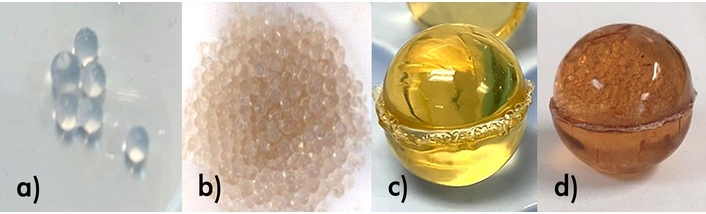
Visual appearance of alginate beads and gelatin gums with and without polyphenols. a) Control alginate bead, b) alginate bead with polyphenols, c) control gelatin gum, d) gelatin gum with polyphenols.
The supplements were dried to preserve the polyphenols. However, the beads lost their characteristic shape after dehydration, making complicated chewing and dissolution necessary for subsequent tests; thus, we discarded the option of a dry supplement for possible technological applications.
The total polyphenolic content of alginate beads and gelatin gums with pomegranate peel polyphenols and their respective controls is shown in Figure 3.
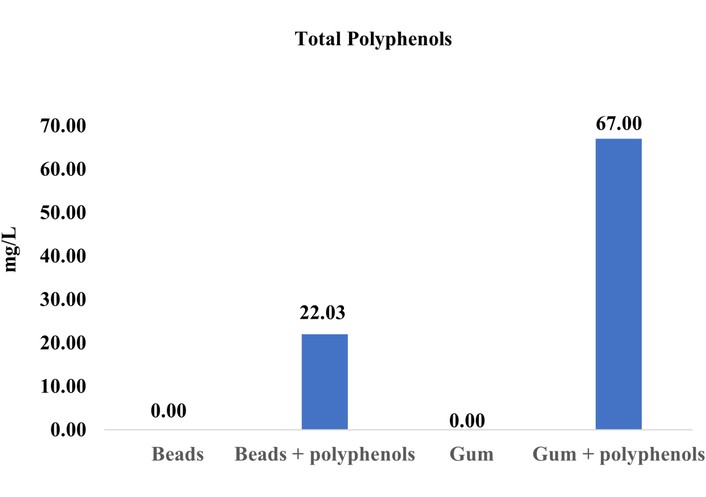
Total polyphenolic content of beads with polyphenols, gums, and controls for each treatment.
The content of polyphenols extracted, partially purified, and applied in the preparation of the alginate beads and the gelatin gummies was 1,000 mg/L. In the polyphenols gummies, a concentration of 67.00 ± 0.76 mg/L was quantified, which was the treatment with the highest polyphenolic content among the supplements; the polyphenols bead had 22.03 ± 0.39 mg/L, and both controls were adjusted to zero (Figure 3).
The polyphenol treatments yielded the expected results for polyphenol quantification. The bioactivity and efficiency of these polyphenols are discussed in the next paragraphs of this document.
The entrapment efficiency was 2.20% for the beads and 6.70% for the gums (Table 3).
Entrapment efficiency.
| Treatment | Entrapment efficiency |
|---|---|
| Bead with polyphenols | 2.20% |
| Gum with polyphenols | 6.70% |
Among the biological activities reported for the polyphenols, the antioxidant capacity is the most widely explored and used to design alternative and/or natural supplements. Using two free radical-trapping techniques, ABTS and DPPH, we evaluated this capacity.
Table 4 shows the results obtained, where the control treatments did not show significant differences in antioxidant activity between them (bead ABTS 7.72%, DPPH 4.78%; gum ABTS 9.88%, and DPPH 3.27%); concerning the treatments, the beads had significantly different results than the gum (ABTS 77.92%, DPPH 50.06% versus ABTS 39.66%, DPPH 22.60%, respectively).
Antioxidant activity results.
| Sample | % ABTS | % DPPH |
|---|---|---|
| Control bead | 7.72 ± 0.26 | 4.78 ± 0.09 |
| Polyphenol bead | 77.92 ± 0.15 | 50.06 ± 0.14 |
| Gum control | 9.88 ± 0.62 | 3.27 ± 0.83 |
| Gum polyphenols | 39.66 ± 1.13 | 22.60 ± 1.38 |
The probiotic strains selected for the study yielded convincing results regarding the influence of the supplements proposed in this work as potential prebiotics. In the L. brevis strain, the highest number of cells (4.10 × 10⁹ cells/mL) was obtained with the supplement of gums with polyphenols, while the control culture in the MRS medium reached only 3.44 × 10⁹ cells/mL, and the bead treatment without polyphenols was the best in this presentation, with a total of 3.96 × 10⁹ cells/mL. These three treatments were significantly different from the results obtained with the bead containing polyphenols (2.04 × 10⁹ cells/mL) and the gum without polyphenols (1.51 × 10⁹ cells/mL) (Figure 4).
Regarding L. paracasei strain, the best responses were obtained with the bead without polyphenol supplementation (2.61 × 10⁹ cells/mL) and the gum supplemented with polyphenols (2.49 × 10⁹ cells/mL); such results are significantly different from those obtained with the polyphenol-supplemented bead (1.22 × 10⁹ cells/mL), the unsupplemented gum (8.86 × 10⁸ cells/mL) and the MRS broth positive control (8.89 × 10⁸ cells/mL) (Figure 5).
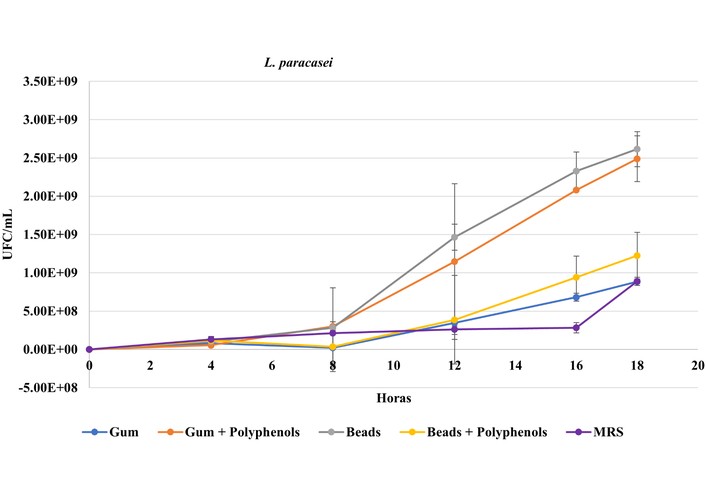
Growth of L. paracasei bacteria on beads and gums with pomegranate peel polyphenols.
The results obtained in this section do not show antimicrobial activity in the treatments analyzed with the strains used. However, the assay is valid, as the tetracycline used as a positive control showed the expected results: 10.2 ± 0.10 mm for E. coli and 11.3 ± 0.15 mm for Salmonella enterica.
To evaluate the potential toxicity of the proposed supplements, we performed the hemolysis test. Healthy erythrocytes were in contact with the treatment solutions, resulting in the data shown in Table 5, which demonstrates that the hemolysis rates were less than 2%.
Hemolytic activity percentage of beads and gums with polyphenols.
| Supplement | 250 µg/mL | 500 µg/mL | 750 µg/mL | 1,000 µg/mL | Positive control |
|---|---|---|---|---|---|
| Gum | 0.224 ± 0.002 | 0.224 ± 0.004 | 0.000 ± 0.003 | 0.000 ± 0.002 | 100 ± 0.048 |
| Bead | 0.793 ± 0.010 | 1.372 ± 0.020 | 0.473 ± 0.140 | 0.214 ± 0.010 | 100 ± 0.020 |
The concentration of sodium alginate is arguably the most critical factor determining morphology, efficiency, and the ability to release bioactive compounds, and this, in turn, allows control over the density of the polymeric network that will hold the active ingredient. If the concentration is insufficient, the polymer chains are not close enough together to form a continuous, robust network. The result is misshapen, fragile microspheres, or the droplet’s inability to maintain its shape upon impact with the calcium chloride bath. On the other hand, an excess of alginate results in a highly dense and compact network. That situation increases the solution’s viscosity, making it difficult to form capsules with uniform morphology and size. According to the literature, at higher calcium concentrations, there is a smaller diameter of the beads [13], attributed to the fact that the CaCl2 concentrations are lower than those used for the other beads; according to other authors, such as [29], who report that the concentration of calcium chloride has an important influence on the characteristics of the resulting alginate beads. Generally, calcium concentration influences bead size [30]. Table 6 summarizes works that used the same entrapment matrices with favorable results.
The concentration of polyphenols decreased, a phenomenon attributed to interactions between the matrices during quantification in the medium [31]. Another finding was the significant difference between the phenolic content of the beads and the gums, a situation evidenced by the higher absorbance reading reported by the gums, attributed to the fact that Folin Ciocalteu reacts with proteins and other carbohydrates, and since the gum has gelatin (80% protein), the response obtained is attributable; besides the possible interaction with sucrose and the Folin Ciocalteu reagent [32]. Other authors reported these possible interactions and noted that the primary considerations in the analysis of the Folin-Ciocalteu assay are that the chemistry is not specific and that other oxidation substrates in each extract sample can interfere in an inhibitory, potentiating, or additive manner [33, 34]. Nevertheless, all these interferences can be quantified, and the data can be adjusted to reflect the true polyphenol concentration.
Previous studies have reported interactions between Folin-Ciocalteu and other compounds, such as phenols, proteins, and thiols, comparable to those in the present study, as proteins and polyphenols were reactive with Folin-Ciocalteu [35]. This phenomenon may also be related to molecular weight and the higher content of hydroxyl groups [10, 36]; studied the interaction between β-lactoglobulin and epicatechin gallate and found that the reaction between the polyphenol and the protein was more favorable with a higher number of hydroxyl groups. In another study, phenolics compounds quantification using the Folin-Ciocalteu method, focusing on the effects of sucrose, glucose, fructose, xylose, and mannose, reported that sucrose showed reactivity; however, fructose was the most reactive. Compared with the results of this study, a strong interaction between sucrose and protein was observed; therefore, the difference may be due to the addition of citric acid, a bioactive compound present in different plants and expected to influence the Folin-Ciocalteu method for phenol evaluation [35].
In addition to the analytical implications mentioned above, it is very important to note that, although the reported entrapment efficiencies may seem low, they allow for a reasonable comparison based on the addition of polyphenols. In this regard, it is important to note that the compounds that were retained in the formulated materials exhibit significant bioactive properties (which will be discussed further).
Phenomenon attributed to the entrapment of polyphenols in the precipitate that formed, which may have prevented complete extraction [37]. On the other hand, it is also possible that the polyphenolic content concentration decreased after the beads were washed and during the entrapment process [38, 39]. Another reason to modify the phenolic content in beads is the wall porosity, which allows the migration of molecules between media [38, 40].
There is a direct correlation between alginate concentration and its ability to bind the bioactive compound. A higher polymer concentration reduces the pore volume within the gel matrix. Crucial for low-molecular-weight compounds, which tend to diffuse outward (leakage) during the curing process in the calcium bath; However, increasing the concentration indefinitely does not always improve bioavailability. If the viscosity is too high, mixing and homogenization of the bioactive compound within the matrix may be inadequate, leading to a non-uniform distribution. Authors [23] performed microentrapment of phenolic extracts of Clitoria ternatea petals by the alginate extrusion method with CaCl2, and their entrapment efficiency was considerably higher compared to the results of the present study, attributed to the extract concentration and the method applied. The literature reports that different microstructures are related to the entrapment method and/or various conditions, as well as to the retention of encapsulated core materials. Working with materials such as sodium alginate and gelatin to encapsulate bioactive compounds (especially small, hydrophilic molecules such as certain polyphenols) often results in low retention efficiencies, which is a common physicochemical challenge in this field of study. This is due to the nature of matrix formation and the compound’s behavior in an aqueous medium. If the resulting capsules are inherently macroporous and retain a large amount of water inside them, and the bioactive compounds to be encapsulated are of low or medium molecular weight and water-soluble, they will not be mechanically trapped within the capsule; instead, they will diffuse or be “washed out” rapidly into the aqueous cross-linking bath, thereby affecting the entrapment efficiency [41–44]. As mentioned above, in this regard, it is important to note that the compounds that were retained in the formulated materials exhibit significant bioactive properties (which will be discussed below).
The observed behavior of the samples is attributed to the reaction between the alginate beads and DPPH, in which a precipitate formed at the bottom of the test tube, with a consistency similar to that of jelly, exhibiting a response similar to that observed with the Folin-Ciocalteu reagent previously mentioned. This behavior is similar to that reported in [26], which used the DPPH assay to assess the antioxidant activity of alginate beads encapsulating polyphenols from Mexican rambutan peel and observed a precipitate upon reaction with the radical.
These analyses show that the polyphenolic content retains high antioxidant activity; however, the decrease in the initial concentration without entrapment may be attributed to interactions between the matrix types used and the radicals involved, which can interfere with the absorbance reading. As is well known, the ABTS and DPPH methods are among the most widely used in research on bioactive compounds, particularly polyphenols, because they provide a standardized, rapid, and comparable metric. In this case, ABTS and DPPH differ: the ABTS radical is water-soluble, while DPPH is hydrophobic, and each material showed a different adaptation or reaction. In the case of the beads, a precipitate formed. Given the results shown compared to the literature, there is another factor that could mediate the results: the complex molecular structures can more easily interpose with each other and prevent access to DPPH at low concentrations and strongly block the reaction at high concentrations [45], coupled that due to washings or some step of the entrapment process would allow the loss of polyphenolic content; although previous studies have suggested that alginate could act as a barrier for the release of polyphenols, protecting them from simulated gastric fluid, allowing them to arrive in greater quantity.
To summarize the most important aspects, the ABTS and DPPH methods are among the most widely used in research on bioactive compounds (primarily polyphenols) because they provide a standardized, rapid, and comparative metric. Since DPPH dissolves primarily in organic solvents (such as methanol or ethanol), it is ideal for lipophilic or moderately polar polyphenols. On the other hand, ABTS is soluble in both water and organic solvents. Using both in the same study allows evaluating the antioxidant activity of both hydrophilic and lipophilic fractions (useful when working with biopolymers such as sodium alginate) [46–48].
Other studies have reported higher antioxidant capacity [19]; however, this study aimed to measure this parameter after product formulation and to identify the qualities of each food matrix based on these criteria. Likewise, it is necessary to quantify and characterize the polyphenols after processing them into gummies and beads to confirm they maintain their structure.
Pomegranate polyphenols demonstrated their prebiotic potential on the intestinal microbiota [49, 50].
This work demonstrates that pomegranate peel polyphenols, when used as a substrate in the gum presentation, stimulate the growth of only L. brevis and L. paracasei. Phenomenon attributed to the presence of the sugar constituent of the gum, which, when metabolized by the lactic acid bacteria, allows them to obtain an accessible source of glucose; some authors have reported that L. paracasei can ferment a variety of monosaccharides and disaccharides, such as glucose, fructose, galactose, tagatose, mannose, ribose, lactose, sorbose, sucrose, maltose, trehalose, and cellobiose [51–53].
Treating beads with pomegranate polyphenols did not produce the desired effect on the two bacteria tested. Sodium alginate is a commonly used material for coating probiotics [54, 55]. However, authors have reported that alginate has disadvantages, including high porosity and susceptibility to low acidic conditions in probiotic food products [56, 57] reported that alginate with inulin has the potential to be used as a matrix for entrapment of probiotic cells in fruit juices, as it did not affect the viability of Lactococcus lactis ABRIINW-N19. Another finding was reported by [58], where they worked with fructooligosaccharides (FOS) from Aguamiel; similarly, they observed growth interference when sucrose was included due to the high sucrose concentration.
On the other hand, the antioxidant activity of different molecules, such as phenolic compounds, varies, which could explain differences in probiotic growth [59]. The literature reports that phenolic compounds from pomegranate peels can act as prebiotics [59, 60]. However, these compounds are usually sensitive to environmental factors, so entrapment alternatives are necessary to demonstrate the extent to which the coating matrix affects their bioactivities.
The results of this study showed that entrapment using sodium alginate did not affect cell growth; however, further in vitro intestinal simulation studies are necessary to corroborate these findings.
The literature provides evidence of the bactericidal effects of polyphenols on Gram-positive and Gram-negative bacteria [61, 62].
Other studies reported that Gram-negative bacteria tend to have more resistance to polyphenols [63] measured the antimicrobial activity of pepper seed oil encapsulated in a gum arabic/maltodextrin matrix against the growth of S. aureus, E. faecalis, E. coli and P. aeruginosa; the results showed that there was no inhibition on any of the Gram-negative microorganisms, while it only showed inhibition with S. aureus which is Gram-positive. Another study with similar results [64] reported that microencapsulation of sour cherry oil using maltodextrin and Arabic gum as encapsulating agents resulted in inhibition of the bacteria evaluated, except E. coli. These results were similar to those obtained in the present study.
Generally, antimicrobial activity varies with the type of encapsulated extract, the strain in question, and the materials used for the entrapment particles; other factors include polyphenol concentration and the encapsulating agents [65–67]. In addition, reports indicate that both Salmonella and E. coli are Gram-negative bacteria and exhibit low susceptibility to antimicrobial compounds, such as polyphenols, due to their lipopolysaccharide outer membrane walls [62], which confer resistance and support. However, another report [65] nano-entrapped pomegranate peel polyphenols using sodium alginate as a matrix. They reported that pomegranate peel polyphenols, both before and after nano-entrapment, inhibited bacteria, including S. enterica, E. coli, S. aureus, and L. monocytogenes. However, the results showed greater inhibition with Gram-positive pathogens, which lack an outer membrane, making them more susceptible to inhibition and/or killing agents.
A material considered for biomedical or food applications must be biocompatible and non-toxic [68]. Some authors have reported that, to be considered non-hemolytic, a material must present less than 5 % hemolysis [69, 70]; with the results obtained, it is possible to state that the proposed matrices can be feasible for improvement as food supplements with polyphenols, as well as the literature reports [71, 72].
Formulating two food supplements using sodium alginate and gelatin gum as food matrices provides another application for these compounds, which have important bioactivities but are sensitive to various environmental factors. Nevertheless, by using food matrices, formulations are prepared to preserve the polyphenolic content, which is the principle by which this product can confer different bioactivities to consumers. Both formulations preserve high antioxidant activity and demonstrate in vitro that they are non-toxic, making them suitable for consumption by the general public. However, they did not demonstrate an inhibitory effect against S. enterica or E. coli.
Likewise, encapsulating gums with polyphenols stimulated the growth of probiotic bacteria; further in vivo tests are needed, along with optimizing both formulations to enhance their effects and corroborate their effects with other bacterial strains. However, higher concentrations of polyphenols or other encapsulating materials, as well as other pathogenic strains, need to be tested, as there is evidence of harmful effects against the strains used and against other microorganisms of food interest.
ABTS: acid 2,2-azino-bis(3-etilbenzotiazolina-6-sulfónico)
ADA: agar diffusion assay
ANOVA: analysis of variance
AU: arbitrary units
CFU: colony-forming units
DPPH: 1,1-diphenyl-2-picrylhydrazyl
FOS: fructooligosaccharides
MRS: Man Rogosa Sharpe
TPCe: total phenol content encapsulated
TPCi: total phenol content in the initial extract solution
The authors thank SECIHTI, a Mexican government agency, for the scholarship provided to Andrea Valero during their postgraduate studies.
AGVM: Investigation, Writing—original draft. NPMR: Conceptualization, Validation, Writing—review & editing, Supervision. MLCG: Resources. JEWP: Methodology, Formal analysis, Resources. AZC: Methodology, Formal analysis. ACFG: Methodology, Formal analysis. MGS: Resources. JAAV: Conceptualization, Validation, Resources, Writing—review & editing, Project administration. All authors read and approved the submitted version.
The authors declare that they have no conflicts of interest.
Not applicable.
Not applicable.
Not applicable.
The raw data supporting the conclusions of this manuscript will be made available by the authors, without undue reservation, to any qualified researcher.
Not applicable.
© The Author(s) 2026.
Open Exploration maintains a neutral stance on jurisdictional claims in published institutional affiliations and maps. All opinions expressed in this article are the personal views of the author(s) and do not represent the stance of the editorial team or the publisher.
Copyright: © The Author(s) 2026. This is an Open Access article licensed under a Creative Commons Attribution 4.0 International License (https://creativecommons.org/licenses/by/4.0/), which permits unrestricted use, sharing, adaptation, distribution and reproduction in any medium or format, for any purpose, even commercially, as long as you give appropriate credit to the original author(s) and the source, provide a link to the Creative Commons license, and indicate if changes were made.



View: 524
Download: 17
Times Cited: 0