Original Article


Affiliation:
Department of Food Science and Technology, Faculty of Technology, Obafemi Awolowo University, Ile-Ife 220282, Nigeria
Email: adebayow@oauife.edu.ng
ORCID: https://orcid.org/0000-0002-2407-7593


 ,
,
Affiliation:
Department of Food Science and Technology, Faculty of Technology, Obafemi Awolowo University, Ile-Ife 220282, Nigeria
ORCID: https://orcid.org/0000-0002-9092-8667
,
Affiliation:
Department of Food Science and Technology, Faculty of Technology, Obafemi Awolowo University, Ile-Ife 220282, Nigeria
Affiliation:
Department of Food Science and Technology, Faculty of Technology, Obafemi Awolowo University, Ile-Ife 220282, Nigeria
Explor Foods Foodomics. 2026;4:1010185 DOI: https://doi.org/10.37349/eff.2026.1010185
Received: December 12, 2025 Accepted: May 17, 2026 Published: August 24, 2026
Academic Editor: Amnart Poapolathep, Kasetsart University, Thailand
Aim: This work focused on numerical modeling of thermal inactivation parameters of Escherichia coli O157:H7 in pretreated watermelon fruit juice as influenced by processing conditions. The work aimed to enhance microbiological safety and information of the product.
Methods: Mature and fresh watermelon fruits were sourced, graded, and processed into juice under hygienic conditions. The extracted juice was pasteurized and allowed to cool. Prior to thermal treatments, the juice was sterilized, cooled, and inoculated with Escherichia coli O157:H7. The inoculated samples were then subjected to different treatments. The effect of pH (4.5, 5.5, and 6.5) and temperature (70℃, 80℃, and 90℃) on thermobacteriological properties was investigated. Meanwhile, Design Expert 13 for Windows was used for experimental layout for interactive impact of pH and inactivation temperatures. All experiments were conducted in triplicate. Thermal inactivation curves of Escherichia coli O157:H7 in the juice samples were obtained by plotting the number of survivors (CFU/mL) against time, and the corresponding D-value was obtained. Other thermobacteriology parameters were subsequently calculated using appropriate equations. The data obtained were fitted into a model using Design Expert 13 for Windows.
Results: Thermal inactivation data obtained showed that the thermal inactivation curve of Escherichia coli O157:H7 in pretreated watermelon juice had a linear interactive effect as temperature and pH varied. As temperature (70–90°C) and pH (4.5–6.5) varied, thermobacteriology parameters such as D-value, F-value, z-value and activation energy ranged from 11.8–23.4 min, 23.6–46.8 min, 8–9.6°C, 32.49–42.03 kJ/mol, respectively. The results showed that Escherichia coli O157:H7 in pretreated watermelon juice demonstrated significant inactivation at a higher temperature of 90℃ and a lower pH of 4.5.
Conclusions: This study provided valuable data that could be employed as a guide for the potential food industry, scientists, and engineers in order to improve the consumption safety of the product.
Fruit juice is a liquid obtained from extracting or pressing natural liquid contained in edible parts of fruits [1]. It has been a commonly consumed beverage in human diets, with evidence of juice production dating back to ancient civilizations in Egypt, Greece, and Rome. As trade routes expanded and new fruits were discovered, the variety of fruit juices available increased, leading to a global fruit juice industry [2]. According to [3], the global fruit juice market has experienced significant growth in recent years, driven by increasing consumer demand for healthy and safe beverages. Amidst these widely consumed fruits, watermelon (Citrullus lanatus), a high moisture content fruit, plays a key role due to its nutritional richness, palatable taste, and vibrant color. Watermelon is a refreshing and nutritious fruit that belongs to the Cucurbitaceae family, which comprises cucumbers, melons, and squash [4]. The fruit is cultivated in Africa, Asia, Europe and America, wherein it occupies the third position among the world’s highly cultivated crops, with China leading globally in its cultivation [5, 6]. The global watermelon production reached 200.2 mt in 2020 [6]. In Nigeria, it is grown extensively in the northern states such as Borno, Adamawa, Yobe, Plateau, Benue and Taraba, facilitated by its increasing consumption rate due to current awareness of its nutritional and medicinal value [6]. Watermelon is rich in carotenoids such as β-carotene and lycopene, which play an essential role in fighting and neutralizing free radicals in the body [4]. Free radicals oxidize cholesterol in the body and make it stick to the walls of the blood vessels, which can lead to a heart attack. Findings have shown that consumption of carotenoids found in watermelon and other fruits such as tomatoes reduces the risk of some diseases such as arthritis and cancer [7, 8]. The fruit has low energy value and high vitamins and minerals such as vitamin K, vitamin C, riboflavin, and iron. It also contains a reasonable amount of protein and fat that can be useful as a protein source in various food formulations and preparations [8].
Approximately one-third of the world’s annual production of fruits and vegetables goes to waste due to postharvest losses, and watermelon is no exception [9]. Storage-related issues caused by spoilage, deterioration, and physiological disorders like bruising and sun scorching result in significant losses for watermelon, with over 40% due to these disorders [9]. Post-harvest losses of watermelon represent a significant challenge in the fruit supply chain due to its high perishability. To address this issue, the fruit is often processed into juice, thereby producing a value-added product. Watermelon juice retains the hydrating properties and nutritional benefits of the fresh fruit due to its naturally high water content, pH, and sugar content [4]. However, these characteristics that contribute to its nutritional appeal also make the juice highly susceptible to microbial spoilage [10, 11]. Spoilage microorganisms commonly associated with fruit juices include Escherichia coli, Bacillus cereus, Staphylococcus aureus, Pseudomonas spp., Saccharomyces cerevisiae, and Clostridium sporogenes [12]. To ensure microbiological safety while preserving the sensory and nutritional attributes of the juice, pasteurization is commonly employed. Pasteurization is the application of heat to inactivate pathogenic and spoilage microorganisms without causing significant degradation of product quality [13]. Pasteurization is used in food industries as a heat treatment to prevent food borne diseases that can be caused by the presence of pathogen causing bacteria such as Escherichia coli from fresh produce of fruits and vegetables which can generate economic loss and food waste. The production of fresh-cut produce of fruits was identified as a potential pathway for dispersion of spoilage bacteria, faecal indicator bacteria such as Escherichia coli or introduction of pathogens via cross-contamination. In this context, inoculating pretreated watermelon juice with Escherichia coli and subjecting it to thermal processing allows determination of pasteurization parameters necessary to ensure the inactivation of this pathogenic bacterial [14]. Therefore, this study investigated the thermal inactivation parameters of Escherichia coli in pretreated watermelon juice under varying pH and inactivation temperature levels. The outcomes of this research would provide valuable insights into optimizing pasteurization processes for enhanced microbiological safety of watermelon juice.
Fresh and mature watermelons were sourced from Obafemi Awolowo University Teaching and Research Farm, Ile-Ife. All chemicals used for this work were of analytical grade and were sourced from Sigma Aldrich MO, USA.
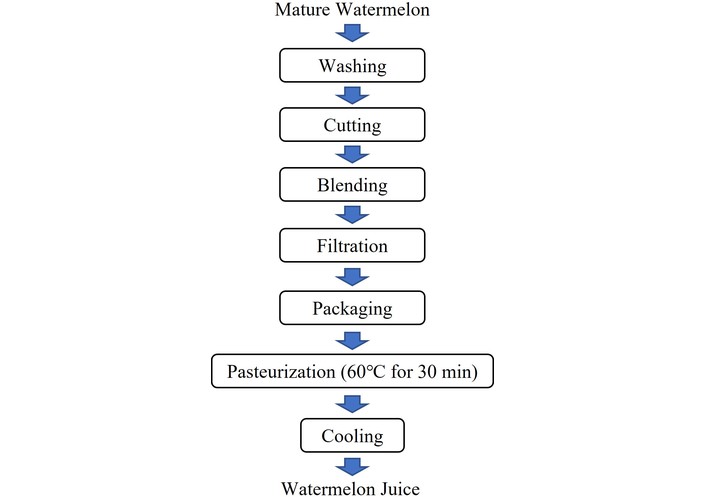
The watermelon juice was processed using the method documented by [15] with slight modification (Figure 1). The fresh and matured watermelon were washed thoroughly using potable water to remove dirt. The cleaned watermelon was cut into four equal parts using a stainless steel kitchen knife and pulp was separated from its rind and seeds. The de-seeded watermelon pulp was blended in a stainless-steel juice blender (Yutai FJ20) at speed 3. The blended juice was then filtered using a sterile 0.5 mm muslin cloth to eliminate fiber residues, yielding a clear juice base liquid. The filtered juice was packaged in well corked cleaned food grade plastic bottles and pasteurized at 60 ℃ for 30 min [15]. The pasteurized juice was cooled and stored in a refrigerator till its further usage.
Bacterial strains, inoculation, and thermal treatment: Pretreated watermelon juice (10 mL) was dispensed into a 25 mL conical flask and sterilized in an autoclave (Infitek Autoclave, Class B, STB-BZ Series). Thereafter, the pH of the juice sample was subsequently adjusted using 0.4 N HCl and 2 N NaOH and confirmed using digital pH meter (Infitek Benchtop pH Meter, PH-B600L). Effect of pH (4.5, 5.5 and 6.5) and inactivation temperature (70℃, 80℃ and 90℃) on thermobacteriological parameters was investigated. Meanwhile, Design Expert 13 for Windows was used for the experimental lay-out for the interactive impact of pH and inactivation temperatures with each run conducted in triplicate (Table 1). The treated watermelon juice in the conical flask was inoculated with 1 mL of 18 h old Escherichia coli O157:H7 strain suspension. Slant containing Escherichia coli was scrapped and washed with sterile distilled water. The optical density of the properly mixed inoculum was adjusted until 0.2 was obtained with a spectrophotometer. The count of 1 mL was then determined with pour plate method [16]. The hot water bath (Neslab GP-400, Newington, NH) was set at predetermined temperatures and the conical flasks were placed in the hot water bath and timed. The come-up time of the sample was verified using a non-inoculated watermelon juice sample in a well labelled conical flask with a K-type thermocouple located at the center of the flask.
Experimental design layout for D-value determination.
| Run | pH | Temperature (°C) | D-value (min) |
|---|---|---|---|
| 1 | 5.5 | 80 | |
| 2 | 5.5 | 80 | |
| 3 | 6.5 | 90 | |
| 4 | 4.1 | 80 | |
| 5 | 6.5 | 70 | |
| 6 | 7.0 | 80 | |
| 7 | 4.5 | 70 | |
| 8 | 5.5 | 66 | |
| 9 | 5.5 | 95 | |
| 10 | 5.5 | 80 | |
| 11 | 5.5 | 80 | |
| 12 | 5.5 | 80 | |
| 13 | 4.5 | 90 |
The come-up time (45, 30 and 20 s for temperatures 70°C, 80°C and 90°C, respectively) for the non-inoculated watermelon juice sample to reach within 0.5°C of the targeted temperature was used as time 0 for the thermal inactivation. Once a particular conical flask reached its predetermined time, it was removed from the hot water bath. The juice samples were removed at an interval of 10 min starting with the time 0 samples. The conical flasks removed were allowed to cool in an ice-filled water bath to terminate thermal treatment, and 1 mL of the watermelon juice sample was introduced into tubes for serial dilution. From the dilution tubes, 1 mL was plated in duplicate on selective agar [Escherichia coli isolation (CBI) agar, HiMedia M911-500G] plates prepared based on the manufacturer’s specification of 28 g to 1,000 mL of distilled water, and the plates were incubated for 24 h at 37°C. The same procedure was applied to the other test tubes at their individual times. After incubation, the number of colonies present on the plates was counted to evaluate the level of survival of the organism.
Conversion of numbers of microbial survival to CFU/mL: Number of Escherichia coli survivors to colony-forming units per g (CFU/mL) was calculated using Equation 1:
where: CFU/mL = number of microorganism survival; N = number of microbial colonies counted; d.f = dilution factor; mL = volume of sample, ml. The CFU/mL was plotted against microbial destruction time, and the D-value, which is the time required at a given temperature to destroy 1 log cycle (90%) of the target microorganism, was obtained as reported by [17].
Determination of rate constant (k-value): The k-value, which measures the rate at which a microbial population is inactivated under constant lethal conditions, was obtained from the slope of the graph of the natural logarithm of the number of survivors (CFU/mL) versus time (Equation 2):
where: k = rate constant; t = time; No = initial population of microorganism; N = number of final population.
Determination of F-value: The F-value, which measures total equivalent time at the reference temperature for the desired overall log reduction, was calculated using Equation 3:
where: D = D-value; No = initial population of microorganism; N = number of final population.
Determination of z-value: z-value which measures temperature change required to change microbial inactivation rate by a factor of 10 was obtained using Equation 4:
where: D1 = D-value at initial temperature, min; D2 = D-value at final temperature; T1 = initial temperature, °C; T2 = final temperature, °C; z = z-value, °C.
Determination of activation energy (Ea): Ea, which measures minimum amount of energy required for inactivation process to occur was calculated using Equation 5 and Equation 6:
where: R = 8.3144; z = z-value, °C; Ea = activation energy, kJ/mol.
All the data were means ± standard deviation. Comparisons between two groups were performed using Student’s t-test. Also, for multiple group comparisons, one-way ANOVA followed by Tukey’s post-hoc test was used. A p-value < 0.05 was considered statistically significant. Statistical analyses were performed using Tukey’s post test procedures of GraphPad Prism version 4.00 for Windows.
The effects of inactivation temperature and pH on the D-value of Escherichia coli O157:H7 in pretreated watermelon juice are presented in Table 2. At pH 4.5, D-values of Escherichia coli O157:H7 in pretreated watermelon juice ranged from 21 to 11.8 min, as inactivation temperature increased from 70–90°C, respectively. At pH 5.5, D-value ranged from 22.6 to 13.7 min, as inactivation temperature increased from 70–90°C; and at pH 6.5, D-value ranged from 23.4 to 14.5 min as inactivation temperature increased from 70–90°C. This showed that as the pH increased (4.5–6.5), there is a corresponding increase in D-value of Escherichia coli O157:H7 in pretreated watermelon juice.
Effect of inactivation temperature and pH on thermal inactivation parameters of Escherichia coli O157:H7 in pretreated watermelon juice.
| S/N | pH | Temperature (°C) | D-value (min) | F-value (min) | z-value (°C) | Activation energy, Ea (kJ/mol) |
|---|---|---|---|---|---|---|
| 1 | 4.5 | 70 | 21.0 ± 1.24c | 42.0 ± 2.37c | 8.0 ± 0.02a | 42.03 ± 2.43b |
| 80 | 17.7 ± 1.12b | 35.4 ± 2.29b | ||||
| 90 | 11.8 ± 1.07a | 23.6 ± 2.26a | ||||
| 2 | 5.5 | 70 | 22.6 ± 1.36c | 45.2 ± 2.39c | 9.2 ± 0.06b | 32.49 ± 2.33a |
| 80 | 18.1 ± 1.20b | 36.2 ± 2.30b | ||||
| 90 | 13.7 ± 1.11a | 27.4 ± 2.25a | ||||
| 3 | 6.5 | 70 | 23.4 ± 2.38c | 46.8 ± 2.41c | 9.6 ± 0.07b | 35.26 ± 2.34a |
| 80 | 20.0 ± 2.22b | 40.0 ± 2.39b | ||||
| 90 | 14.5 ± 2.14a | 29.0 ± 2.28a |
Values are means ± standard deviation, values in the columns with the same superscripts are not significantly different at (p < 0.05).
Influence of inactivation temperature on D-value of Escherichia coli O157:H7 in pretreated watermelon juice at various pH levels was shown in Table 2. At inactivation temperature 70°C, the D-value of Escherichia coli O157:H7 in pretreated watermelon juice ranged from 21–23.4 min, as pH increased from 4.5 to 6.5, respectively. At temperature 80°C, D-value ranged from 17.7 to 20 min, and at inactivation temperature 90°C, D-value ranged from 11.8 to 14.5 min. This showed that as inactivation temperature increased (70–90°C), there is a corresponding decrease in the D-value. The highest D-value (23.4 min) was observed at inactivation temperature 70°C and pH 6.5. It implied that the maximum D-value was recorded at the lowest inactivation temperature and highest pH. Also, the lowest D-value (11.8 min) was observed at inactivation temperature 90°C and pH 4.5.
Interactive impact of inactivation temperature and pH on the D-value of Escherichia coli O157:H7 in pretreated watermelon juice was presented in Figure 2. The Figure showed that at all pH levels investigated, D-value decreased with increase in temperature, indicating a negative gradient along the temperature axis.
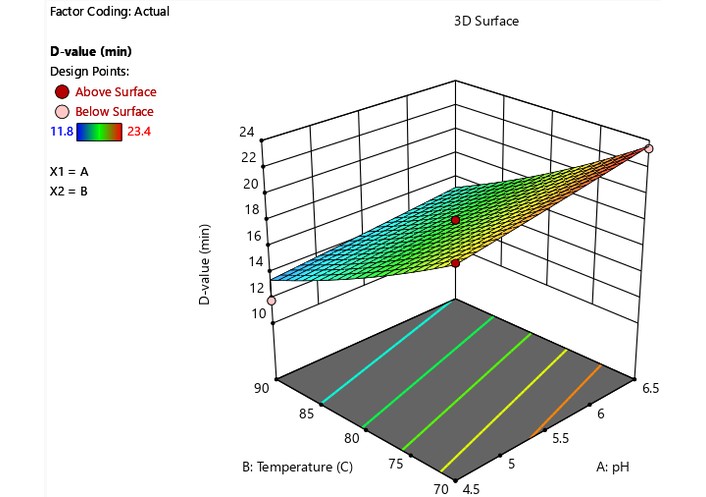
Interactive effect pH and inactivation temperature on D-value of Escherichia coli O157:H7 in pretreated watermelon juice.
In order to select a model that best fits the experimental results, ANOVA was performed on the transformed data. A linear model was selected after a natural logarithm transformation was applied to the D-value to ensure normality. The model for the D-value was highly significant (p < 0.0001) with a coefficient of determination (R2) of 0.922. Independent variables, inactivation temperature and pH, were highly significant at p < 0.0001 and p < 0.0153, respectively. Therefore, a numerical model describing the relationship of inactivation temperature and pH on the natural logarithm of the D-value was presented in Equation 7:
where: D = D-value, min; P = pH; and T = inactivation temperature, °C.
The ANOVA results for the linear model of D-value of Escherichia coli O157:H7 in pretreated watermelon juice were presented in Table 3. The model was found to be highly significant with a high F-value of 59.31 indicating a strong relationship between the independent variables (pH and inactivation temperature) and the dependent variable, D-value. The F-value (59.31) for the D-value implied that the model is significant and there is only a < 0.01% chance that the F-value could occur due to noise. While, p-value less than 0.05 further confirmed that the model terms are significant. Therefore, pH and inactivation temperature are significant model terms for D-value. The adequacy and goodness of fit for the model was evaluated using R2 and adjusted R2. The high adjusted R2 value of 0.9067 indicated that inactivation temperature is a critical parameter in determining D-value. The R2 value of 0.9223 was observed for the D-value and along with a low p-value (< 0.001), depict the statistical significance of the model. The coefficient of variation (C.V.%) value of 2.06% observed for the model indicated a high level of precision and reliability in the experimental data. The model’s robustness is further confirmed by the adequate precision value of 21.85, which indicated an adequate signal-to-noise ratio. This implied that the model can be used to navigate the design space. The predicted optimal D-value for achieving maximum microbial destruction (least D-value) suggested using a higher temperature (90°C) and a more acidic pH (4.5) (Table 4).
Regression analysis of inactivation temperature and pH on D-value of Escherichia coli O157:H7 in pretreated watermelon juice.
| Source | Sum of squares | Df | Mean squares | F-value | P value | Decision |
|---|---|---|---|---|---|---|
| Model | 0.4185 | 2 | 0.2092 | 59.31 | < 0.0001 | Significant |
| A: pH | 0.0301 | 1 | 0.0301 | 8.53 | < 0.0153 | |
| B: Temperature | 0.3884 | 1 | 0.3884 | 110.10 | < 0.0001 | |
| Residual | 0.0353 | 10 | 0.0035 | |||
| Lack of fit | 0.0353 | 6 | 0.0059 | |||
| Pure error | 0.0000 | 4 | 0.0000 | |||
| Cor total | 0.4538 | 12 |
Processing conditions for desirability levels (D-value) of Escherichia coli O157:H7 in pretreated watermelon juice.
| Number | pH | Temperature (°C) | D-value (min) | Desirability | Decision |
|---|---|---|---|---|---|
| 1 | 4.500 | 90.000 | 13.451 | 0.811 | Selected |
| 2 | 4.520 | 90.000 | 13.467 | 0.810 | |
| 3 | 4.500 | 89.876 | 13.488 | 0.807 | |
| 4 | 4.603 | 90.000 | 13.535 | 0.802 | |
| 5 | 4.500 | 89.419 | 13.624 | 0.793 | |
| 6 | 4.833 | 90.000 | 13.725 | 0.782 | |
| 7 | 4.946 | 90.000 | 13.819 | 0.772 |
The summary statistics for the fitted model were presented in Table 5. The model demonstrated a strong fit, with an R2 value of 0.9223 for the D-value of Escherichia coli in pretreated watermelon juice.
Model summary statistics (D-value) of Escherichia coli O157:H7 in pretreated watermelon juice.
| Model summary | D-value (min) |
|---|---|
| Standard deviation | 0.0594 |
| Mean | 2.88 |
| C.V.% | 2.06 |
| R2 | 0.9223 |
| Adjusted R2 | 0.9067 |
| Predicted R2 | 0.8329 |
| Adequate precision | 21.8483 |
The lack of fit test results for various model was presented in Table 6. This test did not produce an F-value and p-value. This could be attributed to the model’s complexity, insufficient degrees of freedom, or lack of replicate measurements in the experimental design. These factors may have led to the inability to perform the test.
Analysis of variance for lack of fit test (D-value) of Escherichia coli O157:H7 in pretreated watermelon juice.
| Source | D-value (min) | ||||
|---|---|---|---|---|---|
| Sum of squares | Df | Mean square | F-value | p-value | |
| Linear | 0.0353 | 6 | 0.0059 | ||
| 2FI | 0.0329 | 5 | 0.0066 | ||
| Quadratic | 0.0260 | 3 | 0.0087 | ||
| Cubic | 0.0000 | 0 | |||
| Pure error | 0.0000 | 4 | 0.0000 | ||
Influence of inactivation temperature and pH on z-value of Escherichia coli O157:H7 in pretreated watermelon juice was presented in Table 2. At pH 4.5, z-value was 8°C as inactivation temperature increased from 70 to 90°C, respectively, in pretreated watermelon juice. At pH 5.5, z-value was 9.2°C; as inactivation temperature increased from 70 to 90°C; and at pH 6.5, z-value was 9.6°C as inactivation temperature increased from 70 to 90°C. This showed that as pH increased (4.5–6.5), there is a corresponding increase in z-value of Escherichia coli O157:H7 in pretreated watermelon juice.
Influence of inactivation temperature and pH on F-value of Escherichia coli O157:H7 in pretreated watermelon juice was presented in Table 2. At pH 4.5, F-value ranged from 42 to 23.6 min, as inactivation temperature increased from 70–90°C, respectively in pretreated watermelon juice; at pH 5.5, F-value ranged from 45.2 to 27.4 min, and at pH 6.5, F-value ranged from 46.8 to 29.0 min. Hence, it can be deduced that as pH increased, there is a corresponding increase in F-value of Escherichia coli O157:H7 in pretreated watermelon juice for all the pH levels considered.
Table 2 also showed the influence of inactivation temperature on F-value at various pH levels of Escherichia coli O157:H7 in pretreated watermelon juice, at temperature 70°C, F-value ranged from 42 to 46.8 min, as pH increased from 4.5 to 6.5 respectively in pretreated watermelon juice; at inactivation temperature 80°C, F-value ranged from 35.4 to 40.0 min, and at inactivation temperature 90°C, F-value ranged from 23.6 to 29.0 min. The highest F-value (46.8 min) was observed at inactivation temperature 70°C and pH 6.5. It implied that the highest F-value (46.8 min) was recorded at the lowest temperature and highest pH. While the lowest F-value (23.6 min) was observed at temperature 90°C and pH 4.5.
Influence of pH on Ea of Escherichia coli O157:H7 in pretreated watermelon juice was presented in Table 2. At pH 4.5, Ea was 42.03 kJ/mol as inactivation temperature increased from 70 to 90°C, respectively in pretreated watermelon juice; at pH 5.5, Ea was 32.49 kJ/mol and at pH 6.5, Ea was 35.26 kJ/mol.
The data obtained indicated that Escherichia coli O157:H7 exhibited greater thermal resistance at less acidic pH levels. Mazzotta (2001) [18] reported similar trends wherein D-values of Escherichia coli O157:H7 in apple, orange and white grape juices at pH 3.9 were 1.5–7.0 min; 1.7–11.0 min, and 1.2–6.1 min, respectively when treated at inactivation temperature 56–60°C. D-values of Salmonella in apple, orange, and white grape juices at pH 3.9 were 1.07–0.09 min; 1.40–0.10 min. and 3.62–0.36 min, respectively, when treated at inactivation temperature 56–62°C [18]. The D-values obtained were higher than 1.5–7.0 min; 1.7–11.0 min and 1.2–6.1 min reported for Escherichia coli O157:H7 in apple, orange, and white grape juices, respectively [18]. However, a lower D-value (3.03–0.24 min) was reported for Escherichia coli K12 in grape juice [19]. The D-values obtained were also lower than 20.3–2.75 min reported for Alicyclobacillus acidoterrestris in carbonated broth [20]. The differences in D-value may be associated with differences in juice compositions, pH value, varying inactivation temperatures and the bacteria strain type being treated [19].
The result showed that D-value of Escherichia coli O157:H7 in pretreated watermelon juice decreased as inactivation temperature increased. Similar trends were reported by [19] for D-value of Escherichia coli K12 in blueberry and cantaloupe juices, wherein the value ranged from 4.55 to 0.44 min and 3.94 to 0.27 min, respectively as temperature increased from 52 to 62°C. The D-values obtained were lower than 23.3–0.34 min, reported for Aspergillus niger in carbonated broth but higher than 5.00–0.43 min; 3.83–0.38 min, and 4.59–0.48 min, documented for Listeria monocytogenes in apple, orange and white grape juices, respectively [18, 20], whereby the D-values decreased as inactivation temperature increased. The differences in D-value may be associated with differences in food samples, pH values, varying inactivation temperature, food composition and the bacteria strain type being treated [19]. The rapid thermal inactivation of Escherichia coli O157:H7 in pretreated watermelon juice may be associated with irreversible damage to proteins, DNA and cell membranes [21, 22].
The data obtained implied that Escherichia coli O157:H7 cells were more rapidly inactivated at elevated temperature. Conversely, the D-value increased with increasing pH, showing a positive gradient along the pH axis. This indicates that Escherichia coli O157:H7 exhibited greater thermal resistance at less acidic pH levels. At low pH (around 4.5), the acidic environment likely weakened the bacterial cell membrane, enhancing susceptibility to heat damage and thus reducing the time required for microbial inactivation. This showed that the combined effect of acidity and inactivation temperature had an influence on microbial lethality, with acidic conditions enhancing the effectiveness of heat treatment. The color gradient ranging from blue (low D-value) to red (high D-value) further visualizes these interactions. Blue and green regions represent conditions where Escherichia coli O157:H7 was rapidly destroyed (low pH and high temperature), while yellow to red regions represent slower inactivation rates (high pH and low temperature).
The z-value result showed that Escherichia coli O157:H7 exhibited greater thermal resistance at less acidic pH levels. Mazzotta (2001) [18] reported similar trends wherein z-value of Escherichia coli O157:H7 in orange, white grape and apple juices at pH 3.9 were 4.9, 5.7 and 5.9°C, respectively when treated at inactivation temperature 56–60°C. The z-value obtained was higher than 5.52 and 7.64°C reported for Alicyclobacillus acidoterrestris in carbonated broth and Escherichia coli K12 in grape juice [19, 20]. The differences in z-value may be associated with factors such as strain type, storage conditions, pH value, inactivation temperature and food matrix [19]. The z-value provides information on how Escherichia coli O157:H7 responded to changes in inactivation temperature and this knowledge is crucial for tailoring thermal treatments to effectively target the organism in pretreated watermelon juice. It also guides in the selection of appropriate temperatures and treatment times to ensure longer shelf life without compromising safety.
The data obtained implied that the lowest F-value (23.6 min) was observed at the highest inactivation temperature and lowest pH. This showed that increasing inactivation temperature reduced the F-value of Escherichia coli O157:H7 at all pH levels because elevated thermal energy accelerates both microbial inactivation and chemical degradation. The F-value played a significant role in food industries, particularly in the context of ensuring food safety, extending shelf life, and maintaining product quality. The data would provide information on the selection of optimal heat treatment conditions in watermelon juice that minimize impact on the quality while ensuring safety, as well as improving production efficiency and reducing energy consumption.
The results showed that as pH increased, there was a corresponding decrease in Ea of Escherichia coli O157:H7 in pretreated watermelon juice for all the pH levels considered. The information on Ea can help food processors or manufacturers to select the suitable temperature and time combination to ensure sufficient microbial reduction, thereby reducing the risk of foodborne illness while preserving product quality [23].
Ea: activation energy
Dr. Waliu Adewale Adebayo acknowledges Late Prof. C. T. Akanbi for inspiring his interest on thermos-bacteriology of foods most especially indigenous ones.
WAA: Conceptualization, Data curation, Formal analysis, Investigation, Methodology, Resources, Project administration, Software, Supervision, Validation, Visualization, Writing—original draft, Writing—review & editing. HAA: Data curation, Formal analysis, Methodology, Project administration, Supervision, Validation, Visualization, Writing—original draft, Writing—review & editing. OA: Investigation, Resources. SNO: Investigation, Resources. All authors read and approved the submitted version.
Authors authoritatively declared there are no conflicts of interest.
Not applicable.
Not applicable.
Not applicable.
Waliu Adewale Adebayo (adebayow@oauife.edu.ng) will make the data of the research work available to any researcher.
Not applicable.
© The Author(s) 2026.
Open Exploration maintains a neutral stance on jurisdictional claims in published institutional affiliations and maps. All opinions expressed in this article are the personal views of the author(s) and do not represent the stance of the editorial team or the publisher.
Copyright: © The Author(s) 2026. This is an Open Access article licensed under a Creative Commons Attribution 4.0 International License (https://creativecommons.org/licenses/by/4.0/), which permits unrestricted use, sharing, adaptation, distribution and reproduction in any medium or format, for any purpose, even commercially, as long as you give appropriate credit to the original author(s) and the source, provide a link to the Creative Commons license, and indicate if changes were made.



View: 509
Download: 19
Times Cited: 0