 Original Article


Affiliation:
Department of Analytical Chemistry, University of Valencia, Jeroni Munoz Building, 46100 Valencia, Spain

Affiliation:
Department of Analytical Chemistry, University of Valencia, Jeroni Munoz Building, 46100 Valencia, Spain
Email: daniel.gallart@uv.es
ORCID: https://orcid.org/0000-0001-5283-2114


Explor Foods Foodomics. 2026;4:1010147 DOI: https://doi.org/10.37349/eff.2026.1010147
Received: September 15, 2025 Accepted: April 08, 2026 Published: May 18, 2026
Academic Editor: Ana Sanches Silva, National Institute of Agrarian and Veterinary Research, University of Coimbra, Portugal
The article belongs to the special issue Food Contaminants: Analysis, Occurrence and Risk Assessment
Aim: Alkylphenols (APs) are synthetic organic compounds widely used in the chemical industry and in consumer products such as detergents, cosmetics, plastics, pesticides, pharmaceuticals, and cleaning agents. These compounds are persistent in the environment, prone to bioaccumulation in aquatic organisms, and exhibit considerable toxicity. Their presence has been reported in a wide range of environmental matrices, including surface water, wastewater, drinking water, sediments, and biological tissues, with concentrations reaching up to 30 μg/L in surface waters. The aim of this work is to study the concentration of APs in drinking water samples from several locations across the Mediterranean basin of Spain in order to establish an assessment of the occurrence of these compounds in these samples.
Methods: In this study, a solid-phase extraction (SPE) method followed by gas chromatography-mass spectrometry (GC-MS) was developed, validated, and applied to determine the presence of APs in water. Two sorbents (C18 and HLB) were evaluated for extraction efficiency, with C18 yielding the best recoveries. The method showed good linearity and low detection and quantification limits, achieving acceptable recovery and precision values across various concentrations.
Results: A set of 64 tap water samples was collected across Spain between February and May 2025, and 4-nonylphenol (4-NP), 4-octylphenol (4-OP), and 4-tert-octylphenol (4-tOP) concentrations were determined. Among the compounds studied, 4-OP was the most frequently detected (73%), followed by 4-NP (34%) and 4-tOP (12%). All detected concentrations were below the legal threshold of 0.3 µg/L, although certain locations showed relatively higher levels.
Conclusions: The results demonstrate the method’s suitability for environmental monitoring and highlight the continued presence of APs in drinking water despite existing regulations, with the 4-alkylphenol (4-AP) being the most prevalent found in the analyzed drinking water.
Alkylphenols (APs) constitute a group of synthetic organic compounds widely used in industrial processes and consumer products, including detergents, cosmetics, plastics, textiles, pesticides, pharmaceuticals, and cleaning agents [1, 2]. Their extensive use is largely linked to alkylphenol ethoxylates (APEOs), a family of nonionic surfactants valued for their emulsifying and detergent properties [2]. However, APEOs are not completely removed during conventional wastewater treatment and undergo both abiotic and biotic degradation, generating more persistent and lipophilic metabolites such as 4-nonylphenol (4-NP) and 4-octylphenol (4-OP) [2, 3]. These transformation products exhibit enhanced environmental persistence, bioaccumulation potential, and toxicity [2, 4], and have been detected in multiple environmental matrices, including surface waters, wastewater, drinking water, sediments, and biological tissues [1, 5, 6], with concentrations reaching up to 30 μg/L in some aquatic systems [2]. Of particular concern are 4-NP, 4-OP, and 4-tert-octylphenol (4-tOP), due to their widespread use and toxicological relevance. In particular, 4-NP is employed as an intermediate in the manufacture of resins, stabilizers, and nonylphenol ethoxylates and can also migrate from food packaging materials [7–10].
APs are widely recognized as endocrine-disrupting chemicals (EDCs), showing affinity for estrogen receptors and acting as agonists capable of inducing feminizing effects in fish and mammals [1–4]. Additional documented effects include immune and endocrine dysfunction, neurotoxicity, DNA damage, carcinogenicity, and reproductive disorders such as male infertility [11, 12]. Importantly, such responses have been observed at concentrations as low as 5 μg/L for 4-NP and 3 μg/L for 4-tOP [7], underscoring the need for sensitive monitoring tools.
Consequently, regulatory interest in APs has increased. The Commission Implementing Decision (EU) 2022/679 includes 4-NP in the watch list for drinking water contaminants, establishing a reference value of 300 ng/L. This requirement has been adopted in Spain through Royal Decree 3/2023 [13]. As a result, analytical methods must be capable of detecting concentrations in the ng/L range, particularly in complex matrices such as wastewater or surface waters, where levels may fall below regulatory thresholds [10].
From an analytical perspective, the accurate determination of APs requires the combination of appropriate sample preparation and advanced chromatographic techniques. Although traditional liquid-liquid extraction (LLE) has been widely used [14], solid-phase extraction (SPE) is now preferred due to its higher efficiency, versatility, and selectivity [15–20]. Other emerging sample preparation approaches include the use of molecularly imprinted polymers (MIPs), which allow highly selective extractions [21], and magnetic SPE (MSPE), which enables rapid and efficient separations through magnetically responsive sorbents [22].
Several analytical techniques have been applied to AP determination in water, including HPLC-UV [23] and LC-MS/MS [24]. However, gas chromatography-mass spectrometry (GC-MS) remains one of the most widely used reference techniques due to its high sensitivity, selectivity, and robust identification capacity [10]. Because APs exhibit low volatility and limited thermal stability, a derivatization step is required prior to GC-MS analysis [25]. Silylation is the most common derivatization approach, with N,O-bis(trimethylsilyl)trifluoroacetamide (BSTFA) being widely used due to its high reactivity and ability to generate volatile, thermally stable derivatives [26, 27]. Other reagents such as N-methyl-N-(trimethylsilyl)trifluoroacetamide (MSTFA), N-tert-butyldimethylsilyl-N-methyltrifluoroacetamide (MTBSTFA) [28], or trimethylchlorosilane (TMCS) [29] have also been employed.
Considering these precedents, the aim of this work is to study the concentration of APs in drinking water samples from several locations within the Mediterranean basin of Spain, in order to establish an overview of the occurrence of these compounds in these samples. For this purpose, an analytical methodology based on GC-MS analysis was applied following an SPE sample-treatment step, selecting the most effective sorbent for the determination of APs in drinking-water samples.
The target compounds 4-nonylphenol (4-NP, 99.9%, CAS 84852-15-3), 4-octylphenol (4-OP, 99.9%, CAS 1806-26-4), and 4-tert-octylphenol (4-tOP, 99.9%, CAS 140-66-9) were purchased from Sigma-Aldrich (St. Louis, USA). Individual stock solutions (500 mg/L) were prepared in methanol and stored at 20°C in the dark. The derivatization reagent BSTFA with 1% TMCS and the internal standard (IS) 4-nonylphenol-2,3,5,6-D4 (4-NP-D4) were obtained from LGC (Toronto, Canada). The solvents used in this study, methanol and ethyl acetate, were also acquired from Sigma-Aldrich.
To perform the SPE extraction, two cartridge types Bond Elut C18 500 mg 3 mL from Varian (Palo Alto, CA, USA) and Supel™ Swift HLB tubes 200 mg 6 mL from Supelco (St. Louis, MO, USA) were employed.
A total of 64 tap water samples were collected from several points of the Mediterranean basin of Spain, including 61 from different locations within the Valencian Community, 1 from the province of Cuenca, and 2 from the province of Barcelona, see Figure S1. Sampling was carried out between February and May 2025. Each sample consisted of 1,000 mL of sample collected in glass bottles, which were immediately stored in a refrigerator at 4°C until analysis to preserve their integrity.
A volume of 500 mL of water sample was extracted by SPE using a C18 cartridge. The cartridge was conditioned with 5 mL of methanol followed by 5 mL of Milli-Q water [30]. Then, 25 µL of 4-NP-D4 as IS was added to the water sample before loading it onto the cartridge, reaching a 50 µg/L final concentration at the end of the whole procedure. Elution is carried out with 4 mL of methanol. The eluate was evaporated under N2 flow until microdrop formation. Subsequently, 25 µL BSTFA was added, and the vial was placed in an oven at 60°C for 30 minutes. After derivatization, 25 µL of ethyl acetate was added, and the sample was analyzed by GC-MS. For quantification, a calibration curve ranging from 20 to 1,000 µg/L was prepared.
The GC-MS analysis was performed using an Agilent 6890 gas chromatograph (Agilent Technologies, Palo Alto, CA, USA) equipped with a 5973 Network mass selective detector and a ZEBRON ZB-5MSplus capillary column (30 m × 0.25 mm × 0.25 µm; Phenomenex, Torrance, CA, USA). Helium was employed as the carrier gas at a constant flow rate of 0.9 mL/min. A 1 µL aliquot of the sample was injected in splitless mode. The injector temperature was maintained at 280°C. The oven temperature program began at 120°C (held for 1 min), followed by a ramp of 15°C/min up to 280°C, with a final hold of 1 min. The mass spectrometer operated in selected ion monitoring (SIM) mode using electron impact ionization at 70 eV. The characteristic ions employed for each analyte are shown in Table 1.
GC-MS conditions, coefficient of determination (R2), and limits of detection (LOD) and quantification (LOQ) for the determination of alkylphenols in samples.
| Compound | RT (min) | Selected ions (m/z)* | R2 | LODinstrumental(ng/L) | LOQinstrumental(ng/L) | LODmethod(ng/L) | LOQmethod(ng/L) |
|---|---|---|---|---|---|---|---|
| 4-OP | 6.62 | 278, 263, 207 | 0.998 | 6 | 20 | 0.6 | 2 |
| 4-tOP | 8.00 | 278, 263, 179 | 0.998 | 9 | 30 | 0.9 | 3 |
| 4-NP | 8.72 | 292, 277, 179 | 0.997 | 6 | 20 | 0.6 | 2 |
| 4-NP-d4 (IS) | 8.72 | 296, 188, 73 | - | - | - | - | - |
*: Data obtained from [10].
The proposed analytical method was validated using tap water (as a blank sample) spiked at three concentration levels in the water matrix: low (5 ng/L), medium (25 ng/L), and high (100 ng/L). After the complete sample preparation and extraction process, these levels correspond to points on the calibration curve at concentrations of 50 ng/L, 250 ng/L, and 1,000 ng/L, respectively. Validation was carried out over three days, with several replicates per level each day, evaluating parameters such as accuracy, selectivity, linearity, precision, repeatability, as well as limits of detection (LOD) and quantification (LOQ).
To perform any statistical analysis of data from this study, Origin Pro 8.5 (OriginLab corporation) and Microsoft Excel were employed.
As part of the development of the SPE method, the first step was to evaluate the most suitable type of cartridge for the extraction of APs from aqueous samples.
In this study, C18 [31–34] and HLB [28, 34, 35] cartridges were selected due to their widespread use and proven effectiveness for the extraction of APs, as reported in previous studies. To compare the performance of both cartridge types, recoveries obtained with C18 and HLB were evaluated. After conditioning each cartridge with 5 mL of methanol and 5 mL of Milli-Q water, 500 mL of tap water spiked at 0.1 µg/L with APs multicomponent standard solution was passed through each cartridge. The procedure was carried out in triplicate, and elution was performed with 4 mL of methanol. The recovery results obtained for each cartridge type are shown in Figure 1. As can be seen, C18 cartridges provided higher recoveries for the three analytes studied, with values of (93 ± 1)% for 4-OP, (99 ± 6)% for 4-tOP, and (93 ± 3)% for 4-NP. In comparison, HLB cartridges yielded recoveries of (69 ± 9)%, (73 ± 6)%, and (52 ± 3)% for 4-OP, 4-tOP, and 4-NP, respectively. These results clearly demonstrate a higher performance of C18 for the studied analytes. This behavior can be attributed to the marked hydrophobic nature of APs, which promotes their retention on non-polar stationary phases such as C18. In contrast, HLB cartridges, designed to retain analytes with varying polarities, may exhibit lower specific affinity toward this type of compound, which explains the observed differences. Moreover, the deviation between replicates was lower for the C18 cartridges, indicating a higher precision in the extraction process using this sorbent. These results support the selection of C18 cartridges as the most effective option for this study, in line with their retention characteristics and compatibility with hydrophobic compounds such as APs.
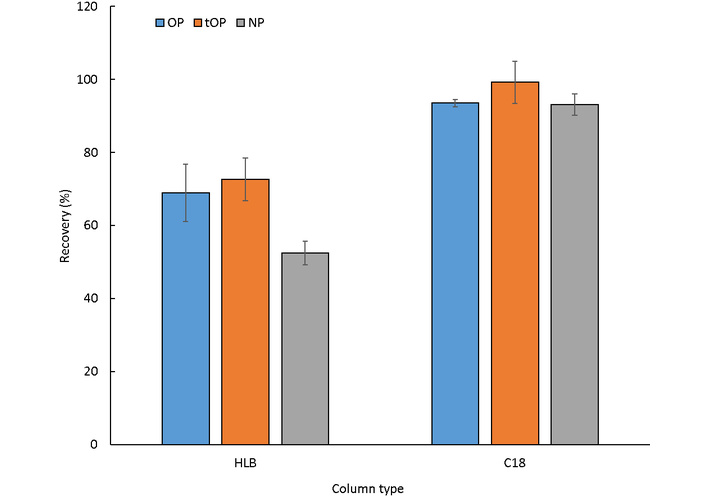
Recoveries obtained for 4-OP, 4-tOP, and 4-NP using C18 and HLB cartridges. 4-OP: 4-octylphenol; 4-NP: 4-nonylphenol; 4-tOP: 4-tert-octylphenol.
Once the C18 cartridge had been selected as the most suitable option, the elution volume was studied to ensure complete recovery while minimizing solvent consumption. The tests were carried out using C18 cartridges under the aforementioned conditions. Each cartridge was conditioned with 5 mL methanol and 5 mL Milli-Q water, followed by the load of 500 mL tap water spiked at 0.1 µg/L APs. Elution was tested with methanol volumes of 2, 4, 6, 8, and 10 mL, and three replicates were prepared for each condition.
The recovery percentages obtained for each elution volume are shown in Figure 2, where it can be seen that the recoveries increase up to 4 mL and remain practically constant and statistically comparable with this volume. On the other side, 2 mL was insufficient, resulting in lower recoveries, spanning a range between 73% to 79% recovery values. Based on these results, 4 mL methanol elution volume was selected as the adequate elution volume, ensuring the complete recovery of the analytes and avoiding unnecessary solvent use.
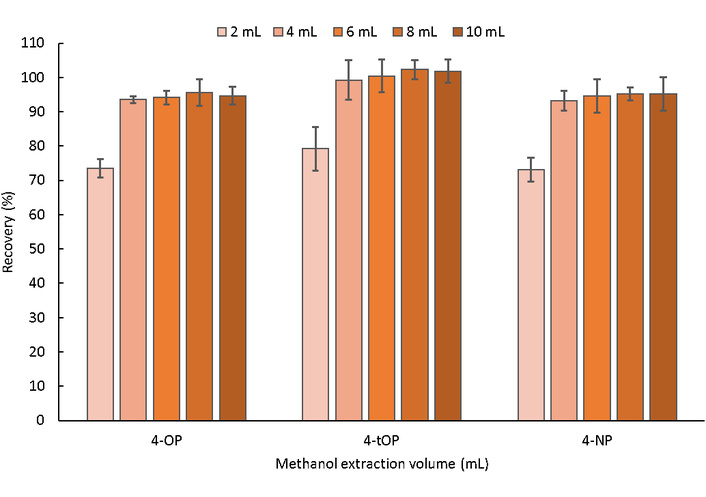
Recovery values obtained in a single-step extraction using different volumes of methanol as eluent solvent. 4-OP: 4-octylphenol; 4-NP: 4-nonylphenol; 4-tOP: 4-tert-octylphenol.
After selecting the elution volume, the effect of sample volume on extraction efficiency was evaluated. For this purpose, two sample volumes, 100 mL of tap water spiked at 0.5 µg/L and 500 mL spiked at 0.1 µg/L, were prepared to develop the extraction study. The procedure was performed in triplicate using previously conditioned C18 cartridges. The results obtained are shown in Figure 3. As can be seen, recovery values obtained for the three compounds were similar when using sample volumes of 100 mL and 500 mL. When a 100 mL volume was employed, the recovery values obtained spanned a range from 92% to 95% for 4-OP, 4-tOP, and 4-NP, respectively. In a 500 mL study, recoveries were from 90% for 4-NP till 98% for 4-OP. Attending to these results, it can be seen that the differences between using those volumes were not significant, and a sample volume of 500 mL was selected for the subsequent experiments, providing a pre-concentration factor of 10,000, enhancing the method’s sensitivity and being enough to reach the legislated values in samples.
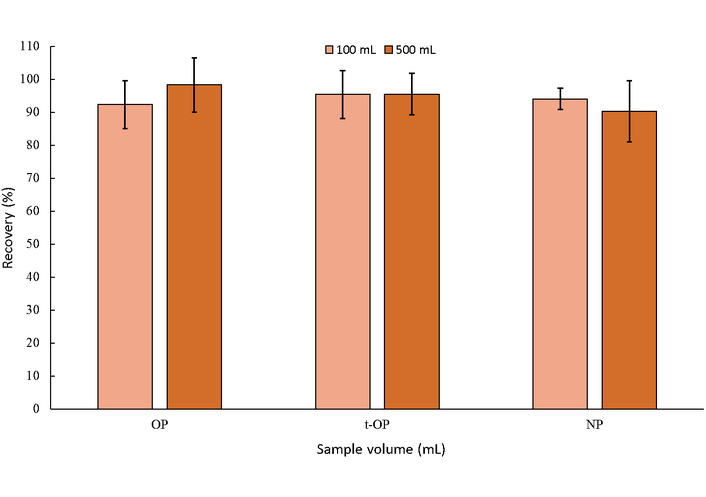
Effect of sample volume employed in the analytes under study on recoveries by using the proposed methodology. 4-OP: 4-octylphenol; 4-NP: 4-nonylphenol; 4-tOP: 4-tert-octylphenol.
The developed methodology was validated in terms of linearity, LOD and LOQ, trueness, and precision.
The method’s linearity was assessed through the calibration curves, constructed using standard solutions in a concentration range from 20 µg/L to 1,000 µg/L. In all cases, a good linear response was observed, with determination coefficients (R2) above 0.997 and residuals lower than 20%.
The instrumental LOD and LOQ were calculated from the peak area deviation of the lowest concentration standard, 20 µg/L, and the slope of the calibration curve. These values ranged from 6 to 9 ng/L for the instrumental LOD, and from 20 to 30 ng/L for the instrumental LOQ, depending on the compound (see Table 1). Taking into account the sample preconcentration step, which provides a preconcentration factor of 10,000, the method LOD and LOQ were calculated by dividing the instrumental values by this factor. The resulting method LOD ranged from 0.6 to 0.9 ng/L, and the LOQ ranged from 2 to 3 ng/L, thus confirming that the method is sensitive enough to detect and quantify APs at very low concentrations in water samples.
Table 2 indicates a comparison of the achieved LOD together with the respective method characteristics obtained in the present study with those reported in the literature for APs determination in different water sample types. As can be seen, several references report LOD in the range of 2 to 7 ng/L, while others show higher values, between 24 and 37 ng/L. One notable exception is a study with a much higher LOD, around 50,000 ng/L, indicating a less sensitive method. On the other side, the comparison with studies regarding the analysis of APs in drinking water showed higher LODs, with the exception of the study performed by dispersive liquid-liquid microextraction prior to GC-MS analysis, which showed LODs in the same order of magnitude as those presented in this work. Overall, these comparisons confirm that the proposed analytical method shows a good sensitivity, allowing for the detection and quantification of APs at very low concentrations in water samples.
Analytical methods, detected compounds, concentration found, and LOD of the employed methodology in the reviewed studies on APs determination in water samples.
| Sample type | Location | Analytes | Method | Concentration (ng/L) | LOD (ng/L) | References |
|---|---|---|---|---|---|---|
| Ground, surface, marine, and wastewater | China | 4-NP, 4-OP, 4-tOP | LLE-GC-MS(DCM + BSFTA) | 4-NP: 2–174-OP: 26–1,8104-tOP: 7 | 2–6 | [6] |
| River water | Philippines | 4-NP, 4-OP | SPE-LC-MS/MS(HLB) | 4-NP: 173–1,8774-OP: 17–62 | - | [30] |
| River water | China | 4-NP, 4-OP, 4-tOP | SPE-GC-MS(HLB; BSTFA + TMCS, 99:1) | 4-NP: 38–2664-OP: 154-tOP:14–34 | 2–7 | [34] |
| Surface water | Poland | 4-NP, 4-tOP | MIP-LC-DAD | < LOD | 50,000 | [36] |
| Raw and treated water | Brazil | 4-NP, 4-OP | SPE-GC-MS(PS-DVB; BSTFA + TMCS, 99:1)LC-MS/MS | 4-NP: 0.04294-OP: 0.002–0.0334 | - | [20] |
| Wastewater | Mexico | 4-NP, 4-OP | SPE-GC-MS(HLB; BSTFA + TMCS, 99:1) | 4-NP: 0.2–18.94-OP: 0.8–58.8 | 2 | [31] |
| Raw and treated wastewater | Canada | 4-NP, 4-OP | SPE-LC-MS/MS(HLB, MAX, C18) | 4-NP: 464-OP: 132 | - | [19] |
| River and canal water | China | 4-NP | MSPE-LC-DAD | < LOD | 17 | [37] |
| Surface water | Mexico | 4-NP | SPE-GC-MS(C18; BSTFA + TMCS, 99:1) | 4-NP: 85.5 | 24–37 | [32] |
| Drinking water | Czech Republic | 4-NP, 4-OP, 4-tOP | SPE-LC-MS/MS(C18; Dansyl chloride) | 4-NP: 4.74-tOP: 1.3 | - | [38] |
| Drinking water | Spain | 4-NP, 4-OP | DLLME-UHPLC-MS(NaHDES) | < LOD | 450–2,990 | [39] |
| Mineral drinking water | Japan | 4-NP | HPLC-ECD | 4-NP: 30 | 19–78 | [40] |
| Drinking water | Spain | 4-NP, 4-OP, 4-tOP | MASE-LC-MS/MS | 4-NP: 81–250 | 8–16 | [41] |
| Drinking water | Iran | 4-NP, 4-tOP | DLLME-GC-MS | 4-NP: 182–9334-tOP: 1.5–19 | 0.28–0.76 | [42] |
| Tap water | Spain | 4-NP, 4-OP, 4-tOP | SPE-GC-MS(C18; BSTFA) | 4-NP: 0.2–37.94-OP: 0.95–76.74-tOP: 0.1–9.5 | 0.6–0.9 | This study |
BSTFA: N,O-Bis(trimethylsilyl)trifluoroacetamide; C18: octadecylsilica; DLLME: dispersive liquid-liquid microextraction; ECD: electron capture detector; FAD: fluorescence array detector; GCMS: gas chromatography-mass spectrometry; HLB: hydrophilic–lipophilic balanced; HPLC: high performance liquid chromatography; LC-MS/MS: liquid chromatography-tandem mass spectrometry; LLE: liquid-liquid extraction; LOD: limit of detection; MASE: membrane assisted solvent extraction; MAX: mixed-mode anion eXchange; MIP: molecularly imprinted polymer; MSPE: magnetic solid-phase extraction; NaHDES: natural hydrophobic deep eutectic solvent; PS-DVB: polystyrene–divinylbenzene; SPE: solid-phase extraction; TMCS: trimethylchlorosilane; UHPLC: ultra-high performance liquid chromatography; UV: ultraviolet.
To evaluate the trueness and precision of the selected method, recovery experiments were carried out at three concentration levels: 50, 250, and 1,000 ng/L. SPE was performed using C18 cartridges and 500 mL of tap water spiked with the target compounds. Each concentration level was tested in triplicate over three different days to ensure consistency and to assess the method’s performance. The recovery results are summarized in Table 3.
Recovery values (%) and intra-day precision values, expressed as RSD (%), obtained for different concentrations of spiked waters analyzed by the proposed methodology.
| Concentration (ng/L) | Recovery (% ± s, n = 9) [RSD, %] | ||
|---|---|---|---|
| Analyte | 4-OP | 4-tOP | 4-NP |
| 50 | 96.5 ± 0.2 [0.2] | 98.2 ± 0.7 [0.7] | 88.2 ± 1.3 [1.5] |
| 250 | 93.3 ± 0.4 [0.4] | 92.0 ± 0.9 [1.0] | 91.7 ± 0.2 [0.2] |
| 1,000 | 88.6 ± 0.5 [0.6] | 99.2 ± 0.6 [0.6] | 89.5 ± 0.8 [0.9] |
4-OP: 4-octylphenol; 4-NP: 4-nonylphenol; 4-tOP: 4-tert-octylphenol.
Recoveries of 4-OP, 4-tOP, and 4-NP were between 88% and 99%, indicating that the selected method provides accurate results in water at all tested concentrations. On the other side, the precision values of the proposed methodology, calculated as RSD (%), spanned a range from 0.2% to 1.5%.
The robustness of the gas chromatographic method, which includes a derivatization step prior to analysis, was assessed by introducing small, deliberate variations in critical parameters to evaluate their influence on method performance. The tested factors included derivatization reaction time and temperature, reagent concentration, injection volume, carrier flow rate, and oven temperature program. Results indicated that these variations did not significantly affect peak resolution, retention times, or quantification accuracy, confirming that the method is robust under typical operating conditions.
The proposed method was applied to the determination of APs in 64 water samples collected from 40 different points in the Mediterranean basin of Spain, see Table 4. Some samples showed high 4-OP concentrations, being lower than the EU legal limit, set as a reference for APs at 300 ng/L for 4-NP, while any sample exceeded this value regarding the concentration of 4-NP. On the other side, the concentration of the individual APs in the remaining samples was under this legislated value or non-detected. These results may be related to lower human contamination, more effective wastewater treatment systems, or reduced use of products containing APs. Those results highlight the performance gain and the practical significance of the proposed methodology when compared with literature studies in a similar sample type, see Table 2. It can be seen that the developed methodology allows the determination of APs in drinking water at lower concentrations than other studies performed with methodologies time consuming and expensive compared to those employed in its development and application.
Concentration of 4-OP, 4-tOP, and 4-NP, expressed as ng/L, found in analyzed samples.
| Region | Code | Sampling location | 4-OP | 4-tOP | 4-NP |
|---|---|---|---|---|---|
| Valencia | SV1 | Ademuz | < LOQ | < LOQ | < LOQ |
| SV2 | Ademuz | 5.1 ± 0.2 | < LOD | < LOQ | |
| SV3 | Alacuas | < LOQ | < LOQ | < LOD | |
| SV4 | Albalat dels Tarongers | 2.6 ± 0.06 | < LOD | < LOD | |
| SV5 | Albalat dels Tarongers | 2.7 ± 0.06 | < LOD | 2.03 ± 0.06 | |
| SV6 | Albalat dels Tarongers | 2.45 ± 0.12 | < LOD | < LOD | |
| SV7 | Aldaia | 6.1 ± 0.03 | < LOD | < LOQ | |
| SV8 | Aldaya | 3.0 ± 0.05 | < LOD | < LOD | |
| SV9 | Almàssera | 5.53 ± 0.07 | < LOD | < LOD | |
| SV10 | Burjassot | 11.01 ± 0.14 | < LOD | 2.19 ± 0.04 | |
| SV11 | Burjassot | 5.9 ± 0.1 | < LOD | 2.64 ± 0.03 | |
| SV12 | Campo Arcís | 11.2 ± 0.8 | < LOD | < LOQ | |
| SV13 | Camporrobles | < LOD | 3.22 ± 0.04 | 37.97 ± 0.14 | |
| SV14 | Canet d’En Berenguer | 15.5 ± 1.5 | < LOQ | 4.02 ± 0.01 | |
| SV15 | Faura | 4.8 ± 0.4 | < LOD | < LOD | |
| SV16 | Faura | < LOD | < LOD | < LOD | |
| SV17 | Foios | 4.2 ± 0.6 | < LOD | < LOQ | |
| SV18 | Foios | 2.6 ± 0.2 | < LOD | < LOQ | |
| SV19 | Godella | 5.37 ± 0.05 | < LOD | < LOQ | |
| SV20 | Godella | < LOQ | <LOQ | < LOQ | |
| SV21 | L’Eliana | 72.08 ± 0.25 | 9.46 ± 0.12 | 7.10 ± 0.08 | |
| SV22 | L’Eliana | 10.16 ± 0.04 | < LOD | < LOD | |
| SV23 | L’Ollería | 2.28 ± 0.02 | < LOQ | 4.45 ± 0.07 | |
| SV24 | Los Santos | 76.7 ± 0.4 | 8.17 ± 0.05 | < LOQ | |
| SV25 | Meliana | 13.53 ± 0.07 | < LOQ | < LOQ | |
| SV26 | Moncada | 2.82 ± 0.03 | < LOD | < LOD | |
| SV27 | Moncada | 10.00 ± 0.06 | < LOD | 3.75 ± 0.07 | |
| SV28 | Museros | 10.69 ± 0.05 | < LOD | 2.56 ± 0.11 | |
| SV29 | Museros | 5.67 ± 0.03 | < LOD | 2.69 ± 0.09 | |
| SV30 | Paterna | < LOD | 5.17 ± 0.04 | < LOD | |
| SV31 | Pobla de Farnals | 3.33 ± 0.06 | < LOD | < LOD | |
| SV32 | Quart de Poblet | < LOQ | < LOQ | < LOQ | |
| SV33 | Rafelbunyol | 2.15 ± 0.05 | < LOD | < LOD | |
| SV34 | Rafelbunyol | 13.97 ± 0.16 | < LOD | 3.06 ± 0.05 | |
| SV35 | Requena | 46.95 ± 0.23 | 5.88 ± 0.05 | 3.93 ± 0.07 | |
| SV36 | Ribarroja | < LOD | 3.81 ± 0.03 | 4.70 ± 0.07 | |
| SV37 | Ribarroja | 16.88 ± 0.13 | < LOD | 3.01 ± 0.06 | |
| SV38 | Silla | < LOQ | < LOQ | < LOD | |
| SV39 | Sinarcas | 5.17 ± 0.06 | < LOQ | 3.15 ± 0.05 | |
| SV40 | Sinarcas | 10.88 ± 0.03 | < LOD | 2.19 ± 0.04 | |
| SV41 | Utiel | 5.66 ± 0.04 | < LOD | 2.31 ± 0.02 | |
| SV42 | Valencia | 2.39 ± 0.02 | < LOD | < LOQ | |
| SV43 | Valencia | 6.96 ± 0.05 | < LOD | 2.48 ± 0.04 | |
| SV44 | Valencia | 6.50 ± 0.06 | < LOD | < LOD | |
| SV45 | Valencia | 5.09 ± 0.04 | < LOD | < LOQ | |
| SV46 | Valencia | < LOD | < LOQ | < LOQ | |
| SV47 | Valencia | 8.38 ± 0.08 | < LOD | < LOD | |
| Alicante | SA1 | Benimarfull | < LOD | < LOQ | < LOQ |
| SA2 | Benissa | < LOQ | < LOQ | < LOQ | |
| Barcelona | SB1 | Cerdanyola | < LOD | < LOQ | 4.33 ± 0.05 |
| SB2 | Cerdanyola | < LOD | < LOQ | 29.28 ± 0.23 | |
| Castellón | SC1 | Almenara | 4.68 ± 0.06 | < LOD | < LOQ |
| SC2 | Almenara | 5.52 ± 0.03 | < LOD | < LOQ | |
| SC3 | Altura | 5.59 ± 0.07 | < LOD | < LOQ | |
| SC4 | Altura | 9.97 ± 0.04 | < LOD | < LOD | |
| SC5 | Burriana | 5.52 ± 0.09 | < LOD | < LOD | |
| SC6 | Burriana | < LOQ | < LOD | 2.21 ± 0.09 | |
| SC7 | Castellón | 7.28 ± 0.02 | < LOD | < LOQ | |
| SC8 | Caudiel | 11.3 ± 0.6 | < LOD | < LOD | |
| SC9 | Caudiel | 12.15 ± 0.07 | < LOD | < LOQ | |
| SC10 | Moncófar | 35.34 ± 0.18 | < LOD | 2.93 ± 0.12 | |
| SC11 | Montanejos | < LOQ | < LOQ | < LOQ | |
| SC12 | Vall d’uixó | 30.13 ± 0.25 | < LOD | < LOQ | |
| Cuenca | SCu1 | Talayuelas | < LOQ | < LOD | < LOQ |
4-OP: 4-octylphenol; 4-NP: 4-nonylphenol; 4-tOP: 4-tert-octylphenol.
Regarding the samples in which APs were detected, the most frequently found compound was 4-OP, present in 73% of the samples (see Figures S2 and S3). This indicates that 4-OP is widely distributed in the aquatic environment studied and may be more prevalent than typically assumed. It also suggests that 4-OP may be more persistent or more frequently released, reinforcing the need to include it as a priority in environmental monitoring programs.
4-NP was detected in 34% of the samples. Although its occurrence was lower than that of 4-OP, it remains significant, particularly considering that 4-NP is a well-known and regulated compound due to its toxicity and endocrine-disrupting effects. Its detection in more than one-third of the samples indicates that, despite regulatory efforts and reductions in use, it continues to be present in the environment.
Finally, 4-tOP was the least frequently detected compound, appearing in only 12% of the samples. This may be attributed to its lower usage or reduced environmental stability. Nevertheless, its detection in several samples shows that it can also contribute to aquatic pollution and should not be overlooked. When the comparison with other literature regions regarding the content of APs in drinking water is performed, it can be seen that 4-NP found in this study is in concordance with those found in regions from Japan [40] or the Czech Republic [38]. In the same way, the concentration levels of 4-tOP found are in concordance with those from regions of Iran [42] and the Czech Republic [38]. On the contrary, other regions from Spain or Iran [41, 42] showed higher concentrations of 4-NP than the concentrations found in the Mediterranean basin of Spain showed in this study.
For 4-NP specifically, the average concentration was 3.0 ng/L, with values ranging from 2.2 to 38.0 ng/L, well below the European Union reference value of 300 ng/L, see Figure S4. These results indicate a consistent yet moderate presence of 4-NP in the analyzed waters, aligning with its known widespread use and environmental persistence.
When compared with studies conducted in other regions, a wide variability in 4-NP concentrations is observed, influenced by both environmental and anthropogenic factors. For example, in three urban areas of Sweden, Uppsala, Norrköping, and Söderköping, 4-NP concentrations in water ranged from below the LOD to 268 ng/L under dry conditions, with median values between 100 and 150 ng/L. Under wet conditions, concentrations decreased, with medians between 60 and 110 ng/L, attributed to dilution effects caused by rainfall [35].
In the Seine River (France), which drains a highly urbanized region, 4-NP concentrations showed similar patterns, ranging from 28 to 157 ng/L with a median of 61 ng/L. These findings suggest that, in addition to direct contamination, factors such as historical discharges and groundwater inputs contribute to the persistent presence of 4-NP in aquatic ecosystems [35].
In Southeast Asia, particularly in the Saigon River (Vietnam), surface water concentrations were very low, around 0.10 ng/L, although urban wastewater reached values up to 1,000 ng/L, indicating that wastewater treatment plants serve as major sources of 4-NP contamination in this region [43].
Conversely, in areas of Malaysia such as the Terengganu rivers, 4-NP concentrations in surface waters were so low that in some years they could not be reliably quantified, falling below detection limits. A decrease in levels was recorded between 2018 and 2019, although their continued presence is associated with constant discharges from wastewater and urban activities [44].
Analyzing a broader set of studies worldwide (see Figure S5), 4-NP concentrations vary considerably depending on region and local conditions. In urban and industrial areas of China and the Philippines, such as Dongying City and the Marikina River, 4-NP levels have reached high values, up to 1,877 ng/L, reflecting greater anthropogenic pressure and possibly insufficient wastewater treatment [6, 30, 34].
Conversely, in regions with lower urban impact or more developed treatment systems, such as Saskatchewan (Canada) and Belém (Brazil), concentrations are generally lower, typically below 50 ng/L [19, 20].
In areas where urban and rural influences coexist, such as the Apatlaco River in Mexico, intermediate values (around 85 ng/L) reflect the mixture of sources and spatial variability in contamination [32].
This regional pattern indicates that 4-NP concentrations largely depend on the degree of urbanization, effectiveness of water treatment systems, and existing environmental regulations. Therefore, it is essential to design specific strategies for monitoring and controlling these contaminants based on local characteristics, ensuring better protection of aquatic ecosystems.
Regarding 4-OP, in this study, concentration ranged from 0.95 to 76.7 ng/L. This presence is comparable to that reported in surface waters of industrial and urban regions, where variable concentrations are observed. For example, in Dongying City (China), levels ranged from 26 to 1,810 ng/L, while in rivers in Mexico and Brazil, concentrations were lower, near tens of ng/L [6, 19, 31]. These differences reflect the higher or lower pollutant load and treatment applied in each area.
Regarding 4-tOP, concentrations in this study ranged from 0.1 to 9.5 ng/L. Although it was detected less frequently in other studies, its presence has also been confirmed in samples from urban and industrial waters, with ranges generally lower than those of 4-NP and 4-OP. However, it remains environmentally significant due to its toxicity and endocrine-disrupting potential [6, 34].
Overall, both 4-OP and 4-tOP follow similar patterns to 4-NP in terms of spatial distribution and dependence on human activity and wastewater treatment quality. Their monitoring is equally important to assess the environmental impact of APs and to design appropriate mitigation strategies.
Focusing on our study, the highest concentrations of 4-OP were found in samples from Los Santos (76.7 ng/L), L’Eliana (72.08 ng/L), and Requena (46.95 ng/L) in the province of Valencia, as well as from Moncófar (35.34 ng/L) in the province of Castellón. For 4-NP, the highest values were recorded in Camporrobles (37.97 ng/L) (Valencia) and Cerdanyola del Vallés (29.28 ng/L) (Barcelona). These locations could be prioritized for more detailed monitoring in future sampling campaigns to determine whether localized contamination sources or seasonal trends are present.
To examine potential differences between regions, the boxplot shown in Figure S6 was created to represent the detected concentrations in each of the three regions considered: Valencia, Castellón, and an “other” category that includes Barcelona, Alicante, and Cuenca.
4-OP was the most frequently detected compound in both provinces, confirming its widespread presence across the study area. In Valencia, 37 out of 47 samples contained quantifiable concentrations (≥ 2 ng/L), ranging from 2.15 to 76.7 ng/L, with a median of approximately 5.4 ng/L. In Castellón, 10 samples had detectable levels, with values between 4.68 and 35.34 ng/L and a slightly higher median of 7.3 ng/L (Figure S6). These findings suggest generalized contamination by 4-OP in both provinces, although concentrations were, on average, somewhat higher in Castellón. This pattern may be related to the persistence of the compound and its widespread use in industrial and domestic applications.
For 4-tOP, quantifiable concentrations (≥ 3 ng/L) were detected only in samples from Valencia, where 6 samples exceeded the LOQ. Values ranged from 3.2 to 9.5 ng/L, with a median of 5.6 ng/L. The absence of detections in Castellón may reflect lower use or discharge of this compound, or possibly more effective removal during wastewater treatment processes. Regarding 4-NP, quantifiable concentrations (≥ 2 ng/L) were detected in both provinces, although with notable differences. In Valencia, 19 samples exceeded the LOQ, with concentrations ranging from 2.03 to 37.97 ng/L and a median value of 3.1 ng/L. In contrast, only two samples from Castellón slightly exceeded the LOQ, with values of 2.21 and 2.93 ng/L. These differences may be attributed to local pollution sources, such as urban wastewater discharges or surface runoff in peri-urban areas of Valencia, where population density and urban activity are generally higher.
Overall, 4-OP appears to be the most ubiquitous compound, whereas 4-tOP and 4-NP show a more limited and localized presence, particularly in Castellón. This distribution pattern may be influenced by regional variations in industrial activity, population density, and the efficiency of wastewater treatment systems. Understanding these trends is essential for establishing priorities in environmental monitoring and developing effective strategies to reduce the impact of these endocrine-disrupting compounds. However, long-term monitoring of nonylphenols, taking into account more sampling sites and the seasonal effect, will enhance those conclusions. Furthermore, its presence in natural environments could be related to anecological risk assessment.
In this study, a method has been developed and applied for the determination of APs in water samples based on SPE followed by GC-MS. During the experimental phase, various conditions were selected to improve the efficiency of the procedure. The selected extraction cartridge was C18, as it provided higher recoveries and better reproducibility compared to HLB cartridges. Regarding the elution volume, 4 mL of methanol was found to be sufficient for the complete recovery of the analytes without unnecessary solvent consumption. A sample volume of 500 mL was selected in order to obtain a high preconcentration factor.
The selected method was applied to the analysis of tap water samples from various provinces. The results showed that 4-OP was the most frequently detected compound, present in 73% of the samples, followed by 4-NP (34%) and 4-tOP (12%). Geographically, the highest and most variable concentrations were observed in Valencia, while Castellón showed lower values. In other provinces with fewer samples, no strong conclusions could be drawn, although APs were also detected in some cases.
Overall, the concentrations found were low and below the legal limit of 0.3 µg/L, although some samples presented relatively high levels. The highest concentrations of 4-OP were found in Los Santos, L’Eliana, Requena (Valencia), and Moncófar (Castellón), while the highest levels of 4-NP were detected in Camporrobles (Valencia) and Cerdanyola (Barcelona). These locations could be studied in more detail in future sampling campaigns to assess potential local pollution sources.
In conclusion, the developed method proved to be effective, sensitive, and reproducible, with results that indicate that despite current regulations, APs are still present in the aquatic environment, which highlights the importance of continued monitoring.
4-NP: 4-nonylphenol
4-OP: 4-octylphenol
4-tOP: 4-tert-octylphenol
APEOs: alkylphenol ethoxylates
Aps: alkylphenols
GC-MS: gas chromatography-mass spectrometry
LOD: limit of detection
LOQ: limit of quantification
SPE: solid-phase extraction
The supplementary material for this article is available at: https://www.explorationpub.com/uploads/Article/file/1010147_sup_1.pdf.
AMV: Investigation, Formal analysis, Writing—original draft. DGM: Conceptualization, Investigation, Formal analysis, Methodology, Writing—original draft, Writing—review & editing, Funding acquisition. Both authors have read and approved the submitted version of the manuscript.
The authors declare that they have no known competing financial interests or personal relationships that could have appeared to influence the work reported in this paper.
Not applicable.
Not applicable.
Not applicable.
The raw data supporting the conclusions of this manuscript will be made available on request.
This work has been supported by the Conselleria d’Educació, Universitats i Ocupació from Generalitat Valenciana project CIAICO2022/217. The funders had no role in study design, data collection and analysis, decision to publish, or preparation of the manuscript.
© The Author(s) 2026.
Open Exploration maintains a neutral stance on jurisdictional claims in published institutional affiliations and maps. All opinions expressed in this article are the personal views of the author(s) and do not represent the stance of the editorial team or the publisher.
Copyright: © The Author(s) 2026. This is an Open Access article licensed under a Creative Commons Attribution 4.0 International License (https://creativecommons.org/licenses/by/4.0/), which permits unrestricted use, sharing, adaptation, distribution and reproduction in any medium or format, for any purpose, even commercially, as long as you give appropriate credit to the original author(s) and the source, provide a link to the Creative Commons license, and indicate if changes were made.



Olga Pardo, Francesc A. Esteve-Turrillas
Clara Ochoa-Esteso ... María Jesús Lerma-García
Daniel Gallart-Mateu
Gabriel Mustatea ... Elena L. Ungureanu
Serkan SUGEÇTİ
Ayodeji Johnson Ajibare ... Abraham Olufemi Asuku
Paula Ponz-Perelló ... David Pérez-Guaita


