 Original Article


Affiliation:
1Faculty of Food Science and Nutrition, Universiti Malaysia Sabah, Kota Kinabalu, Sabah 88400, Malaysia

Affiliation:
1Faculty of Food Science and Nutrition, Universiti Malaysia Sabah, Kota Kinabalu, Sabah 88400, Malaysia
ORCID: https://orcid.org/0009-0004-7288-9897
 ,
,
Affiliation:
1Faculty of Food Science and Nutrition, Universiti Malaysia Sabah, Kota Kinabalu, Sabah 88400, Malaysia
ORCID: https://orcid.org/0000-0001-7512-7397
,
Affiliation:
1Faculty of Food Science and Nutrition, Universiti Malaysia Sabah, Kota Kinabalu, Sabah 88400, Malaysia
ORCID: https://orcid.org/0000-0003-4143-4975
,
Affiliation:
1Faculty of Food Science and Nutrition, Universiti Malaysia Sabah, Kota Kinabalu, Sabah 88400, Malaysia
ORCID: https://orcid.org/0000-0002-6682-207X
,
Affiliation:
2Faculty of Engineering Technology and Science, Higher College of Technology (HCT), Abu Dhabi P.O. Box 25026, United Arab Emirates
ORCID: https://orcid.org/0000-0003-4886-496X
,
Affiliation:
1Faculty of Food Science and Nutrition, Universiti Malaysia Sabah, Kota Kinabalu, Sabah 88400, Malaysia
Email: idamsah@ums.edu.my
ORCID: https://orcid.org/0000-0001-8637-5257

Explor Foods Foodomics. 2026;4:1010136 DOI: https://doi.org/10.37349/eff.2026.1010136
Received: February 05, 2026 Accepted: April 08, 2026 Published: April 21, 2026
Academic Editor: Antonio Di Stefano, “G. d’Annunzio” University of Chieti-Pescara, Italy
Aim: This study aimed to determine the best formulation of gluten-free biscuits made from red rice and cassava composite flour and to evaluate their physicochemical properties, shelf life, and consumer acceptability.
Methods: Five biscuit formulations (F1: 100:0, F2: 75:25, F3: 50:50, F4: 25:75, F5: 0:100; red rice flour:cassava flour) were prepared. Sensory evaluation using a nine-point hedonic scale identified the optimal formulation. The selected biscuit was further analyzed for proximate composition, dietary fiber, total energy, and physical properties (hardness, color, spread ratio, and bulk density). Shelf life was monitored over eight weeks through microbiological counts, water activity, and texture changes. Consumer acceptance was assessed via a market survey.
Results: F3 (50:50) achieved the highest scores for color, aroma, taste, crispiness, and overall acceptance. It contained lower moisture (2.87%) and protein (5.45%) but higher ash (0.81%), carbohydrate (72.46%), dietary fiber (3.57%), and energy (474.03 kcal/100 g) than the control (p < 0.05). Fat and crude fiber contents did not differ significantly among the formulations (p > 0.05). F3 showed lower hardness, darker color, higher spread ratio, and greater bulk density. Microbial counts remained at < 10 CFU g⁻1 and water activity ≤ 0.65 during storage, while hardness gradually decreased. Over 70% of consumers rated the product as highly acceptable.
Conclusions: A 50:50 red rice-cassava formulation produced gluten-free biscuits with favorable nutritional, physical, and sensory qualities and good storage stability, indicating strong potential as a functional snack product.
Rice (Oryza sativa L.) is one of the most important cereal crops globally and serves as a staple food for more than half of the world’s population. Approximately 95% of global rice production originates from Asia, underscoring its critical role in ensuring global food security [1]. Two primary rice species dominate cultivation: Oryza sativa, widely grown in Asia, and Oryza glaberrima, native to Africa [2]. The grain’s structure, comprising bran, endosperm, and germ, provides essential carbohydrates, proteins, and micronutrients that contribute substantially to dietary energy and nutrition [3]. However, the milling process that converts brown rice to white rice commonly consumed in most countries removes the bran and germ layers, resulting in significant nutrient losses, particularly in vitamins, minerals, and dietary fiber [4].
Rice plays a pivotal role not only as a staple food but also as a symbol of cultural heritage, forming the base of traditional cuisines across diverse ethnic groups [5]. The nation’s dependency on rice as a primary carbohydrate source highlights the importance of enhancing local rice production and exploring innovative uses of indigenous rice varieties to support food security and economic resilience [6]. Ongoing efforts in Malaysia focus on improving rice quality, yield, and diversification through the utilization of nutrient-rich pigmented varieties and by-products as functional food ingredients [7, 8].
The rising prevalence of gluten intolerance and celiac disease has spurred growing interest in gluten-free bakery products [9, 10]. Gluten-free biscuits, in particular, have become a popular alternative due to their versatility, wide consumer acceptance, and potential for incorporating nutrient-dense local ingredients [11–14]. Formulating gluten-free biscuits using composite flours such as red rice and cassava not only provides a safe option for individuals with gluten sensitivity but also enhances product diversity, promotes the use of indigenous crops, and reduces reliance on imported wheat [6].
Among the nutrient-dense alternatives, pigmented rice varieties such as red rice have gained attention for their superior nutritional and functional properties [15, 16]. Red rice contains high levels of bioactive compounds, including anthocyanins, proanthocyanidins, γ-oryzanol, phenolic acids, and γ-aminobutyric acid, all of which contribute to antioxidant, anti-inflammatory, and cardioprotective effects [17]. Its mineral content, particularly iron, magnesium, calcium, and zinc are also significantly higher than that of polished white rice [18]. These attributes make red rice a promising functional ingredient for developing health-promoting food products. Cassava (Manihot esculenta Crantz), another key tropical crop, presents additional advantages for sustainable food production. It is highly tolerant to drought, thrives in marginal soils, and is rich in starch (up to 80% dry weight), making it an excellent energy source and a potential raw material for flour-based applications [19, 20]. In Malaysia and other tropical regions, cassava flour has been explored as a partial substitute for wheat flour in bakery products due to its low cost and local availability [21].
The growing demand for wheat-based products such as biscuits has placed increasing pressure on wheat imports, particularly in countries such as Malaysia, where wheat is not cultivated locally. To reduce dependency on imported wheat and enhance product nutritional quality, composite flours prepared by blending wheat with locally available non-wheat ingredients have gained considerable attention [11, 22, 23]. Previous studies have explored the incorporation of various alternative flours, including rice, cassava, and other plant-based ingredients, into bakery products to improve nutritional value and diversify product formulations [24–27]. However, many of these studies have primarily focused on individual flour substitutions or limited aspects of product quality.
Pigmented rice varieties such as red rice have attracted growing interest due to their superior nutritional and functional properties, including high levels of phenolic compounds, antioxidants, and essential minerals [28, 29]. Likewise, cassava (Manihot esculenta Crantz) is a widely cultivated tropical crop known for its high starch content and adaptability to marginal soils, making it an attractive ingredient for sustainable food production [19, 20]. Although both red rice and cassava flours have been individually investigated in bakery formulations, studies examining their combined application in gluten-free biscuit systems remain limited, particularly with regard to their integrated effects on physicochemical properties, shelf-life stability, and consumer acceptance.
Therefore, the novelty of this study lies in the development and comprehensive evaluation of gluten-free biscuits formulated using composite flours derived from red rice and cassava. Unlike previous studies that have primarily focused on single flour substitutions or limited product attributes, this research provides a holistic assessment encompassing physicochemical characteristics, microbiological stability during storage, and consumer sensory acceptance. The findings contribute new insights into the potential of combining nutrient-rich pigmented rice and locally abundant cassava flour as sustainable ingredients for developing value-added gluten-free bakery products.
Accordingly, this study aims to evaluate the physicochemical properties, shelf-life stability, and consumer acceptability of gluten-free biscuits formulated using red rice and cassava composite flours, providing a potential strategy for enhancing the nutritional value of bakery products while promoting the utilisation of locally available crops.
The raw materials used for preparing both the control biscuits and the composite flour biscuits formulated with red rice and cassava flours were all food-grade ingredients procured locally in Kota Kinabalu, Sabah, Malaysia. Wheat flour, cassava flour, margarine, granulated sugar, omega-3 eggs, and salt were purchased from Servay Supermarket (Servay Hypermarket Sdn. Bhd., Kota Kinabalu, Sabah, Malaysia). Red rice (Oryza sativa L.) grains were obtained from Pasar Besar Kota Kinabalu, Sabah, Malaysia. The cassava flour used in this study was a commercial food-grade flour derived from cassava (Manihot esculenta Crantz) with a high starch content typical of cassava-based flours used in bakery applications. The red rice grains were cleaned and milled into flour using a laboratory grinder and sieved through a 250 µm mesh to obtain a uniform particle size prior to composite flour preparation. All ingredients were stored at ambient laboratory conditions (25 ± 2°C) until use.
The preparation of red rice flour was carried out following the procedure of Bolarinwa et al. [30] with minor modifications. Approximately 1 kg of red rice grains was washed thoroughly with distilled water to remove impurities. The cleaned grains were dried in a hot-air drying cabinet (Thermoline Scientific TD-78T-SD, Sydney, Australia) at 40°C for 12 hours or until constant weight. The dried grains were ground into fine flour using a Waring blender (Panasonic MX-898 M, Selangor, Malaysia) at speed level 1 for 5 minutes. The interior walls of the blender jar were scraped at 1-minute intervals to ensure uniform grinding. The milled flour was then sieved using a sieve shaker (Endecotts Ltd., London, United Kingdom) to obtain a uniform particle size of less than 250 μm. The flour was packed in airtight polyethylene bags and stored at room temperature until further use.
The biscuit formulation and preparation were adapted from Montes et al. [31] with slight modifications. Ingredient proportions were determined using the Baker’s percentage method, where the total flour weight represented 100%, and all other ingredients were expressed as percentages relative to this value. Composite flour biscuits were formulated by substituting wheat flour with red rice and cassava flours at different ratios (0–100%), as shown in Table 1. The selection of these ratios was based on preliminary formulation trials and previous studies on composite flour bakery products, which suggested that varying substitution levels allow the assessment of functional, nutritional, and sensory characteristics of the resulting biscuits. Other ingredients, including sugar (40%), margarine (35%), egg (30%), and salt (1%), were kept constant across all formulations to ensure that any observed differences in biscuit properties could be attributed primarily to the variation in flour composition rather than changes in the overall formulation.
Composite flour biscuit formulations based on Baker’s percentage.
| Formulation | Wheat flour (%) | Red rice flour (%) | Cassava flour (%) | Sugar (%) | Margarine (%) | Egg (%) | Salt (%) |
|---|---|---|---|---|---|---|---|
| Control | 100 | 0 | 0 | 40 | 35 | 30 | 1 |
| F1 | 0 | 100 | 0 | 40 | 35 | 30 | 1 |
| F2 | 0 | 75 | 25 | 40 | 35 | 30 | 1 |
| F3 | 0 | 50 | 50 | 40 | 35 | 30 | 1 |
| F4 | 0 | 25 | 75 | 40 | 35 | 30 | 1 |
| F5 | 0 | 0 | 100 | 40 | 35 | 30 | 1 |
Margarine and sugar were creamed using an electric mixer at speed 1 for 3 minutes, with scraping at 1-minute intervals to ensure uniform mixing. The egg was then added and mixed until a homogeneous batter was obtained. Dry ingredients (flour and salt) were sifted and gradually incorporated into the creamed mixture, followed by hand-kneading for 5 minutes to form a firm dough. The dough was rolled to 6 mm thickness, chilled at 4°C for 20 minutes, and cut into 5 cm circular shapes using a standard cutter. The biscuits were baked in a commercial electric oven (Sinmag, Selangor, Malaysia) at 150°C for 15 minutes, cooled at room temperature (25 ± 2°C) for 30 minutes, packed in airtight polyethylene zipper bags, and stored at ambient temperature until sensory evaluation.
A sensory evaluation was carried out in the Sensory Laboratory of the Faculty of Food Science and Nutrition, Universiti Malaysia Sabah, where all participants provided informed consent prior to participation. A nine-point hedonic sensory evaluation was conducted to determine the most acceptable formulation among the five composite flour biscuit samples. The sensory test assessed consumer preference for color, aroma, taste, crispiness, and overall acceptability using a structured 9-point scale (1 = dislike extremely, 9 = like extremely). Fifty untrained panelists participated in the evaluation, following the recommendations of Heymann and Ebeler [32]. Each biscuit sample was coded with a random three-digit number and presented in a randomized order. Panelists were provided with bottled water to cleanse the palate between samples.
The proximate composition, total energy, and dietary fiber contents of the control and selected composite biscuits (red rice-cassava formulation) were determined according to standard methods of the Association of Official Analytical Chemists (AOAC) [33]. Moisture content was determined by the oven-drying method (AOAC 925.10), in which approximately 5 g of sample was dried in a hot-air oven (Binder, Tuttlingen, Germany) at 105°C until a constant weight was achieved. Ash content was determined using the dry-ashing method (AOAC 923.03) by incinerating about 5 g of sample in a muffle furnace (Thermo Fisher Scientific, Massachusetts, USA) at 550°C for 5 h to constant weight. Crude protein was analyzed using the Kjeldahl method (AOAC 979.09), employing a FOSS Kjeltec™ 2300 (Hilleroed, Denmark). The nitrogen content obtained was multiplied by a conversion factor of 6.25 to estimate total crude protein. Crude fat content was determined using the Soxhlet extraction method (AOAC 920.39) with petroleum ether as the extraction solvent in a semi-continuous system (FOSS Soxtec™ 2050, Hilleroed, Denmark). Crude fiber was analysed following AOAC 978.10 using a Fibretherm FT12 system (Gerhardt, Brackley, UK), where defatted samples were sequentially digested with dilute acid and alkali, dried, ashed at 550°C, and the residue loss was recorded as crude fiber. Total carbohydrate content was estimated by difference using the equation: Carbohydrate (%) = 100 – (% moisture + % ash + % protein + % fat + % fiber). Total energy content (kcal/100 g) was calculated using the Atwater conversion factors of 4 kcal g⁻1 for protein and carbohydrates and 9 kcal g⁻1 for fat. Total dietary fiber was determined using the enzymatic-gravimetric method (AOAC 985.29) and expressed as g/100 g of dry sample.
Physical analyses were conducted on both the control biscuits and the best-performing composite formulation containing red rice and cassava flours. The analyses included hardness, color measurement, spread ratio, and bulk density to evaluate the physical characteristics and quality of the biscuit samples. Hardness was measured using a texture analyser (TA.XTPlus, Stable Micro Systems, Godalming, UK) fitted with a three-point bend rig. Each biscuit was placed on two support points, and the probe applied a downward force at the midpoint. The peak force (N) required to fracture each biscuit was recorded as the hardness value. Measurements were obtained at a pre-test speed of 1 mm/s, a test speed of 3 mm/s, a distance of 5 mm, and a trigger force of 50 g.
Color measurement was conducted using a colorimeter (HunterLab ColorFlex EZ, Reston, USA). The surface color of biscuits was recorded in the CIE Lab color system as L* (lightness; 0 = black, 100 = white), a* (− = green, + = red), and b* (− = blue, + = yellow). Three random points on each sample were analysed, and the mean values were reported. The spread ratio, indicating the spreadability and shape of biscuits, was determined according to AACC [34]. Biscuit diameter (D) and thickness (T) were measured using a vernier caliper, and the spread ratio was calculated as D/T. For diameter, four biscuits were placed edge-to-edge on a flat surface and measured in two perpendicular directions; for thickness, four biscuits were stacked vertically, and the total height was measured three times to obtain an average. Bulk density was determined following the method by Mir et al. [35] using the mustard seed displacement technique. Biscuit weight (g) and bulk volume (mL) were recorded, and bulk density was calculated as weight divided by bulk volume. The volume displacement was measured by introducing biscuit samples into a container filled with mustard seeds of known density.
A shelf-life study was conducted to monitor quality changes in both control and composite biscuits during storage. The direct storage method was employed, whereby biscuits were packed in low-density polyethylene (LDPE) zipper bags and stored at ambient temperature (25 ± 2°C). Samples were analyzed at 2, 4, 6, and 8 weeks to evaluate microbiological quality, water activity (aw), and hardness changes during storage. All measurements were performed in triplicate for both control and composite biscuit samples.
Microbiological analysis was performed to determine total yeast and mould counts using potato dextrose agar (PDA). The medium was prepared by dissolving 39.0 ± 0.1 g of PDA powder in 1 L of distilled water, followed by boiling to dissolve completely and sterilisation at 121°C for 15 minutes. Approximately 25 mL of the sterilised medium was poured into sterile Petri dishes and allowed to solidify. For sample preparation, 10 g of biscuit sample was aseptically mixed with 90 mL of 0.1% peptone water in a sterile stomacher bag and homogenized for 5 minutes (Interscience, Shah Alam, Malaysia). Serial dilutions (10⁻1–10⁻4) were prepared, and 0.1 mL of each dilution was spread onto PDA plates. The plates were incubated at 25°C for 5–7 days according to International Standards Organization (ISO) 21527-2:2008 for yeast and mould enumeration (Contherm, Neuenstein, Germany). Only plates containing 25–250 colonies were counted using a colony counter (WTW BZG 30, Florida, USA), and the results were expressed as colony-forming unit per gram (CFU g⁻1).
aw was measured to evaluate moisture availability influencing microbial growth and textural changes. Biscuit samples were analysed using a Rotronic Hygrolab C1 aw meter (Bassersdorf, Switzerland). Prior to measurement, samples were ground and homogenized to ensure uniform surface contact, and the aw values were recorded directly from the instrument display. The hardness of the stored biscuits was determined to assess texture stability during storage using the same procedure described in Physical analysis, employing a TA.XTPlus texture analyser (Stable Micro Systems, Surrey, UK) under identical test conditions.
A consumer acceptance study was conducted at the final stage of product development to evaluate consumer preferences toward the formulated biscuit. The biscuit formulation that obtained the highest overall acceptability score from the nine-point hedonic test was used for this consumer study. A total of 100 untrained respondents were randomly recruited at Gaya Street Sunday Market, Kota Kinabalu, Sabah, Malaysia, a popular public market and tourist destination that attracts a diverse group of local residents and visitors, making it a suitable location for obtaining preliminary consumer feedback. Participants were asked to record their responses regarding appearance, aroma, taste, texture, and overall acceptability using a three-point scale (like, neutral, dislike). The use of a three-point scale allowed rapid consumer feedback in a real-market setting and facilitated participation among respondents with diverse backgrounds. However, the simplicity of this scale may limit the sensitivity of preference discrimination compared with more detailed hedonic scales. In addition, since the consumer survey was conducted at a single market location, the results primarily reflect the preferences of local consumers and may not fully represent broader consumer populations. Nevertheless, the approach provides useful preliminary insights into consumer perception and potential market acceptance of the optimized biscuit formulation.
All data obtained from the nine-point hedonic test were analysed using one-way analysis of variance (ANOVA) under a completely randomized design. Significant differences among mean values were determined using Tukey’s honest significant difference (HSD) test for multiple mean comparisons at a confidence level of p < 0.05. Data derived from proximate composition, total energy, total dietary fiber, physical analyses, and shelf-life studies were analysed using independent sample t-tests to compare the control biscuit with the optimized composite formulation. For the consumer study, frequency analysis was applied to evaluate the distribution of respondents’ preferences. All statistical analyses were performed using IBM Statistical Package for the Social Sciences (SPSS) statistics version 28 (IBM Corp., Armonk, NY, USA).
A total of 50 sensory panelists participated in the nine-point hedonic test, and the results are expressed as mean ± standard deviation (Table 2). No significant difference (p > 0.05) was observed in color scores between the control biscuit and those produced with composite flours at different substitution levels. Among all formulations, F3 (50% red rice flour:50% cassava flour) recorded the highest mean color score, followed by F2. The control, F1, and F4 showed similar values, while F5 (100% cassava flour) had the lowest score. For aroma, F3 achieved the highest score and was significantly higher than the control (p < 0.05). Taste scores for F3, F4, and F5 were significantly higher than the control (p < 0.05), with F3 recording the highest mean value. Crispiness varied significantly among samples, and F3 exhibited the highest score, followed by F4. Significant differences were observed between F3 and the control, F1, F2, and F5 (p < 0.05). Overall acceptability increased significantly from F1 to F3 as cassava flour substitution increased up to 50%, followed by a non-significant decline at higher substitution levels. Formulation F3 achieved mean scores above 7 for crispiness and overall acceptability. Panelists described F3 biscuits as pleasant, flavourful, and well-balanced in texture. Consequently, F3 was selected for subsequent analyses. Figure 1 shows biscuits produced using the F3 formulation and the wheat-based control.
Sensory characteristics of control and composite biscuits formulated with different proportions of red rice and cassava flours.
| Attribute | Control | F1 | F2 | F3 | F4 | F5 |
|---|---|---|---|---|---|---|
| Color | 6.26 ± 2.19a | 6.30 ± 2.10a | 6.38 ± 1.92a | 6.68 ± 2.00a | 6.20 ± 2.30a | 5.82 ± 2.02a |
| Aroma | 5.38 ± 2.09b | 6.16 ± 2.29ab | 6.12 ± 2.13ab | 6.72 ± 2.15a | 6.04 ± 2.09ab | 5.78 ± 2.14ab |
| Taste | 4.78 ± 2.06c | 5.48 ± 2.23bc | 6.12 ± 2.05ab | 6.86 ± 1.82a | 6.56 ± 2.14ab | 6.40 ± 2.18ab |
| Crispiness | 3.96 ± 2.30d | 3.72 ± 2.30d | 4.78 ± 2.41cd | 7.10 ± 1.87a | 6.48 ± 2.14ab | 5.64 ± 2.42bc |
| Overall acceptability | 4.86 ± 2.04c | 4.82 ± 1.89c | 5.82 ± 1.91bc | 7.06 ± 1.87a | 6.56 ± 2.01ab | 6.26 ± 1.98ab |
Data are expressed as mean ± SD (n = 50). Means followed by different superscript letters indicate significant differences between the groups in the same row (p < 0.05). Repeated superscript letters indicate that the means were not significantly different (p > 0.05). F1 (100% RRF), F2 (75% RRF:25% CF), F3 (50% RRF:50% CF), F4 (25% RRF:75% CF), F5 (100% CF). CF: cassava flour; RRF: red rice flour.
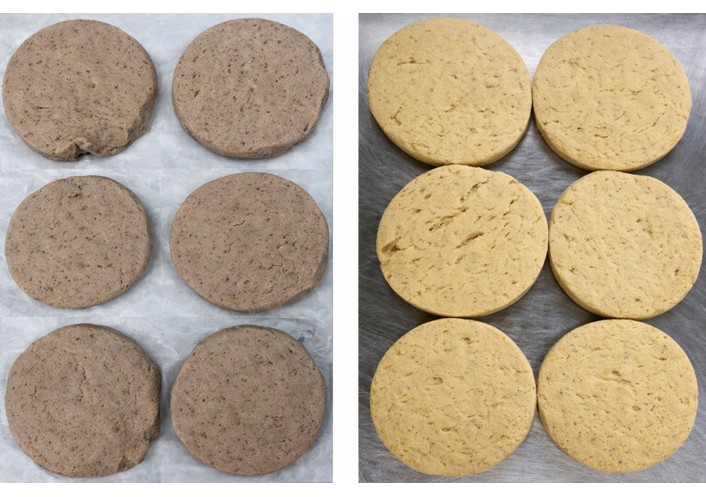
Biscuits produced with red rice-cassava composite flour (F3, left) and biscuits made with 100% wheat flour (control, right). The figure is for illustration purposes only and does not depict the actual size ratio of the samples.
The proximate composition, total energy, and dietary fiber contents of the control biscuit and the optimized F3 formulation are presented in Table 3. The moisture content of the control biscuit was significantly higher than that of F3 (p < 0.05), whereas the ash content was significantly higher in F3 (p < 0.05). Crude protein content was significantly higher in the control than in F3 (p < 0.05). No significant differences (p > 0.05) were observed in crude fat and crude fiber contents between the samples. However, the total dietary fiber content increased significantly in F3 compared to the control (p < 0.05). Carbohydrate content in F3 was significantly higher than in the control (p < 0.05), and the total energy content was also slightly but significantly higher in F3 (p < 0.05).
Proximate composition, total energy, and total dietary fiber content of control and composite biscuits (F3).
| Parameter | Control | F3 (50% RRF:50% CF) |
|---|---|---|
| Moisture (%) | 4.29 ± 0.06a | 2.87 ± 0.07b |
| Ash (%) | 0.73 ± 0.03b | 0.81 ± 0.02a |
| Crude protein (%) | 10.38 ± 0.22a | 5.45 ± 0.05b |
| Crude fat (%) | 18.23 ± 0.37a | 17.25 ± 0.02a |
| Crude fiber (%) | 0.88 ± 0.17a | 1.17 ± 0.06a |
| Total dietary fiber (%) | 1.49 ± 0.04b | 3.57 ± 0.11a |
| Carbohydrate (%) | 65.49 ± 0.68b | 72.46 ± 0.17a |
| Total energy (kcal/100 g) | 470.59 ± 1.43b | 474.03 ± 0.52a |
Values are mean ± SD (n = 3). Means followed by different superscript letters indicate significant differences between the groups in the same row (p < 0.05). Repeated superscript letters indicate that the means were not significantly different (p > 0.05). CF: cassava flour; RRF: red rice flour.
Physical analysis showed that the control biscuit exhibited significantly greater hardness than the F3 formulation (p < 0.05) (Table 4). Color measurements revealed significant differences between samples, with F3 showing lower lightness, higher redness, and lower yellowness values (p < 0.05). F3 demonstrated a significantly higher spread ratio than the control (p < 0.05), and its bulk density was also significantly higher than that of the control (p < 0.05).
Physical properties of control and composite (F3) biscuits.
| Parameter | Control | F3 (50% RRF:50% CF) |
|---|---|---|
| Hardness (N) | 64.58 ± 0.00a | 28.29 ± 0.80b |
| Color | ||
| L* | 78.57 ± 0.24a | 68.70 ± 0.33b |
| a* | 5.27 ± 0.32b | 8.99 ± 0.09a |
| b* | 27.39 ± 0.96a | 19.82 ± 0.18b |
| Diameter (cm) | 10.27 ± 0.09b | 10.93 ± 0.32a |
| Thickness (cm) | 2.77 ± 0.06a | 2.80 ± 0.10a |
| Spread ratio (Rₐ) | 3.71 ± 0.03b | 3.91 ± 0.05a |
| Bulk density (g mL–1) | 0.56 ± 0.01b | 0.66 ± 0.01a |
Values are mean ± SD (n = 3). Means followed by different superscript letters indicate significant differences between the groups in the same row (p < 0.05). Repeated superscript letters indicate that the means were not significantly different (p > 0.05). CF: cassava flour; RRF: red rice flour.
Microbiological count, aw, and hardness of the control and F3 biscuits during the 8-week storage period are presented in Table 5. Shelf-life evaluation indicated that total plate counts for both control and F3 biscuits remained below 10 CFU g⁻1 throughout eight weeks of storage. aw increased gradually over time but remained ≤ 0.65 by week 8. At all storage intervals, F3 exhibited significantly lower aw than the control (p < 0.05). Hardness declined progressively for both formulations during storage; however, F3 remained consistently softer than the control at all time points (p < 0.05).
Microbiological count, aw, and hardness of control and F3 biscuits during 8-week storage.
| Week | Total plate count (CFU g–1) | Water activity (aw) | Hardness (N) | |||
|---|---|---|---|---|---|---|
| Control | F3 | Control | F3 | Control | F3 | |
| 0 | < 10 (est) | < 10 (est) | 0.46 ± 0.01a | 0.40 ± 0.01b | 64.58 ± 0.00a | 28.29 ± 0.80b |
| 2 | < 10 (est) | < 10 (est) | 0.54 ± 0.00a | 0.52 ± 0.00b | 61.15 ± 0.71a | 25.42 ± 0.68b |
| 4 | < 10 (est) | < 10 (est) | 0.60 ± 0.00a | 0.58 ± 0.00b | 47.26 ± 1.35a | 21.63 ± 0.68b |
| 6 | < 10 (est) | < 10 (est) | 0.63 ± 0.00a | 0.60 ± 0.00b | 42.27 ± 0.06a | 19.94 ± 0.34b |
| 8 | < 10 (est) | < 10 (est) | 0.65 ± 0.00a | 0.61 ± 0.00b | 38.80 ± 0.42a | 18.85 ± 0.21b |
Values are mean ± SD (n = 3). Means followed by different superscript letters indicate significant differences between the groups in the same row (p < 0.05). Repeated superscript letters indicate that the means were not significantly different (p > 0.05). CFU: colony-forming unit.
Figure 2 depicts consumer acceptance of sensory attributes of composite flour biscuits. A total of 100 respondents participated in the consumer acceptance study, and over 70% expressed positive acceptance across all evaluated attributes for the red rice-cassava biscuit, indicating favourable consumer perception of the composite formulation.
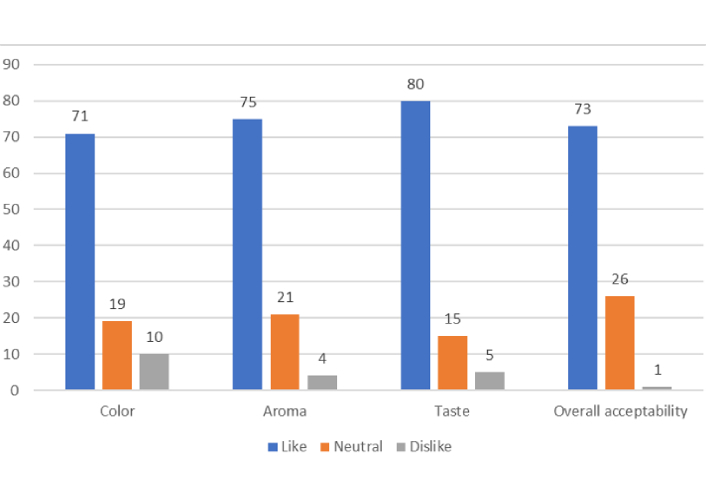
Consumer acceptance of sensory attributes of composite flour biscuits (50% red rice flour + 50% cassava flour) (n = 100).
Sensory performance of composite biscuits is strongly influenced by flour characteristics, processing conditions, and consumer expectations. In this study, different ratios of red rice flour and cassava flour (100:0 to 0:100) were systematically evaluated to investigate how variations in starch composition, fiber content, and functional properties influence biscuit quality. Red rice flour contributes higher dietary fiber, minerals, and bioactive compounds, whereas cassava flour provides a high starch content that can influence dough rheology and texture development during baking. Evaluating a gradient of flour ratios, therefore, allowed identification of the optimal balance between nutritional enhancement and desirable sensory properties in gluten-free biscuit formulations. The comparable color perception between composite and wheat-based biscuits suggests that substitution with red rice and cassava flours does not necessarily compromise visual acceptability. Similar observations have been reported when wheat flour was partially replaced with sweet potato flour without significantly altering biscuit color [36]. The minimal visual difference may be explained by the intrinsic properties of the raw materials. Cassava flour is naturally white and visually similar to wheat flour [37], while the washing step during red rice flour preparation removes portions of pigmented bran containing anthocyanins and proanthocyanidins [38]. As a result, the composite flour appears lighter and closer in color to refined wheat flour, which supports acceptable color development in the final baked product.
Aroma and taste remain critical drivers of consumer liking and are often more influential than appearance. The limited differentiation among some formulations may relate to the use of untrained panelists, who are generally more suited for overall acceptability assessment than for detecting subtle aroma nuances [39]. Nevertheless, aroma plays a dominant role in food enjoyment, contributing up to 80% of overall satisfaction and shaping perceptions of freshness and safety [40]. Taste, encompassing sweetness, saltiness, sourness, bitterness, and umami [41], is widely recognised as a primary determinant of consumer preference and market success [42]. The favourable taste perception of the balanced red rice-cassava blend may reflect complementary flavour interactions between the two flours. This interpretation is consistent with reports that gluten-free bakery products exhibit broad taste variability depending on flour type and formulation strategy [43].
Texture, particularly crispiness, is a defining quality attribute in biscuits. Crispiness is closely associated with hardness and moisture distribution within the product matrix [44], and consumers typically favor thin, crisp biscuits [45]. The improved crispiness observed in balanced composite formulations likely relates to optimal starch gelatinisation and structural setting during baking. Composite and gluten-free biscuits frequently encounter issues such as excessive hardness or dryness; therefore, achieving a balanced texture is crucial for acceptance. Overall acceptability reflects the combined perception of color, aroma, taste, and texture [46], and the sensory performance of the composite formulation indicates that these attributes can be successfully optimised even in gluten-free systems.
Sensory benchmarks further contextualise product quality. Products with mean hedonic scores ≥ 5.0 are generally considered acceptable, while scores ≥ 7.0 indicate high acceptability and can serve as sensory targets in product development [47]. The strong sensory performance of the balanced composite formulation suggests that appropriate flour combinations can yield biscuits with high consumer appeal. This supports the broader understanding that gluten-free or composite flour biscuits can achieve desirable sensory quality when formulation and processing are carefully optimised.
The proximate composition results revealed that the composite biscuit formulation exhibited lower moisture content compared to the wheat-based control, which can be attributed to the higher dietary fiber content of red rice and cassava flours. Dietary fiber has a strong water-binding capacity during dough formation and reduces moisture retention after baking. This explanation is consistent with Shareenie et al. [48], who reported reduced moisture in fiber-enriched composite biscuits. Ng et al. [49] similarly observed that increased fiber promotes water redistribution within the dough matrix, resulting in lower final moisture. Reduced moisture is advantageous in biscuit systems because it enhances crispiness and prolongs shelf-life [50].
The elevated ash content in the composite formulation indicates greater mineral contribution from the raw materials. Similar increases in ash content have been documented in multigrain and legume-based composite biscuits [51, 52]. Red rice flour is known to contain higher levels of minerals such as iron and potassium compared to cassava and refined wheat flours [53], which likely explains this observation. From a nutritional standpoint, higher ash values suggest improved mineral density.
The lower protein content in composite biscuits is mainly due to the absence of gluten-forming proteins in red rice and cassava flours, both of which are low in protein and high in starch [54, 55]. Since gluten proteins constitute about 80% of wheat’s total protein fraction [56, 57], replacing wheat flour naturally leads to protein dilution. This phenomenon is commonly reported in gluten-free bakery formulations and reflects ingredient composition rather than processing inefficiency.
Comparable crude fat levels among formulations are expected because red rice, cassava, and wheat flours contain similar lipid contents. In biscuit systems, fat levels are largely influenced by added shortening or margarine, which primarily contribute to tenderness and mouthfeel [58]. The slightly higher crude fiber content in the composite biscuit is related to the inherent fiber present in red rice and cassava flours. Fiber content depends strongly on flour type [59], and both ingredients contain more insoluble fiber than refined wheat flour [60, 61]. More importantly, the increase in total dietary fiber is consistent with previous reports on fiber-enriched composite biscuits [48]. Dietary fiber, composed of indigestible polysaccharides such as cellulose, hemicellulose, lignin, and pectins, contributes positively to nutritional quality.
The higher carbohydrate content in the composite biscuit reflects the starch-rich nature of red rice and cassava flours [62, 63] and shows an inverse relationship with protein content. Because carbohydrates are the main contributors to caloric value in bakery products, this also explains the slightly higher energy content observed. Such compositional patterns are typical in gluten-free and root-crop-based formulations where starch replaces gluten proteins as the structural backbone. Furthermore, these compositional trends indicate that substituting wheat flour with red rice and cassava flours enhances mineral and dietary fiber content while maintaining comparable fat and energy levels. This supports the potential of composite flours as nutritionally improved alternatives, particularly for consumers seeking fiber-rich or gluten-free bakery products.
These compositional modifications are not only nutritionally relevant but also influence the structural and textural behaviour of the resulting biscuits. The softer texture observed in composite biscuits compared to wheat-based counterparts is widely associated with the absence of a gluten network. Gluten proteins normally form a cohesive, elastic matrix that provides structural rigidity in wheat dough. When wheat flour is replaced with gluten-free flours such as red rice and cassava, this structural framework is weakened, leading to a softer and more friable texture. This reduction in structural rigidity also contributes to the greater spread ratio observed in the composite biscuits, as a weaker dough structure allows increased lateral expansion during baking. Similar textural reductions in composite biscuits have been reported [31, 48, 52]. Higher lipid contributions can further tenderize the crumb by interfering with starch-protein interactions [64]. In addition, composite flours often possess coarser particle size distributions (typically < 250 µm) than refined wheat flour (< 130 µm), which can promote a more open structure and reduce resistance to compression [65].
Color differences in composite biscuits are primarily linked to ingredient pigmentation and thermal reactions during baking. Red rice flour contains natural pigments from the bran layer that contribute to darker and more reddish tones, while Maillard browning further intensifies color development during baking [59]. Reduced yellowness can be explained by the thermal degradation of carotenoids naturally present in cassava and rice flours, a phenomenon frequently observed in gluten-free and composite baked products [65]. Such color shifts are expected when pigmented or whole-grain flours are incorporated into bakery formulations.
Greater biscuit spread during baking is commonly related to dough viscosity and water-binding behaviour. Composite flours generally exhibit lower water-binding capacity than wheat flour, which can produce softer doughs that spread more readily during baking [51, 66]. Larger particle size also reduces the specific surface area available for hydration, limiting water absorption and promoting lateral expansion [65]. These factors collectively influence dough flow and final biscuit geometry.
Denser biscuit structures are often reported when wheat flour is replaced with alternative flours, as shown by Zouari et al. [67] and Dada et al. [68]. Bulk density is governed by flour composition, particle packing, and internal air cell structure [69]. It plays a critical role in determining product texture, packaging efficiency, and mouthfeel perception [70]. Variations in starch composition, fiber content, and particle morphology in composite flours can modify packing behaviour and internal structure, contributing to these differences.
Taken together, the physicochemical behaviour of red rice-cassava composite flours explains the softer texture, darker appearance, greater spread, and denser structure typically observed in gluten-free biscuits. These characteristics are consistent with the known functional roles of gluten absence, flour composition, and water-fat interactions in composite bakery systems and help explain the sensory responses reported for such products.
Shelf-life evaluation is essential for guiding formulation and packaging decisions in bakery products, particularly those formulated with gluten-free composite flours. In this study, microbiological stability, aw, and hardness were selected as key indicators of storage quality because they represent the primary factors influencing the safety, texture, and consumer acceptability of low-moisture baked products such as biscuits. Low-moisture systems and reduced aw are well known to suppress microbial growth and contribute to the extended stability of products such as cookies and crackers. Maintaining aw below the critical limits for yeast and mould development is therefore a key factor in ensuring microbiological safety and shelf stability in baked goods.
Differences in aw between formulations can be partly explained by compositional factors, especially dietary fiber content. Fiber-rich ingredients enhance water binding during dough formation and can facilitate greater moisture loss during baking, resulting in lower aw in the final product. Over storage, gradual increases in aw are commonly associated with the hygroscopic nature of biscuits and the permeability of packaging materials such as LDPE, which allow moisture transfer from the environment.
Textural changes during storage are also strongly influenced by moisture redistribution within the biscuit matrix. Softening over time is a typical phenomenon in baked products and is often linked to rising aw and internal water migration. Fiber incorporation may further influence texture by modulating starch retrogradation, potentially reducing the rate of structural firming or fracture development. Collectively, the relationships among microbiological stability, aw, and texture highlight the importance of moisture control and formulation design in maintaining the quality and acceptability of composite biscuits during storage. These factors play a critical role in determining shelf-life performance and consumer-perceived freshness in gluten-free and composite bakery products.
Consumer acceptance of composite biscuits is closely linked to familiarity, sensory expectations, and perceived product quality. The mixed prior exposure of consumers to composite flour products suggests that acceptance is not solely dependent on familiarity but also on the sensory performance of the product itself. Positive acceptance across attributes indicates that well-formulated composite biscuits can meet consumer expectations even when non-wheat flours are used. The favourable perception of the red rice-cassava biscuit is consistent with previous studies showing that composite flour biscuits can achieve high sensory acceptance when appropriate flour combinations are applied. For example, rice-green gram-potato composite biscuits achieved acceptability ratings ranging from “like moderately” to “like very much” compared to controls [71]. Likewise, wheat-millet biscuits fortified with Moringa oleifera and Camellia sinensis leaf powders also received strong sensory ratings, highlighting the growing consumer openness toward functional bakery products made with local or alternative flours [72].
These observations suggest that successful composite formulations can balance flavour and texture to overcome potential biases against non-traditional ingredients. In this context, the sensory appeal of the F3 formulation indicates that composite flour biscuits can be positioned as acceptable and potentially attractive alternatives to conventional wheat-based products. This supports the broader notion that incorporating local flours into bakery products can be feasible from a consumer acceptance standpoint, provided that sensory quality is maintained.
The biscuit formulated with 50% red rice flour and 50% cassava flour (F3) exhibited the most favourable overall quality among the tested formulations. Sensory evaluation showed that F3 achieved the highest scores for crispiness (7.10) and overall acceptability (7.06) on the nine-point hedonic scale, indicating strong consumer preference. Compared with the wheat-based control, F3 contained lower moisture (2.87%) and protein (5.45%) but higher ash (0.81%), carbohydrate (72.46%), and total dietary fiber (3.57%), demonstrating improved nutritional characteristics. Physical analysis revealed that F3 produced softer biscuits (28.29 N hardness) with a greater spread ratio (3.91) and higher bulk density (0.66 g mL⁻1) when compared with the control formulation. During storage, microbial counts remained below 10 CFU g⁻1 and aw remained ≤ 0.65 for up to eight weeks, confirming acceptable shelf stability under ambient conditions. These results demonstrate that a balanced combination of red rice and cassava flours can produce gluten-free biscuits with improved nutritional value, desirable sensory properties, and satisfactory storage stability. However, this study was limited to laboratory-scale production and a single consumer survey location, which may restrict the generalizability of the consumer acceptance results. Future studies should explore larger consumer panels, broader demographic sampling, and optimization of composite flour functionality to further evaluate the commercial potential of red rice-cassava biscuits.
AOAC: Association of Official Analytical Chemists
aw: water activity
CFU: colony-forming unit
ISO: International Standards Organization
LDPE: low-density polyethylene
PDA: potato dextrose agar
SPSS: Statistical Package for the Social Sciences
KLCS: Investigation, Writing—original draft. SNI: Validation. MER: Visualization. AHAA: Formal analysis, Validation. NMR: Methodology. NRP: Validation, Visualization. HM: Conceptualization, Writing—review & editing, Supervision, Funding acquisition. All authors read and approved the submitted version.
The authors declare that they have no conflicts of interest.
This study involved voluntary participation in minimal-risk sensory and consumer acceptance tests with adult volunteers. All participants were informed of the study objectives and procedures and provided written consent prior to participation, and no personal, medical, or sensitive data were collected. In accordance with the institutional research ethics policy and applicable national regulations, formal ethics committee approval was not required for this non-invasive food sensory research; an exemption from ethics review was documented. Where a human ethics committee or formal documentation process was unavailable, the study nonetheless adhered to recognized ethical principles, including no coercion to participate, full disclosure of requirements and any foreseeable risks, written or verbal consent, protection of privacy with no release of individual data without participants’ knowledge, and the right to withdraw at any time without penalty.
Informed consent to participate in the study was obtained from all participants.
Informed consent to publication was obtained from relevant participants.
The raw data supporting the conclusions of this manuscript will be made available by the authors, without undue reservation, to any qualified researcher.
This research was funded by the Universiti Malaysia Sabah Research Grant (Grant No. GUG0633-2/2023 and DN22104). The funder had no role in study design, data collection and analysis, decision to publish, or preparation of the manuscript.
© The Author(s) 2026.
Open Exploration maintains a neutral stance on jurisdictional claims in published institutional affiliations and maps. All opinions expressed in this article are the personal views of the author(s) and do not represent the stance of the editorial team or the publisher.
Copyright: © The Author(s) 2026. This is an Open Access article licensed under a Creative Commons Attribution 4.0 International License (https://creativecommons.org/licenses/by/4.0/), which permits unrestricted use, sharing, adaptation, distribution and reproduction in any medium or format, for any purpose, even commercially, as long as you give appropriate credit to the original author(s) and the source, provide a link to the Creative Commons license, and indicate if changes were made.



View: 4036
Download: 68
Times Cited: 0


