 Original Article


Affiliation:
1Department of Food Science and Technology, Botswana University of Agriculture and Natural Resources (BUAN), Private Bag 0027, Gaborone, Botswana
Email: eseifu@buan.ac.bw; eyassu.b@gmail.com
ORCID: https://orcid.org/0000-0003-0700-4648


 ,
,
Affiliation:
1Department of Food Science and Technology, Botswana University of Agriculture and Natural Resources (BUAN), Private Bag 0027, Gaborone, Botswana
Affiliation:
2Department of Animal Sciences, BUAN, Private Bag 0027, Gaborone, Botswana
ORCID: https://orcid.org/0000-0003-3907-4413
,
Affiliation:
2Department of Animal Sciences, BUAN, Private Bag 0027, Gaborone, Botswana
ORCID: https://orcid.org/0000-0003-0450-3505
,
Affiliation:
3Department of Range and Forest Resources, BUAN, Private Bag 0027, Gaborone, Botswana
ORCID: https://orcid.org/0000-0002-6763-3959
,
Affiliation:
1Department of Food Science and Technology, Botswana University of Agriculture and Natural Resources (BUAN), Private Bag 0027, Gaborone, Botswana
ORCID: https://orcid.org/0000-0001-7388-5127
,
Affiliation:
1Department of Food Science and Technology, Botswana University of Agriculture and Natural Resources (BUAN), Private Bag 0027, Gaborone, Botswana
ORCID: https://orcid.org/0000-0002-6038-5091
,
Affiliation:
1Department of Food Science and Technology, Botswana University of Agriculture and Natural Resources (BUAN), Private Bag 0027, Gaborone, Botswana
ORCID: https://orcid.org/0000-0002-7147-3767
,
Affiliation:
1Department of Food Science and Technology, Botswana University of Agriculture and Natural Resources (BUAN), Private Bag 0027, Gaborone, Botswana
Affiliation:
3Department of Range and Forest Resources, BUAN, Private Bag 0027, Gaborone, Botswana
ORCID: https://orcid.org/0000-0002-6716-6975
,
Affiliation:
1Department of Food Science and Technology, Botswana University of Agriculture and Natural Resources (BUAN), Private Bag 0027, Gaborone, Botswana
ORCID: https://orcid.org/0000-0003-4187-679X
,
Affiliation:
4Department of Agricultural and Applied Economics, BUAN, Private Bag 0027, Gaborone, Botswana
ORCID: https://orcid.org/0000-0003-1410-8023
,
Affiliation:
5Department of Agricultural Extension and Rural Development, BUAN, Private Bag 0027, Gaborone, Botswana
ORCID: https://orcid.org/0000-0003-1565-9847
,
Affiliation:
1Department of Food Science and Technology, Botswana University of Agriculture and Natural Resources (BUAN), Private Bag 0027, Gaborone, Botswana
ORCID: https://orcid.org/0000-0003-4954-9574
,
Affiliation:
3Department of Range and Forest Resources, BUAN, Private Bag 0027, Gaborone, Botswana
ORCID: https://orcid.org/0000-0003-4015-4381
,
Affiliation:
6Department of Wildlife and Aquatic Resources, BUAN, Private Bag 0027, Gaborone, Botswana
ORCID: https://orcid.org/0000-0001-5005-526X
Explor Foods Foodomics. 2026;4:1010135 DOI: https://doi.org/10.37349/eff.2026.1010135
Received: December 08, 2025 Accepted: March 09, 2026 Published: April 16, 2026
Academic Editor: Gabriele Rocchetti, Università Cattolica del Sacro Cuore (Piacenza and Cremona Campus), Italy
Aim: The study aimed to develop feta-type cheese from camel milk and evaluate its physicochemical properties and sensory acceptability.
Methods: Milk samples were obtained from dromedary camels (Camelus dromedarius) kept at the Tsabong Ecotourism Camel Park in Botswana. Feta-type cheese was developed using WhiteDaily 41 culture, which contains mesophilic and thermophilic lactic acid bacteria, and camel chymosin (CHY-MAX M1000). Standard procedures were used to assess physicochemical characteristics and sensory-based consumer acceptability. Cow-milk feta cheese produced using the same procedure served as the control. Mann–Whitney test was used to compare quality parameters of the camel- and cow-milk cheeses.
Results: The results showed that producing feta-type cheese from camel milk was more difficult than from cow milk, and the yield from camel milk was slightly lower. Except for ash and fat content, no significant differences (p > 0.05) were found between the two cheese types. Cow-milk feta had significantly higher ash and fat levels (p < 0.05) than camel-milk feta. Overall, camel-milk feta displayed physicochemical characteristics comparable to those of cow-milk feta. The sensory acceptability test revealed that aroma, texture, taste, and overall acceptability scores were significantly higher (p < 0.05) for cow-milk feta than for camel-milk feta. However, colour did not differ significantly (p > 0.05) between the two cheeses.
Conclusions: The findings show that making feta-type cheese from camel milk is possible, provided that manufacturing protocols are modified and processing parameters optimized. It is essential to improve the organoleptic properties of camel-milk feta cheese. Future research should consider the use of natural additives such as spices or condiments to improve flavour, aroma, texture, antioxidant and antimicrobial properties, and shelf life of the cheese.
Camels (Camelus dromedarius) are important dairy animals in arid and semi-arid regions of the world. They are kept mainly for milk production in most pastoral areas of Africa and Asia [1, 2]. Camel milk has high nutritional value, and it contains high amounts of vitamin C and iron [3, 4]. It also has several health benefits, such as boosting the immune system, preventing diseases such as anaemia, diabetes, and autoimmune disorders, increasing blood circulation in the body, lowering atherosclerosis, and lowering heart attacks and strokes, and has anticarcinogenic properties [2, 5].
Camels are multipurpose animals and are used for the production of milk, meat, hides, wool, and the provision of transport [6]. Their unique adaptability makes the dromedary (one-humped) camel ideal for exploitation under arid and semi-arid environments. Unlike other animals, when exposed to conditions of extreme drought and lack of pasture, dromedary camels can produce high-quality milk [7].
Camel milk does not contain the whey protein β-lactoglobulin [2, 8]. α-Lactalbumin is the primary whey protein found in camel milk, whereas it only accounts for 25% of the total whey protein in cow milk whey [9]. β-Casein is the main casein type found in camel milk, the same as in human milk [9]. Dromedary camel milk has a higher digestibility and lower incidence of allergies than cow milk due to the above two characteristics [10]. Hence, children who are allergic to cow’s milk should drink camel milk [11].
Camel milk has special qualities compared to cow’s and other ruminants’ milk. The unique structural and functional features of the milk components make it difficult to process camel milk using the same technologies as bovine milk [11]. It has been observed that the inherent characteristics of camel milk make it difficult to manufacture products such as butter and cheese from it [12]. The higher whey protein to casein ratio, the larger micelle size, and the lower amount of kappa casein (κ-CN) in camel milk are all factors that contribute to the difficulty of making cheese from it [8, 11]. These properties result in prolonged coagulation time, formation of a less firm coagulum, and lower yield during cheese processing [12, 13]. Despite this, different studies [8, 11, 14–16] have shown the possibility of making cheese from camel milk through optimization and adjustment of the processing procedures.
Processing dairy products from other mammalian species (i.e., mammals other than cattle) is challenging because of a lack of comprehensive research and technological advancement, consumer unfamiliarity, negative perceptions, behaviours, and attitudes [17, 18]. Even though the nutritional and health benefits of milk from camels, goats, donkeys and sheep such as their functional food qualities, nutraceutical and probiotic potentials are widely recognized, there is limited global consumer acceptance because of considerable rejection based on sensory attributes (texture, aroma, flavour and taste), cultural, social and religious considerations by those adapted to cattle milk dairy products [17, 19]. To overcome the negative perception of consumer sensory acceptance and to promote marketing, it was recommended that product innovations, such as the use of fruits, inulin, processing, packaging, and labelling, demonstrate the nutritional and health benefits of dairy products from other ruminants [17, 19].
In product development, sensory liking and market acceptability are two distinct, but related concepts. Sensory liking, often referred to as consumer liking, focuses on the immediate, hedonistic reaction to a product’s inherent sensory qualities, such as taste, scent, texture, and appearance. To determine whether or not consumers would actually buy, repurchase, and accept a product in a real-world setting, market acceptance is a more comprehensive, multidimensional concept that considers pricing, branding, and convenience [20].
Use of camel milk and its products is not common in Botswana. To date, no attempt has been made to make products such as cheese from camel milk in the country. Cheese production from camel milk would help diversify dairy products in the market and would contribute to the income generation of camel milk producers in the country. Production of cheese from camel milk would contribute towards public awareness about the potential utilization of camels and their products, and hence their contribution to food and nutrition security. This study was conducted to develop Feta-type cheese from camel milk and evaluate its physicochemical properties and consumer acceptability.
Milk samples were collected from dromedary camels kept in Tsabong, which is in the Kalahari Desert in southwestern Botswana. According to the 2011 census, 8,939 people were living in the area. The geographical coordinates of Tsabong are 26°3'0" S, 22°27'0" E. The study area is located at a distance of 520 km from Gaborone, the country’s capital, and 10 km north of Tsabong town, which is 3,200 hectares of fenced area, with an annual precipitation of less than 250 mm and an average temperature of more than 35°C in summer and less than 20°C during winter [21]. Senegalia/Vachellia and Grewia species, together with a few grass species, predominate in the region's poorly scattered vegetation.
Milk samples were collected from camels kept in Tsabong Ecotourism Camel Park. Five litres of milk, collected from ten lactating camels, were sampled and placed in sterile containers. Then, the milk samples were stored in a cooler box and transported right away to the Botswana University of Agriculture and Natural Resources (BUAN) Food Science and Technology laboratory. The milk samples were stored at 4°C overnight after they arrived at the lab prior to being processed the following day. Five litres of milk samples were used for the cheesemaking experiment in each of the three batches. An equal amount of cow milk sample was used as a control. Pasteurized cow milk samples were purchased from the supermarket and used for the experiment. The cow milk had an average fat, protein, lactose, total solids, and solids-not-fat contents of 3.4, 3.0, 4.7, 12, and 8.9%, respectively.
The composition of camel milk used for the cheesemaking experiment is indicated in Table 1.
The composition of camel milk used for the cheesemaking experiment (n = 10).
| Parameter | Mean ± SD |
|---|---|
| Fat (%) | 3.21 ± 0.44 |
| Protein (%) | 2.14 ± 0.20 |
| Lactose (%) | 4.28 ± 0.45 |
| Total solids (%) | 10.27 ± 1.36 |
| pH | 6.52 ± 0.10 |
n = number of samples.
Prior to the actual experiment, a series of preliminary trials was conducted in order to come up with a formulation that resulted in the production of feta-type cheese of acceptable quality from camel milk. At first, we tried to follow the cowʼs milk feta cheese procedure for making feta-type cheese from camel milk. However, this did not result in cheese of acceptable quality. The milk did not coagulate well, and the curd was weak and not strong enough at the time of cutting. In order to overcome this problem, we prolonged the duration of pre-ripening (acidification) time until the pH of the milk was reduced to a value of 5.5, which roughly took 1.5 h. Another problem encountered was that after cutting, the curd was too soft (creamy), and thus, it was not possible to drain the curd. To address this challenge, we heated the curd at 55°C for 1 h and kept the cooked curd overnight at room temperature (23°C). This step improved whey drainage and resulted in a thick curd mass with crumbly texture, i.e., cooking improved the consistency and texture of the curd most probably by coagulating casein micelles to aggregate and form gel. In an attempt to improve the flavour of feta-type cheese from camel milk, we used different spices, viz., rosemary, black pepper, and garlic, and added these directly to the milk prior to the addition of chymosin.
In the initial stages of the cheesemaking experiment, we used a mesophilic cheese starter culture (R-704) (Chr. Hansen, Denmark). However, this resulted in a soft and slimy curd that retained a lot of whey and did not drain well. In subsequent experiments, we changed the starter culture and used WhiteDaily 41 (Chr. Hansen, Denmark), which consisted of a mixture of mesophilic and thermophilic lactic acid bacteria. The WhiteDaily 41 culture resulted in better curd texture compared to R-704.
Five litres of milk were pasteurized in a thermostatically controlled water bath at 65°C for 30 minutes. After pasteurization, the milk was cooled to 40°C. Then, 75 mL of cheese starter culture (WhiteDaily 41, Chr. Hansen, Denmark) was added to the milk and mixed thoroughly. After 1.5–2 h of addition of the starter culture, when the pH of the milk was reduced below 6.0, camel chymosin (CHY-MAX M1000, Chr. Hansen, Denmark) was added to the milk at a rate of 1 mL/5 L milk, mixed thoroughly, and allowed to coagulate at a renneting temperature of 40°C. After 2 h of addition of chymosin, a curd was formed, and the coagulum was cut into cubes (2 cm3), and the curd-whey mixture was cooked (heated) at 55°C for 1 h in order to form a firm curd. It was then kept overnight at room temperature (23°C), and the next morning, the whey was drained off. The curd was salted at a rate of 2 g salt/500 g curd after draining the whey [22]. Then, the curd was wrapped in a cheesecloth, placed in a mould, and pressed to remove as much whey as possible. The curd was allowed to dry for 1–2 days by turning it every 2 hours. It was then removed from the cloth, weighed, and the pH was measured using a penetration pH Meter. Finally, the curd was cut into small blocks using a knife and placed in a brine solution (2%) and kept in the refrigerator at 4°C. Three separate batches of cheese were produced, and each batch was analysed independently in triplicate. Five litres of milk were used for the production of cheese in each batch. The manufacturing procedure of the feta-type cheese is indicated in Figure 1. Since the camel chymosin (CHY-Max M1000) used in the cheesemaking experiment coagulates both camel and cow milk, identical procedures were used to make feta-type cheese from both types of milk. While bovine chymosin is used to coagulate cow milk, it does not coagulate camel milk, whereas camel chymosin coagulates both camel and cow milk. In fact, camel chymosin exhibits a 70% higher clotting activity towards bovine milk than bovine chymosin and has a low general proteolytic activity, resulting in a sevenfold higher ratio of clotting to general proteolytic activity [23, 24]. This is the rationale behind using camel chymosin in the cheesemaking experiments for the two milk types.
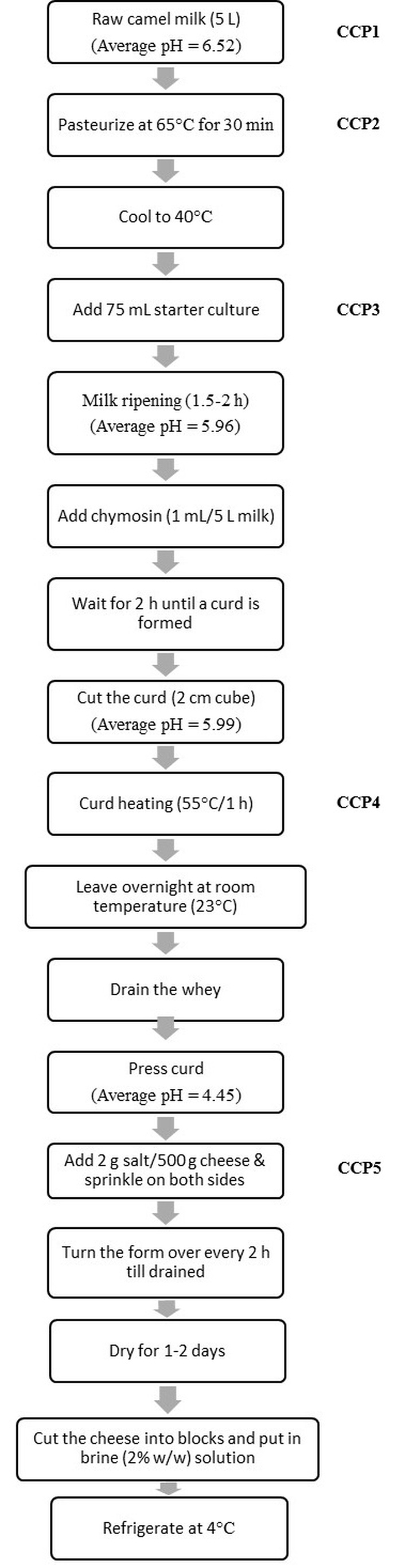
Manufacturing procedures for Feta-type cheese from camel milk [22]. CCPs: critical control points.
The cheese yield was determined as the weight in grams of fresh cheese per 100 g of milk and calculated as suggested by Mehaia [25].
Analyses of the physicochemical properties of the cheese samples were performed on three independent production batches, each analysed in triplicate. The feta cheeses were ripened for 15 days by placing them in the refrigerator at 4°C before being used for analyses of physicochemical parameters and consumer evaluation.
The moisture content of the cheese samples was determined by drying three grams of cheese samples in a forced draft oven (Model 224, Scientific Laboratory Equipment, Johannesburg, South Africa) at 102 ± 2°C for 3 h as described by Bradley et al. [26].
The total nitrogen content of a cheese sample (1 g) was determined by the Kjeldahl method using an automatic Kjeldahl Nitrogen/Protein Analyzer (UDK 149, VELP Scientifica, Italy) as described by the International Dairy Federation (IDF) [27]. The crude protein content of the cheese samples was determined by multiplying the nitrogen content by the factor 6.38.
The ash content was determined by igniting the pre-dried cheese samples (≈ 2.0 g) that were used for moisture determination in a muffle furnace (Carbolite BWF 11/13, United Kingdom) at 550°C. The samples were ignited until constant mass was achieved (≈ 4 h) [26].
The pH of the cheese samples was measured using a penetration glass electrode attached to a pH meter (HI 99163 pH meter, Hanna Instruments, USA) as described by the Association of Official Analytical Chemists (AOAC) [28].
The fat content of the cheese samples was determined by the Soxhlet method according to AOAC [28]. About 10 g of the cheese sample was weighed and put in thimbles using dry paper and plugged with cotton wool. The thimbles and samples were placed in a sample container and fixed under the condenser of the fat extraction apparatus. The solvent beakers were dried in an oven at 105°C for 30 min, cooled in desiccators to room temperature, and weighed. Diethyl ether (30–40 mL) was added to the weighed solvent beakers and placed on a condenser. The extraction process was carried out for 9 h. The beakers were placed in the open air under the hood to completely dry the ether. Finally, the ether extract was dried in a forced draft oven at 105°C for 30 min and cooled in the desiccator at room temperature, and weighed. Percentages of fat were calculated using the formula below:
Where: W1 = weight of air-dried sample, W2 = weight of empty beaker, W3 = weight of beaker plus ether extract.
The weight of the residue obtained from moisture content analysis was used to compute the total solids using the formula below [28]:
Sensory evaluation of cheese samples (camel and cow milk cheese) was conducted by consumer panelists according to the method described by Resurreccion [29]. Thirty-two adult consumers (men and women) aged between 18 and 60 years were requested to evaluate the sensory attributes of the cheese samples. Consumer panelists were selected based on their experience of cheese consumption; however, none of the panelists were familiar with camel milk and camel milk cheese. Cheese samples (10 g) were placed in three-digit coded white plastic plates with forks and served in the Food Processing Laboratory of the BUAN. Distilled water was provided to the panelists to rinse their mouths after each taste. The sensory attributes of the cheese samples, i.e., colour, aroma, taste, texture, and overall acceptability, were evaluated using a 9-point Hedonic scale (9 = like extremely, 8 = like very much, 7 = like moderately, 6 = like slightly, 5 = neither like nor dislike, 4 = dislike slightly, 3 = dislike moderately, 2 = dislike very much, and 1 = dislike extremely). The cheese samples were presented to the panelists randomly [30]. Prior to sensory evaluation, panelists read an explanation about the purpose of the study and gave their informed consent to participate in the sensory evaluation.
Quality parameters of camel and cow milk cheese samples were compared. To check for normality and homogeneity of variance, the data sets were subjected to the Shapiro–Wilk test and Leveneʼs test, respectively, in R version 4.4.0 [31]. Failure to satisfy these assumptions resulted in the data set being analyzed using a Mann–Whitney U test in R version 4.4.0 [31].
The procedure followed to make feta-type cheese from camel milk is indicated in Figure 1. The rate of acid development (pH) is very critical in cheesemaking. The changes in pH throughout the cheesemaking process, as well as the critical control points (CCPs) that are essential to control and/or eliminate potential hazards that would occur in the production of feta-type cheese from camel milk and consequently determine the quality of the cheese, are also indicated in Figure 1.
The pH of the raw camel milk that was used for the cheesemaking experiment was 6.52 (Figure 1). This pH value is within the recommended pH range (6.2–6.65) [32] for cheesemaking since a higher pH of milk significantly affects the cheesemaking process and the quality of the resulting cheese. Subsequently, the pH of the milk/curd continued to drop as the rate of acid development increased after the addition of the starter culture. Eventually, the pH of the curd dropped to 4.45 at pressing, which is within the recommended final pH value (4.4–4.6) for feta cheese [33].
Five CCPs were identified for feta-type cheese production from camel milk. The first CCP (CCP1) is the raw camel milk used for the cheesemaking experiment. This is a CCP because the pH of the raw milk used should be within the recommended range, and if it is very high, such as when milk is obtained from mastitic animals, it will significantly affect the cheesemaking process, and as a result, cheese of desired quality will not be produced. The second CCP (CCP2) is the pasteurization of the milk. The pasteurization process (temperature/time) used (65°C/30 min) must ensure the elimination of potential pathogens from the milk. If there is any deviation from the set values, this will result in survival of pathogens and will, in turn, increase the risk to public health. The third CCP (CCP3) is the addition of starter culture because if starter culture is not added or if the correct starter culture is not used, acid will not be produced at the desired rate, and consequently, the expected pH drop before the addition of rennet will not be attained. The fourth CCP (CCP4) identified in the present study was the heating of the curd after cutting. This step is crucial and ensures effective separation of whey from the curd. Without the heating step, the curd remains too soft, and it doesn’t drain well with a lot of retained whey. After one hour of cooking at 55°C, the separation of whey from the curd greatly improved. The last CCP (CCP5) is the stage of addition of salt, which is very crucial in the production of feta-type cheese, as it determines the quality and acceptability of the cheese.
The yield and physicochemical properties of feta-type cheese made from camel milk in comparison to feta cheese made from cow milk are presented in Table 2. In general, the yield of cheese made from camel milk is lower than that made from cow milk. Moreover, the ash and fat contents of camel milk feta-type cheese were significantly lower (p < 0.05) than those of cow milk feta cheese (Table 2). However, no significant difference (p > 0.05) was observed between camel milk feta-type cheese and cow milk feta cheese for the other parameters considered (Table 2). The fat-in-dry matter (FIDM) of camel milk feta-type cheese was lower than the FIDM of cow milk feta cheese (Table 2). Similarly, the moisture on a fat-free basis (MFFB) of camel milk feta-type cheese was lower than the MFFB of cow milk feta cheese (Table 2).
Yield and physicochemical properties of camel milk feta-type cheese in comparison to cow milk feta cheese (n = 9).
| Treatment | Yield (g/100 g) | pH | Moisture (%) | Ash (%) | Protein (%) | Fat (%) | Total solids (%) | FIDM (%) | MFFB (%) |
|---|---|---|---|---|---|---|---|---|---|
| Camel milk | 12.96 ± 2.66 | 4.53 ± 0.031 | 56.50 ± 1.210 | 2.25a ± 0.186 | 16.06 ± 2.076 | 2.93a ± 0.358 | 43.50 ± 1.210 | 6.74 ± 0.36 | 58.21 ± 1.21 |
| Cow milk | 13.72 ± 0.89 | 4.36 ± 0.042 | 58.12 ± 2.215 | 3.12b ± 0.067 | 14.96 ± 0.365 | 4.11b ± 0.371 | 41.89 ± 2.215 | 9.81 ± 0.37 | 60.61 ± 1.22 |
Means with different superscript letters within a column are significantly different (p < 0.05). FIDM: fat-in-dry matter; MFFB: moisture on a fat-free basis; n = number of cheese samples.
The results of the sensory acceptability test showed that the aroma, taste, texture, and overall acceptability scores of feta-type cheese from cow milk were significantly higher (p < 0.05) than those from camel milk (Table 3). However, no significant difference (p > 0.05) in colour score was observed between feta-type cheese from camel milk and that from cow milk (Table 3).
Sensory acceptability of camel milk feta-type cheese as compared to cow milk feta cheese (n = 32).
| Treatment | Colour | Aroma | Taste | Texture | Overall liking |
|---|---|---|---|---|---|
| Camel milk | 6.56 ± 1.99 | 5.75a ± 2.00 | 4.06a ± 2.34 | 5.25a ± 2.09 | 4.19a ± 2.12 |
| Cow milk | 6.81 ± 1.73 | 6.97b ± 1.82 | 7.41b ± 1.58 | 6.44b ± 2.17 | 7.41b ± 1.43 |
| p-value | 0.595 | 0.013 | < 0.001 | 0.030 | < 0.001 |
Means with different superscript letters within a column are significantly different (p < 0.05); values in the Table are means plus standard deviations. n = number of panelists.
It was reported by Konuspayeva and Faye [34] and Marete et al. [11] that processing camel milk with the same technology used for bovine milk is difficult due to the unique structural and functional features of the milk components. Therefore, optimization and modification of processing conditions are required before making products such as cheese from camel milk.
In the present study, a number of preliminary cheesemaking trials were conducted in order to come up with a formulation that would result in cheese of required quality, which included use of different ingredients and manipulation of processing parameters. Among the ingredients used were different spices, which were added to improve the flavour of the cheese. However, the addition of the spices prolonged the coagulation time and resulted in a curd that was not firm enough for cutting. This might be attributed to a change in the pH of the milk and interference of the spices with the milk components, leading to coagulation problems. As a result, we did not use the spices in the subsequent cheesemaking experiments. In the present study, spices were added to the milk before coagulation. However, the addition of spices to the curd after drainage of the whey may alleviate the problem associated with coagulation of the milk due to addition of the spices.
The preliminary experiment also revealed that the cheese starter culture WhiteDaily 41, which consisted of a mixture of mesophilic (Lactococcus lactis subsp. cremoris, Lactococcus lactis subsp. lactis) and thermophilic lactic acid bacteria (Lactobacillus delbrueckii subsp. bulgaricus, Streptococcus thermophilus), resulted in feta-type cheese of desired quality from camel milk. This suggests that an appropriate strain of lactic acid bacteria has to be identified and isolated that can be used as a starter culture for production of cheese from camel milk. It is recommended that thermophilic lactic acid starter cultures are more appropriate for cheesemaking from camel milk due to their high acidification properties [34] and improvement of the sensory quality of the cheese [11].
For the same amount of milk used, the yield of cheese from camel milk was slightly lower than that from cow milk. The lower yield of cheese observed in camel milk compared to cow milk could be attributed to the difference in composition between the two milk types, especially the protein and fat contents of the milk. Camel milk differs from its bovine counterpart in terms of the relative distribution and amino-acid composition of the caseins. Camel milk has low κ-CN (3.5% versus 13%) and alpha S1-casein (αs1-CN) (22% versus 38%) but has high beta-casein (β-CN) (65% versus 39%) content as compared to bovine milk [8, 17]. Moreover, the casein micelle size of camel milk is larger (average diameter of 380 nm) than bovine (150 nm), caprine (260 nm), and ovine (180 nm) milk [35]. The difficulty of making cheese from camel milk is associated with the larger micelle size and the lower amount of κ-CN in camel milk. The low level of κ-CN, coupled with large micelle size in camel milk, leads to the formation of a fragile and weak coagulum and lower cheese yield [8, 36]. Standardizing camel milk to a higher casein-to-fat ratio (0.90) increases cheese yield and reduces solid losses in the whey [37]. It was reported that increasing the total solids content in camel milk by ultrafiltration was found to improve the cheese yield, and protein and fat recovery rates [36].
The lower yield of camel milk cheese observed also suggests loss of casein and fat into the whey during the preparation of camel milk cheese. Camel milk is characterized by a weak coagulum, and the yield is low because a significant amount of the dry matter is lost into whey [38]. This observation is in line with the findings of Athar et al. [39], who reported that the average yield of cheese obtained from camel milk was lower than that of cow or buffalo milk, and this was attributed to the lower total solids content (TS) of camel milk as compared to cow milk. Benkerroum et al. [40] reported that a cheese yield of 16.74 g⁄100 g of camel milk was obtained when a chymosin concentration of 1.7 mL/L of milk was used as a coagulant. This value is higher than the cheese yield (12.96 g/100 g) observed in the present study. Konuspayeva et al. [41] reported a cheese yield of 9.31 ± 0.64 kg/100 kg for dry-salted feta-type camel milk cheese. Standardising camel milk and increasing the casein-to-fat ratio to 0.9 C/F led to higher cheese yield, lower mineral and solids losses in whey [37].
Camel milk feta-type cheese had lower FIDM and MFFB as compared to cow milk feta cheese. This is attributed to the low fat content of the raw camel milk used for the cheesemaking experiment. The low FIDM suggests that fat recovery during production of feta-type cheese from camel milk was low, and loss of fat into whey during the preparation of camel milk feta-type cheese.
Although differences were observed in ash and fat contents between cow milk and camel milk feta-type cheeses, generally, feta-type cheese from camel milk had comparable quality characteristics to that from cow milk. The low-fat content of feta-type cheese made from camel milk observed in the present study, as compared to cow milk feta cheese, could be attributed to higher fat loss into whey during processing of camel milk feta-type cheese. It was reported that the low casein-to-fat ratio and low total solids of camel milk lead to soft cheese textures and higher fat losses into the whey during drainage [25, 36]. The ash (mineral) content of cheese is influenced by the diet of the animal and the season of production, which determine the initial mineral composition of the milk and consequently the ash content of the cheese processed from it [42]. Thus, the low ash content of camel milk feta-type cheese compared to cow milk feta cheese observed in the present study could be attributed to the diet of the animal and the season of production, in addition to the obvious difference due to the species of the animal.
The crude protein content of feta-type cheese from camel milk observed in the present study (16.06%) is lower than the value of 20.37 g/100 g reported by Hailu et al. [43] for soft brined cheese made from camel milk and 29.25% reported by Bouazizi et al. [44] for white brined cheese made from dromedary camel milk. However, the ash content of feta-type cheese from camel milk observed in the present study (2.25%) is higher than the value 1.48 g/100 g reported by Hailu et al. [43] for soft brined cheese made from camel milk and 1.73% reported by Bouazizi et al. [44] for white brined cheese made from dromedary camel milk. On the other hand, the TS of feta-type cheese from camel milk observed in the current study (43.5%) is comparable to the TS of 45.42 g/100 g reported by Hailu et al. [43] for soft brined cheese made from camel milk, while it is lower than the TS value of 48.17% reported by Bouazizi et al. [44] for white brined cheese made from dromedary camel milk. These differences may be due to the feeding regimes of camels from different studies compared to the present study. Camels in the present study were grazing natural pasture without any supplementation.
The fat content of feta-type cheese from camel milk observed in the present study (2.95%) is higher than the fat content (1.30% dry matter basis) of white brined cheese made from dromedary camel milk [44], but it is much lower than the value (26.0 g/100 g) reported by Hailu et al. [43]. The pH (4.53) of feta-type cheese from camel milk observed in the present study is slightly lower than the pH values of 4.73 and 4.96 reported by Hailu et al. [43] and Bouazizi et al. [44] for soft brined cheese and white brined cheese made from camel milk, respectively.
The observed difference in taste and aroma between feta-type cheeses made from cow and camel milk could be attributed to the difference in fatty acid profile of camel milk fat and cow milk fat. Camel milk fat has a lower proportion of short-chain fatty acids (which are important for flavour development in cheese) and a higher melting point than cow milk fat [45]. This affects the lipolysis process during ripening, resulting in different flavour compounds and less desirable aroma development compared to that in cow milk cheese. The observed difference in taste between feta-type cheese made from cow and camel milk could also be attributed to the salty taste in the latter. Although the same amount of salt was added to both camel milk and cow milk feta cheeses, panelists complained that feta-type cheese made from camel milk was too salty compared to that made from cow milk, which is most likely due to the salty taste of camel milk. Camel milk has a slightly salty or “unique” taste depending on the camel's diet and water availability [45], which may not align with typical consumer preferences for cowʼs milk feta.
The sensory scores of colour, aroma, taste, texture, and overall acceptability of camel milk feta-type cheese observed in the present study are higher than the sensory score values of 3.4, 2.9, 2.8, 3.4, and 3.4 for colour, aroma, taste, texture, and overall acceptability, respectively, as reported by Bouazizi et al. [44] for white brined cheese made from dromedary camel milk. The feta-type cheese from camel milk was very white as compared to cheese from cow milk, which had a cream colour. Whey from cow milk had a clear greenish colour, whereas the camel whey had a greyish white colour.
The sensory panelists in the present study noted that cow milk feta cheese had a firm texture and buttery feel, while camel milk feta-type cheese broke easily into crumbs. The soft texture of camel milk feta-type cheese observed in the present study could be attributed to the small fat globule size of camel milk. Mbye et al. [36] reported that camel milk fat globules are small (3.2–5.6 μm), and this contributes to the soft, smooth texture observed in camel milk cheeses. The challenges in achieving the characteristic firm, yet crumbly texture and the expected aroma and taste of traditional feta cheese using camel milk result in lower overall acceptability scores in standard sensory evaluations, which are typically based on preferences established for cow/sheep/goat milk cheeses [45]. The results of the sensory analysis suggest the need for improving the organoleptic properties of feta-type cheese from camel milk by exploring the use of additives such as different spices and condiments.
In the present study, sensory analysis of the feta cheese samples was conducted only based on sensory acceptability (liking) of the cheese samples. Consumer acceptability of the cheese, based on a market study and consumer behaviour, was not conducted. As a result, it is not possible to tell whether the feta-type cheese made from camel milk will have a potential market and be acceptable to consumers, given the fact that camel milk feta-type cheese is a new product and also owing to the unfamiliarity of consumers with camel milk. Thus, future research studies should consider market analysis and conduct detailed consumer acceptability studies to address the limitations of the current study.
Although feta-type cheese made from camel milk could possibly experience consumer resistance due to the unfamiliarity of the product, its consumer acceptability can be improved through education of the consumers and proper promotion of the product using appropriate communication channels. Camel milk feta-type cheese would potentially have a niche market among health-oriented consumer groups, at least in the short run.
This study revealed that feta-type cheese can be made from camel milk by modifying and standardizing the manufacturing protocols and optimizing processing parameters, but the resulting cheese had lower overall acceptability compared to cow milk feta cheese. To address this, future research should focus on improving the flavour, aroma, and texture of camel milk feta-type cheese by incorporating spices and condiments or by using modified processing methods, as camel milk presents unique technological challenges for cheesemaking.
AOAC: Association of Official Analytical Chemists
BUAN: Botswana University of Agriculture and Natural Resources
CCPs: critical control points
FIDM: fat-in-dry matter
MFFB: moisture on a fat-free basis
TS: total solids content
κ-CN: kappa casein
The authors would like to thank Tsabong Ecotourism Camel Park in Botswana for providing camel milk samples. We would also like to extend our appreciation to the Botswana University of Agriculture and Natural Resources (BUAN) for the logistical support provided.
ES: Conceptualization, Funding acquisition, Project administration, Methodology, Investigation, Visualization, Writing—original draft, Writing—review & editing. KTN: Methodology, Investigation, Writing—review & editing. WSB, RIKL, and GDH: Investigation, Writing—review & editing. ORM and AA: Project administration, Writing—review & editing. MM, BM, and NT: Investigation. DT: Project administration. GB, KRK, BSM, and WM: Writing—review & editing. KS: Formal analysis. All authors read and approved the submitted version.
The authors declare that there are no conflicts of interest.
This research was approved by the Research, Technology Development and Transfer Committee (RTDTC) of the Botswana University of Agriculture and Natural Resources (Reference number BUAN 7/15/1).
Written informed consent to participate in the study was obtained from all panelists who participated in the sensory evaluation of the cheese samples. Participants were fully informed about the study’s purpose, the nature of the cheese, any potential risks, and the evaluation process.
Not applicable.
The raw data supporting the conclusions of this manuscript will be made available by the authors, without undue reservation, to any qualified researcher.
This study was supported by a research fund (Camel Research RPC–49) obtained from the Botswana University of Agriculture and Natural Resources (BUAN), which is managed by the Research, Technology Development and Transfer Committee (RTDTC). The funder had no role in study design, data collection and analysis, decision to publish, or preparation of the manuscript.
© The Author(s) 2026.
Open Exploration maintains a neutral stance on jurisdictional claims in published institutional affiliations and maps. All opinions expressed in this article are the personal views of the author(s) and do not represent the stance of the editorial team or the publisher.
Copyright: © The Author(s) 2026. This is an Open Access article licensed under a Creative Commons Attribution 4.0 International License (https://creativecommons.org/licenses/by/4.0/), which permits unrestricted use, sharing, adaptation, distribution and reproduction in any medium or format, for any purpose, even commercially, as long as you give appropriate credit to the original author(s) and the source, provide a link to the Creative Commons license, and indicate if changes were made.



View: 1464
Download: 50
Times Cited: 0


