 Systematic Review


Affiliation:
1Faculty of Clinical Sciences, University of Ilorin, Ilorin 240003, Kwara State, Nigeria
Email: otosinafolabi@gmail.com
ORCID: https://orcid.org/0009-0000-1472-7946


 ,
,
Affiliation:
2Federal Teaching Hospital, Ido-Ekiti 371101, Ekiti State, Nigeria
ORCID: https://orcid.org/0000-0003-0272-200X
,
Affiliation:
2Federal Teaching Hospital, Ido-Ekiti 371101, Ekiti State, Nigeria
ORCID: https://orcid.org/0009-0002-4065-9726
,
Affiliation:
2Federal Teaching Hospital, Ido-Ekiti 371101, Ekiti State, Nigeria
ORCID: https://orcid.org/0009-0006-7239-7651
,
Affiliation:
2Federal Teaching Hospital, Ido-Ekiti 371101, Ekiti State, Nigeria
ORCID: https://orcid.org/0000-0002-4493-0598
Explor Cardiol. 2026;4:1012124 DOI: https://doi.org/10.37349/ec.2026.1012124
Received: June 11, 2026 Accepted: July 06, 2026 Published: September 17, 2026
Academic Editor: Gaetano Isola, University of Catania, Italy
The article belongs to the special issue Periodontitis and cardiovascular disease: local and systemic links
Background: Cardiovascular disease is the leading cause of mortality globally, with its impact escalating swiftly throughout Africa. Periodontitis, a widespread chronic inflammatory condition, is a recognized correlate of cardiovascular disease in high-income countries; however, evidence from Africa remains unsynthesised. This scoping review systematically examined the existing evidence concerning the local and systemic associations between periodontitis and cardiovascular disease in African populations, evaluated their implications for causal plausibility, and identified key research gaps requiring attention.
Methods: The review followed the Joanna Briggs Institute methodology and was reported in accordance with the PRISMA Extension for Scoping Reviews. Eligible sources were primary studies conducted in African populations that reported a measure of periodontal status together with a cardiovascular or cardiometabolic outcome, risk indicator, or related care construct. MEDLINE (PubMed), Scopus, Web of Science, and African Journals Online were searched from inception to June 2026. Records were independently screened by two reviewers, with disagreements resolved by a third reviewer; findings were charted and synthesised using descriptive methods.
Results: Only seven primary studies, concentrated in Cameroon, Nigeria, and Rwanda, met the eligibility criteria. The studies were predominantly cross-sectional and hospital-based. Reported associations aligned with the global literature, particularly for hypertension and cardiometabolic risk; however, periodontal exposure was defined inconsistently and few studies adjusted fully for shared risk factors. No interventional study with a cardiovascular endpoint and no prospective cohort was identified.
Discussion: African research on the periodontitis and cardiovascular disease association is limited, predominantly cross-sectional, and concentrated in a few countries. Causal plausibility therefore cannot be adequately assessed from the current evidence, which is dominated by seven cross-sectional studies. Given that the region carries one of the highest periodontitis burdens globally alongside a rising cardiovascular burden, longitudinal and interventional research and integrated oral and cardiovascular care should be prioritised.
Cardiovascular disease is the foremost cause of mortality globally, accounting for roughly one-third of all deaths, and its absolute burden is shifting towards low- and middle-income regions undergoing rapid demographic and epidemiological transitions [1]. Africa is at the center of this shift, where the growing prevalence of hypertension and other cardiovascular conditions is superimposed on persistent communicable diseases and constrained health-system capacity. In parallel, periodontitis, a chronic inflammatory disease of the tooth-supporting tissues driven by a dysbiotic subgingival biofilm and a dysregulated host response, remains one of the most prevalent human diseases worldwide, with a substantial and rising global burden documented in the most recent Global Burden of Disease estimates [2].
Over the past two decades, a substantial body of evidence from high-income settings has linked periodontitis to cardiovascular disease. Consensus reports from the European Federation of Periodontology, the World Heart Federation, and family medicine bodies have concluded that periodontitis is independently associated with atherosclerotic cardiovascular disease and that the association is biologically plausible [3, 4]. Proposed mechanisms include the translocation of periodontal pathogens and their virulence factors into the circulation (keystone pathogens most often implicated include Porphyromonas gingivalis, Tannerella forsythia, and Fusobacterium nucleatum), a sustained systemic inflammatory and oxidative response marked by increased C-reactive protein and interleukin-6 levels, and consequent endothelial dysfunction, all of which may promote atherogenesis [3, 5]. Interventional studies have shown that periodontal therapy improves surrogate cardiovascular measures, such as flow-mediated dilatation and ambulatory blood pressure [5, 6], and observational syntheses have reported associations with hypertension, incident myocardial infarction, and cardiovascular and all-cause mortality [7–9].
However, the strength of this evidence should not be exaggerated. Although the association is consistently observed, its causal nature remains unclear. A comprehensive two-sample Mendelian randomisation study did not find substantial genetic evidence supporting a causal effect of periodontitis on stroke, coronary artery disease, or subclinical atherosclerosis, suggesting that observational associations may partly reflect shared risk factors and confounding [10]. Factors such as smoking, diabetes, aging, and socioeconomic status are common to both conditions and are difficult to separate. Determining the position of the evidence between association and causation therefore requires careful, context-specific evaluation rather than assertion.
Regional specificity matters because of the dense web of risk factors shared by periodontitis and cardiovascular disease. Tobacco use, diabetes, advancing age, obesity, and lower socioeconomic status independently increase the risk of both conditions, so any apparent association may be confounded unless these factors are measured and adjusted for [3, 7]. The African context adds further particularities. Periodontal disease is highly prevalent across the continent, with population-based studies documenting a high prevalence and severity of periodontitis in African adults, yet routine periodontal care and standardised epidemiological surveillance remain limited, so that disease is frequently untreated and under-measured relative to high-income settings [11]. At the same time, the cardiovascular burden is rising under distinct drivers, including low rates of hypertension awareness and control, the cardiometabolic consequences of rapid urbanisation, and a high background of infectious disease, all of which shape how a periodontitis and cardiovascular disease association might manifest. Oral-health behaviors and tooth-cleaning practices also differ from those in the settings where most evidence has been generated [2, 12]. These differences indicate that estimates derived from high-income cohorts cannot be directly transferred, underscoring the value of a regional evidence map.
Most of this evidence originated outside Africa. Whether and how the link between periodontitis and cardiovascular disease manifests in African populations, which differ from high-income populations in risk-factor distribution, access to oral and medical care, periodontal disease patterns, and competing health priorities (including infectious diseases such as HIV and tuberculosis, and maternal and child health), has not been systematically described. Here, causal plausibility refers to the degree to which the available evidence, judged against established causal viewpoints, is compatible with a causal interpretation; it denotes compatibility rather than proof. Because the anticipated evidence was likely to be sparse and methodologically heterogeneous, a scoping review was the appropriate approach, as it maps the extent, range, and nature of evidence and identifies gaps rather than producing a pooled effect estimate [13, 14]. This review aimed to map the available evidence on the local and systemic links between periodontitis and cardiovascular disease in African populations, to appraise the extent to which the evidence speaks to causal plausibility, and to identify priority gaps for research and integrated care.
The review was conducted in accordance with the Arksey and O’Malley [15] framework as advanced by Levac and colleagues [16] and the Joanna Briggs Institute methodology for scoping reviews [17], and is reported in line with the PRISMA Extension for Scoping Reviews (PRISMA-ScR) [13]. The protocol was registered on the Open Science Framework (registration identifier: https://doi.org/10.17605/OSF.IO/5CW32).
Eligibility was determined using the Population, Concept, and Context (PCC) mnemonic (Table 1). The population comprised human participants of any age residing in an African country. No age restriction was applied: although periodontitis and cardiovascular disease are predominantly diseases of adults, an inclusive criterion was adopted to avoid prematurely excluding evidence in a sparsely studied region, and the age range of included participants was charted. The concept was any reported measure of periodontal status, gingival inflammation, or periodontal treatment together with a cardiovascular or cardiometabolic outcome, surrogate, risk indicator, or a related knowledge, attitude, or care construct. A care construct was defined as any reported measure of clinician or patient knowledge, attitudes, referral practices, or service-delivery arrangements bearing on the oral-cardiovascular interface. The context included any African country and any care or community setting. Primary studies of all designs were included. Reviews, commentaries, animal and in vitro studies, and studies conducted wholly outside Africa were excluded, although global reviews were retained for background. No language or date restrictions were imposed.
Eligibility criteria framed by Population, Concept, and Context (PCC).
| Element | Included | Excluded |
|---|---|---|
| Population | Humans of any age resident in an African country | Populations resident wholly outside Africa |
| Concept | A measure of periodontal status, gingival inflammation, or periodontal treatment reported alongside a cardiovascular or cardiometabolic outcome, surrogate, risk indicator, or related knowledge or care construct | Oral conditions other than periodontal disease without a cardiovascular dimension; cardiovascular outcomes without an oral measure |
| Context | Any African country; hospital, dental, primary-care, or community setting | Non-African settings (retained only as background where they were in global reviews) |
| Study types | Primary studies of any design (cross-sectional, case-control, cohort, interventional, qualitative) | Narrative reviews, editorials, conference abstracts without data, animal or in vitro studies |
We searched MEDLINE via PubMed, Scopus, Web of Science, and African Journals Online (AJOL) from inception to June 2026, complemented by hand-screening of the reference lists of the included studies and relevant reviews. The search combined periodontal and cardiovascular terms with an African geographic filter. A representative Boolean string for MEDLINE is as follows:
(“periodontitis” OR “periodontal disease*” OR “gingivitis” OR “clinical attachment loss” OR “periodontal pocket*”) AND (“cardiovascular disease*” OR “hypertension” OR “blood pressure” OR “atherosclerosis” OR “coronary” OR “stroke” OR “metabolic syndrome” OR “endothelial”) AND (“Africa*” OR “sub-Saharan” OR “Nigeria” OR “Cameroon” OR “Rwanda” OR “Ghana” OR “Kenya” OR “Ethiopia” OR “South Africa” OR “Egypt” OR “Tanzania” OR “Uganda” OR “Democratic Republic of Congo”).
The string was adapted to the syntax of each database. No language restriction was applied at the search stage; the practical implications of database and language coverage are addressed in the limitations.
Two reviewers (O.G.A. and D.T.I.) independently removed duplicate records and screened them by title and abstract, followed by full-text screening. Each record was screened independently by both reviewers. Disagreements at either stage were resolved by discussion, and where consensus could not be reached, a third reviewer (A.I.O.) adjudicated. Data were charted independently by two reviewers (M.E.O. and A.B.A.) using a piloted charting form, and the completed charts were cross-checked and reconciled by the lead reviewer (O.G.A.). The charting form documented country, setting, study design, sample size, participant characteristics, the periodontal exposure definition and assessment method, the cardiovascular outcome or construct, effect estimates with confidence intervals where available, the degree of adjustment for confounders, and the authors’ main conclusions.
A meta-analysis was not conducted because of the expected variability in periodontal case definitions, outcomes, and study designs; combining data across such diverse exposure and outcome definitions would lack methodological validity [14]. The findings were synthesised using descriptive methods and categorised according to cardiovascular construct, including hypertension and blood pressure, composite cardiovascular disease, cardiometabolic risk, and constructs related to knowledge and care. In appraising causal plausibility, the findings were considered in relation to established causal viewpoints, including the consistency, strength, temporality, biological gradient, and biological plausibility of the observed associations. In line with scoping-review methodology, a formal critical appraisal of individual sources was not undertaken. Accordingly, descriptive references to study design (for example, prospective versus cross-sectional) characterise the type and limitations of the evidence and should not be read as the output of a formal quality or risk-of-bias assessment. The methodological characteristics most pertinent to interpretation, particularly study design and confounder adjustment, were charted and reported narratively [13, 17].
The database and supplementary searches yielded 503 records. After removing 94 duplicates, 409 records were screened by title and abstract, resulting in the exclusion of 376 records. Subsequently, 33 full-text sources were evaluated for eligibility, with 26 excluded for the following reasons: absence of an African population (n = 11), lack of paired oral and cardiovascular measures (n = 9), and ineligible design or review article (n = 6). Ultimately, seven African primary studies satisfied the eligibility criteria and were included. Figure 1 summarizes the flow of records through identification, screening, eligibility, and inclusion.
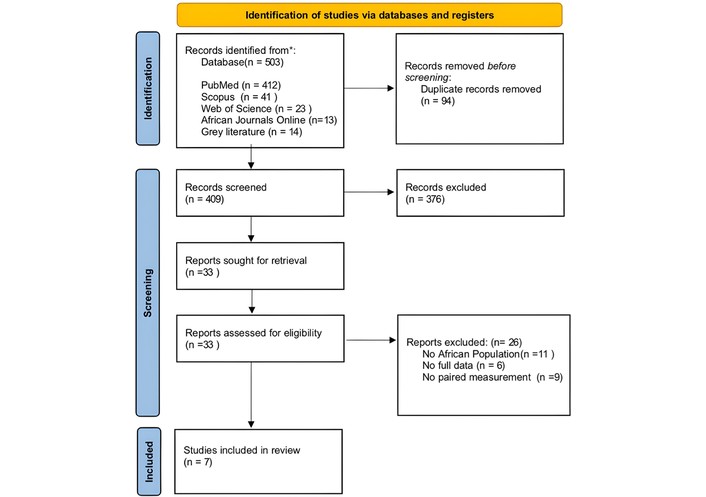
PRISMA-ScR flow of records through the scoping review. Adapted from [18]. © 2021 The Authors. Distributed under the Creative Commons Attribution (CC BY 4.0) licence.
The included African evidence was small in volume and geographically concentrated, with most studies arising from a limited number of countries, most prominently Cameroon, Nigeria, and Rwanda, with a single additional report from Tanzania [12, 19–24]. Cross-sectional hospital- or clinic-based designs predominated, and one prospective observational study was identified [19]. Periodontal exposure was assessed inconsistently across studies using the Dutch Periodontal Screening Index, the Community Periodontal Index, full-mouth clinical attachment loss and probing depth, or composite plaque, gingival, and bleeding indices, and case definitions varied accordingly. Cardiovascular constructs ranged from physician-diagnosed cardiovascular disease and measured or self-reported hypertension to clustered cardiometabolic risk and clinician knowledge of the oral-systemic link. The principal characteristics of the included studies are summarised in Table 2. Table 2 now also reports sample size and the variables adjusted for in each study.
Characteristics of the included African studies.
| Study, country | Design; setting | Sample size (n) | Periodontal measure | Cardiovascular construct | Adjustment variables | Principal finding |
|---|---|---|---|---|---|---|
| Belinga et al. [19] 2018, Cameroon | Prospective observational; 3 hospitals | 558 | Dutch periodontal screening index | Physician-diagnosed CVD (mainly hypertension) | Age, sex, lifestyle (logistic regression) | Periodontitis OR 2.87 (1.04–7.93); gingivitis OR 4.30 (1.85–10.00) |
| Ngan et al. [20] 2021, Cameroon | Cross-sectional; military population | 205 | Dutch periodontal screening index | Cardiovascular risk profile | NR (descriptive) | Poorer oral health tracked with adverse cardiovascular risk profile |
| Ngoude et al. [12] 2021, Cameroon | Cross-sectional; 3 hospitals | 83 | Plaque, gingival, pocket depth, attachment loss | Metabolic syndrome components | Unadjusted OR; exclusions by design (diabetes, hypertension, smoking) | Periodontitis was associated with obesity (OR 11.1 [3.97–31.03]) and low HDL (OR 4.58 [1.79–11.70]) |
| Gatarayiha et al. [21] 2024, Rwanda | Cross-sectional; 2 referral hospitals | 420 | CAL, BoP, pocket depth | Hypertension | Adjusted (logistic regression) | CAL: adjusted OR 6.24 (1.99–19.56) |
| Oyapero et al. [22] 2023, Nigeria | Cross-sectional; cardiology clinic | 268 | Clinical attachment loss; caries (DMFT) | CVD risk indicators (in CVD patients) | Adjusted: age, sex, BMI, lipids, education, smoking, alcohol, BP control (multivariable logistic regression) | CAL independently associated with diabetes, smoking, and obesity (adjusted ORs) |
| Yamori et al. [24] 2011, Tanzania | Cross-sectional; community women | 81 | Periodontal examination | Hypertension; potassium intake | Exclusions by design (smoking, alcohol, medication); multiple regression | Periodontitis severity correlated with higher systolic and diastolic BP |
| Umeizudike et al. [23] 2016, Nigeria | Cross-sectional survey; physicians | 109 | Knowledge construct | Awareness of periodontal-CVD link | Not applicable (survey) | Inadequate awareness among internal medicine residents (28.4% adequate) |
BoP: bleeding on probing; BP: blood pressure; CAL: clinical attachment loss; CVD: cardiovascular disease; DMFT: decayed, missing, filled teeth; HDL: high-density lipoprotein cholesterol; NR: not reported; OR: odds ratio. Sample sizes are the analysed samples reported in each source.
Three features of the evidence map are worth emphasising. First, the geographic footprint is narrow: the included studies cluster in Central, West, and East Africa, with large parts of the continent, including most of Southern Africa and the Sahel, unrepresented [12, 19–24]. Second, the design profile is shallow: with a single prospective observational exception [19], the evidence is cross-sectional and was generated in hospital or clinic populations, which limits generalisability to the community and precludes any statement about the order in which periodontal and cardiovascular changes arise. Third, exposure ascertainment is inconsistent, ranging from screening indices to full-mouth measurements, so that the same word, periodontitis, denotes materially different case definitions across studies.
Hypertension was the most frequently examined cardiovascular construct and the one for which the African evidence showed the most consistent findings. A study conducted in Rwanda among 420 adults attending two referral hospitals identified a significant association between clinical attachment loss and hypertension, with an adjusted odds ratio of 6.24 (95% CI 1.99–19.56), the strongest single estimate among the included studies; the cross-sectional design, however, precludes any inference about the temporal sequence of periodontal and blood-pressure changes [21]. In a Nigerian cardiology-clinic study, periodontal indicators correlated with elevated cardiovascular risk, including raised blood pressure, in patients already receiving cardiac care [22]. Methodologically distinct earlier research involving 81 non-smoking, non-drinking Tanzanian women not taking medication minimised confounding from antihypertensive therapy and tobacco, situating the periodontal-blood-pressure relationship within dietary factors such as potassium intake [24]. Despite substantial differences in populations and periodontal measures, the direction of the association remained consistent across these settings.
This directional consistency is reflected in the global literature. The findings agree with a systematic review and meta-analysis that identified associations between periodontitis and prevalent hypertension and higher systolic and diastolic blood pressure [7]. Combined interventional and Mendelian randomisation evidence further suggests that periodontal therapy can reduce blood pressure, indicating that this association may be the most mechanistically supported among the cardiovascular links [6]. Regional interest is evident in a systematic review led by African researchers examining oral hygiene and periodontal treatment interventions for blood pressure in low- and middle-income settings [25]. A principal caution is that the heterogeneous periodontal case definitions across the African studies preclude any consistent assessment of a dose-response gradient.
Beyond hypertension, the Cameroonian evidence addressed broader cardiovascular and cardiometabolic endpoints. The multi-hospital study by Belinga and colleagues, the single prospective observational design in the included set, reported associations between oral inflammatory disease and physician-diagnosed cardiovascular disease, with odds ratios of 2.87 (95% CI 1.04–7.93) for periodontitis and 4.30 (1.85–10.00) for gingivitis; the prospective element distinguishes this study from the cross-sectional remainder, although it remains observational and subject to residual confounding [19]. A study in a Cameroonian military population, an occupationally defined and relatively young group, found poorer oral health tracking with an adverse cardiovascular risk profile [20]. A third Cameroonian study related periodontal disease to newly diagnosed components of the metabolic syndrome, specifically obesity and low high-density lipoprotein cholesterol, locating the association within a cardiometabolic frame [12]. The Nigerian cardiology-clinic study similarly found periodontal indicators clustering with established cardiovascular risk factors [22]. These reports are directionally consistent with global syntheses linking periodontitis to composite cardiovascular outcomes, including incident myocardial infarction in prospective work [8, 9]. The consistency across distinct endpoints is notable in such a small body of evidence. The interpretive limitations are, however, the same throughout: with the single prospective exception, the designs are cross-sectional, the populations are hospital- or clinic-based, exposure ascertainment varies, and adjustment for shared risk factors such as smoking, diabetes, age, obesity, and socioeconomic status is frequently incomplete. The associations are therefore best read as signals warranting confirmation in stronger designs rather than as established independent effects.
A distinct strand of African evidence addressed awareness and care integration rather than the association itself. A survey of Nigerian internal medicine residents found that knowledge of periodontal disease as a contributor to systemic illness was incomplete, with the oral-systemic link recognized more readily for some conditions than others, yet most respondents expressed willingness to ask about oral health and to refer patients for periodontal care if referral pathways existed [23]. The limiting factor was not clinician reluctance but a shortfall in knowledge and in the structures needed to act on it. Because physicians, rather than dentists, see most patients with cardiovascular disease in many African settings, their awareness is a rate-limiting step for any oral-systemic care pathway.
Equally notable is what the evidence map did not contain. No included study evaluated an integrated oral and cardiovascular care model, a reciprocal referral pathway, or a shared screening protocol in an African setting, and none reported patient-side knowledge, health-seeking behaviour, or barriers to accessing periodontal care alongside cardiovascular risk. This is a conspicuous gap, given that integrated dental and medical management of non-communicable disease is now recommended by international consensus [4] and that regional interest in periodontal interventions for blood pressure indicates appetite for such pathways [25].
It must be stated plainly that causal plausibility cannot be adequately assessed from the current African evidence, which comprises seven studies that are, with one exception, cross-sectional. When the charted findings are considered against established causal viewpoints, they support compatibility with a causal link rather than causation. On consistency, the associations were consistently aligned across the included settings and with the global literature, though this is weakened by the small number of studies and the selective-reporting risks of a nascent literature [7, 21, 22]. On strength, several associations were sizeable, notably the adjusted odds ratio for clinical attachment loss and hypertension in the Rwandan study, although wide confidence intervals reflect modest samples [21]. On biological plausibility, there is supportive reasoning from mechanistic and global work; the pathways involved, including systemic inflammation, transient bacteraemia, and endothelial dysfunction, remain proposed rather than definitively established mechanisms [3, 5]. The remaining considerations are where the evidence is weakest: temporality cannot be established from cross-sectional data; a biological gradient cannot be assessed consistently because exposure is defined heterogeneously; and incomplete adjustment leaves confounding as a live alternative explanation.
This caution is echoed globally, where a large two-sample Mendelian randomisation analysis found no robust genetic support for a causal effect of periodontitis on stroke, coronary artery disease, or subclinical atherosclerosis [10]. Mendelian randomisation nonetheless warrants balanced interpretation. A null genetic finding does not exclude a causal effect, as such analyses rest on assumptions about instrument validity and may be underpowered for modest effects; conversely, the instruments are derived largely from European-ancestry genome-wide association studies, so their relevance to African populations, who differ in allele frequencies and linkage structure, is uncertain. The global genetic evidence and the African observational evidence are therefore best regarded as complementary and, at present, jointly inconclusive on causation. Presenting the contribution as one of plausibility rather than proof is the most defensible stance for a regional evidence map at this stage.
This scoping review assessed the available African evidence on the association between periodontitis and cardiovascular disease and found it limited, geographically concentrated, and methodologically constrained, even though the continent bears one of the highest periodontitis burdens globally [2] and faces a rising cardiovascular burden [1]. The existing evidence aligns directionally with the larger high-income literature, particularly for hypertension and cardiometabolic risk [7, 21], but relies predominantly on cross-sectional hospital-based studies from a few countries, with heterogeneous case definitions and inconsistent confounder adjustment. No interventional study with a cardiovascular endpoint and no prospective cohort was identified.
Three points follow directly from the identification of only seven studies. First, causal plausibility cannot be assessed from seven predominantly cross-sectional studies; the design of the evidence, not merely its volume, is the binding constraint, because cross-sectional data cannot establish temporality. Second, interventional studies with cardiovascular endpoints are required in African settings, as none currently exist. Third, the role of shared risk factors, namely smoking, diabetes, age, obesity, and socioeconomic position, remains inadequately characterised, so confounding cannot be excluded as an explanation for the observed associations. These conclusions are consistent with the wider field, in which the association is observed but the causal question remains unresolved [3, 10].
The contrast with the high-income evidence base is itself informative. Whereas large prospective cohorts, mechanistic studies, and randomized periodontal-treatment trials underpin the global literature, the African evidence comprises a handful of small cross-sectional studies. This disparity is unlikely to reflect a genuinely weaker biological relationship and more probably reflects limited access to dental care and diagnostic infrastructure, constrained research capacity and funding for oral-health epidemiology, and the prioritisation of communicable disease and maternal health in regional research agendas. The high burden of untreated periodontal disease in Africa is relevant here: a population with more prevalent and more advanced untreated disease could, in principle, show a stronger or differently shaped association than treated high-income populations, which makes the near-absence of longitudinal African data a substantive gap rather than a mere replication exercise.
Several region-specific factors deserve explicit study as potential confounders or effect modifiers. The high prevalence of HIV and tuberculosis is particularly relevant: HIV-associated immune dysregulation is itself linked to periodontal breakdown and to cardiovascular risk, so these infections could confound or modify any periodontitis-cardiovascular association and should be measured in future African studies. High dietary salt intake alongside low rates of hypertension control may interact with periodontal inflammation in shaping blood pressure, an interaction not yet examined in the region. Traditional oral-hygiene practices, including the widespread use of chewing sticks, may influence periodontal status in either direction and are rarely captured by standard indices. None of the included studies addressed these factors, and each represents a concrete, locally grounded research question.
On this basis, a concrete research and policy agenda emerges. Priority should be given to prospective cohort studies in community and clinical populations that define periodontitis using a standardised, internationally recognised case definition, measure cardiovascular outcomes objectively, and adjust rigorously for shared risk factors. Such cohorts would, for the first time in the region, allow temporality and dose-response to be examined. These should be complemented by pragmatic periodontal-treatment trials using validated cardiovascular surrogates such as blood pressure and endothelial function, building on regional interest in periodontal interventions for blood pressure in low- and middle-income settings [6, 25]. Harmonising periodontal case definitions across African studies and embedding oral measures within existing non-communicable disease surveillance would increase comparability and efficiency. Hypertension is the most promising initial target, given the consistency of the African and global signals and the comparatively strong causal evidence for that link [6, 7, 21].
The integrated-care opportunity is equally tangible. The documented gap in clinician awareness [23], set against consensus recommendations for joint dental and medical management of non-communicable disease [4], points to low-cost, near-term interventions: incorporating periodontal risk into cardiovascular and diabetes clinics, introducing blood-pressure screening into dental settings, and building reciprocal referral pathways. In health systems with few dentists per head of population, task-sharing models that equip primary-care and community health workers to recognize and refer advanced periodontal disease may be more realistic than dentist-delivered pathways and warrant evaluation. Embedding oral health within the broader non-communicable disease agenda aligns with a common risk-factor approach and with the holistic care models emphasised in this Special Issue.
This review has several limitations. First, only seven studies were identified, which limits the breadth and generalisability of the evidence mapped. Second, the included studies came predominantly from Cameroon, Nigeria, and Rwanda, with no representation from much of East, West, Central, and Southern Africa. Third, the evidence is overwhelmingly cross-sectional, so temporality and causality cannot be assessed. Fourth, periodontal disease was measured heterogeneously (Dutch Periodontal Screening Index, Community Periodontal Index, clinical attachment loss, and composite indices) with varying case definitions, precluding pooling. Fifth, adjustment for shared risk factors such as smoking, diabetes, and socioeconomic status was limited. Sixth, publication bias is likely, as positive associations are more readily published while negative findings may remain unpublished. Seventh, although AJOL was searched, the search relied largely on English-language databases and did not systematically interrogate other African grey-literature sources such as institutional repositories, theses and dissertations, ministry and agency reports, and conference proceedings, nor French-, Portuguese-, or Arabic-language publications; available African evidence may therefore be underestimated. Eighth, the physician-knowledge study differs qualitatively from the clinical association studies and was retained as a distinct construct within the map rather than synthesized with them. Finally, as a scoping review, this work did not assess methodological quality or perform a meta-analysis. Reference screening and the inclusion of AJOL were intended to mitigate indexing gaps, and the small yield should itself be read as a finding about the state of the evidence.
The association between periodontitis and cardiovascular disease in Africa is plausible and directionally supported but substantially under-evidenced. Priority research gaps are clear: population-based longitudinal studies, standardised periodontal measures, assessment of biological mechanisms in African populations, interventional studies, and health-systems research on integrated care. Despite these gaps, periodontal disease should not be neglected in cardiovascular care, given its known systemic effects, and strengthening the integration of dental and public-health services in Africa is a reasonable and low-regret step. Given the scale of both diseases on the continent, this is a priority rather than a peripheral concern.
AJOL: African Journals Online
OGA: Conceptualization, Methodology, Investigation, Data curation, Writing—original draft, Writing—review & editing. AIO: Conceptualization, Validation, Writing—review & editing, Supervision. DTI: Investigation, Data curation, Writing—review & editing. MEO: Investigation, Formal analysis, Writing—review & editing. ABA: Investigation, Data curation, Writing—review & editing. All authors read and approved the submitted version.
The authors declare that they have no conflicts of interest.
Not applicable. This study is a scoping review of previously published literature and did not involve human participants or animals.
Not applicable.
Not applicable.
All data analyzed during this review are derived from the published studies cited. The review protocol is available on the Open Science Framework (https://doi.org/10.17605/OSF.IO/5CW32).
Not applicable.
© The Author(s) 2026.
Open Exploration maintains a neutral stance on jurisdictional claims in published institutional affiliations and maps. All opinions expressed in this article are the personal views of the author(s) and do not represent the stance of the editorial team or the publisher.
Copyright: © The Author(s) 2026. This is an Open Access article licensed under a Creative Commons Attribution 4.0 International License (https://creativecommons.org/licenses/by/4.0/), which permits unrestricted use, sharing, adaptation, distribution and reproduction in any medium or format, for any purpose, even commercially, as long as you give appropriate credit to the original author(s) and the source, provide a link to the Creative Commons license, and indicate if changes were made.



View: 251
Download: 6
Times Cited: 0


