 Review


Affiliation:
2Department of Engineering for Innovation, University of Salento, 73100 Lecce, Italy
Email: gverrienti@villaverde.lecce.it
ORCID: https://orcid.org/0000-0003-3477-7195


 ,
,
Affiliation:
Affiliation:
Affiliation:
Affiliation:
Explor Neurosci. 2026;5:1006143 DOI: https://doi.org/10.37349/en.2026.1006143
Received: March 24, 2026 Accepted: July 06, 2026 Published: August 04, 2026
Academic Editor: Janine Gronewold, University Hospital Essen, Germany
Traumatic brain injury (TBI) is a major cause of long-term neurological and psychiatric morbidity and is frequently associated with persistent cognitive impairment. Deficits in attention, memory, processing speed, and executive dysfunctions are among the most commonly reported cognitive sequelae and may significantly compromise everyday functioning, social integration, and quality of life. Importantly, cognitive dysfunction following TBI often co-occurs with a wide range of psychiatric manifestations, including depression, anxiety, irritability, emotional dysregulation, and post-traumatic stress symptoms, which may further exacerbate functional disability. These cognitive and psychiatric disturbances arise from complex pathophysiological processes, including diffuse axonal injury, which involves cytoskeletal disruption, axolemmal permeability changes, calcium influx, and Wallerian degeneration, and neuroinflammation, characterized by microglial M1/M2 polarization and reactive astrogliosis that alter synaptic plasticity and promote excitotoxicity. These cellular events collectively disrupt large-scale neural networks involved in cognitive control and emotional regulation, underpinning the observed deficits. This narrative review aims to provide an overview of the mechanisms underlying cognitive impairment after TBI, describe the most common clinical cognitive profiles and associated psychiatric manifestations, and discuss their implications for cognitive remediation and functional recovery. Particular attention is given to the role of cognitive rehabilitation strategies in addressing both cognitive dysfunction and functional outcomes. Emerging approaches integrating digital technologies and neuromodulation are also discussed as potential avenues to enhance rehabilitation and improve psychiatric and functional outcomes in individuals with TBI.
Traumatic brain injury (TBI) represents a major public health concern worldwide, affecting more than 50 million individuals annually and representing a leading cause of death and long-term disability across all age groups [1]. Advances in acute medical care have substantially improved survival rates after TBI; however, a large proportion of individuals experience persistent neurological, cognitive, and psychiatric sequelae that can significantly affect long-term functioning [2]. Among these consequences, cognitive impairment (CI) is one of the most prevalent and disabling outcomes, often persisting for months or years after the initial injury and substantially interfering with social participation, occupational functioning, and overall quality of life (QoL) [3, 4].
CI following TBI commonly involves multiple domains, including attention, processing speed, memory, and executive functioning [3, 5, 6]. These impairments reflect the complex and heterogeneous nature of brain injury and are frequently associated with widespread disruption of neural circuits responsible for higher-order cognitive processes [3, 7]. Specifically, damage to frontal and fronto-subcortical networks has been consistently implicated in executive dysfunction, reduced cognitive flexibility, and difficulties in goal-directed behavior [7, 8]. Moreover, deficits in attention and information processing speed may further exacerbate impairments in learning, memory consolidation, and problem-solving abilities.
Importantly, CI after TBI rarely occurs in isolation and is often accompanied by a broad spectrum of psychiatric and behavioral disturbances [9, 10]. Depression, anxiety, irritability, emotional dysregulation, and post-traumatic stress symptoms are frequently reported among individuals with TBI and may substantially contribute to long-term disability [11, 12]. These neuropsychiatric manifestations are thought to arise from the interaction between structural and functional brain alterations, psychosocial stressors, and the individual's premorbid vulnerability. The coexistence of cognitive deficits and psychiatric symptoms can create a complex clinical picture, in which each domain may influence and exacerbate the other, ultimately affecting recovery trajectories and rehabilitation outcomes.
From a pathophysiological perspective, cognitive and psychiatric sequelae of TBI are driven by a range of interconnected mechanisms. Diffuse axonal injury (DAI), one of the hallmark features of TBI, disrupts large-scale white matter pathways and impairs communication between distributed neural networks involved in cognitive control and emotional regulation [13]. In addition, secondary injury processes, including neuroinflammation, excitotoxicity, oxidative stress, and alterations in neurotransmitter systems, may contribute to ongoing neural dysfunction and progressive neurodegenerative changes [14, 15]. These processes can lead to long-term disruption of large-scale brain networks, such as the frontoparietal network (FPN), the default mode network (DMN), and the salience network (SN), which play a critical role in both cognitive and affective regulation [16, 17].
Given the multidimensional nature of TBI-related impairments, rehabilitation strategies have increasingly focused on addressing not only cognitive deficits, but also their impact on everyday functioning and psychological well-being. Cognitive rehabilitation represents a key component of post-TBI care and encompasses a variety of interventions aimed at restoring impaired cognitive processes, promoting compensatory strategies (CS), and enhancing functional independence [18–20]. In recent years, innovative approaches integrating digital technologies, computerized cognitive training, and neuromodulation techniques have emerged as promising tools to augment traditional rehabilitation programs and potentially improve both cognitive and psychiatric outcomes.
It is important to emphasize that both clinical manifestations and treatment responses in TBI are highly heterogeneous, reflecting variability in injury severity, lesion characteristics, patient-specific factors, and time since injury. This heterogeneity represents a major challenge for both mechanistic understanding and therapeutic translation.
The present narrative review (NR) aims to provide a comprehensive overview of CI following TBI and its relationship with psychiatric manifestations. Furthermore, we discuss current approaches to cognitive rehabilitation and highlight emerging strategies that may enhance functional recovery and long-term outcomes in individuals with TBI.
This manuscript is structured as an NR aiming to provide a comprehensive and critical synthesis of the literature on CI after TBI, its neurobiological mechanisms, clinical manifestations, and rehabilitation strategies. A comprehensive literature search was conducted in PubMed, Scopus, and Web of Science databases. The search strategy combined keywords and MeSH terms related to TBI and cognitive dysfunction, including “traumatic brain injury,” “cognitive impairment,” “neuroinflammation,” “diffuse axonal injury,” “executive function,” “memory,” “attention,” “cognitive rehabilitation,” and “neuroplasticity.” Additional searches were performed to identify emerging topics such as digital rehabilitation, neuromodulation, and neuroregenerative strategies. Our NR prioritized peer-reviewed articles published in English, primarily within the last 15 years, while including seminal older studies when relevant. Study selection was based on relevance to the following domains: (i) pathophysiological mechanisms of CI after TBI, (ii) clinical cognitive and psychiatric phenotypes, (iii) cognitive rehabilitation strategies, and (iv) emerging and translational therapeutic approaches.
Given the narrative nature of the review, no formal quality assessment or risk-of-bias scoring was applied. Instead, a critical and interpretative synthesis was performed, with particular attention to converging and conflicting evidence across experimental and clinical studies.
TBI triggers a complex cascade of pathophysiological processes that can impair cognitive function across multiple domains (Figure 1). Mechanisms underlying cognitive deficits after TBI include primary and secondary injury [21], neuroinflammatory and neurodegenerative processes [22, 23], disruption of large-scale brain networks [24–26], and compensatory neuroplasticity [27, 28].
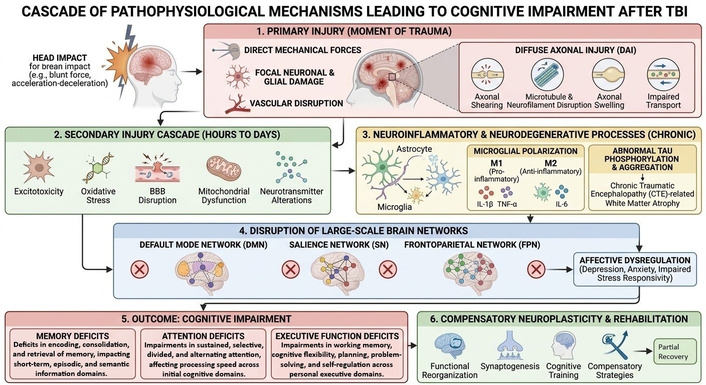
Cognitive impairment after traumatic brain injury. This schematic illustrates the pathophysiological cascade of traumatic brain injury (TBI) leading to cognitive deficits. It highlights primary injury, secondary injury mechanisms, network disruption, neurodegeneration, and compensatory neuroplasticity, showing how these interconnected processes contribute to impairments in memory, attention, and executive function. This image was generated using Gemini 3 Flash (Google) and subsequently edited by the authors. BBB: blood-brain barrier.
Primary injury occurs at the moment of trauma and consists of direct mechanical forces exerted on the brain, such as contusions, lacerations, and vascular disruption, resulting in focal neuronal and glial damage [29, 30]. Even mild injuries can induce widespread neural strain, particularly affecting networks involved in attention, memory, and executive function [13, 31–33]. A hallmark of moderate-to-severe TBI is DAI, which arises from shearing forces that stretch and damage axons throughout white matter tracts [13, 34, 35]. At the biochemical level, DAI involves microtubule and neurofilament disruption [13], leading to axonal swelling and impaired transport of organelles and synaptic vesicles. Increased axolemmal permeability permits abnormal ionic flux, particularly of calcium, which triggers activation of calpain and caspase proteases, resulting in cytoskeletal breakdown and Wallerian degeneration [36, 37]. These local cellular events propagate along white matter tracts, ultimately disrupting communication within large-scale networks such as DMN, SN, and FPN, which are critical for attention, executive function, and goal-directed behavior. Alterations in these networks may also contribute to affective dysregulation, depression, anxiety, and impaired stress responsivity, further linking cognitive and psychiatric sequelae after TBI. Such disruptions provide a central mechanism linking structural injury to persistent cognitive dysfunction after TBI and explain why similar focal lesions can produce highly variable outcomes across patients, supporting systems-level approaches for prognosis and rehabilitation.
While primary injury and network disruption set the stage for immediate cognitive deficits, secondary injury processes evolve over hours to days. Secondary injury cascades include excitotoxicity, oxidative stress, blood-brain barrier disruption, mitochondrial dysfunction, and neurotransmitter alterations [21, 38–40]. These processes exacerbate neuronal injury and contribute to long-lasting cognitive deficits [15, 41, 42]. Neuroinflammation is a key component, characterized by microglial activation and release of pro-inflammatory cytokines such as interleukin-1β, tumor necrosis factor-α, and interleukin-6 [15, 22, 25]. Microglia can polarize into M1 (pro-inflammatory) and M2 (anti-inflammatory) phenotypes, differentially influencing synaptic pruning, dendritic spine remodeling, and excitotoxicity. Reactive astrocytes contribute to glutamate clearance, but prolonged astrogliosis may exacerbate excitotoxicity and limit synaptic plasticity. Moreover, chronic calcium dysregulation, mitochondrial dysfunction, and oxidative stress may promote abnormal tau phosphorylation and aggregation, contributing to progressive axonal degeneration and chronic traumatic encephalopathy-related neurodegenerative processes. Notably, persistent neuroinflammation may promote long-term neurodegenerative changes, such as white matter atrophy, further impairing cognition and increasing vulnerability to neurodegenerative diseases [13, 14, 43–45].
Despite these disruptions, the brain retains a degree of neuroplasticity, enabling partial recovery of cognitive function. Functional reorganization, synaptogenesis, and recruitment of perilesional and contralateral brain regions provide a substrate for adaptive changes. Rehabilitation strategies harness these mechanisms through targeted cognitive training, CS, and environmental enrichment, promoting functional improvement and enhancing independence in daily life [18, 19].
The translation of mechanistic discoveries into effective therapies for TBI remains challenging. A major limitation in the TBI field is the persistent failure of many neuroprotective agents that demonstrate robust efficacy in preclinical models but do not translate into clinical benefit. Despite promising results in experimental studies, most pharmacological interventions have failed in large-scale clinical trials [46, 47]. This translational gap reflects several factors, including the limited ecological validity of animal models, insufficient representation of patient heterogeneity, and differences in timing and dosing of interventions between preclinical and clinical settings. Moreover, another major limitation is the incomplete ability of current experimental models to reproduce the biological and clinical heterogeneity of human TBI [48–50]. Commonly used in vivo models, including controlled cortical impact and fluid percussion injury, reproduce selected aspects of focal or diffuse injury but often fail to capture the complex interaction between DAI, chronic neuroinflammation, psychiatric manifestations, and long-term CIs observed in humans [51–53]. Furthermore, interspecies differences in white matter organization, neuroimmune responses, and recovery trajectories may limit the translational validity of preclinical findings [54].
Similarly, traditional in-vitro systems based on two-dimensional neuronal cultures provide limited representation of the multicellular and network-level interactions involved in TBI pathophysiology. These models inadequately reproduce the three-dimensional cytoarchitecture of the human brain, blood-brain barrier dynamics, and long-term neuroinflammatory responses that contribute to persistent CI [55, 56]. To address these limitations, emerging experimental platforms such as human induced pluripotent stem cell (iPSC)-derived brain organoids and three-dimensional organotypic cultures are increasingly being used to model axonal injury, neuroinflammation, synaptic dysfunction, and network disconnection in a more physiologically relevant context [56–58]. These advanced models may improve understanding of TBI-related neurodegeneration and facilitate the identification of novel therapeutic targets aimed at restoring neural connectivity and cognitive function.
Finally, TBI is increasingly recognized as a highly heterogeneous condition rather than a single disease entity. Variability in injury mechanism, lesion distribution, genetic background, age, comorbidities, and neuropsychiatric profile contributes to markedly different recovery trajectories across patients [1, 4]. This heterogeneity may explain why interventions effective in controlled experimental conditions often show inconsistent or null results in clinical populations.
As noted above, CI following TBI is highly heterogeneous and may vary depending on injury severity, lesion location, premorbid characteristics, and the time elapsed since trauma. Rather than reflecting a single deficit, post-TBI cognitive dysfunction typically involves a constellation of impairments affecting multiple cognitive domains [3, 59–62]. As displayed in Figure 2, among the most commonly reported deficits are disturbances in attention, processing speed, memory, and executive functioning [63–65]. These cognitive alterations often interact with each other and may contribute to difficulties in everyday functioning, social participation, and vocational reintegration [19, 66].
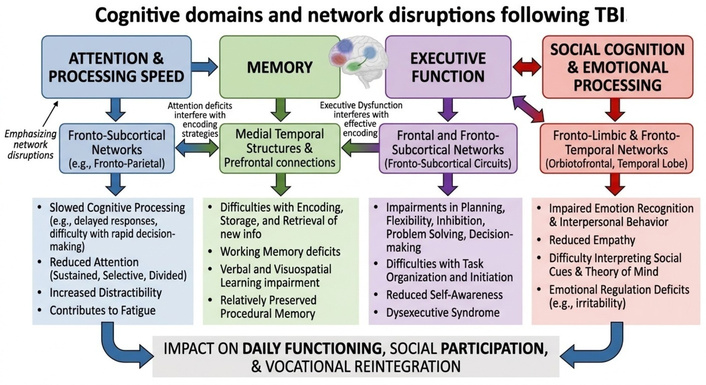
Cognitive domains and network disruptions following traumatic brain injury (TBI). The diagram depicts four key post-TBI cognitive domains—Attention & Processing Speed, Memory, Executive Function, and Social Cognition & Emotional Processing—with associated fronto-subcortical, fronto-limbic, and fronto-temporal networks. Arrows illustrate interactions between domains, and annotations highlight clinical manifestations such as slowed processing, working memory deficits, executive dysfunction, and impaired social-emotional processing, emphasizing their impact on daily functioning and social reintegration. This image was generated using Gemini 3 Flash (Google) and subsequently edited by the authors.
Impairments in attention and processing speed are among the most frequently observed cognitive consequences of TBI and can occur even after mild injury [7, 63, 64]. Attention deficits may involve several components, including sustained attention, selective attention, divided attention, and attentional control [62, 67]. Patients often report difficulties maintaining focus over time, increased distractibility, and reduced ability to manage multiple sources of information simultaneously. Reduced information processing speed represents another core feature of post-TBI cognitive dysfunction and may underlie deficits observed across other domains [63, 64]. Slowed cognitive processing has been linked to diffuse white matter damage and disruption of large-scale neural networks responsible for efficient information transmission [68, 69]. Clinically, reduced processing speed can manifest as delayed responses, difficulty following complex conversations, and reduced performance in tasks requiring rapid decision-making [19, 64]. These deficits may significantly impact daily functioning and can contribute to fatigue and reduced cognitive endurance [19, 70].
Memory disturbances are also highly prevalent after TBI and can affect different stages of the memory process, including encoding, storage, and retrieval [19, 64]. Difficulties in learning new information are commonly reported, particularly in individuals with moderate-to-severe injuries [71, 72].
Working memory deficits are frequently observed and may compromise the ability to temporarily maintain and manipulate information necessary for complex cognitive tasks. Episodic memory impairment, particularly involving verbal and visuospatial learning, is also common and has been associated with dysfunction in medial temporal structures and their connections with prefrontal cortical regions [60, 72]. In contrast, procedural memory and previously acquired knowledge are often relatively preserved, although performance may still be affected by attentional limitations and slowed processing speed [19, 64].
Executive dysfunction represents one of the most disabling cognitive sequelae of TBI [64, 67]. Executive functions refer to a set of higher-order cognitive processes that support goal-directed behavior, including planning, cognitive flexibility, inhibitory control, problem solving, and decision-making. Damage to frontal and fronto-subcortical networks frequently leads to impairments in these processes [19, 64]. Clinically, individuals with executive dysfunction may demonstrate difficulties organizing tasks, initiating activities, adapting to changing demands, or inhibiting inappropriate responses [70, 73]. These deficits can significantly interfere with independent living, occupational functioning, and social relationships [73, 74]. Moreover, executive dysfunction often contributes to impaired self-awareness, a phenomenon commonly observed after TBI in which patients underestimate the extent of their cognitive difficulties [75].
In addition to traditional cognitive domains, TBI may also affect social cognition and emotional processing [9, 65, 72]. Social cognitive abilities include the capacity to recognize emotional expressions, interpret social cues, understand others' mental states (theory of mind), and regulate interpersonal behavior [65]. Disruptions in these processes are frequently linked to damage within fronto-limbic and fronto-temporal networks [16], contributing to impairments in emotion recognition, empathy, and interpersonal behavior [9, 64, 74]. These impairments can lead to inappropriate social behavior, interpersonal conflicts, and social isolation [64, 74]. Furthermore, deficits in emotional regulation may interact with psychiatric symptoms such as irritability, depression, and anxiety, further complicating the clinical picture [9, 10]. Overall, the cognitive profile observed after TBI reflects the widespread disruption of distributed neural networks that support complex cognitive and socio-emotional processes [16]. Understanding the specific pattern of cognitive deficits in each individual is essential for guiding targeted rehabilitation strategies and optimizing functional recovery [10, 75].
The clinical manifestations and long-term consequences of CI following TBI may differ substantially across the lifespan, reflecting age-related variations in brain maturation, neuroplasticity, comorbidities, and recovery potential. Pediatric and older adult populations represent particularly vulnerable groups with distinct cognitive and functional trajectories.
In children and adolescents, TBI occurs during a critical phase of brain development and may interfere with the maturation of attention, executive functions, learning, and socio-emotional abilities. Importantly, children may “grow into their deficits,” with cognitive and behavioral impairments becoming more evident as developmental demands increase over time. These difficulties may negatively affect academic performance, social functioning, and family dynamics, highlighting the importance of early identification, longitudinal monitoring, and multidisciplinary rehabilitation.
Older adults are also at increased risk of persistent CI after TBI due to reduced neuroplasticity, frailty, comorbidities, and pre-existing neurodegenerative changes. Cognitive deficits commonly involve memory, attention, processing speed, and executive functioning, often overlapping with age-related cognitive decline. Moreover, TBI may increase the long-term risk of dementia in vulnerable individuals. Although rehabilitation outcomes may be less favorable compared with younger patients, elderly individuals can still benefit from personalized cognitive rehabilitation programs adapted to fatigue, reduced cognitive endurance, and multisystem clinical complexity.
TBI is frequently followed by a broad spectrum of psychiatric symptoms that may arise de novo or in the context of pre-existing conditions (Table 1). These disturbances often coexist with CI and have a significant impact on disability, rehabilitation outcomes, and QoL. Importantly, increasing evidence suggests that cognitive and psychiatric sequelae of TBI are not independent phenomena but rather emerge from shared and interacting pathophysiological mechanisms. Deficits in executive functioning, attention, and processing speed may impair emotional regulation and adaptive coping, thereby increasing vulnerability to affective disturbances such as depression, anxiety, and irritability. Conversely, psychiatric symptoms such as depression and post-traumatic stress disorder (PTSD) may further exacerbate cognitive dysfunction through effects on motivation, arousal regulation, and attentional control, creating a self-reinforcing bidirectional cycle of impairment. Epidemiological and mechanistic studies indicate that neuropsychiatric sequelae are common across the full spectrum of TBI severity and may persist long after the acute injury phase [76].
Psychiatric manifestations following TBI and their interactions with cognitive impairment.
| Psychiatric symptom | Estimated prevalence | Proposed mechanisms | Impact on cognitive function | Relevant references |
|---|---|---|---|---|
| Depression | High prevalence; persistent low mood, anhedonia, fatigue, sleep disturbances, reduced motivation | Chronic neuroinflammation; monoamine dysregulation; disrupted mood-regulating neural circuits | Exacerbates attention, memory, and executive deficits; further impairs functional recovery and QoL | [14, 74–76, 83] |
| Anxiety disorders | Common; generalized anxiety, panic symptoms | Limbic and prefrontal structural/functional changes; dysregulated stress response systems | Increases distractibility; reduces cognitive efficiency; compounds executive and attentional deficits | [83, 91] |
| Post-traumatic stress disorder (PTSD) | Substantial comorbidity; intrusive memories, avoidance, hyperarousal, negative mood | Dysregulated HPA axis; altered amygdala-prefrontal circuitry | Interacts with attention and memory impairments; diminishes functional outcomes | [92, 93] |
| Irritability/Aggression/Emotional dysregulation | Frequent; rapid mood shifts, impulsivity, low frustration tolerance | Disruption of fronto-limbic and orbitofrontal networks | Leads to social isolation, interpersonal difficulties, caregiver burden; co-occurs with depression/anxiety | [86, 94] |
| Cognitive-psychiatric interaction | Bidirectional interplay between cognitive and psychiatric symptoms | Executive dysfunction, slowed processing, attentional deficits impair emotional regulation | Psychiatric disorders exacerbate cognitive deficits, creating a cycle affecting functional independence and QoL | [86] |
The table summarizes the major psychiatric symptoms observed after traumatic brain injury (TBI), including prevalence, clinical features, proposed neurobiological mechanisms, and their impact on cognitive function and daily functioning. The bidirectional interactions between cognitive deficits and psychiatric disturbances are highlighted, emphasizing the importance of integrated assessment and rehabilitation strategies. HPA: hypothalamic-pituitary-adrenal; QoL: quality of life.
In this context, TBI-related psychiatric symptoms are increasingly conceptualized as manifestations of large-scale network dysfunction and neurotransmitter dysregulation rather than isolated psychological reactions to trauma. Structural and functional alterations involving fronto-limbic, fronto-striatal, and salience-processing circuits contribute to the emergence of depression, anxiety, emotional dysregulation, and PTSD symptoms after TBI [77–79].
Disruption of fronto-limbic pathways connecting the prefrontal cortex, anterior cingulate cortex (ACC), amygdala, and hippocampus has been strongly associated with impaired emotional regulation and depressive symptomatology [80]. Damage to these circuits may reduce top-down inhibitory control over limbic structures, leading to heightened emotional reactivity, impaired stress adaptation, and affective instability. Similarly, alterations within the orbitofrontal cortex and ventromedial prefrontal regions have been implicated in irritability, impulsivity, and aggression following TBI [77, 78].
At the network level, dysfunction of DMN, SN, and FPN appears to represent a key mechanistic substrate linking cognitive and psychiatric sequelae. Reduced connectivity within the DMN has been associated with impaired self-referential processing, depressive symptoms, and attentional dysfunction, whereas abnormal SN activity may contribute to hypervigilance, anxiety, and altered emotional salience attribution [76, 81–84]. Furthermore, impaired interaction between the SN and FPN may compromise cognitive control and emotional regulation, thereby exacerbating both executive dysfunction and psychiatric symptoms [16, 85].
In parallel, TBI-induced alterations in monoaminergic neurotransmission may further contribute to neuropsychiatric and cognitive disturbances. DAI and neuroinflammatory processes can disrupt dopaminergic, serotonergic, and noradrenergic pathways projecting from the brainstem to frontal and limbic regions [81, 86, 87]. Dopaminergic dysfunction has been associated with reduced motivation, executive deficits, and slowed information processing, while serotonergic alterations may contribute to depression, anxiety, and emotional dysregulation [86, 87].
Collectively, these findings support a systems-level model in which CI and psychiatric manifestations emerge from overlapping disturbances in distributed neural networks, neurochemical signaling, and neuroinflammatory pathways after TBI. These interacting cognitive and affective disturbances are further reflected in distinct and clinically relevant psychiatric phenotypes, which are detailed in the following sections.
Depression is among the most prevalent psychiatric disorders after TBI, affecting a substantial proportion of survivors. Systematic reviews (SRs) and meta-analyses (MAs) demonstrate that individuals with TBI have a significantly higher incidence of depressive symptoms compared to non-TBI controls, with elevated risk extending beyond the first post-injury year [88, 89]. Pathophysiological mechanisms include chronic neuroinflammation, monoamine dysregulation, and disruption of neural circuits involved in mood regulation [14, 88, 90].
Anxiety disorders, including generalized anxiety and panic symptoms, are commonly reported after TBI [91]. Meta-analytic evidence suggests that affected individuals are nearly twice as likely to develop anxiety compared to non-TBI populations [77]. Structural and functional alterations in limbic and prefrontal regions, alongside dysregulation of stress response systems, contribute to these symptoms. Anxiety may exacerbate cognitive dysfunction by increasing distractibility and reducing efficiency, compounding attentional and executive deficits characteristic of TBI [86].
PTSD may develop following traumatic events associated with TBI and is characterized by intrusive memories, avoidance, hyperarousal, and negative mood changes. Epidemiological studies indicate a substantial comorbidity between TBI and PTSD, with dysregulated hypothalamic-pituitary-adrenal (HPA) axis function and altered amygdala-prefrontal circuitry increasing vulnerability to stress responses [92]. PTSD symptoms often persist chronically and can interact with CIs, particularly in attention and memory domains, thereby diminishing functional outcomes [93].
Behavioral disturbances such as irritability, aggression, and emotional dysregulation are frequently observed after TBI. These reflect disruption of fronto-limbic and orbitofrontal networks responsible for inhibitory control and affect regulation [83]. Emotional dysregulation manifests as rapid mood shifts, impulsivity, and low frustration tolerance, leading to interpersonal difficulties, social isolation, and challenges for caregivers [94]. Aggression and irritability often co-occur with depression and anxiety, emphasizing the multifactorial nature of post-TBI neuropsychiatric sequelae [86].
Cognitive rehabilitation is a key component of post-acute care after TBI, aimed at reducing the functional impact of cognitive deficits in daily life. Given the multidimensional nature of post-TBI CI, interventions typically target multiple domains, including attention, memory, executive functions, and social cognition. The main goals are to support cognitive recovery, develop CS, and improve functional independence in everyday activities [18, 60, 95, 96].
Several rehabilitation approaches have been developed to address CI after TBI. Traditional cognitive rehabilitation approaches following TBI generally fall into three broad categories: restorative interventions (RI), CS, and metacognitive interventions (MIs) [18, 19]. These approaches, summarized in Table 2 and described in the following subsections, are often combined within individualized rehabilitation programs to address the heterogeneous cognitive profiles observed after brain injury [18, 97–99].
Traditional cognitive rehabilitation approaches.
| Approach | Description | Primary objectives | Typical techniques/examples | Key references |
|---|---|---|---|---|
| Restorative interventions | Directly improve impaired cognitive processes through repeated practice and structured exercises | Strengthen attention, processing speed, working memory, executive function; promote neural reorganization | Attention Process Training, computerized cognitive exercises, structured memory programs | [18, 19, 100] |
| Compensatory strategies | Help individuals adapt to persistent deficits by using preserved abilities and environmental supports | Reduce functional impact of deficits; improve everyday functioning and independence | External aids (notebooks, electronic reminders, smartphone apps), structured routines, environmental modifications; internal strategies (verbal rehearsal, chunking, visual imagery) | [101–104] |
| Metacognitive training | Improve self-awareness and regulation of cognitive and behavioral processes | Enhance self-monitoring, error detection, strategic problem solving; facilitate generalization to real-world tasks | Guided feedback, structured reflection on task performance, goal-management strategies | [98, 105] |
The table summarizes the three main traditional approaches to cognitive rehabilitation following traumatic brain injury.
Traditional cognitive rehabilitation following TBI includes approaches based on principles of neuroplasticity, aimed at improving cognitive functions, adapting to persistent deficits, and enhancing awareness of one’s limitations [18, 19, 70, 98, 100–103]. RI focuses on strengthening attention, processing speed, working memory, and executive functions through repeated practice and targeted exercises, such as attention process training (APT), computerized programs, and structured memory training [18, 19, 100]. CS facilitate adaptation to cognitive deficits by leveraging preserved abilities and using external or internal tools, including notebooks, electronic reminders, apps, structured routines, environmental modifications, verbal rehearsal, chunking, and visual imagery [101–104]. Finally, MI aims to improve self-awareness and regulation of cognitive and behavioral processes through self-monitoring, error detection, strategic problem solving, guided feedback, structured reflection, and goal-management, promoting the transfer of cognitive gains to daily activities and supporting recovery of executive functions [98, 105].
A growing body of research supports the use of cognitive rehabilitation interventions to address CI following TBI. Over the past two decades, numerous randomized clinical trials (RCTs), SRs, and MAs have evaluated remediation programs targeting attention, memory, and executive functions. Although variability in TBI populations and intervention protocols sometimes limits direct comparisons, the overall evidence indicates that structured cognitive rehabilitation can produce meaningful improvements in both cognitive performance and functional outcomes [19, 95, 106]. Attention training programs, such as APT, have demonstrated beneficial effects on sustained, selective, and divided attention in individuals with TBI. RCTs report significant improvements in working memory, inhibitory control, and cognitive flexibility compared with control conditions [107]. Other studies confirm that targeted attention training leads to measurable gains in attentional performance, with additional benefits observed when training is combined with metacognitive strategies or optimized engagement conditions [108, 109]. These findings suggest that improving attentional control can also positively influence other cognitive domains, including memory and executive functions, thereby supporting functional recovery after TBI [18].
Memory rehabilitation has similarly been widely investigated. Structured memory training combined with CS, such as external memory aids and errorless learning, can improve the acquisition of new information and support everyday functioning. For example, the TBI-MEM trial demonstrated that a contextualized behavioral intervention based on a modified Story Memory Technique significantly enhanced both objective memory performance and everyday memory outcomes compared with a placebo control [110]. Likewise, the multicenter ReMemBrIn trial found that a group-based memory rehabilitation program emphasizing CS improved goal attainment and aspects of functional adaptation in individuals with TBI, although it did not significantly reduce everyday memory problems as measured by the primary outcome [111]. Controlled studies also indicate that strategy-based and errorless learning approaches—whether therapist-delivered or computerized—produce significant improvements on standardized memory measures relative to controls [112]. Interventions incorporating strategic training and contextualized learning appear particularly effective in facilitating the transfer of cognitive gains to real-world situations [18, 110].
Executive function rehabilitation has received increasing attention in TBI, where deficits in planning, problem-solving, and goal-directed behavior are often persistent and disabling. Structured interventions, such as goal management training (GMT) and other metacognitive programs, aim to enhance individuals’ ability to monitor performance, regulate responses, and adopt adaptive problem-solving strategies. By focusing on task organization, self-monitoring, and strategic control, these interventions not only improve performance on specific cognitive exercises but also facilitate generalization of cognitive skills to daily life. Several clinical studies provide empirical support for GMT in TBI rehabilitation. Early controlled trials comparing GMT with an active control (motor skills training) demonstrated that participants receiving GMT achieved significant improvements on everyday tasks designed to simulate real-world executive demands, providing foundational evidence for its efficacy in reducing disorganized behavior [113]. In veterans with blast-related mild TBI, a modified GMT protocol led to significant gains on performance-based measures (such as the Tower of London), suggesting that structured strategy training can enhance executive function even in mild TBI, although generalization to daily activities was limited [114]. To overcome barriers to traditional clinic-based rehabilitation, an RCT protocol was developed to evaluate telephone-delivered GMT in adults with mild TBI, comparing this MI with telephone education and usual care. While primarily a protocol study, it highlights growing interest in broader implementation and the potential benefits of GMT on executive function and functional outcomes [115].
Consistent with recent clinical practice guidelines, these findings suggest that metacognitive strategy instruction—particularly approaches emphasizing goal setting, self-monitoring, and strategic problem solving—can play a meaningful role in executive function rehabilitation after TBI, potentially enhancing cognitive control and everyday functioning [116]. Evidence-based recommendations from organizations such as the American Congress of Rehabilitation Medicine further support the use of targeted cognitive interventions for individuals with TBI. These guidelines emphasize the effectiveness of structured attention training, strategy-based memory rehabilitation, and metacognitive approaches for executive dysfunction, while also highlighting the need to integrate cognitive rehabilitation with interventions addressing emotional, behavioral, and psychosocial factors that may influence recovery [19, 117]. Despite these encouraging findings, several limitations persist, including variability in injury severity, time since injury, intervention intensity, and outcome measures, which complicate the interpretation of treatment effects. Additionally, some studies report improvements primarily in trained tasks rather than broader functional outcomes, underscoring the importance of rehabilitation programs that explicitly target real-world activities and participation [19, 92, 110]. Overall, current evidence supports the clinical utility of cognitive remediation after TBI, particularly when interventions are individualized, strategy-based, and embedded within multidisciplinary programs.
Recent advances in neuroscience, digital health, and neurotechnology have led to the development of innovative approaches for cognitive rehabilitation after TBI. In particular, digital interventions have attracted increasing attention as flexible, scalable tools capable of targeting cognitive domains commonly affected post-injury, including attention, memory, processing speed, and executive function. Computerized cognitive training programs, virtual reality (VR) environments, and mobile health applications provide structured and adaptive exercises while delivering immediate feedback and objective performance monitoring [118]. These platforms also enable remote supervision and home-based rehabilitation, improving accessibility and continuity of care for individuals with long-term CIs [118, 119]. Emerging evidence indicates that digital cognitive interventions may produce significant improvements in global cognitive functioning, executive function, and attention in individuals with TBI, although effects on memory and daily functioning remain less consistent across studies [120, 121]. A recent MA synthesizing 16 studies reported moderate positive effects on global cognitive outcomes (SMD ≈ 0.64), executive function (SMD ≈ 0.32), and attention (SMD ≈ 0.40) compared with control conditions, whereas benefits for memory, processing speed, activities of daily living, or psychosocial outcomes such as mood and self-efficacy were less pronounced [122]. Earlier SRs corroborate these findings, highlighting improvements across multiple cognitive domains and suggesting that combining computerized training with other rehabilitative strategies yields more robust effects than computer-based interventions alone [123].
Immersive technologies such as VR may provide additional advantages by creating ecologically valid environments that simulate real-world situations. Interactive and engaging VR scenarios can facilitate the transfer of cognitive skills to everyday activities, while enhancing patient motivation and adherence to therapy. Several SRs have emphasized the potential of VR-based interventions to improve cognitive performance in TBI, particularly in attention, executive functioning, and visuospatial processing, although heterogeneity in study designs and outcome measures currently limits definitive conclusions [123, 124]. Moreover, subgroup analyses from meta-analytic studies of digital cognitive interventions suggest that VR-based interventions may produce greater improvements in cognitive domains compared with traditional therapy formats, highlighting the potential of immersive and interactive technologies to enhance engagement, training intensity, and ecological validity. These advantages may translate into better generalization of cognitive gains to real-life functioning, especially when patients practice complex goal-directed behaviors within simulated environments that closely mirror daily challenges [122].
Despite these advantages, adherence to home-based digital rehabilitation remains a significant challenge. Long-term engagement may be limited by cognitive fatigue, reduced motivation, psychiatric comorbidities, limited digital literacy, and insufficient caregiver or therapist support. Furthermore, variability in access to digital technologies and internet connectivity may contribute to disparities in treatment adherence and outcomes. Future studies should therefore investigate strategies to improve usability, personalization, and sustain patient engagement in remote rehabilitation settings.
In parallel, non-invasive neuromodulation techniques have emerged as promising adjunctive interventions to enhance cognitive recovery after TBI. Approaches such as transcranial direct current stimulation (tDCS) and repetitive transcranial magnetic stimulation (rTMS) aim to modulate cortical excitability and promote neuroplasticity in networks involved in cognition and emotion. By influencing neuronal membrane potentials and synaptic plasticity, these techniques may facilitate functional reorganization and support improvements in cognitive performance and emotional regulation [125–127]. Recent studies have explored combining neuromodulation with cognitive training, based on the hypothesis that stimulation can “prime” neural circuits and increase the efficiency of learning-related plasticity. Preliminary evidence suggests that integrated interventions may yield greater cognitive and functional gains than either modality alone [128, 129], though current studies are limited by small sample sizes, heterogeneous patient populations, and variability in stimulation parameters and training protocols.
Collectively, these emerging approaches underscore the potential of digital, immersive, and neuromodulatory interventions to complement traditional cognitive rehabilitation, enhancing the intensity, engagement, and ecological relevance of therapy. Figure 3 provides a schematic overview of traditional and emerging cognitive rehabilitation approaches for TBI, highlighting their conceptual relationships and shared therapeutic goals of improving cognitive functioning, enhancing participation in daily activities, and promoting long-term independence.
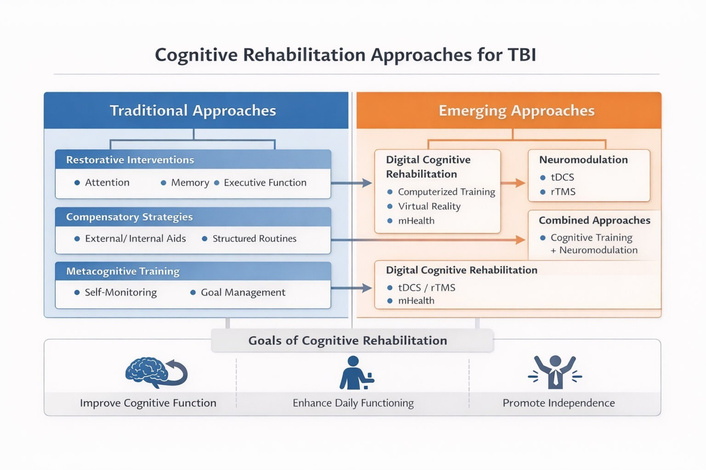
Overview of cognitive rehabilitation approaches following TBI. Traditional approaches include restorative interventions, compensatory strategies, and metacognitive training. Emerging approaches include digital cognitive rehabilitation, non-invasive neuromodulation, and combined interventions. Arrows indicate conceptual links, and the bottom panel highlights primary rehabilitation goals: improving cognitive function, enhancing daily functioning, and promoting independence. This image was generated using ChatGPT (OpenAI, 2023; https://chatgpt.com/) and subsequently edited by the authors. rTMS: repetitive transcranial magnetic stimulation; TBI: traumatic brain injury; tDCS: transcranial direct current stimulation.
Beyond cognitive rehabilitation and neuromodulation, increasing attention has been directed toward neuroregenerative strategies aimed at promoting structural repair and restoration of neural network connectivity after TBI [130, 131]. These approaches seek to modulate the hostile post-injury microenvironment characterized by neuroinflammation, axonal degeneration, glial scar formation, and impaired synaptic plasticity.
Biomaterial-based strategies, including injectable hydrogels, nanofibrous scaffolds, and bioengineered extracellular matrix platforms, have emerged as potential tools for supporting tissue repair and axonal regeneration. These biomaterials may provide structural support for cell migration and synaptic reconnection while simultaneously serving as vehicles for the controlled delivery of neurotrophic and anti-inflammatory factors [132–134].
Neurotrophic factor delivery systems have also attracted growing interest. Molecules such as brain-derived neurotrophic factor (BDNF), nerve growth factor (NGF), and glial cell line-derived neurotrophic factor (GDNF) have demonstrated potential to enhance neuronal survival, synaptic plasticity, and functional recovery in experimental TBI models. However, clinical translation remains limited by challenges related to blood-brain barrier penetration, short biological half-life, and targeted delivery [135, 136].
Cell-based therapies, including mesenchymal stem cells, neural stem cells, and extracellular vesicle/exosome-based approaches, are also being investigated for their immunomodulatory and neurorestorative properties. Experimental evidence suggests that these therapies may attenuate neuroinflammation, promote angiogenesis, and support synaptic remodeling, although robust clinical evidence is still lacking [137–140].
Importantly, advances in bioengineering and organotypic three-dimensional models may accelerate translational research by enabling more accurate investigation of neural network dysfunction and therapeutic responses. The integration of biomaterials, neurotrophic signaling, stem-cell-derived systems, and rehabilitation-based neuroplasticity may ultimately support the development of multimodal interventions capable of improving long-term cognitive and functional recovery after TBI.
Despite substantial progress in understanding CI after TBI, several important research gaps remain. Future studies should aim to refine rehabilitation strategies, identify predictors of treatment response, and develop interventions tailored to individual patient profiles. Personalized rehabilitation represents a promising direction, as cognitive deficits after TBI are highly heterogeneous, reflecting differences in injury severity, lesion location, premorbid characteristics, and psychosocial factors. Individualized programs may combine neuropsychological assessments, functional and neuroimaging data, and adaptive digital platforms to adjust task difficulty and rehabilitation targets in real time. Another priority is the identification of reliable biomarkers to predict cognitive outcomes and treatment response. In this context, blood-based biomarkers such as neurofilament light chain (NfL) and glial fibrillary acidic protein (GFAP) have emerged as promising tools for predicting long-term cognitive outcomes, monitoring axonal injury, and stratifying patients for personalized rehabilitation interventions [140–142].
Structural and functional neuroimaging, electrophysiological measures, and molecular indicators of inflammation, axonal injury, or neurodegeneration can provide insight into disrupted neural networks, such as DMN and FPN, and help guide targeted interventions. Longitudinal studies are essential to understand the evolution of cognitive deficits over months and years, determine the durability of rehabilitation effects, and investigate potential links between TBI and later-life neurodegenerative processes. Finally, the integration of neuroimaging with digital biomarkers derived from wearable devices, mobile applications, and computerized cognitive assessments may allow continuous monitoring of real-world cognitive and behavioral performance, improve early detection of decline, and support the development of precision rehabilitation strategies that adapt to individual recovery trajectories.
CI is a common and disabling long-term consequence of TBI, affecting attention, memory, processing speed, executive function, and social cognition, and often co-occurring with psychiatric symptoms such as depression, anxiety, and emotional dysregulation. These deficits arise from complex neurobiological mechanisms, including DAI, neuroinflammation, and network disruption. Cognitive rehabilitation remains central to recovery, with traditional approaches—restorative, compensatory, and MIs—proven effective in improving cognitive performance and functional independence. Emerging strategies using digital technologies, virtual environments, and non-invasive neuromodulation show promise for enhancing recovery, though further research is needed.
Another important research priority involves improving the translational bridge between experimental discoveries and clinical rehabilitation. Future studies should develop standardized and clinically relevant preclinical models capable of better reproducing the heterogeneity of human TBI. In parallel, greater integration between neuroengineering, biomaterials science, stem cell biology, and cognitive rehabilitation may facilitate the development of combined neurorestorative strategies targeting both structural and functional recovery.
Moreover, upcoming studies should further investigate how dysfunction of large-scale neural networks and monoaminergic systems contributes to the interaction between cognitive and psychiatric symptoms after TBI. Improved neuroanatomical and neurochemical characterization may facilitate the development of targeted and personalized rehabilitation strategies. Furthermore, rehabilitation models should also account for age-specific mechanisms and recovery trajectories, particularly in pediatric and older adult populations.
Finally, future directions include personalized rehabilitation, identification of prognostic biomarkers, longitudinal studies, and integration of neuroimaging with digital assessments to support precision rehabilitation. Interdisciplinary approaches combining neuroscience, neuropsychology, rehabilitation, and digital health hold the potential to optimize cognitive and functional outcomes after TBI.
APT: attention process training
CI: cognitive impairment
CS: compensatory strategies
DAI: diffuse axonal injury
DMN: default mode network
FPN: frontoparietal network
GMT: goal management training
MAs: meta-analyses
MIs: metacognitive interventions
NR: narrative review
PTSD: post-traumatic stress disorder
QoL: quality of life
RCTs: randomized clinical trials
RI: restorative interventions
SN: salience network
SRs: systematic reviews
TBI: traumatic brain injury
VR: virtual reality
During the preparation of this work, the authors used AI-assisted graphical drafting tools (Gemini 3 Flash and ChatGPT-OpenAI) to generate Figures. After utilizing the tool, the authors reviewed and edited the content as necessary and take full responsibility for the final content of the publication.
GV: Validation, Supervision, Methodology, Visualization, Writing—review & editing, Project administration. ST: Conceptualization, Investigation, Writing—original draft, Writing—review & editing. GM: Conceptualization, Investigation, Writing—original draft, Writing—review & editing. EA: Data curation, Investigation, Formal analysis. DT: Conceptualization, Investigation. All authors read and approved the submitted version.
The authors declare that there are no conflicts of interest.
Not applicable.
Not applicable.
Not applicable.
Not applicable.
Not applicable.
© The Author(s) 2026.
Open Exploration maintains a neutral stance on jurisdictional claims in published institutional affiliations and maps. All opinions expressed in this article are the personal views of the author(s) and do not represent the stance of the editorial team or the publisher.
Copyright: © The Author(s) 2026. This is an Open Access article licensed under a Creative Commons Attribution 4.0 International License (https://creativecommons.org/licenses/by/4.0/), which permits unrestricted use, sharing, adaptation, distribution and reproduction in any medium or format, for any purpose, even commercially, as long as you give appropriate credit to the original author(s) and the source, provide a link to the Creative Commons license, and indicate if changes were made.



View: 1767
Download: 31
Times Cited: 0


