 Original Article


Affiliation:
1Department of Agricultural Economics, Alex Ekwueme Federal University, Abakaliki 1010, Nigeria
Email: osujiemeka2@yahoo.com
ORCID: https://orcid.org/0000-0001-8605-834X


 ,
,
Affiliation:
2Department of Agricultural Economics and Extension, University of Delta, Agbor 2090, Nigeria
ORCID: https://orcid.org/0009-0005-3970-7438
,
Affiliation:
3Department of Soil Science and Technology, Federal University of Technology, Owerri 1526, Nigeria
ORCID: https://orcid.org/0000-0001-8402-3012
,
Affiliation:
4Department of Agricultural Economics, Federal University of Technology, Owerri 1526, Nigeria
ORCID: https://orcid.org/0000-0002-9857-674X
,
Affiliation:
5Department of Agricultural Economics, Management and Extension, Ebonyi State University, Abakaliki 053, Nigeria
ORCID: https://orcid.org/0009-0008-4999-3265
,
Affiliation:
6Department of Crop Science and Technology, Federal University of Technology, Owerri 1526, Nigeria
ORCID: https://orcid.org/0009-0008-8040-1889
,
Affiliation:
7Department of Agricultural Science, Alvan Ikoku Federal University of Education, Owerri 1033, Nigeria
ORCID: https://orcid.org/0000-0002-0556-9437
,
Affiliation:
8Department of Vocational and Technical Education, Alex Ekwueme Federal University, Abakaliki 1010, Nigeria
ORCID: https://orcid.org/0009-0007-3076-3091
,
Affiliation:
9Department of Agricultural Economics, Federal University of Agriculture, Makurdi 2373, Nigeria
ORCID: https://orcid.org/0009-0000-8035-5765
,
Affiliation:
10Department of Environmental Management, Federal University of Technology, Owerri 1526, Nigeria
ORCID: https://orcid.org/0000-0001-7475-5527
,
Affiliation:
11Department of Economics and Development Studies, Alex Ekwueme Federal University, Abakaliki 1010, Nigeria
ORCID: https://orcid.org/0000-0001-9576-3470
,
Affiliation:
12Department of Agricultural Economics and Extension, Federal University Lokoja, Felele 1154, Nigeria
ORCID: https://orcid.org/0000-0002-4638-9547
,
Affiliation:
4Department of Agricultural Economics, Federal University of Technology, Owerri 1526, Nigeria
ORCID: https://orcid.org/0000-0002-3728-1550
,
Affiliation:
13Department of Geography and Environmental Studies, Prince Abubakar Audu University, Anyigba 1008, Nigeria
ORCID: https://orcid.org/0000-0002-7269-7746
,
Affiliation:
14Department of Social Science Education, Prince Abubakar Audu University, Anyigba 1008, Nigeria
ORCID: https://orcid.org/0009-0007-6792-8611
,
Affiliation:
15Department of Forestry and Wild Life Technology, Federal University of Technology, Owerri 1526, Nigeria
ORCID: https://orcid.org/0000-0002-4690-1053
,
Affiliation:
16Department of Mechatronics Engineering, Federal University of Technology, Owerri 1526, Nigeria
ORCID: https://orcid.org/0000-0002-4693-391X
,
Affiliation:
4Department of Agricultural Economics, Federal University of Technology, Owerri 1526, Nigeria
ORCID: https://orcid.org/0009-0008-1993-8353
,
Affiliation:
4Department of Agricultural Economics, Federal University of Technology, Owerri 1526, Nigeria
ORCID: https://orcid.org/0000-0003-2115-663X
Explor Foods Foodomics. 2026;4:1010189 DOI: https://doi.org/10.37349/eff.2026.1010189
Received: April 07, 2026 Accepted: July 28, 2026 Published: September 10, 2026
Academic Editor: Charles Odilichukwu R Okpala, University of Georgia Athens-GA, USA
Aim: This study examines the interactions of climate change, economic, and social factors on food security, by way of a three -decade impact and threat assessment of Nigeria.
Methods: The study employs annual time-series data covering 32 observations and applies the Autoregressive Distributed Lag (ARDL) modeling approach to examine both the long-run and short-run relationships among the variables. Prior to estimation, the Augmented Dickey-Fuller (ADF) unit root test was conducted to determine the stationarity properties of the variables, while the ARDL bounds test was used to verify the existence of a long-run cointegration relationship.
Results: The findings confirm a long-run equilibrium relationship between food security and the selected climatic and socio-economic variables. Both the long-run and short-run estimates show that temperature, rainfall variability, relative humidity, population growth, poverty rate, migration, and limited access to credit significantly reduce per capita food expenditure, thereby worsening food security. The error correction model is negative and statistically significant, indicating rapid adjustment to long-run equilibrium following short-run disturbances. Diagnostic tests further confirm that the estimated model is statistically robust, free from multicollinearity, heteroskedasticity, and serial correlation, and stable over the study period.
Conclusions: The study demonstrates that food security in Nigeria is shaped by the combined effects of climate change and socio-economic vulnerabilities, underscoring the need for integrated adaptation and development policies. Strengthening climate-resilient agricultural practices, expanding access to credit, reducing poverty, and enhancing social protection measures are essential to improving household food security and building resilience to future climatic and economic shocks.
Climate change has emerged as one of the most pressing global challenges of the 21st century, with profound implications for human livelihoods, natural ecosystems, and socioeconomic stability [1]. Its effects are particularly pronounced in developing countries, where a high dependence on rain-fed agriculture, limited access to technological innovations, and low adaptive capacity make populations highly vulnerable to environmental variability [2]. Nigeria, Africa’s most populous country with over 230 million people, represents a critical case in point. Agriculture constitutes a major part of Nigeria’s economy, employing more than 70% of the rural population and contributing significantly to the national Gross Domestic Product (GDP) [3]. Despite its importance, the sector remains largely characterized by low-input, rain-dependent farming systems, making it highly sensitive to climatic disruptions such as drought, flooding, and irregular rainfall patterns. The manifestations of climate change in Nigeria are diverse and multifaceted. Average temperatures have risen consistently over the past decades, affecting both crop and livestock production. Heat stress has been shown to reduce the yields of temperature-sensitive staple crops, including maize, millet, sorghum, and cassava, while also impacting livestock health, milk production, and reproductive performance [4]. Rainfall patterns have become increasingly erratic, with delayed onset, early cessation, and uneven distribution leading to drought in the northern regions and flooding in the southern and coastal areas. Such climatic shocks exacerbate soil degradation, erosion, and desertification, undermining the long-term sustainability of agricultural production. Coastal communities also face rising sea levels, saltwater intrusion, and increased vulnerability of fisheries, further threatening food security [5].
Food security, as defined by the Food and Agriculture Organization (FAO), encompasses four key dimensions: availability, access, utilization, and stability. In Nigeria, climate change undermines all four, leading to food security issues [6]. Currently, climate-induced crop failures and reduced livestock productivity limit food availability, while economic constraints resulting from yield losses reduce households’ ability to purchase food. Nutrition quality is compromised when climate shocks reduce crop diversity or increase reliance on a limited range of staples [7]. Furthermore, the unpredictability and frequency of extreme weather events threaten the stability of food supply, exposing communities to seasonal and chronic food insecurity [8]. Vulnerable groups, including rural smallholder farmers, women, and children, are disproportionately affected due to limited access to financial resources, agricultural extension services, and adaptive technologies [9]. Socio-economic factors interact with environmental stressors to amplify vulnerability. Smallholder farmers, who constitute the majority of Nigeria’s agricultural workforce, often lack access to modern inputs, credit facilities, and insurance schemes, constraining their ability to adapt to climatic variability [10]. Land degradation, flooding, overexploitation of natural resources, and inadequate infrastructure further limit resilience. High poverty levels, farmer-herder clashes, and insurgency, combined with rapid population growth, place additional pressure on the food system, making it increasingly difficult for households to maintain adequate food access. The interplay between these factors suggests that climate change is not merely an environmental issue but a multidimensional challenge that intersects with economic, social, and policy domains [11].
Despite the growing body of literature on climate change and food security in Nigeria, important knowledge gaps remain. Existing studies have largely concentrated on the effects of individual climatic variables such as temperature or rainfall on agricultural productivity [12–14], while others have focused on specific crops, regions, or agro-ecological zones [15]. For instance, many studies have assessed the impacts of climate variability on crop yields, agricultural output, or farmers’ adaptation strategies without explicitly examining food security outcomes [16, 17]. Furthermore, previous research has often relied on either climatic variables or socio-economic indicators in isolation, thereby overlooking the complex interactions between environmental change and household socio-economic conditions. As a result, the multidimensional nature of food security, encompassing availability, access, utilization, and stability, has not been adequately addressed within a unified analytical framework. In addition, most empirical studies in Nigeria have employed relatively short time-series data or cross-sectional surveys, limiting their ability to capture long-term dynamics between climate change and food security. Few studies have incorporated broader socio-economic determinants such as population growth, poverty rate, migration, and access to credit alongside climatic variables within a single econometric model. Consequently, there remains limited evidence on how these factors jointly influence household food security over an extended period. This study addresses these gaps in several important ways. First, it adopts an integrated approach by simultaneously examining the effects of climatic variables (temperature, rainfall, and relative humidity) and socio-economic factors (population growth, poverty rate, migration, and access to credit) on food security in Nigeria. Second, unlike many previous studies that focus primarily on agricultural production, this study employs per capita food expenditure as a proxy for food security, thereby capturing the economic dimension of household food access. Third, the study utilizes 32 years of annual data, providing a long-term perspective on the relationship between climate change and food security. Fourth, the application of the Autoregressive Distributed Lag (ARDL) model enables the estimation of both short-run and long-run effects, offering a more comprehensive understanding of the dynamics among the variables. Overall, this study examines the interactions of climate change, economic, and social factors on food security, by way of a three -decade impact and threat assessment of Nigeria. By integrating climatic, economic, and social dimensions within a comprehensive analytical framework, this study provides novel empirical evidence on the interactions between climate change, socioeconomic factors, and food security in Nigeria over the past three decades. The findings advance understanding of the complex drivers of food insecurity and offer valuable insights for evidence-based policy formulation, climate change adaptation, and the development of resilient and sustainable food systems.
Figure 1 presents the overall methodological framework adopted in this study, illustrating the sequential stages followed from data acquisition to econometric analysis and model validation.
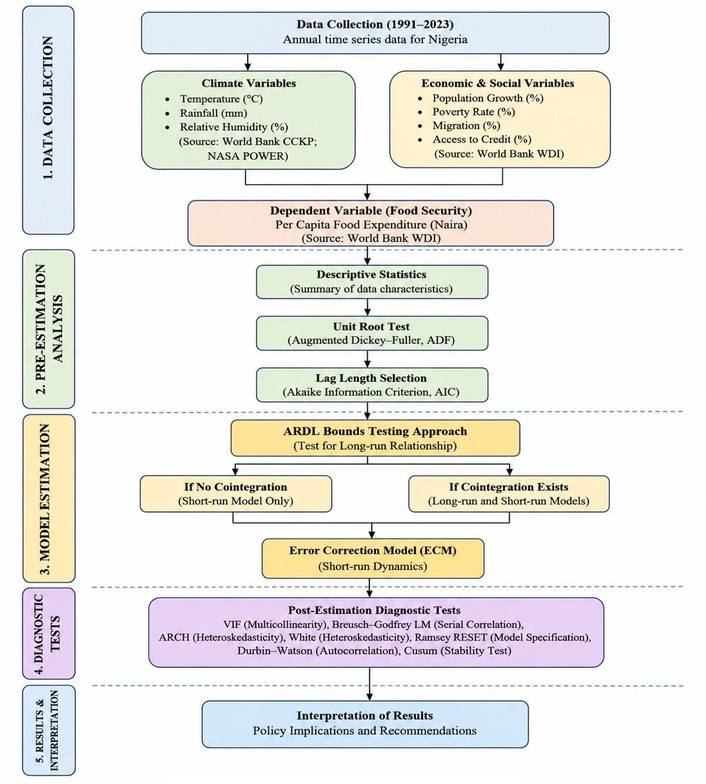
Flow Diagram of the study methodology. ARDL: Autoregressive Distributed Lag; CCKP: Climate Change Knowledge Portal; LM: Lagrange Multiplier; VIF: Variance Inflation Factor.
The framework directly aligns with the study objective of examining the interactions between climate change, economic, and social factors and their effects on food security in Nigeria by integrating multiple datasets within a comprehensive analytical process.
The adopted methodological framework is appropriate because it combines data collection, variable classification, stationarity testing, cointegration analysis, short- and long-run estimations, and extensive diagnostic evaluations, thereby ensuring a robust assessment of the complex relationships among the study variables.
To ensure data quality and reliability, all datasets were obtained from internationally recognized databases, including the World Bank Climate Change Knowledge Portal (CCKP), Nasa Power, FAO Statistics (FAOSTAT), and the World Bank. The datasets were screened for consistency, completeness, and comparability before analysis, while the validity and robustness of the estimated models were further confirmed through unit root, cointegration, diagnostic, and parameter stability tests.
This study focuses on Nigeria, the most populous country in Africa, covering approximately 923,770 km2 and characterized by diverse ecological and climatic conditions. The country spans several agro-ecological zones ranging from the arid and semi-arid Sudan and Sahel savannahs in the north to the humid rainforest and coastal ecosystems in the south. Agriculture remains predominantly rain-fed and constitutes the primary source of livelihood for more than 70% of the rural population. Agricultural production varies across ecological zones. Millet, sorghum, and cowpea dominate the northern regions where rainfall is relatively low and droughts are frequent, while maize, cassava, yam, rice, and vegetables are widely cultivated in the central and southern regions where rainfall is comparatively higher. The northern region is increasingly threatened by drought, desertification, and heat stress, whereas the southern region experiences recurrent flooding and excessive rainfall. These contrasting climatic conditions make Nigeria an ideal case study for investigating the interactions among climatic, social, and economic factors influencing food security.
The study employed annual secondary time-series data covering the period 1991–2023. Data were obtained from internationally recognized databases to ensure consistency, reliability, and comparability. Climate variables comprising annual mean temperature, annual rainfall, and relative humidity were obtained from the World Bank CCKP and Nasa Power. Socio-economic variables including population growth and access to credit were sourced from FAOSTAT, while data on food security (proxied by per capita food expenditure), poverty rate, and migration were obtained from the World Bank Development Indicators. Table 1 presents the definition, measurement units, and data sources for each variable included in the analysis.
Source of variables.
| Variable | Unit | Source |
|---|---|---|
| Temperature | °C | World Bank Climate Change Knowledge Portal |
| Rainfall | mm | World Bank Climate Change Knowledge Portal |
| Relative humidity | % | Nasa Power |
| Population growth | % | Food and Agriculture Organization Statistics (FAOSTAT) |
| Poverty rate | % | World Bank |
| Migration | % | World Bank |
| Access to credit | % | FAOSTAT |
| Food security | Per capita food expenditure (Naira) | World Bank |
The selection of variables for this study was guided by theoretical considerations, empirical evidence from previous studies, and data availability. Climate variables, including temperature, rainfall, and relative humidity, were selected because they directly influence agricultural productivity and food availability, which are critical dimensions of food security. Socio-economic variables such as population growth, poverty rate, migration, and access to credit were included due to their established roles in determining food access, utilization, and households’ adaptive capacity to climate-related shocks. Furthermore, all selected variables had consistent annual data available for the study period from reputable international databases, including the World Bank CCKP, Nasa Power, the World Bank Database, and FAOSTAT. Variables with insufficient data coverage, substantial missing observations, weak theoretical relevance to food security, or high collinearity with other explanatory variables were excluded from the analysis to ensure the robustness and reliability of the model estimates.
Food security, measured using per capita food expenditure, served as the dependent variable. The explanatory variables were categorized into three broad dimensions. This classification enables a comprehensive assessment of the combined influence of environmental, demographic, and economic factors on food security. Thus:
Temperature
Rainfall
Relative humidity
Population growth
Migration
Poverty rate
Access to credit
The analytical framework was designed to evaluate both the short-run and long-run interactions between climate change, socio-economic factors, and food security in Nigeria. The study employed the ARDL modelling approach because of its flexibility in estimating dynamic relationships among variables integrated of order I(0) and I(1). Unlike conventional cointegration techniques, the ARDL approach provides reliable estimates even when explanatory variables possess mixed orders of integration and when the sample size is relatively small.
The implicit model of the ARDL framework is stated as follows:
Where:
Yt = Food security proxied by per capita food expenditure (Naira)
t = Time period
X1 = Temperature (°C)
X2 = Rainfall (mm)
X3 = Relative humidity (%)
X4 = Population growth (%)
X5 = Poverty rate (%)
X6 = Migration (%)
X7 = Access to credit (%)
Where: ΔYt = Yt – Yt – 1 (short-run changes) and represents the first difference operator. t – 1, t – i indicate time-period lagged values. β = coefficients of independent variables. α = short-run dynamic coefficients, λ = long-run relationship parameters, ε = summation, ECMt – 1 = error correction model lag for one period, p, q (lag lengths), θ (long-run coefficients), and φ (speed of adjustment), εt = error term.
Note: the dependent variable in the ARDL model is food security (Yt), proxied by per capita food expenditure and measured in Naira (₦). Per capita food expenditure was used as an indicator of food security because it reflects households’ economic access to food and their capacity to meet dietary needs. The explanatory variables include temperature (X1), measured in degrees Celsius (°C), which captures the effect of changing climatic conditions on agricultural productivity; rainfall (X2), measured in millimeters (mm), representing the availability of water for crop and livestock production; and relative humidity (X3), measured as a percentage (%), indicating atmospheric moisture conditions that may affect crop growth and disease prevalence. The socio-economic variables comprise population growth (X4), measured as the annual percentage growth in population; poverty rate (X5), measured as the percentage of the population living below the poverty line; migration (X6), measured as the percentage migration rate, reflecting population movements that may influence labor supply and food demand; and access to credit (X7), measured as the percentage of the population with access to financial services, which can enhance investment in agricultural production and improve household food security. These variables were selected based on their theoretical relevance and empirical significance in explaining food security outcomes.
Before estimating the ARDL model, the stationarity properties of all variables were examined using the Augmented Dickey-Fuller (ADF) unit root test. The ARDL Bounds testing procedure was subsequently applied to determine whether a long-run equilibrium relationship exists among the variables. The decision was based on the comparison between the calculated Fisher’s statistic (F-statistic) and the lower and upper critical bounds.
To ensure the reliability of the estimated model, several post-estimation diagnostic tests were conducted. These included: Breusch-Godfrey Lagrange Multiplier (LM) test for serial correlation; White test for heteroskedasticity; Autoregressive Conditional Heteroskedasticity (ARCH) test; Ramsey RESET test for model specification; Variance Inflation Factor (VIF) for multicollinearity; Durbin-Watson (DW) statistic for residual autocorrelation; and CUSUM stability test for parameter stability. Collectively, these tests verified that the estimated ARDL model satisfied the classical regression assumptions and produced statistically reliable estimates.
The study utilized 32 annual observations with seven explanatory variables. The relatively limited sample size justified the adoption of the ARDL methodology because it is specifically designed for small-sample time-series analyses and has been widely demonstrated to generate efficient and unbiased parameter estimates under such conditions [18]. Moreover, the ARDL technique accommodates variables integrated of both I(0) and I(1), eliminating the requirement that all variables possess the same order of integration. This characteristic makes the method particularly suitable for macroeconomic and environmental studies where variables often exhibit mixed integration properties. The validity of the estimated model was further strengthened through comprehensive unit root, cointegration, diagnostic, and stability analyses. The satisfactory performance of these tests confirms the robustness, reliability, and stability of the estimated relationships, thereby enhancing the credibility of the empirical findings and the policy recommendations derived from the study.
Table 2 presents the descriptive statistics of the variables used in the study. The mean annual temperature was 27.2°C, with a minimum value of 21.0°C and a maximum value of 29.4°C. Annual rainfall averaged 1,177 mm, ranging from 1,106 mm to 1,400 mm. Relative humidity had a mean value of 79.6%, with values varying between 40.8% and 98.9%. The average population growth rate was 2.09%, with a minimum and maximum value of 2.02% and 2.12%, respectively. Poverty rate recorded a mean value of 63.4%, ranging from 35.5% to 80.6%. Migration had an average value of 48.1%, with values ranging from 22.3% to 56.8%. Access to credit recorded a mean value of 6.2%, with a minimum value of 4.6% and a maximum value of 12.9%. The standard deviations of temperature, rainfall, relative humidity, population growth, poverty rate, migration, and access to credit were 1.05, 85.30, 10.06, 0.03, 9.78, 7.03, and 2.07, respectively. Skewness values ranged from –1.0 to 0.8, while kurtosis values ranged from 1.8 to 3.0.
Summary statistics of variables.
| Variable | Unit | N | Minimum | Maximum | Mean | Standard deviation | Skewness | Kurtosis |
|---|---|---|---|---|---|---|---|---|
| Temperature | °C | 32 | 21.0 | 29.4 | 27.2 | 1.05 | –0.9 | 2.3 |
| Rainfall | mm | 32 | 1,106 | 1,400 | 1,177 | 85.30 | 0.8 | 2.5 |
| Relative humidity | % | 32 | 40.8 | 98.9 | 79.6 | 10.06 | –0.5 | 1.8 |
| Population growth | % | 32 | 2.02 | 2.12 | 2.09 | 0.03 | 0.2 | 3.0 |
| Poverty rate | % | 32 | 35.5 | 80.6 | 63.4 | 9.78 | –1.0 | 2.0 |
| Migration | % | 32 | 22.3 | 56.8 | 48.1 | 7.03 | –0.3 | 3.0 |
| Access to credit | % | 32 | 4.6 | 12.9 | 6.2 | 2.07 | –0.6 | 2.0 |
Table 3 presents the ADF test (unit root test). The ADF unit root test results indicate that the variables in the study exhibit a mixed order of integration. Specifically, the dependent variable (Y) and the explanatory variables X3, X4, X5, and X7 are stationary at level, implying that they are integrated of order zero, I(0). This indicates that these variables do not contain a unit root and their statistical properties remain stable over time. In contrast, X1, X2, and X6 are non-stationary at level but become stationary after first differencing, indicating that they are integrated of order one, I(1). This means that these variables initially contain a unit root but achieve stationarity after being differenced once.
Augmented Dickey-Fuller test (unit root test).
| Variable | At level I(0)t-statistic | Remark | At first difference I(1)t-statistic | Remark | Decision: H0 | Order of integration |
|---|---|---|---|---|---|---|
| Y | –4.673*** | Stationary | –4.321*** | Stationary | Reject | I(0) at 1% |
| X1 | –1.225 | Non-stationary | –4.022*** | Stationary | Reject | I(1) at 1% |
| X2 | –1.051 | Non-stationary | –4.343*** | Stationary | Reject | I(1) at 1% |
| X3 | –5.114*** | Stationary | –2.782*** | Stationary | Reject | I(0) at 1% |
| X4 | –2.501** | Stationary | –4.011*** | Stationary | Reject | I(0) at 5% |
| X5 | –5.140*** | Stationary | –5.822*** | Stationary | Reject | I(0) at 1% |
| X6 | –1.006 | Non-stationary | –4.311*** | Stationary | Reject | I(1) at 1% |
| X7 | –2.104** | Stationary | –3.701*** | Stationary | Reject | I(0) at 5% |
** and *** denote significance at the 5% and 1% levels, respectively. H0: series have a unit root.
Overall, the results confirm that the dataset consists of a combination of I(0) and I(1) variables, with no variable integrated of order two, I(2).
Table 4 presents the results of the ARDL bounds test for co-integration, conducted to determine the existence of a long-run equilibrium relationship among the variables. The decision rule is based on comparing the computed F-statistic with the lower and upper bound critical values. The results show that the calculated F-statistic is 7.07, while the lower and upper bound critical values at the conventional significance levels are 2.01 and 2.67, respectively. Since the computed F-statistic exceeds both the lower and upper bound critical values, the null hypothesis of no co-integration is rejected. This outcome indicates the presence of a long-run co-integrating relationship among the variables included in the model.
ARDL-bounds test for co-integration.
| Critical value | F-statistic (tabulated) | F-statistic (calculated) | Remark |
|---|---|---|---|
| Upper bound (1%) | 2.67** | 7.07*** | Reject H0 |
| Lower bound (5%) | 2.01** | - | - |
** and *** denote significance at the 5% and 1% levels, respectively. H0: series have a unit root. ARDL: Autoregressive Distributed Lag; F-statistic: Fisher’s statistic.
Table 5 presents ARDL estimates of the long- and short-run impact of climate change, social, and economic factors on food security. The ARDL estimates provide evidence on both the long-run and short-run determinants of food security in Nigeria. The long-run results show that temperature (–4.064), rainfall (–0.956), relative humidity (–3.732), population growth (–0.802), poverty rate (–0.911), migration (–0.655), and access to credit (–6.580) all have negative and statistically significant effects on per capita food expenditure. In the short run, temperature (–0.790), rainfall (–4.082), population growth (–5.402), poverty rate (–0.953), migration (–4.504), and access to credit (–0.993) also exhibit negative and statistically significant effects. However, relative humidity shows a positive and significant short-run effect (0.701). The error correction model (ECM)t – 1 is negative and statistically significant with a coefficient of –0.881, indicating a strong speed of adjustment toward long-run equilibrium.
Autoregressive Distributed Lag (ARDL) estimates of long- and short-run impact of climate change, social, and economic factors on food security.
| Variable | Coefficient | t-value | Standard error |
|---|---|---|---|
| Long-run estimates | |||
| LnX1 | –4.064 | –3.683*** | 1.103 |
| LnX2 | –0.956 | –4.372*** | 0.218 |
| LnX3 | –3.732 | –2.532** | 1.473 |
| LnX4 | –0.802 | –4.231*** | 0.189 |
| LnX5 | –0.911 | –2.625** | 0.347 |
| LnX6 | –0.655 | –3.467*** | 0.188 |
| LnX7 | –6.580 | –4.488*** | 1.466 |
| Short-run estimates | |||
| ECMt – 1 | –0.881 | –4.467*** | 0.197 |
| Δ LnX1 | –0.790 | –4.011*** | 0.196 |
| Δ LnX2 | –4.082 | –3.678*** | 1.109 |
| Δ LnX3 | 0.701 | 2.092** | 0.335 |
| Δ LnX4 | –5.402 | –2.900** | 1.862 |
| Δ LnX5 | –0.953 | –3.677*** | 0.259 |
| Δ LnX6 | –4.504 | –3.022*** | 1.490 |
| Δ LnX7 | –0.993 | –2.722** | 0.364 |
** and *** denote significance at the 5% and 1% levels, respectively. ECM: error correction model.
Table 6 presents the results of the diagnostic tests conducted to evaluate the reliability and robustness of the estimated ARDL model. The VIF value is 2.022, indicating a low level of multicollinearity among the explanatory variables. The Breusch-Godfrey LM test statistic of 0.701 is not statistically significant, suggesting the absence of serial correlation in the model residuals. The ARCH test statistic of 0.911 indicates no evidence of ARCH. Similarly, the White heteroskedasticity test statistic of 1.010 shows that the model does not suffer from heteroskedasticity, implying constant variance of the residuals. The Ramsey RESET test statistic of 1.321 confirms that the model is correctly specified. The coefficient of determination (R2) is 0.781, indicating that 78.1% of the variation in per capita food expenditure is explained by the model. The F-statistic value of 6.901 shows that the explanatory variables are jointly statistically significant. The DW statistic of 1.505 suggests no serious autocorrelation problem. Finally, the CUSUM stability test indicates that the model is stable over the study period.
Diagnostic statistical test.
| Diagnostic statistical test | Statistical values |
|---|---|
| VIF test | 2.022 |
| LM test | 0.701 |
| ARCH test | 0.911 |
| White test | 1.010 |
| Ramsey RESET test | 1.321 |
| R2 | 0.781 |
| F-statistic | 6.901 |
| DW-statistic | 1.505 |
| CUSUM test | Stable |
ARCH: Autoregressive Conditional Heteroskedasticity; DW: Durbin-Watson; F-statistic: Fisher’s statistic; LM: Lagrange Multiplier; R2: coefficient of determination; VIF: Variance Inflation Factor.
The descriptive statistics indicate that climatic conditions in the study area were characterized by relatively stable temperatures and population growth rates, as evidenced by their low standard deviations (Table 2). In contrast, rainfall, relative humidity, poverty rate, and migration exhibited greater variability, suggesting fluctuations in climatic and socio-economic conditions over the study period. The high mean relative humidity (79.6%) and substantial annual rainfall (1,177 mm) reflect the humid tropical climatic conditions typical of southeastern Nigeria. The average poverty rate of 63.4% indicates a high incidence of poverty, which may increase the vulnerability of households to climate-related shocks. Similarly, the mean migration rate of 48.1% suggests considerable population movement, which may be associated with economic and environmental factors. The skewness values, which fall within the acceptable range of ± 1, suggest that the variables are reasonably symmetrical and do not exhibit severe departures from normality. Furthermore, the kurtosis values are close to the benchmark value of 3, indicating that the distributions are approximately normal. These results imply that the data are suitable for further econometric analysis and inference.
The presence of both I(0) and I(1) variables suggests a mixed integration structure, which has important implications for model selection (Table 3). The stationarity of Y, X3, X4, X5, and X7 at level implies that these variables are inherently stable and do not require transformation before inclusion in the model. On the other hand, the need to difference X1, X2, and X6 to achieve stationarity indicates that these variables are influenced by time-dependent stochastic trends. This behavior is common in macroeconomic and environmental data, where shocks may have persistent effects over time [19]. Importantly, the absence of I(2) variables satisfies a key assumption for the application of the ARDL model. The ARDL framework is particularly suitable in this context because it can accommodate a combination of I(0) and I(1) variables without requiring all variables to be integrated at the same order. Therefore, the results justify the use of the ARDL modeling approach for further econometric analysis, including the examination of both short-run dynamics and long-run relationships among the variables.
The rejection of the null hypothesis implies that the dependent and explanatory variables maintain a stable long-run equilibrium relationship, despite possible short-run fluctuations (Table 4). This suggests that the variables move together over time and that any deviations from equilibrium are temporary and will eventually adjust back to the long-run path [20]. The existence of co-integration is particularly important in time series analysis, as it confirms that the estimated relationships are meaningful and not spurious. It also validates the theoretical expectation that the variables are interrelated over the long term. Furthermore, the presence of co-integration justifies the application of the ARDL framework for estimating both long-run coefficients and short-run dynamics. Specifically, it supports the use of the ECM, which captures the speed at which short-run disequilibria adjust toward long-run equilibrium. Overall, the findings provide strong empirical support for continuing with ARDL-based estimation, enabling a comprehensive analysis of both long-run relationships and short-run adjustments among the variables.
The findings clearly demonstrate that both climatic and socio-economic factors play a significant and interrelated role in shaping food security outcomes in Nigeria (Table 5). The negative long-run effect of temperature suggests that sustained increases in temperature impose structural constraints on agricultural productivity and household welfare. Rising temperatures accelerate evapotranspiration, reduce soil moisture, and shorten crop growth cycles, all of which contribute to declining yields [21]. This not only lowers farm incomes but also reduces food supply, leading to higher market prices. Consequently, households experience reduced purchasing power, limiting their ability to maintain adequate food consumption. The negative short-run effect further indicates that even temporary heat shocks—such as heatwaves—can disrupt labor productivity, damage crops, and increase non-food expenditures (e.g., health-related costs), thereby immediately constraining food expenditure [22]. Rainfall also exhibits a negative relationship with food expenditure in both the short and long run, highlighting the importance of rainfall patterns rather than total rainfall volume. In Nigeria, rainfall is often characterized by high variability, including delayed onset, early cessation, and extreme events such as flooding. Excessive rainfall can destroy crops, erode fertile land, and damage critical infrastructure such as roads and storage facilities, thereby disrupting food distribution systems [23]. On the other hand, poorly timed rainfall reduces planting efficiency and crop yields. These dynamics reduce both agricultural output and household income, ultimately constraining economic access to food. The stronger short-run effect suggests that sudden rainfall shocks—particularly floods—have immediate and severe consequences on livelihoods and food production and availability [24]. Relative humidity presents a complex and dynamic relationship with food security. The negative long-run effect indicates that persistently high humidity creates unfavorable conditions for agricultural production and storage. Elevated humidity levels create favorable conditions for the development and spread of plant diseases, particularly those caused by fungal and bacterial pathogens, while also reducing the effectiveness of host resistance mechanisms and disease control measures [25]. Additionally, it accelerates post-harvest spoilage, especially in environments with limited storage infrastructure, thereby reducing effective food supply and increasing prices. However, the positive short-run effect suggests that moderate increases in humidity may temporarily support crop growth by enhancing soil moisture retention and reducing plant water stress. This dual effect highlights the nonlinear nature of climatic influences, where short-term benefits can be outweighed by long-term detrimental impacts [26]. Population growth exerts a consistently negative effect on per capita food expenditure, reflecting the pressure of increasing population on limited economic and natural resources. As household size expands, available income must be distributed among more individuals, leading to a decline in food expenditure per person [27]. At a broader level, rapid population growth increases aggregate food demand without a proportional increase in food production, contributing to rising food prices. The stronger short-run effect indicates that households face immediate resource constraints when population increases, as income adjustments and productivity improvements take time to materialize. This underscores the importance of aligning population growth with economic expansion and agricultural development. Poverty remains one of the most critical determinants of food insecurity. The negative relationship between poverty and food expenditure in both the short and long run confirms that limited income is a major barrier to accessing adequate and nutritious food [28]. Poor households often allocate a large proportion of their income to food, leaving little room to absorb price increases or income shocks. As a result, they are more likely to adopt coping strategies such as reducing meal frequency, lowering dietary diversity, or consuming less nutritious foods. Over time, chronic poverty reinforces a cycle of undernutrition, low productivity, and reduced income, further deepening food insecurity [29]. Migration also negatively affects per capita food expenditure, indicating that population movements—particularly rural–urban migration and displacement—disrupt household economic stability. Rural labor outmigration reduces agricultural productivity and farm household income through the loss of productive labor, while migrants frequently encounter unstable employment and high living costs in urban areas [30]. In the short run, migration can lead to immediate income instability and increased expenditures related to relocation, thereby reducing food spending. In the long run, the expected benefits of migration, such as remittances, may not fully materialize or may be insufficient to offset the associated costs, resulting in persistent constraints on food access. The negative effect of access to credit is particularly noteworthy, as it contradicts conventional expectations. Ideally, credit should enhance food security by enabling households to invest in productive activities and smooth consumption during income shocks [31]. However, the observed negative relationship suggests structural inefficiencies in the credit system. High interest rates, unfavorable repayment conditions, and limited access to formal financial institutions may burden households, forcing them to allocate a significant portion of their income to debt servicing rather than food consumption. Additionally, agricultural credit may be used to meet immediate household consumption needs, emergencies, and other non-farm expenditures instead of productive farm investments, limiting its effectiveness in improving agricultural productivity and long-term farm performance [32]. This finding highlights the need for more inclusive and well-structured financial systems. The ECM provides strong evidence of a stable long-run relationship among the variables and indicates a rapid adjustment process. The coefficient (–0.881) implies that approximately 88.1% of any short-run disequilibrium is corrected within one period, reflecting a high speed of adjustment toward equilibrium. This suggests that although households are vulnerable to short-term shocks, there are underlying mechanisms—such as market adjustments, income reallocation, and adaptive strategies—that facilitate recovery over time. The significance of the ECM also validates the robustness of the ARDL model in capturing both short-run dynamics and long-run equilibrium relationships [33].
The diagnostic results confirm that the estimated ARDL model satisfies key econometric assumptions, enhancing confidence in the validity of the findings (Table 6). The low VIF value indicates that multicollinearity is not a concern, meaning that the explanatory variables provide distinct and reliable information in explaining food security. The absence of serial correlation, as confirmed by both the LM and DW statistics, suggests that the residuals are independent over time. This ensures that the estimated coefficients are unbiased and efficient. In addition, the lack of heteroskedasticity, as indicated by the ARCH and White tests, implies that the variance of the error terms is constant, making the standard errors and statistical inferences reliable. The Ramsey RESET test further validates the model by confirming that the functional form is correctly specified and that no major variables have been omitted. This strengthens the credibility of the estimated relationships between climate variables, socio-economic factors, and food security. The relatively high R2 value demonstrates strong explanatory power, indicating that the included variables capture a substantial portion of the variation in per capita food expenditure. The significant F-statistic reinforces that the model is jointly meaningful and statistically sound. Moreover, the stability confirmed by the CUSUM test suggests that the estimated parameters remain consistent over time, with no evidence of structural breaks. This stability is particularly important for policy analysis, as it implies that the identified relationships are dependable across the study period. Overall, the diagnostic tests establish that the ARDL model is robust, well-specified, and reliable. Consequently, the estimated results can be confidently used for interpretation and policy formulation regarding the impact of climate change and socio-economic factors on food security in Nigeria.
The study examined the long-run and short-run effects of climatic factors (temperature, rainfall, and relative humidity) and socio-economic variables (population growth, poverty rate, migration, and access to credit) on household food security. The unit root and ARDL bounds tests confirmed the suitability of the ARDL model and established a long-run relationship among the variables. The results revealed that climatic variability and socio-economic pressures significantly reduce household food security, as reflected in lower per capita food expenditures. Specifically, increases in temperature, rainfall variability, relative humidity, population growth, poverty rate, and migration negatively affected food security. Access to credit was identified as a key determinant of household food security, highlighting the importance of financial resources in supporting food consumption. The short-run estimates also showed significant adverse effects of most variables on food security. The ECM was negative and significant, indicating a stable long-run equilibrium and a relatively rapid adjustment to short-run shocks. Diagnostic tests further confirmed the reliability, stability, and robustness of the estimated model.
Based on the findings of the study, it is recommended that governments and relevant stakeholders strengthen climate-resilient agricultural practices through improved farming techniques, irrigation facilities, and crop management systems to mitigate the adverse effects of climate variability on food security. Efforts should also be directed toward poverty reduction through employment creation, rural livelihood enhancement, and income-generating programs to improve households’ access to food. Policymakers should address the challenges posed by population growth by improving food supply systems and ensuring efficient allocation of resources. Furthermore, expanding access to agricultural credit and other financial services is essential to enable households and farmers to invest in productive activities and cope with economic shocks. Finally, rural development initiatives, including infrastructure provision, agricultural investments, and job creation, should be promoted to reduce migration pressures and enhance food security among rural households.
ADF: Augmented Dickey-Fuller
ARCH: Autoregressive Conditional Heteroskedasticity
ARDL: Autoregressive Distributed Lag
CCKP: Climate Change Knowledge Portal
DW: Durbin-Watson
ECM: error correction model
FAO: Food and Agriculture Organization
FAOSTAT: Food and Agriculture Organization Statistics
F-statistic: Fisher’s statistic
GDP: Gross Domestic Product
LM: Lagrange Multiplier
R2: coefficient of determination
VIF: Variance Inflation Factor
We acknowledge the contribution of Prof N.C. Ehirim in proofreading the entire manuscript and model stabilization, data and structural framework.
EO, UO, BA, MO: Conceptualization, Data Analysis, Writing—original draft. CN, CT, ATA: Data curation, Formal analysis, Writing—original draft. CO, TI, IMN, KA: Methodology, Validation, Writing—review & editing. YA, EN, HA, KS: Software, Supervision, Writing—review & editing. OU, KE, OA, IO: Visualization, Project administration, Writing—review & editing. All authors read and approved the submitted version.
The authors declare that they have no conflicts of interest.
Not applicable.
Not applicable.
Not applicable.
Data for the study are publicly available in the World Bank Climate Change Knowledge Portal, Nasa Power, FAOSTAT, and the World Bank.
Not applicable.
© The Author(s) 2026.
Open Exploration maintains a neutral stance on jurisdictional claims in published institutional affiliations and maps. All opinions expressed in this article are the personal views of the author(s) and do not represent the stance of the editorial team or the publisher.
Copyright: © The Author(s) 2026. This is an Open Access article licensed under a Creative Commons Attribution 4.0 International License (https://creativecommons.org/licenses/by/4.0/), which permits unrestricted use, sharing, adaptation, distribution and reproduction in any medium or format, for any purpose, even commercially, as long as you give appropriate credit to the original author(s) and the source, provide a link to the Creative Commons license, and indicate if changes were made.



View: 498
Download: 21
Times Cited: 0


