Original Article


Affiliation:
1Postharvest Technology Division, Bangladesh Agricultural Research Institute (BARI), Gazipur 1701, Bangladesh
Email: mainuddinmolla@yahoo.com
ORCID: https://orcid.org/0000-0002-3851-7094


 ,
,
Affiliation:
1Postharvest Technology Division, Bangladesh Agricultural Research Institute (BARI), Gazipur 1701, Bangladesh
ORCID: https://orcid.org/0009-0000-7953-5689
,
Affiliation:
1Postharvest Technology Division, Bangladesh Agricultural Research Institute (BARI), Gazipur 1701, Bangladesh
ORCID: https://orcid.org/0000-0002-9266-7093
,
Affiliation:
1Postharvest Technology Division, Bangladesh Agricultural Research Institute (BARI), Gazipur 1701, Bangladesh
Affiliation:
2Jashore University of Science and Technology, Jashore 7408, Bangladesh
ORCID: https://orcid.org/0000-0003-2173-7143
,
Affiliation:
3Institute of Food Science and Technology, BCSIR, Dhaka 1217, Bangladesh
ORCID: https://orcid.org/0000-0002-4156-3016
,
Affiliation:
1Postharvest Technology Division, Bangladesh Agricultural Research Institute (BARI), Gazipur 1701, Bangladesh
ORCID: https://orcid.org/0000-0003-1105-0049
,
Affiliation:
1Postharvest Technology Division, Bangladesh Agricultural Research Institute (BARI), Gazipur 1701, Bangladesh
Affiliation:
4Department of Horticulture, Bangladesh Agricultural University, Mymensingh 2202, Bangladesh
Affiliation:
5Postharvest Technology Section, HRC, Bangladesh Agricultural Research Institute (BARI), Gazipur 1701, Bangladesh
ORCID: https://orcid.org/0000-0003-0473-6632
Explor Foods Foodomics. 2026;4:1010119 DOI: https://doi.org/10.37349/eff.2026.1010119
Received: December 29, 2025 Accepted: February 09, 2026 Published: March 04, 2026
Academic Editor: Rafael Gavara, Instituto de Agroquímica y Tecnología de Alimentos (IATA-CSIC), Spain
Aim: Bangladesh produces a huge number of pineapples in the hilly areas with its medium-high land. The country has several pineapple jam and jelly processing industries. But after processing into jelly, the pomace is dumped here and there, which creates environmental pollution. Thus, the objective of the study was to utilize the pineapple pomace for processing into pomace balls as laddus with its better shelf life and quality studies.
Methods: The pineapple pomaces were treated with different proportions of potassium metabisulfite (KMS) and potassium sorbate (KS). Then the prepared laddus were packed into polyethylene terephthalate (PET) boxes and kept at room temperature for further studies.
Results: The laddus treated with preservatives had higher total soluble solids, energy value, crude fiber, crude protein, vitamin C, β-carotene, and total sugars. Both laddus showed a trend of decreasing water activity. After 60 days of storage, tests for microbes and mycotoxins showed that the treated laddus were free of both, while the control sample showed some microbial activity. The developed pomace balls (T2, T3, and T4) also had acceptable levels of preservatives, KMS, and KS, both alone and in combination (KMS + KS). The levels were 71.28 ppm, 78.01 ppm, and 110.31 ppm, respectively. T4 laddus were the best of the formulations when it was evaluated for its color, texture, and low water activity. The cost-benefit ratio was evaluated considering the inputs required and the benefits of the product.
Conclusions: The preservative-treated laddus could be stored for more than 60 days, whereas the control laddus could only be stored for 30 days. The cost-benefit ratio for the laddus was 1:1.33. The agro-food processing industries and small-scale pineapple processors could apply this technology for producing and marketing the pomace ball with a shelf life of up to 60 days.
Pineapple (Ananas comosus) is one of the most important fruits in the world. Its swollen stem has juicy pulp that holds six-sided berries in a spiral pattern. It is the third most popular fruit juice in the world, after orange and apple juices [1]. The fruit is crowned with spiny leaves on top and can weigh anywhere from 1 to 3 kg. The Spanish named it “piña” because it looks like a pinecone. It comes from Brazil. Each plant only makes one fruit, which can take up to two years to grow [2]. Pineapple is grown in tropical areas all over the world. Globally, major pineapple-producing countries include Costa Rica, Indonesia, Brazil, the Philippines, China, Malaysia, South Africa, and Australia. In addition, significant pineapple production also occurs in regions such as Hawaii, Puerto Rico, and East Africa. Among these producers, Costa Rica ranks as the world’s leading country in pineapple production and export [3]. It is a major fruit in Bangladesh, mostly grown in Madhupur, Sreemongal, Rangamati, Khagrachari, and Chattagram. It covers 34,246.66 acres and produces 208,141 MT [4]. The fruit is rich in pro-vitamin A, vitamin B, and C, and it is often canned and consumed [5]. It is also turned into juices, dehydrated foods, marmalade, jelly, jams, and frozen pineapple slices. As more and more pineapple products are made, a lot of waste is created. This waste is called pineapple pomace. It is becoming more and more important to use this waste in a way that is efficient, cheap, and beneficial for the environment. The existing literature suggests that pineapple pomace has not yet been fully exploited for the development of value-added by-products. Only Jose et al. [6] have used it to make cookies with composite flour. Processing tropical and subtropical fruits produces a greater quantity of by-products than temperate fruits [7]. Recent advancements emphasize the use of these byproducts as sources of functional compounds.
The potential applications of pineapple by-products, such as leftover pulp, peels, stems, and leaves, are noteworthy. Using pineapple pomace has several health advantages and can help minimize large postharvest losses. Due to its high dietary fiber content, this pomace can help people lose weight and avoid a number of cardiovascular conditions [8]. Laddus is one of the most amazing and tasty by-products, enjoyed by people of all ages. The main issue that prevents the laddus from remaining on the market for a long time is that pulse and dalda-based motichur laddus can be found in the market with a short shelf life of 8 to 9 days. Shelf-life studies can offer crucial market data to reassure customers about high-quality products and keep them on the market for an extended amount of time. In this study, an attempt has been made to formulate the fruit pomace laddus as an abundant source of antioxidants with its longer shelf life as compared to existing market laddus. The longer shelf life could be extended using both natural and synthetic preservatives. Jaggery is one of the natural preservatives that acts by lowering water activity (aw), which prevents food from spoiling and microbial development. By binding water molecules, it prevents bacteria and fungi from thriving. Its high mineral and antioxidant content also helps to keep food stable [9]. With the right dosage, preservatives, particularly potassium metabisulfite (KMS) and potassium sorbate (KS), can extend the shelf life. With a range of 250 ppm to 1,000 ppm, KMS and KS are frequently used to extend the shelf life of various food items [10]. Both KMS and KS work well to stop the growth of a range of microorganisms, including mold, yeast, and some bacteria. In the country, refined sugar is usually sold for a high price as granulated sugar. It’s prepared, but the white product lacks appeal. Traditionally consumed in Asia, Africa, Latin America, and the Caribbean, jaggery (known locally as ‘gur’) is an unrefined, non-centrifuged sugar made from sugarcane [11]. Its color ranges from brown to red, and the products made from it are more aesthetically pleasing and less expensive than granulated sugar. The majority of the country’s sugarcane production area is found in isolated regions, hills, and fallow land. The trend for production is rising annually. As a result, the use of jaggery to create a visually appealing and economical product with a good blend of pineapple pomace has been prioritized.
Pineapple pomace, which comes from fruit processing, is a great source of dietary fiber and bioactive compounds. But throwing this stuff away the wrong way pollutes the environment and wastes many valuable resources. To reduce environmental risks and support sustainable food production practices, it is important to use pineapple pomace efficiently. In this context, the research study was conducted to produce value-added pomace balls by integrating appropriate food-grade preservatives to extend their shelf life while preserving their nutritional and functional attributes. The study also aimed to assess the product’s microbiological safety, mycotoxin levels, and cost-effectiveness to verify that it could be used commercially.
In accordance with the “National Guidelines” and the “Agricultural Policy Guidelines”, mature pineapple fruits (Ananas comosus) were bought from the local market of Joydebpur, Gazipur (23° 59’ 20.4504” N and 90° 25’ 5.4012” E), Dhaka, Bangladesh.
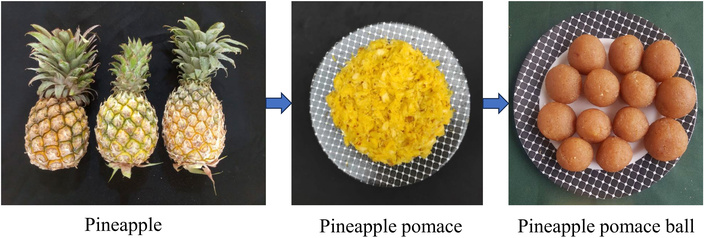
After harvesting, the pineapples were taken to the Bangladesh Agricultural Research Institute’s (BARI) Postharvest Technology Division, located in Gazipur-1701, Bangladesh. Upon arrival, the BARI Postharvest Technology Division meticulously sorted the fruits to eliminate any pests or illnesses. To remove surface contaminants, the selected fruits were thoroughly cleaned with pure tap water. After the peels were taken off, the pulp was gathered to extract the juice and make pineapple-based products like marmalade and jelly. The fruit cores were also used to make candy, though that wasn’t the study’s main goal. The leftover jelly and marmalade processing were used to collect the pomace. After that, the fresh pomace was processed to develop pineapple pomace balls, or laddus (Figure 1), according to the formulation of Table 1. The laddus’ flavor was enhanced by the addition of cardamom seeds. For a shelf-life analysis, the laddus were subsequently stored in polyethylene terephthalate (PET) boxes. The experiment was set up using a completely randomized design (CRD) and included four treatments in total, each with three replications.
Treatments of pineapple pomace ball (laddus).
| Treatment | Ingredients | ||||||
|---|---|---|---|---|---|---|---|
| Pineapple pomace (g) | Coconut meat (g) | Jaggery (g) | Cardamom seed (g) | Ghee (g) | KMS (g) | KS (g) | |
| T1 | 250 | 250 | 500 | 2 | 2 | – | – |
| T2 | 250 | 250 | 500 | 2 | 2 | 1 | – |
| T3 | 250 | 250 | 500 | 2 | 2 | – | 1 |
| T4 | 250 | 250 | 500 | 2 | 2 | 0.5 | 0.5 |
T1 = control, T2 = KMS-treated pomace ball, T3 = KS-treated pomace ball, T4 = KMS + KS-treated pomace ball. KMS: potassium metabisulfite; KS: potassium sorbate.
The physicochemical characteristics of pomace laddus in terms of moisture, ash, titrable acidity, pH, total sugar, and reducing sugar were determined according to the method of Ranganna [12]. In brief, pH was measured using a glass electrode pH meter (Delta 320, Mettler, Shanghai). Titrable acidity (%) was determined by titrating against standard NaOH solution. Total soluble solids (TSS) were measured (°B) by a hand digital refractometer. Crude protein was determined by Kjeldahl apparatus, and crude fat was determined by Soxhlet apparatus. Crude fiber was determined by the AOAC [13] method. Total carbohydrate was determined by the difference of total contents (crude fat, crude fiber, crude protein, ash, and moisture content) from 100. The aw of the pomace ball was recorded using a Lab Touch water activity meter (Novasina, AG, CH-8853, Switzerland).
The β-carotene content was analyzed according to the method of Molla et al. [14] with slight modifications. About 3 g of pomace ball was taken to dilute with acetone and petroleum ether. Then, the diluted sample was taken for further purification with acetone, KOH, and distilled water. The prepared solution was filtered with anhydrous sodium sulfate. At last, the absorbance was analyzed by a UV-Vis spectrophotometer at 765 nm, where petroleum ether was used as a blank.
Vitamin C was quantified using a high-performance liquid chromatography (HPLC) system (Shimadzu SPD-M10A) with a C18 column (250 mm × 4.6 mm) [15]. In order to extract 0.5 g of dried pomace powder, 4.5 mL of a 5% w/v metaphosphoric acid aqueous solution containing 1% w/v dithiothreitol (DTT) was used. Ascorbic acid, or vitamin C concentration, was measured in milligrams per 100 g on a dry weight basis.
The energy value of the pineapple pomace laddus was measured based on the prior approach outlined by Molla et al. [16] with minor adjustments, where 1 g of dried powder was placed in a cup of a bomb calorimeter (The Parr 6100 Calorimeter; Parr Instrument Company, Moline, IL 61265, USA) and then allowed to complete burning. The energy value of the pineapple pomace ball (laddus) was expressed as kcal/100 g.
With a few minor adjustments, texture analysis was carried out using the methodology described by Molla et al. [2]. A texture analyzer (Stable Micro Systems, Godalming, UK) was used to assess the texture of the treated laddus. Back-extrusion was carried out by directly penetrating the samples with a P/5 probe. With a test speed of 1 mm/s and a penetration distance of 2.5 cm, the device was run in compression mode. Texture Exponent Lite software (version 6.1.14.0) was used for data collection and analysis. The rupture force (FR) was measured and expressed as force (kg).
The sensory evaluation was assessed both on the day of preparation and after 60 days of storage according to the methodology outlined by Dey et al. [17]. The evaluation was done based on a 9-point hedonic scale and adhered to the ethical guidelines of the “International Standards Organization (ISO) Committee on ISO/TC34/SC12”, and was also conducted in compliance with the Declaration of Helsinki. It was also approved by the BARI research approval committee, bearing the ethics approval number 12.21.0000.040.09.003.21.88. Informed consent was given by each participant. In summary, ninety experts from the BARI inter-divisional scientists and scientific staff were assembled into three judgment panel groups to assess the laddus’ sensory qualities. Since there were 30 members in each judgement group, a total of 90 members (1 group of 30 members × 3 groups) were asked to assess the sensory qualities. The panel did not include any children under the age of eighteen. During a one-hour introductory session, the day before the evaluation, they received an outline of the sensory process and the purpose of the sensory evaluation. The panelist’s sensory evaluation scores were statistically examined.
Based on triplicate measurements, the data were statistically analyzed and displayed as means ± standard deviations. The data were analyzed using Tukey’s multiple comparison test after a one-way ANOVA. The 95% confidence level was used to determine significance. SPSS 20.0 software (IBM Inc., New York) was used for data processing and statistical analysis.
Tables 2 and 3 present the results of an analysis of the physicochemical and nutritional characteristics of various laddus, including moisture, ash, crude protein, crude fat, crude fiber, total carbohydrate, TSS, pH, acidity, vitamin C, β-carotene, total sugar, reducing sugar, energy value, and aw, both on the day of preparation and after 60 days of storage.
Nutritional composition of pineapple pomace ball (laddus) on the day of storage.
| Nutrition facts | T1 | T2 | T3 | T4 |
|---|---|---|---|---|
| Moisture (%) | 23.23 ± 0.23a | 23.23 ± 0.23a | 23.23 ± 0.10a | 23.23 ± 0.13a |
| Ash (%) | 0.16 ± 0.02b | 0.17 ± 0.02ab | 0.17 ± 0.02ab | 0.18 ± 0.02a |
| Crude protein (%) | 6.30 ± 0.03a | 5.96 ± 0.04b | 5.95 ± 0.05b | 5.94 ± 0.06b |
| Crude fat (%) | 2.19 ± 0.02b | 2.65 ± 0.02a | 2.67 ± 0.06a | 2.71 ± 0.02a |
| Crude fiber (%) | 4.08 ± 0.03a | 4.01 ± 0.01b | 4.03 ± 0.03ab | 4.05 ± 0.05ab |
| Total carbohydrate (%) | 64.04 ± 0.04a | 63.98 ± 0.02b | 63.95 ± 0.05b | 63.89 ± 0.11b |
| TSS (°B) | 69.28 ± 0.02b | 69.53 ± 0.03a | 69.55 ± 0.05a | 69.59 ± 0.04a |
| pH | 4.27 ± 0.03a | 4.22 ± 0.02b | 4.23 ± 0.03ab | 4.25 ± 0.05ab |
| Acidity (%) | 0.23 ± 0.02b | 0.25 ± 0.02ab | 0.27 ± 0.03ab | 0.28 ± 0.02a |
| Vitamin C (mg/100 g) | 9.40 ± 0.05b | 11.73 ± 0.03a | 11.74 ± 0.03a | 11.78 ± 0.02a |
| β-Carotene (mg/100 g) | 15.30 ± 0.30b | 15.43 ± 0.19a | 15.35 ± 0.35b | 15.37 ± 0.37b |
| Total sugar (%) | 31.25 ± 0.25b | 31.39 ± 0.30a | 31.38 ± 0.38a | 31.40 ± 0.40a |
| Reducing sugar (%) | 6.06 ± 0.06b | 6.43 ± 0.13a | 6.41 ± 0.11a | 6.46 ± 0.10a |
| Energy (kcal/100 g) | 435.53 ± 0.23b | 437.44 ± 0.44a | 437.43 ± 0.43a | 437.46 ± 0.20a |
| Water activity (aw) | 0.71 ± 0.02a | 0.64 ± 0.02b | 0.63 ± 0.03b | 0.61 ± 0.02a |
T1 = control, T2 = KMS-treated pomace ball, T3 = KS-treated pomace ball, T4 = KMS + KS-treated pomace ball. All values represent the means of triplicate determinations ± standard deviation (SD). Means within the same row followed by different letters (a, b) indicate statistically significant differences (p < 0.05). TSS: total soluble solids; KMS: potassium metabisulfite; KS: potassium sorbate.
Nutritional composition of the pineapple pomace ball (laddus) after 60 days of storage.
| Nutrition facts | T1 | T2 | T3 | T4 |
|---|---|---|---|---|
| Moisture (%) | 23.70 ± 0.03a | 23.63 ± 0.02b | 23.60 ± 0.01b | 23.62 ± 0.01b |
| Ash (%) | 0.15 ± 0.02c | 0.16 ± 0.02b | 0.16 ± 0.02b | 0.17 ± 0.02a |
| Crude protein (%) | 6.33 ± 0.02a | 6.03 ± 0.03b | 6.01 ± 0.01b | 6.04 ± 0.04b |
| Crude fat (%) | 3.21 ± 0.04b | 3.33 ± 0.03a | 3.35 ± 0.05a | 3.41 ± 0.05a |
| Crude fiber (%) | 4.19 ± 0.06a | 4.14 ± 0.04bc | 4.15 ± 0.15b | 4.17 ± 0.07b |
| Total carbohydrate (%) | 62.37 ± 0.37b | 62.69 ± 0.19a | 62.30 ± 0.30b | 62.70 ± 0.70a |
| TSS (°B) | 69.80 ± 0.02b | 71.87 ± 0.02a | 71.89 ± 0.01a | 71.90 ± 0.01a |
| pH | 4.52 ± 0.02b | 4.53 ± 0.03b | 4.55 ± 0.05b | 4.59 ± 0.02a |
| Acidity (%) | 0.29 ± 0.02b | 0.31 ± 0.02a | 0.33 ± 0.03a | 0.34 ± 0.04a |
| Vitamin C (mg/100 g) | 5.89 ± 0.02b | 5.90 ± 0.03b | 5.93 ± 0.02a | 5.95 ± 0.02a |
| β-Carotene (mg/100 g) | 14.03 ± 0.03b | 14.13 ± 0.13a | 14.15 ± 0.15a | 14.17 ± 0.17a |
| Total sugar (%) | 32.21 ± 0.21b | 32.37 ± 0.37a | 32.38 ± 0.38a | 32.39 ± 0.40a |
| Reducing sugar (%) | 6.11 ± 0.11b | 6.51 ± 0.40a | 6.53 ± 0.40a | 6.55 ± 0.40a |
| Energy (kcal/100 g) | 437.11 ± 1.11b | 441.03 ± 1.03a | 441.10 ± 1.10a | 441.17 ± 1.17a |
| Water activity (aw) | 0.73 ± 0.02a | 0.68 ± 0.01b | 0.65 ± 0.02b | 0.63 ± 0.03b |
T1 = control, T2 = KMS-treated pomace ball, T3 = KS-treated pomace ball, T4 = KMS + KS-treated pomace ball. All values represent the means of triplicate determinations ± standard deviation (SD). Means within the same row followed by different letters (a, b, c) indicate statistically significant differences (p < 0.05). TSS: total soluble solids; KMS: potassium metabisulfite; KS: potassium sorbate.
On the day of storage and after the storage period, the moisture content of the control and treated samples was measured for this study. Both the treated and control samples had an initial moisture content of 23.23%. The laddus T1, T2, T3, and T4 had moisture contents of 23.70%, 23.63%, 23.60%, and 23.62%, respectively, after 60 days of storage (Table 3). The findings indicate that the moisture content of the laddus was insignificantly changed on the day of preparation, but after 60 days of storage, statistically significant changes occurred (Tables 2 and 3).
At initial day, the ash content of the non-treated (control) and treated laddus ranged from 0.16 to 0.18%, whereas it was recorded from 0.15 to 0.17% after 60 days of storage. The results indicated that the amount of ash decreased somewhat with longer storage times. These findings are consistent with those of Pandita and Gupta [18].
Pineapples provide the human diet with both essential and non-essential amino acids, despite being a relatively low source of dietary protein. The proteolytic enzymes known as bromelain are frequently linked to pineapple protein. In this study, the initial protein content of the laddus was recorded with a range from 5.94 to 6.30%, whereas it was calculated as 6.01 to 6.33% after 60 days of storage. The results indicate that the protein content increased with the increasing storage periods. The crude fat content was recorded as 2.19 to 2.71% on the initial day of storage, but after 60 days of storage, it ranged from 3.21 to 3.41% in all treated samples (Tables 2 and 3). The crude fiber of the prepared laddus ranged from 4.01 to 4.08% on the day of storage, but after 60 days of storage, it ranged from 4.14 to 4.19% respectively (Tables 2 and 3). Carbohydrate content of the prepared laddus ranged from 63.89 to 64.04% on the first day of storage. After 60 days of storage, it was calculated as 62.30 to 62.70%.
TSS are a crucial metric for assessing food quality because they affect product flavor. It is exposed to various organic materials, amino acids, a small number of soluble proteins, and total sugar Bexiga et al. [19]. Higher product concentrations indicate more TSS in the sample. The control laddus had the lowest TSS (69.28 °B), while the treated laddus had the highest TSS, ranging from 69.53 °B to 69.59 °B (Table 2).
On the first day of storage, the laddus’ pH varied greatly, ranging from 4.22 to 4.27. The pH range varied between 4.52 and 4.59 after 60 days of storage. The control sample had a higher pH on the first day of storage, but the treated laddus showed an elevated pH following storage.
The acidity level affects how the processed foods taste and how they should be stored. The H+ ion makes the taste sour. But the intensity depends more on the potential than on the actual H+ ion concentration, which shows the pH. Therefore, it is important to find out how acid affects the products. The titratable acidity of the treated laddus was between 0.25% and 0.28% on the first day of preparation, while the control sample had 0.23%. But after 60 days of storage, the acidity of the treated pomace laddus was between 0.31% and 0.34% while the control sample was 0.29%.
Vitamin C is an important and potent antioxidant in foods. It has been shown to reduce oxidative stress and is linked to a lower risk of cancer in people Didier et al. [20]. It is specifically more prevalent in fresh products than processed ones, as it undergoes multiple processing steps. In this study, the vitamin C of pomace laddus ranged from 9.40 to 11.78 mg/100 g on the first day of storage and 5.89 to 5.95 mg/100 g after 60 days of storage.
Total sugar represents the sum of all monosaccharides and disaccharides (glucose, fructose, lactose, maltose, sucrose) in food, while reducing sugars are a subset capable of giving electrons in chemical reactions, such as ions, such as glucose and fructose. These ingredients are crucial for detecting sweetness, evaluating nutritional value, and ensuring the quality of the products. The conversion of insoluble cell wall components into soluble molecules or the conversion of organic acid into sugar content could be the cause of the increase in sugar content over the storage period. These results are consistent with those of Niu et al. [21], who found that sugar content varies over time. On the day of storage and after 60 days of storage, the total and reducing sugar content of the T4-treated sample ranged from 31.40 to 32.39% and 6.46 to 6.55%, whereas they ranged from 31.25 to 32.21% and 6.06 to 6.11% by the T1-treated sample. The results indicate that on the day of storage, T4 had the highest total and reducing sugar content compared to the T1 sample. The results also confirm that the total and reducing sugar content of both treated samples were increased with the advancement of storage periods.
Energy is an invisible component that is essential for supporting the body’s basal metabolism. Fats and carbohydrates are used as a source of energy. About 85% to 90% of total energy needs are met by fats and carbohydrates, and the remaining about 10% to 15% from proteins [22]. In this study, the initial energy content of the laddus ranged from 435.53 to 437.46 kcal/100 g, and after 60 days of storage, the range was 437.11 to 441.17 kcal/100 g.
The aw of products determines how long they can be stored. The moisture content of the products being stored must therefore be known. The aw also affects how microorganisms grow. Although microbial growth may not be eliminated, the reduced moisture content may assist in reducing the activity of microorganisms in the treated samples [2]. In this study, the highest aw value of the non-treated laddus was 0.71, whereas the treated laddus were observed from 0.61 to 0.64 on the day of storage (0 day). But after 60 days of storage, the highest aw value of the non-treated laddus was calculated as 0.73, and the treated laddus ranged from 0.63 to 0.68. This study indicates that the aw of the treated laddus decreased with the advancement of storage periods.
Laddus hardness depends on moisture content and storage time. To determine the hardness of the control and treated samples, we first measured the FR and then again after storage (Figures 2 and 3). The FR in samples T1, T2, T3, and T4 was 0.99 force (kg), 1.11 force (kg), 1.23 force (kg), and 1.33 force (kg), respectively, on the first day of storage. After 60 days of storage, however, the highest FR was found in treated sample T4 [3.08 force (kg)], whereas the lowest was recorded as 2.74 force (kg), 2.97 force (kg), and 3.01 force (kg) in T1, T2, and T3.
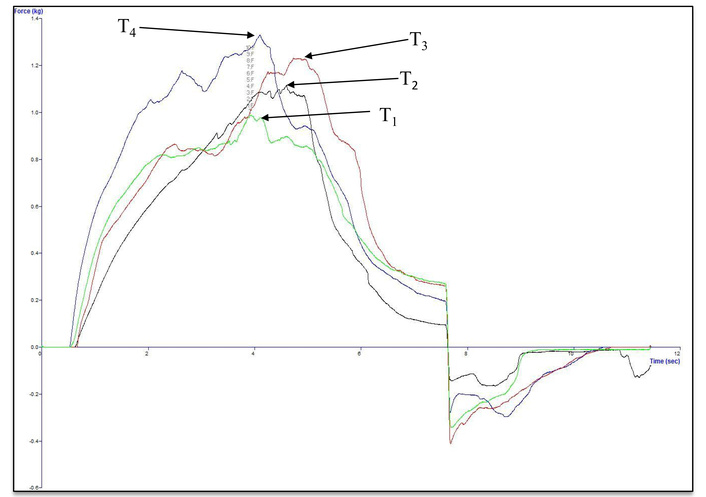
Texture of the pineapple pomace ball on the day of preparation (0 day). T1 = control, T2 = KMS-treated pomace ball, T3 = KS-treated pomace ball, T4 = KMS + KS-treated pomace ball. KMS: potassium metabisulfite; KS: potassium sorbate.
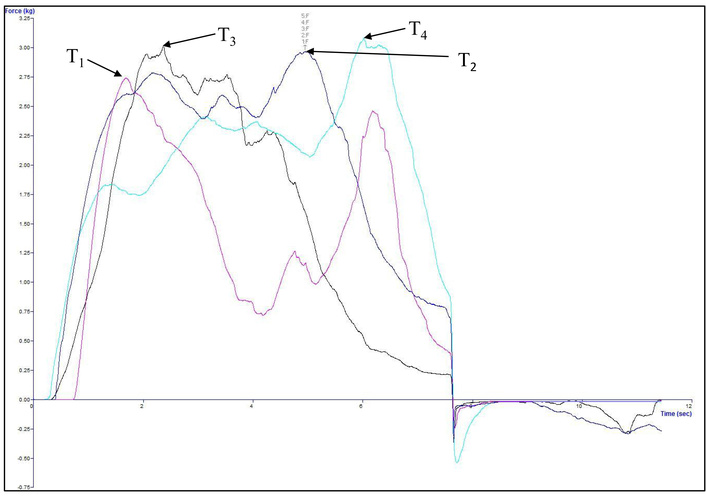
Texture of the pineapple pomace ball after 60 days of storage. T1 = control, T2 = KMS-treated pomace ball, T3 = KS-treated pomace ball, T4 = KMS + KS-treated pomace ball. KMS: potassium metabisulfite; KS: potassium sorbate.
The main factor causing food quality degradation is microorganisms, which can also present a number of health hazards when consumed [23]. Table 4 displays the microbiological profiles of the pineapple pomace balls that were analyzed for Aspergillus, Shigella, E. coli, and mycotoxins. The findings showed that treated laddus T1, T2, T3, and T4 did not contain any microorganisms after 30 days of storage. However, a small amount of Aspergillus, Shigella, and E. coli were found during the 60-day storage period, with respective values of 3.10 × 10⁵ CFU/g, 2.10 × 10⁶ CFU/g, and 1.10 × 10⁷ CFU/g. All of the detected values, nevertheless, fell within the permissible bounds. Several researchers also concur with these findings [2, 18].
Microbial and mycotoxin properties of pineapple pomace ball after 60 days of storage.
| Parameter | 30 days of storage | 60 days of storage | ||||||
|---|---|---|---|---|---|---|---|---|
| T1 | T2 | T3 | T4 | T1 | T2 | T3 | T4 | |
| Aspergillus (CFU/g) | × | × | × | × | 3.10 × 10⁵ | × | × | × |
| Shigella (CFU/g) | × | × | × | × | 2.10 × 10⁶ | × | × | × |
| E. coli (CFU/g) | × | × | × | × | 1.10 × 10⁷ | × | × | × |
| Mycotoxin profile | ||||||||
| Aflatoxin B1 (µg/kg) | × | × | × | × | × | × | × | × |
| Aflatoxin B2 (µg/kg) | × | × | × | × | × | × | × | × |
| Aflatoxin G1 (µg/kg) | × | × | × | × | × | × | × | × |
| Aflatoxin G2 (µg/kg) | × | × | × | × | × | × | × | × |
| Ochratoxin A (µg/kg) | × | × | × | × | × | × | × | × |
| Patulin (µg/kg) | × | × | × | × | × | × | × | × |
T1 = control, T2 = KMS-treated pomace ball, T3 = KS-treated pomace ball, T4 = KMS + KS-treated pomace ball. KMS: potassium metabisulfite; KS: potassium sorbate. ×: Not detected.
KMS, sometimes referred to as food additive E-224, is a preservative that preserves food’s natural color while preventing bacterial growth because of its antimicrobial qualities. At concentrations up to 1,000 ppm, it shows no lingering effects and is widely acknowledged as safe with low allergenic potential [24]. Between 0.5% and 1.0% is the typical usage level of KS. Table 5 displays the lingering effects of KMS and KS on the laddus after 30- and 60-day storage periods. Because the control sample (T1) had a 30-day shelf life, it was not taken into consideration for residual analysis. The KMS (T2) and KS (T3) treated laddus had less residue after 30 and 60 days of storage, according to the results, than the sample that was treated jointly by KMS and KS (T4).
Residual effect of KMS and KS after storage of pineapple pomace ball.
| Treatment | Applied doses (g/kg) | Residue (ppm) | |
|---|---|---|---|
| 30 days of storage | 60 days of storage | ||
| T1 | 0.00 | – | – |
| T2 | KMS (1.00) | 76.28 ± 5.43b | 71.28 ± 3.11b |
| T3 | KS (1.00) | 83.83 ± 5.53b | 78.01 ± 4.41b |
| T4 | KMS + KS (0.50 + 0.50 = 1.00) | 130.20 ± 10.10a | 110.31 ± 5.01a |
T1 = control, T2 = KMS-treated pomace ball, T3 = KS-treated pomace ball, T4 = KMS + KS-treated pomace ball. All values represent the means of triplicate determinations ± standard deviation (SD). Means within the same column followed by different letters (a, b) indicate statistically significant differences (p < 0.05). KMS: potassium metabisulfite; KS: potassium sorbate.
As indicated in Tables 6 and 7, the sensory assessment of the pineapple pomace balls (laddus) was carried out using a 9-point hedonic scale both on the day of preparation and after 60 days of storage. Due to their freshness, the treated and control laddus showed no discernible differences on the day of preparation; the T1 laddus received the highest flavor, softness, mouthfeel, and overall acceptability score compared to the treated laddus. Although the panelists found T1 laddus to be highly acceptable up to 30 days of storage, they were discarded after 30 days because of their decreased shelf life (Figure 4), increased microbial activities (Table 4), and unpleasant color, flavor, and mouthfeel. After 60 days, the treated laddus T2, T3, and T4 had the highest sensory score. The findings indicated that the laddus prepared on the day of storage were more acceptable to the evaluator as compared to the stored laddus. On the other hand, T4-treated laddus gained the highest flavor, softness, and overall acceptability after 60 days of storage. But in the case of mouthfeel, no significant differences were observed.
Sensory evaluation of pineapple pomace ball (laddus) on the day of preparation.
| Treatment | Color | Flavor | Mouthfeel | Hardness | Softness | Overall acceptability |
|---|---|---|---|---|---|---|
| T1 | 7.20 ± 0.05a | 7.53 ± 0.10a | 7.51 ± 0.10a | 6.50 ± 0.10d | 7.40 ± 0.04a | 7.21 ± 0.08a |
| T2 | 7.20 ± 0.10a | 7.51 ± 0.10b | 7.30 ± 0.10b | 6.51 ± 0.10c | 7.33 ± 0.03c | 7.15 ± 0.01d |
| T3 | 7.20 ± 0.10a | 7.51 ± 0.10b | 7.30 ± 0.10b | 6.53 ± 0.10b | 7.35 ± 0.05b | 7.18 ± 0.09c |
| T4 | 7.20 ± 0.10a | 7.50 ± 0.10c | 7.33 ± 0.20b | 6.55 ± 0.05a | 7.35 ± 0.05b | 7.19 ± 0.02b |
T1 = control, T2 = KMS-treated pomace ball, T3 = KS-treated pomace ball, T4 = KMS + KS-treated pomace ball. All values represent the means of triplicate determinations ± standard deviation (SD). Means within the same column followed by different letters (a, b, c, d) indicate statistically significant differences (p < 0.05). KMS: potassium metabisulfite; KS: potassium sorbate.
Sensory evaluation of the pineapple pomace ball (laddus) after 60 days of storage.
| Treatment | Color | Flavor | Mouthfeel | Hardness | Softness | Overall acceptability |
|---|---|---|---|---|---|---|
| T2 | 7.03 ± 0.05b | 7.34 ± 0.06a | 7.00 ± 0.01b | 7.50 ± 0.10a | 6.33 ± 0.03b | 7.04 ± 0.01b |
| T3 | 7.10 ± 0.10a | 7.31 ± 0.10b | 7.07 ± 0.05a | 7.23 ± 0.15b | 6.35 ± 0.05b | 7.01 ± 0.04b |
| T4 | 7.00 ± 0.00b | 7.33 ± 0.10a | 7.06 ± 0.05a | 7.01 ± 0.04c | 6.71 ± 0.33a | 7.16 ± 0.01a |
T2 = KMS-treated pomace ball, T3 = KS-treated pomace ball, T4 = KMS + KS-treated pomace ball. All values represent the means of triplicate determinations ± standard deviation (SD). Means within the same column followed by different letters (a, b, c) indicate statistically significant differences (p < 0.05). KMS: potassium metabisulfite; KS: potassium sorbate.
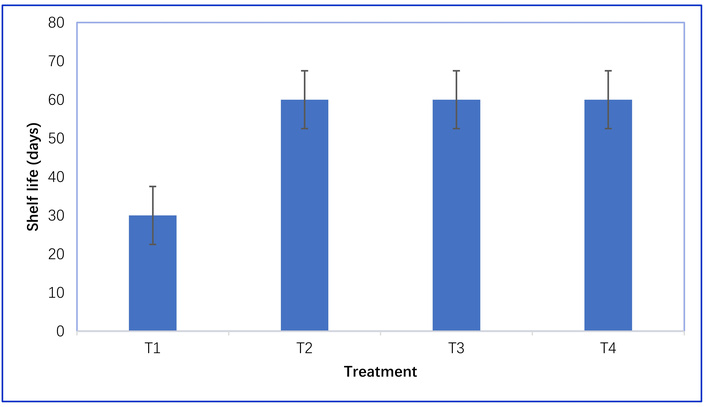
Shelf life of pineapple pomace ball (laddus). T1 = control, T2 = KMS-treated pomace ball, T3 = KS-treated pomace ball, T4 = KMS + KS-treated pomace ball. KMS: potassium metabisulfite; KS: potassium sorbate.
The laddu’s shelf life was increased by using KMS (T2), KS (T3), and KMS + KS (T4) preservatives. Figure 4 illustrates the shelf life of the laddus in storage. The findings showed that preservative-treated laddus (T2, T3, and T4) and preservative-free treated laddus (T1) differed significantly. After 60 days of storage, there were negligible differences among all laddus treated with preservatives. Laddus treated with preservatives and kept at room temperature had the longest shelf life (60 days) (Figure 4). Laddus T1 (control) without preservatives had the shortest shelf life (30 days). Because of their low aw and moisture content, T2, T3, and T4 had the longest shelf life [2].
In all of the country’s growing areas, fresh pineapple is a popular crop to grow. The developed products’ production history and cost-benefit ratio (BCR) are shown in Tables 8 and 9. Sixty-four laddus could be made from two pineapples and one coconut. The market price for each laddu would be 8.00 BDT ($0.08). The total cost of making the product is 722 BDT, and the benefit is 962 BDT. After doing the maths, the BCR of the laddus was found to be 1:1.33, which means that the laddus are profitable and could be sold in the US. Therefore, small-scale processors and the food processing industry could use this technology to make more money and improve their social and economic status.
Pineapple pomace, pomace ball, and coconut meat production history.
| Fruit | Quantity (No.) | Fresh weight (g) | Pineapple pomace (g) | Coconut meat (g) | Pineapple juice (mL) | Coconut water (mL) | Final pomace ball (No.) |
|---|---|---|---|---|---|---|---|
| Pineapple | 2 | 2,760 | 325 | – | 1,000 | – | 64 |
| Coconut | 1 | 801.13 | – | 325.10 | – | 235.33 |
No.: number.
Inputs required and production cost of the developed pineapple pomace ball.
| Sl. No. | Inputs | Quantity | Cost (BDT) |
|---|---|---|---|
| 1 | Pineapple | 2 Nos. | 100 |
| 2 | Coconut | 1 No. | 100 |
| 3 | Jaggery | 1.3 kg | 140 |
| 4 | Labor for one hour | 1 labor | 75 |
| 5 | Plastic box (food grade)-one time | 8 Nos. | 40 |
| 6 | Ghee | 10 g | 10 |
| 7 | KMS | 1 g | 2 (@ 2,000 BDT/kg) |
| 8 | KS | 1 g | 2 (@ 2,000 BDT/kg) |
| 9 | Miscellaneous (gas, electricity, utensils, etc.) | LS | 20 |
| Total cost | 489 | ||
Sl. No.: serial number; Nos.: numbers; KMS: potassium metabisulfite; KS: potassium sorbate; LS: lumsum; @: per capita.
Juice extraction from 2 pineapples: 1,000 mL.
Pineapple jelly from 1,000 mL juice: 3 jars (each jar weighs 400 g).
Sugar required for 1,000 mL juice: 650.00 g.
Sugar cost for 3 jars from 1,000 mL juice: BDT 91.00.
Pectin required for 3 jars from 1,000 mL juice: 15.00 g.
Pectin cost: BDT 63.00.
Sodium Benzoate (0.5 g): BDT 4.00.
Production cost of jelly: BDT 233.00.
Total production cost of jelly and pomace ball (from 2 pineapples): BDT (489.00 + 233.00) = BDT 722.00.
Number of produced pineapple pomace balls (from 2 pineapples): 64 numbers (Nos.).
Retail price of 64 pineapple pomace balls: 64 × BDT 8.00 = BDT 512.00.
Retail price of 3 jars of pineapple jelly: 150 × 3 = BDT 450.00.
Total benefit: BDT (512.00 + 450.00) = BDT 962.00.
So, BCR of the product: BDT 722.00: BDT 962.00 = BDT 1:1.33.
Moisture is the primary substance in the majority of foods that contain direct reactants in hydrolytic reactions. Accordingly, removing moisture from processed foods prolongs their shelf life by preventing microbial growth [25]. Depending on the type of processed product, the moisture content can change. Extreme moisture absorption affects the product’s quality and storage behavior. In this study, the initial moisture (on the day of preparation) content was unchanged, but after 60 days of storage, it gradually changed with the advancement of storage periods. The disruption of cell walls, membranes, and packaging into PET boxes during the 60 days of storage may be the cause of the difference in moisture content between the first and last day of storage. According to Sairagul et al. [11], there was an increase in the moisture content of hard-boiled candies made with jaggery at the end of their storage.
Ash, an indicator of the overall mineral content of food, is the inorganic residue that remains after water and organic components have been removed by heating in the presence of oxidizing agents. Natural foods typically have a lower ash content, and the amount of ash varies depending on the processing methods used. In this study, the ash content decreased with the advancement of storage periods. The lower ash content was recorded after 60 days of storage, whereas the higher ash content was observed on the initial day of storage. The lower ash content in the sample indicates that a lower quantity of essential elements like Na, P, K, etc. exists in the sample [26].
All human cells are made up of proteins, which are basic structural elements made up of chains of amino acids necessary for cellular activity. Dietary proteins contain the amino acids necessary for promoting healthy growth and physiological development. According to the European Food Safety Authority (EFSA), adults should consume at least 0.83 g of protein per kg of body weight per day, which is roughly 58 g per day for a 70 kg person. Consuming proteins from a range of food sources is advised to support general health because the quality and digestibility of dietary proteins differ depending on the source. In this study, the protein content was increased with the advancement of storage periods. The various ingredients like pineapple pomaces, jaggery, cardamom, ghee, and coconut meat present in the laddus might be attributed to holding a higher amount of protein (Tables 2 and 3).
Fats are necessary for the transportation of fat-soluble vitamins A, D, E, and K, which are essential for the integrity and proper function of cellular and subcellular membranes. It is more concentrated than carbohydrates when it comes to storing energy. Carbohydrates are stored in fatty tissue when they are available in sufficient amounts. Additionally, consuming too many carbohydrates can cause them to be converted and stored as fat in fatty tissue. In this study, the fat content of the treated laddus was increased (2.65% to 3.41%) with increasing storage periods. The results are fully in agreement with the previous findings of Molla et al. [2], who reported that the changes in lipid metabolism transported by oxygen may be the cause of the higher fat content of the treated samples.
The crude fiber showed no appreciable variations on the day of preparation (0 day) and after 60 days of storage among the different treatments (Tables 2 and 3). After 60 days of storage, the fiber content gradually increased from its initial range of 4.01 to 4.08% to 4.14 to 4.19%. The results indicate that the fiber content of the sample increased with the increasing storage periods. These might be due to dehydration or changes in structural carbohydrates over the storage periods [27]. It is well known that fruit pomace, a processing by-product, is a rich source of antioxidants, bioactive compounds, and dietary fibers [28].
Carbohydrates are essential macronutrients, whereas the sugars, starches, and fibers provide the body’s primary energy source, breaking down into glucose to fuel cells. In this study, the carbohydrate content of the treated laddus was decreased with the advancement of storage periods (0 to 60 days). Results indicate that the longer the storage period, the lower the carbohydrate content. The findings of this study are similar to those of Souza et al. [29], who reported that the percentage of carbohydrates in cereal bars made from fruit peels ranged from 61.61 to 71.57%. The results from this study suggest that pomace laddus has less carbohydrate than cereal-based food products [8]. However, healthy adults may consume pineapple pomace laddus as the presence of carbohydrates in the samples is within the range of the daily recommended value (45% to 70%). It is well reported that the proportion of carbohydrates in a person’s diet should not exceed 70% of their daily caloric needs. Exceeding this carbohydrate intake limit may lead to being overweight.
The TSS content in all treated and control laddus rose from 69.80 °B to 71.90 °B after 60 days of storage (Table 3). A partial hydrolysis of polysaccharides like cellulose, starch, and pectic substances into simpler compounds or the solidification of pulp constituents during storage could be the cause of the observed increase in TSS content in stored laddus [16]. Another explanation for this phenomenon could be that the laddus were processed using heat, which helped to increase the product’s concentration by eliminating water during storage [2].
Food pH is vital for flavor, texture, preservation, and safety. Low pH inhibits bacteria, whereas high pH influences everything from fermentation to spoilage. The pH varied from 4.22 to 4.27 and 4.53 to 4.59 among the different treated laddus on the day of preparation and after 60 days of storage. Considering the storage periods (0 to 60 days), the differences were varied from 4.22 to 4.59. The pH differences between the treated and control samples may result from biochemical alterations in the treated laddus over the period of KMS’s and KS’s storage periods. After 30 days of storage, a higher pH in the control laddus may help microorganisms grow (Table 4).
The acidity of the control and treated laddus was increased from 0.23 to 0.29% and from 0.25 to 0.34%. Results revealed that the acidity increased with the advancement of storage periods. The significant increase in acidity during extended storage may result from the degradation of pectic substances into soluble acids. Several researchers have indicated that acidity deteriorates with the advancement of storage duration [2].
In this study, the vitamin C content of the samples was recorded as 9.40 to 11.78 mg/100 g on the day of preparation but after 60 days of storage, it was calculated as 5.89 to 5.95 mg/100 g, respectively. Results indicate that the vitamin C content of the samples decreased with increasing storage period. Increased oxidative stress during long-term storage in ambient conditions may be the cause of the decreased vitamin C. Degradation of vitamin C in stored laddus might be caused by heat treatments during processing [30]. Temperature, oxygen concentration, pH, metal ion presence, light exposure, and aw are some of the physicochemical factors that affect the vitamin C degradation [31]. The body needs vitamin C according to age and physical condition limits. The recommended daily allowance (RDA) of vitamin C for adults is 52 to 65 mg; pregnant women need 85 mg, and older adults need 90 mg [25]. Total sugars, primarily broken down into glucose, serve as the body’s primary fuel source, powering essential cellular functions, brain activity, and physical movement. Excess glucose is stored in the liver and muscles as glycogen for later energy needs or converted into fat.
Naturally occurring sugars play an important role in providing energy and a variety of nutrients the body needs to remain healthy. The total and reducing sugar naturally present in the pineapple pomace may provide energy in the body. In this study, the treated and non-treated samples’ highest sugar content may have resulted from prolonged storage and treatment with various preservatives. Both total and reducing sugars were found to increase with increasing storage periods. These results are consistent with those of Bishnoi et al. [32], who found that after 18 days of storage, strawberry pulp treated with sodium benzoate had higher levels of total and reducing sugars. The increase is most likely the result of enzymatic inversion of non-reducing sugars into reducing sugars, as observed by Ayub et al. [33], who found that sucrose hydrolyses into glucose and fructose during storage.
The energy value of the pomace laddus ranged from 435.53 to 437.46 kcal/100 g and 437.11 to 441.17 kcal/100 g on the day of preparation and after 60 days of storage. Results revealed that the energy value of the samples increased with the advancement of storage periods. The highest energy content (441.17 kcal/100 g) was observed in treated sample T4, whereas the lowest (437.11 kcal/100 g) was recorded in the T1 sample (control) after 60 days of storage. The higher energy value in T4 compared to T1 (control) might be attributed to a significant amount of crude fat, crude protein, total carbohydrates, and total and reducing sugars.
In this study, T1 laddus had higher levels of both moisture and aw, suggesting that a higher sample moisture content can help produce a higher aw [2]. While T1 laddus (control sample) had the highest aw, treated sample T4 had the lowest, ranging from 0.61 to 0.71. However, following 60 days of storage, the aw varied from 0.63 to 0.73, with the highest value of 0.73 in T1 laddus (control). This suggests that a higher aw could be the reason for the control sample’s faster growth of microorganisms such as mold, yeast, and bacteria (Table 4), which could result in a shorter shelf life for the laddus (T1). On the other hand, the lower aw in the treated laddus might be due to the presence of jaggery that acts as a bonding agent to absorb the moisture over the 60-day storage period.
Texture analysis shows that the texture was increased with increasing storage periods. The highest texture (FR) was found in the treated laddus as compared to the non-treated laddus. The findings indicated that the hardness of the treated laddus increased during storage intervals. This improvement could be due to crystallization from longer storage and the TSS content of the laddus [26]. Microbial study indicates that the mold was found in the control laddus (T1) after thirty days of storage, but not in the laddus that had been treated with preservative (T2, T3, and T4). After 60 days of storage, all treated laddus were free from mycotoxin activity or microbial contamination. Molds produce poisons known as mycotoxins. Molds produce toxins known as mycotoxins. High temperatures and humidity encourage the growth of mold and the generation of toxins. Animals can develop cancer due to specific mycotoxin types. Aflatoxin, a type of mycotoxin, is a potent liver toxin that has the potential to cause cancer in all of the animals that have been studied. Ochratoxin A, patulin, and aflatoxins B1, B2, G1, and G2 were not present in any of the treated laddus during the storage periods in this investigation (Table 4). The absence of microorganisms and mycotoxin activity during the storage period was probably caused by the use of good hygiene practices in the processing of laddus and good agricultural practices (GAP) and appropriate handling during pineapple production. During cooking and processing, the dissolution of KMS and KS in water produces sorbic acid. This acid is effective against mold, yeast, E. coli, and mycotoxins in the products. Furthermore, treating laddus with a combination of KMS and KS may provide increased defense against a range of microbes. According to the study, the residue levels of both KMS- and KS-treated laddus gradually decreased as storage times increased. This is consistent with the findings of Khan et al. [24], who found that KMS treatment of ready-to-cook (RTC) jackfruit during various processing steps and storage for up to 6 months may have helped bring the residue levels of KMS down to acceptable levels. When compared to untreated laddus (control), the treated laddus were found to be substantially microorganism-free after 60 days of storage. Preservatives like KS and KMS are probably to blame for the treated laddus. KS inhibits the mold and yeast reproduction, while KMS acts as an antimicrobial against bacteria and wild yeast, as well as an antioxidant. These results are fully supported by Pereira et al. [34], who reported that the use of KS and sodium metabisulphite (SMS) in coconut water gave the best results to lower the microbiological contamination. Following 30 days of storage, Aspergillus, Shigella, and E. coli were detected in the control sample (Table 4). Ghee may have been applied during the laddus’ processing, which is why the treated laddus T2, T3, and T4 showed no signs of microorganisms. Microorganisms in the treated laddus may have been destroyed as a result of the heat treatment of ghee during the laddus’ processing. Ghee’s chemical and microbiological qualities have been demonstrated by researchers Kirazci and Javidipur [35], who found that ghee made from cow or buffalo milk can kill most bacteria at low moisture content. All treated laddus were consistently free of detectable mycotoxin and microbial contamination over the course of 60 days of storage, as verified by common microbiological and mycotoxin assays.
Sensory evaluation revealed that the softness of the laddus was more acceptable to the evaluator. The hardness laddus were less acceptable to the evaluator, whereas the hardness increased with the advancement of storage periods. The softness and hardness depend on the texture of the laddus. In this study, there was an inverse relationship between the hardness and softness of the treated laddus. The use of jaggery might contribute to increasing the hardness with the advancement of storage periods. Similar findings were also reported by Pandita and Gupta [18], who found that, over a period of three months of storage, the flavored laddu’s overall acceptability score dropped as a result of increased non-enzymatic browning to a certain degree and changes in color, flavor, and chemical composition. Moreover, the prepared laddus using pineapple pomaces were accepted in terms of nutritional quality, storage periods, microbial studies, texture, and sensory attributes.
The results indicate that after 60 days of storage, the “pomace balls” treated with preservatives T2, T3, and T4 performed the best out of all the formulations. Treated laddus showed higher levels of energy, crude fiber, vitamin C, and β-carotene, and lower levels of aw. No mycotoxin activity or microbial contamination was detected after 60 days of storage. However, the treated laddus had the longest shelf life (60 days) compared to the control. The BCRs of the laddus were calculated as 1:1.33, which indicates that the pineapple waste byproduct (pomace) could be efficiently used by the small and large-scale processors without any quality deterioration up to 60 days.
@: per capita
aw: water activity
BARI: Bangladesh Agricultural Research Institute
BCR: cost-benefit ratio
FR: rupture force
ISO: International Standards Organization
KMS: potassium metabisulfite
KS: potassium sorbate
LS: lumsum
Nos.: numbers
PET: polyethylene terephthalate
Sl. No: serial number
TSS: total soluble solids
The authors wish to acknowledge the Asia Food and Agriculture Cooperative Initiative (AFACI), Rural Development Administration (RDA), South Korea for encouraging the utilization of byproducts through their APPT Project, Bangladesh.
MMM: Conceptualization, Data curation, Formal analysis, Funding acquisition, Methodology, Writing—original draft. BCD: Data curation, Investigation, Formal analysis. AAS: Software, Data curation. SP: Supervision, Resources. MA: Conceptualization, Software. AK: Data curation, Validation, Visualization. MGFC: Resources, Software, Supervision. MAH: Funding acquisition, Project administration. IAR: Resources, Data curation. TAAN: Writing—review & editing. All authors read and approved the submitted version.
All authors declare that there is no conflict of interest related to this paper.
The authors declare that ethical and professional approval were received from the Bangladesh Agricultural Research Institute (BARI) research approval committee bearing the ethics approval number 12.21.0000.040.09.003.21.88.
All the participants have freely given consent to participate in the sensory evaluation. There were no children under 18 years included in the evaluation. All the evaluators were employees and pre-trained before the sensory evaluation. All listed participants were approved by the Research Committee and the Director General of Bangladesh Agricultural Research Institute (BARI), Bangladesh. Then the participants spontaneously participated in the sensory evaluation.
Not applicable.
The data generated during the study are available upon reasonable request from the corresponding author.
This study was supported by the Ministry of Science and Technology (MoST), Bangladesh Secretariat, Dhaka, Government of the People’s Republic of Bangladesh, under the project entitled ‘Shelf-life extension of pineapple pomace ball (laddus) through postharvest treatments [SRG-221022]’. The funders had no role in study design, data collection and analysis, decision to publish, or preparation of the manuscript.
© The Author(s) 2026.
Open Exploration maintains a neutral stance on jurisdictional claims in published institutional affiliations and maps. All opinions expressed in this article are the personal views of the author(s) and do not represent the stance of the editorial team or the publisher.
Copyright: © The Author(s) 2026. This is an Open Access article licensed under a Creative Commons Attribution 4.0 International License (https://creativecommons.org/licenses/by/4.0/), which permits unrestricted use, sharing, adaptation, distribution and reproduction in any medium or format, for any purpose, even commercially, as long as you give appropriate credit to the original author(s) and the source, provide a link to the Creative Commons license, and indicate if changes were made.



View: 2519
Download: 63
Times Cited: 0