Review


Affiliation:
1Department of Biochemistry, Dr. Rammanohar Lohia Avadh University, Ayodhya 224001, Uttar Pradesh, India
†These authors share the first authorship.

Affiliation:
2Biotechnology Program, Dr. Rammanohar Lohia Avadh University, Ayodhya 224001, Uttar Pradesh, India
†These authors share the first authorship.
Affiliation:
2Biotechnology Program, Dr. Rammanohar Lohia Avadh University, Ayodhya 224001, Uttar Pradesh, India
ORCID: https://orcid.org/0000-0003-2020-8709
 ,
,
Affiliation:
1Department of Biochemistry, Dr. Rammanohar Lohia Avadh University, Ayodhya 224001, Uttar Pradesh, India
ORCID: https://orcid.org/0000-0003-2412-4756
,
Affiliation:
1Department of Biochemistry, Dr. Rammanohar Lohia Avadh University, Ayodhya 224001, Uttar Pradesh, India
Affiliation:
2Biotechnology Program, Dr. Rammanohar Lohia Avadh University, Ayodhya 224001, Uttar Pradesh, India
Email: singhpankaj0984@rediffmail.com
ORCID: https://orcid.org/0000-0003-2290-0563

Explor Foods Foodomics. 2026;4:1010120 DOI: https://doi.org/10.37349/eff.2026.1010120
Received: December 26, 2025 Accepted: February 10, 2026 Published: March 09, 2026
Academic Editor: Jose Antonio Mendiola, Institute of Food Science Research (CIAL-CSIC), Spain
Across all regions, in light of climate change and other global crises, accelerating the food systems transformation necessitates numerous adjustments at all levels. Insect culturing has drawn attention for its potential economic benefits and offers one of the viable approaches to overcome the challenges of global food insecurity and the requirement for medicines. Millions of people around the world depend on insects as an alternate food source. The aim of the current work was to explore the new source of functional food for global food insecurity and applications of bioactive compounds present in insects and their product in the food and pharmaceutical industry. Farmers, producers of insect products, researchers, and policymakers can all benefit from the insights of this work. Insects are not only a source of animal and human food, but they also have nutritional properties due to the presence of high concentrations of bioactive compounds like phenolics, terpenoids, alcohols, and their derivatives. These contain natural bioactive compounds that may be used as a source of therapeutics against major diseases like cancer, Parkinson’s disease, anti-HIV, gastric ulcer, Alzheimer’s disease, as well as other acute and chronic non-communicable diseases. Insects and their products, such as honey, royal jelly, and bee venom, have become known for their healing and nutritional value. Hence, insect farming serves as a high-efficiency and low-footprint solution for global food security, acting as entomoceuticals, offering a most prominent source of bioactive compounds for advanced therapeutic applications.
The world’s population is increasing rapidly, which results in higher demand for food to satisfy their nutritional needs [1]. Approximately billions of people die from hunger as a result of insufficient food, which is a critical challenge of global hunger. Insects and their products are considered as an alternative food source for over the billions of people across the world. It’s offering a sustainable solution of global food security, which could be achieved when all individuals have physical, social, and financial access to sufficient nutritious food that satisfies dietary nutritional requirements for active and healthy lifestyles [2, 3]. Most of the people in developing countries like Asia, Europe, and America, and also in sub-Saharan Africa, consume diverse types of insects and their products [4, 5]. Insects are also used as food for dogs, pigs, chickens, and fish, which has sparked increased interest that tackles numerous environmental and health challenges, including hunger, environmental damage, and climate change caused by agricultural production [2]. They are rich in functional food that comprises diverse ingredients such as antioxidants, carotenoids, prebiotics, probiotics, polyphenols, sterols, etc. All components have been associated with various functional roles for the treatment of diabetes, cardiovascular disease, HIV disease, cancer, and osteoporosis [6]. Insects and their by-products yield a range of nutritive and useful products, such as propolis, royal jelly, ant and bee honey, and colors that have long been used as essentials in traditional medicine in parts of Africa, South America, and East Asia. Although the use of insects for medical purposes is known as entomotherapy, which is the therapeutic use of insects and their products to treat diseases, which have been practiced in many nations for centuries. Scientific understanding is little known about the potential of using these insects as a viable substitute for conventional pharmaceuticals in the treatment of illnesses. Additionally, plant proteins are easily converted into insect products via insect culture technology [7]. This is demonstrated by the referred to protein transition, in which proteins derived from plants are taking over those derived from animals. Despite their potential, it has received a lot of attention and still require more information regarding production, marketing, and other benefits associated with harvesting. With its therapeutic uses and potential medical applications of insects and their products, this review provides a basic understanding of the chemical constituents of insects that contribute in over-all swarm behavior. Scientists have investigated and confirmed the potential uses of insects, along with their products, in treating various diseases. Finally, this review explores the challenges relating to ethical and sustainable considerations with guidance for scientists interested in entomoceuticals. Entomoceuticals are composed of two words, i.e., entomo means insects, and nutraceuticals means any products that provide health benefits, which refers to a class of pharmaceuticals. Bioactive compounds and pharmaceuticals derived from insects and their products, which identify possible avenues for the development of therapeutics, are known as entomoceuticals. In the future, entomoceuticals may become a sustainable and cost-effective solution for treating various ailments and have the potential to revolutionize modern medicine [8]. Hence, entomoceuticals act as a bridge for gap between global food security act as food sources and their therapeutic application to prevent various diseases. This comprehensive literature review searches were conducted across PubMed, Science Direct, Scopus, and Google Scholar for peer-reviewed articles published in recent years. During the writing of this review, a total of 114 research papers were used to explore the role of insects in sustainable solutions for global food security and its therapeutics applications. The keywords edible insects, food security, sustainable nutrition, therapeutic applications, and insect-bioactive components were used during the search of content.
Insect culturing is a technique used for growing and breeding insects under controlled environmental conditions like temperature, humidity, light, and diet to produce insects or insect-derived products for use in research, agriculture, industry, medical, and food applications. The concept is deeply inspired by nature, particularly biological systems, where creatures like bees, ants, insects, etc., live in communities and make decisions through distributed, localized interactions. This effective natural strategy, where a group of organisms accomplish task through collective behavior, has become a model for swarm technology. There are certain chemicals that are produced by insects, which regulate over-all behavior of insects. Pheromones act as chemical messengers coordinating group-level behaviors to ensure social cohesion and survival. These hormones act to regulate internal physiological processes and chemical signalling systems [9]. In insects, chemical particularly pheromones, are essential for guiding collective action in defence, nest selection, aging, and large production of insects. Based on their functions, these insect chemical components can be divided into different categories as attractants, communication mediators, and behavioral modulators, discussed below (Figure 1).
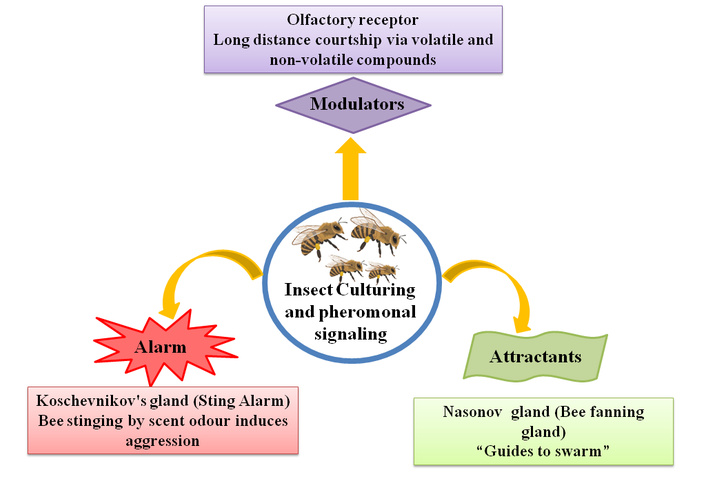
Schematic overview of how different classes of pheromones coordinate an insect’s behavior, from long-range attraction to immediate defense and complex modulation.
Pheromones are the primary means of communication among insect members, triggering specific physiological and behavioral responses after being processed in the olfactory centres. A key example of an attractant is the secretion of the nasonov gland, discovered in 1883 by zoologist Nikolai Viktorovich Nasonov. Historically debated as either a general attractant or a true pheromone, the Nasonov pheromone is now recognized as both an attractant and an orientation cue. This pheromone is a volatile blend of seven terpenoid compounds: geraniol, (E)-citral, (Z)-citral, geranic acid, nerolic acid, (E, E)-farnesol, and nerol. The composition of this blend changes with time and age. For instance, newly emerged bees lack geraniol and (E, E)-farnesol, with geraniol concentrations rising to 0.3 µg within the first 10–17 days [10]. Interestingly, a similar combination of compounds is found in the fragrances of some flowering plants, which supports recent reviews confirming its strong attractant properties [11].
The most extensively studied honeybee pheromone is the queen mandibular pheromone (QMP). First identified by Colin Gasking Butler in 1954, who termed it “queen substance”, QMP influences nearly all aspects of colony life. It regulates retinue behavior, swarm clustering, drone attraction, queen rearing, worker division of labour, and the inhibition of worker ovarian development. It achieves these effects through olfactory perception that is releaser effects and by priming specific neuronal pathways, also known as primer effects [12]. The chemical profile of QMP includes compounds such as 9-oxo-2-(E)-decenoic acid (9-ODA), 9-hydroxy-2-decenoic acid (9-HDA), methyl p-hydroxybenzoate (HOB), 4-hydroxy-3-methoxyphenylethanol (HVA), and others [13]. The specific blend varies between mated and virgin queens. Unmated queens produce less 9-HDA and 9-ODA, which constitute 80% of the mated queen’s secretion and negligible HVA, making them less attractive to workers [14]. Workers also produce some QMP compounds, including 10-HDA and its precursor 10-hydroxydecanoic acid (10-HDAA). The biosynthesis of these compounds involves caste-specific pathways, beginning with stearic acid and proceeding through hydroxylation, β-oxidation, and final oxidation steps [13].
Alarm pheromones are low molecular weight, volatile organic molecules that diffuse rapidly and generate a concentration gradient from their source. They trigger arousal, defensive, and assembly behaviors. In social insects, these pheromones are often not species-specific, though they can elicit different responses in different species. For example, high concentrations of 4-methyl-3-heptanone trigger digging in some Pogonomyrmex ants but repulsive behavior in the Texas leaf-cutting ant (Atta texana). Alarm signals detected far from the nest may trigger a flight context that is also critical, while the same signals near the nest entrance provoke defensive aggregation and frenzied excitement [15].
The honeybee alarm pheromone is one of the most well-known, with over 40 components and a distinctive banana-like odour known as sting alarm pheromone (SAP). It is released during significant threats and causes a high respiration rate with aggressive behaviors like stinging and biting. Alongside, it functions as the mandibular alarm pheromone (MAP). Both queens and workers possess the Koschevnikov’s gland, which releases potent pheromones, but its secretions act for different purposes. In case of worker bees, it produces SAP to warn of danger, but in queens, it works as a supportive blend for the QMP during her first year to attract workers. The worker SAP mixture includes key compounds like isoamyl acetate (IAA), also known as isopentyl acetate (IPA), which is the major volatile and is primarily responsible for eliciting the defensive stinging response, including attracting other bees to the sting location. Research studies show that IAA induces greater aggression in group settings than in isolated bees [16]. Other components include butyl acetate, 1-hexanol, and n-butanol, the latter contributing to the banana scent [17]. The queen’s Koschevnikov gland secretion is chemically distinct, containing 20–40 unique compounds like alkanes, alcohols, aldehydes, etc., to contribute to defensive behavior, and the gland itself degenerates after a year [18].
In the course of evolution, insects have developed a sophisticated, diverse array of chemical communication systems, including fatty acids, ketones, and aldehydes as pheromones to modulate and regulate behavior. The central function of these chemicals is the regulation of mating, though the specific strategies employed vary widely among different species. For instance, the regulation of complex courtship rituals in fruit flies (Drosophila) uses a combination of volatile and non-volatile cuticular hydrocarbons (CHCs) [19]. Conversely, Lepidoptera (butterflies and moths) rely on complex ritualized courtship behavior and secretion of volatile compounds to ensure successful sexual attraction for long-distance [20]. A research example illustrates that 11-cis-vaccenyl acetate (cVA), the volatile pheromone in Drosophila melanogaster, is specific to males and has a pleiotropic effect. It simultaneously suppresses male-male courtship while stimulating aggressive behavior [21]. The volatility of these signals dictates that their detection method is that the volatile pheromones are sensed by olfactory receptors present in the antennae, while non-volatile pheromones like long-chain CHCs are detected by contact chemosensory receptors across the body [22]. Finally, insect behavioral modulators encompass both chemical and non-chemical products, including inherent genetic predispositions and the surrounding physical environment. Although the combined action (synergy) of different signal types can boost the efficiency of insect activities, research studies indicate that not all chemical cues cooperate; certain odors, for example, fail to increase the attractiveness of the primary pheromones [23].
There is growing interest in insect-produced bioactive compounds due to their promising applications in biotechnology, agriculture, medicine, and cosmetics. Green synthesis of these compounds exhibits diverse bioactivities, including cytotoxic, antiviral, and antimicrobial properties as part of their natural metabolism or in response to external stimuli. A research study on these compounds is essential for developing sustainable alternatives to synthetic chemically-derived medicines. Consistently, studies show their significant outputs as key ingredients in pharmaceutical formulations where they enhance the drug delivery system, stability, and patient compliance. According to Gunjal et al. [24], these substances work as binders, disintegrants, fillers, lubricants, and preservatives, which are essential for transforming an active pharmaceutical ingredient (API) into a stable and effective final product of the drug. Furthermore, insect-based entomoceuticals are becoming popular primarily due to their environmental benefits and biocompatibility. Selecting these insects must be strictly adhering to regulatory standards to ensure both safety and efficacy, emphasizing their critical role as therapeutics in the treatment of diseases.
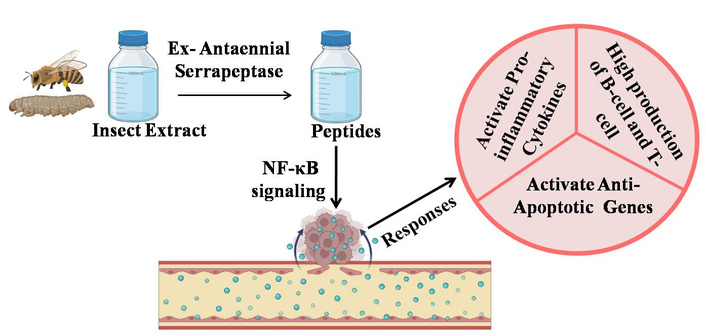
Insects are a significant and valuable source of bioactive peptides [25]. These peptide domains are small protein segments with distinctive physiological properties that offer benefits beyond the basic nutrition [26]. They exist within a larger “parent” protein in an inactive state and becoming native state when released through various processes like gastrointestinal digestion, food processing, or fermentation [27]. Bioactive peptides are obtainable from diverse sources, including terrestrial animals, plants, bacteria, and marine organisms. A key characteristic of these peptides (15–81% of dry weight) is their high affinity towards target tissues, which results in minimal to no toxicity. They are also effective even at low concentrations, making them a promising option for managing chronic diseases [28]. Common techniques for releasing peptides include enzymatic hydrolysis, which is favored for its safety, and fermentation, which is a more cost-effective method utilizing microbial or fungal enzymes [29]. The peptides themselves exhibit a diverse range of health-promoting properties, such as antihypertensive, antioxidant, anti-inflammatory, and antimicrobial effects (Figure 2). They are also being explored for their potential pharmacological application against conditions like cardiovascular diseases, cancer, and inflammation [30]. Future research efforts should prioritize production technologies through optimization and studying efficacy, appropriate dosing, and in vivo case safety, primarily to realize their functional foods and nutraceuticals potential [31].
As the second most important macronutrient in edible insects is lipids, which are frequently characterized by a higher concentration of unsaturated fatty acids (UFAs) as compared to saturated fatty acids (SFAs) [32]. The sustainable and eco-friendly nature of insect oils and waxes positions them as compelling alternatives for the cosmetics, pharmaceutical, and food industries. These oils are typically extracted by using mechanical pressing or solvent extractions, which are valued for their rich supply of essential fatty acids, including omega-3 and omega-6. Several insect oils have specialized applications, including black soldier fly oil, which contains a high level of lauric acid [i.e., monounsaturated fatty acid (MUFA) content ranging from 9.9% to 19%, while polyunsaturated fatty acid (PUFA) concentration of 10.4–14.5%], providing antimicrobial properties useful in cosmetics and animal feed [33]. Mealworm cricket oil possesses a high percentage of UFA (4.4–77.4%), suggesting a range of potential applications in food and cosmetics [34]. It is a source of MUFAs (27.1–29%) and PUFAs (25.5–30.0%) components range known to be beneficial for cardiovascular health, suitable for nutritional supplements and food products [35]. The ratio of PUFAs to SFAs in nutritional supplements and food products plays a significant role in biological functions. A PUFAs/SFAs ratio of 0.45 or higher may potentially contribute to cancer prevention. This ratio suggests that some insect oils are becoming chemically more similar to vegetable oils than animal fats [32]. Furthermore, essential fatty acids like omega-6 and omega-9 are also known to contribute to reducing hypertension, autoimmune disorders, and inflammation, and assist in neurological functions [32].
Honey is a sophisticated, complex chemical composition with a natural sweetener and numerous health-promoting characteristics [36, 37]. For centuries, it has been used therapeutically for conditions such as burns, gastrointestinal diseases, asthma, infected wounds, and skin ulcers [38]. Honey contains approximately 180 different compounds, including fructose (levulose) 38.2%, glucose (dextrose) 31.3%, water (moisture) 17.2%, maltose 7.3%, sucrose 1.3%, higher sugars (oligosaccharides) 1.5%, minerals, vitamins, enzymes, amino acids, organic acids, etc. Potassium is one of the most abundant minerals in honey [39]. Beyond this, honey is particularly rich in phenolic compounds like quercetin, caffeic acid, and gallic acid, all of which function as natural antioxidants. These compounds are thought to benefit human health by improving coronary vasodilation, decreasing blood clotting, and preventing the oxidation of low-density lipoproteins (LDLs). For instance, studies have demonstrated that gallic acid can reduce the viability of fibroblast-like synoviocytes and suppress pro-inflammatory cytokines in rheumatoid arthritis patients [39]. Other phenolic compounds, including caffeic acid, p-hydroxybenzoic acid, cinnamic acid, naringenin, pinocembrin, and chrysin, display a range of properties such as antimicrobial, antidiabetic, and antioxidant activities. Furthermore, protocatechuic and p-hydroxybenzoic acid show considerable antioxidant, anticancer, and antiatherogenic effects. Specifically, the study in 2VO rats found that chrysin lowered lipid peroxide, suppressed the superoxide dismutase (SOD) activity, and mitigated the reduced glutathione (GSH) peroxidase activity. Additionally, quercetin-3-O-rhamnoside demonstrates moderate antitumor activity [39, 40].
Propolis is a resinous compound enriched with bee saliva enzymes that bees gather from plant secretions [41]. Its composition features hundreds of complex, distinct components. These include phenolic acids, prenylated benzophenones, glycosides, aglycones, and their esters, as well as various volatile organic compounds and their esters, sesquiterpenes, quinones, coumarins, steroids, aldehydes, alcohols, ketones, and amino acids [42, 43]. Furthermore, propolis contains essential elements like magnesium, calcium, nickel, iron, zinc, cesium, manganese, silver, copper, aluminum, vanadium, amino acids, and vitamins B, C, and E [42, 44–46]. Due to the action of bee enzymes, the flavonoids found in propolis mostly exist in the form of aglycones [45]. Globally, propolis is valued for its anti-inflammatory, antimicrobial, and antioxidant properties. It is commonly used in managing chronic diseases that involve infections and inflammation. Additionally, propolis and its bioactive compounds can positively influence bone formation (osteogenesis). They achieve this primarily by regulating osteoclast and osteoblast activity through their potent antioxidant and anti-inflammatory properties [42, 43, 47]. The compounds such as FGF-2 and vascular endothelial growth factor (VEGF) also stimulate the production of growth factors that are crucial for angiogenesis and bone formation [48, 49].
Royal jelly is an acidic substance (with a pH ranging from 3.5 to 4.2) that worker bees secrete and feed only to the larvae and queen bees. Its intricate complex composition, which consists of 60–70% water, 9–18% proteins, 7–18% sugars, and 3–8% lipids, in addition to essential minerals and vitamins, gives it a broad range of pharmacological benefits [50]. These attributes include immunomodulating, neuroprotective, and anti-aging effects, which establish royal jelly as a promising therapeutic agent for various diseases, from immunodeficiency to age-related neurodegenerative disorders. The biological efficacy of royal jelly stems from its concentration of bioactive compounds. Notably, the proteins present in royal jelly are crucial for the longevity of the queen bees. These are referred to as major royal jelly proteins (MRJPs) and contain specific peptides such as royalisin, jelleines, and royalactina. The lipid component is primarily made up of 10-HDA, which has anticancer and anti-angiogenic actions, and sebacic acid has anti-aging characteristics.
Furthermore, royal jelly exhibits potent antioxidant capacity due to its polyphenolic and flavonoids, such as pinobanksin [51]. These flavonoids are classified into several types, including flavanones (e.g., hesperetin), flavonols (e.g., kaempferol), flavones (e.g., chrysin, apigenin), and isoflavonoids (e.g., formononetin). Together, these compounds deliver anti-inflammatory and anti-apoptotic effects [52]. The potency of these beneficial compounds is significantly impacted by the harvest time of the royal jelly product collected from younger larvae, which contains increased concentrations of proteins and phenolics, which consequently enhances its free radical scavenging capability [51]. This distinctive chemical composition is the foundation for the various health benefits associated with royal jelly provided to humans. Research investigations have demonstrated its promising potential in treating cardiovascular disease [53], hypertension [54], and high cholesterol [55]. Furthermore, it possesses anti-aging [56], anticancer [57], memory-enhancing [58], anti-diabetic [59], wound-healing [60], anti-inflammatory, and antioxidative properties [61]. Every single constituent plays a role in establishing royal jelly as a remarkable therapeutic option for a multitude of diseases.
Silkworms (Bombyx mori) yield valuable enzymes and proteins such as sericin and fibroin. These substances exhibit potential antioxidant, anti-inflammatory, and wound-healing activity. Given their biodegradable nature, these proteins have received considerable focus in the fields of dermatology and tissue engineering for applications in skin repair and regeneration. In addition to these structural proteins, silkworms also produce another type of peptide called serrapeptase. This enzyme is known to reduce inflammation and blood clots, making it beneficial in treating various ailments like arthritis, atherosclerosis, and chronic inflammation [62].
Cantharidin (CTD) is a defensive blistering agent produced by blister beetles of the Meloidae family naturally to ward off predators. It also serves a key function in mating, as male beetles utilize it as a sexual attractant and transfer it to females during copulation [63]. Although generally produced by males, some female species show 5–6% greater CTD concentration, a phenomenon that is still being investigated [64, 65]. Despite its well-known capacity for toxicity, which can result in conditions like renal failure, dysphagia, and liver congestion. CTD demonstrates considerable anticancer potential. Its method of operation involves inhibiting the protein phosphatases PP1 and protein phosphatase 2A (PP2A), promoting apoptosis (programmed cell death), and modifying protein synthesis within malignant cells [66]. To utilize these advantages while reducing fatal consequences, researchers are working on developing delivery systems that are specific to cancer cells. Additionally, ethanolamine (ETA) has been identified as a powerful counteragent that reverses CTD cytotoxicity by specifically and selectively altering the functions associated with phosphatidylethanolamine (PE) [67]. Due to its toxicity, thousands of CTD derivatives have been synthesized, many of which retain tremendous anticancer abilities [68]. Many of the synthesized CTD derivatives, such as norcantharidin, norcantharimide, cantharidinamides, sodium cantharidate, and anhydride-modified derivatives, still possess considerable anticancer capabilities. The therapeutic application of CTD is rooted deeply in history. For centuries, dried blister beetles have been incorporated into traditional Chinese medicine to address a wide range of health issues. These uses include treating skin conditions like warts and molluscum contagiosum, as well as managing conditions such as tuberculosis, scrofuloderma, ulcers, chronic constipation, and parasitic infections [67, 69]. It was also historically used as an abortifacient and aphrodisiac [69]. Modern research has confirmed and broadened these applications, specifically proving CTD’s effectiveness against genital warts (condyloma acuminatum) [70]. Furthermore, its antiparasitic properties are also significant. It can induce apoptosis in Leishmania major, the parasite responsible for cutaneous leishmaniasis [69]. CTD has also shown to possess broad-spectrum activity against protozoa (Trichomonas vaginalis), insects, ticks, and plant-parasitic nematodes [71]. Blister beetles are considered an essential natural source for the pharmacology of CTD. Consequently, this compound and its derivatives, synthesized analogs are now in use and are being extensively researched across multiple medical fields, such as oncology, gynecology, and reconstructive surgery, for their demonstrated anticancer, antiviral, and tissue-healing properties [62].
Wasp venom contains bioactive peptides, such as melittin and mastoparan, both of which exhibit antimicrobial, anticancer, and anti-inflammatory effects. Because of these varied properties, they are being vigorously investigated as promising candidates for new pharmacological agents to treat infectious, cancerous, and inflammatory diseases [62]. A key part of melittin’s mechanism involves its direct engagement with the impaired nuclear factor erythroid 2-related factor 2 (Nrf2)/HO-1 pathway. By reactivating this crucial cellular defense system, melittin successfully reestablishes the basis for the natural correction of various processes downstream, including inflammation, apoptosis, neurotrophic factor regulation, cholinergic function, and mitochondrial performance. The melittin molecule is large (with a mw: 2,840 daltons) and possesses multiple sites for activity. This structure enables a high number of potential biomolecular interactions that require further investigation. However, within the confines of the present study, its effect on the Keap1-Nrf2 system was the most significant finding. These results emphasize melittin’s potential as a holistic therapeutic agent for disorders rooted in oxidative stress and inflammation, providing robust support for clinical research into its applications for neurodegenerative diseases [72].
Insect products contain a high concentration of natural compounds that offer a documented array of health-benefits (Table 1). Specifically, these compounds have been shown to reduce inflammation, exhibit anticancer effects, supply antioxidant support, and protect the hepatic and nervous system (Figure 3). Individually, these components function as potent therapeutic agents, enhancing the products’ total efficacy in managing various illnesses.
Sources associated with different insect products and the bioactive substances that provide health benefits.
| Sources | Obtained products | Bioactive compound | Application | Reference |
|---|---|---|---|---|
| Insects (generally) | Proteins/Peptides | Bioactive peptides | Potential for managing inflammatory, cancer, microbial, cardiovascular diseases | [30] |
| Black soldiers fly, mealworm cricket | Lipids | UFA, omega-3, 6, and 9, 6-lauric acid | Used in cosmetics, food, and pharmaceuticals like antimicrobial diseases, cardiovascular health | [33, 35] |
| Bees | Honey | Quercetin, caffeic acid and gallic acid, minerals, enzymes | Treatment for burns, ulcers, wound healing, antimicrobial, antioxidant, antimicrobial benefits | [38, 39] |
| Wax and nectar | Esters, fatty acids, rutin, quercetin, nectarins | Used in cosmetics and as an emulsifying agent | [73, 74] | |
| Propolis | Phenolic acid, flavonoid, vitamins, volatile compounds | Used in bone formation, chronic infections, antioxidants, anti-inflammatory, anticancer | [42, 48] | |
| Royal jelly | MRJPs, 10-hydroxy-2-decanoic acid, flavonoids | Potential for immunomodulating, neuroprotective, anti-aging, anti-cancer, anti-diabetic | [50] | |
| Silkworm | Sericin and fibroin | Sericin, fibroin, serrapeptase | Used in dermatology, tissue engineering, and reducing blood clots and inflammation | [62] |
| Blister beetles | CTD | CTD and non-CTD | Used for warts and skin diseases, anticancerous via inducing apoptosis, antiviral, and protecting from plant parasitic infections | [69, 71] |
| Wasp venom | Melittin and mastoparan | Melittin, mastoparan peptides | Treating infectious diseases, cancer, neurodegenerative disorders by modulating the oxidative stress pathway | [62, 72] |
CTD: cantharidin; MRJPs: major royal jelly proteins; UFA: unsaturated fatty acid.
Since oxidative stress is a primary contributor to numerous chronic diseases, the necessity for potent antioxidants is critical. Compounds from insects are proving to be a highly valuable option. For instance, royal jelly has special peptides and fatty acids that allow it to fight free radicals much better than proteins and fats. These antioxidants shield cells from damage, which in turn helps decrease the risk of heart disease and brain disorders. Similarly, silkworm proteins like sericin and fibroin are excellent antioxidants; they clean up harmful reactive oxygen species (ROS) and enhance the body’s natural defense system. Propolis, a resin-like sticky substance collected by bees, further supports this protective function. It is abundant in phenolic compounds that shield cells from oxidative stress. Taken together, these antioxidants derived from insects demonstrate considerable therapeutic promise for the management and prophylaxis of disorders linked to decreasing the prevalence of conditions like cardiovascular diseases, Alzheimer’s, and numerous other age-associated illnesses. Given their powerful effects, these natural agents are crucial for supporting human health and slowing the progression of diseases caused by oxidative stress [75].
Insects represent an emerging frontier in the form of a valuable source of bioactive compounds, with antineoplastic properties garnering intensive scientific attention for their pharmacological investigation. These substances frequently display a targeted cytotoxicity, meaning they can eliminate cancer cells while generally leaving healthy cells undamaged. This selectivity could significantly reduce the harsh side effects commonly associated with conventional chemotherapy. A number of key compounds highlight this potential for therapeutic use. Melittin, for instance, has been shown to trigger apoptosis (programmed cell death) in cancer cells by disrupting their membranes and initiating caspase-dependent pathways. Specifically, the propolis-based flavonoids chrysin and caffeic acid phenethyl ester (CAPE) have been observed to curb tumor growth and inhibit angiogenesis. Furthermore, CTD shows its effect by precisely interfering with PP2A, ultimately leading to apoptosis, which means cell death. Similarly, mastoparan in wasp venom disrupts the function of cancer cells’ mitochondria, causing them to die. Royal jelly is another potent source of anticancer agents. Its key components, including 10-HDA and the proteins apalbumin-1 and apalbumin-2, work together to inhibit the spread of cancer. For instance, 10-HDA suppresses VEGF, which reduces angiogenesis, cell proliferation, and migration, thereby hindering a tumor’s ability to develop its own blood supply. Additionally, royal jelly possesses potent antioxidative properties. By enhancing the production of essential enzymes like GSH and SOD, its properties complement chemotherapy drugs like cisplatin (CDDP) by fighting oxidative stress. Royal jelly has also been found to suppress tumor growth, enhance immune functions, and alleviate cancer-related fatigue. It shows promise as an adjunctive therapy for menopausal breast cancer by helping to control proliferation and metastasis. The diverse, novel, and targeted mechanisms of action demonstrated by these insect-derived compounds make them outstanding candidates for use as an exciting path toward developing treatment options that are both more selective and better tolerated than existing conventional methods [76].
Insects are recognized as a rich source of antimicrobial peptides (AMPs), which are key components of their innate immune system. These peptides are crucial for the insect’s defense against a variety of pathogens, including bacterial, fungal, and viral pathogens. Specific peptides such as defensins, cecropins, and attacins exhibit broad-spectrum activity against microorganisms, effectively targeting both Gram-positive and Gram-negative bacteria. Their mechanism of action involves destroying the cell membranes of these microbes, which ultimately results in the microbe’s death. This potent defense strategy is especially valuable when combating drug-resistant pathogens, providing a distinct and significant advantage in the worldwide effort to overcome antibiotic resistance. For example, cecropins sourced from silkworms and defensins from honeybees have shown proven effectiveness against multidrug-resistant bacteria, highlighting their potential therapeutic relevance. In addition to AMPs production, honeybees possess other inherent antimicrobial properties, including a naturally low pH, high osmolarity, and hydrogen peroxide content, which aid in wound healing. Moreover, propolis is rich in beneficial compounds like flavonoids and phenolic acids, which contribute to its antimicrobial and anti-inflammatory effects. These naturally occurring substances are capable of not only eradicating pathogens but also helping to regulate the immune system’s response to infection. Royal jelly further enhances this antimicrobial profile. It contains royalisin, a protein that exhibits potent antibacterial activity against various Gram-positive bacteria, though it doesn’t affect Gram-negative strains [77]. Royal jelly also includes Jelleines, a group of peptides with specific antimicrobial functions: Jelleines I, II, and III are active against Gram-positive bacteria, Gram-negative bacteria, and yeast, respectively, whereas type IV shows no such activity [78]. However, consuming royal jelly directly might lead to the degradation of these active components due to pH variations within the digestive tract [61, 79]. Consequently, the antimicrobials sourced from insects represent a vast and largely undeveloped resource. By strategically utilizing these distinct characteristics of AMPs and related bioactive compounds, researchers aim to develop viable alternatives to conventional antibiotics. This effort constitutes a crucial stride toward resolving one of the most significant challenges in present-day healthcare [80].
The liver plays a fundamental role in metabolism, but it is frequently damaged by exposure to toxic chemicals and medications. Such damage is often signaled by high levels of serum enzymes like alanine aminotransferase (ALT) and aspartate aminotransferase (AST). Substances known to be toxic to the liver such as cadmium and carbon tetrachloride (CCl4), typically reduce the body’s store of GSH while simultaneously increasing malondialdehyde (MDA) levels. Royal jelly helps to counteract this toxicity by restoring antioxidant levels, including the enzyme SOD, catalase (CAT), and GSH, by reducing the high concentration of AST and ALT markers [81]. Its defence capabilities are broad, extending to liver damage caused by various substances, including the drugs azathioprine and paracetamol [82]. Royal jelly exhibits considerable hepatoprotective qualities through multiple molecular pathways. For instance, in mice, it influences the expression of 267 liver genes. It regulates key factors by decreasing squalene epoxidase (SQLE) and increasing the low-density lipoprotein receptor (LDLR), which collectively help to reduce cholesterol levels. Additionally, royal jelly boosts the production of genes that encode for critical antioxidant enzymes such as GSH S-transferase (GST) and GSH peroxidase (GSH-Px) [51]. Royal jelly is also effective at mitigating hepatotoxicity induced by chemotherapeutic agents. It specifically counters damage from CDDP and taxol (TXL) by restoring the level of GST and GSH-Px, thereby reducing the rate of hepatocyte apoptosis [51]. Moreover, royal jelly decreases the elevated levels of alkaline phosphatase (ALP) and lactate dehydrogenase (LDH) caused by TXL and helps to modulate liver growth regulatory factors [83]. At the molecular level, royal jelly provides protection against cadmium toxicity by dampening the expression of inducible nitric oxide synthase (iNOS) and interleukin-1β (IL-1β). Simultaneously, it upregulates the Nrf2 pathway and the anti-apoptotic protein Bcl-2. It also downregulates pro-apoptotic markers like caspase-3 and Bax [84]. Specific components, such as MRJP-2 is the safeguard against CCl4-induced injury by enhancing the liver’s overall antioxidant capacity [85]. Thus, royal jelly protects the liver from various forms of injury primarily by strengthening its intrinsic antioxidant defenses and regulating apoptotic and inflammatory pathways.
Growing scientific evidence highlights the promise of bioactive insect compounds as a new class of therapeutic agents for treating neurological diseases. Substances extracted from insects possess various properties advantageous to nervous system health, including the ability to promote neurogenesis, reduce oxidative stress, and aid in nerve repair. This line of inquiry presents exciting novel avenues for managing conditions like Alzheimer’s, Parkinson’s, and multiple sclerosis. Several examples further highlight this therapeutic promise. Royal jelly, for instance, offers neuroprotection primarily due to its key ingredient 10-HDA. This compound is known to both stimulate new neuron formation and shield cells from oxidative damage. Likewise, silk proteins exhibit anti-neurodegenerative effects by lowering oxidative stress and promoting nerve repair. Furthermore, peptides found in bee venom have shown promising outcomes in treating multiple sclerosis [51].
Royal jelly benefits on the nervous system are particularly well-established. Studies indicate it can boost memory, increase energy, and provide anxiety-reducing and calming effects. A major part of how it works is through the intricate regulation of gamma-aminobutyric acid (GABA) signalling. Specifically, royal jelly affects GABA-transaminase (GABA-T), the enzyme responsible for GABA breakdown, resulting in localized shifts in GABA levels that reflect a complex regulatory capacity. Moreover, royal jelly supplies crucial precursors, specifically tryptophan and tyrosine, that are vital for synthesizing the neurotransmitters serotonin and dopamine. Studies show that royal jelly supplementation elevates brain concentrations of dopamine and its metabolites, which, by enhancing neurotransmission and improving cognitive function. This is demonstrated by its effectiveness in reversing age-associated cognitive decline, that caused by D-galactose in mice model through the restoration of noradrenaline and dopamine levels. Royal jelly directly protects neurons against toxins like tartrazine and cadmium. It helps normalize neurotransmitter balance and promotes the synthesis of protective molecules, such as cysteic acid, suggesting its involvement in the cysteine-taurine metabolic pathway. Hence, royal jelly’s positive impact on the nervous system is a product of its neurotransmission modulating ability, its protection against age-related cognitive issues, and its role in stimulating endogenous neuroprotective pathways. These outcomes highlight its significant potential as a powerful dietary supplement and a viable therapeutic agent for enhancing cognitive and neuroprotection [86].
Insects, bees, and their swarms are a rich source of bioactive compounds that hold significant therapeutic potential. These substances exert their effects through various pathways, including modulating signalling pathways, acting as potent antioxidants, and disrupting cellular membranes. For instance, peptides derived from insects such as cecropins and melittin have demonstrated both antibacterial and anticancer properties. They achieve this by specifically targeting and compromising the integrity of harmful bacteria and tumor cell membranes [87]. Furthermore, beyond its membrane-disrupting action, melittin is also known to reduce inflammation by inhibiting the NF-κB pathway, suggesting it could be a useful agent for managing conditions like rheumatoid arthritis. Other notable compounds, such as those found in royal jelly, have the capacity to modulate insulin signalling. This opens up new avenues for treating and managing diabetes and metabolic disorders [88]. Additionally, enzymes like serrapeptase from silkworms are used to alleviate inflammation and promote tissue repair. Antioxidants present in substances like royal jelly and silk sericin help counteract oxidative stress, a major contributor to aging, neuro-degeneration, and cardiovascular disease. Collectively, these natural molecules offer a broad and versatile array of tools for addressing a range of health issues, including cancer, inflammation, and chronic illnesses (Table 2) [89]. They represent a promising direction for sustainable and innovative solutions to global health challenges [90].
Bioactive compounds having pharmacological potential and their mechanism of action.
| Bioactive compounds | Formulation | Pharmacological potential | Mechanism of action | References |
|---|---|---|---|---|
| Royal jelly (peptides, fatty acids), silkworm protein (sericin and fibroin), propolis (phenolic acid) | Water and liposoluble extracts | Antioxidant activity | Scavenges free radicals and reactive oxygen species, enhances the natural antioxidant defense system | [75] |
| Melittin, propolis (chrysin, CAPE), cantharidin, mastoparan, royal jelly (10-hydroxy-2-decanoic acid, apalbumin) | Bioactive peptides | Anticancer activity | Induces apoptosis, inhibits angiogenesis and metastasis, disrupts mitochondria in cancer cells | [76] |
| Peptides like defensins, cecropins, attacins, royalisin, propolis (flavonoids, phenolics) | Polyphenolic ethanol and ethanol: water extracts | Antimicrobial activity | By the disruption of cell membrane, inherent low pH, and H2O2 in bee products | [61, 77, 80] |
| Royal jelly, MRJP-2 | Ethanolic extract | Hepatoprotective activity | Boosts SOD, CAT, GSH, GST, GSH-Px, regulates Bcl-2, caspase-3, reduces inflammation and cholesterol | [51, 84] |
| Royal jelly, silk protein, bee venom protein | Bioactive peptides | Neuroprotectivity activity | Modulates neurotransmitters like GABA, dopamine, serotonin, aids nerve repair, reduces oxidative stress in the brain | [86] |
CAPE: caffeic acid phenethyl ester; CAT: catalase; GABA: gamma-aminobutyric acid; GSH: glutathione; GSH-Px: glutathione peroxidase; GST: glutathione S-transferase; MRJP: major royal jelly protein; SOD: superoxide dismutase.
Edible insects present a considerably more sustainable and environmentally friendly source of nutrients compared to traditional livestock, yielding significant economic and environmental benefits [91, 92]. Current food production systems heavily strain limited natural resources. If these practices continue, they will inevitably cause more deforestation, widespread environmental degradation, and higher greenhouse gas emissions. For perspective, livestock farming is responsible for approximately 70% of global agricultural land use [93]. Conversely, insects offer a high protein and nutrient content as well as a high feed-to-mass conversion ratio. A critical sustainability benefit is their natural ability to flourish on organic byproducts, like biological waste, manure, and compost. These characteristics not only minimize environmental pollution but also improve the economic viability of insect farming [7].
Insect farming offers a source of high-quality protein with significantly reduced resource needs, specifically requiring less arable land and water, which translates to a low ecological cost and a minimal environmental footprint [94, 95]. Despite these advantages, economic challenges remain. These are particularly pronounced in temperate areas where the essential need for electricity to power climate control drives up operational costs [96]. This situation stands in stark contrast to tropical regions, which naturally provide a favorable climate. The success of insect farming in East Africa highlights its viability as a profitable, “climate-smart” business that aligns well with the ideals of circular economy principles [97, 98]. By adopting inclusive business models, the sector can boost the incomes of smallholder farmers through low startup costs while simultaneously contributing to food security. Moreover, using insects to convert low-value organic waste into high-quality livestock feed is a key strategy for lowering the environmental impact of traditional animal production [99]. For the industry to scale, especially in Western societies with lower consumer acceptance, it is critical to establish robust regulatory frameworks, engage in consumer education, and implement effective marketing strategies [100].
The use of pharmaceuticals introduces ethical concerns regarding their welfare when produced in mass production, alongside challenges related to consumer acceptance. Furthermore, the environmental consequences of operating large-scale insect farming, specifically concerning resource consumption and waste management, must be carefully governed. Nevertheless, if properly managed, insects could serve as a more sustainable replacement for the ingredients traditionally used as pharmaceutical excipients [101]. Regarding the safety of using insects, existing evidence suggests they are generally comparable to other food sources [102]. However, potential risks include the inherent presence of toxic compounds, potential contamination from heavy metals or pesticides, and the possibility of causing allergic reactions in sensitive individuals [103–105]. To mitigate these risks, implementing controlled farming practices is necessary to prevent contamination, along with thorough processing steps like washing, blanching, and cooking to lower microbial loads and neutralize allergens [106]. Furthermore, comprehensive regulatory frameworks are crucial for ensuring safe farming, processing, and distribution [7, 107]. These regulations should address guidelines for species selection, farm management, and regular environmental monitoring. Finally, more research, including extensive, comprehensive human studies, is needed to directly assess health outcomes and confirm the safety and benefits of entomophagy (eating insects).
The regulatory environment governing insect-derived pharmaceutical excipients remains under development. Because most nations haven’t established clear guidelines, regulatory agencies are mandating strict safety assessments, allergen testing, and demanding rigorous manufacturing standards. The absence of a precise classification system for these materials further complicates their approval and marketing, highlighting the need for more specialized regulatory structures [108]. Beyond regulation, several technical and commercial issues must be resolved. Maintaining quality control is difficult due to the variability in raw insect materials, a lack of standardized extraction methods, and contamination risks. Further issues include challenges related to allergenicity, immunogenicity, and consumer acceptance. Other critical factors involve scalability, reliable supply chain consistency, production expenses, and guaranteeing the stability and compatibility of the insect materials once they are incorporated into final drug formulations. Unlocking the complete potential of insect-derived materials will require concerted efforts in rigorous research, close collaboration with regulators, and targeted education for consumers.
The consumption of insects in our diet, it could be a substantial solution to fulfill the requirement of food across the globe [109]. To strengthen food security, significant problems must be overcome. Although insects are a healthy food source and are nutritious, scientific research is insufficient. Various species of insects provide particular health benefits; we require deep knowledge of the nutritional content of each and every species of insect. It should be noticed that in which manner this insect industry affects the environment. We can compare the new farming method with the conventional cattle farming approach after thorough research, and the new farming method would have less of an impact on the environment. Both insect gathering and farming for social and economic benefits, particularly regarding their ability to improve food security in cost effective manner, also require more investigation. As compared to traditional farming, insect farming shows less ethical concern, the concern of animal welfare, that insects will feel how much pain or how much discomfort has been resolved [107]. For complicated issues and multidisciplinary research effort an institute is made across Africa, which is only involved in improving food security, and the institute’s name is the International Centre of Insect Physiology and Ecology (ICIPE) in Nairobi, Kenya. This ICIPE mainly focuses on improving food security and providing better health benefits. This institute achieves this by developing insect management skills, and they are not only useful, economical, and sound but also culturally appropriate. The government should cooperate to start the production and trade of insect-based products, both domestically and at the international level, and the government should also support funding.
Furthermore, a significant amount of proteins, UFAs, and essential minerals are all offered by healthy insects, which fulfill the requirement for animal proteins. This will solve the malnutrition problem for the growing population [7]. For improving gut health, insects are very good because chitin acts as a prebiotic, which is present in insect structure, that helps in the growth of beneficial gut bacteria. Examples of this type of bacteria are Faecalibacterium and Roseburia [110]. Many studies show that taking whole cricket powder supports the probiotic bacterium Bifidobacterium animalis and also lowers systemic inflammation, which is proven by reduced plasma TNF-alpha levels [111]. Entomophagy not only provides high-quality proteins but also provides particular benefits for the gut. The interests that grow in the nutritious insects also solve the issues at the global level, such as food security and urbanization. For small-scale agriculture producers, insect rearing offers new economic opportunities [112]. In insects, bioactive compounds are present like phenolics, which have antioxidant properties. For improving antioxidants activity of insect-derived products, many studies are in progress [113]. As most of the research is in its initial stage and in vivo studies, it is important to fully verify these health claims and prove them without any doubt [114].
This review paper presents a critical and thorough assessment of the broad therapeutic potentials of insect products. We emphasize their notable, promising benefits as a multifaceted solution to modern natural healthcare remedies and dietary supplement challenges. Most importantly, the review elaborates on the underlying mechanisms of these effects, thereby advancing our knowledge of how they are employed in health and disease management. This is a valuable resource for both clinical and research communities, which helps in pinpointing current research gaps in the existing knowledge. A key future of this research direction is to advance the development of insect-based therapeutic strategies. The evidence strongly highlights the necessity of incorporating insect products derived from insects into both complementary and alternative medicine. Separately, insect products are recognized as an abundant source of valuable bioactive compounds, such as peptides, phenolic compounds, chitosan, and essential vitamins. These compounds enhance the already substantial nutritional value of insects, which are widely accepted as highly valuable protein sources. However, effectively incorporating them into regular diets will necessitate additional knowledge to fully understand the impact of their bioactive components on human health. Through a systematic evaluation of scientific literature, this work illuminates light on the diverse biological actions of these products. Finally, investigating the bioactive potential of insect-derived products reveals sustainable solutions to future nutritional concerns, which include anti-diabetic, anti-inflammatory, antioxidant, antimicrobial, and anticancer properties. By leveraging their abundant nutritional value and diverse array of biologically active substances, we can move toward creating a more resilient and better-nourished global population. This integration could unlock new avenues for treating a variety of ailments, such as gastrointestinal protection and cardiovascular health benefits, anti-tumor, anti-aging, neuroprotective, hepatoprotective, and metabolic disorders. By providing a thorough mechanism of action and therapeutic efficacy, this work aims to inform and direct future clinical applications and research. Because of their multifunctional profile, insect’s product is attractive prospects for satisfying expanding global food security needs. Insect’s product adoption not only directly improves health as a dietary component but also concurrently advances such as sustainability, biodiversity preservation, and food security are the more general goals. Ultimately, this review offers a comprehensive look at the latest findings on the diverse potential of insect products and the necessity of interdisciplinary research to address current knowledge gaps in production needs and marketing demand. Finally, aiming is an insect product standardized as a viable with coat-effective alternatives to conventional pharmaceuticals.
9-HDA: 9-hydroxy-2-decenoic acid
9-ODA: 9-oxo-2-(E)-decenoic acid
ALT: alanine aminotransferase
AMPs: antimicrobial peptides
AST: aspartate aminotransferase
CCL4: carbon tetrachloride
CDDP: cisplatin
CHCs: cuticular hydrocarbons
CTD: cantharidin
GABA: gamma-aminobutyric acid
GSH: glutathione
GSH-Px: glutathione peroxidase
GST: glutathione S-transferase
HVA: 4-hydroxy-3-methoxyphenylethanol
IAA: isoamyl acetate
ICIPE: International Centre of Insect Physiology and Ecology
MRJPs: major royal jelly proteins
MUFA: monounsaturated fatty acid
Nrf2: nuclear factor erythroid 2-related factor 2
PP2A: protein phosphatase 2A
PUFA: polyunsaturated fatty acid
QMP: queen mandibular pheromone
SAP: sting alarm pheromone
SFAs: saturated fatty acids
SOD: superoxide dismutase
TXL: taxol
UFAs: unsaturated fatty acids
VEGF: vascular endothelial growth factor
All authors are thankful to their parent institution for providing a platform for this scientific contribution.
FR, PG, and PS: Conceptualization, Writing—original draft, Writing—review & editing, Supervision. MT, NP, and SS: Writing—original draft, Writing—review & editing. All authors read and approved the submitted version.
The authors do not have any conflict of interest.
Not applicable.
Not applicable.
Not applicable.
Not applicable.
Not applicable.
© The Author(s) 2026.
Open Exploration maintains a neutral stance on jurisdictional claims in published institutional affiliations and maps. All opinions expressed in this article are the personal views of the author(s) and do not represent the stance of the editorial team or the publisher.
Copyright: © The Author(s) 2026. This is an Open Access article licensed under a Creative Commons Attribution 4.0 International License (https://creativecommons.org/licenses/by/4.0/), which permits unrestricted use, sharing, adaptation, distribution and reproduction in any medium or format, for any purpose, even commercially, as long as you give appropriate credit to the original author(s) and the source, provide a link to the Creative Commons license, and indicate if changes were made.