Original Article


Affiliation:
1Department of Animal Science, Bangladesh Agricultural University, Mymensingh 2202, Bangladesh
ORCID: https://orcid.org/0000-0002-6697-9122

 ,
,
Affiliation:
2Department of Agricultural Economics, Bangladesh Agricultural University, Mymensingh 2202, Bangladesh
ORCID: https://orcid.org/0009-0008-3821-1635
,
Affiliation:
3Department of Animal Nutrition, Bangladesh Agricultural University, Mymensingh 2202, Bangladesh
ORCID: https://orcid.org/0000-0002-4769-2820
,
Affiliation:
1Department of Animal Science, Bangladesh Agricultural University, Mymensingh 2202, Bangladesh
ORCID: https://orcid.org/0000-0003-0969-2106
,
Affiliation:
4Department of Poultry Science, Bangladesh Agricultural University, Mymensingh 2202, Bangladesh
ORCID: https://orcid.org/0000-0001-9300-4294
,
Affiliation:
1Department of Animal Science, Bangladesh Agricultural University, Mymensingh 2202, Bangladesh
ORCID: https://orcid.org/0000-0001-5691-3544
,
Affiliation:
5College of Food Science and Technology, Guangdong Ocean University, Zhanjiang 524088, Guangdong, China
ORCID: https://orcid.org/0000-0002-0819-7157
,
Affiliation:
1Department of Animal Science, Bangladesh Agricultural University, Mymensingh 2202, Bangladesh
Email: azad_animalscience@bau.edu.bd
ORCID: https://orcid.org/0000-0003-1372-1416

Explor Foods Foodomics. 2026;4:1010117 DOI: https://doi.org/10.37349/eff.2026.1010117
Received: October 22, 2025 Accepted: February 04, 2026 Published: March 01, 2026
Academic Editor: Ivone Vaz-Moreira, Universidade Católica Portuguesa, Portugal
Aim: This study aimed to assess the knowledge, attitudes, and practices (KAP) of butchers and beef handlers in Bangladesh, and to examine factors associated with their food safety knowledge.
Methods: A two-stage stratified random sample of 160 respondents was drawn from 16 districts between January 2023 and December 2024. Data were collected using a structured KAP questionnaire. Scores were categorized into low, medium, and high knowledge groups. Descriptive statistics, chi-square (χ²) tests, and a partial proportional odds model (PPOM) were applied.
Results: Findings showed high awareness of the importance of hygiene and willingness to adopt training (> 90%), yet actual practices were poor. Only 8.8% of butchers performed post-mortem examinations, 2.5% had chilling facilities, and < 1% reported using modern processing technology. Knowledge of GAP, GMP, HACCP, relevant regulations, and withdrawal periods was limited. In the PPOM analysis, higher profit per kilogram of beef (OR = 1.14; 95% CI: 1.04–1.25; p = 0.004) and average practice level (OR = 3.26; 95% CI: 1.02–10.45; p = 0.047) were significantly associated with higher food safety knowledge. Demographic variables were not significant predictors.
Conclusions: The results highlight substantial gaps between attitudes and actual practices in beef handling. Targeted training, infrastructure support, and regulatory enforcement are recommended to strengthen meat safety in Bangladesh.
The safety and quality of meat have a significant impact on public health, particularly in developing countries like Bangladesh, where meat consumption patterns are evolving [1]. According to the Household Income and Expenditure Survey, Bangladesh’s per capita consumption of meat and fish has increased to 201.9 g per day, a significant increase over previous years [2]. In Bangladesh, a significant portion of the population depends on the fresh meat that is offered in local butcher shops. Appropriate handling, storage, and hygiene practices are essential to prevent contamination, reduce the risk of foodborne illnesses, and ensure customer safety. Poor meat handling practices, a lack of understanding of hygiene, and a lack of enforcement of regulations are the main causes of microbiological contamination and diminishing meat quality in Bangladesh [3, 4].
Beef handlers and butchers are essential to preserving the safety and cleanliness of meat. The microbiological and chemical quality of meat sold at markets is directly impacted by their knowledge, attitudes, and practices (KAP) surrounding food safety. Prior research has demonstrated that butchers’ inadequate sanitation and lack of understanding about food safety can result in contamination with bacteria like Salmonella, Escherichia coli, and Staphylococcus aureus [5]. Furthermore, the problem is made worse by a lack of knowledge about appropriate cooling, the dangers of cross-contamination, and personal cleanliness [6]. To guarantee the safety and quality of meat, butcher shops must uphold strict cleanliness standards. A study in Kathmandu, Nepal, found that inadequate facilities and unhygienic practices in meat shops greatly increase the risk of meat contamination [7]. Similarly, according to the Alabama Cooperative Extension System (2021), in retail settings for beef, good handling and sanitation procedures are crucial to minimizing spoiling and extending product shelf life [8]. A single study found that poor meat-handling practices and inadequate sanitation in retail settings greatly increase the risk of microbial contamination, which can lead to spoilage and pose health hazards to the public [6]. A study conducted in Gopalganj, Bangladesh, exhibited that not more than 30% beef handlers follow good hygiene practice; as a result, 93% and 87% of meat samples had higher levels of total E. coli count (TEC) and total Staphylococcus aureus count (TSAC), respectively, than the highest acceptable limit [9]. Another study conducted in South Africa found that unsanitary practices such as inconsistent handwashing and inadequate use of protective gear were more common in village butcheries, resulting in higher microbial loads on meat products [10]. Similar to this, a study conducted in Ethiopia discovered that meat samples from butcher shops were more contaminated than those from slaughterhouses. The study attributed this discrepancy to inadequate environmental cleanliness and handling practices in retail settings [11]. Therefore, another study highlighted the role of quality assurance schemes in strengthening food safety along the meat supply chain [12].
Although the use of KAP frameworks in food safety research is increasing, there are still significant methodological gaps in how the factors that influence KAP outcomes are analyzed. Binary or multinomial logistic regression models, which are used in many current studies, do not make use of the natural ordering of KAP categories and may result in a loss of statistical efficiency and interpretability. The proportional odds model (POM), also known as ordered logistic regression, is better suited for ordinal outcomes since it takes category ordering into account and produces parsimonious predictions. The proportional odds assumption, which is that the effect of each explanatory variable remains the same throughout all cumulative outcome thresholds, is frequently contravened in social and behavioral data, such as research on knowledge and hygiene behaviors. If the POM’s underlying assumption is not met, estimates from conventional ordered logistic models may become biased or misleading.
By relaxing the proportional odds restriction just for those covariates that break it, the partial POM (PPOM) offers a flexible extension that retains the cumulative logit structure and interpretability of ordered models for other predictors [13, 14]. PPOMs are more statistically efficient, need fewer parameters, and maintain the ordinal character of the dependent variable when compared to multinomial logistic regression. In other public health areas in Bangladesh, such as the analysis of child malnutrition, PPOMs have been effectively used to show better model fit and more reliable inference when proportional odds assumptions are broken [15]. To our knowledge, no published study has used this methodology to examine butcher-level KAP in connection with meat safety. Addressing this methodological gap enhances the statistical basis for determining major predictors of food safety knowledge and hygiene behaviors and offers more reliable information to guide policy and focused interventions. A thorough grasp of butchers’ knowledge, attitudes, and behaviors regarding meat safety and cleanliness is necessary to address these issues [16].
This study, therefore, aims to assess the KAP of Bangladeshi beef handlers and butchers, identify gaps in food safety awareness and hygiene practices, and evaluate the determinants of KAP using PPOM. By doing so, it seeks to generate evidence for training initiatives, policy reforms, and resource-oriented interventions to improve meat safety in Bangladesh.
This is a community-based cross-sectional study on butchers of Bangladesh from January 2023 to December 2024. This study used a cross-sectional research design with a quantitative approach to evaluate the factors affecting food safety knowledge of butchers and beef handlers of selected districts. A two-stage stratified random sampling method was applied to select the district and the respondent. From each division of Bangladesh, two districts were randomly selected for the study. Our sampling frame was butchers and beef handlers of the randomly selected districts. A total of 16 districts included Bagerhat, Barisal, Bhola, Chattogram, Dhaka, Feni, Gaibandha, Gazipur, Khulna, Moulvibazar, Mymensingh, Rajshahi, Rangpur, Sherpur, Sirajganj, and Sylhet. A total of 160 butchers and beef handlers from eight divisions were randomly surveyed. Butchers and beef handlers were selected randomly from the market, that ensures each of them had an equal chance of being selected for the survey. Although it is understood that a big sample size increases the strength or statistical power of cross-sectional studies, the study was restricted to a small number of participants. Due to resource limitations, we only sampled 160 butchers and beef handlers. In spite of this restriction, the study made sure to adhere to appropriate sampling techniques in order to improve representativeness across the study area. As a result, this study offers valuable insights into the variables influencing food safety knowledge, but more research with a larger sample size may be done to further evaluate the facts.
A structured KAP questionnaire was developed to assess the food safety awareness, hygiene behavior, and meat handling practices of butchers and beef handlers in Bangladesh. The questionnaire was designed based on existing literature, food safety guidelines, and expert consultations to ensure its relevance and validity. It was divided into three key sections: (a) sociodemographic information—collected data on age, education, work experience, and type of meat-related occupation (butcher or meat seller); (b) knowledge assessment—included questions on awareness of Good Agricultural Practices (GAP), Good Manufacturing Practices (GMP), Hazard Analysis and Critical Control Points (HACCP), hygiene standards, and food safety laws in Bangladesh; and (c) attitude evaluation—assessed respondents’ perspectives on the importance of food safety training, hygiene regulations, preservation facilities, and their willingness to adopt improved practices.
The study emphasized the current status of food safety knowledge of the butchers and beef handlers of Bangladesh and evaluated whether education, experience, legal knowledge, cleanliness practice, etc., are affecting the knowledge of food safety.
Studies involving analysis of a categorical dependent variable often use a multinomial logit model or an ordered logistic model [17–19]. A multinomial logistic regression model was not considered in this study because of its inability to account for the inherent ordering of the dependent variable. Therefore, the ordered logistic regression model was found to be the most appropriate in this study because of the ordinal nature of the dependent variable. According to Fullerton (2009) [20], the ordered logistic model is commonly employed when the dependent variable has an ordinal outcome.
The ordered logistic regression model makes the assumption of proportional odds, which means that the link between predictors and the dependent variable remains the same throughout the ordered outcome’s thresholds. The Brant test (omodel) was used to confirm this hypothesis. According to the test results, the chi-square (χ²) value was statistically significant (p < 0.001), indicating that the proportional odds assumption was violated for several predictors, such as age, education, legal knowledge, and profit. The use of a conventional ordered logit model is not appropriate when the proportionate odds hypothesis is broken [21, 22].
The generalized ordered logit model was taken into account due to this infraction. In order to strike a balance between flexibility and frugality, the PPOM was estimated in Stata using the gologit2, pl command. Only variables that violated the proportional odds assumption are relaxed by the PPOM, while those that obeyed the assumption are kept, which enhances its accuracy, and the models are noted for their effectiveness and interpretability [15, 21, 22]. For clarity of understanding, odds ratios (ORs) were presented.
The generalized ordered logit model effectively builds the relationship between an ordinal outcome and a combination of ordinal and continuous explanatory variables, preserving the inherent order of the dependent variable and providing more accurate and interpretable estimates. As McCullagh notes, the ordered logit model is specifically designed for situations where the response variable is ordinal, making it ideal for this analysis [23]. Several studies have employed ordered logit regression to assess hygiene practices among beef handlers. For instance, Akpan et al. [24] utilized this method to evaluate the relationship between hygiene practices and various factors among beef handlers in Ibadan, Nigeria. Similarly, Viator et al. [25] applied ordered logit regression to examine food safety practices among meat processing workers in the United States. These studies demonstrate the applicability of ordered logit regression in analyzing ordinal dependent variables related to hygiene practices in the meat industry.
The variables utilized in the regression model are listed in Table 1, along with the anticipated sign of the association between the predictors and the food safety knowledge of butchers and beef handlers.
Explanation of variables used in the model.
| Variables | Description | Measurements | Expected outcomes |
|---|---|---|---|
| Age | Age category of the beef handlers | 1 = ≤ 20 years | Positive |
| 2 = 21 to 30 years | Positive/Negative | ||
| 3 = 31 to 40 years | Positive/Negative | ||
| 4 = > 40 years | Negative | ||
| Cleanliness | The level of cleanliness observed in the selling outlet | 1 = Very poor | Negative |
| 2 = Poor | Negative | ||
| 3 = Fair | Positive/Negative | ||
| 4 = Good | Positive | ||
| 5 = Excellent | Positive | ||
| Respondent type | Type of meat handler | 0 = Meat seller | Positive/Negative |
| 1 = Butcher | Positive/Negative | ||
| Practice | The level of practice reported by beef handlers | 1 = Below average | Negative |
| 2 = Average | Positive/Negative | ||
| 3 = Higher than average | Positive | ||
| Education | The level of formal education attained by beef handlers | 1 = Primary | Negative |
| 2 = Secondary | Positive/Negative | ||
| 3 = Higher secondary | Positive/Negative | ||
| 4 = Undergraduate degree | Positive | ||
| Experience | Category of years of experience of beef handlers | 1 = ≤ 10 years | Positive/Negative |
| 2 = 11 to 20 years | Positive | ||
| 3 = 21 to 30 years | Positive | ||
| 4 = > 30 years | Positive | ||
| Legal knowledge | The level of legal knowledge of beef handlers | 1 = Low | Positive/Negative |
| 2 = Medium | Positive | ||
| 3 = High | Positive |
Stata (version 15.1) was used for the data analysis. To describe the socioeconomic profile of survey participants as well as their food safety knowledge, beliefs, and behaviors, descriptive statistics were calculated. χ² tests were used to analyze the bivariate relationships between food safety knowledge levels and explanatory variables. At the 5% level, statistical significance was evaluated. We treated the five-point scale responses to the food safety knowledge questions (covering GAP, GMP, HACCP, meat safety law, workplace and personal hygiene, and withdrawal periods of antibiotics, steroids, and veterinary drugs) as the ordinal dependent variable. The categorization of food safety knowledge levels used in this analysis is presented in Table 2.
Food safety knowledge level categories of butchers and beef handlers.
| Food safety knowledge | Description |
|---|---|
| Low | Reported ‘Not Acquainted’ for all four food safety knowledge parameters |
| Medium | Reported ‘Poorly Acquainted’ and ‘Fairly Acquainted’ for all four food safety knowledge parameters |
| High | Reported ‘Acquainted’, & ‘Highly Acquainted’ for all four food safety knowledge parameters |
The three categories: low, medium, and high, of food safety knowledge, as specified in Table 2, were considered to be an ordinal dependent variable. An ordered regression approach was utilized in order to discover the variables that are linked to the understanding of food safety. The Brant test (omodel) was used to assess the proportional odds assumption. Because the hypothesis was broken for many covariates (p < 0.001), a PPOM was calculated using the gologit2, pl command. For ease of comprehension, ORs are presented with 95% confidence intervals. The estimated PPOM having a single latent continuous variable with multiple cut-points is given in this equation:
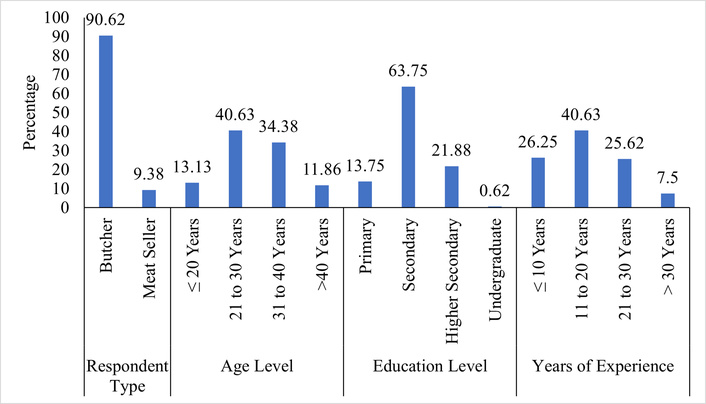
Figure 1 shows that the sample consisted predominantly of butchers (90.62%), with the remaining 9.38% being meat sellers. The age distribution indicates that most respondents were between 21 and 30 years old (40.63%), followed by those aged 31–40 years (34.38%), suggesting a largely young to middle-aged, energetic workforce.
Education levels were fairly low: 63.75% had only a secondary education, and 13.75% had only a primary education. Higher education was uncommon, with just 0.62% holding an undergraduate degree. Regarding work experience, 40.63% reported 11–20 years of experience, while only 7.50% had more than 30 years. These figures imply that the industry is dominated by mid-career professionals who possess practical experience but generally have limited formal education in food safety.
In spite of the limited knowledge, butchers showed a positive attitude toward improving food safety. While most respondents lacked awareness of the hazards associated with veterinary drugs, antibiotic residues, and contamination risks, more than 90% agreed that scientific training should be provided to butchers. Furthermore, 93.75% believed that traditional meat-handling practices should be improved, and 95.63% supported the need for better preservation facilities. On the contrary, their actual practices were far away from what they needed to do. Only 8.75% performed post-mortem inspections to detect abnormalities, and almost none recorded animal diseases, followed scalding or chilling procedures, or used grading techniques. A significant lack of adoption of technology was also observed, as 99.38% of butchers reported not using any modern processing tools. Results from Table 3 state the current status of knowledge, attitudes, and practices among butchers. While butchers acknowledge the need for improvement, they require resources and training to implement better meat-safety practices.
Knowledge, attitudes, and practices among butchers on meat safety.
| Domains | Variables | Responses, n (%) | |
|---|---|---|---|
| Yes | No | ||
| Knowledge | Do you know about the effects of veterinary drugs, hormones, antibiotics, and steroidal residue? | 23 (14.38) | 137 (85.63) |
| Do you know about decontamination and/or protection technologies for meat processing? | 34 (21.25) | 126 (78.75) | |
| Do you know about the physical, biological, and chemical hazards of meat? | 16 (10.00) | 144 (90.00) | |
| Do you collect information on antibiotics or drug applications during rearing by producers before purchasing animals? | 10 (6.25) | 150 (93.75) | |
| Attitude | Do you think butchers require scientific training? | 150 (93.75) | 10 (6.25) |
| Do you think consumers are willing to pay for premium quality? | 146 (91.25) | 14 (8.75) | |
| Do you think traditional practice should be improved? | 150 (93.75) | 10 (6.25) | |
| Do you think preservation facilities are required? | 153 (95.63) | 7 (4.38) | |
| Do you think scientific facilities should be incorporated? | 145 (90.63) | 15 (9.38) | |
| Do you prefer an inspection laboratory? | 120 (75.00) | 40 (25.00) | |
| Practice | Post-mortem abnormalities check | 14 (8.75) | 146 (91.25) |
| Post-mortem recording of animal diseases | 6 (3.75) | 154 (96.25) | |
| Recording of animal diseases | 6 (3.75) | 154 (96.25) | |
| Do you use scalding water/steam temperature? | 0 (0.00) | 160 (100.00) | |
| Do you practice the grading of meat? | 6 (3.75) | 154 (96.25) | |
| Do you have chilling facilities? | 4 (2.50) | 156 (97.50) | |
| Do you follow the regulations regarding slaughtering? | 5 (3.13) | 155 (96.88) | |
| Is there any technology used by the butchers? | 1 (0.63) | 159 (99.38) | |
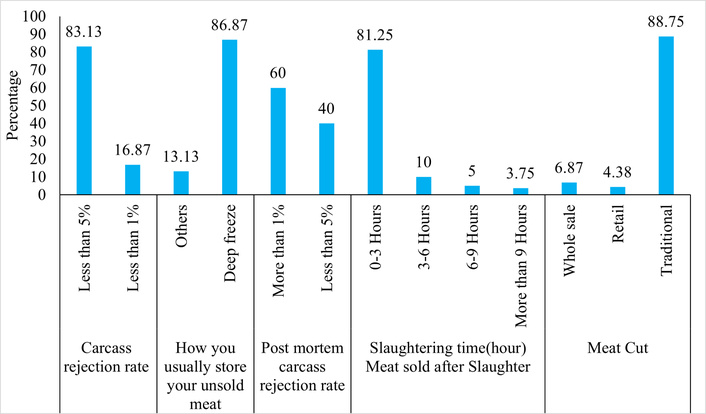
The findings from Figure 2 indicate that meat handling practices in Bangladesh are still mostly traditional. The carcass rejection rate was comparatively low, with 83.13% of butchers rejecting less than 5% of carcasses, which suggests that unfit animals might still be entering the food chain. Most butchers (86.87%) stored unsold meat in deep freezers, while the rest relied on other methods that could compromise food safety. Meat was generally sold within three hours of slaughter (81.25%), but some butchers (3.75%) kept meat for more than nine hours, increasing the risk of bacterial contamination. Meat cutting methods were predominantly traditional (88.75%), with very few butchers following wholesale or retail cutting practices.
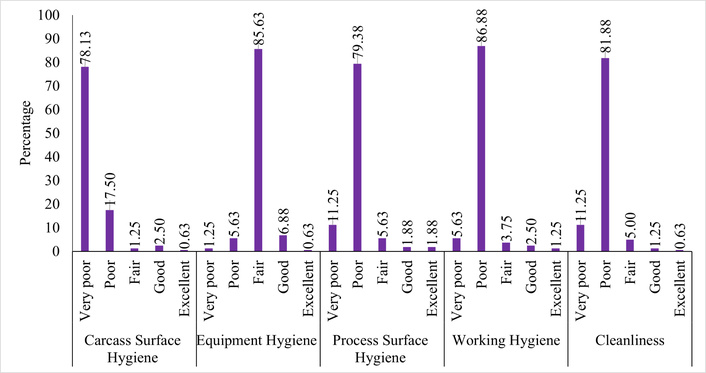
Figure 3 illustrates the distribution of hygiene and cleanliness ratings, showing that the majority of butchers rated carcass surface hygiene as very poor, followed by poor workplace and process hygiene. Hygiene standards among butchers were generally poor, particularly in terms of carcass surface hygiene, which 78.13% of respondents rated as “very poor”. Process hygiene and workplace hygiene also scored poorly, indicating an overall lack of sanitary measures. Equipment hygiene fared slightly better, with 85.63% and 6.88% of butchers rating it as “fair” or “good”. However, general cleanliness remained inadequate, with only a few respondents maintaining satisfactory hygiene levels.
The availability of adequate slaughterhouse facilities was another critical concern. Although 65.63% of respondents reported access to a slaughterhouse, a substantial proportion (34.38%) slaughtered animals in unsanitary locations such as roadsides, drains, or beside their shops. These unhygienic conditions greatly increase the risk of contamination and pose serious public health hazards.
Table 4 indicates that butchers sold an average of 236.25 kg of meat per day, with a mean profit of 22.38 BDT per kg. While these figures highlight the economic significance of the meat industry, the low profitability suggests that butchers may have limited financial resources to invest in better facilities, training, or food safety measures. This economic constraint could be a barrier to adopting improved meat-handling and hygiene practices.
Sales and profit per day.
| Particulars | Mean | Std. Dev. |
|---|---|---|
| The profit you usually have per kg of meat (BDT) | 22.375 | 6.293 |
| Beef sales per day (kg) | 236.25 | 109.451 |
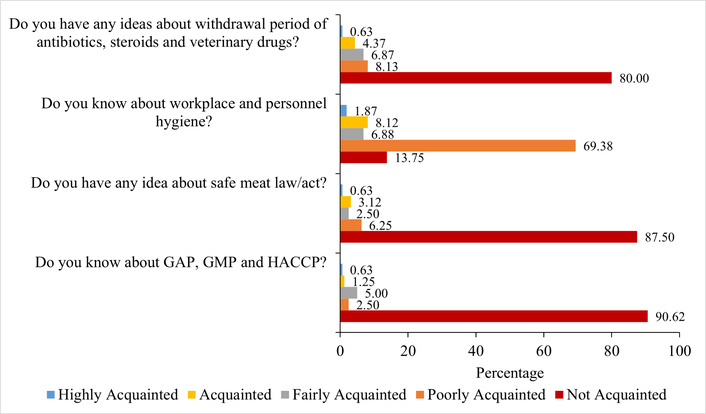
Figure 4 illustrates the extent of knowledge across various meat-safety parameters. These parameters were measured using structured questions and recorded on a five-point scale: “Not Acquainted”, “Poorly Acquainted”, “Fairly Acquainted”, “Acquainted”, and “Highly Acquainted”.
Responses from butchers in different regions of Bangladesh reveal a substantial lack of understanding of critical food-safety concepts, as shown in Figure 4. Almost all butchers were unfamiliar with GAP, GMP, and HACCP, all of which are essential for ensuring meat quality and hygiene. Knowledge of Bangladesh’s food-safety laws and regulations was also very low, with only a minority of respondents demonstrating any awareness. Awareness of workplace and personal hygiene was poor: 69.38% of respondents were rated as “Poorly Acquainted”. Knowledge of withdrawal periods for veterinary drugs, antibiotics, and steroids was alarmingly low, with 80% of respondents showing little to no understanding, raising the risk of chemical residues contaminating meat. In summary, only a small number of beef handlers are aware of proper meat-safety practices.
The χ² test results (Tables S1–S7) showed that there was no statistically significant variation in food safety knowledge according to age, education, experience, respondent type, cleanliness, practice level, or legal understanding.
A number of diagnostic and validity tests were conducted to make sure the regression approach was appropriate. Spearman’s rank correlation (Table 5) was used to analyze multicollinearity among explanatory variables. There are moderate correlations between several predictors, like age and experience (ρ = 0.743) and age and education (ρ = –0.695), according to the results. Considering the nature of population trends, this was anticipated. Nevertheless, none of the correlations came close to unity, and other factors like cleanliness and practice (ρ = 0.161 with age; ρ = –0.129 with education) also played a role. Detailed marginal effects from the ordered logit model are summarized in Table S8, which supports the robustness of the PPOM results.
Multicollinearity test of the explanatory variables using the correlation matrix, Spearman’s rank correlation coefficient matrices.
| Variables | Age | Education | Experience | Legal knowledge | Practice | Cleanliness | Respondent type | Profit per kg |
|---|---|---|---|---|---|---|---|---|
| Age | 1.000 | |||||||
| Education | –0.695 | 1.000 | ||||||
| Experience | 0.743 | –0.628 | 1.000 | |||||
| Legal knowledge | –0.281 | 0.242 | –0.258 | 1.000 | ||||
| Practice | 0.161 | –0.129 | 0.023 | –0.054 | 1.000 | |||
| Cleanliness | 0.010 | –0.014 | –0.029 | –0.007 | –0.035 | 1.000 | ||
| Respondent type | 0.034 | –0.131 | 0.067 | –0.252 | 0.018 | –0.033 | 1.000 | |
| Profit per kg | 0.105 | –0.090 | –0.023 | 0.152 | –0.000 | 0.162 | –0.053 | 1.000 |
Second, the Brant test (omodel) was used to formally assess the ordered logit model’s parallel regression (proportional odds) assumption (Table S9). The PPOM was used in the study to deal with this problem since it maintains proportionality but only relaxes the proportionality assumption for the variables that violate it.
Third, the likelihood ratio (LR) χ² statistic was used to assess the model’s fit. The PPOM yielded a pseudo R2 of 0.1916 and an LR χ²(18) = 33.64 with p = 0.0139 (Table 6), demonstrating that, taken as a whole, the predictors were able to predict well, which describes a significant amount of the variation in food safety understanding.
Partial proportional odd generalized ordered logit (PPOM) result of the factors affecting food safety knowledge.
| Food safety knowledge | Low vs. medium/high | Low/Medium vs. high | ||
|---|---|---|---|---|
| Odds ratio [95% conf. interval] | p > |z| | Odds ratio [95% conf. interval] | p > |z| | |
| Age | ||||
| 1. 21 to 30 years | 0.146** [0.025–0.850] | 0.032 | 0.146** [0.025–0.850] | 0.032 |
| 2. 31 to 40 years | 0.029*** [0.003–0.295] | 0.003 | 0.029*** [0.003–0.295] | 0.003 |
| 3. > 40 years | 0.102 [0.005–2.110] | 0.140 | 0.102 [0.005–2.110] | 0.140 |
| Profit per kg | 1.141*** [1.042–1.250] | 0.004 | 1.141*** [1.042–1.250] | 0.004 |
| Cleanliness | ||||
| 1. Poor | 1.078 [0.253–4.600] | 0.919 | 1.078 [0.253–4.600] | 0.919 |
| 2. Fair | 0.095* [0.008–1.074] | 0.057 | 0.095* [0.008–1.074] | 0.057 |
| 3. Good | 0.039* [0.001–1.422] | 0.077 | 0.039* [0.001–1.422] | 0.077 |
| 4. Excellent | 0.767 [0.000–1,414.023] | 0.945 | 0.767 [0.000–1,414.023] | 0.945 |
| Respondent type | 0.189* [0.027–1.296] | 0.090 | 0.189* [0.027–1.296] | 0.090 |
| Practice | ||||
| 1. Average | 3.258** [1.016–10.454] | 0.047 | 3.258** [1.016–10.454] | 0.047 |
| 2. Higher than average | 2.173 [0.376–12.548] | 0.386 | 2.173 [0.376–12.548] | 0.386 |
| Education | ||||
| 1. Secondary | 2.230 [0.440–11.298] | 0.333 | 2.230 [0.440–11.298] | 0.333 |
| 2. Higher secondary | 0.223 [0.026–1.949] | 0.175 | 0.223 [0.026–1.949] | 0.175 |
| Experience | ||||
| 1. 11 to 20 years | 0.909 [0.218–3.804] | 0.897 | 0.909 [0.218–3.804] | 0.897 |
| 2. 21 to 30 years | 0.559 [0.086–3.615] | 0.541 | 0.559 [0.086–3.615] | 0.541 |
| 3. > 30 years | 5.140 [0.300–88.201] | 0.259 | 5.140 [0.300–88.201] | 0.259 |
| Legal knowledge | ||||
| 1. Medium | 0.885 [0.054–14.493] | 0.932 | 0.885 [0.054–14.493] | 0.932 |
| 2. High | 0.138 [0.002–10.726] | 0.372 | 0.138 [0.002–10.726] | 0.372 |
Number of obs. = 160, LR χ²(18) = 33.64, Prob > χ² = 0.0139, Pseudo R2 = 0.1916. ***p < 0.01, **p < 0.05, *p < 0.1. The partial proportional odds model retained the proportional odds constraint for all covariates based on variable-specific tests in gologit2, pl, resulting in identical estimates across the two cumulative logits. LR: likelihood ratio.
According to the findings, butchers between the ages of 21–30 (OR = 0.146, p = 0.032) and 31–40 (OR = 0.029, p = 0.003) had considerably lower odds of being in a higher knowledge category than the youngest group (20 years old or younger).
The PPOM findings, in general, highlight that gaps in food safety knowledge are widespread and more impacted by economic output and practices that are self-reported rather than based on demographic characteristics, emphasizing the need for comprehensive training and resource-oriented initiatives to raise the bar for meat safety in Bangladesh.
The findings of this study reveal a concerning scenario of the present state of meat handling, hygiene, and safety KAP among butchers in Bangladesh. The sector is still mostly traditional, and it uses practices that can harm public health. One important finding is the low carcass rejection rate, which suggests that unfit animals might not be properly identified and are probably entering the food chain [26]. Most of the butchers are dependent on deep freezers (–20°C) for storage. Additionally, conventional meat-cutting techniques are dominant all over the country. A tiny but important percentage of meat is exposed in the open market for long periods of time after slaughter, which increases the risk of contamination and bacterial growth. These findings are supported by other research [27]. Raw meat from local slaughterhouses was found to be heavily contaminated with microorganisms [9].
A serious lack of cleanliness and hygiene worsens these handling problems. Most butchers reported carcass surface hygiene a “very poor” rating, and they also reported process and workplace hygiene lower marks. Pathogenic bacteria like Salmonella and E. coli, which are the main causes of foodborne illnesses, thrive in such unsanitary environments [28]. Lack of adequate infrastructure makes the issue worse because a significant percentage of butchers kill animals in extremely unhygienic places like drains and roadsides, which is in line with findings from another study conducted in Bangladesh [27].
Widespread ignorance among beef handlers about food safety is a central concern. The data reveal a troubling lack of awareness of basic food-safety procedures such as HACCP, GMP, and GAP. The very low level of knowledge about national food-safety regulations and key concepts, such as the veterinary drug withdrawal period, suggests a high risk of chemical residue contamination in meat. These findings align with the broad knowledge gaps reported by Sarma et al. [6].
The results of the χ² test further highlight the systemic and pervasive nature of food safety knowledge gaps. Knowledge deficiencies are widespread across all subgroups, as evidenced by the lack of statistically significant correlations between food safety knowledge and important demographic factors, such as age, education, experience, and respondent type. Previous studies conducted in Bangladesh have found weak or inconsistent relationships between food safety awareness and sociodemographic factors [3, 5, 29]. This pattern is consistent with those findings. For instance, just 28.3% of beef handlers in Gopalganj had sufficient knowledge, and although education was somewhat linked to practice, other factors like age were also important. Additionally, Hossain et al. [9] discovered that experience and education were not good predictors. Similarly, a survey conducted in Khulna city found that, on average, people had a moderate understanding of food safety and engaged in practices that didn’t differ much between the majority of sociodemographic groups [5]. This indicates the problem is industrywide rather than confined to a specific group, and calls for inclusive, comprehensive solutions instead of interventions that target only particular populations.
The model evaluation validates the strength of our analysis. With other predictors, ρ ~0, suggesting that the multicollinearity was not high enough to skew the regression predictions [30]. The Brant test revealed that the parallel regression assumption was broken for a number of predictors, which supported the use of the PPOM [31]. The standard ordered logit model was shown by the Brant test to have considerable infractions for a number of predictors, such as age, education, legal knowledge, and profit (p < 0.001), which was inappropriate [31, 32]. The validity of the regression results was guaranteed by the PPOM, which offered a well-fitting model with substantial explanatory power [15].
Important new information about the variables affecting food safety knowledge was provided by the PPOM results. In contrast to those between the ages of 21 and 40, younger butchers (20 or younger) were more likely to possess superior knowledge. This could suggest that younger employees have had more recent exposure to contemporary instruction or training materials [29]. According to research conducted among food handlers in Bangladesh, younger employees may have superior knowledge or practice scores, maybe as a result of increased interaction with current hygiene standards and educational resources [33]. Food safety research shows that younger individuals prefer digital and media-based channels for information, potentially boosting awareness, whereas older employees rely more on traditional methods [34]. Profit per kilogram and knowledge level were found to be significantly positively correlated, indicating that economic capacity may allow for investments in safer practices and information access, which is supported by Banna et al. [3]. The inherent connection between knowledge and practice was further supported by the fact that butchers who self-reported average practice levels were substantially more likely to possess greater knowledge than those with below-average practices [6]. Conversely, there were weak or non-significant correlations between knowledge levels and elements like education, experience, legal knowledge, and outlet cleanliness. The complexity and context-specificity of food safety determinants are highlighted by this departure from some earlier research [3] and agreement with reviews containing contradictory findings [29]. It demonstrates that apparent cleanliness and underlying knowledge are not always related [35].
This study has several limitations. First, the sample size was small relative to the number of covariates used in the regression analysis, which may have produced wide confidence intervals and reduced precision for some estimates. Second, a field-based selection strategy was necessary because no comprehensive sampling frame for butchers existed; this approach may limit generalizability. Third, the cross-sectional design and reliance on self-reported behaviors preclude causal inference. Despite these limitations, the study employs a robust ordinal modeling framework to identify key associations between food safety knowledge and offers one of the few multi-district assessments of butcher-level KAP in Bangladesh.
Therefore, the results taken together show that Bangladesh has systemic and pervasive meat safety deficiencies. Widespread knowledge gaps are caused more by self-reported behaviors and financial incentives than by conventional demographic traits. This demonstrates the pressing need for extensive, industry-wide training and resource-focused programs that go beyond demographic targeting in order to successfully improve the nation’s meat safety standards.
This multi-district survey demonstrates widespread deficiencies in the knowledge and practices of beef butchers in Bangladesh, particularly in post-slaughter inspection, cold storage, and awareness of international food-safety standards. Economic performance and reported practice levels were positively linked to food safety knowledge, while demographic characteristics were not. These findings suggest that financial capacity and practice-based experience may be more important determinants than background factors.
To improve beef safety, interventions should prioritize training programs tailored to butchers, investment in preservation and processing facilities, and stricter enforcement of existing regulations. Study limitations include the modest sample size, small numbers in higher knowledge categories, and reliance on self-reported practices. Future research should integrate microbiological assessments and larger, representative samples to better inform policy.
GAP: Good Agricultural Practices
GMP: Good Manufacturing Practices
HACCP: Hazard Analysis and Critical Control Points
KAP: knowledge, attitudes, and practices
LR: likelihood ratio
ORs: odds ratios
POM: proportional odds model
PPOM: partial proportional odds model
χ²: chi-square
The supplementary tables for this article are available at: https://www.explorationpub.com/uploads/Article/file/1010117_sup_1.pdf.
The authors express their gratitude to the Livestock and Dairy Development Project (LDDP) of the Department of Livestock Services, Bangladesh, for funding the survey work.
HMM: Conceptualization, Data curation, Methodology, Writing—original draft, Writing—review & editing. MMFS: Data curation, Formal analysis, Writing—original draft, Writing—review & editing. MSRS: Resources, Software, Methodology. SMER: Supervision, Validation, Visualization. MSA: Supervision, Visualization. MAH: Supervision, Validation, Visualization. SW: Validation, Visualization. MAKA: Supervision, Funding acquisition, Validation, Investigation, Visualization, Project administration, Writing—review & editing. All authors read and approved the submitted version.
The authors declare that they have no conflict of interest with respect to the content of this article. Likewise, they declare that there is no conflict of interest among the entities involved in the financing of this project.
Not applicable.
Participants were fully informed about the purpose of the study and the procedures involved. Participants voluntarily agreed to participate in the questionnaire survey, and written consent (signature) of each participant was taken on the questionnaire.
Informed consent for anonymous publication of the collected data was obtained from all participants.
The raw data supporting the conclusions of this manuscript will be made available by the authors, without undue reservation, to any qualified researcher.
The survey work was funded by the Livestock and Dairy Development Project (LDDP) of the Department of Livestock Services, Bangladesh. Subproject title is “Improvement of Meat Safety and Quality of Beef Carcass Selling at Butchers’ Shop” (Project No. 2022/5/LDDP). The funders had no role in study design, data collection and analysis, decision to publish, or preparation of the manuscript.
© The Author(s) 2026.
Open Exploration maintains a neutral stance on jurisdictional claims in published institutional affiliations and maps. All opinions expressed in this article are the personal views of the author(s) and do not represent the stance of the editorial team or the publisher.
Copyright: © The Author(s) 2026. This is an Open Access article licensed under a Creative Commons Attribution 4.0 International License (https://creativecommons.org/licenses/by/4.0/), which permits unrestricted use, sharing, adaptation, distribution and reproduction in any medium or format, for any purpose, even commercially, as long as you give appropriate credit to the original author(s) and the source, provide a link to the Creative Commons license, and indicate if changes were made.