Original Article


Affiliation:
Brescia School of Food and Nutritional Sciences, Faculty of Health Sciences, University of Western Ontario, London, ON N6A 3K7, Canada
ORCID: https://orcid.org/0009-0000-7394-6727

 ,
,
Affiliation:
Brescia School of Food and Nutritional Sciences, Faculty of Health Sciences, University of Western Ontario, London, ON N6A 3K7, Canada
Email: hekmat@uwo.ca
ORCID: https://orcid.org/0000-0002-7301-9496

Explor Foods Foodomics. 2025;3:1010101 DOI: https://doi.org/10.37349/eff.2025.1010101
Received: August 01, 2025 Accepted: October 22, 2025 Published: December 01, 2025
Academic Editor: Andrea Gomez-Zavaglia, Center for Research and Development in Food Cryotechnology (CIDCA CONICET), Argentina
Aim: This study aimed to assess the viability of Lacticaseibacillus rhamnosus GR-1 in four yogurt formulations with or without flax, chia, and hemp seeds during multiple time points across fermentation and cold storage. Additionally, the study evaluated consumer acceptance of the seed-fortified yogurts based on ratings of appearance, flavour, texture, and overall acceptability.
Methods: Four yogurt samples were inoculated with the probiotic strain L. rhamnosus GR-1 and fermented for up to 6 h at 38°C, followed by refrigerated storage at 4°C for up to 30 days, respectively. Microbial enumeration was performed throughout fermentation and storage to assess the viability of L. rhamnosus GR-1. 84 participants engaged in a sensory evaluation where the consumer acceptability of the yogurt samples was evaluated.
Results: Microbial analysis showed consistent viable counts of L. rhamnosus GR-1 across all fermentation and storage time points, where the sample containing chia seeds maintained the highest levels of probiotic viability. pH significantly decreased (p < 0.05) during fermentation in all treatments, with further reductions during storage only in the flax, hemp, and chia samples. Sensory evaluation revealed that the control scored highest in appearance, flavour, texture, and overall acceptability (p < 0.001). While participants showed the highest preference for the control sample, 77% indicated they would consider purchasing probiotic yogurt.
Conclusions: Overall, adding flax, hemp, and chia seeds supports the viability of L. rhamnosus GR-1 in probiotic yogurt. Seed mucilage may play a vital role in the growth and viability of probiotics in yogurt products. The findings from this research provide a valuable foundation for the development of more nutrient-dense and consumer-friendly probiotic yogurt products.
Yogurt is a widely researched dairy product in the food industry, often used as a vehicle to enhance the nutritional quality of consumers’ daily diets. Its production relies on lactic acid bacteria in the starter culture, which coagulate milk protein, allowing the formation of what we know as yogurt [1]. Due to the increasing interest in health food products in today’s world population, further study and modification of dairy products proves to be a valuable area of research. Yogurt also serves as a versatile base for the incorporation of additional ingredients, allowing for the creation of a more nutrient-dense product.
In addition to its many health benefits, yogurt provides a rich source of beneficial microorganisms that support a healthy diet. These microorganisms, often in the form of probiotics, enhance physiological functions and help prevent disease. When incorporated into foods like yogurt, they contribute to the classification of these products as functional foods. Functional benefits of food can be enhanced by “incorporating phytochemicals such as antioxidants, vitamins, fibers, and minerals like omega-3 fatty acids” [1]. Probiotics, including Lacticaseibacillus, prevent the growth of intestinal pathogens and improve the overall microbial status of the intestine [2]. The benefits of adding the probiotic strain Lacticaseibacillus rhamnosus GR-1 (L. rhamnosus GR-1) to various foods have been widely studied. Specifically, its bile resistance and ability to survive passage through the human digestive tract “contribute to protection against urinary tract infections and help reduce the incidence of bacterial vaginosis and yeast vaginitis” [3–5]. L. rhamnosus GR-1 is considered safe for consumption by most individuals, including those with weakened immune systems, such as people living with HIV/AIDS [6].
Seeds such as flax, chia, and hemp may function as prebiotics; compounds that support the growth of beneficial microorganisms [7], and each provides unique health benefits that complement the nutritional value of yogurt. Chia seeds are linked to improved cholesterol, blood pressure, weight management, joint health, and antioxidant protection, and an overall reduction in the risk of chronic disease [8]. Flax seeds are rich in peptides, fiber, lignans, and omega-3s, with lignans offering potential anti-carcinogenic and immune-supporting effects [9, 10]. Hemp seeds provide high protein, fiber, and minerals, supporting athletic performance and vegetarian diets with notable iron content [11]. All three seeds are rich in omega-3s [alpha linolenic acid (ALA)], known to reduce the risk of cardiovascular, metabolic, autoimmune, and neurological conditions while supporting cell membrane integrity [12].
This study aims to evaluate the benefits of adding chia, flax, and hemp seeds to probiotic yogurt to enhance its nutritional value. In addition, this study aims to assess consumer preference for probiotic yogurt fortified with flax, chia, and hemp seeds. While previous research has explored the health benefits of each seed individually, to our knowledge, no study has investigated their combined incorporation into probiotic yogurt containing L. rhamnosus GR-1. Given the well-established health benefits of these seeds, we performed microbial analysis and sensory evaluation to assess their effects on probiotic viability and consumer acceptance in cows’ milk-based yogurt.
This study aligns with the approach taken in other peer-reviewed articles on probiotic yogurt [1, 13, 14]. The de Man Rogosa and Sharpe (MRS) (catalog number: CA1-10661.0500, EMD Millipore Corporation, Gibbstown, NJ, USA) broth was prepared by mixing it with distilled water at a 5.2% weight per volume (w/v) ratio. After being divided among 20 mL test tubes, the solution was autoclaved at 121°C for 15 min to achieve sterilization, cooled, and refrigerated at 4°C for 24 h. L. rhamnosus GR-1 (10% w/v) (Canadian Centre for Human Microbiome and Probiotic Research, Lawson Health Research Institute, London, ON, Canada) was inoculated into the MRS broth under aseptic conditions. This mixture was then incubated at 37°C for 24 h using the GasPak anaerobic system (catalog number: CA90003-642, BD GasPak™ EZ Container System, Becton Dickinson and Co., Sparks, BD, USA) and stored under refrigerated conditions at 4°C following incubation. The probiotic solution was regularly prepared in MRS broth every 10 days to maintain viable L. rhamnosus GR-1 levels and promote bacterial growth.
Two hundred milliliters of partially skimmed cows’ milk (1% milk fat, 9 g of protein per 250 mL) (Neilson Partly Skimmed Milk, Saputo Inc., Montreal, Quebec, Canada) was autoclaved at 121°C for 15 min. After this sterilization process, the milk was gradually cooled to 37°C using a water bath. Four percent (w/v) probiotic stock solution was then inoculated into the milk and gently stirred using a sterilized spoon to ensure equal distribution of the probiotic into the milk. This solution was incubated anaerobically at 37°C for 24 h using a GasPak anaerobic system (catalog number: CA90003-642, BD GasPak™ EZ Container System, Becton Dickinson and Co., Sparks, BD, USA).
The purchase details of the dairy and seed products were as follows. Partially skimmed milk was purchased at Real Canadian Superstore in London, ON, Canada. Various seeds, including Manitoba Harvest Organic Hemp Hearts, Manitoba Harvest Hemp Foods, Winnipeg, MB, CA; Organic Traditions Sprouted Flax Seed Powder, Organic Traditions, North York, ON, CA; and Organic Traditions Sprouted Chia Seed Powder, Organic Traditions, North York, ON, CA, were purchased from Healthy Planet in London, ON, Canada. Additionally, a plain yogurt starter culture with 2% milk fat, specifically Astro Original Balkan Yogurt, Plain, No Gelatin, provided by Parmalat Canada Inc. in Toronto, ON, Canada, was procured from Sobeys in London, ON, Canada.
Flax, chia, and hemp seeds were selected based on the unique combination of health benefits that these ingredients offer. Additionally, functional benefits of the seeds themselves played a role in their selection. Due to the gum and protein content within the flax seeds, these seeds have the potential to improve texture characteristics and reduce the syneresis amongst yogurt products. Moreover, due to their fungistatic activity, the addition of flax seeds to food products may result in a prolonged shelf life [15]. Further, chia seeds offer stabilizing properties when in contact with water by forming a mucilage. This improves the rheological properties and stability of the yogurt, in addition to reducing the calorie content. The gel-like consistency formed by the fiber within the seeds and their mucilage creates a feeling of fullness [16]. Finally, the fluid-holding capacity of hemp seeds makes them a noteworthy addition, exhibiting properties similar to those of chia and flax seeds [17].
Flax and chia seeds were obtained in their ground form, whereas hemp seeds were purchased whole. No further processing of the seeds took place. Preliminary experiments revealed that the addition of 2% (w/v) of seeds was the best concentration, yielding the most desirable physical properties compared to other tested concentration (3% w/v). This aligns with previous studies indicating that seed concentrations between 2–6% yield optimal results in terms of both microbial viability and sensory acceptability [16, 18, 19]. Four treatments were prepared as follows: Treatment 1 (T1) served as the control sample, and contained 100% (w/v) cows’ milk, Treatment 2 (T2) contained 100% (w/v) cows’ milk with the addition of 2% (w/v) of flax seeds, Treatment 3 (T3) contained 100% (w/v) cows’ milk with the addition of 2% (w/v) hemp seeds, and Treatment 4 (T4) contained 100% (w/v) cows’ milk with the addition of 2% (w/v) chia seeds. In addition, 6% sucrose (w/v) was added to each treatment prior to pasteurization. Each treatment was heat-processed in a water bath maintained at 85°C to 87°C for 30 min, with consistent temperature ensured by gentle stirring using a sterilized spoon. The treatments were then cooled to 40°C, and 3% (w/v) yogurt starter culture containing Lactobacillus delbrueckii subsp. bulgaricus and Streptococcus thermophilus (Astro® Original Balkan, Parmalat Canada Inc., Toronto, ON, Canada), along with 4% (w/v) probiotic mother culture, were added.
The samples were divided into seven 30 mL beakers. Beakers 1–4 were designated for fermentation time points (0 h, 2 h, 4 h, and 6 h), while Beakers 5–7 were assigned to refrigerated storage time points (1, 15, and 30 days). Microbial counts and pH measurements were recorded at each fermentation time point (0 h, 2 h, 4 h, 6 h) and after each cold storage interval (1, 15, and 30 days). Beaker 1 served as the untreated control. Beakers 2–4 were incubated at 38°C for 2, 4, and 6 h, respectively, and then discarded. Beakers 5–7 were each incubated at 38°C for 6 h, followed by storage at 4°C for 1, 15, and 30 days, respectively. Each treatment was performed in duplicate, including the full probiotic mother culture preparation, to ensure consistency and account for variability.
This study aligns with a similar analysis taken in other peer-reviewed articles on probiotic yogurt [1, 3, 6, 13, 14]. Enumeration of viable L. rhamnosus GR-1 colonies was performed across all treatments at four fermentation time points (0, 2, 4, and 6 h) and three storage intervals (1, 15, and 30 days). Each sample (11% w/v) was serially diluted to concentrations of 10–1, 10–3, 10–5, 10–6, and 10–7 using a sterile 0.85% (w/v) saline solution. MRS agar plates were prepared with 5.22% (w/v) MRS (EMD Millipore Corporation, Gibbstown, NJ, USA), 1.5% (w/v) agar (EMD Millipore Corporation), and 0.0015% (w/v) fusidic acid (catalog number: 89149-804, Enzo Life Sciences, Farmingdale, NY, USA). A 0.1 mL aliquot from each dilution was plated and incubated anaerobically at 37°C for 24 h using the BD GasPak™ EZ Container System (Becton Dickinson and Co., Sparks, BD, USA). Colony counts were recorded as colony-forming units per milliliter (CFU/mL), with values averaged from two replicates per sample. pH measurements were also taken at the same fermentation and storage time points using a calibrated pH meter (VWR sympHony™ B10P, VWR International, Radnor, PA, USA). For each sample, the average of two replicates was calculated to ensure accuracy.
A sensory evaluation was conducted with 84 healthy participants aged 18–55, including 20 men and 63 women, with one participant not reporting their biological sex. All panellists were untrained to better represent potential probiotic yogurt consumers. Demographic data collection was limited to age and biological sex. Despite efforts to ensure gender diversity, the distribution was skewed, with females comprising 75% of participants. The average age of participants was 24 years. Recruitment occurred through an email newsletter sent to all undergraduate students in the Foods and Nutrition undergraduate program at the Brescia School of Food and Nutritional Sciences, sent by the Academic Advising team at the school. In addition, posters were printed and displayed prior to the sensory evaluation dates. Participants were excluded if they were under 18 years of age or over 55 years of age, unable to provide consent, allergic or intolerant to cows’ milk, flax, chia, and hemp seeds, pregnant, diabetic, or undergoing chemotherapy. Individuals who were unable to provide consent, or had communication difficulties, such as those who are illiterate or require a translator, were excluded from participation. This study complies with ethical principles outlined by the Helsinki Declaration (2024), where the exclusion criteria were applied to eliminate any potential risks associated with the study, ethics approval was obtained from the Health Sciences Research Ethics Board at the University of Western Ontario (Project ID: 126226) before research began, and written consent of all participants was obtained. Prior to participation, all individuals provided informed consent by signing written consent forms.
Participants were guided to well-lit sensory evaluation booths located in the Academic Pavilion of Western’s West Campus and provided with a prepared tray that included four randomly coded samples, a sensory evaluation questionnaire, a disposable spoon, a water cup, a napkin, and a pencil. All treatments were prepared as reported in the methods section, under the Fermentation and storage of probiotic yogurt, where they were incubated at 38°C for 6 h and refrigerated at 4°C until tasting. Yogurt was evenly distributed into disposable cups, ensuring sufficient quantity for additional tasting, if required. Participants were instructed to taste each sample from left to right and rate them using a nine-point hedonic scale, ranging from 1 (dislike extremely) to 9 (like extremely), evaluating appearance, flavour, texture, and overall acceptability. Additional mandatory questions evaluated participants’ usual consumption of probiotic yogurt and seeds, along with their likelihood of purchasing the samples they tasted.
To evaluate the effect of fermentation and subsequent refrigerated storage on the viability of L. rhamnosus GR-1 and yogurt pH, a one-way repeated measures analysis of variance (ANOVA) was conducted. This analysis assessed changes over time both within individual treatments and between different treatments. For the sensory evaluation, repeated measures ANOVA was also used to analyze hedonic scale ratings for appearance, flavour, texture, and overall acceptability. This allowed for the assessment of differences in participants’ responses across the different yogurt samples. When the ANOVA indicated statistically significant differences (p < 0.05), post hoc pairwise comparisons were conducted using Fisher’s least significant difference (LSD) test to determine which specific groups differed. To ensure validity and reliability, clear research objectives were established, and pilot testing was carried out prior to full-scale data collection. All tools and procedures were standardized for consistency.
To ensure therapeutic benefits at the time of consumption, a food product should contain a minimum of 106 CFU/mL of viable, health-promoting lactic acid bacteria [20]. In this study, L. rhamnosus GR-1 consistently achieved viable counts of at least 108 CFU/mL across all treatments and fermentation time points (Table 1). A statistically significant increase in microbial counts during fermentation was observed in T4 (p = 0.006), indicating that the presence of chia seeds influenced the growth, viability, and survival of L. rhamnosus GR-1 during fermentation. Throughout 30 days of refrigerated storage, the mean viable count of 108 CFU/mL was maintained. No statistically significant changes in microbial counts were observed from Day 1 to Day 30, suggesting that the addition of flax, hemp, and chia seeds did not negatively impact the viability or shelf-life of L. rhamnosus GR-1 during storage. Overall, the findings indicate that incorporating hemp, flax, and chia seeds into cows’ milk yogurt supports the growth and stability of L. rhamnosus GR-1 throughout both fermentation and storage.
Viable counts (mean ± SD) (× 108 CFU/mL) of L. rhamnosus GR-1 in probiotic yogurt treatments after 0, 2, 4, and 6 h of fermentation and 1, 15, and 30 days of storage.
| Treatment | 0 h | 2 h | 4 h | 6 h | p-value | 1 day | 15 days | 30 days | p-value |
|---|---|---|---|---|---|---|---|---|---|
| 1 | 1.35 ± 0.17 | 1.74 ± 1.68 | 2.09 ± 0.34 | 2.95 ± 1.81 | 0.737 | 1.56 ± 0.52 | 3.26 ± 1.04 | 2.11 ± 0.48 | 0.344 |
| 2 | 2.28 ± 0.30 | 2.76 ± 0.72 | 1.95 ± 0.14 | 4.31 ± 2.18 | 0.233 | 2.22 ± 0.11 | 4.23 ± 1.20 | 6.35 ± 1.41 | 0.055 |
| 3 | 1.79 ± 0.76 | 1.08 ± 0.07 | 2.27 ± 1.73 | 2.64 ± 0.41 | 0.554 | 1.78 ± 0.49 | 3.70 ± 1.59 | 3.09 ± 0.93 | 0.370 |
| 4 | 2.32 ± 1.02b | 2.49 ± 1.64b | 2.56 ± 0.02b | 9.24 ± 0.23a | 0.006 | 2.56 ± 1.93 | 3.87 ± 1.66 | 3.79 ± 0.79 | 0.248 |
A one-way repeated measures ANOVA and Fisher’s LSD test were used to analyze statistically significant differences between mean microbial counts (mean ± SD) during 6 h of fermentation and 30 days of refrigerated storage in four probiotic yogurt treatments. A p-value of < 0.05 was statistically significant. In a row, mean microbial count values for each treatment followed by the same superscript letter (a)–(b) are not significantly different (p > 0.05). Treatment 1: 100% (w/v) cows’ milk; Treatment 2: 100% (w/v) cows’ milk with the addition of 2% (w/v) of flax seeds; Treatment 3: 100% (w/v) cows’ milk with the addition of 2% (w/v) hemp seeds; Treatment 4: 100% (w/v) cows’ milk with the addition of 2% (w/v) chia seeds. CFU: colony-forming units; L. rhamnosus: Lacticaseibacillus rhamnosus; ANOVA: analysis of variance; LSD: least significant difference; w/v: weight per volume.
pH analyses were performed at all fermentation time points (0 h, 2 h, 4 h, and 6 h) and at storage intervals every 15 days over 30 days of storage (Table 2). Statistically significant changes were observed across all treatments during fermentation (p < 0.05), indicating a notable decrease in pH between 0 h and 6 h. During storage, no significant pH changes were detected in T1. However, T2, T3, and T4 showed statistically significant decreases in pH over time (p < 0.05), suggesting that the addition of seeds in these treatments contributed to a continued reduction in pH from Day 1 to Day 30.
Mean pH (mean ± SD) of L. rhamnosus GR-1 in probiotic yogurt treatments after 0, 2, 4, and 6 h of fermentation and 1, 15, and 30 days of storage.
| Treatment | 0 h | 2 h | 4 h | 6 h | p-value | 1 day | 15 days | 30 days | p-value |
|---|---|---|---|---|---|---|---|---|---|
| 1 | 5.80 ± 0.00a | 5.70 ± 0.00a | 5.00 ± 0.00b | 4.60 ± 0.14c | 0.001 | 4.50 ± 0.14 | 4.25 ± 0.07 | 4.10 ± 0.00 | 0.058 |
| 2 | 5.80 ± 0.00a | 5.55 ± 0.07b | 4.80 ± 0.14c | 4.55 ± 0.07d | 0.002 | 4.55 ± 0.07a | 4.15 ± 0.07b | 3.94 ± 0.06c | 0.016 |
| 3 | 5.90 ± 0.00a | 5.60 ± 0.14b | 4.75 ± 0.07c | 4.35 ± 0.07d | 0.001 | 4.35 ± 0.07a | 4.00 ± 0.00b | 3.95 ± 0.07b | 0.017 |
| 4 | 5.95 ± 0.07a | 5.55 ± 0.07a | 4.90 ± 0.28b | 4.25 ± 0.07c | 0.004 | 4.25 ± 0.07a | 3.90 ± 0.00b | 3.80 ± 0.00b | 0.015 |
A one-way repeated measures ANOVA and Fisher’s LSD test were used to analyze statistically significant differences between mean pH (mean ± SD) during 6 h of fermentation and 30 days of refrigerated storage in four probiotic yogurt treatments. A p-value of < 0.05 was statistically significant. In a row, mean pH values for each treatment followed by the same superscript letter (a)–(d) are not significantly different (p > 0.05). Treatment 1: 100% (w/v) cows’ milk; Treatment 2: 100% (w/v) cows’ milk with the addition of 2% (w/v) of flax seeds; Treatment 3: 100% (w/v) cows’ milk with the addition of 2% (w/v) hemp seeds; Treatment 4: 100% (w/v) cows’ milk with the addition of 2% (w/v) chia seeds. L. rhamnosus: Lacticaseibacillus rhamnosus; ANOVA: analysis of variance; LSD: least significant difference; w/v: weight per volume.
Based on the sensory analysis questionnaire completed by 84 participants, T1 (which contained no seeds) received the highest mean score of 7.75 (± 1.07) and was found to be significantly (p < 0.001) higher than all other treatments. A value of 8 on the hedonic scale corresponds with “like very much”. Notably, T3 had the second-highest mean score of 6.35 (± 1.67), where a value of 6 on the hedonic scale corresponds with “like slightly”. The mean hedonic scores for appearance for all treatments are depicted in Figure 1. T2 and T4 displayed slightly off-colours—brown and grey, respectively—resulting from the addition of flax and chia seeds, which may have contributed to their lower hedonic scores.

Panellists (n = 84) rated the appearance of four probiotic yogurt treatments using a nine-point hedonic scale ranging from 1 (dislike extremely) to 9 (like extremely). A one-way repeated measures ANOVA and Fisher’s LSD test were used to analyze statistically significant differences (p < 0.05) between mean hedonic scores. Significant differences between treatments are denoted by different lowercase letters (a)–(d) above each graph. ANOVA: analysis of variance; LSD: least significant difference.
According to the sensory analysis questionnaire completed by 84 participants, T1, which contained no seeds, received the highest mean hedonic score of 6.88 (± 1.72), significantly higher than all other treatments (p < 0.001). A score of 7 on the hedonic scale corresponds to “like moderately”. T3 received the second-highest mean score of 5.24 (± 2.16), aligning with a neutral preference (“neither like nor dislike”). Mean flavour scores for all treatments are presented in Figure 2. T2 was noted for its strong flax seed flavour, which may be unappealing to some consumers. In contrast, T4 exhibited a sour taste that is not typical of yogurt products commonly available in the Canadian market.
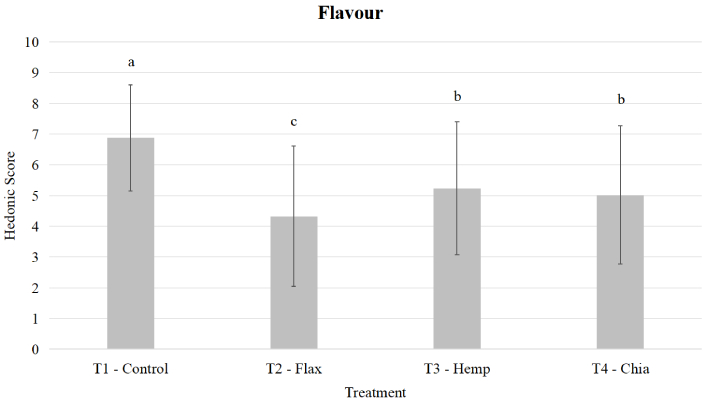
Panellists (n = 84) rated the flavour of four probiotic yogurt treatments using a nine-point hedonic scale ranging from 1 (dislike extremely) to 9 (like extremely). A one-way repeated measures ANOVA and Fisher’s LSD test were used to analyze statistically significant differences (p < 0.05) between mean hedonic scores. Significant differences between treatments are denoted by different lowercase letters (a)–(c) above each graph. ANOVA: analysis of variance; LSD: least significant difference.
Based on the results of the sensory analysis questionnaire completed by 84 participants, T1, containing no seeds, had the highest mean score of 7.21 (± 1.40) and was found to be significantly (p < 0.001) higher than all other treatments. A value of 7 on the hedonic scale corresponds with “like moderately”. Notably, T3 had the second-highest mean score of 6.02 (± 1.82), where a value of 6 on the hedonic scale corresponds with “like slightly”. The mean hedonic scores for texture for all treatments are depicted in Figure 3. Both T2 and T4 displayed extremely viscous, grainy textures, which may have contributed to their lower sensory scores.
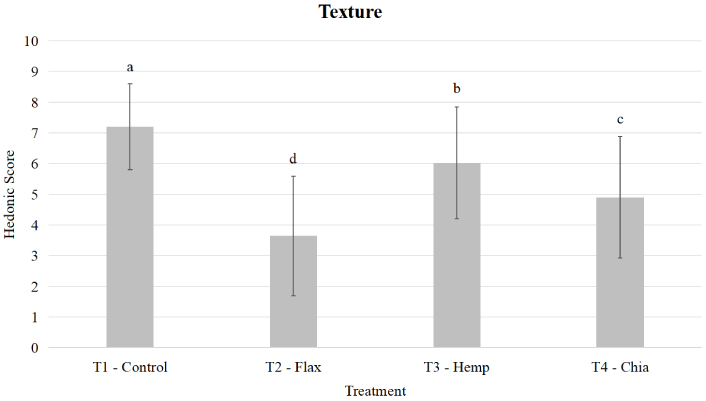
Panellists (n = 84) rated the texture of four probiotic yogurt treatments using a nine-point hedonic scale ranging from 1 (dislike extremely) to 9 (like extremely). A one-way repeated measures ANOVA and Fisher’s LSD test were used to analyze statistically significant differences (p < 0.05) between mean hedonic scores. Significant differences between treatments are denoted by different lowercase letters (a)–(d) above each graph. ANOVA: analysis of variance; LSD: least significant difference.
Due to errors in completing the sensory questionnaire, some participants were excluded from the analysis of overall acceptability. Based on valid responses from 79 participants, T1, containing no seeds, had the highest mean score of 7.29 (± 1.19) and was found to be significantly (p < 0.001) higher than all other treatments. A value of 7 on the hedonic scale corresponds with “like moderately”. Notably, T3 had the second-highest mean score of 5.78 (± 1.84), where a value of 6 on the hedonic scale corresponds with “like slightly”. The mean hedonic scores for overall acceptability for all treatments are depicted in Figure 4. Due to their physical properties, including viscous, grainy textures, off-flavours, and brown or grey colouring, T2 and T4 received the lowest ratings for overall acceptability.
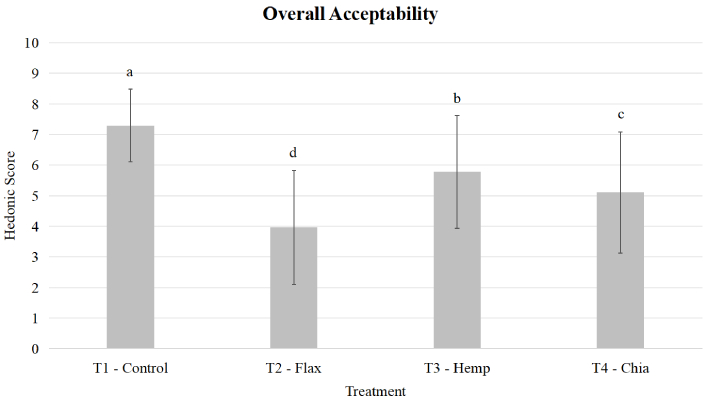
Panellists (n = 79) rated the overall acceptability of four probiotic yogurt treatments using a nine-point hedonic scale ranging from 1 (dislike extremely) to 9 (like extremely). A one-way repeated measures ANOVA and Fisher’s LSD test were used to analyze statistically significant differences (p < 0.05) between mean hedonic scores. Significant differences between treatments are denoted by different lowercase letters (a)–(d) above each graph. ANOVA: analysis of variance; LSD: least significant difference.
This study aimed to evaluate the viability of L. rhamnosus GR-1 in yogurt fortified with flax, hemp, and chia seeds. All treatments maintained viable counts of L. rhamnosus GR-1 during 6 h of fermentation and 30 days of storage. All treatments showed counts of at least 108 CFU/mL (Table 1), exceeding the recommended threshold of 106 CFU/mL required for a product to be considered probiotic [20]. The treatment fortified with chia seeds had the greatest viability amongst fermentation time points (Table 1). These results are consistent with other studies measuring the viability of L. rhamnosus GR-1. Previous research indicates that L. rhamnosus GR-1 maintains its viability in probiotic yogurt made with cows’ milk, even with the addition of functional ingredients such as almond milk, functional flours, inulin fiber, and fruit and vegetable juices [1, 13, 14, 21]. Recent studies indicate that chia seed mucilage can enhance the integrity of probiotic cells during processing and storage by functioning as a natural encapsulating agent [22]. This may help explain why chia seeds exhibited the highest levels of probiotic growth and viability. Similarly, flax seed mucilage has shown comparable effects, significantly improving the survival of L. acidophilus and B. lactis in kefir products [23]. These results indicate that while chia seeds showed the highest probiotic viability, other seeds like flax and hemp also provided strong support for probiotic survival. Similar to this study, previous research has reported that L. rhamnosus GR-1 maintains viable counts between 107 and 109 CFU/mL. Additionally, no adverse effects have been associated with the consumption of products containing L. rhamnosus GR-1. These findings support the conclusion that probiotic yogurt fortified with L. rhamnosus GR-1 offers a nutritious and distinctive option for enhancing the health benefits of yogurt. Across 6 h of fermentation, the pH of all treatments reduced significantly. During storage from 1 day to 30 days, T2, T3, and T4 showed significant reductions in pH, indicating increased acidity over time. These results differ slightly from previous studies, which commonly reported significant pH decreases during fermentation but relatively stable pH levels throughout storage [1, 13, 24].
Sensory evaluation results showed that T1, which contained no added seeds, was the most preferred across all categories, appearance, flavour, texture, and overall acceptability (Figures 1–4). A total of 77% (n = 65) of participants indicated they would purchase the probiotic yogurt samples. The control (T1) was the most preferred, selected by 47.6% of participants. T3, containing hemp seeds, was the second most preferred, with 10.7% (n = 9) of participants indicating it as their top choice (data not shown). The lower scores for T2 and T4 may be attributed to their sour taste, gel-like texture, and off-colours. Additionally, most participants expressed a preference for sweetened yogurt with added flavouring, whereas the yogurts tested were plain. Participants preferred the control sample for its “simple and smooth texture”, noting it closely resembled the yogurt they typically purchase from the store. Results from previous studies analyzing consumer preference of chia, flax, and hemp seeds in various yogurt products revealed that the appearance of food items plays a strong role in people’s expectations [25, 26]. This suggests that the lower scores for flax and chia seed treatments may be due to their brown and grey colours, which are uncommon in typical yogurt products on the market. Given the gender variation among participants, it is important to acknowledge potential differences in sensory perception between males and females. Research indicates that factors such as muscle strength, consumption rates, and bite size may influence sensory and texture preferences [27]. However, due to limited gender-specific data in this study, these differences could not be fully assessed and should be explored in future research. Additionally, 65% of sensory panellists (n = 55) indicated that chia and/or flax seeds were their preferred or favorite seeds (data not shown). Research shows that consumer familiarity with certain seeds can influence hedonic scores, with samples often rated higher due to this familiarity [26, 28, 29]. For instance, some participants may have mistaken the hemp seed sample for chia seeds and, due to their familiarity, given it a more favorable rating.
Flax seeds, hemp seeds, and chia seeds are all nutrient-dense options that, when added to yogurt, enhance the overall health benefits of both the seeds and the yogurt. The high omega-3 content in flax, hemp, and chia seeds is associated with numerous health benefits, including “a reduced risk of cardiovascular disease, hypertension, atherosclerosis, diabetes, cancer, and other chronic conditions” [3, 9–12]. Further benefits include good sources of vitamins and minerals, plant-based proteins, and dietary fiber. These health benefits, combined with those of the probiotic, suggest that this yogurt offers a nutrient-dense option for consumers. Previous research has highlighted the functional food potential of dairy products, identifying them as “primary carriers for delivering health beneficial microbes” due to their ability to incorporate various bioactive components, including prebiotics and probiotics [30, 31]. When combined with probiotic strains, the inclusion of nutrient-dense seeds may enhance this functionality, potentially leading to a “greater physiological impact on the body” [32]. Emerging evidence suggests that certain nutrients, such as omega-3 fatty acids, may demonstrate greater efficacy when consumed synergistically rather than in isolation, thereby amplifying their effects on health and longevity. Accordingly, the potential combined effect of probiotic-rich dairy and functional seeds may offer enhanced health benefits beyond those provided by each component alone. Specifically, research on yogurt fortification with flax seeds suggests enhanced nutritional properties, including an improved fatty acid profile, increased fiber and protein content, and higher mineral levels [33, 34].
Future research should explore enhancing flax and chia seed-containing samples with flavouring or sweeteners to improve hedonic scores and increase market acceptability. Moreover, future research could also examine the nutrient composition of the yogurt product, specifically protein, ash, and fat content, to provide a comprehensive comparison of its nutritional profile against conventional probiotic yogurt [35]. Additionally, investigating the specific synergistic effects and individual health benefits of each seed combined with the probiotic could further indicate their functional contributions. Current research indicates that the prebiotic activity of seeds and their mucilage may substantially enhance the production of short-chain fatty acids, which play a key role in gut health. However, future studies should investigate the strain-specific effects of probiotics combined with the prebiotic nature of seed mucilage during gastrointestinal transit, particularly using in vitro gut models [10]. Further investigation into combining flax, hemp, and chia seeds with probiotic yogurt presents a promising area for innovation with strong market potential.
The limitations of this study included a relatively small sample size, with 84 participants, which may limit the generalizability of the findings. Although efforts were made to ensure gender diversity, the sample was skewed, with females comprising 75% of participants. Additionally, some errors occurred in completing the sensory evaluation questionnaires, particularly in the overall acceptability ratings. These responses were excluded from the statistical analysis, which was conducted using only valid data. Moreover, although the inclusion of volatile compound analysis and colorimetry would have strengthened the assessment by reducing subjectivity, these analyses could not be conducted due to time constraints.
In conclusion, this study effectively assessed the viability of L. rhamnosus GR-1 in yogurt fortified with functional seeds—flax, hemp, and chia. Results showed that all treatments maintained viable counts of 108 CFU/mL across all fermentation and storage time points. Hedonic scores revealed that next to the control, containing no functional seeds, hemp was the second most preferred treatment due to its appearance, flavour, and texture. The findings from this research provide a valuable foundation for the development of more nutrient-dense and consumer-friendly probiotic yogurt products. Future studies focused on improving the current formulations, as well as completing a full nutritional analysis, will contribute meaningful insights to the growing field of functional probiotic foods, enhancing both their nutritional quality and market appeal.
ANOVA: analysis of variance
CFU/mL: colony-forming units per milliliter
L. rhamnosus: Lacticaseibacillus rhamnosus
MRS: de Man Rogosa and Sharpe
T1: Treatment 1
T2: Treatment 2
T3: Treatment 3
T4: Treatment 4
w/v: weight per volume
The authors acknowledge the Brescia School of Food and Nutritional Sciences at University of Western Ontario for providing the facilities that made this research possible.
HGA: Investigation, Project administration, Resources, Validation, Visualization, Writing—original draft, Writing—review & editing. SH: Conceptualization, Data curation, Formal analysis, Funding acquisition, Methodology, Resources, Supervision, Visualization, Writing—review & editing. Both authors read and approved the submitted version.
The authors declare that they have no conflicts of interest.
The sensory evaluation involved in this study was approved by the Health Sciences Research Ethics Board at the University of Western Ontario (Project ID: 126226).
Informed consent to participation in the study was obtained from all participants.
Not applicable.
The raw data supporting the conclusions of this manuscript will be made available by the authors, without undue reservation, to any qualified researcher.
This study was supported by Brescia Internal Research Fund [BA12]. The funders had no role in study design, data collection and analysis, decision to publish, or preparation of the manuscript.
© The Author(s) 2025.
Open Exploration maintains a neutral stance on jurisdictional claims in published institutional affiliations and maps. All opinions expressed in this article are the personal views of the author(s) and do not represent the stance of the editorial team or the publisher.
Copyright: © The Author(s) 2025. This is an Open Access article licensed under a Creative Commons Attribution 4.0 International License (https://creativecommons.org/licenses/by/4.0/), which permits unrestricted use, sharing, adaptation, distribution and reproduction in any medium or format, for any purpose, even commercially, as long as you give appropriate credit to the original author(s) and the source, provide a link to the Creative Commons license, and indicate if changes were made.