Editorial


Affiliation:
Cardiology Clinic, Clinical Center of Serbia, Medical School, University of Belgrade, Belgrade 11000, Serbia
Email: eugeniopicanoeditorinchief@gmail.com
ORCID: https://orcid.org/0000-0002-6375-6361


Explor Cardiol. 2026;4:101286 DOI: https://doi.org/10.37349/ec.2026.101286
Received: January 01, 2026 Accepted: January 06, 2026 Published: January 14, 2026
The editor-in-chief plays a vital role in ensuring a journal’s scientific integrity and quality. Their primary responsibilities include managing the peer-review process, selecting qualified reviewers, and making final decisions on manuscript acceptance, revision, or rejection. In cases of scientific misconduct, conflicts of interest, authorship disputes, or ethical concerns, the editor has the ultimate authority.
An editor’s vision for the journal shapes which manuscripts are reviewed and accepted, influencing the journal’s academic direction. While the role offers benefits such as scientific prestige, greater research visibility, and financial compensation, it also entails significant ethical responsibilities. Academic editor malpractice refers to any actions that violate ethical standards or compromises the integrity of the peer-review process.
Editors typically serve five-year terms, often with the possibility of renewal, and are frequently evaluated based on the journal’s impact factor trend. However, their role extends beyond editorial duties—they act as gatekeepers, literary agents, accountants, mediators, and judges, navigating the complex relationships among authors, reviewers, and publishers.
Editors of major journals hold an extraordinary amount of power within the publication process. They act as an umpire to judge the scientific research that is being published. Like an umpire, they must know about the sport and rules of play, but they themselves should never be in the competition. The problem is that this ideal is not always met. Whether the subject is the efficacy of an antihypertensive drug, the value of a new costly biomarker, or the origin of a pandemic, editors often make decisions for multi-parametric—and also extra-scientific—reasons. On this basis, some papers are published while others are declined, and the stream of scientific evidence can be polluted.
In summary, the editor-in-chief is a cornerstone of academic publishing, ensuring that scientific quality and integrity are upheld while balancing multiple responsibilities.
An academic editor plays a crucial role in managing the peer-review process, ensuring that manuscripts are rigorously assessed for scientific accuracy, originality, and relevance. This involves selecting qualified reviewers, overseeing the review process, and deciding whether to accept, reject, or request revisions. Additionally, editors shape editorial policies, uphold best practices in scholarly publishing, and ensure the timely release of high-quality content. Their strategic vision influences the selection of manuscripts and ultimately defines the journal’s academic impact.
Beyond quality control, editors must also protect the journal from conflicts of interest that could compromise the integrity of the review process. However, even guardians must be guarded. Editors should adhere to the International Committee of Medical Journal Editors’ Recommendations for the conduct, reporting, editing, and publication of scholarly work in medical journals [1]. Just as authors and reviewers must disclose potential conflicts of interest, editors should regularly declare any affiliations or commitments that could influence their editorial decisions. When an editor submits a manuscript to their journal, the review process must be fully independent, with another editor overseeing it to prevent undue influence. This should be transparently stated in the Conflicts of interest declaration of the published article. It is now established that “The relationship of editors to publishers and journal owners is often complex but should always be based on the principle of editorial independence. Notwithstanding the economic and political realities of the journal, the editor should select submissions on the basis of their quality and suitability for readers rather than for immediate financial, political or personal gain.”. By ‘publisher’ we mean the entity responsible for the hosting, distribution, and preservation of content [2].
Academic editor malpractice refers to actions that violate ethical publishing standards or compromise the integrity of the peer-review process. Common forms of misconduct include:
Discrimination: Favoring or disadvantaging authors based on non-scientific criteria.
Failure to disclose conflicts of interest: Allowing biases to influence editorial decisions.
Neglecting error correction: Failing to address significant mistakes or omissions in published articles.
Breach of confidentiality: Disclosing unpublished manuscript details to unauthorized parties.
Overlooking plagiarism: Failing to detect or act on cases of academic misconduct.
Editors are responsible for ensuring that all submitted manuscripts are original, ethically sound, and confidentially handled throughout the review process. Upholding these responsibilities is essential for maintaining trust in scientific publishing and safeguarding the integrity of academic research [3].
An editor’s daily life is a constant battle against email messages from unresponsive reviewers, sensitive authors, and demanding publishers. However, the role also comes with significant professional and economic benefits.
The scientific prestige of an editor-in-chief depends largely on the journal’s impact factor and reputation. Leading a well-established, high-impact journal can enhance an editor’s standing in the academic community, offering opportunities to shape the journal’s direction, promote innovative research, and influence scientific discourse. However, the broader impact of these efforts on the advancement of knowledge may be limited.
The economic benefits of serving as an editor-in-chief vary widely based on the journal’s size, funding, and submission volume. Compensation ranges from a few thousand dollars per year for smaller journals to hundreds of thousands of dollars or more for top-tier journals with high submission rates [4].
The term length for an editor-in-chief varies by journal policy. Some journals impose fixed terms of three to five years, often renewable for only one additional term. Others allow editors to serve indefinitely until they step down or are replaced. In exceptional cases, extraordinary editors may serve for decades, as seen with William C. Roberts [5], who led the American Journal of Cardiology for 40 years. During his tenure, Roberts [5] personally reviewed and edited each accepted manuscript, overseeing the publication of thousands of articles.
The impact factor measures the average number of citations received per paper published in a journal over a specific period. While this metric provides some insight into a journal’s influence and reach, it does not account for the quality of the research published, the editorial standards, or the editor’s role in improving the journal.
A notable success story is the rise of the European Heart Journal, the official journal of the European Society of Cardiology. In 2008, its impact factor was 8.917, ranking it 4th among cardiovascular journals. In 2024, the journal’s impact factor, released by Clarivate in June 2025, soared to 35.7.
Although impact factor remains one of the most widely recognized indicators of journal quality, it is neither the only nor the most comprehensive metric for evaluating an editor’s contribution. Other relevant measures include the Altmetric attention scores, Eigenfactor, Journal Citation Indicator [6], article downloads, and usage statistics.
These metrics may seem objective, straightforward, and appealing. However, their misuse is widespread. Some journals pressure authors to cite their papers before acceptance, some editors or reviewers demand citations of their work, and some journals or authors engage in reciprocal citation practices to artificially boost their metrics. More citations mean higher impact factors, more published papers, and increased grant funding—creating fertile ground for citation gaming, a subtle yet pervasive form of scientific misconduct.
To combat this, Thomson Reuters, which calculates and publishes impact factors, developed algorithms to detect citation stacking—unnatural citation bursts between journals [7]. Since 2009, journals found guilty of citation manipulation have faced penalties ranging from blacklisting, temporary suspension, or official warnings from Thomson Reuters, rebranded as Clarivate starting in 2016.
Citation gaming is the unethical practice of manipulating citations to artificially inflate the citation count of an article, author, or journal. This practice distorts research impact metrics and can mislead funding agencies, institutions, and the scientific community.
Common forms of citation gaming include:
Self-citation: Authors excessively cite their own work, even when it is not relevant.
Citation farming: Editors pressure authors to cite articles from their journal to boost its impact factor.
Citation swapping: Authors or journals form citation cartels, agreeing to cite each other’s work regardless of its relevance.
These practices are unethical because they distort the perceived influence of research and can lead to undue recognition and career advancement based on inflated metrics. Moreover, citation gaming undermines the integrity of the peer-review process and the reliability of bibliometric indicators.
Maintaining ethical citation practices is essential for preserving the credibility of scientific publishing. Authors, reviewers, and editors must resist citation manipulation to ensure that research impact is measured accurately and transparently [8].
A competent editor may occasionally make errors in evaluating submitted manuscripts; however, a truly exceptional editor not only acknowledges such mistakes but also has the integrity and courage to reverse an incorrect decision. This principle is well illustrated by a real-life case involving a manuscript that was ultimately published in a leading cardiology journal some years ago.
In the following account, plain text represents letters from the Editor-in-Chief, while italicized text denotes correspondence from the authors.
-------------------------------------------------------------------
Date: Thu, 5 Apr xxxx
Dear Author,
Thank you for your recent submission. Your manuscript has been carefully evaluated by the editors and by expert external referees. Unfortunately, the consensus is that it cannot be accepted in its current form. However, we would be willing to consider a revised manuscript on a de novo basis. Because of the extensive revisions required, your manuscript will be treated as a new submission, assigned a new manuscript number, and will be subjected to peer review and prioritization in competition with all other manuscripts.
Thank you for your interest in the journal, and we look forward to reviewing other submissions from you in the future.
Sincerely,
-------------------------------------------------------------------
May 24th, xxxx
Dear Author,
Thank you for allowing us to review your revised manuscript. The paper has again been evaluated by the editors and two expert reviewers. Although the paper is improved, the consensus is that it still does not achieve a sufficiently high priority for publication.
We recognize the thought and effort that went into your work. Unfortunately, we are able to publish only a small percentage of the manuscripts submitted, and must decline many of considerable merit. We are sorry for the negative decision and hope the review process has been helpful to you in preparing the manuscript for submission elsewhere.
-------------------------------------------------------------------
May 27th, xxxx
Dear Editor,
We refer to the decision on our manuscript. We had the first decision letter asking for a de novo revision. We extensively revised the manuscript (and it took time and resources). All three reviewers (a very rare instance of unanimous response) were apparently satisfied with the revision (#1: This revised study has addressed many of the limitations that were raised on initial review. The validity and impact of the findings have been improved by a more detailed analysis of covariates that could confound results; #2: The authors have addressed and answered all my comments adequately. I was pleased with the changes made in the manuscript; #3 No further issues and all prior issues have been addressed).
In spite of the 3 reviews, you rejected the paper. Does this mean that the Authors should not take too seriously the editorial correspondence? In the future, should we consider the “de novo” formula a gentle way to mean “reject”?
Please, clarify. The rules of the game should be followed by both the Referee and the players. Otherwise, the game loses credibility.
-------------------------------------------------------------------
May 29th, xxxx
Dear Author,
I am responding to your email regarding our decision on the above-referenced manuscript. I am sorry we were unable to give you a favorable response. Let me explain our process so that you understand how our decision came to be.
Every week, we consider approximately 90–100 manuscripts for acceptance. Based upon the external reviews and the opinion of the Associate Editors, approximately 20–25 are forwarded to me with the recommendation to accept (I also often act as Associate). Each week we consider discuss these manuscripts in depth to select the 8 to 10 papers we can accommodate in our limited pages. Thus, in any week only about one of three papers recommended for acceptance by reviewers and Associate Editors can actually be accepted.
In the initial consideration, some of the 100 papers are judged to be of interest and potentially acceptable, and are referred for a de novo revision. Essentially, in the parlance of American baseball, we are giving the authors another chance at bat. While the acceptance rate of all manuscripts is about 10%, the acceptance rate of the de novos approaches 50%. However, if after revision they are judged to be acceptable, they go into the group of 25 that are considered in any week, of which only one third can be published. We have always made the assumption that authors would choose to have another chance at acceptance, even if de novo, rather than take a rejection. In fact, our provisional acceptances are sometimes ultimately rejected, although very rarely. So even though your paper received favorable reviews, it was not judged by the consensus of Associate Editors to be in the top one third that week.
Perhaps we should be more explicit as to our process when we issue a de novo. However, as I said, we can't imagine an author would pass up a 50% chance of acceptance. We recognize that authors often go to great lengths to revise a paper, often to the satisfaction of the reviewers (each of whom sees only one of the 25 papers being considered that week), only to have it ultimately rejected. Again, I apologize.
The process of selecting manuscripts for publication is imperfect, and subject to many variables. We do our best, but sometimes we make mistakes. Your manuscript may be one. I do hope, however, that you agree that the way we handled your paper was intended to give it every chance of acceptance possible. In light of your letter, and after review of our deliberations, we would be willing to reconsider the paper again. If you are interested, please revise again to address the additional remarks of the reviewers and resubmit as an appeal.
-------------------------------------------------------------------
June 7th, xxxx
Dear Editor,
Thank you for your kind, fast, and teaching response.
We are aware that the selection of manuscripts is a tough job, and it requires not only knowledge, but also wisdom and balance.
We are happy that the Editor-in-Chief has the rare capability to listen and to reassess editorial decisions if needed. Essentially, in the parlance of soccer (after all, Italians are the world champ in this game), if the Referee is honest, the game will be fair.
We are therefore resubmitting the manuscript as an appeal.
-------------------------------------------------------------------
The paper was accepted and published in the revised form.
A good editor maintains a skeptical attitude toward their closest collaborators: authors, reviewers, and associate editors. As one highly respected editor once remarked about reviewers:
“Criticism, of course, serves a useful function, but not all criticisms are justified. Not all changes in manuscripts to pacify critics produce improvements. No one has a monopoly on justifiable criticisms or on correctness in accepting or rejecting a manuscript. The power to pass judgment on the work of others should inspire humility, not arrogance. ‘Writers,’ notes Saul Bellow, ‘seldom wish other writers well.’ Thus, recommendations from reviewers have complex origins, and these must be taken into account when evaluating a manuscript.” [9].
A renowned Italian cardiologist and editor wrote:
“Unfortunately, the quality of peer reviews is not always adequate. Experienced researchers do not have the time to review papers thoroughly, and younger researchers often lack the necessary experience and tools to conduct a high-quality review.” [10].
Even associate editors can pose challenges. Consider an incident at a highly ranked cardiology journal where an associate editor rejected a manuscript that had received two highly favorable reviews. The author appealed, arguing that the rejection was editorial malpractice. The editor-in-chief immediately reversed the decision, issuing a rather unusual explanation:
“You are right, and we are wrong! The paper, based on the referees’ reports, should have been accepted with revisions. I’ll attempt a weak excuse—our associate editor was heavily pregnant at the time, and she tells me her hormones must have been playing up! We are therefore interested in publishing it.”.
While this happened decades ago, today such a statement would likely trigger a discrimination lawsuit. Regardless, the paper was accepted by the prestigious journal.
Ultimately, an editor must make decisions based on reviewers’ recommendations and associate editors’ input. However, there are times when an editor chooses to override unanimous recommendations.
One example occurred in 1995 at a well-regarded American cardiology journal. A submitted manuscript received highly favorable reviews from two independent reviewers—one from the USA and another from Italy (who, due to a clerical error, also saw the confidential comments of the USA reviewer). Both reviewers recommended acceptance with minor revisions, rating the paper 7/10 and 9/10.
Yet, the editor rejected the manuscript—not due to quality but on a “priority basis”. Undeterred, the author resubmitted the unchanged manuscript to another American journal with a threefold higher impact factor, where it was accepted with minor revisions after a swift review.
The best retaliation against an unjustified rejection is publishing the same paper in a better journal.
Sometimes, a good editor makes a real difference—for the author, the journal, and the readers. More often, however, an editor’s role hinges on factors beyond their control. Political dynamics, limited expertise across a journal’s vast scope of topics, and hidden variables affecting the review process contribute to uncertainty in decision-making. Even the most seasoned editors may suspect they are wrong when accepting or rejecting a manuscript.
As one distinguished editor candidly admitted:
“When I divide the week’s submissions into two piles—one to publish, the other to reject—I wonder whether it would make any real difference to the journal or its readers if I exchanged one pile for the other.” [11].
A final and important message for submitting authors: most writing happens before 8 a.m., after 5 p.m., or during weekends and holidays. The long hours required for success demand genuine passion and enthusiasm for one’s work [12]. Every piece of research must find its place in the vast editorial landscape, and if you have something meaningful to share, publishing somewhere is more important than publishing in a top-tier journal.
With so many journals available, and given the vulnerabilities of the peer-review system—along with the strong financial incentives driving publication—moving down the ranks of impact factor makes it possible to publish almost anything [13]. This is not necessarily bad news. Ultimately, the responsibility for what is published lies with the submitting author, and, in the end, the knowledge market—readers and researchers—will determine a paper’s real impact.
For example, in 2024, I published two papers almost simultaneously: one in a high-impact journal, after a long and grueling peer-review process with prominent co-authors, and the other in Exploration of Cardiology, a journal that, at the time, had no impact factor and was not yet indexed in PubMed but offered open-access publication. One year later, the high-impact journal article with pay-per-view access had been viewed 521 times, with 7 citations, while the open-access article had the same 7 citations and was viewed 20 times more, with close to 12,000 views (Figure 1).
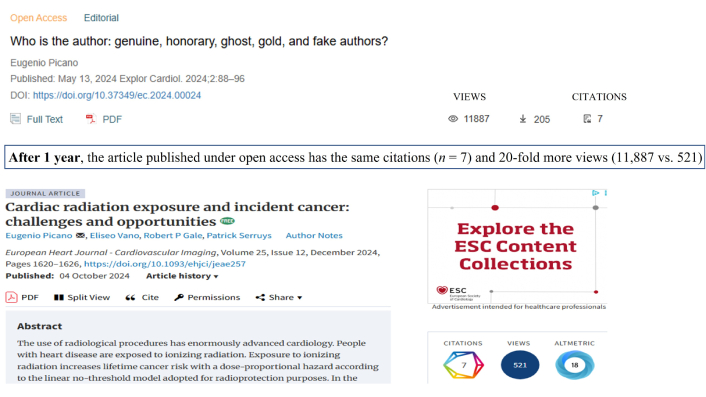
Metrics of 2 articles from the same author, one article published in a journal with zero impact factor and open access, and the other published in an excellent journal with a good impact factor and a subscription model (pay-per-view). After the same time frame, the first article has a much higher visibility expressed in terms of downloads and the same number of citations. Data frozen on 10 December 2025.
Times are changing. Open access is disrupting scientific communication and redefining journal rankings in ways that traditional impact factors and subscription journals fail to capture.
In the final stage of the editorial process, the editor must decide the fate of a submitted paper, typically choosing among four options:
Accept.
Accept with revisions (major or minor).
Reject with an option to resubmit (substantial revision required).
Reject outright (with or without external review).
Ideally, an editor would possess comprehensive knowledge of both science and human nature to make these decisions flawlessly. However, this is rarely the case. More often, editorial judgments are probabilistic and made under uncertainty. A good editor acknowledges this and remains open to reassessment based on new information.
In the words of Hon. Brad Wentrup, House representative from Ohio, during a hearing of the U.S. Committee on Academic Oversight and Accountability: “Editors hold an extraordinary amount of power within the journals in the publication process, a process that is a black box to most of the public. They act as an umpire to judge the scientific research that is being published. Like an umpire, it is vital that they know about the sport and rules of play, but they themselves should never be in the competition. It is important to separate opinion versus scientifically proven fact and to highlight the varying hypotheses that may exist.” [14].
The problem is that this ideal is not always met. Whether the subject is the efficacy of an antihypertensive drug, the value of a new costly biomarker, or the origin of a pandemic, editors often make decisions for multi-parametric—and sometimes not purely scientific—reasons. On this basis, some papers are published while others are declined. This reality underscores the importance of having a diversity of journals, including those independent of official scientific societies, which may be less vulnerable to structured interventions for extra-scientific reasons. For a long time, the academic community has understood this dynamic, but now public opinion is also well aware of it [14]. In 2025, the U.S. Department of Justice sent letters to tens of scientific journals, raising the suspicion that they might be “partisan” and asking whether they are including “competing viewpoints” [15]. Many scientists and legal experts viewed the letters as intimidation meant to chill the freedom and scientific rigor of scientific speech.
Embrace doubt. The best editors constantly question whether their decisions truly enhance the journal. They recognize that the difference between accepted and rejected papers is often subtle and contingent rather than absolute.
Accept the risk of unpopularity. Editorial decisions can be difficult. Rejecting a paper from an author may lead to lasting resentment. Moreover, authors tend to remember their rejections far more than their acceptances. Some may even argue that the one rejected paper was their most groundbreaking work, and that the rejection harmed both their career and the journal.
Understand the complexity of human nature. Editors must navigate relationships with authors, reviewers, and even whistleblowers. Holding the authority to evaluate others’ work should cultivate humility, not arrogance. Reviewer recommendations can be influenced by personal biases, disciplinary trends, or unconscious preferences. In scientific publishing, there is a real risk of favoring conformity over originality, making it essential for editors to critically assess reviewer feedback.
Recognize that editing is distinct from writing. Editors are often invited to the role based on their achievements as authors. However, excelling in research and writing does not necessarily translate to effective editing—just as a great athlete does not always make a great coach. Writing is often a solitary, self-driven pursuit that requires intense focus on one’s ideas. Editing, by contrast, is a social and collaborative endeavor, requiring engagement with authors, publishers, and readers. Editors are not always at the peak of their scientific careers, but their impact lies in shaping the discourse of their field (Table 1).
The age of a scientist, from the submitting author to the editor-in-chief.
| Age (years) | Academic rank | Skills | H-index | Editorial role |
|---|---|---|---|---|
| 20–30 | PhD | Reading | 0 | Submitting author |
| 30–40 | Assistant professor | Writing | > 1 | Reviewer |
| 40–50 | Associate professor | Signing | 10–30 | Elite reviewer |
| 50–60 | Full professor | Funding | > 30 | EB member |
| 60–70 | Chief of department | Check references | > 50 | Associate editor |
| > 70 | Retired emeritus professor | None | > 100 | Editor in chief |
EB: editorial board.
According to the experienced writer and editor Bill Roberts, “Editing is much easier than writing; judging is much easier than creating. It is the creator who brings about significant change, not the evaluator of their work.” [12]. This perspective helps explain why many great writers have been poor editors and why editors interpret their roles in different ways. There is no single rule or universal commandment for editing—it depends on the journal, the editor’s background, the publishing policy, and, most importantly, the quality and volume of submitted material. The editor can do a good job only if the author submits genuine and high-quality work and if the reviewer is honest and knowledgeable.
Meanwhile, the debate continues: Should an editor be a supreme judge, making definitive decisions? A mere postman, simply forwarding the reviewers’ recommendations? Or a yes-man to the publisher’s interests? The answer varies, and the role remains as complex as the field of publishing itself. In the words of an editor: “Sometimes we do not get things right, but one of the major qualities of any Editor-in-Chief must be an ability to learn from mistakes, quickly make amends when things go wrong, and to ensure that mistakes are not repeated. The reputation of a journal, a team of editors, and a publishing house is in your hands.” [16].
In conclusion, the duties of the editor in the peer review process can be summarized as follows:
Screen submissions before assigning them to reviewers to ensure relevance and basic quality standards.
Enhance the quality of acceptable papers through constructive feedback and editorial guidance.
Reject manuscripts outright if an in-house review determines them to be unpublishable.
Safeguard the integrity of the journal, authors, and readers by preventing overt or covert conflicts of interest.
Promptly investigate allegations of fraud, plagiarism, or redundant (salami) publication.
Maintain a fair and ethical review process, avoiding undue scrutiny or fostering malicious whistleblowing.
The main editorial practices to avoid can be summarized as follows:
Rejecting a manuscript after thorough revisions if reviewers have expressed satisfaction.
Reject a manuscript after > 2 months in the absence of reviewers’ comments.
Overriding unanimous positive reviews with an editorial rejection.
Accepting a manuscript despite unanimous negative reviews.
Pressuring authors to cite irrelevant journal articles to artificially boost the impact factor.
Forcing citations of an editor’s work to inflate their H-index.
Introducing hostile editorial comments in accepted papers.
Dismissing the author’s appeals based on personal biases rather than merit.
EP: Conceptualization, Writing—original draft, Writing—review & editing. The author read and approved the submitted version.
Eugenio Picano is not only the author of this manuscript, but also the Editor-in-Chief of the Exploration of Cardiology.
Not applicable.
Not applicable.
Not applicable.
Not applicable.
Not applicable.
© The Author(s) 2026.
Open Exploration maintains a neutral stance on jurisdictional claims in published institutional affiliations and maps. All opinions expressed in this article are the personal views of the author(s) and do not represent the stance of the editorial team or the publisher.
Copyright: © The Author(s) 2026. This is an Open Access article licensed under a Creative Commons Attribution 4.0 International License (https://creativecommons.org/licenses/by/4.0/), which permits unrestricted use, sharing, adaptation, distribution and reproduction in any medium or format, for any purpose, even commercially, as long as you give appropriate credit to the original author(s) and the source, provide a link to the Creative Commons license, and indicate if changes were made.