 Mini Review


Affiliation:
1Department of Internal Medicine, University of Cincinnati, Cincinnati, OH 45219, USA
Email: Fatima.farrukh1@gmail.com
ORCID: https://orcid.org/0000-0001-8725-4350


 ,
,
Affiliation:
2Aga Khan University Medical College, Aga Khan University Hospital, Karachi 74800, Pakistan
ORCID: https://orcid.org/0000-0002-2246-0978
,
Affiliation:
2Aga Khan University Medical College, Aga Khan University Hospital, Karachi 74800, Pakistan
Affiliation:
3Kabir Medical College, Peshawar 25000, Pakistan
Affiliation:
4National Institute of Cardiovascular Disease, Karachi 75510, Pakistan
Affiliation:
5Department of Cardiology, Aga Khan University, Karachi 74800, Pakistan
ORCID: https://orcid.org/0000-0003-4849-2502
,
Affiliation:
5Department of Cardiology, Aga Khan University, Karachi 74800, Pakistan
ORCID: https://orcid.org/0000-0003-2422-3199
Explor Cardiol. 2026;4:1012108 DOI: https://doi.org/10.37349/ec.2026.1012108
Received: September 04, 2025 Accepted: March 16, 2026 Published: May 12, 2026
Academic Editor: Maria Grazia Andreassi, CNR Institute of Clinical Physiology, Italy
The article belongs to the special issue Cardiovascular Risk for Mothers and Offspring Resulting from Complicated Pregnancy
Cardiovascular disease (CVD) is the leading cause of mortality in women worldwide. While increasing parity has been associated with greater CVD risk in several populations, limited data exist on this association in South Asian women who experience some of the highest fertility rates globally. This narrative review synthesizes current literature examining the relationship between multiparity and CVD in South Asian women, including epidemiologic patterns, proposed biological mechanisms, and the influence of sociocultural factors. Evidence from South Asia suggests a possible association between high parity (particularly ≥ 4 or 5 births) and increased risk of hypertension, obesity, metabolic syndrome, and coronary heart disease. However, the available data are limited, largely cross-sectional, and occasionally contradictory. Some studies found no association or even protective effects at lower parity levels, suggesting a potential threshold or nonlinear effect. Biologically, proposed mechanisms include insulin resistance, endothelial dysfunction, and dysregulation of adipokines. Sociocultural factors such as male child preference, restricted contraceptive access, and limited autonomy in family planning decisions may also contribute to high parity and indirectly affect cardiovascular health. Although global research supports a positive association between multiparity and CVD, the evidence specific to South Asian populations remains inconsistent and underexplored. Further region-specific, longitudinal research is essential to clarify causality and inform culturally tailored screening and prevention strategies.
Globally, cardiovascular disease (CVD) remains the leading cause of mortality in women [1]. According to the 2019 Global Burden of Disease Study, the leading cause of death in women worldwide was ischemic heart disease, with approximately 275 million women affected by CVD globally [2]. Increasing parity has been associated with an increased risk of future CVD in women [3]. Despite the high prevalence of multiparity in South Asian countries, data examining the association between multiparity and CVD in this region remain limited. In this narrative review, we discuss the epidemiology, pathophysiology, and sociocultural determinants of multiparity and CVD in South Asian women, with the aim of synthesizing existing evidence and identifying key gaps relevant to regional prevention strategies.
A targeted literature search was performed using PubMed and Google Scholar for English-language articles published up to 2025. Search terms included combinations of “multiparity,” “parity,” “cardiovascular disease,” “coronary heart disease,” and “South Asia,” along with country-specific terms (India, Pakistan, Bangladesh, Nepal, Sri Lanka). Observational studies, cohort studies, meta-analyses, and relevant reviews evaluating parity and cardiovascular outcomes in women were included. Given the scarcity of South Asian specific longitudinal data, high-quality international studies were included when necessary and interpreted in the context of regional epidemiology and sociocultural factors. Reference lists of key articles were manually reviewed to identify additional relevant studies.
CVD is the leading cause of mortality in women globally [1]. Approximately 45% of females over the age of 20 suffer from CVD worldwide, and one in three deaths in women is attributable to CVD [4]. South Asian countries comprise approximately 25% of the global population and experience a disproportionately high burden of CVD compared to Chinese and Canadian populations [5, 6]. According to the Global Burden of Disease Study (2019), 58% of the 18.6 million CVD deaths worldwide occurred in Asia, with mortality rates of 185, 153, and 152 per 100,000 in India, Nepal, and Pakistan, respectively [2, 7].
National and regional data further illustrate this burden. In Pakistan, national survey data report comparable CVD prevalence in men and women [8, 9], while large population-based studies from India demonstrate a substantial prevalence of CVD among women aged 45 years and older [9]. Similar patterns of high CVD burden have been reported across Sri Lanka, Bangladesh, Nepal, and Afghanistan, underscoring the regional importance of cardiovascular risk assessment in women [10–13].
The definition of multiparity has evolved, with most contemporary studies defining multiparity as two or more deliveries and grand multiparity as five or more live or stillbirths after 20 weeks of gestation [14]. Although fertility rates in South Asia have declined over recent decades, several countries continue to report higher average births per woman compared with high-income settings [15]. Table 1 provides demographic context by summarizing fertility rates across South Asian countries in 2021.
Births per woman in South Asian countries in 2021.
| Country | Prevalence (births per woman) | Year |
|---|---|---|
| Pakistan | 3.5 | 2021 |
| Afghanistan | 4.6 | 2021 |
| India | 2.0 | 2021 |
| Bangladesh | 2.0 | 2021 |
| Sri Lanka | 2.0 | 2021 |
| Nepal | 2.0 | 2021 |
| Bhutan | 1.4 | 2021 |
| Maldives | 1.7 | 2021 |
Across studies conducted in South Asia, a consistent pattern emerges in which higher parity—particularly four or more births—is associated with an increased prevalence of adverse cardiometabolic risk factors, including obesity, metabolic syndrome, hypertension, and coronary heart disease [16–19]. In contrast, lower parity levels (one to three births) have shown neutral or occasionally protective associations in some populations, suggesting a potential nonlinear or threshold effect rather than a uniform dose-response relationship.
Findings from India, Bangladesh, and Nepal collectively suggest that the adverse cardiovascular profile associated with multiparity is more apparent at higher parity thresholds, whereas results are less consistent at lower parity levels. Differences in breastfeeding practices, educational attainment, and socioeconomic status—variables that were variably measured or incompletely adjusted for across studies—may partially explain these heterogeneous findings.
Limitations of the available epidemiologic evidence should be acknowledged. Most South Asian studies are cross-sectional, limiting causal inference and temporal assessment of parity-related risk. Definitions of multiparity vary across studies, and adjustment for key confounders such as breastfeeding duration, gestational complications, and socioeconomic factors is inconsistent. Additionally, much of the dose-response evidence linking parity and CVD risk is derived from non-South Asian cohorts, which may limit generalizability to regional populations.
Epidemiologic findings from South Asian studies indicate that higher parity—particularly four or more births—is associated with increased prevalence of obesity, metabolic syndrome, hypertension, and CVD [17–19]. These patterns suggest that the biological impact of parity is more plausibly explained by cumulative metabolic and vascular stress that intensifies with repeated pregnancies rather than by uniform effects across all parity levels.
One key mechanism involves adipokine dysregulation. Pregnancy induces systemic inflammation, oxidative stress, and insulin resistance, which alter levels of adipokines—cytokines secreted by adipose tissue—such as leptin, resistin, and adiponectin [20–23]. Elevated leptin and resistin and reduced adiponectin are associated with insulin resistance, metabolic syndrome, and atherosclerotic CVD [24]. Data from the Multi-Ethnic Study of Atherosclerosis demonstrated higher leptin and resistin levels in women with grand multiparity (≥ 5 live births) [22], consistent with South Asian studies reporting higher BMI, metabolic syndrome, and elevated blood pressure in women with multiple births [17–19].
Insulin resistance represents another important pathway linking multiparity and cardiovascular risk. Pregnancy is characterized by physiologic insulin resistance, partly driven by placental and maternal hormonal changes, including human placental lactogen, also known as human chorionic somatomammotropin, estrogen, progesterone, and cortisol/corticosteroid-related pathways [20, 25]. With repeated pregnancies, incomplete postpartum metabolic recovery may lead to cumulative insulin resistance, increasing susceptibility to gestational diabetes, type 2 diabetes, and subsequent CVD. A meta-analysis of cohort studies reported a 42% increased risk of type 2 diabetes among women with five or more live births [26], aligning with the elevated prevalence of diabetes and hypertension observed among multiparous women in South Asian cohorts [17–19].
Endothelial dysfunction and atherosclerosis further link multiparity to CVD. Repeated pregnancies have been associated with increased oxidative stress and subclinical atherosclerosis, manifested as higher carotid intima-media thickness and plaque formation [21, 27]. Adverse lipid profiles observed in multiparous women—characterized by lower high-density lipoprotein cholesterol and higher triglyceride levels—may further contribute to cardiovascular risk [28]. These vascular and metabolic changes provide a biologically plausible explanation for why cardiovascular risk appears to increase predominantly at higher parity levels rather than at lower parity ranges. Figure 1 integrates these biological pathways and illustrates how cumulative metabolic, inflammatory, and vascular changes associated with repeated pregnancies may contribute to increased cardiovascular risk.
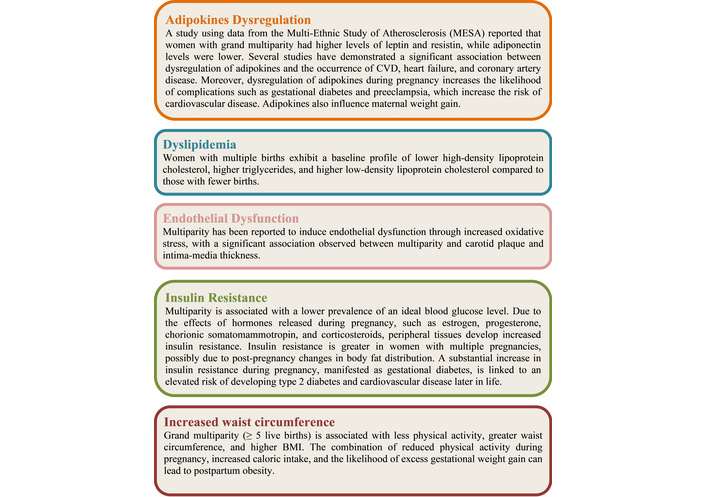
Pathophysiology of increased cardiovascular disease (CVD) risk in women with multiparity.
It is important to note that much of the mechanistic evidence linking multiparity to cardiometabolic dysfunction is derived from non-South Asian populations; however, these pathways are consistent with the cardiometabolic phenotypes observed in South Asian women, including higher baseline insulin resistance, central adiposity, and elevated diabetes risk. Nonetheless, the relative contribution of individual mechanisms remains uncertain, and causality cannot be inferred from existing observational data. Future longitudinal studies in South Asian populations are needed to clarify the temporal relationship between repeated pregnancies, metabolic recovery, and CVD development.
Sociocultural factors play a critical role in shaping reproductive behaviors and indirectly influencing cardiovascular risk among South Asian women. Evidence suggests that multiparity is associated with CVD risk in fathers as well, highlighting the contribution of shared lifestyle factors, such as reduced physical activity after parenthood [29].
Cultural norms such as son preference, early marriage, and traditional gender roles often encourage continued childbearing until a male child is born, contributing to higher parity [30]. Limited female autonomy and restricted access to education and healthcare further constrain women’s ability to make informed decisions regarding family size and contraception [31, 32].
Education and literacy are important modifiers of reproductive behavior. Key sociocultural determinants influencing parity patterns and downstream cardiovascular risk in South Asian women are summarized in Table 2. In 2022, the adult female literacy rate in South Asia was approximately 67% [33]. Lower educational attainment has been associated with reduced contraceptive use and poorer cardiometabolic health behaviors. Contraceptive prevalence in South Asia remains lower than in high-income countries, with sociocultural acceptance playing a major role alongside healthcare access [31, 32]. Rather than functioning as independent risk factors, these sociocultural determinants interact with biological mechanisms by increasing exposure to repeated pregnancies and cumulative metabolic stress.
Socio-cultural determinants of parity and their influence on cardiovascular risk in South Asian women.
| Socio-cultural factor | Mechanism influencing parity | Evidence/Quantitative data | Downstream biological effect | Reference |
|---|---|---|---|---|
| Son preference | Couples continue childbearing until a male child is born | Observational data: women often have additional pregnancies if there is no male child; fertility persists until a son is born | Increased parity → cumulative metabolic stress, insulin resistance, obesity → higher CVD risk | [30] |
| Low female autonomy | Limited decision-making about contraception and family size | Odds ratio 0.72 for contraceptive use among women with low autonomy | Higher parity → obesity, metabolic syndrome, dyslipidemia → CVD | [32] |
| Limited education/literacy | Reduced awareness of family planning and health practices | Adult female literacy rate: 67% in South Asia (2022) | Higher parity → poor maternal health behaviors → insulin resistance, increased BMI → CVD | [33] |
| Rural residence/limited access to healthcare | Fewer opportunities for family planning counseling and services | Contraceptive prevalence: 50% in rural vs. 70% in urban areas | Higher parity → cumulative pregnancies → obesity, dyslipidemia → increased CVD risk | [31] |
| Traditional gender roles | Social expectations prioritize childbearing and homemaking over education/work | Qualitative data from South Asian surveys | Higher parity → limited physical activity and postpartum weight retention → CVD risk | [34] |
CVD: cardiovascular disease.
This review aimed to evaluate whether multiparity is associated with CVD in South Asian women. Overall, global evidence supports a positive association between higher parity and CVD risk, while data from South Asia remain limited and heterogeneous. Studies from India, Bangladesh, and Nepal suggest increased risk of obesity, metabolic syndrome, hypertension, and coronary heart disease among women with four or more births, whereas lower parity levels may not confer similar risk and may even appear protective in some contexts. These findings underscore the likelihood of nonlinear associations influenced by confounding and contextual factors.
Recognizing multiparity as a potential marker of cardiovascular risk may aid in identifying women who could benefit from earlier screening for hypertension, diabetes, and dyslipidemia. However, biological mechanisms alone do not fully explain observed patterns. Sociocultural determinants—including gender norms, education, and access to family planning—shape parity trajectories and may amplify long-term cardiometabolic risk. Future research should explicitly integrate biological and sociocultural frameworks rather than addressing these domains in isolation.
In summary, further research is needed to explore how multiparity affects CVD in South Asian women and the contributing biological and sociocultural factors. The findings of such studies would help formulate culturally tailored and gender-sensitive interventions for females in South Asian countries.
Future research should prioritize longitudinal cohort studies in South Asian populations to clarify causal pathways linking multiparity and CVD, with particular attention to metabolic, inflammatory, and hormonal mechanisms. Existing regional evidence is largely cross-sectional, employs variable definitions of parity, and often lacks adequate adjustment for confounders. Establishing region-specific cohorts and incorporating parity into cardiovascular risk assessment may support more precise, gender-sensitive prevention strategies for South Asian women.
CVD: cardiovascular disease
FF: Conceptualization, Writing—original draft. SSBZ: Writing—original draft. M Amin: Writing—original draft. M Asif: Writing—original draft. SB: Writing—review & editing. FB: Writing—review & editing, Funding acquisition. ZS: Conceptualization. All authors read and approved the submitted version.
The authors declare no conflicts of interest.
Not applicable.
Not applicable.
Not applicable.
Not applicable.
Farhala Baloch is a Fogarty Fellow of the Fogarty International Center of the National Institutes of Health under award [#D43TW011625]. The funders had no role in study design, data collection and analysis, decision to publish, or preparation of the manuscript.
© The Author(s) 2026.
Open Exploration maintains a neutral stance on jurisdictional claims in published institutional affiliations and maps. All opinions expressed in this article are the personal views of the author(s) and do not represent the stance of the editorial team or the publisher.
Copyright: © The Author(s) 2026. This is an Open Access article licensed under a Creative Commons Attribution 4.0 International License (https://creativecommons.org/licenses/by/4.0/), which permits unrestricted use, sharing, adaptation, distribution and reproduction in any medium or format, for any purpose, even commercially, as long as you give appropriate credit to the original author(s) and the source, provide a link to the Creative Commons license, and indicate if changes were made.



View: 1196
Download: 26
Times Cited: 0
Johanna A. van der Zande ... Jerome M. J. Cornette
Kazim Raza Talpur ... Muhammad Waleed Abdullah
Jingwen Guo, Xueying Wang


