Original Article


Affiliation:
1Faculty of Food Science and Nutrition, Universiti Malaysia Sabah, Kota Kinabalu, Sabah 88400, Malaysia

Affiliation:
1Faculty of Food Science and Nutrition, Universiti Malaysia Sabah, Kota Kinabalu, Sabah 88400, Malaysia
ORCID: https://orcid.org/0009-0008-5299-1447
 ,
,
Affiliation:
1Faculty of Food Science and Nutrition, Universiti Malaysia Sabah, Kota Kinabalu, Sabah 88400, Malaysia
ORCID: https://orcid.org/0000-0001-7512-7397
,
Affiliation:
1Faculty of Food Science and Nutrition, Universiti Malaysia Sabah, Kota Kinabalu, Sabah 88400, Malaysia
ORCID: https://orcid.org/0000-0001-8637-5257
,
Affiliation:
1Faculty of Food Science and Nutrition, Universiti Malaysia Sabah, Kota Kinabalu, Sabah 88400, Malaysia
ORCID: https://orcid.org/0000-0002-2496-829X
,
Affiliation:
1Faculty of Food Science and Nutrition, Universiti Malaysia Sabah, Kota Kinabalu, Sabah 88400, Malaysia
ORCID: https://orcid.org/0000-0002-6682-207X
,
Affiliation:
1Faculty of Food Science and Nutrition, Universiti Malaysia Sabah, Kota Kinabalu, Sabah 88400, Malaysia
ORCID: https://orcid.org/0000-0002-5976-2427
,
Affiliation:
2Faculty of Chemical Engineering & Technology, Universiti Malaysia Perlis, Arau, Perlis 02600, Malaysia
ORCID: https://orcid.org/0000-0001-6517-048X
,
Affiliation:
3Faculty of Fisheries and Marine Science, Universitas Brawijaya, Malang, East Java 65145, Indonesia
ORCID: https://orcid.org/0000-0001-7121-4055
,
Affiliation:
4Higher Institution Centers of Excellence (HICoE) Institut Marin Borneo, Universiti Malaysia Sabah, Kota Kinabalu, Sabah 88400, Malaysia
ORCID: https://orcid.org/0000-0002-7411-6036
,
Affiliation:
1Faculty of Food Science and Nutrition, Universiti Malaysia Sabah, Kota Kinabalu, Sabah 88400, Malaysia
Email: hazim.aziz@ums.edu.my
ORCID: https://orcid.org/0000-0003-4143-4975

Explor Foods Foodomics. 2026;4:1010123 DOI: https://doi.org/10.37349/eff.2026.1010123
Received: January 16, 2026 Accepted: March 06, 2026 Published: March 17, 2026
Academic Editor: Noureddine Benkeblia, University of Life Sciences, Jamaica
Aim: This study aimed to develop a corn-based instant cereal enriched with chickpea and carrot using drum drying, and to evaluate the effects of formulation on nutritional composition, functional properties, colour characteristics, sensory acceptability, and short-term storage stability.
Methods: Five formulations were prepared by varying chickpea (0–40%) and carrot (0–40%) proportions. Proximate composition, total dietary fibre (TDF), antioxidant activity (DPPH assay), colour parameters, sensory acceptability (9-point hedonic scale, n = 50), and water activity (aw) during 28 days of storage were analyzed.
Results: Moisture content ranged from 6.32 ± 0.11% to 10.42 ± 0.20%, while protein content increased significantly from 0.63 ± 0.08% (control) to 18.66 ± 0.36% with 40% chickpea incorporation. TDF ranged from 19.81 ± 0.41% to 26.66 ± 0.71%. DPPH radical scavenging activity increased with extract concentration (10–50 mg/mL), with the 40% chickpea formulation exhibiting higher inhibition (70.61 ± 3.50%–83.14 ± 0.23%) compared to the control (64.17 ± 0.14%–82.64 ± 0.16%). Sensory overall acceptability scores (9-point hedonic scale, n = 50) ranged from 4.62 ± 2.16 to 5.92 ± 1.81, with the highest score observed in the 40% chickpea formulation. aw remained low (0.602–0.614) during 28 days of storage, indicating favourable stability.
Conclusions: Chickpea fortification significantly enhanced protein, dietary fibre, antioxidant capacity, and sensory acceptability of corn-based instant cereal without compromising storage stability, supporting its potential as a functional food product.
The increasing demand for nutritious and convenient food products has driven the development of functional instant cereals enriched with plant-based ingredients [1]. Cereal-based products are traditionally consumed as a staple food worldwide, primarily due to their high carbohydrate content and ease of preparation. However, conventional cereals often fall short in essential nutrients like protein, dietary fiber, and bioactive compounds. Yasmeen et al. [2] found that commonly consumed pulses such as mash beans, lentils, mung beans, and chickpeas had significantly higher protein and dietary fibre content than cereal grains like wheat, maize, oat, and barley. To address these nutritional gaps, the incorporation of legumes and vegetables has been explored to enhance both the nutritional and functional properties of instant cereal formulations.
Chickpea (Cicer arietinum L.) has attracted attention in cereal product development due to its high protein content, beneficial fatty acid composition, and notable levels of bioactive compounds. Studies have reported that chickpea protein ranges from 18–21% in raw seeds and contributes significantly to dietary quality [3]. Chickpeas are nutritionally rich, containing polyunsaturated fatty acids, particularly linoleic and oleic acids, along with soluble and insoluble dietary fibre and antioxidant peptides derived from protein hydrolysates that exhibit strong radical-scavenging activity [4]. Likewise, vegetables such as carrot (Daucus carota) and corn (Zea mays) provide carbohydrates, natural pigments, and antioxidant compounds including β-carotene and phenolics [5]. Combining cereals, legumes, and vegetables thus offers a promising strategy to develop instant foods with improved nutrient density and enhanced functional properties.
Processing technology plays a crucial role in determining the nutritional and sensory quality of such products. Drum drying is one of the most widely used methods for producing instant cereals, as it effectively reduces moisture while maintaining desirable texture, solubility, and shelf stability [6]. Nevertheless, thermal processing may also induce changes in color and flavor due to Maillard reactions or pigment degradation, which may affect consumer acceptance [7]. Therefore, evaluating physicochemical and sensory properties is essential to identify formulations that balance enhanced nutritional quality with consumer-preferred attributes.
Drum drying is a thin-film thermal process that can substantially modify ingredient functionality due to rapid heat transfer and short residence times. For protein-rich formulations, process conditions such as feed moisture, drum speed, and heating intensity can alter protein conformation and solubility, which in turn affects dispersion, viscosity, and reconstitution behaviour in instant products. For example, drum-drying process variables have been shown to significantly influence protein solubility and other techno-functional properties (e.g., foaming and absorption capacities), indicating that drum drying can meaningfully change protein functionality depending on operating conditions [8].
Thermal drying can also affect colour and bioactive compounds in vegetable/legume blends. Carotenoids are susceptible to heat- and oxygen-driven degradation; the flat, thin geometry of drum-dried materials may increase surface exposure and accelerate β-carotene breakdown compared with other dried forms, highlighting the need to consider pigment stability when drum drying carotenoid-rich ingredients such as carrot [9]. In broader evaluations of shelf-stable vegetable powders, drum drying has been reported to cause measurable changes in carotenoid-related attributes (with losses dependent on matrix and processing), reinforcing that drying method and intensity can affect pigment retention [10].
In addition, heating during drying can influence antioxidant capacity through a balance of degradation and formation reactions. Phenolic compounds may decrease with thermal treatment, while Maillard reaction products—particularly melanoidins—can contribute appreciably to antioxidant activity; multiple studies on thermally processed foods report melanoidin fractions exhibiting antioxidant activity and evolving with processing/storage conditions [11]. These compositional changes may also impact sensory properties, as controlled thermal reactions can generate desirable “toasted” or “cooked” notes and colour development, while excessive heating may promote bitterness or off-notes. Therefore, formulation (e.g., chickpea level) and drum-drying intensity should be considered jointly when optimizing both nutritional functionality and sensory acceptability of instant cereal products [8].
Beyond basic nutritional composition and sensory attributes, functional properties such as antioxidant activity and storage stability are critical indicators of product quality. Chickpea-derived peptides exhibited dose-dependent antioxidant capacity, which may contribute to reducing oxidative stress when incorporated into food systems [12]. Additionally, water activity (aw) plays a key role in microbial stability and shelf life of cereal products. Maintaining aw below 0.65 is essential to prevent microbial growth and ensure product safety during storage [13].
Despite increasing interest in legume-fortified cereal products, limited studies have systematically evaluated the quantitative impact of graded chickpea substitution on the nutritional composition, antioxidant capacity, sensory acceptance, and short-term storage stability of drum-dried corn-based instant cereals. In particular, the relationship between chickpea incorporation level and changes in protein enrichment, dietary fibre enhancement, antioxidant activity, and aw during storage has not been clearly established.
Therefore, this study aimed to quantitatively evaluate the effect of increasing chickpea substitution levels (0–40%) in a corn-based instant cereal enriched with carrot and processed by drum drying on proximate composition, total dietary fibre (TDF), antioxidant activity, sensory acceptability, and aw during storage.
The primary raw ingredients were corn kernels, chickpeas, and carrots, purchased from a local market in Kota Kinabalu, Sabah. Corn kernels were cleaned, blended with water, and processed into a smooth purée. Fresh carrots were washed thoroughly, peeled, shredded, blanched for 3 min, and blended into a purée. Chickpeas were soaked for 8 to 12 h, boiled until soft, and blended to obtain a purée. The carrot, chickpea, and corn purées were mixed in different proportions according to the formulations presented in Table 1, along with 20% water to facilitate uniform spreading during drum drying. The formulation design was constructed to isolate the effect of replacing carrot with chickpea while maintaining a constant cereal base. Corn was fixed at 40% in formulations A–E to provide a consistent starch matrix required for film formation during drum drying and for comparable reconstitution behaviour across samples. Chickpea substitution was increased stepwise from 0% to 40% (in 10% increments), while carrot was decreased correspondingly from 40% to 0%, keeping the total purée solids (80%) and added water (20%) constant. This design allowed a systematic evaluation of chickpea levels on nutritional composition, functional properties, sensory acceptance, and aw stability without confounding effects from changing the corn proportion. Five formulations were selected to provide a practical gradient (low-medium-high chickpea) commonly used in product development and sufficient resolution to identify an optimum formulation, alongside a positive control (100% corn purée) for baseline comparison. A positive control containing 100% corn purée (0% carrot, 0% chickpea) was prepared for comparison. In total, five formulations (A–E) were developed by systematically varying the proportions of carrot and chickpea.
Formulations of instant cereal with a constant corn base (40%) and graded chickpea substitution (0–40%) with complementary carrot reduction.
| Ingredient | Formulations | |||||
|---|---|---|---|---|---|---|
| Control | A | B | C | D | E | |
| Carrot (%) | 0 | 40 | 30 | 20 | 10 | 0 |
| Chickpea (%) | 0 | 0 | 10 | 20 | 30 | 40 |
| Corn (%) | 80 | 40 | 40 | 40 | 40 | 40 |
| Water (%) | 20 | 20 | 20 | 20 | 20 | 20 |
| Total (%) | 100 | 100 | 100 | 100 | 100 | 100 |
All formulations were processed using a twin drum dryer (Model AM-2530/10, Agridon Sdn. Bhd., Malaysia). The drum rotation speed was fixed at 3 rpm and the product film was removed using a stainless-steel scraper, cooled to ambient temperature, and ground into powder. The system was operated under stable boiler conditions, and the drum surface temperature was maintained according to the equipment set point; however, drum gap, steam pressure, feed total solids content, and continuous surface temperature profiling were not logged during the experimental runs. To ensure comparability among formulations, all processing settings (drum speed, feeding/spreading procedure, and scraping conditions) were kept constant across batches, and all samples were processed using the same equipment and operational configuration.
The instant vegetable cereal formulations were analyzed for proximate composition using the Association of Official Analytical Chemists (AOAC) methods, including moisture content (AOAC 925.10), fat content (AOAC 920.85), and ash content (AOAC 923.03). Protein content was determined by the Kjeldahl method (AOAC 920.87) and calculated as %N × 6.25; results are reported on a dry basis for all formulations. Carbohydrate content was calculated by difference according to Equation 1:
All analyzes were performed in duplicate, and results were expressed as mean ± standard deviation (SD).
Colour parameters (L*, a*, b*) were determined using a HunterLab Colorimeter (HunterLab, USA) according to the method described by Ishak et al. [14]. L* represents lightness, a* indicates redness, and b* denotes yellowness. Measurements were conducted both before and after drum drying to assess colour changes, and results were expressed as mean ± SD of duplicate readings. Overall colour difference (ΔE*ab, CIE76) between the pre- and post-drum-drying samples was calculated according to Equation 2:
where ΔL*, Δa*, and Δb* represent the differences between colour coordinates before and after drum drying. The ΔE*ab metric is based on the CIE76 colour difference model.
Total dietary fiber content of the instant vegetable cereal was determined using AOAC Method 985.29. Analytical repeatability was evaluated from duplicate determinations and expressed as SD. Given the enzymatic-gravimetric nature of AOAC 985.29, variability may arise from enzymatic digestion efficiency, filtration/transfer losses, and sample heterogeneity.
Sensory evaluation was conducted using a 9-point hedonic scale (1 = dislike extremely, 9 = like extremely) with 50 untrained volunteer panelists recruited from students at Universiti Malaysia Sabah. Panelists were adults (≥ 18 years old) who provided informed consent prior to participation. Individuals with known allergies or intolerances to corn, chickpea, or carrot were excluded from the evaluation.
Samples were prepared using the same reconstitution procedure and served in identical containers labeled with random three-digit codes to ensure blind evaluation. The serving order of samples was randomized for each panelist to minimize order bias. Testing was conducted under controlled indoor lighting conditions at room temperature. Panelists were instructed not to discuss their evaluations during testing and were provided with water to rinse their mouths between samples. Attributes evaluated included colour, aroma, appearance, taste, and overall acceptability.
The antioxidant activity of each sample was assessed using the 2,2-diphenyl-1-picrylhydrazyl (DPPH) radical scavenging method described by Khurun Hizar et al. [15] with minor modifications. Approximately 1.00 ± 0.05 g of powdered sample was extracted with 25 mL of methanol (solid-to-solvent ratio of 1:25, w/v) and agitated for 30 min at room temperature, followed by centrifugation at 6,000 rpm for 15 min. Aliquots of the supernatant (1–5 mL) were diluted to 10 mL with 95% methanol, mixed with 3.0 mL of 0.1 mM DPPH solution. The reaction mixture was incubated in the dark for 30 min at room temperature before measuring absorbance at 517 nm using a UV-Vis spectrophotometer (Shimadzu UV-1800, Japan). Radical scavenging activity was calculated as a percentage inhibition using Equation 3. Results were expressed as % DPPH radical scavenging activity at extract concentrations ranging from 10 to 50 mg/mL. IC50 values were not determined in this study.
Where Abscontrol is the absorbance of a blank sample, Abssample is the absorbance of the sample. All analyzes were performed in duplicate, and results were expressed as mean ± SD.
The best-performing formulation (E) was subjected to short-term storage stability evaluation by monitoring aw over 28 days at room temperature (~25°C). aw is a critical parameter influencing microbial growth and overall stability in low-moisture cereal-based products. Although aw alone does not fully characterize shelf-life, it provides an important preliminary indicator of microbiological safety and moisture-related changes. Measurements were conducted on days 1, 7, 14, 21, and 28. Measurements were performed using a ROTRONIC Hygrolab 3 aw meter (Switzerland) under controlled temperature conditions. Each analysis was conducted in duplicate, and results were expressed as mean ± SD.
All measurements were performed in duplicate (n = 2). Data were analyzed using one-way analysis of variance (ANOVA) with Tukey’s post-hoc test at p < 0.05. Given the limited replication, statistical inferences were interpreted cautiously, and emphasis was placed on consistent formulation-dependent trends and effect sizes. Statistical analysis was carried out using SPSS Statistics version 29.0.
The proximate composition of the instant vegetable cereal formulations, including moisture, ash, fat, protein, and carbohydrate contents, is summarised in Table 2. The moisture content of the instant vegetable cereal ranged from 6.32% to 10.42%. Formulations C, D, and E exhibited significantly lower (p < 0.05) moisture values compared with the control and formulation A. All samples recorded moisture content below the recommended safe limit.
Proximate composition of instant vegetable cereal.
| Sample | Moisture content (%) | Ash content (%) | Fat content (%) | Protein content (%) | Carbohydrate content (%) |
|---|---|---|---|---|---|
| Control | 10.04 ± 0.31d | 2.68 ± 0.07a | 3.62 ± 0.18ab | 0.63 ± 0.08a | 81.70 ± 1.88b |
| A | 10.42 ± 0.20d | 3.37 ± 0.42a | 2.77 ± 0.35ab | 0.44 ± 0.05a | 81.79 ± 1.71b |
| B | 8.69 ± 0.11c | 2.95 ± 0.16a | 4.05 ± 0.87ab | 0.79 ± 0.02a | 81.26 ± 3.19b |
| C | 7.44 ± 0.03b | 3.04 ± 0.18a | 3.80 ± 0.05ab | 16.56 ± 0.64b | 69.07 ± 0.13a |
| D | 7.64 ± 0.16b | 3.24 ± 0.45a | 3.81 ± 0.16ab | 17.63 ± 0.15bc | 68.34 ± 0.93a |
| E | 6.32 ± 0.11a | 3.08 ± 0.21a | 4.46 ± 0.27b | 18.66 ± 0.36c | 66.98 ± 0.69a |
Different superscript letters in the same column indicate significant differences (p < 0.05) according to Tukey’s test.
Ash content varied between 2.68% and 3.37%, with no significant differences (p > 0.05) among formulations. Fat content ranged from 2.77% to 4.46%, with formulation E showing a significantly higher (p < 0.05) fat content compared to formulations containing lower chickpea proportions. Protein content increased significantly from 0.63% ± 0.08% (control) to 18.66% ± 0.36% (formulation E). Conversely, carbohydrate content decreased significantly (p < 0.05) with increasing chickpea substitution, ranging from 81.79% to 66.98%. Overall, the compositional data indicate a clear trend associated with increasing chickpea incorporation across the formulations.
TDF ranged from 19.81% ± 0.41% (control) to 26.66 ± 0.71% (formulation E), as presented in Table 3. Although the mean values increased with higher chickpea incorporation, the differences were not statistically significant (p > 0.05). This outcome is attributable to the limited replication (n = 2) and relatively high within-group variability in certain formulations (e.g., formulation A), which reduced ANOVA power despite an apparent difference in means. The observed trend nevertheless suggests that chickpea addition contributed to a higher fibre content, consistent with the compositional profile of legumes.
Total dietary fibre content for all formulations of instant vegetable cereal.
| Sample | Total dietary fiber (%) |
|---|---|
| Control | 19.81 ± 0.41a |
| A | 23.54 ± 4.18a |
| B | 24.63 ± 1.30a |
| C | 26.21 ± 0.92a |
| D | 24.37 ± 0.18a |
| E | 26.66 ± 0.71a |
Different superscript letters in the same column indicate significant differences (p < 0.05) according to Tukey’s test.
Colour parameters (L*, a*, and b*) of the formulations before and after drum drying are shown in Table 4. A significant decrease (p < 0.05) in L* values was observed after drum drying across all formulations. The a* and b* values remained positive after drying, indicating the retention of red and yellow colour components. These physicochemical parameters provide important indicators of product quality following drum drying.
Colour of all formulations of instant vegetable cereal before and after drum drying.
| Sample | Colour before drum drying | Colour after drum drying | ΔE*ab | ||||
|---|---|---|---|---|---|---|---|
| L* | a* | b* | L* | a* | b* | ||
| Control | 84.86 ± 0.09f | 3.02 ± 0.01b | 33.71 ± 0.12e | 52.95 ± 0.07b | 14.34 ± 0.35c | 34.25 ± 0.37c | 33.87 |
| A | 67.80 ± 0.05a | 31.11 ± 0.06f | 48.22 ± 0.19f | 56.00 ± 0.15e | 19.12 ± 0.04f | 45.40 ± 0.23f | 17.06 |
| B | 73.53 ± 0.06b | 22.06 ± 0.01e | 29.98 ± 0.08d | 53.97 ± 0.14c | 15.32 ± 0.12d | 37.84 ± 0.15e | 22.13 |
| C | 76.82 ± 0.04c | 18.43 ± 0.02d | 25.63 ± 0.02b | 54.91 ± 0.15d | 13.72 ± 0.09b | 35.66 ± 0.36d | 24.55 |
| D | 78.74 ± 0.03d | 15.21 ± 0.02c | 26.12 ± 0.04c | 46.80 ± 0.01a | 17.13 ± 0.04e | 28.69 ± 0.06a | 32.10 |
| E | 84.66 ± 0.04e | 1.99 ± 0.04a | 20.34 ± 0.04a | 64.08 ± 0.01f | 8.89 ± 0.02a | 32.37 ± 0.02b | 24.82 |
Different superscript letters in the same column indicate significant differences (p < 0.05) according to Tukey’s test.
The overall colour difference (ΔE*ab) between samples before and after drum drying was calculated using the CIE76 equation. ΔE*ab values ranged from 17.06 (formulation A) to 33.87 (control), indicating substantial colour changes following drum drying. All formulations exhibited ΔE*ab values well above the commonly reported perceptibility threshold (ΔE ~2–3), confirming that the colour differences would be clearly noticeable to consumers. The colour shift was primarily driven by a marked decrease in lightness (ΔL* = −11.80 to −31.91), suggesting significant darkening during thermal processing.
The sensory evaluation results are presented in Figure 1 [variability (± SD) and statistical groupings are presented in Table 5]. Sensory attributes were analyzed using one-way ANOVA followed by Tukey’s test (p < 0.05). Significant differences were observed for colour, aroma, taste, and overall acceptability among formulations, while appearance showed no significant differences (p > 0.05).
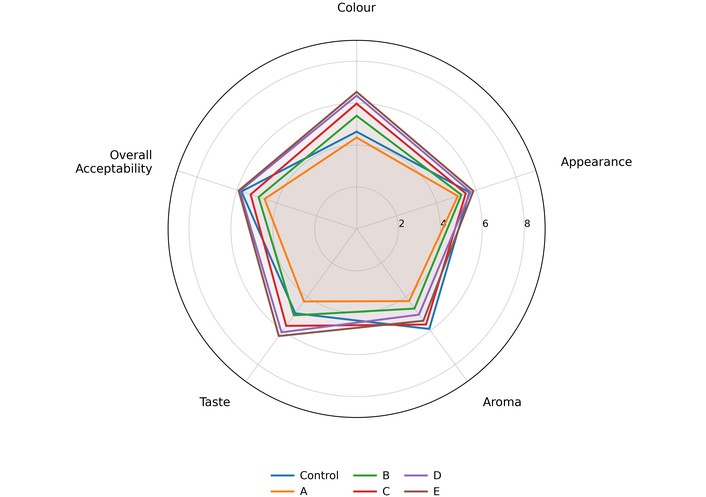
Sensory evaluation results. The spider chart displays mean values; variability (± SD) and statistical groupings are presented in Table 5.
Sensory evaluation results (mean ± SD) for corn-based instant cereal formulations (n = 50).
| Attributes | Formulation | |||||
|---|---|---|---|---|---|---|
| Control | A | B | C | D | E | |
| Colour | 4.64 ± 2.11a | 4.36 ± 2.10a | 5.40 ± 1.84ab | 5.98 ± 1.81bc | 6.36 ± 1.48bc | 6.54 ± 1.49c |
| Appearance | 5.66 ± 1.67a | 5.08 ± 2.03a | 5.26 ± 1.82a | 5.48 ± 1.48a | 5.72 ± 1.56a | 5.86 ± 1.55a |
| Aroma | 5.90 ± 1.83c | 4.26 ± 2.41a | 4.70 ± 1.84ab | 5.64 ± 1.67bc | 5.06 ± 1.71abc | 5.42 ± 1.83bc |
| Taste | 4.98 ± 2.01ab | 4.28 ± 1.91a | 5.10 ± 1.85abc | 5.72 ± 1.69bcd | 6.10 ± 1.68cd | 6.32 ± 1.62d |
| Overall acceptability | 5.78 ± 1.71b | 4.62 ± 2.16a | 4.92 ± 1.90ab | 5.32 ± 1.58ab | 5.86 ± 1.41b | 5.92 ± 1.81b |
Different letters indicate significant differences (p < 0.05).
For overall acceptability, formulation E recorded the highest mean score (5.92 ± 1.81), which was significantly higher than formulation A (4.62 ± 2.16). The 95% confidence interval for formulation E ranged from 5.41 to 6.44, indicating moderate variability but consistent consumer preference. Similar trends were observed for taste, where formulation E (6.32 ± 1.62) differed significantly from formulation A.
DPPH radical scavenging activity increased with extract concentration for both samples, as presented in Figure 2. Formulation E exhibited significantly higher inhibition percentages than the control at lower concentrations (10–30 mg/mL) (p < 0.05), indicating enhanced antioxidant potential due to chickpea incorporation. However, at higher concentrations (40–50 mg/mL), no significant differences were observed, suggesting a plateau effect in radical scavenging activity. These findings indicate that chickpea enrichment improves antioxidant performance, particularly at lower extract concentrations.
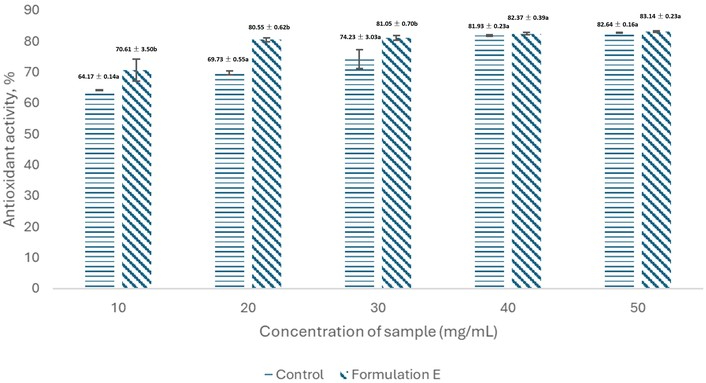
DPPH radical scavenging activity (% inhibition) of control and formulation E at different concentrations. Bars represent mean ± SD (n = 2). Different letters at the same concentration indicate significant differences (p < 0.05). DPPH: 2,2-diphenyl-1-picrylhydrazyl.
The aw values of formulation E during 28 days of storage are presented in Table 6. A gradual increase in aw was observed over the storage period, from 0.602 ± 0.01 on day 1 to 0.614 ± 0.01 on day 28. All values remained below 0.65 throughout storage.
Water activity of formulation E.
| Storage period (days) | Water activity (aw) |
|---|---|
| 1 | 0.602 ± 0.01a |
| 7 | 0.603 ± 0.01a |
| 14 | 0.606 ± 0.02ab |
| 21 | 0.610 ± 0.01bc |
| 28 | 0.614 ± 0.01c |
Different superscript letters in the same column indicate significant differences (p < 0.05) according to Tukey’s test.
The progressive changes observed in proximate composition across the formulations clearly demonstrate the influence of chickpea substitution on the nutritional profile of the instant vegetable cereal. Moisture content in all formulations remained below the recommended safe limit of 11.5%, as reported by Befikadu [16], indicating effective dehydration through drum drying and suitability for storage. According to Bala [17], cereal products exceeding 14% moisture are susceptible to microbial growth and insect infestation; therefore, the moisture levels achieved in this study confirm the microbiological safety of all formulations.
Ash content values were slightly higher than those reported for vegetable-based instant cereals formulated with red amaranth, corn, barley, and pineapple [5]. This increase can be attributed to the mineral contribution of chickpea and carrot, as ash content is commonly used as an indirect indicator of total mineral content in food products [18]. Although differences among formulations were not statistically significant, the observed values suggest that legume incorporation enhances the micronutrient density of cereal-based products.
Fat content increased significantly with higher chickpea inclusion, particularly in formulation E. This trend is consistent with the lipid composition of chickpea, which contains a substantial proportion of polyunsaturated and monounsaturated fatty acids [19, 20]. From a nutritional standpoint, the enrichment of unsaturated fatty acids may improve the overall lipid quality of the cereal, contributing to its functional food value.
Protein content showed the most pronounced change among all proximate components, increasing from 0.63% in the control to 18.66% in formulation E. This substantial improvement reflects the naturally high protein content of chickpea seeds (18–21%) [21] and confirms the effectiveness of chickpea as a protein-enriching ingredient in cereal formulations. Additionally, thermal processing during drum drying may promote partial protein denaturation, which has been reported to improve protein digestibility [22], further enhancing the nutritional quality of the product.
Conversely, the significant reduction in carbohydrate content with increasing chickpea substitution reflects the compositional shift from starch-rich corn to fibre- and protein-rich chickpea and carrot. Conventional cereal-based products are generally rich in starch and carbohydrates, often exceeding 70% depending on the cereal type. The reduced carbohydrate levels observed in formulations with higher chickpea content, therefore, represent a nutritional advantage, particularly for consumers seeking products with moderated carbohydrate intake.
Overall, the proximate composition results indicate that chickpea substitution effectively improves protein, fat quality, and mineral content while reducing carbohydrate levels, without compromising product safety. These compositional improvements support the development of nutritionally enhanced instant vegetable cereals with improved functional potential.
The increase in TDF observed with higher chickpea incorporation reflects the inherently higher fibre content of legumes compared with cereal grains. Chickpea contains both soluble and insoluble dietary fibre fractions, which contribute to bulking effects and physiological functionality when incorporated into cereal-based products. The gradual rise in fibre content across formulations, although not statistically significant, is consistent with the formulation trend and confirms the contribution of chickpea as a fibre-enriching ingredient, as also reported by Ishak et al. [5].
From a nutritional perspective, increased dietary fibre intake has been widely associated with improved gastrointestinal health, enhanced satiety, and a reduced risk of chronic diseases such as cardiovascular disease and type 2 diabetes [23, 24]. The fibre levels achieved in the chickpea-fortified formulations therefore enhance the functional value of the instant vegetable cereal beyond basic macronutrient provision. Importantly, the drum drying process did not appear to adversely affect fibre retention, indicating that this thermal technique is suitable for producing fibre-enriched instant cereal products.
The significant reduction in lightness (L*) values observed after drum drying indicates the development of darker colour tones, which is a common effect of thermal processing in cereal- and vegetable-based products. This change is primarily attributed to pigment concentration following moisture removal, as well as the occurrence of non-enzymatic browning reactions, particularly the Maillard reaction between reducing sugars and amino acids during heating. Similar colour changes associated with melanoidin formation during thermal treatment have been reported by Schutte et al. [25].
The persistence of positive a* (redness) and b* (yellowness) values after drum drying suggests that carotenoid pigments from carrot and corn were partially retained despite exposure to elevated temperatures. This retention is desirable, as these pigments contribute not only to visual appeal but also to the perceived naturalness of vegetable-based products. According to Starowicz and Zieliński [7], moderate non-enzymatic browning can enhance colour acceptability by imparting a golden-brown appearance without negatively affecting consumer perception. Overall, the colour changes induced by drum drying reflect a balance between thermal effects and pigment stability, resulting in visually acceptable products that align with consumer expectations for instant cereal formulations.
The high ΔE*ab values (17.06–33.87) confirm that drum drying induced visually perceptible colour changes. ΔE*ab values exceeding 2–3 are generally considered detectable by the human eye, while values greater than 10 indicate pronounced differences [26]. The observed darkening (reduced L*) is consistent with non-enzymatic browning reactions, particularly Maillard reactions occurring during thermal processing [7]. Additionally, heat exposure may contribute to partial degradation or transformation of carotenoid pigments, influencing overall chromatic properties [27].
Sensory evaluation plays a critical role in determining the commercial feasibility of functional food products, as nutritional enhancement must be balanced with consumer acceptance. The higher sensory scores observed for formulation E indicate that increased chickpea incorporation positively influenced key sensory attributes, particularly colour, taste, and overall acceptability. Chickpea is known to impart a mild nutty flavour and improved mouthfeel, which can enhance palatability when appropriately formulated, as reported by Pushpakumara et al. [28]. The statistically significant improvements observed in colour, taste, and overall acceptability for higher chickpea formulations are supported by inferential analysis and confidence intervals. Although mean differences appear moderate numerically, the consistent statistical grouping and non-overlapping confidence intervals between extreme formulations indicate meaningful sensory differentiation among samples.
In contrast, formulations with higher carrot proportions tended to receive lower acceptability scores, likely due to the development of vegetal or earthy notes that may be less desirable in cereal-based products. Similar sensory challenges associated with carrot-enriched cereal and snack products have been reported by Baljeet et al. [29] and Alam et al. [30]. The reduced carrot content in formulation E may therefore have contributed to a more balanced flavour profile, while chickpea addition enhanced texture and flavour complexity.
Furthermore, the favourable sensory performance of formulation E suggests that drum drying did not adversely affect flavour perception, despite the application of thermal processing. Controlled drum drying may facilitate desirable flavour development through mild Maillard reactions while limiting excessive thermal degradation, thereby preserving sensory quality. Overall, the sensory results demonstrate that chickpea fortification can be successfully implemented without compromising consumer acceptance, supporting its suitability for instant cereal formulation.
The antioxidant activity of the instant vegetable cereal exhibited a clear concentration-dependent increase, which is a characteristic response of the DPPH radical scavenging assay [31]. The consistently higher scavenging activity observed in formulation E compared to the control across all tested concentrations highlights the functional contribution of chickpea incorporation. Chickpea is known to contain phenolic compounds and bioactive peptides capable of donating hydrogen or electrons to neutralize free radicals, thereby enhancing antioxidant capacity [5, 12].
At lower extract concentrations, formulation E demonstrated significantly greater antioxidant activity than the control, indicating improved scavenging efficiency when antioxidant compounds are present in limited amounts. This finding is particularly relevant from a nutritional standpoint, as it suggests that chickpea enrichment enhances antioxidant effectiveness even at moderate intake levels. Similar improvements in antioxidant performance at lower concentrations have been reported in legume-fortified cereal products.
At higher extract concentrations, both samples approached a plateau in scavenging activity, with no significant differences observed between formulation E and the control. This phenomenon is commonly attributed to saturation of available DPPH radicals, where further increases in antioxidant concentration result in minimal additional scavenging. Since total phenolic content, specific phenolic profiles, or peptide fractions were not determined in this study, the mechanistic contribution of individual antioxidant compounds cannot be confirmed and warrants further investigation. The observed saturation behaviour confirms that the assay response was governed by reaction kinetics rather than limitations in antioxidant availability. Overall, the enhanced antioxidant activity of formulation E reinforces the functional food potential of chickpea-fortified instant vegetable cereal and supports the role of legume incorporation in improving the health-promoting properties of cereal-based products.
aw is a critical determinant of microbial stability, chemical reactivity, and shelf life in low-moisture food systems. The gradual increase in aw observed during storage of formulation E likely reflects moisture sorption from the surrounding environment, a common phenomenon in dried cereal powders even when stored in sealed containers [32]. Factors such as packaging permeability, ambient humidity, and storage duration can influence moisture uptake over time.
Despite this increase, the aw values of formulation E remained consistently below 0.65 throughout the 28-day storage period. Maintaining aw below this threshold is widely recognized as an effective strategy for suppressing the growth of most yeasts and moulds in dried foods [13, 33]. This indicates that the product retained microbiological stability under the tested storage conditions. Additionally, pathogenic bacteria are generally unable to proliferate at aw levels below 0.85, although survival remains possible, highlighting the importance of hygienic processing and appropriate packaging [34].
The shelf stability observed in this study is consistent with previous reports on dried cereal and breakfast cereal products, where aw control was shown to be a key factor in extending storage life [35]. The results therefore demonstrate that chickpea-fortified, drum-dried instant vegetable cereal can maintain acceptable stability for at least four weeks at room temperature, supporting its potential for practical application and short-term storage.
This study has several limitations that should be acknowledged. First, analytical measurements were conducted in duplicate (n = 2), which may reduce statistical power and underestimate process and analytical variability. Second, key drum-drying parameters (e.g., drum gap, steam pressure, feed solids content, and continuously recorded drum surface temperature profiles) were not instrumentally logged during processing. Although operating conditions were maintained consistently across formulations to ensure valid comparative interpretation, more comprehensive process monitoring and increased independent replication would strengthen reproducibility and enable deeper process—quality modelling. Future work should therefore incorporate full process parameter recording and at least three independent production batches with triplicate analyzes to confirm robustness of the observed formulation effects.
This study demonstrated that graded chickpea incorporation significantly enhanced the nutritional profile and antioxidant activity of corn-based instant cereal produced by drum drying, while maintaining acceptable sensory quality. The approach offers a practical strategy for improving protein and fibre content in cereal-based products using a scalable thermal processing method.
However, limitations, including restricted replication and short-term stability assessment, highlight the need for further validation. Future research should focus on process optimization, extended shelf-life evaluation, and targeted characterization of bioactive compounds. In the context of emerging plant-based and sustainable food trends, chickpea fortification presents a promising avenue for developing functional cereal products with improved nutritional value and commercial potential.
ANOVA: analysis of variance
AOAC: Association of Official Analytical Chemists
aw: water activity
DPPH: 2,2-diphenyl-1-picrylhydrazyl
TDF: total dietary fibre
The authors gratefully acknowledge the support from the Faculty of Food Science and Nutrition, Universiti Malaysia Sabah for providing laboratory facilities and technical support.
CZY: Writing—original draft, Formal analysis. SAKH: Conceptualization, Data curation. MER: Validation, Resources. HM: Conceptualization. SFMA: Investigation, Validation. NMR: Methodology, Validation. MAA: Methodology, Validation. MSMS: Validation. AAJ: Validation. MTML: Writing—review & editing. AHAA: Writing—review & editing, Supervision, Project administration. All authors read and approved the submitted version.
The authors declare no conflicts of interest.
This study did not require ethical approval as it did not involve medical intervention, collection of personal or sensitive data, or procedures posing risk to human participants. The sensory evaluation was conducted using food products under normal consumption conditions, and participation was voluntary and anonymous, in accordance with the ethical guidelines and institutional policies of Universiti Malaysia Sabah.
Informed consent to participate in the study was obtained from all participants.
Not applicable.
Data sets are available on request.
This study was funded by Universiti Malaysia Sabah under the Skim Pensyarah Lantikan Baru research grant (SLB2242). The funder had no role in study design, data collection and analysis, decision to publish, or preparation of the manuscript.
© The Author(s) 2026.
Open Exploration maintains a neutral stance on jurisdictional claims in published institutional affiliations and maps. All opinions expressed in this article are the personal views of the author(s) and do not represent the stance of the editorial team or the publisher.
Copyright: © The Author(s) 2026. This is an Open Access article licensed under a Creative Commons Attribution 4.0 International License (https://creativecommons.org/licenses/by/4.0/), which permits unrestricted use, sharing, adaptation, distribution and reproduction in any medium or format, for any purpose, even commercially, as long as you give appropriate credit to the original author(s) and the source, provide a link to the Creative Commons license, and indicate if changes were made.