 Review


Affiliation:
1Department of Cardiovascular Medicine, The Second Affiliated Hospital of Xi’an Jiaotong University, Xi’an 710114, Shaanxi, China
†These authors share the first authorship.
ORCID: https://orcid.org/0009-0000-1664-7608

 ,
,
Affiliation:
1Department of Cardiovascular Medicine, The Second Affiliated Hospital of Xi’an Jiaotong University, Xi’an 710114, Shaanxi, China
†These authors share the first authorship.
ORCID: https://orcid.org/0009-0008-2256-3556
,
Affiliation:
1Department of Cardiovascular Medicine, The Second Affiliated Hospital of Xi’an Jiaotong University, Xi’an 710114, Shaanxi, China
†These authors share the first authorship.
ORCID: https://orcid.org/0009-0007-9146-6947
,
Affiliation:
1Department of Cardiovascular Medicine, The Second Affiliated Hospital of Xi’an Jiaotong University, Xi’an 710114, Shaanxi, China
ORCID: https://orcid.org/0009-0001-0046-1275
,
Affiliation:
1Department of Cardiovascular Medicine, The Second Affiliated Hospital of Xi’an Jiaotong University, Xi’an 710114, Shaanxi, China
ORCID: https://orcid.org/0009-0001-2935-369X
,
Affiliation:
2Institute of Cardiovascular Science, Translational Medicine Institute of Health Science Center, Xi’an Jiaotong University, Xi’an 710061, Shaanxi, China
ORCID: https://orcid.org/0000-0002-4129-8662
,
Affiliation:
1Department of Cardiovascular Medicine, The Second Affiliated Hospital of Xi’an Jiaotong University, Xi’an 710114, Shaanxi, China
Email: heart0228@xjtu.edu.cn
ORCID: https://orcid.org/0000-0002-5314-6404

Explor Endocr Metab Dis. 2026;3:101481 DOI: https://doi.org/10.37349/eemd.2026.101481
Received: May 26, 2026 Accepted: July 23, 2026 Published: August 13, 2026
Academic Editor: Myron R. Szewczuk, Queen’s University, Canada
With the rising global prevalence of obesity and type 2 diabetes, metabolic disorders have become major drivers of cardiovascular morbidity and mortality worldwide. Cardiovascular-kidney-metabolic (CKM) syndrome encompasses obesity, type 2 diabetes mellitus (T2DM), chronic kidney disease (CKD), and cardiovascular disease (CVD), all of which share common pathophysiological pathways. Glucagon-like peptide-1 receptor agonists (GLP-1RAs), a novel class of antihyperglycemic agents, have demonstrated pleiotropic effects—including weight reduction, blood pressure lowering, albuminuria reduction, decreased major adverse cardiovascular events (MACE), and slowed progression of renal dysfunction. These benefits position GLP-1RAs as a potential cornerstone therapy for CKM syndrome. This review synthesizes recent advances in GLP-1RA research within the CKM framework, explores their underlying mechanisms, and offers insights to refine diagnostic and therapeutic strategies for cardiometabolic diseases.
The global burden of overweight, obesity, and type 2 diabetes mellitus (T2DM) has intensified. Over recent decades, the surging prevalence of metabolic disorders, including T2DM and metabolic dysfunction-associated steatotic liver disease (MASLD), has significantly escalated the incidence of cardiovascular disease (CVD) and chronic kidney disease (CKD), thereby increasing overall mortality [1]. Of the 41 million annual chronic disease deaths globally, some 5 million stem directly from overweight and obesity, while the world’s diabetic population is forecast to hit 853 million (12.96% prevalence) by 2050 [2, 3]. Proposed by the American Heart Association (AHA), cardiovascular-kidney-metabolic (CKM) syndrome describes systemic multi-organ dysfunction driven by intertwined metabolic, renal and cardiovascular pathologies—including obesity, T2DM, CKD, atrial fibrillation, coronary artery disease, stroke and heart failure with preserved ejection fraction (HFpEF)—that raises risks of severe cardiovascular adverse events [4, 5]. Glucagon-like peptide-1 (GLP-1) is an incretin hormone secreted by intestinal L cells that regulates appetite and glucose homeostasis [6]. Beyond its glycemic effects, GLP-1 exerts pleiotropic cardiometabolic benefits. Over the past decade, clinical trials of GLP-1 receptor agonists (GLP-1RAs) have expanded rapidly across T2DM, obesity, CVD, and CKD, demonstrating not only glycemic efficacy but also significant improvements in weight, cardiovascular outcomes, and renal protection. Given the newly proposed AHA CKM framework that unifies these interconnected conditions, this review synthesizes recent trial evidence on GLP-1RAs across the CKM spectrum and explores the underlying mechanisms, with the goal of providing a practical reference for clinicians managing patients with cardiometabolic diseases.
The AHA has conceptualized CKM as a unified clinical entity across Stages 0–4, enabling a life-course approach to intervention [7]. Within this framework, the deployment of GLP-1RAs shifts dynamically according to disease severity. In early stages (Stages 0–1, characterized by overweight or prediabetes without organ damage), GLP-1RAs serve as preventative tools, with their primary goals being glycemic optimization and substantial weight loss, curbing systemic inflammation before irreversible injury occurs. As patients enter intermediate stages (Stages 2–3, marked by subclinical organ damage such as albuminuria or left ventricular hypertrophy), GLP-1RAs transition into therapeutic agents. Here, their value extends beyond glucose lowering to direct cardioprotection and renoprotection, slowing glomerular filtration rate decline and reducing major adverse cardiovascular events (MACE) risk [8, 9]. In advanced Stage 4 (established CVD), they function to reduce morbidity and stabilize clinical status. By integrating GLP-1RAs across this entire spectrum, clinicians can adopt a whole-system strategy that targets the underlying metabolic driver rather than isolated symptoms, representing a paradigm shift from reactive comorbidity management to proactive, stage-adapted care.
From 1990 to 2022, global obesity rose sharply in all age cohorts: adult women’s obesity rose from 8.8% to 18.5%, men from 4.8% to 14.0%, and 5–19-year-old girls/boys from 1.7%/2.1% to 6.9%/9.3%. Obesity dominates the dual malnutrition burden worldwide [10]. Research suggests that GLP-1RAs exert their weight-loss effects primarily by inhibiting the feeding center, causing visceral discomfort, increasing satiety, and decreasing appetite to reduce calorie intake [11]. In addition, GLP-1RAs can stimulate activation of the sympathetic pathway in brown adipose tissue, thereby enhancing thermogenesis and energy expenditure, leading to a redistribution of visceral fat [12, 13]. The STEP-1 study showed that overweight or obese individuals achieved an average weight loss of 14.9% after weekly injections of semaglutide at a dose of 2.4 mg for 68 weeks, compared to just 2.4% in the placebo group. Moreover, 86.4% of subjects who received semaglutide experienced at least 5% weight loss, compared to only 31.5% in the placebo group [14]. In the STEP-4 study of 803 overweight or obese participants, continuous use of semaglutide for 20 weeks and subsequent random discontinuation of treatment resulted in an average weight loss of approximately 18.2%, equivalent to an average reduction of 17.8 kg in body weight, highlighting significant benefits associated with sustained usage to achieve continuous weight loss [15]. The SUSTAIN series studies found that semaglutide resulted in an average weight loss of 10.6% in patients with T2DM, outperforming dulaglutide, canagliflozin, and liraglutide. It also demonstrated on-demand effectiveness in weight loss, with greater reductions observed in patients with higher baseline weights (Figure 1) [16].
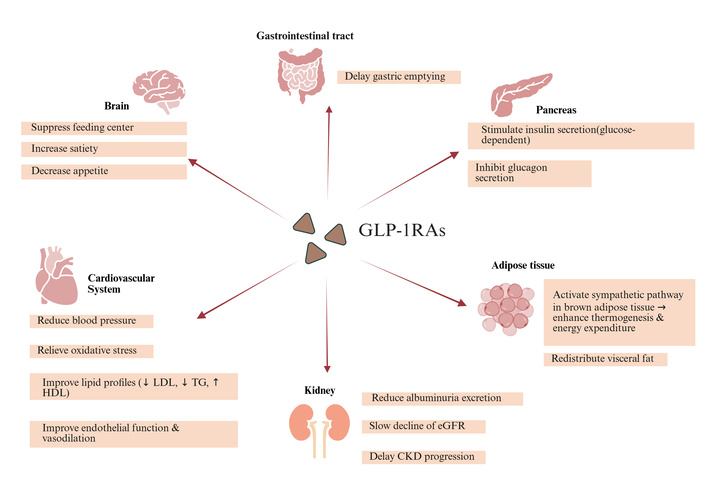
System-level cardiometabolic actions of glucagon-like peptide-1 receptor agonists (GLP-1RAs). 1) In the central nervous system, GLP-1RAs suppress the feeding centre and increase satiety, leading to reduced appetite and lower caloric intake. 2) Gastric emptying is markedly delayed, flattening post-prandial glucose excursions. 3) Pancreatic GLP-1 receptor activation stimulates glucose-dependent insulin secretion while simultaneously inhibiting glucagon release, improving glycaemic control with minimal hypoglycemia risk. 4) In adipose tissue, GLP-1RAs enhance sympathetic tone in brown fat, increasing thermogenesis and energy expenditure; they also redistribute visceral fat and improve the lipid profile (↓LDL-C, ↑HDL-C, ↓triglycerides). 5) Cardiovascular effects include blood-pressure reduction, relief of oxidative stress, improved endothelium-dependent vasodilation and decreased systemic inflammation. 6) Renal outcomes comprise reduced albuminuria, slower estimated glomerular filtration rate (eGFR) decline and delayed progression of chronic kidney disease. Created in BioRender.Created in BioRender. Zhou, J. (2026) https://BioRender.com/ica7ri6
Collectively, these findings establish semaglutide as a potent metabolic modifier in CKM syndrome, where reducing visceral adiposity alleviates systemic cardiac and renal injuries [17]. The greater weight loss observed in patients with higher baseline BMI compared to those with T2DM likely reflects different drivers: appetite dysregulation in severe obesity versus hyperinsulinemia-induced lipolytic inhibition in diabetes. However, clinical application requires caution. The rapid weight regain following discontinuation in the STEP-4 trial highlights the need for long-term maintenance. Moreover, dose-dependent gastrointestinal effects, gallstone risk, and potential sarcopenia, especially in frail elderly patients, may hinder adherence [18]. To optimize outcomes, GLP-1RAs should be integrated with high-protein nutrition and resistance training to preserve lean mass and ensure long-term safety.
It’s reported that China has the highest number of diabetics in the world at over 140 million [19]. Among them, the majority suffer from T2DM, with cardiovascular and renal diseases being the most common causes of disability and death. The cardiovascular and renal benefits of GLP-1RAs in patients with T2DM have been confirmed in numerous expert consensus statements as a priority in the treatment of T2DM, regardless of their glycated hemoglobin (HbA1c) level [20]. The LEADER study enrolled 9,340 patients with T2DM who received standard therapy in combination with liraglutide up to 1.8 mg once daily or placebo for a median follow-up of 3.8 years. The risk of the primary composite endpoint (cardiovascular death, non-fatal myocardial infarction or stroke) was significantly reduced in the liraglutide group compared to the placebo group (14.9% vs 13.0%, HR 0.87, 95% CI 0.78–0.97). In addition, there was an average HbA1c reduction of 0.4% compared to placebo and a decrease of 22% in nephropathy incidence [21]. The SUSTAIN series studies showed that weekly semaglutide injection achieved a maximum HbA1c reduction of 1.8% with a compliance rate of approximately 80%. Furthermore, these glucose-lowering effects were significantly superior to drugs such as canagliflozin, sitagliptin, dulaglutide, and insulin [22]. In addition, it was shown to be able to lower HbA1c on demand, resulting in more significant reductions in patients with elevated baseline levels. At the same time, rates of serious or confirmed hypoglycemia remain extremely low [23]. These outcomes validate the preferential use of GLP-1RAs for T2DM patients with CKM risks, as their glucose-independent cardio-renal protection targets the core drivers of diabetes-related mortality. Moreover, their glucose-dependent insulin secretion provides a significant safety advantage over insulin and sulfonylureas by minimizing hypoglycemia [24].
Meta-analyses have demonstrated the significant effectiveness of GLP-1RAs in reducing the risk of myocardial infarction, stroke, and cardiovascular death in patients with T2DM, regardless of the presence of CVD or cardiovascular risk factors [25]. The REWIND trials demonstrated that dulaglutide significantly reduced the risk of MACE by an impressive rate of 36.1% in T2DM patients [26]. In the SUSTAIN-6 trial, semaglutide was found to significantly reduce the risk of MACE by 26%, including a 39% reduction in nonfatal strokes [27]. In addition, semaglutide effectively reduced systolic blood pressure by up to 7.3 mmHg and improved lipid profiles, thereby reducing low-density lipoprotein cholesterol and triglycerides while increasing high-density lipoprotein cholesterol levels. These multiple benefits contributed to its synthetic cardiovascular protection against a variety of risk factors. The results of the SELECT study further expanded the potential beneficiary population of GLP-1RAs. The study involved 17,604 overweight or obese people (BMI ≥ 27 kg/m2) with confirmed CVD but without diabetes who received a placebo in addition to standard therapy for a five-year follow-up period. Compared to the placebo group, injections of semaglutide at a dosage of 2.4 mg/week significantly reduced the risk of MACE by 20% [9], marking the first weight-loss drug to demonstrate a reduction in the risk of cardiovascular events.
These CV outcome trials support prioritizing GLP-1RAs for CKM patients with atherosclerotic lesions, as their cardio-protection stems from direct anti-inflammatory and plaque-stabilizing effects on the vascular endothelium, independent of weight and glucose reduction. The SELECT trial further extends this benefit to obese non-diabetic individuals with established CVD, addressing a significant gap in secondary prevention. However, the substantial variance in MACE reduction across different agents (20–36.1%)—driven by heterogeneous baseline risks and follow-up durations—precludes a definitive head-to-head comparison. Additionally, the exclusion of patients with advanced heart failure or severe renal impairment in RCTs restricts the generalizability of these results to complex CKM cohorts. Therefore, GLP-1RAs should be prescribed based on individual atherosclerotic burden, organ function, and economic status.
The SUSTAIN 6 and PIONEER 6 studies demonstrated that in subgroups with an estimated glomerular filtration rate (eGFR) of 30–60 and ≥ 60 mL/min/1.73 m2, the decline in eGFR among patients receiving semaglutide was significantly slower compared to those on placebo, indicating its potential to delay the progression of renal function deterioration in individuals with T2DM [28]. However, direct evidence regarding the impact of GLP-1RA on renal outcomes remains limited; only one study reported a reduction in eGFR from –0.56 (–0.63, –0.50) to –0.13 (–0.17, –0.09) mL/min/1.73 m2/month before and after GLP-1RA treatment for patients with CKD stages 4 and 5 [29]. The latest FLOW study enrolled 3,533 T2DM patients with CKD who received either semaglutide at a dosage of 1.0 mg/week or placebo over a median follow-up period of 3.4 years. Results indicated that compared to the placebo group, participants treated with semaglutide experienced a reduced risk of encountering primary composite endpoint events by 24%, which included renal failure, significant declines in kidney function, and mortality due to renal or CVDs. Regarding secondary endpoints, the total slope of eGFR decline in the semaglutide cohort was lower by an annual rate of 1.16 mL/min/1.73 m2; additionally, MACE risk decreased by 18%, while all-cause mortality risk diminished by 20% [8]. A meta-analysis conducted to evaluate the renal benefits associated with GLP-1RAs among T2DM patients revealed a notable reduction of approximately 17% in composite renal endpoint risks as well as a substantial decrease of about 25% in persistent proteinuria development risks [30].
These collective findings suggest that the renal-protective effects of GLP-1RAs extend beyond simple glycemic control. This benefit is likely mediated by a synergistic combination of reduced systemic inflammation, attenuation of glomerular hyperfiltration, and the inhibition of pro-fibrotic pathways within the renal interstitium. However, SGLT2 inhibitors remain core cardiorenal agents with more robust hard renal outcome data, preceding GLP-1RA initiation in clinical sequencing [31–33]. Jensen et al. [34] reported that SGLT2i initiators had a 5-year CKD risk of 6.7% vs 8.2% for GLP-1RA initiators (RR 0.81, 95% CI 0.76–0.87) alongside a lower 5-year acute kidney injury burden. Even so, GLP-1RAs deliver marginal advantages in mitigating albuminuria and lowering all-cause mortality [34]. Clinically, GLP-1RAs serve as valuable add-on agents, particularly for patients with concurrent obesity and atherosclerotic CVD who fail to achieve full metabolic control on SGLT2 inhibitor monotherapy.
The pathogenesis of CKM is rooted in a self-perpetuating cycle of metabolic dysregulation, hemodynamic overload, and chronic low-grade inflammation that collectively drives multi-organ damage. Insulin resistance and nutrient excess promote hepatic steatosis and adipose tissue dysfunction, which in turn release pro-inflammatory adipokines and exacerbate systemic inflammation. This metabolic-inflammatory cascade sustains hyperglycemia, lipotoxicity, and endothelial damage, leading to multi-organ dysfunction, thereby linking metabolic dysfunction to cardiovascular and renal injury, and providing a mechanistic rationale for GLP-1RAs to target these shared pathways [5]. Centrally, they activate CCKAP/NTS neurons to suppress appetite and delay gastric emptying, reducing caloric intake and promoting sustained weight loss [35, 36]. Metabolically, they enhance glucose-dependent insulin secretion while suppressing glucagon release, improve insulin sensitivity, and promote fatty acid oxidation [37]. On a multi-organ scale, GLP-1RAs reduce hepatic steatosis and inflammation, attenuate oxidative stress and enhance endothelial function in the vasculature, and promote natriuresis in the kidneys, collectively lowering blood pressure and hemodynamic load [38, 39]. Taken together, these mechanisms may synergistically contribute to the systemic benefits of GLP-1RAs throughout the cardiovascular, renal, and metabolic systems (Figure 2).
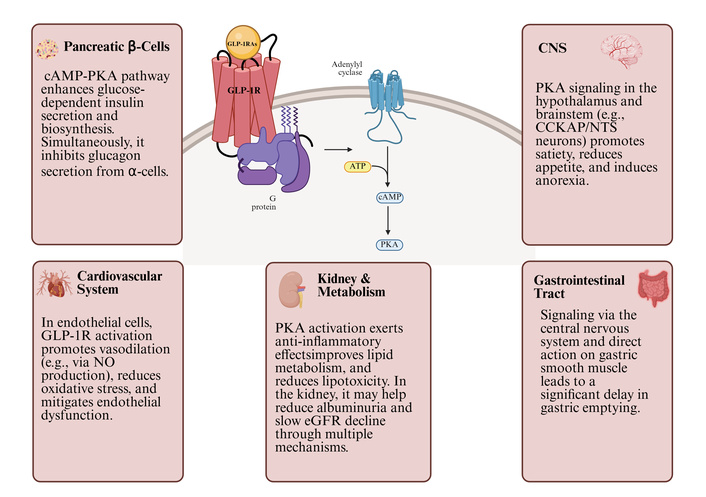
Molecular circuitry underlying glucagon-like peptide-1 receptor agonist (GLP-1RA) actions. Binding of GLP-1RAs to the GLP-1 receptor (GLP-1R), a G-protein-coupled receptor, triggers Gαs-mediated activation of adenylyl cyclase (AC). Subsequent generation of cyclic AMP (cAMP) activates protein kinase A (PKA), the central signaling node. 1) In pancreatic β-cells, PKA enhances glucose-dependent insulin exocytosis and pro-insulin gene transcription, while PKA-dependent suppression of α-cell calcium signaling curbs glucagon release. 2) Within the hypothalamus and brainstem, PKA phosphorylates anorexigenic neurons (e.g., CCKAP/NTS), inducing satiety and anorexia. 3) PKA in gastric smooth-muscle cells decreases contractile frequency, producing delayed gastric emptying. 4) Endothelial PKA augments nitric-oxide synthase activity, promoting vasodilation, lowering blood pressure, and attenuating oxidative stress. 5) In kidney podocytes and tubular cells, PKA reduces inflammatory cytokine expression and inhibits sodium-hydrogen exchanger-3, lessening albuminuria and slowing estimated glomerular filtration rate (eGFR) loss. Created in BioRender. Zhou, J. (2026) https://BioRender.com/orf7z73
Given the complex and multi-faceted nature of CKM, optimal management often requires combination therapy targeting distinct pathophysiological pathways. Notably, SGLT2 inhibitors and GLP-1RAs play complementary roles in this multi-organ metabolic disease. SGLT2 inhibitors, as the first-line guideline-recommended therapy for heart failure, primarily relieve cardiac volume overload and reduce renal metabolic pressure through glycosuria and osmotic diuresis; GLP-1RAs, on the other hand, compensate for the metabolic limitations of SGLT2 inhibitors by suppressing appetite and reducing visceral fat accumulation, thereby interrupting the deleterious metabolic-inflammatory cycle [40, 41]. Recent clinical evidence has demonstrated the efficacy of this dual-target strategy across multiple metabolic and cardiovascular domains, including in T2DM, MASLD and obesity-related heart failure [39, 42, 43].
GLP-1RAs have evolved from hypoglycemic agents into landmark therapies for comprehensive metabolic control. The development and application of multi-target agonists have further expanded their potential in treating metabolic disorders. The efficacy of GLP-1RAs has been validated across multiple clinical applications, with the semaglutide series of trials being the most representative (Table 1). In the field of combined treatment for overweight/obesity and T2DM, the STEP studies demonstrated that sustained use of semaglutide significantly reduces patient weight, enables long-term weight maintenance, and effectively addresses the clinical challenge of weight regain after initial loss [14, 15, 44, 45]. More notably, the benefits of semaglutide extend to metabolic disease complications. The SELECT trial revealed it could reduce major cardiovascular events by 20% [9]. While the FLOW trial, focusing on its protective effects in patients with kidney disease, revealed a 24% reduction in major kidney events and an 18% reduction in major cardiovascular events [8]. This breakthrough challenges the traditional single-target, single-effect model in metabolic disease treatment.
Clinical Trials of glucagon-like peptide-1 receptor agonists (GLP-1Ras) in cardiometabolic diseases.
| Drugs | Name of the study | Type of the study | Research area | Participants | Key findings | Conclusion | Reference |
|---|---|---|---|---|---|---|---|
| Semaglutide | STEP 1 clinical trials | Randomized, double-blind, placebo-controlled, multicenter, phase 3 trial | Overweight and obesity | 1,961 patients with BMI ≥ 30 (or ≥ 27 with ≥ 1 weight-related comorbidity) and without diabetes | Semaglutide 2.4 mg once weekly led to a mean weight loss of 14.9% (vs 2.4% with placebo) and a mean weight reduction of 15.3 kg (vs 2.6 kg with placebo) over 68 weeks. | Semaglutide 2.4 mg once weekly achieved significant weight loss in participants with overweight or obesity | [14] |
| Semaglutide | STEP 2 clinical trials | Randomized, double-blind, double-dummy, placebo-controlled, multicenter, superiority, phase 3 trial | Overweight and obesityT2DM | 1,210 patients with BMI ≥ 27 and T2DM | Semaglutide 2.4 mg once weekly resulted in a mean weight loss of 9.6% (vs 3.4% with placebo) | Semaglutide 2.4 mg once weekly achieved significant weight loss in adults with overweight or obesity and T2DM | [44] |
| Semaglutide | STEP 4 clinical trials | Randomized, double-blind, placebo-controlled withdrawal study, phase 3 trial | Overweight and obesity | 803 patients with BMI ≥ 30 (or ≥ 27 with ≥ 1 weight-related comorbidity) and without diabetes | Continued semaglutide treatment resulted in sustained weight loss, with a mean weight change of –7.9% from week 20 to week 68, compared to +6.9% with placebo | Continued semaglutide treatment sustained weight loss over 48 weeks | [15] |
| Semaglutideliraglutide | STEP 8 clinical trials | Randomized, double-blind, placebo-controlled open-label, phase 3b trial | Overweight and obesity | 338 patients with BMI ≥ 30 (or ≥ 27 with ≥ 1 weight-related comorbidity) and without diabetes | Semaglutide (2.4 mg) led to a mean weight loss of 15.8%, compared with 6.4% for liraglutide (3.0 mg) at 68 weeks | Semaglutide resulted in significantly greater weight loss than liraglutide | [45] |
| Tirzepatide | SURMOUNT-1 clinical trials | Randomized, double-blind, placebo-controlled, phase 3 trial | Overweight and obesity | 2,539 patients with BMI ≥ 30 (or ≥ 27 with ≥ 1 weight-related comorbidity) and without diabetes | At week 72, tirzepatide (5 mg, 10 mg, 15 mg) led to mean weight loss of 15.0%, 19.5%, and 20.9%, respectively, compared to 3.1% with placebo. | Tirzepatide achieved significant and sustained weight loss in participants with obesity | [46] |
| Tirzepatide | SURMOUNT-2 clinical trials | Randomized, double-blind, multicentre, placebo-controlled, phase 3 trial | Overweight and obesityT2DM | 1,514 adults with BMI ≥ 27 and glycated hemoglobin (HbA1c) of 7–10% (53–86 mmol/mol) | At week 72, tirzepatide (10 mg, 15 mg) achieved mean weight loss of 12.8%, 14.7% vs 3.2% with placebo. | Tirzepatide resulted in significant weight loss in adults with obesity and T2DM | [47] |
| Semaglutide Cagrilintide (Dual Amylin–Calcitonin Receptor Agonist) | REDEFINE 1 clinical trials | Randomized, multicenter, double-blind, placebo-controlled, active-controlled, phase 3a trial | Overweight and obesity | 3,417 patients with BMI ≥ 30 (or ≥ 27 with ≥ 1 weight-related comorbidity) and without diabetes | At week 68, the combination of semaglutide 2.4 mg and cagrilintide 2.4 mg (CagriSema) led to a mean weight loss of –20.4% vs –3.0% with placebo; 91.9% of participants receiving CagriSema achieved at least a 5% weight reduction | CagriSema significantly reduced body weight in adults with overweight or obesity | [49] |
| Semaglutide Cagrilintide (Dual Amylin–Calcitonin Receptor Agonist) | REDEFINE 2 clinical trials | Randomized, international, double-blind, placebo-controlled, phase 3 trial | Overweight and obesityT2DM | 1,206 patients with BMI ≥ 27, a HbA1c level of 7 to 10%, and T2DM | At week 68, cagrilintide-semaglutide (2.4 mg each) led to a mean weight loss of –13.7% vs –3.4% with placebo; 86.5% of participants in the CagriSema group achieved at least a 5% weight reduction | CagriSema significantly reduced body weight in adults with obesity and T2DM | [50] |
| Mazdutide | GLORY-1 clinical trials | Randomized, double-blind, parallel-group, phase 3 trial | Overweight and obesity | 610 patients with BMI ≥ 28 (or ≥ 24 with ≥ 1 weight-related comorbidity) | At week 48, Mazdutide (4mg, 6mg) achieved mean weight loss of 11.00% and 14.01% vs 0.30% with placebo | Mazdutide significantly reduced body weight in adults with overweight or obesity and was well tolerated | [57] |
| Maridebart Cafraglutide | MARITIME-1clinical trials | Randomized, double-blind, parallel-group, phase 2 trial | Overweight and obesityT2DM | 465 patients with obesity and 127 individuals with obesity and diabetes | At week 52, Maridebart-cafraglutide achieved mean weight loss of –12.3% to –16.2% in the obesity cohort and –8.4% to –12.3% in the obesity-diabetes cohort, compared to –2.5% and –1.7% with placebo | Maridebart cafraglutide significantly reduced body weight in participants with obesity, with or without T2DM | [58] |
| Ecnoglutide | SLIMMER clinical trials | Randomized, double-blind, multicenter, placebo-controlled, phase 3 trial | Overweight or obesity | 882 patients with BMI ≥ 28 (or ≥ 24 with ≥ 1 weight-related comorbidity) without diabetes | At week 40, mean weight loss was –9.1% (1.2 mg), –10.9% (1.8 mg), and –13.2% (2.4 mg) vs 0.1% (placebo). At least 5% weight reduction was achieved by 77% (1.2 mg), 84% (1.8 mg), and 87% (2.4 mg) vs 16% (placebo). | Ecnoglutide significantly reduced weight with a favorable safety profile | [59] |
| Semaglutide VS Dulaglutide | SUSTAIN 7 clinical trials | Randomized, open-label, parallel-group, phase 3b trial | T2DM | 1,201 patients aged 18 years or older with T2DM with HbA1c 7.0–10.5% (53.0–91.0 mmol/mol) on metformin monotherapy | At week 40, semaglutide 0.5 mg reduced HbA1c by 1.5% vs 1.1% with dulaglutide 0.75 mg, and semaglutide 1.0 mg reduced HbA1c by 1.8% vs 1.4% with dulaglutide 1.5 mg. Semaglutide led to weight loss of –4.6 kg with 0.5 mg vs –2.3 kg with 0.75 mg dulaglutide and –6.5 kg with 1.0 mg vs –3.0 kg with 1.5 mg dulaglutide. | Semaglutide was superior to dulaglutide in improving glycemic control and reducing body weight, with a similar safety profile | [22] |
| Semaglutide | STEP-HFpEF DM clinical trials | Randomized, international, double-blind, placebo-controlled, phase 3 trial | CVDObesityT2DM | 616 patients who had HFpEF, BMI ≥ 30 kg/m2 and T2DM | Semaglutide led to a mean KCCQ-CSS improvement of 13.7 points and a mean weight loss of 9.8%, compared to 6.4 points and 3.4% with placebo | Semaglutide resulted in greater reductions in symptoms and weight loss than placebo in patients with HFpEF, obesity, and T2DM | [60] |
| Semaglutide | STEP-HFpEF clinical trials | Randomized, international, double-blind, placebo-controlled, phase 3 trial | ObesityCVD | 529 patients who had HFpEF and BMI ≥ 30 kg/m2 | Semaglutide (2.4 mg) significantly improved symptoms and physical limitations, with a mean KCCQ-CSS increase of 16.6 points and a mean weight loss of 13.3%, compared to 8.7 points and 2.6% with placebo | Semaglutide (2.4 mg) led to greater improvements in symptoms, physical limitations, and weight loss than placebo in patients with HFpEF and obesity | [61] |
| Semaglutide | SELECT clinical trials | Randomized, double-blind, multicenter, placebo-controlled, event-driven superiority trial | CVDOverweight or obesity | 17,604 patients aged 45 or older with preexisting CVD and BMI ≥ 27 kg/m2 without diabetes | Primary cardiovascular events occurred in 6.5% of the semaglutide group vs 8.0% of the placebo group (HR 0.80; 95% CI 0.72–0.90; P < 0.001) | Semaglutide reduced cardiovascular events in patients with CVD and overweight/obesity without diabetes | [9] |
| Dulaglutide | REWIND clinical trials | Randomized, double-blind, multicenter, placebo-controlled trial | CVDT2DM | 9,901 patients aged 45 or older with T2DM who had either a previous cardiovascular event or cardiovascular risk factors | Dulaglutide reduced major adverse cardiovascular events (MACE) by 12% in patients with T2DM and cardiovascular risk factors. The primary composite outcome occurred in 12.0% of participants in the dulaglutide group vs 13.4% in the placebo group during a median follow-up of 5.4 years | Dulaglutide demonstrated significant cardiovascular protection in patients with T2DM and cardiovascular risk factors | [26] |
| Semaglutide | SOUL clinical trials | Randomized, double-blind, placebo-controlled, event-driven, superiority trial | CVDT2DMCKD | 9,650 patients aged 50 years or older with T2DM (HbA1c 6.5%–10.0%) and atherosclerotic CVD, CKD, or both | After a mean follow-up of 47.5 months, the incidence of major adverse cardiovascular events (MACE) was 12.0% in the semaglutide group and 13.8% in the placebo group | Semaglutide significantly reduced the risk of major adverse cardiovascular events without increasing the incidence of serious adverse events | [62] |
| Semaglutide | FLOW clinical trials | Randomized, double-blind, International, parallel-group, phase 3 trial | CKDT2DM | 3,533 patients with T2DM and CKD (defined by an estimated glomerular filtration rate [eGFR] of 50 to 75 mL per minute per 1.73 m2 of body-surface area and a urinary albumin-to-creatinine ratio [with albumin measured in milligrams and creatinine measured in grams] of > 300 and < 5,000 or an eGFR of 25 to < 50 mL per minute per 1.73 m2 and a urinary albumin-to-creatinine ratio of > 100 and < 5,000) | Semaglutide reduced the risk of major kidney disease events by 24% and major cardiovascular events by 18% | Semaglutide significantly lowered the risk of kidney failure and cardiovascular death in patients with T2DM and CKD | [8] |
| Semaglutide | Tirzepatide in MASH | Randomized, double-blind, multicenter, placebo-controlled, ongoing phase 3 trial | Metabolic dysfunction-associated steatohepatitis (MASH) | 1,197 patients with biopsy-defined MASH and fibrosis stage 2 or 3 | At week 72, semaglutide resolved steatohepatitis in 62.9% of patients vs 34.3% with placebo and reduced liver fibrosis in 36.8% vs 22.4% with placebo | Semaglutide significantly improved liver histology in patients with MASH and moderate to advanced fibrosis | [63] |
BMI: body mass index; CKD: chronic kidney disease; CVD: cardiovascular disease; HFpEF: heart failure with preserved ejection fraction; T2DM: type 2 diabetes mellitus.
The development of multi-target agonists has further expanded the therapeutic boundaries beyond single-target GLP-1RAs, with the clinical data for the Glucose-dependent insulinotropic polypeptide (GIP)/GLP-1 dual-target agonist Tirzepatide being particularly noteworthy. The SURMOUNT series of studies demonstrated its potential to outperform single-target agents in the treatment of overweight and obesity [46, 47]. Furthermore, Tirzepatide has demonstrated advantages in treating metabolic-related complications. The SURMOUNT-OSA trial revealed that Tirzepatide significantly reduced the apnea-hypopnea index regardless of positive airway pressure therapy use, offering a novel treatment approach for the obesity-sleep apnea comorbidity [48].
Beyond tirzepatide, other multi-target combinations have demonstrated clear potential. For instance, the REDEFINE series of studies on the GLP-1/amyloid polypeptide receptor (AMY-R) dual agonist (semaglutide with cagrilintide, abbreviated as CagriSema) showed that in the REDEFINE 1 trial for overweight/obese individuals without diabetes, CagriSema achieved an average weight loss of 20.4% at 68 weeks, with 91.9% of patients achieving at least 5% weight loss [49]. While in the REDEFINE 2 trial for overweight/obese individuals with T2DM, the combination still achieved an average weight loss of 13.7%, with 86.5% of patients losing over 5% of their body weight [50]. This efficacy surpassed that of semaglutide alone, validating the clinical value of dual-target synergistic therapy.
Despite robust cardiometabolic benefits, GLP-1RAs face real-world barriers including gastrointestinal intolerance, lean muscle loss, and limited accessibility. Transient gastrointestinal symptoms during dose escalation often drive early treatment dropout [51]. To date, consistent clinical evidence regarding GLP-1RAs’ overall impact on skeletal muscle mass remains insufficient. While preclinical data support favorable muscular effects of GLP-1RAs signaling, existing human clinical studies yield conflicting outcomes [52]. Sattar et al. [53] demonstrated that tirzepatide induced proportional declines in absolute skeletal muscle volume alongside total weight loss. By contrast, multiple semaglutide cohort studies reported mild losses in absolute lean mass accompanied by profound fat mass reduction, with relative muscle proportion well preserved [54]. Combined resistance training alongside high-protein whole-food dietary intake effectively mitigates lean muscle loss during GLP‑1RA-driven rapid weight loss [55]. Beyond clinical safety, lifelong GLP-1RA treatment faces major socioeconomic barriers driven by high drug costs, widening treatment inequities in low-and middle-income regions with limited insurance coverage. Though GLP-1RAs theoretically yield long-term savings by reducing expenditures on dialysis and heart failure hospitalizations, real-world economic evaluations from China demonstrate that liraglutide, semaglutide, tirzepatide, and benaglutide fail to meet local willingness-to-pay thresholds for general obese populations [56]. Universal prescription is thus impractical; clinicians should prioritize high-risk CKM patients who gain the greatest clinical and economic benefits. Expanding medical insurance coverage and adopting cheaper long-acting GLP-1RAs formulations can narrow access gaps and reduce health disparities.
GLP-1RAs, as a new class of hypoglycemic drugs, have shown significant potential in the treatment of metabolic disorders such as CKM due to their pleiotropic effects and favorable safety profile. Ongoing clinical trials of multi-target agonists will further clarify the patient populations suited for different target combinations and their efficacy, providing more precise and comprehensive treatment options for patients with metabolic disorders.
AHA: American Heart Association
CKD: chronic kidney disease
CKM: cardiovascular-kidney-metabolic
CVD: cardiovascular disease
eGFR: estimated glomerular filtration rate
GLP-1: glucagon-like peptide-1
GLP-1RAs: glucagon-like peptide-1 receptor agonists
HbA1c: glycated hemoglobin
MACE: major adverse cardiovascular events
MASLD: metabolic dysfunction-associated steatotic liver disease
T2DM: type 2 diabetes mellitus
Schematic illustrations were generated using BioRender; all copyright permissions for academic publication have been obtained.
JZ: Investigation, Methodology, Writing—original draft. NZ: Investigation, Methodology, Writing—original draft. JL: Investigation, Methodology, Writing—original draft. XQ: Investigation, Methodology, Writing—original draft. LK: Investigation, Methodology, Writing—original draft. LB: Writing—review & editing, Supervision. TH: Writing—review & editing, Supervision. All authors read and approved the submitted version.
The authors declare that there is no conflict of interest related to this publication.
Not applicable.
Not applicable.
Not applicable.
Not applicable.
This research was supported by Xi’an Science and Technology Plan Project (24YXYJ0148), Scientific Research Fund Youth Project of the Second Affiliated Hospital of Xi’an Jiaotong University (YJ(QN)202325). The funders had no role in study design, data collection and analysis, decision to publish, or preparation of the manuscript.
© The Author(s) 2026.
Open Exploration maintains a neutral stance on jurisdictional claims in published institutional affiliations and maps. All opinions expressed in this article are the personal views of the author(s) and do not represent the stance of the editorial team or the publisher.
Copyright: © The Author(s) 2026. This is an Open Access article licensed under a Creative Commons Attribution 4.0 International License (https://creativecommons.org/licenses/by/4.0/), which permits unrestricted use, sharing, adaptation, distribution and reproduction in any medium or format, for any purpose, even commercially, as long as you give appropriate credit to the original author(s) and the source, provide a link to the Creative Commons license, and indicate if changes were made.



View: 931
Download: 29
Times Cited: 0


