Original Article


Affiliation:
1Quality Use of Respiratory Medicines Group, Woolcock Institute of Medical Research, Macquarie Park, NSW 2113, Australia
2Macquarie University, Macquarie Park, NSW 2113, Australia
Email: biljana.cvetkovski@woolcock.org.au
ORCID: https://orcid.org/0000-0003-2297-8141


 ,
,
Affiliation:
3ReCare, Chirnside Park, VIC 3116, Australia
Affiliation:
1Quality Use of Respiratory Medicines Group, Woolcock Institute of Medical Research, Macquarie Park, NSW 2113, Australia
2Macquarie University, Macquarie Park, NSW 2113, Australia
ORCID: https://orcid.org/0000-0002-0818-6239
,
Affiliation:
1Quality Use of Respiratory Medicines Group, Woolcock Institute of Medical Research, Macquarie Park, NSW 2113, Australia
2Macquarie University, Macquarie Park, NSW 2113, Australia
ORCID: https://orcid.org/0000-0001-5171-4036
,
Affiliation:
1Quality Use of Respiratory Medicines Group, Woolcock Institute of Medical Research, Macquarie Park, NSW 2113, Australia
2Macquarie University, Macquarie Park, NSW 2113, Australia
ORCID: https://orcid.org/0000-0001-5077-8329
Explor Asthma Allergy. 2026;4:1009134 DOI: https://doi.org/10.37349/eaa.2026.1009134
Received: April 22, 2026 Accepted: August 03, 2026 Published: September 14, 2026
Academic Editor: Mario Di Gioacchino, G. d’Annunzio University, Italy
The article belongs to the special issue Allergy and Asthma in the Digital Age
Aim: Asthma exacerbations are associated with significant morbidity and mortality, yet identifying individuals at high risk of an exacerbation remains challenging in community settings. Pharmacists, with access to pharmacy dispensing systems, are well positioned to address this gap. This study aimed to determine whether the utilization of pharmacy electronic communication can assist community pharmacists in identifying people with asthma, within the patient cohort, who are at high risk of exacerbation.
Methods: A retrospective analysis of de-identified data from 45 community pharmacies in Australia and New Zealand was conducted using data from reCare software. Patients with a respiratory medication dispensed in the previous 12 months who had consented to electronic communication were invited to complete a five-item questionnaire. Patients who visited a General Practitioner (GP)/hospital, used oral corticosteroid (OCS), or purchased ≥ 3 short-acting beta-agonist (SABA) inhalers for their asthma in the past year were considered at high risk of exacerbation. Responses were linked to patients’ dispensing records for pharmacist review and referral.
Results: Of 1,043,815 eligible patients, 69,932 received invitations; 863 responded, and 253 completed the questionnaire fully. All those who completed the questionnaire met the criteria for being at high risk of asthma exacerbation. Among these, 55.7% reported GP/hospital visits, 100% used OCS, and 69.5% purchased ≥ 3 SABA inhalers. Poor adherence was reported by 58.1%. SABA overuse was significantly associated with GP/hospital visits (p < 0.01) and poor adherence (p < 0.01).
Conclusions: Electronic communication integrated with data in pharmacy dispensing systems can support pharmacists in understanding individuals’ exacerbation risk and the need to refer people with asthma. Patient consultation regarding preferred communication methods is critical before broader implementation; validation of screening tools is also recommended.
People at high risk of asthma exacerbation are more likely to experience a sudden worsening of asthma symptoms ranging from mild to life-threatening and may require emergency treatment [1]. Asthma exacerbations are a burden to individuals, impacting their ability to breathe, mental health, and productivity, as well as being a drain on health care resources [2]. It is important to identify people at high risk of exacerbation because they may suffer more serious complications, require hospitalization, and have a higher risk of death from asthma, which are potentially avoidable with good asthma management [3].
Risk factors for high risk of future exacerbation include a history of severe exacerbations (visit to emergency department or frequent use of oral corticosteroid (OCS), poor asthma control [use of 3 or more short-acting beta-agonist (SABA) per year], and non-adherence to preventer inhalers, especially inhaled corticosteroids (ICS) [1, 4–7]. It would be ideal to identify these patients proactively to minimize their risk of future exacerbations; however, the challenge remains that not all risk factors are associated with presentation to health care, and people at risk can go unnoticed.
One key consideration in minimizing risk of asthma exacerbation is optimizing medication use [8]. The ability to identify and moderate the risk of asthma exacerbation based on medication use is an ideal opportunity for pharmacists whereby people at high risk of asthma exacerbation are identified [9]. Community pharmacists are primary healthcare providers in a unique position to identify people with asthma at high risk of exacerbation by monitoring and observing their medication use [9, 10]. Pharmacists have access to patients’ dispensing history, shedding light on the use of SABA, OCS, and adherence to ICS; they also have the opportunity to interact with patients face-to-face regularly [10]. While pharmacists have the skills to evaluate a patient’s risk of asthma exacerbation based on their medication use, this has traditionally required a face-to-face interaction where a conversation can be had about medication use that is not always recorded on the dispensing history [9, 11, 12]. This reliance on traditional methods of communication in the digital world means that opportunities to engage and support patients may be missed. Furthermore, evidence demonstrates that integrating pharmacy data with registry data strengthens clinical assessments [13]. It is therefore essential that pharmacist interventions evolve in line with current technologies to ensure they continue to be effective [13, 14].
Digital technology use in the community pharmacy has increased in recent years, partly driven by social distancing requirements introduced during the COronaVIrus Disease (COVID) pandemic but also due to advances in technology [15]. A 2025 Global Situation Report on Pharmacy from The International Pharmaceutical Federation (FIP) details pharmacy’s role in the digital transformation of health to include telehealth, electronic communication, real-world data applications, and artificial intelligence-driven clinical decision support systems [15]. Patients have also embraced digital technologies with regard to the management of their medications and monitoring of their symptoms through the use of smartwatches and mobile applications [15].
With both pharmacists and patients having access to electronic communication, it is important to consider the benefits of this technology from a clinical perspective in asthma management. As it is challenging to identify people at high risk of asthma exacerbation prior to the need to present to a health care professional for help, it is important to explore whether the solution lies in utilizing digital technologies. Once people at high risk of asthma exacerbation are identified, pharmacists can provide risk minimization strategies, including optimization of medication use, and ensure referral to a doctor where necessary [10].
This study aims to determine whether the utilization of pharmacy electronic communication can assist pharmacists in community care in identifying people with asthma, within the patient cohort, who are at high risk of exacerbation.
This study was retrospective, utilizing de-identified data from reCare (https://www.recareaustralia.com/), a proprietary pharmacy clinical support software, embedded within the pharmacy dispensing system in subscribed community pharmacies in Australia and New Zealand.
Patients were included if:
•their pharmacy dispensing record contained at least one respiratory medication dispensed (Table S1) in the last 12 months; and
•they consented to receiving electronic communication from their pharmacy and reCare and had provided preferred contact details (email/text) (Note: In Australia and New Zealand, pharmacists must obtain informed consent before contacting patients via text for health service invitations); and
•they self-identified as having asthma by responding to a message (email and/or text) (Table S2) and completing a questionnaire.
Patients who were interested and self-identified as having asthma were asked to complete the 5-item electronic questionnaire, containing questions used to identify patients at high risk of asthma exacerbation based on medication use and requirement for emergency care (Table 1).
5-item electronic questionnaire.
| Questions | Answers |
|---|---|
| 1. Have you visited a GP or hospital for bad asthma in last 12 months? | Yes* |
| No | |
| 2. How many times have you needed to use prednisone/prednisolone for your asthma in the last 12 months? | 0 |
| 1–2* | |
| ≥ 3* | |
| 3. How many reliever inhalers have you purchased in the last 12 months? | 0–2 |
| 3–5* | |
| ≥ 6* | |
| 4. During the last 7 days, how many times did you forget to take your usual asthma medication? | All the time^ |
| More than half the time^ | |
| Approximately half the time^ | |
| Less than half the time^ | |
| None | |
| 5. Have you seen your GP in last 4 weeks? | Yes* |
| No |
Note: * High risk of asthma exacerbation: Patients were identified at high risk of an asthma exacerbation in the last 12 months if they: 1) visit GP or hospital for bad asthma, OR; 2) used prednisone/prednisolone (i.e., OCS) for asthma flare-up, OR; 3) purchased 3 or more reliever inhalers (i.e., SABA). ^ Poor adherence to asthma medication: Patients who responded “All the time”, “More than half the time”, “Approximately half the time”, “Less than half the time”.
Patients whose responses were indicative of a high risk of asthma exacerbation were sent a second message, recommending they see their pharmacist or General Practitioner (GP) to discuss their respiratory health. Simultaneously, questionnaire responses were made available on the patient’s clinical record in reCare. The next time the patient visited the pharmacy, the pharmacist could see the answers to the questionnaire and whether the patient had been flagged as having a high risk of asthma exacerbation. Patients who were identified at high risk of asthma exacerbation and had not seen their GP in the last 4 weeks were recommended to be referred to their GP by the pharmacist. Patients received an invitation to complete the questionnaire in Australia from February to July 2024 and in New Zealand during November 2024.
Patients’ responses to the questionnaire were descriptively analyzed using SPSS 29.0. Pearson’s Chi-square test (χ2), with a two-sided significance threshold of α = 0.05, was used to explore the statistical associations between:
patients’ visits to GP/hospital for bad asthma and the number of OCS used for asthma;
patients’ visits to GP/hospital for bad asthma and the number of SABAs used;
patients’ adherence and the number of OCS used for asthma;
patients’ adherence and the number of SABAs used.
Australian community pharmacy data indicate that 20% of people with asthma who present with a prescription for an asthma medication or for a SABA over the counter are at risk of severe asthma; therefore, it was expected that a total of 1,000 people with asthma needed to be screened in order to refer 200 patients [9].
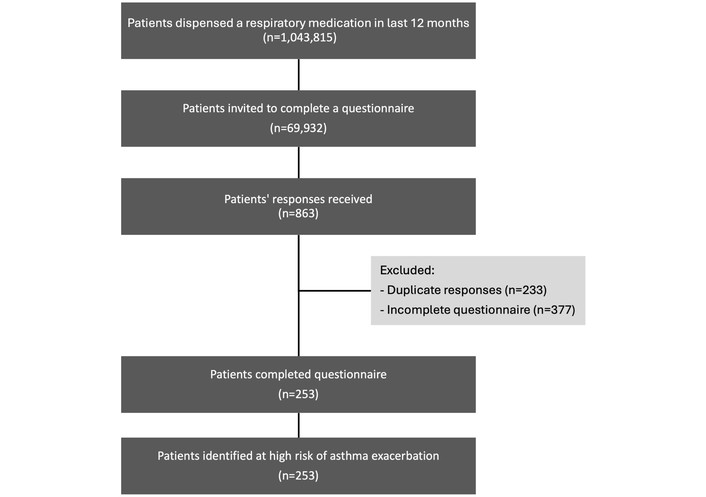
A total of 1,043,815 patients across 45 pharmacies in Australia and New Zealand were identified as having had a respiratory medication dispensed in the last 12 months. Of these, 6.7% (n = 69,932), comprising 34,823 New Zealand patients and 35,109 Australian patients, had given consent to communications as above. They received an electronic invitation from their pharmacy, via reCare software, to complete the 5-item questionnaire if they identified as having asthma. A total of 1.2% (n = 863) of invited patients chose to attempt the questionnaire; after removing duplicates, this equated to 630 responses, 421 from New Zealand and 209 from Australia, with 40% (n = 253) of those completing the questionnaire entirely. All those (100%, n = 253) who completed the questionnaire were identified as being at high risk of an asthma exacerbation and were sent a second message, recommending seeing their pharmacist or GP to discuss their respiratory health (Figure 1).
Table 2 contains the questionnaire data (n = 253). More than half the patients (55.7%, n = 141) reported a visit to their GP or hospital for bad asthma in the last 12 months, all reported the use of OCS for their asthma at least once or twice, and over two-thirds (69.5%, n = 176) reported purchasing 3 or more SABAs in the last 12 months. During the last 7 days, 58.1% (n = 147) of patients forgot to take their asthma medications at least once.
Patients’ questionnaire responses.
| Questions | Answers | Responses n (%) |
|---|---|---|
| 1. Have you visited a GP or hospital for bad asthma in last 12 months? | Yes | 141 (55.7) |
| No | 112 (44.3) | |
| 2. How many times have you needed to use prednisone/prednisolone for your asthma in the last 12 months? | 0 | 0 (0) |
| 1–2 | 149 (58.9) | |
| ≥ 3 | 104 (41.1) | |
| 3. How many reliever inhalers have you purchased in the last 12 months? | 0–2 | 77 (30.4) |
| 3–5 | 95 (37.5) | |
| ≥ 6 | 81 (32.0) | |
| 4. During the last 7 days, how many times did you forget to take your usual asthma medication? | All the time | 28 (11.1) |
| More than half the time | 22 (8.7) | |
| Approximately half the time | 34 (13.4) | |
| Less than half the time | 63 (24.9) | |
| None | 106 (41.9) | |
| 5. Have you seen your GP in last 4 weeks? | Yes | 106 (41.9) |
| No | 147 (58.1) |
Table 3 summarizes the pattern of medication use in patients who visited the GP or hospital for bad asthma. There was a statistically significant association between patients who visited their GP/hospital for bad asthma and the number of OCS used for their asthma (χ2 = 8.065, df = 1, p < 0.05) and an even more statistically significant association between patients who visited their GP/hospital for bad asthma and the number of SABA purchased (χ2 = 12.618, df = 1, p < 0.01).
Patients who visited a GP/hospital for bad asthma and the frequency of OCS used, and SABA purchased for their asthma.
| In the last 12 months | GP/Hospital visits for bad asthma | p-value | |
|---|---|---|---|
| Yes(n = 141) | No(n = 112) | ||
| Number of OCS used for asthma | |||
| 1–2 | 72 (51.1%) | 77 (68.8%) | < 0.05 |
| ≥ 3 | 69 (48.9%) | 35 (31.2%) | |
| Number of SABAs purchased | |||
| 0–2 | 30 (21.3%) | 47 (42.0%) | < 0.01 |
| ≥ 3 | 111 (78.7%) | 65 (58.0%) | |
Table 4 summarizes the patterns of SABA and OCS use with patients’ adherence. There was a statistically significant association between patients’ adherence and the number of SABA purchased (χ2 = 10.568, df = 1, p < 0.01). There was no significant association between patients’ adherence and the number of OCS used for their asthma.
Patients’ adherence and the frequency of OCS used and SABA purchased for their asthma.
| In the last 12 months | Self-reported adherence to preventer use | p-value | |
|---|---|---|---|
| Gooda(n = 106) | Poorb(n = 147) | ||
| Number of OCS used for asthma | |||
| 1–2 | 62 (58.5%) | 87 (59.2%) | > 0.05 |
| ≥ 3 | 44 (41.5%) | 60 (40.8%) | |
| Number of SABAs purchased | |||
| 0–2 | 44 (41.5%) | 33 (22.4%) | < 0.01 |
| ≥ 3 | 62 (58.5%) | 114 (77.6%) | |
Gooda = Responded “None” in Question 4 “During the last 7 days, how many times did you forget to take your usual asthma medication?”. Poorb = Responded “All the time”, “More than half the time”, “Approximately half the time”, “Less than half the time” in Question 4 “During the last 7 days, how many times did you forget to take your usual asthma medication?”.
This study demonstrates that utilizing electronic communication in an already engaged network of people with asthma in a community pharmacy can facilitate the identification of people at high risk of asthma exacerbation by a pharmacist in community care, allowing for timely referral and intervention where necessary.
While we recognize that the findings of this study may not be generalizable given its narrow cohort, the learnings that are provided from this proof-of-concept study should be considered when exploring the use of technology in pharmacy-based screening and engaging large populations in a community health care setting, in future research in the digital era. Similarly, while the use of a non-validated questionnaire is a limitation in adopting these findings in broader practice, it prompts further discussion about whether a short questionnaire with key medication-based questions can be valuable in a pharmacy setting. With our understanding that patients at high risk of asthma exacerbation are reflected in the use of OCS, overuse of SABA, and the need to attend a general practice or emergency department for acute care for their asthma, asking patients these limited questions may be a practical way for pharmacists to engage in a more in-depth evaluation of exacerbation risk in their practice. Through this approach, all the patients who completed the questionnaire met at least one of the inclusion criteria for being at high risk of asthma exacerbation. More importantly, the study outlines a clear potential pathway from identification to intervention. Pharmacists’ interventions in respiratory care have been proven to be effective in improving asthma outcomes previously [10, 16–18]. This study adds to prior knowledge in demonstrating that with the support of appropriate software, electronic communication can be streamlined to facilitate early intervention and bridge the gap between medication dispensing and appropriate medical care.
In this study, all patients who completed the questionnaire had used at least one course of OCS in the past year. This finding is noteworthy because OCS use is often self-regulated by patients and may not be identified by health care practitioners [19]. About 70% of patients were overusing SABA (purchased 3 or more), so if SABA use was the only criterion used to detect people at high risk of asthma exacerbation, the 30% who were identified as being at high risk of asthma exacerbation based on their OCS use would have been missed. This contrasts with previous research where only 26% of SABA over-users used OCS to manage worsening asthma [9]. Interestingly, there was no significant difference in the amount of OCS used among people who were considered to be adherent to the preventer medications compared to those that were not adherent, demonstrating that there is a subset of people that have poorly controlled disease despite regular use of preventer medications such as ICS. Therefore, pharmacists should be conscious of monitoring these people for signs of severe asthma and refer them to their GP for specialist care as needed.
Excessive SABA use was a strong indicator of patients being at high risk of asthma exacerbation in this study, consistent with reports from Azzi et al. [9] where 70% of people purchasing SABA over the counter were identified as overusing SABA, and slightly higher than that reported in a systematic review of up to 66% overuse among SABA users [9]. Those in the current study who had visited their GP or hospital were more likely to be using 3 or more SABA than those who were not adherent to their preventer medication. However, 58.5% of patients who were considered adherent to their preventer medication were overusing SABA, demonstrating that SABA overuse is not always associated with non-adherence to preventer medication [9]. This result suggests that patients who excessively use SABA should be reviewed and evaluated by a health care professional for risk of asthma exacerbation and referred to their doctor where appropriate. Some patients using SABA believe it is unnecessary to visit a doctor for follow-up [10], so it is essential that pharmacists strongly encourage review and optimal use of SABA, especially in relation to asthma management guidelines that recommend SABA not be used without ICS [20]. This study also confirmed that dispensing data, in addition to a patient questionnaire, is a good method for detecting SABA overuse, as has been done in other studies, albeit where the regulations require SABA use to be recorded on the patient’s dispensing history [21].
While determining adherence to preventer medication can be complicated [22, 23], this study used a single question to understand patients’ adherence. Patients who reported never forgetting to use their inhaler were considered to have good adherence, yet these patients were still exhibiting behaviors associated with high risk of asthma exacerbation, namely using OCS (n = 106, 100%) and using 3 or more SABAs a year (n = 62, 58.5%). This result highlights the complexity of using adherence as a guide to assessing patients’ risk of asthma exacerbation, with further consideration required for anti-inflammatory reliever (AIR) therapy maintenance and reliever therapy (MART) and patient understanding of what constitutes adherence and forgetting to take their preventer inhaler [21, 23]. Given the ongoing focus on improving adherence to preventer medications in asthma, it is pertinent that the majority of patients in this study admitted to forgetting to use their inhaler at least once.
This study demonstrates that electronic communication with patients (email, text) can supplement the information that pharmacists have available to them in their dispensing system to help identify patients at high-risk of asthma exacerbation and refer them for treatment. Other studies have shown that the use of digital patient-reported outcomes in community pharmacy practice can enhance exchange of information [24]. However, we again highlight that further work must be done with consumer consultation, in order to explore the feasibility of a large-scale electronic screening in community pharmacy.
Despite these promising outcomes, the authors acknowledge that these findings are not generalizable as the study had some limitations. ReCare is new to Australia and does not have the same uptake as it has in New Zealand, therefore, it is not a representative sample of Australian patients. The five-item questionnaire is not a validated screening tool for the identification of people at high risk of asthma exacerbation, and its diagnostic performance (sensitivity/specificity) is not known. However, although exploratory, it has served as a useful conversation starter to initiate patient engagement and clinical review with their pharmacist. Although validated tools for risk of asthma exacerbation exist [25], in this context, fewer questions were used to flag risk factors and trigger an in-depth conversation with the pharmacist. Although it is beyond the scope of this study, this initiation of conversation may possibly be an opportunity for the pharmacist to evaluate the patient’s asthma using a validated questionnaire. However, patient acceptability of survey completion must be considered, as our results show that fewer than half of the people who started the survey completed it, raising questions about the acceptability of completing a clinical questionnaire remotely. Given this limitation, it can be considered that all the patients who completed the questionnaire felt they were at high risk of an asthma exacerbation and therefore were more motivated to answer all the questions and prompt a pharmacist review. For further development and evaluation of such an intervention, it would be essential to incorporate co-design and validation of the patient questionnaire and measurement of the impact of pharmacist referral.
Overall, there was a low uptake regarding consent to receive emails/texts from reCare when they signed up within their pharmacy (6.7%). This study demonstrated the difference in scale when screening patients electronically compared to face-to-face. The sample size calculation for this study was based on a study where people with asthma were identified by their pharmacist as being at high risk of asthma exacerbation following a face-to-face interaction with the pharmacist and completion of a questionnaire [9]. It was expected that 1,000 people with asthma would need to be screened in order to identify 200 who required a referral to their doctor. However, in this study, the numbers were much higher. This demonstrates the considerations that must be made in the future when conducting an electronic screening study. Although tens of thousands of people were potentially eligible to be screened, the study was only able to be completed on a narrow subset of engaged participants that had self-identified as having asthma and were familiar with receiving electronic communication from their pharmacists. This therefore contributed to the overall low response rate from eligible patients, as this cohort is only patients who consented to electronic communication and chose to respond; it may not be representative or generalizable to the broader asthma population. In order for wider implementation of pharmacy communication to occur electronically, the challenge of engaging patients in the real world must be addressed, taking into account the patient perspective and concerns regarding electronic communication. In future and in practice, this highlights that consumer engagement is essential prior to the implementation of such a screening service to ensure it is delivered in a manner that is trusted and valued by those it is intended to help, i.e., the patients.
Patient-provided information is crucial, especially given the nature of asthma self-management, where SABA can be purchased without any record of the frequency of its use in Australia and OCS use is also uncertain given the provision of large quantities at the time of prescribing and dispensing [9]. While pharmacy data and general practice electronic medical records are fundamental to understanding patients’ engagement with health care professionals, supplemental patient-provided data fills the gaps when identifying people at high risk of asthma exacerbation [10, 26]. Pharmacists recognize the positive impact they can make on patients’ respiratory outcomes but highlight that they are often faced with time pressures [12]. These findings underscore the potential of community pharmacies to play a pivotal role in asthma management through patient engagement utilizing electronic communication and dispensing systems to readily identify people in need of referral and further care.
Looking ahead, this study highlights an important direction for future research in digital health and pharmacy-based care. Enhancements could include the addition of further risk factors to the screening process, including inhaler technique assessment, evaluation of comorbidities that impact asthma outcomes such as allergic rhinitis, development of stronger engagement strategies with GPs to foster a model of collaborative care, and the introduction of longer-term follow-up mechanisms to facilitate review, crucial to any supported self-management of a chronic disease [27–30]. Furthermore, ongoing monitoring and evaluation of referral outcomes, intervention success rates, and longitudinal patient data will be essential to evaluate and refine the program and determine the impact on asthma outcomes and health care utilization.
In conclusion, utilizing a pharmacy electronic communication tool can help pharmacists in community care identify individuals with asthma at high risk of exacerbation, and further research should be conducted to explore scalability.
AIR: anti-inflammatory reliever
COVID: COronaVIrus Disease
FIP: International Pharmaceutical Federation
GP: General Practitioner
ICS: inhaled corticosteroids
MART: maintenance and reliever therapy
OCS: oral corticosteroid
SABA: short-acting beta-agonist
The supplementary tables for this article are available at: https://www.explorationpub.com/uploads/Article/file/1009134_sup_1.pdf.
SBA: Conceptualization, Methodology, Funding acquisition. SD: Writing—review & editing, Methodology, Investigation, Project administration. MdG: Data curation, Investigation, Software. RH: Formal analysis, Writing—original draft, Writing—review & editing, Visualization. BC: Writing—original draft, Writing—review & editing, Supervision, Project Administration. All authors read and approved the submitted version.
MdG has received non-financial support from NostraData for this manuscript. SBA has received honoraria for participation in expert advisory boards and given lectures for Teva Pharmaceuticals, AstraZeneca, GlaxoSmithKline, Meda/Mylan, Sanofi, Mylan, Chiesi, Menarini, Sanofi, Boehringer Ingelheim, AbbVie and received unrestricted research grants from Mylan, AstraZeneca, Teva, AstraZeneca, GlaxoSmithKline, and Viatris. The other authors declare that they have no conflicts of interest.
This study was exempted from ethical review and meets the requirements set out in section 5.1.23 (b) of the National Statement on Ethical Conduct in Human Research 2007 (Updated 2018), which states that the institutions may choose to exempt from ethical review research that involves the use of existing collections of data or records that contain only non-identifiable data about human beings [31].
Informed consent to participate in the study was obtained from all participants.
Not applicable.
Original source data cannot be made publicly available because it belongs to ReCare and all data relevant to the manuscript has been included in the results section.
This work was supported by the Investigator Sponsored Study IIS GSK 213524/11035. The funders had no role in study design, data collection and analysis, decision to publish, or preparation of the manuscript.
© The Author(s) 2026.
Open Exploration maintains a neutral stance on jurisdictional claims in published institutional affiliations and maps. All opinions expressed in this article are the personal views of the author(s) and do not represent the stance of the editorial team or the publisher.
Copyright: © The Author(s) 2026. This is an Open Access article licensed under a Creative Commons Attribution 4.0 International License (https://creativecommons.org/licenses/by/4.0/), which permits unrestricted use, sharing, adaptation, distribution and reproduction in any medium or format, for any purpose, even commercially, as long as you give appropriate credit to the original author(s) and the source, provide a link to the Creative Commons license, and indicate if changes were made.



View: 572
Download: 14
Times Cited: 0
Melvin Lee Qiyu ... Qasim Malik