Short Communication


Affiliation:
1Department of Allergy and Clinical Immunology, New Civil Hospital of Guadalajara “Dr. Juan I. Menchaca”, Guadalajara, Jal. 44340, Mexico
Email: drmbedbar@gmail.com
ORCID: https://orcid.org/0000-0003-4915-1582


 ,
,
Affiliation:
2Hospital Beneficencia Española de Tampico, Tampico, Tamps. 89120, Mexico
ORCID: https://orcid.org/0000-0002-4862-8759
,
Affiliation:
3Hospital San Angel Inn Chapultepec, Ciudad de Mexico 06600, Mexico
ORCID: https://orcid.org/0000-0003-2359-3614
,
Affiliation:
4Hospitales Puerta de Hierro, Colima 28018, Mexico
ORCID: https://orcid.org/0000-0002-8003-4694
,
Affiliation:
5Clínica Hospital ISSSTE “Dr. Roberto Nettel Flores”, Tapachula, Chis. 30740, Mexico
ORCID: https://orcid.org/0000-0002-9120-584X
,
Affiliation:
6Hospital Star Medica, Ciudad Juárez, Chih. 32618, Mexico
ORCID: https://orcid.org/0000-0002-5021-2146
,
Affiliation:
7Universidad Quetzalcóatl Irapuato, Irapuato, Gto. 36615, Mexico
ORCID: https://orcid.org/0000-0002-9315-0993
,
Affiliation:
8Centro Médico Medici, Puebla 72090, Mexico
ORCID: https://orcid.org/0000-0002-4873-6012
,
Affiliation:
9Hospital Universitario de Puebla, Puebla 72410, Mexico
ORCID: https://orcid.org/0000-0002-7586-2276
,
Affiliation:
10Torre Médica Corner Center, Cancún, Q.R. 77533, Mexico
ORCID: https://orcid.org/0009-0007-6902-9388
,
Affiliation:
11UMAE Hospital de Especialidades CMNO, IMSS, Guadalajara, Jal. 44340, Mexico
ORCID: https://orcid.org/0000-0002-8359-3790
,
Affiliation:
12Instituto de Salud Pública, Universidad Veracruzana, Xalapa, Ver. 91190, Mexico
ORCID: https://orcid.org/0000-0002-1492-1797
Explor Asthma Allergy. 2026;4:1009110 DOI: https://doi.org/10.37349/eaa.2026.1009110
Received: January 22, 2026 Accepted: February 14, 2026 Published: March 02, 2026
Academic Editor: Umit Murat Sahiner, Hacettepe University Faculty of Medicine, Turkey
The article belongs to the special issue Practical Issues in Pediatric Allergy
Peanut allergy (PA) is a significant public health problem in Western countries; however, while some previous work has been conducted in Mexico among specific subgroups, the national prevalence of PA in the Mexican population remains unknown. This ENRADAL-MEX study aimed to estimate the prevalence of PA among Mexican schoolchildren. A total of 4,269 children aged 6–12 years were included (mean age: 8.7 years; 51.7% male). The national prevalence of adverse food reactions was 9.5%; among these, 16 cases (0.37%) were associated with peanut consumption, but only 11 presented symptoms within the first hour after ingestion, yielding a PA prevalence of 0.26% (95% CI: 0.14–0.47%). Five cases corresponded to convincing non-severe reactions, and the other five to convincing severe reactions (prevalence of 0.12%; 95% CI: 0.06–0.28%, each). Oral symptoms occurred in 54.5% of cases, and 63.6% also had tree nut allergy, with no reactions to other legumes. Since this national study is the first of its kind and indicates that PA is not currently a public health problem among Mexican schoolchildren, further research is encouraged for more comprehensive results.
The United States, Canada, and the United Kingdom are among the countries where peanut allergy (PA) has been documented as a public health concern [1]. However, Mexico lacks epidemiological data on this topic, particularly on the national prevalence of PA among schoolchildren. The National Survey on Adverse Reactions to Food in Mexico study aimed to estimate the prevalence of adverse food reactions (AFRs) among children aged 6–12 years.
ENRADAL-MEX (Encuesta Nacional de Reacciones Adversas a Alimentos Mexico) is a nationwide cross-sectional study of schoolchildren aged 6–12 years in Mexico, with data collected between October 2023 and July 2024 across eight geographic regions. Representative urban cities were selected in each region through the participation of practicing allergists, who incorporated both public and private schools. The sampling was carried out in two phases: first, selection of schools (clusters) in each region; and second, selection of all subjects from the selected schools (consecutive case sampling) until the calculated sample size per region was reached. Public and private schools were selected in equal numbers.
A structured questionnaire, developed specifically for this study and based on the medical history sections developed during allergy consultations, captured data on sex, age, atopic comorbidity, presence of AFRs, reaction severity, and foods involved in these reactions. Surveys were administered to parents of 4,269 schoolchildren, with a minimum sample size of 380 participants per center. Food-related allergic reactions were identified initially through the question, “Does your child experience allergic reactions after ingesting any food or drink?”. Affirmative responses were followed by detailed questions on possible reactions to peanut consumption and symptoms and severity associated, if at all.
Definitions of convincing non-severe and severe food allergy were adapted from Gupta et al. [2]. Convincing non-severe food allergy was defined as multiple typical allergic symptoms in the absence of physician confirmation; convincing severe food allergy was defined as cases with a physician-confirmed diagnosis. Anaphylaxis was defined as a parent-reported reaction previously diagnosed by a physician.
A total of 4,269 children were included in the analysis (51.7% boys; mean age = 8.7 ± 1.8 years). Participation from public and private schools was evenly distributed. The national prevalence of AFR was 9.5% (405/4,269); 16 cases (0.37%) were associated with peanut consumption; however, only 11 of them presented symptoms within the first hour after ingestion, yielding a PA prevalence of 0.26% (95% CI: 0.14–0.47%). Of these, five cases corresponded to convincing non-severe reactions and five to convincing severe reactions (prevalence of 0.12%; 95% CI: 0.06–0.28%, each), as shown in Table 1.
Characteristics of schoolchildren with peanut allergy (n = 11).
| Characteristics | n | % |
|---|---|---|
| Sex, male | 8 | 72.7 |
| Age, years | ||
| 5 | 45.5 |
| 6 | 54.5 |
| Atopic disease | ||
| 2 | 18.2 |
| 4 | 36.4 |
| 4 | 36.4 |
| Severity of the adverse reaction | ||
| 1 | 9.1 |
| 5 | 45.5 |
| 5 | 45.5 |
| Oral symptoms | 6 | 54.5 |
| Allergy to other foods | ||
| 7 | 63.6 |
| 1 | 9.1 |
| 1 | 9.1 |
| 1 | 9.1 |
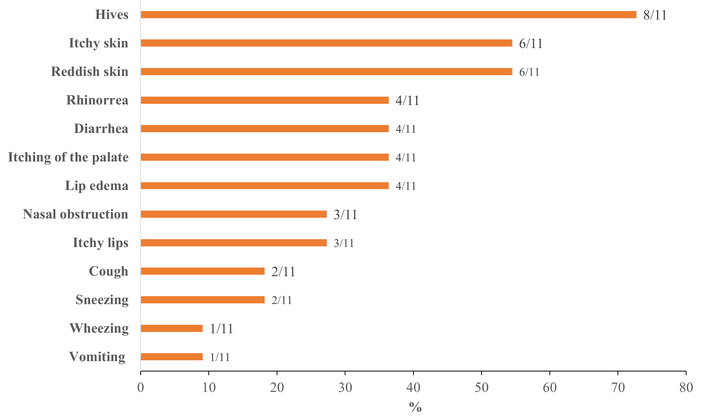
Cutaneous symptoms were the most frequent clinical manifestations among children with PA, with hives being the main reported complaint (72.7%), as illustrated in Figure 1.
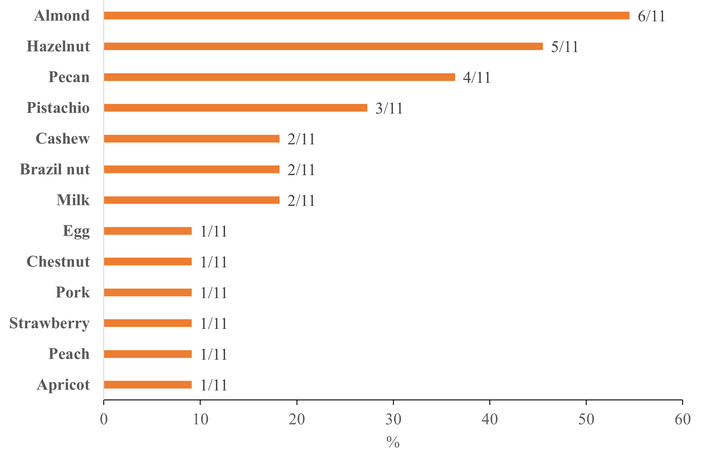
Among children with PA, other foods, particularly almonds (54.5%), hazelnuts (45.5%), and pecans (36.4%), were the most frequently associated allergens, as shown in Figure 2.
None of the children with PA exhibited symptoms after consuming other legumes such as beans or soy.
Given the low PA prevalence observed among schoolchildren in this national study, PA is unlikely to represent a major public health concern in Mexico. Considering a schoolchildren population of just over 13 million and a prevalence of 0.26%, approximately 33,800 children are estimated to be affected. Compared with the PA prevalence rates found in Western countries (1–2%) [1], our study demonstrates prevalence ratios that are 3.8 to almost 8 times higher in those countries than in Mexico. In a previous study conducted in Mexico, 3.3% (10/304) of a sample of children with allergic diseases were found to have a PA, as determined by an oral food challenge [3]. In another study of schoolchildren, 1.9% (14/756) reported a convincing reaction to peanuts [4].
The traditional Mexican diet, which includes corn, beans, lentils, chickpeas, and chili [5], along with the common consumption of boiled peanuts that reduces their allergenicity [6], may help explain the low prevalence of PA. Although there is no certainty about the exact age at which parents introduce boiled peanuts into children’s diets in Mexico, evidence indicates that most children consume peanuts by the age of 2 years [3, 4]. Conversely, peanut proteins transmitted through breast milk may contribute to either sensitization or tolerance development [7]. Moreover, early introduction of peanuts into children’s diets has been associated with a reduced risk of developing PA [8].
The prevalence of convincing severe reactions was extremely low in the current study’s population. In contrast, rates between 1.2 and 14.2% have been reported in the United States and the United Kingdom [1]. Most children with PA presented systemic symptoms, particularly urticaria, rather than oral symptoms, indicating that clinical manifestations in this population tend to be predominantly systemic. These findings suggest that the allergenic proteins involved vary according to the clinical profile. Severe reactions are mainly mediated by allergens such as Ara h 1 and Ara h 2, whereas oral symptoms are more commonly associated with Ara h 5 and Ara h 8, which are related to oral allergy syndrome and cross-sensitization with pollens [9]. Importantly, a public health problem is defined not only by its magnitude (prevalence) but also by its impact. In PA, the condition can incur substantial economic costs due to healthcare utilization and cause lifestyle restrictions that reduce the quality of life for affected individuals. Although this does not appear to be the case in Mexico, periodic surveys such as the current one would help detect any future increase in prevalence.
The study’s primary limitation was the lack of confirmatory testing for PA, which is inherent to parent-reported surveys and challenging to implement nationally. Nonetheless, surveys remain a cost-effective approach for estimating prevalence. The study’s partial use of Gupta et al.’s algorithm [2], combined with rigorous selection methods and a regionally stratified sample, supports the reliability of these ENRADAL-MEX findings for PA. Additionally, the use of epinephrine auto-injectors in severe cases of PA was not assessed, as these devices are not commercially available in Mexico. In food allergy cases where epinephrine is required, physicians provide 1:1,000 epinephrine ampules and a syringe, teaching the patient or caregiver how to administer it correctly.
In conclusion, this is the first national study demonstrating that PA does not currently represent a public health problem among Mexican schoolchildren. Future research, including specific immunoglobulin E quantification and controlled oral food challenges, will be essential to deepen our understanding and characterization of this condition in Mexico.
AFRs: adverse food reactions
ENRADAL-MEX: Encuesta Nacional de Reacciones Adversas a Alimentos Mexico
PA: peanut allergy
MBB: Conceptualization, Data curation, Formal analysis, Methodology, Project administration, Writing—original draft, Writing—review & editing. JMR: Conceptualization, Data curation, Formal analysis, Writing—original draft, Writing—review & editing. MGBGN, BMMM, GARS, JDM, AGA, MRS, EASV, DRY, SCG, IMMB: Investigation, Writing—review & editing. All authors read and approved the submitted version.
The authors declare that they have no conflicts of interest.
This study adhered to the ethical principles outlined in the Declaration of Helsinki for medical research involving human participants and received approval from the Research Ethics Committee of the Jalisco State Health Services (approval number 0460/21 HCJIM/2021). Parents or guardians, who provided written informed consent for the inclusion of their children in the study, were the sole source of information through completing the questionnaire; at no point did the children provide data or were they questioned.
Informed consent to participate in the study was obtained from the parents or legal guardians of all participating children.
Not applicable.
The data of this manuscript could be available from the corresponding authors upon reasonable request.
Not applicable.
© The Author(s) 2026.
Open Exploration maintains a neutral stance on jurisdictional claims in published institutional affiliations and maps. All opinions expressed in this article are the personal views of the author(s) and do not represent the stance of the editorial team or the publisher.
Copyright: © The Author(s) 2026. This is an Open Access article licensed under a Creative Commons Attribution 4.0 International License (https://creativecommons.org/licenses/by/4.0/), which permits unrestricted use, sharing, adaptation, distribution and reproduction in any medium or format, for any purpose, even commercially, as long as you give appropriate credit to the original author(s) and the source, provide a link to the Creative Commons license, and indicate if changes were made.



View: 1413
Download: 12
Times Cited: 0
Melvin Lee Qiyu ... Mich Erlewyn-Lajeunesse