 Review


Affiliation:
1Department of Abdominal Oncology, Istituto Nazionale Tumori di Napoli, IRCCS “G. Pascale”, 80131 Naples, Italy
Email: a.ottaiano@istitutotumori.na.it
ORCID: https://orcid.org/0000-0002-2901-3855


 ,
Affiliation:
1Department of Abdominal Oncology, Istituto Nazionale Tumori di Napoli, IRCCS “G. Pascale”, 80131 Naples, Italy
Affiliation:
2Department of Medicine, Surgery and Dentistry, University of Salerno, 84081 Baronissi, Italy
Affiliation:
2Department of Medicine, Surgery and Dentistry, University of Salerno, 84081 Baronissi, Italy
ORCID: https://orcid.org/0000-0002-5236-3132
,
Affiliation:
1Department of Abdominal Oncology, Istituto Nazionale Tumori di Napoli, IRCCS “G. Pascale”, 80131 Naples, Italy
Affiliation:
3Laboratory of Neuroendocrine Interactions in Rheumatology and Inflammatory Diseases, IDIS, Complexo Hospitalario Universitario de Santiago de Compostela, University of Santiago de Compostela, 15706 Santiago de Compostela, Spain
Affiliation:
4Department of Precision Medicine, University of Campania “Luigi Vanvitelli”, 80138 Naples, Italy
Affiliation:
4Department of Precision Medicine, University of Campania “Luigi Vanvitelli”, 80138 Naples, Italy
Affiliation:
5Department of Clinical and Experimental Medicine, University of Messina, 98125 Messina, Italy
Affiliation:
1Department of Abdominal Oncology, Istituto Nazionale Tumori di Napoli, IRCCS “G. Pascale”, 80131 Naples, Italy
Explor Target Antitumor Ther. 2026;7:1002412 DOI: https://doi.org/10.37349/etat.2026.1002412
Received: May 23, 2026 Accepted: September 09, 2026 Published: November 11, 2026
Academic Editor: Godefridus J. (Frits) Peters, Amsterdam UMC, Netherlands
The article belongs to the special issue Liquid Biopsy: Has Already Changed the Clinical Decision-Making in Solid Tumors Treatment?
Gastrointestinal (GI) cancers account for a substantial proportion of global cancer mortality and remain a major focus of translational and clinical oncology. Over the past decade, advances in molecular profiling, biomarker development, and systemic therapies—including liquid biopsy and circulating tumor DNA (ctDNA) for minimal residual disease (MRD) detection and longitudinal monitoring—have substantially enhanced biological resolution. Precision oncology has already produced major clinical successes in selected molecularly defined subsets, although the magnitude and breadth of benefit remain heterogeneous across tumor types and disease settings. Yet, increasing biological precision has not always translated proportionally into predictable and actionable clinical decisions for individual patients. In this critical narrative review, we examine major GI cancers—including colorectal, gastric, esophageal, pancreatic, biliary tract cancers (BTCs), and hepatocellular carcinoma (HCC)—through the lens of conceptual limitations and unmet clinical needs. Across these malignancies, although with important tumor-specific exceptions and different levels of supporting evidence, recurring themes emerge: the gap between precise prognostication and actionable treatments, exemplified by settings in which ctDNA identifies high-risk patients without providing an effective strategy to modify that risk; the limitations of static models applied to dynamic disease processes; and the persistence of empirically driven decision-making despite increasingly detailed molecular information. By framing uncertainty as an intrinsic feature of cancer biology rather than simply a failure of evidence, this review argues for more adaptive clinical frameworks integrating longitudinal molecular, genetic, and clinical information, allowing therapeutic and surveillance strategies to be reassessed as disease evolves rather than relying exclusively on single-time-point characterization. Such frameworks should complement, rather than replace, the established achievements of precision oncology and be tailored to the distinct biological and evidentiary context of each GI cancer type.
Gastrointestinal (GI) malignancies collectively constitute one of the largest and most lethal disease groups in global oncology. According to the most recent global estimates, cancers arising from the GI tract account for approximately 5.1 million new cases per year, representing ~26% of all cancer diagnoses, and for over 3.4 million deaths annually, corresponding to ~34% of global cancer mortality [1–3]. This disproportionate contribution to cancer-related deaths reflects not only their high incidence but also their aggressive biology, frequent late-stage presentation, and limited responsiveness to systemic therapies in advanced disease. Colorectal cancer (CRC) alone represents the third most commonly diagnosed malignancy worldwide, with ~1.9 million new cases and more than 930,000 deaths per year, and remains a leading cause of cancer mortality despite the availability of effective screening and preventive strategies. Gastric cancer (GC), while declining in incidence in some regions, continues to account for ~1.1 million new cases and ~770,000 deaths annually, ranking among the top causes of cancer death globally. Esophageal adenocarcinoma (EAC), with ~600,000 new diagnoses and ~540,000 deaths each year, exemplifies the persistently high lethality of GI tumors, with five-year survival rates remaining below 20% in most populations. Less frequent but highly aggressive GI malignancies contribute disproportionately to mortality. Pancreatic ductal adenocarcinoma (PDAC), responsible for ~495,000 new cases worldwide, causes nearly the same number of deaths annually and is projected to become the second leading cause of cancer-related mortality in several high-income countries within the next decade. Biliary tract cancers (BTCs), though accounting for fewer than 250,000 new cases per year, are characterized by median survivals measured in months in advanced stages. Hepatocellular carcinoma (HCC), with ~900,000 new diagnoses and ~830,000 deaths annually, remains tightly linked to chronic liver disease and metabolic risk factors, sustaining a high global mortality burden despite advances in locoregional and systemic therapies [1–3].
Beyond absolute numbers, GI cancers exert a profound societal impact in terms of disability-adjusted life years, healthcare utilization, and economic burden [4]. The majority of patients present with regionally advanced or metastatic disease, and even in ostensibly curable settings, recurrence rates remain substantial. These epidemiological realities position GI oncology as both a clinical priority and a conceptual stress test for modern precision medicine.
Over the past decade, technological advances in molecular profiling, high-throughput sequencing, and biomarker discovery have dramatically refined the biological characterization of GI tumors [5]. Disease entities historically defined by anatomical site are now understood as collections of biologically diverse malignancies shaped by genomic instability, epigenetic remodeling, immune contexture, and dynamic tumor—host interactions [6–9]. This increased resolution has improved prognostic discrimination and challenged traditional staging systems, yet it has also exposed fundamental limitations in prevailing clinical frameworks.
A foundational expectation of precision oncology is that increasing biological resolution should progressively reduce therapeutic uncertainty: more accurate characterization of tumor dependencies should classify patients more accurately, predict treatment benefit more reliably, and support more rational treatment selection. However, this relationship is neither automatic nor linear. Biological precision and therapeutic certainty represent distinct dimensions, because increasingly accurate characterization of disease does not necessarily provide an actionable intervention, a validated predictive biomarker, or sufficient evidence to determine the optimal treatment for an individual patient. It is precisely this gap between knowing the disease more precisely and knowing more precisely what to do about it that provides the conceptual starting point of this review. We therefore treat uncertainty not as a failure of evidence, but as an intrinsic feature of GI cancers that clinically useful precision frameworks must accommodate.
In many GI malignancies, the ability to detect and quantify biological risk now exceeds the capacity to therapeutically modify that risk. Molecular subclassification has often yielded sharper prognostic gradients without delivering commensurate gains in treatment individualization. As a result, clinicians increasingly navigate a landscape in which biological precision coexists with persistent therapeutic empiricism. This growing disconnect highlights a central tension in contemporary GI oncology: while knowledge of tumor biology has expanded rapidly, the clinical models used to guide decision-making have evolved more slowly.
Understanding where and why this gap arises—and how it manifests across different GI cancer types—is essential to contextualize current evidence and to identify the conceptual caveats that constrain progress. Rather than reflecting isolated failures, these limitations reveal structural features of how evidence is generated, interpreted, and applied in GI oncology.
We developed this critical narrative review through an iterative, literature-informed process that combined repeated multidisciplinary discussions and brainstorming among the authors with a focused appraisal of the scientific literature relevant to the conceptual questions addressed. We identified the literature through iterative searches of PubMed/MEDLINE and Google Scholar, primarily covering January 2015 to December 2025, and retained earlier landmark studies when they were necessary to establish biological or therapeutic concepts that remain relevant to current clinical practice. Disease-specific searches combined each malignancy with terms related to precision oncology, molecular classification, biomarkers, tumor heterogeneity, ctDNA/minimal residual disease (MRD), targeted therapy, immunotherapy, therapeutic resistance, clinical trials, treatment sequencing, and unmet clinical needs (see Supplementary material for the disease-specific keyword-based search strategies). The multidisciplinary author panel comprised seven medical oncologists and three basic scientists, all with more than 10 years of experience in precision oncology and related translational research. All 10 authors appraised candidate studies. We excluded studies that received an unfavorable assessment from at least three authors; when one or two authors raised concerns, we discussed them collectively and resolved them by consensus whenever possible. Among eligible studies, we defined “prioritized studies” as those that all 10 authors judged positively for scientific quality, representativeness, conceptual relevance, and clinical significance for the specific issue under consideration. Thus, prioritization reflected unanimous multidisciplinary appraisal rather than study design or recency alone. We selected six malignancies—colorectal, gastric, esophageal, pancreatic, BTCs, and HCC—using a purposeful, multi-criterion approach rather than epidemiological frequency alone. Collectively, these cancers carry a substantial clinical burden while spanning markedly different biological architectures, actionable molecular targets, therapeutic settings, and relationships among tumor-, host-, and treatment-related factors. We chose them as complementary rather than redundant disease models in which the central gap examined in this review—the increasing precision with which cancer biology can be described vs the more limited precision with which clinicians can translate that information into treatment decisions—takes distinct and clinically informative forms. Our aim was not to provide an exhaustive catalogue of GI malignancies, but to interrogate the central thesis of the review across a representative, biologically diverse, and methodologically coherent spectrum of contemporary GI oncology. We define precision oncology as a clinical framework in which measurable biological features of the tumor, host, or their interaction refine prognosis and inform individualized treatment decisions beyond conventional anatomical and clinicopathological criteria. Biological characterization alone does not constitute clinically actionable precision.
We performed no de novo patient-level quantitative synthesis, pooled effect estimation, regression analysis, or inferential statistical modeling in this narrative review; therefore, there were no statistical-model assumptions to test.
CRC is often portrayed as the paradigmatic success story of GI oncology, with declining incidence in several high-income countries, established screening programs, and an expanding armamentarium of systemic therapies [3]. Yet this apparent maturity conceals profound conceptual and clinical limitations. CRC is no longer a single disease entity but a spectrum of biologically distinct malignancies that share an anatomical origin while diverging markedly in molecular drivers, immune contexture, metastatic behavior, and treatment sensitivity [8, 9]. The persistence of stage-based decision-making represents the first major caveat.
Tumor-node-metastasis (TNM) staging remains the dominant framework guiding adjuvant and metastatic treatment, despite its limited ability to capture biological risk. Patients with identical pathological stages may experience radically different outcomes, reflecting the influence of molecular features such as microsatellite instability (MSI)-high disease [10], chromosomal instability (CIN), CpG island methylator phenotype (CIMP), and consensus molecular subtypes (CMS) [8, 9]. While these classifications have refined prognostic discrimination, their integration into routine therapeutic algorithms remains inconsistent and, in many cases, superficial.
A second caveat lies in the widespread conflation of prognostic and predictive biomarkers. MSI-high status exemplifies a rare exception, conferring both favorable prognosis in early-stage disease and sensitivity to immune checkpoint inhibition in the metastatic setting [10]. In contrast, most molecular features in CRC provide prognostic information without reliably predicting benefit from specific therapies. This disconnect is particularly evident in the adjuvant setting, where chemotherapy decisions are frequently made in the absence of biomarkers capable of identifying true treatment beneficiaries [11].
The emergence of circulating tumor DNA (ctDNA) as a marker of MRD has sharpened this tension [12–14]. CtDNA robustly identifies patients at high risk of recurrence after curative-intent surgery, yet its ability to direct effective therapeutic intervention remains limited. This distinction was directly illustrated by the randomized phase 2/3 DYNAMIC-III trial in stage III colon cancer, in which postoperative ctDNA strongly stratified recurrence risk, whereas ctDNA-guided treatment modification did not translate straightforwardly into improved outcomes: de-escalation in ctDNA-negative patients reduced oxaliplatin exposure but did not meet the prespecified non-inferiority margin for recurrence-free survival, while chemotherapy escalation in ctDNA-positive patients failed to improve recurrence-free survival compared with standard management [15]. This exposes a fundamental unmet need: the absence of effective adjuvant strategies for biologically aggressive, MRD-positive CRC. DYNAMIC-III therefore provides a particularly clear example of the distinction between prognostic precision and therapeutic actionability: identifying residual disease and quantifying its associated risk does not, by itself, identify an intervention capable of modifying that risk. Thus, ctDNA has illuminated risk with unprecedented clarity while simultaneously revealing the inadequacy of current treatments to modify that risk.
Another underappreciated caveat concerns intratumoral and temporal heterogeneity. Primary tumors and metastases may harbor distinct molecular profiles, and selective pressures imposed by therapy drive clonal evolution over time [16]. Static baseline biomarker assessment therefore risks misrepresenting the biology of residual or recurrent disease. Longitudinal approaches, including serial ctDNA monitoring, may promise greater biological fidelity but introduce new layers of uncertainty related to assay sensitivity, sampling intervals, and clinical interpretation.
In the metastatic setting, therapeutic sequencing remains largely empiric. While targeted therapies for rat sarcoma viral oncogene homolog (RAS) wild-type, B-raf proto-oncogene, serine/threonine kinase (BRAF; v-raf murine sarcoma viral oncogene homolog B1)-mutant, and human epidermal growth factor receptor 2 (HER2)-amplified tumors have improved outcomes in selected subgroups, resistance invariably emerges [17]. In this context, clinicians often prioritize drug availability over biological rationale, and cross-trial comparisons substitute for direct evidence. The unmet need here is not additional agents per se, but rational, biology-driven sequencing strategies supported by adaptive trial designs.
Additional molecular and clinical determinants further illustrate the continuum between biological granularity and actionable treatment options. Kirsten rat sarcoma viral oncogene homolog (KRAS) G12C, present in a small subset of metastatic CRC, has become directly actionable: combined KRAS G12C and epidermal growth factor receptor (EGFR) inhibition has improved outcomes over standard late-line therapy, translating a formerly difficult-to-target driver into a clinically relevant therapeutic vulnerability while leaving optimal sequencing and durability unresolved [18]. Neurotrophic tyrosine receptor kinase (NTRK) fusions are exceedingly rare in CRC but can confer marked sensitivity to tumor-agnostic tropomyosin receptor kinase (TRK) inhibition, representing a paradigmatic example of high actionability despite very low prevalence [19]. Likewise, pathogenic DNA polymerase epsilon, catalytic subunit/DNA polymerase delta 1, catalytic subunit (POLE/POLD1) proofreading defects define a rare ultramutated subgroup with pronounced sensitivity to immune checkpoint blockade, although rarity and variant-level interpretation limit routine implementation [20]. By contrast, primary tumor sidedness has both prognostic and treatment-predictive relevance, particularly for anti-EGFR therapy in RAS wild-type metastatic CRC, but it remains a clinicopathological surrogate for a complex and incompletely resolved biological continuum rather than a molecular target itself [21]. These examples reinforce that precision oncology spans a spectrum from directly druggable alterations to contextual biomarkers whose clinical utility may exceed mechanistic resolution.
GC remains one of the most biologically complex and clinically challenging malignancies in GI oncology. Despite declining incidence in several Western countries, it continues to represent a leading cause of cancer-related mortality worldwide, with a disproportionate burden in East Asia [1]. This geographic variability is not merely epidemiological but reflects differences in tumor biology, environmental exposure, and host factors. Yet, global treatment paradigms often assume biological interchangeability across regions, introducing a first caveat in the interpretation and application of clinical evidence.
Molecular classification has substantially refined the biological taxonomy of GC. The cancer genome atlas (TCGA) defined four major subtypes—Epstein-Barr virus (EBV)-positive, MSI-high, genomically stable (GS), and CIN—with distinct genomic architectures and candidate therapeutic vulnerabilities [22]. The Asian Cancer Research Group (ACRG) proposed a complementary classification with prognostic implications [23]. However, these taxonomies remain only partially treatment-defining: MSI/deficient mismatch repair (dMMR) has clear predictive relevance for immune checkpoint blockade, whereas most TCGA/ACRG categories still function primarily as biological descriptors rather than validated therapeutic selectors. Thus, increasingly granular taxonomy has outpaced its routine clinical use.
This distinction also clarifies which baseline biomarkers remain clinically inadequate. HER2, MSI/dMMR, programmed death-ligand 1 (PD-L1) combined positive score (CPS), and, more recently, claudin 18 isoform 2 (CLDN18.2) can alter treatment selection in defined settings; however, a single pretreatment sample provides only a static and spatially restricted representation of a heterogeneous and evolving disease. PD-L1 CPS is continuous, assay- and sampling-dependent, and enriches—rather than absolutely selects—for benefit from chemoimmunotherapy, as illustrated by CheckMate 649 and KEYNOTE-859 [24, 25]. By contrast, MSI-H/dMMR, although uncommon, identifies a substantially more immunotherapy-sensitive population and represents one of the strongest biologically grounded predictive biomarkers in GC [26]. The unmet need is therefore not simply additional baseline markers, but biomarkers with sufficient spatial, temporal, and treatment-specific fidelity to guide individual decisions.
HER2-positive GC both supports and challenges the central argument of this review. It supports precision oncology because HER2 overexpression/amplification is a validated therapeutic determinant and trastuzumab established a biomarker-selected first-line strategy [27]. At the same time, gastric HER2 expression is frequently heterogeneous and may be lost or change under therapeutic pressure, limiting the reliability of a single baseline assessment [28]. The activity of the HER2-directed antibody-drug conjugate (ADC) trastuzumab deruxtecan (T-DXd) after prior therapy demonstrates that improved drug design can partly overcome biological heterogeneity, but variable antigen expression, acquired resistance, and the need for reassessment remain clinically relevant limitations [29]. HER2 therefore exemplifies successful translation into treatment without complete therapeutic certainty.
CLDN18.2 provides a newer example in which biological identification has translated into clinically meaningful treatment options. In HER2-negative, CLDN18.2-positive advanced GC/gastroesophageal junction (GEJ) adenocarcinoma, adding zolbetuximab to chemotherapy improved progression-free and overall survival (OS) in the phase III SPOTLIGHT and GLOW trials [30, 31]. Nevertheless, CLDN18.2 expression is threshold-dependent and can be heterogeneous over time and across samples, raising familiar questions regarding assay cutoffs, biomarker stability, overlapping eligibility with immunotherapy, and optimal sequencing. Thus, even a newly validated target rapidly generates a second layer of precision-oncology uncertainty once it enters routine therapeutic algorithms.
Fibroblast growth factor receptor 2b (FGFR2b) illustrates an earlier point on the same translational continuum. In the randomized phase II FIGHT trial, bemarituzumab plus mFOLFOX6 showed a clinically promising signal in FGFR2b-selected disease, with greater benefit in tumors with higher FGFR2b expression, but the primary progression-free survival (PFS) analysis was not statistically significant and confirmatory phase III evidence remains necessary [32]. This exposure-response relationship is biologically compelling, yet it also emphasizes how target definition, expression threshold, toxicity, and prospective validation determine whether molecular resolution becomes a reproducible treatment rule.
The perioperative setting exposes additional uncertainties. Multimodal strategies combining chemotherapy with surgery have become standard for resectable disease, yet recurrence rates remain substantial [33, 34]. Pathological response is often used as a surrogate for long-term benefit despite imperfect correlation with survival, and treatment remains largely uniform across biologically diverse tumors. MSI/dMMR is particularly instructive: it carries favorable prognostic information in localized disease and may identify tumors with distinct sensitivity to systemic approaches, but its optimal integration into perioperative treatment selection remains less settled than its predictive role in advanced immunotherapy. The unmet need is therefore to use biological information prospectively to escalate, de-escalate, or substitute treatment according to risk.
Immunotherapy further illustrates the difference between enrichment and certainty. PD-L1 CPS has clinical utility and higher scores are generally associated with greater benefit from first-line programmed cell death protein 1 (PD-1) blockade plus chemotherapy, but clinically used thresholds differ across trials and regulatory settings and do not define mutually exclusive responder and non-responder populations [24, 25]. MSI-H/dMMR provides a stronger predictive signal, whereas EBV-associated biology remains intriguing but is not yet a routinely sufficient stand-alone treatment selector [26, 35]. Static immunohistochemistry therefore captures only part of a dynamic tumor-immune interaction shaped by site, sampling, and therapeutic pressure.
ADCs are expanding the therapeutic consequences of surface-antigen profiling. T-DXd has established proof of principle in HER2-positive disease [28], while ADCs directed against CLDN18.2 and other gastric-cancer-associated antigens are entering clinical development [36]. Their potential is conceptually important because payload delivery and bystander effects may broaden activity beyond the strict binary logic of conventional target inhibition. However, antigen heterogeneity, target loss, payload resistance, and uncertainty regarding optimal biomarker thresholds may reproduce—rather than eliminate—the gap between increasingly sophisticated biological selection and durable clinical benefit.
Another underexplored caveat concerns MRD. Unlike CRC, where ctDNA has begun to inform postoperative risk classification, its application in GC remains investigational [37]. Differences in tumor shedding, anatomical drainage, and assay sensitivity complicate translation. Nonetheless, the absence of reliable markers of residual disease perpetuates empirical postoperative management and delays the recognition of therapeutic failure. The unmet need is the development of longitudinal biomarkers that reflect true disease burden rather than inferred risk.
Finally, GC exemplifies the limitations of one-size-fits-all clinical trial design. Global trials often pool heterogeneous populations and increasingly overlapping biomarker-defined subsets, potentially obscuring differential benefit and complicating therapeutic sequencing. Future trials should accommodate co-expression, longitudinal biomarker change, and adapt patient classification as tumors evolve, aligning biological hypotheses with clinically meaningful endpoints rather than assuming that a single baseline label is sufficient to define therapeutic destiny.
EAC epitomizes the tension between therapeutic intensification and biological uncertainty in modern GI oncology. Over the past two decades, multimodal treatment strategies have significantly improved locoregional control and surgical outcomes, yet long-term survival remains suboptimal [38]. This section specifically addresses adenocarcinoma arising in the esophagus; esophageal squamous cell carcinoma (ESCC) and GEJ adenocarcinoma are discussed below as related but non-interchangeable entities. This distinction is important because histology and anatomic origin influence tumor biology, response to neoadjuvant treatment, and the interpretation of response endpoints.
Neoadjuvant therapy followed by surgery is a major curative-intent strategy for locally advanced EAC [39]. Pathological complete response (pCR) is consistently associated with a favorable prognosis at the individual-patient level; therefore, we do not consider pCR an invalid clinical endpoint. The relevant limitation is narrower: pCR is an imperfect surrogate for long-term treatment benefit and should not be interpreted as equivalent to biological eradication or as a stand-alone substitute for survival endpoints. A trial-level meta-analysis of 40 neoadjuvant studies including 55,344 patients found only moderate correlations between pCR and OS and concluded that pCR was not an ideal surrogate endpoint in randomized trials [40]. Thus, the conceptual inadequacy lies not in measuring pCR, but in overextending its meaning beyond what has been validated.
Accordingly, no single response marker should simply replace pCR for every purpose. For comparative neoadjuvant trials, disease-free survival (DFS) currently provides a more clinically grounded intermediate endpoint when mature OS is not yet available. An individual-patient-data meta-analysis of 4,518 patients with operable esophageal or GEJ carcinoma demonstrated strong individual-level correlations between DFS and OS and very high trial-level correlations between treatment effects on these endpoints (R2 0.93–0.96 across comparisons), supporting DFS as a validated surrogate for OS in trials of neoadjuvant chemotherapy or chemoradiotherapy [41]. OS nevertheless remains the definitive endpoint. At the individual-patient level, the more relevant unmet need is complementary postoperative risk assessment that integrates pathological response, nodal status and, prospectively, dynamic molecular measures of residual disease rather than replacing one imperfect marker with another.
The distinction from ESCC is particularly important. EAC and ESCC are not merely different histologies at the same anatomical site: they have distinct epidemiology, etiologic pathways and genomic architectures. ESCC also achieves higher pCR rates after neoadjuvant chemoradiotherapy than adenocarcinoma; a systematic review and meta-analysis reported pooled pCR rates of 32% for ESCC and 22% for adenocarcinoma after neoadjuvant chemoradiotherapy [42]. Integrated genomic analyses further show that ESCC resembles squamous carcinomas from other organs more closely than EAC, whereas EAC is characterized by prominent CIN and shares molecular features with chromosomally unstable gastric adenocarcinoma [43]. Consequently, response rates, surrogate-endpoint performance and biomarker hypotheses should not be assumed to transfer unchanged between ESCC and EAC.
GEJ adenocarcinoma requires a different distinction. Although distal EAC and some GEJ adenocarcinomas form a biological continuum, GEJ tumors are anatomically and biologically heterogeneous. The Siewert classification separates distal EAC (type I), true cardia carcinoma (type II), and subcardial GC infiltrating the junction (type III), entities that differ in histogenesis, clinicopathological characteristics, and surgical approach [44]. This heterogeneity is also relevant to trial interpretation because studies frequently pool distal esophageal and GEJ adenocarcinomas. Therefore, conclusions drawn for EAC should specify whether GEJ tumors were included and should not automatically be generalized across all junctional adenocarcinomas.
Molecular characterization of EAC has revealed recurrent alterations in tumor protein p53 (TP53), receptor tyrosine kinases, and cell-cycle regulators, together with substantial CIN [45]. However, these insights have yet to translate into consistently actionable stratification in the curative-intent setting. The relevant limitation is therefore not an absence of molecular structure, but the still incomplete conversion of molecular heterogeneity into prospectively validated perioperative treatment selection.
Immunotherapy has introduced new possibilities, particularly in the adjuvant and metastatic settings [46, 47]. The use of immune checkpoint inhibitors (ICIs) after neoadjuvant chemoradiotherapy and surgery has demonstrated DFS benefit in patients with residual pathological disease [47]. Yet, predictive biomarkers of benefit remain incompletely defined, and treatment is administered to a broad biomarker-unselected postoperative population. PD-L1 expression provides context-dependent information but does not resolve this uncertainty, again illustrating the limitations of static biomarkers in a tumor-immune landscape reshaped by multimodal therapy.
The concept of molecular residual disease is therefore complementary to, rather than a replacement for, pathological response. CtDNA can detect occult disease and has shown prognostic potential in esophageal cancer, but clinical integration remains investigational [48]. Challenges related to assay sensitivity, tumor shedding, and optimal sampling timepoints remain substantial, and no validated ctDNA-guided postoperative strategy currently exists. Future response assessment should therefore be layered: pCR or graded pathological regression for local treatment effect, DFS for clinically meaningful trial-level benefit, OS as the definitive endpoint, and longitudinal biomarkers such as ctDNA as investigational tools for individual residual-risk refinement.
This endpoint hierarchy also has implications for trial design. Future EAC studies should prespecify histology and GEJ inclusion criteria, avoid treating pCR as synonymous with survival benefit, and integrate pathological, time-to-event, and longitudinal molecular endpoints according to the clinical question being tested. Such a framework preserves the established prognostic value of pCR while avoiding claims that exceed its validated surrogacy.
PDAC represents the most formidable challenge in GI oncology, with survival outcomes that have improved only marginally over decades despite escalating therapeutic intensity [49]. Its reputation as a biologically intractable disease is well deserved, yet this characterization risks obscuring critical conceptual shortcomings in how PDAC is studied and treated. The prevailing clinical narrative emphasizes intrinsic chemoresistance and late diagnosis, but a closer examination reveals deeper structural caveats that continue to limit progress.
One of the most entrenched assumptions in PDAC management is that treatment failure reflects an absence of actionable biology. In reality, PDAC is molecularly heterogeneous, encompassing classical and basal-like transcriptional subtypes, distinct metabolic dependencies, and variable immune landscapes [50]. However, these biological distinctions rarely inform clinical decision-making. Most molecular subtype data still come from retrospective analyses. Frontline cytotoxic therapy selection is strongly influenced by performance status, comorbidity, organ function, and anticipated tolerance. We agree that this fitness-based selection is biologically and clinically meaningful and should not itself be characterized as empirical. The residual empiricism lies instead in choosing among active regimens for otherwise eligible patients without validated tumor-specific predictive biomarkers. This gap underscores a central unmet need: integrating host fitness with tumor biology rather than treating either dimension as sufficient for precision.
The neoadjuvant and adjuvant settings illustrate the limitations of current paradigms. Combination chemotherapy has become standard for resectable and borderline resectable disease, yet recurrence rates remain high even after apparently curative surgery [51]. Pathological response and margin status are frequently used as indicators of treatment success, but their prognostic value is inconsistent. Moreover, the assumption that intensified perioperative therapy can overcome aggressive biology has not been convincingly validated [52]. Many patients complete arduous treatment courses only to experience early systemic relapse, revealing the inadequacy of anatomical surrogates for biological risk.
MRD represents a particularly unresolved frontier in PDAC. Unlike other GI malignancies, the application of ctDNA has been limited by low tumor shedding and technical challenges. Nonetheless, emerging data suggest that detectable postoperative ctDNA identifies patients with near-universal risk of relapse [53]. The caveat lies not in the prognostic signal, but in the absence of effective interventions for MRD-positive patients. As in CRC, molecular detection has outpaced therapeutic capability, exposing a void rather than a pathway forward.
In advanced disease, precision approaches already modify treatment in selected PDAC subsets and should not be overlooked. Germline testing is clinically relevant because pathogenic breast cancer gene 1/2 (BRCA1/2) and partner and localizer of breast cancer gene 2 (PALB2) variants identify homologous-recombination-deficient tumors with enhanced platinum sensitivity; cisplatin plus gemcitabine is active in germline BRCA/PALB2-mutated PDAC, while maintenance olaparib prolongs PFS in germline BRCA-mutated metastatic disease without progression on first-line platinum [54–56]. MSI-H/dMMR and NTRK fusions, together with other rare actionable alterations, can also support biomarker-directed or tumor-agnostic therapy, but their low prevalence limits population-level impact [57]. Moreover, availability of actionable molecular targets does not invariably translate into treatment delivery: testing may be delayed or incomplete, and regulatory, access, trial-availability, tissue, and clinical-timing constraints may prevent a theoretically matched therapy from being administered [58]. Thus, these successes qualify rather than invalidate our argument: the unmet need is to expand the fraction of patients in whom molecular information becomes timely, accessible, and therapeutically consequential.
Importantly, KRAS-directed therapy is beginning to change this landscape. In the phase III RASolute 302 trial, daraxonrasib, a RAS(ON) multiselective inhibitor, significantly improved OS [13.2 vs 6.6 months; hazard ratio (HR) 0.40] and PFS (7.3 vs 3.5 months; HR 0.45) vs chemotherapy in previously treated metastatic PDAC with RAS G12 mutations [59]. This result provides compelling proof that a dominant PDAC driver can be therapeutically exploited, while leaving major unmet needs regarding optimal sequencing, resistance, and earlier-line integration.
The tumor microenvironment constitutes another critical caveat. PDAC is characterized by a dense desmoplastic stroma that shapes drug delivery, immune exclusion, and metabolic adaptation. Numerous stromal-targeting strategies have failed in clinical trials, often after promising preclinical results [60]. These failures underscore the limitations of model systems that inadequately recapitulate human disease. They also highlight the danger of extrapolating biological mechanisms without accounting for systemic complexity and host factors.
Clinical trial design in PDAC further compounds these challenges. Many trials enroll biologically heterogeneous populations and rely on modest survival endpoints, limiting the ability to detect subgroup-specific benefits. Negative results are frequently interpreted as evidence of biological intractability rather than as signals of poorly aligned hypotheses and methodologies. Adaptive and biomarker-enriched trial designs remain the exception rather than the norm.
PDAC exposes the limits of a treatment paradigm driven by escalation rather than precision. The field’s most pressing unmet need is not another cytotoxic combination, but an integrated strategy that aligns molecular insight, dynamic biomarkers, and rational trial design. Without such a shift, therapeutic advances will continue to be incremental, and the biological lessons of PDAC will remain underexploited.
BTCs represent one of the most heterogeneous and conceptually challenging groups of malignancies in GI oncology. Encompassing intrahepatic and extrahepatic cholangiocarcinoma as well as gallbladder cancer, BTCs are frequently discussed as a single clinical entity despite profound differences in cell of origin, molecular drivers, anatomical context, and clinical behavior [61]. This taxonomic simplification constitutes a fundamental caveat that permeates clinical trial design, therapeutic decision-making, and outcome interpretation.
From a biological standpoint, BTCs display remarkable molecular diversity. Actionable alterations such as FGFR2 fusions, isocitrate dehydrogenase 1 (IDH1) mutations, BRAF mutations, HER2 amplification, and NTRK fusions occur at variable frequencies across anatomical subtypes [62]. These advances have ushered in a new era of systemic therapy, combining biomarker-selected targeted strategies with contemporary chemoimmunotherapy [63–66]. However, availability of actionable molecular targets is not binary. The strength of clinical evidence differs substantially across targets, and even a technically targetable alteration may not translate into treatment because of limited evidence, drug access, timing, patient fitness, or acquired resistance [67, 68]. In a prospective BTC cohort, actionable alterations were identified in 58.3% of patients, but only 11.1% received genotype-matched therapy [68]. Thus, the unmet need extends beyond detecting a target to establishing its clinical use and ensuring that matched treatment can actually be delivered.
Recent therapeutic advances illustrate both the potential and the methodological complexity of precision oncology in BTC. In IDH1-mutant advanced cholangiocarcinoma, the phase III ClarIDHy trial established the clinical benefit of ivosidenib after prior therapy; final OS was 10.3 vs 7.5 months with placebo, and adjustment for the substantial crossover yielded an HR for death of 0.49 [69]. For FGFR2-rearranged cholangiocarcinoma, pemigatinib moved from activity in previously treated disease to randomized first-line evaluation in FIGHT-302: PFS was 8.3 vs 6.8 months with gemcitabine-cisplatin (HR 0.58), with higher response rate and longer response duration, although OS was similar; notably, the trial closed early because the first-line standard changed during recruitment [70]. In parallel, immunotherapy has reshaped the unselected first-line setting: KEYNOTE-966 showed an overall-survival benefit from adding pembrolizumab to gemcitabine-cisplatin (12.7 vs 10.9 months; HR 0.83) [71], while updated TOPAZ-1 confirmed sustained benefit with durvalumab plus gemcitabine-cisplatin (12.9 vs 11.3 months; HR 0.76) [72]. These developments make cholangiocarcinoma a particularly informative model in which biomarker-defined therapies and broadly applicable chemoimmunotherapy are evolving simultaneously, raising increasingly relevant questions of molecular testing, treatment sequencing, and trial design.
The first-line systemic treatment of advanced BTC exemplifies the persistence of empiricism. Platinum-based chemotherapy has long constituted the backbone of treatment, with recent additions marginally improving survival [63]. While these advances are welcome, they apply broadly and do not address the underlying biological heterogeneity of BTCs. Moreover, therapeutic decisions are often made without molecular information, despite the growing availability of genomic profiling. This disconnect reflects both logistical barriers and uncertainty regarding the optimal timing and interpretation of molecular data.
The adjuvant setting reveals additional layers of uncertainty. Surgical resection offers the only chance for cure, yet recurrence rates remain high. Adjuvant chemotherapy is frequently administered despite limited and sometimes conflicting evidence [73]. Trials in this setting often pool disparate BTCs subtypes, obscuring subtype-specific effects and diluting potential signals of benefit. The unmet need is not further intensification of therapy, but precise identification of patients who truly benefit from postoperative treatment.
MRD has emerged as a compelling but underdeveloped concept in BTC. CtDNA analysis has demonstrated prognostic value in small cohorts, identifying patients at high risk of recurrence after surgery [74]. However, clinical integration remains limited by assay variability, tumor shedding heterogeneity, and the absence of validated intervention strategies. As in other GI malignancies, MRD detection exposes a therapeutic void: risk can be identified more readily than it can be mitigated.
Immunotherapy has yielded mixed results in BTC [63, 71, 72]. While a subset of patients derives benefit, predictive biomarkers remain poorly defined. MSI-high tumors represent a small minority, and PD-L1 expression has not reliably predicted response. The immunological landscape of BTCs is shaped by both tumor-intrinsic factors and the biliary microenvironment, yet current biomarkers fail to capture this complexity. The assumption that immunotherapy can be broadly effective without refined patient selection represents a further caveat.
Clinical trial design poses perhaps the greatest barrier to progress in BTCs. The rarity and heterogeneity of these tumors necessitate collaborative, innovative approaches, yet many trials remain underpowered and biologically heterogeneous. We consider it plausible that aggregation of anatomically and molecularly distinct BTCs may obscure subtype-specific treatment effects; however, this remains a methodological hypothesis rather than an established explanation for negative trials. Negative studies should therefore not be attributed to aggregation without direct supporting evidence. Future studies should increasingly incorporate biomarker-driven patient selection, adaptive designs, and international collaboration.
HCC occupies a singular position within GI oncology, not only because of its global epidemiological burden but also due to the unique intertwining of tumor biology and chronic liver disease. Unlike other solid tumors, HCC almost invariably arises in the context of cirrhosis or chronic hepatic injury, rendering oncological decision-making inseparable from host-related factors. This duality constitutes both the defining feature of HCC and its principal conceptual caveat.
Over the past decade, systemic therapy for advanced HCC has undergone a rapid evolution, culminating in the integration of ICIs combined with anti-angiogenic agents as standard first-line treatment [75]. These advances have reshaped expectations, yet durable benefit remains confined to a subset of patients. Importantly, HCC treatment selection is not independent of tumor biology. Contemporary staging and treatment algorithms integrate tumor burden, including tumor number and size, as well as vascular invasion and extrahepatic spread, together with liver function and performance status [76]. The remaining gap is more specifically molecular: despite extensive biological characterization, validated molecular predictors rarely determine systemic treatment choice. Alpha-fetoprotein (AFP) is a notable exception at the biomarker level: an AFP concentration ≥ 400 ng/mL identified the population in whom ramucirumab improved survival in the biomarker-selected phase III REACH-2 trial [77]. By contrast, no molecular biomarker has been sufficiently validated for routine selection among current ICI-based regimens [78]. Thus, the unmet need is not to introduce tumor biology into HCC decision-making de novo, but to convert molecular and immune biology into validated predictive tools that add clinically useful discrimination beyond established tumor- and host-based criteria.
Molecular characterization of HCC has identified recurrent alterations in pathways regulating telomere maintenance, cell cycle control, wingless/integrated signaling pathway (WNT)/β-catenin signaling, and angiogenesis [79]. Despite these insights, molecular subclassification has failed to translate into routine clinical stratification. One major caveat is the assumption that tumor-intrinsic genomics alone can guide therapy in a disease profoundly shaped by its microenvironment and host organ dysfunction. The biological behavior of HCC reflects not only malignant hepatocytes but also the fibrotic, inflammatory, and vascular milieu of the cirrhotic liver.
The interpretation of clinical trial endpoints in HCC further illustrates this complexity. OS remains the gold standard, yet it is influenced by competing risks related to liver failure and portal hypertension. Radiographic response criteria, originally developed for other solid tumors, inadequately capture treatment benefit in HCC, particularly for immunotherapeutic agents [80]. Apparent disease progression may coexist with meaningful survival benefit, while radiographic stability may mask declining hepatic reserve. These ambiguities complicate both trial interpretation and clinical decision-making.
Immunotherapy resistance in HCC highlights additional conceptual blind spots. Activation of the WNT/β-catenin [81] pathway has been associated with immune exclusion and primary resistance to immune checkpoint inhibition, yet routine testing for such features is not standard practice. Furthermore, etiological heterogeneity—viral hepatitis, alcohol-related liver disease, and metabolic dysfunction—associated steatotic liver disease—modulates immune contexture and treatment response. The tendency to treat HCC as a biologically uniform disease disregards these critical modifiers.
MRD remains an underdeveloped concept in HCC. Local therapies such as resection and ablation can achieve radiographic complete responses, yet recurrence rates are high. CtDNA and other liquid biopsy approaches hold promise for detecting occult disease, but their application is complicated by low tumor fraction and background liver-derived DNA [82]. As in other GI malignancies, the ability to identify residual risk has outpaced the development of effective preventive strategies.
Clinical trial design in HCC continues to struggle with patient selection and biologically informed classification. Broad inclusion criteria may enhance accrual but obscure biologically meaningful signals, while restrictive criteria limit generalizability. Balancing these competing priorities remains challenging. Innovative designs that integrate biomarkers, etiology, and dynamic assessment of liver function are urgently needed.
When examined across disease entities, GI malignancies reveal a set of recurring structural patterns that transcend anatomical distinctions. At the core of these patterns lies a consistent gap between increasingly detailed biology and the ability to adapt treatment. Across multiple GI cancers, molecular and clinicopathological variables refine prognostic discrimination, yet exert only marginal influence on treatment selection, timing, or sequencing (Figure 1).
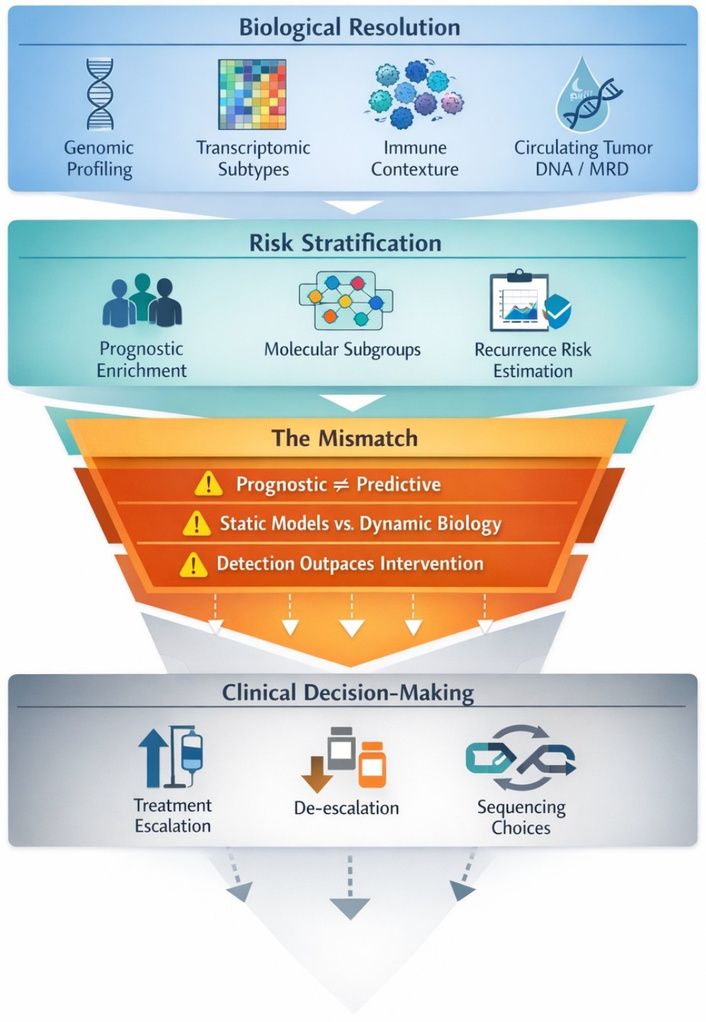
Beyond precision: the central challenge of decision-making in GI oncology. Advances in molecular profiling, immune characterization, and ctDNA analysis have markedly increased biological resolution across GI malignancies. These tools enable increasingly precise risk classification, particularly with respect to recurrence and residual disease. However, more precise prognostication has not led to better treatment decisions. Static clinical frameworks, binary biomarker thresholds, and limited treatment options create a gap between biological insight and treatment decisions. As a result, detection of risk often outpaces the ability to effectively modify that risk, exposing a central challenge in contemporary precision oncology. ctDNA: circulating tumor DNA; GI: gastrointestinal; MRD: minimal residual disease.
This transversal framework should be interpreted as an integrative heuristic rather than as a claim that CRC, HCC, and the other GI malignancies share an identical causal biology or therapeutic problem. Its purpose is to compare recurrent methodological tensions that arise in different biological contexts: heterogeneity within and between tumors, temporal evolution under treatment, imperfect translation of prognostic information into therapeutic action, and the limits of static classification for dynamic disease. Such cross-tumor reasoning is biologically defensible because intratumoral heterogeneity and clonal evolution are general properties of cancer that contribute to treatment resistance across histologies [83], while integrative pan-cancer frameworks have long been used to identify shared functional principles without erasing tumor-specific biology [84]. The clinical development of tissue-agnostic therapies provides further proof of principle that some actionable biological features can transcend organ of origin, although lineage and context remain critical modifiers [85]. Thus, the commonality proposed here is structural and methodological, not disease equivalence.
A second unifying feature is the reliance on static clinical frameworks to manage intrinsically dynamic diseases. Risk is commonly assessed at diagnosis or at predefined treatment milestones, despite mounting evidence that tumor biology evolves continuously under selective pressures imposed by therapy, immune surveillance, and microenvironmental change. This temporal gap constrains the clinical utility of otherwise informative biomarkers and contributes to late or suboptimal treatment adaptation (Figure 2).
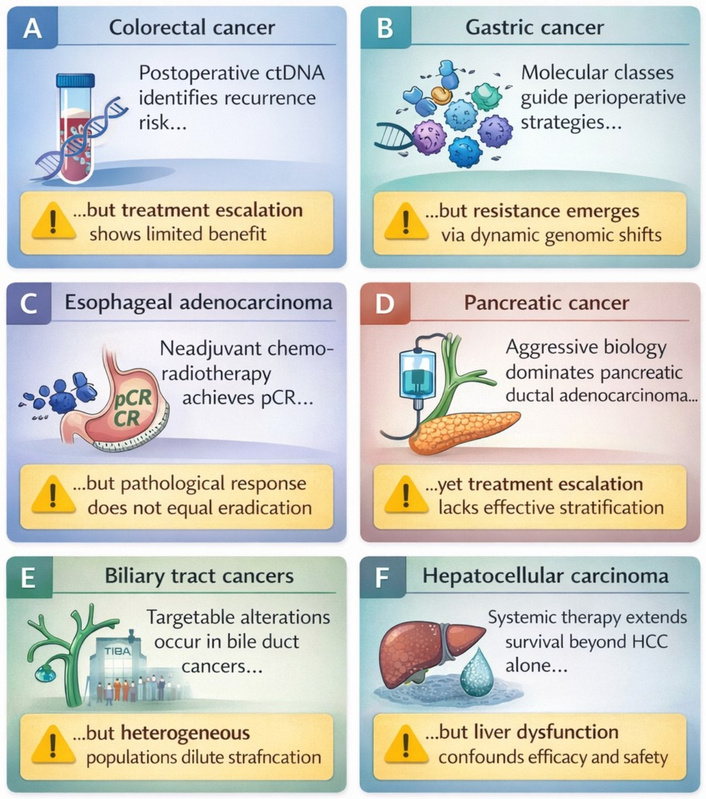
Disease-specific manifestations of conceptual limitations across GI malignancies. Despite shared advances in molecular profiling and systemic therapies, GI malignancies exhibit distinct, disease-specific expressions of a common structural gap between biological insight and clinical decision-making. (A) In CRC, postoperative ctDNA robustly identifies molecular residual disease and recurrence risk, yet escalation strategies for ctDNA-positive patients have shown limited and inconsistent clinical benefit. (B) In GC, molecular classifications inform perioperative and advanced treatment strategies, but static baseline biomarkers fail to capture the emergence of dynamic resistance mechanisms under therapeutic pressure. (C) In EAC, pCR after neoadjuvant therapy is associated with improved outcomes but does not reliably reflect true biological eradication, leaving residual risk insufficiently defined. (D) PDAC exemplifies treatment intensification driven by clinical fitness rather than biological stratification, with aggressive tumor biology frequently dominating therapeutic effect. (E) BTCs highlight the methodological concern that extreme anatomical and molecular heterogeneity—including actionable alterations—may obscure subtype-specific signals when heterogeneous populations are analyzed together. (F) In HCC, therapeutic efficacy is inseparably confounded by underlying liver dysfunction and disease etiology, limiting the predictive value of tumor-centric biomarkers. BTCs: biliary tract cancers; ctDNA: circulating tumor DNA; EAC: esophageal adenocarcinoma; GC: gastric cancer; GI: gastrointestinal; HCC: hepatocellular carcinoma; pCR: pathological complete response; PDAC: pancreatic ductal adenocarcinoma.
Methodological choices further shape these limitations. Clinical trials in GI oncology frequently aggregate biologically heterogeneous populations to achieve statistical power, privileging average treatment effects over biologically meaningful subgroups. Endpoints optimized for regulatory clarity—such as PFS or response rate—may inadequately capture long-term disease control or tumor evolution, reinforcing empiricism even in molecularly stratified settings (Table 1).
Conceptual caveats and unmet needs across GI malignancies.
| Cancer type | Dominant clinical paradigm | What biology reveals | Key conceptual caveat | Unmet clinical need |
|---|---|---|---|---|
| CRC | Stage-based adjuvant therapy; risk classification by clinicopathological factors | Molecular residual disease (ctDNA) identifies recurrence risk independent of stage | Prognostic precision does not equate to predictive utility | Effective MRD-directed therapeutic strategies |
| GC | Static molecular classification guiding perioperative and advanced treatment | Marked spatial and temporal heterogeneity with rapid emergence of resistance | Baseline biomarkers fail to capture dynamic tumor evolution | Longitudinal biomarkers to guide adapting treatment |
| EAC | Neoadjuvant therapy followed by surgery, with response-based prognostication | Pathological response incompletely reflects residual biological risk | Response surrogates do not ensure disease eradication | Reliable markers of residual disease and relapse risk |
| Pancreatic cancer | Treatment escalation driven by performance status | Distinct biological subtypes with differential aggressiveness and resistance | Intensification without biological selection | Classifying patients by tumor biology and adaptive trial designs |
| BTCs | Uniform systemic therapy across anatomical subtypes | Extreme molecular heterogeneity with subtype-specific vulnerabilities | Potential obscuring of subtype-specific signals by aggregation | Subtype-specific, biomarker-enriched clinical trials |
| HCC | Systemic therapy selection based on liver function and stage | Tumor behavior strongly modulated by etiology and host factors | Tumor-centric models ignore host-tumor interaction | Integrated tumor-host predictive frameworks |
BTCs: biliary tract cancer; CRC: colorectal cancer; ctDNA: circulating tumor DNA; EAC: esophageal adenocarcinoma; GC: gastric cancer; GI: gastrointestinal; HCC: hepatocellular carcinoma; MRD: minimal residual disease.
Finally, across the GI cancer spectrum, the detection of adverse biological features often lacks corresponding interventional pathways. High-risk states can be identified with increasing confidence, yet actionable strategies to alter their natural history remain scarce. This asymmetry between risk identification and risk modification represents a central unmet need and recurs across tumor types, stages, and therapeutic contexts (Table 2).
Current clinical frameworks fail to capture the biological complexity of gastrointestinal (GI) cancers.
| Domain | Current framework | Implicit assumption | Why the assumption fails | Clinical consequence |
|---|---|---|---|---|
| Disease classification | Anatomy- and stage-based taxonomy | Tumors within the same stage are biologically similar | Profound inter- and intratumoral heterogeneity exists within anatomical entities | Over- and undertreatment of biologically discordant patients |
| Biomarkers | Binary thresholds (positive/negative) | Biomarker status is stable and context-independent | Tumor biology evolves over time and under treatment pressure | Misclassification of risk and inappropriate therapeutic decisions |
| Response assessment | Radiographic or pathological surrogates | Response equates to eradication of malignant potential | Residual disease may persist despite apparent response | False reassurance and delayed intervention |
| Treatment selection | Escalation based on clinical fitness | More intensive therapy overcomes aggressive biology | Biology often dominates treatment effect | Increased toxicity without proportional benefit |
| Trial design | Broad eligibility and population aggregation | Assumption that average treatment effects adequately represent heterogeneous tumors | Potential loss of subgroup-specific signals | Risk of inconclusive average effects despite biologically distinct subgroups |
| Therapeutic sequencing | Empirical, guideline-driven algorithms | Optimal sequences can be generalized | Resistance and clonal evolution are patient-specific | Suboptimal use of available therapies |
| Host factors | Secondary consideration | Tumor behavior is largely tumor-intrinsic | Host biology and organ dysfunction shape outcomes | Confounded efficacy and safety assessment |
Taken together, these elements define a transversal framework in which uncertainty is not incidental but structural. Rather than diminishing with greater precision, uncertainty is redistributed—shifting from diagnostic ambiguity to therapeutic indeterminacy. Recognizing these shared caveats is a prerequisite for developing adaptive clinical models that integrate biological dynamics, methodological rigor, and patient context across GI oncology.
A further gap deserving specific consideration concerns how therapeutic efficacy itself is defined. In oncology, treatment benefit has traditionally been quantified predominantly through tumor-centered or time-to-event endpoints, including objective response, PFS, and OS. These measures remain indispensable, but they do not fully describe what treatment means for the individual patient. A therapy that delays progression may simultaneously impose persistent symptoms, functional deterioration, or treatment burden, whereas two regimens with similar antitumor efficacy may differ substantially in how patients experience daily life. This distinction is particularly relevant in GI cancers, in which nutritional impairment, fatigue, pain, GI symptoms, stomas, treatment-related toxicity, and progressive loss of physical or role function can strongly influence the value attributed to a given therapeutic strategy. Patient-reported outcomes (PROs) and health-related quality-of-life measures therefore provide information that is complementary, rather than subordinate, to conventional efficacy and safety endpoints. Regulatory frameworks increasingly recognize this principle: the Food and Drug Administration (FDA) has identified disease-related symptoms, symptomatic adverse events, overall side-effect impact, physical function, and role function as core patient-reported domains for cancer clinical trials [86]. In GI cancers specifically, baseline global quality of life and physical functioning measured with the European Organisation for Research and Treatment of Cancer Quality of Life Questionnaire-Core 30 (EORTC QLQ-C30) have also shown independent prognostic associations with OS, underscoring that patient-perceived health status captures clinically meaningful dimensions not reducible to tumor measurements alone [87]. Importantly, patient-centered assessment is becoming increasingly feasible. Electronic PRO systems allow longitudinal symptom reporting between visits and can trigger timely clinical interventions; randomized studies have demonstrated improvements in symptom control, physical function, and health-related quality of life, although effects on survival are not consistent across studies [88, 89]. The unmet need, therefore, is not simply to collect more questionnaires, but to integrate validated patient-generated information into the interpretation of therapeutic benefit and, when appropriate, into clinical decisions. This also extends to patient preferences and shared decision-making. When several clinically reasonable options exist, the optimal treatment cannot always be inferred from molecular features or median trial outcomes alone: toxicity profiles, treatment schedules, functional priorities, personal goals, and the patient’s willingness to accept specific trade-offs may legitimately change the preferred strategy. Contemporary oncology guidance accordingly emphasizes communication about prognosis, goals of care, treatment selection, and patient preferences as integral components of high-quality cancer care [90, 91]. An additional implication concerns the use of prognostic precision itself. More accurate estimation of an unfavorable or limited prognosis should not be interpreted solely as a rationale for therapeutic escalation; it may also identify situations in which the expected benefit of further anticancer treatment becomes increasingly uncertain and supportive priorities should assume greater weight. In advanced cancer, early integration of specialist palliative care alongside active oncologic treatment is recommended by contemporary American Society of Clinical Oncology (ASCO) guidance, while European Society for Medical Oncology (ESMO) guidance emphasizes individualized end-of-life care, communication, and decision-making aligned with patient goals [92, 93]. Thus, prognostic information becomes genuinely patient-centered when it helps clinicians and patients not only decide what treatment to give, but also recognize when avoiding low-value or burdensome interventions, anticipating supportive and palliative needs, and planning care according to realistic goals may represent the more appropriate form of precision. In this sense, moving beyond precision also means moving beyond a purely tumor-centered concept of precision: the clinically relevant endpoint is not only how precisely the tumor is characterized or controlled, but how accurately therapeutic choices reflect the outcomes and trade-offs that matter to the person living with the disease.
A further unmet need emerges even when the biological rationale is sound, the biomarker is analytically valid, and a matched therapy exists: precision oncology may still fail at the point of implementation. The pathway from increasing biological granularity to an actual treatment decision depends on a chain of non-biological conditions, including access to adequate tissue sampling and pathology, validated molecular testing, sequencing and bioinformatics capacity, timely interpretation, molecular tumor boards or equivalent expertise, reimbursement, drug availability, and referral to appropriate clinical trials. If any step is missing or delayed, availability of actionable molecular targets can remain theoretical rather than therapeutic. This gap is not confined to low-resource settings. In a 48-country ESMO survey, advanced biomolecular technologies showed marked heterogeneity in routine availability; for multigene sequencing, test reimbursement was reported as a major barrier in 59% of countries, while access to a suitable matched treatment was also limited by reimbursement, off-label availability, or clinical-trial access [94]. A complementary European analysis found that uptake of multibiomarker next-generation sequencing ranged from virtually absent to greater than 50%, with financial constraints, limited laboratory capability, and incomplete incorporation into guidelines among the principal barriers [95]. The problem becomes even more pronounced globally. Precision oncology in low- and middle-income countries may be constrained simultaneously by diagnostic capacity, availability of trained personnel, drug supply, affordability, and referral infrastructure, creating a situation in which the same molecular alteration does not confer the same practical therapeutic opportunity across health systems [96]. More broadly, rising costs and unequal access to anticancer medicines continue to generate major international disparities in the delivery of clinically meaningful therapies [97]. These implementation constraints therefore introduce an additional dimension to the concept of actionability: a target can be biologically valid and clinically evidence-based yet remain operationally non-actionable for a given patient. This distinction is especially relevant to GI oncology, where rare molecular subsets may require broad testing, specialized interpretation, and access to therapies available only in selected centers or jurisdictions. Importantly, greater technological sophistication could widen rather than reduce health inequities if access to testing expands faster in resource-rich settings than the infrastructures required to deliver matched care elsewhere. Addressing this unmet need requires more than lowering the price of sequencing. Sustainable precision oncology depends on coordinated reimbursement policies, quality-assured diagnostic networks, regional sequencing and referral pathways, multidisciplinary interpretation, timely drug access, and clinical-trial networks capable of converting molecular information into treatment. In this sense, implementation is not external to precision oncology: it is the final step that determines whether biological precision becomes clinically meaningful precision, and health equity should be considered an essential measure of whether that translation has truly succeeded.
Before drawing these conclusions, several limitations of this critical narrative review should be acknowledged. First, its narrative and deliberately concept-driven design necessarily entails a degree of selection bias: although literature identification and study prioritization were conducted through the explicit multidisciplinary process described in the Methods, the evidence discussed was selected for its relevance to the conceptual questions addressed rather than through a systematic-review framework. Second, the evidence base considered, and inevitably the interpretive perspective of the author panel, are weighted toward Western and Northern Hemisphere oncology practice; consequently, regional differences in epidemiology, tumor biology, health-system organization, biomarker access, and treatment availability may limit the global generalizability of some observations. Third, this Review provides a time-bounded interpretation of a rapidly evolving field. New biomarkers, trial results, regulatory approvals, and therapeutic sequences may modify some of the specific examples discussed, even if the broader conceptual tensions are likely to persist. Fourth, the author panel is based in Italy and Spain and includes investigators with established interests in precision oncology and translational GI cancer research; this expertise informed the critical appraisal but may also have influenced the emphasis assigned to particular questions and evidence. Fifth, the literature appraisal was restricted to English-language publications, potentially underrepresenting relevant evidence reported in other languages and geographic settings. Finally, patients and members of the public were not directly involved in defining the review questions, selecting the literature, or interpreting the evidence. This is particularly relevant because several unmet needs discussed here—including access, treatment burden, uncertainty, and the clinical meaning of actionability—may be perceived differently by patients than by clinicians and researchers. These limitations should frame the interpretation of the Review as a critical, expert-informed synthesis rather than an exhaustive or globally representative evidence map.
Across GI oncology, the expansion of molecular and clinical knowledge has not translated into a commensurate reduction in uncertainty. On the contrary, as biological resolution increases, it has become evident that many long-standing clinical frameworks rest on conceptual simplifications rather than on faithful representations of disease biology. Tumors historically grouped under anatomical labels—colorectal, gastric, pancreatic, esophageal, biliary, or hepatocellular—are now recognized as collections of biologically distinct entities, each governed by divergent evolutionary trajectories and therapeutic vulnerabilities.
Importantly, this conclusion is not supported with equal strength across all six cancers. The gap between biological information and actionable treatment options is most directly demonstrated in CRC, where postoperative ctDNA provides powerful prognostic discrimination but treatment intensification for ctDNA-positive stage III disease did not improve recurrence-free survival in the randomized DYNAMIC-III trial [15]. A complementary implementation gap is evident in BTC, where prospective genomic profiling identified actionable alterations in 58.3% of patients but only 11.1% received genotype-matched therapy [68]. By contrast, GC and selected molecular subsets of BTC and PDAC also provide clear examples in which biological stratification has successfully become treatment-defining.
Thus, a unifying theme emerging from this review is the gap between molecular/prognostic insight and therapeutic actionability. The strongest direct evidence comes from DYNAMIC-III, which demonstrated in a randomized setting that a biomarker can markedly refine risk stratification without yet identifying an effective intervention for the highest-risk group: patients with ctDNA-positive stage III colon cancer [15]. More broadly, however, the same tension emerges in different forms across the diseases reviewed, with varying levels of supporting evidence and differing availability of actionable treatments. Precision in measurement can therefore outpace precision in decision-making, without implying that this gap occurs uniformly across all GI cancers.
Another recurrent caveat lies in the persistence of static models applied to dynamic biological systems. Baseline classifications, single-timepoint biopsies, and binary thresholds fail to capture the temporal evolution of tumors under therapeutic pressure. As a result, clinical strategies frequently lag behind the biology they seek to control. Longitudinal approaches—whether molecular, radiographic, or clinical—offer a path forward but require a fundamental reconsideration of how evidence is generated and applied.
Equally important is the recognition that treatment efficacy cannot be disentangled from context. In several GI cancers, particularly HCC and BTCs, host factors, organ dysfunction, and disease etiology exert a dominant influence on outcomes. Ignoring these dimensions risks attributing therapeutic failure to tumor biology alone, thereby overlooking modifiable determinants of benefit and harm.
The implications of these observations are methodological as much as clinical. Trial designs that aggregate biologically heterogeneous populations, rely on imperfect surrogate endpoints, or prioritize feasibility over biological coherence are increasingly misaligned with the complexity of contemporary GI oncology. Negative or equivocal results should prompt not resignation, but critical re-examination of underlying assumptions.
Ultimately, progress in GI oncology will depend less on the discovery of additional biomarkers or therapeutic agents than on the development of adaptive frameworks capable of integrating biological complexity into clinical judgment. The relative importance of this need differs across tumor types: in some, the priority is to convert highly prognostic signals into effective interventions; in others, it is to improve biomarker implementation, treatment sequencing, or integration of host and tumor biology. In this regard, artificial intelligence and advanced computational approaches may provide increasingly powerful tools for integrating multidimensional and longitudinal data, identifying biologically meaningful patterns, and potentially anticipating disease evolution and treatment resistance beyond the capabilities of conventional decision frameworks. The scientific community is actively exploring these approaches, although their ability to translate biological complexity into prospectively validated and clinically actionable decisions remains to be established. A detailed discussion of these rapidly evolving technologies is beyond the scope of this review, but their potential contribution to addressing some of the unmet needs outlined here deserves recognition. Recognizing this heterogeneity of unmet needs, rather than assuming a uniform deficit in precision, may be essential to moving toward truly individualized care.
ACRG: Asian Cancer Research Group
ADC: antibody-drug conjugate
AFP: alpha-fetoprotein
BRAF: B-raf proto-oncogene, serine/threonine kinase
BRCA1/2: breast cancer gene 1/2
BTC: biliary tract cancer
CIN: chromosomal instability
CLDN18.2: claudin 18 isoform 2
CPS: combined positive score
CRC: colorectal cancer
ctDNA: circulating tumor DNA
DFS: disease-free survival
dMMR: deficient mismatch repair
EAC: esophageal adenocarcinoma
EBV: Epstein–Barr virus
EGFR: epidermal growth factor receptor
ESCC: esophageal squamous cell carcinoma
ESMO: European Society for Medical Oncology
FGFR2b: fibroblast growth factor receptor 2b
GC: gastric cancer
GEJ: gastroesophageal junction
GI: gastrointestinal
HCC: hepatocellular carcinoma
HER2: human epidermal growth factor receptor 2
HR: hazard ratio
ICI: immune checkpoint inhibitor
IDH1: isocitrate dehydrogenase 1
KRAS: Kirsten rat sarcoma viral oncogene homolog
MRD: minimal residual disease
MSI: microsatellite instability
NTRK: neurotrophic tyrosine receptor kinase
OS: overall survival
PALB2: partner and localizer of breast cancer gene 2
pCR: pathological complete response
PDAC: pancreatic ductal adenocarcinoma
PD-L1: programmed death-ligand 1
PFS: progression-free survival
PRO: patient-reported outcome
RAS: rat sarcoma viral oncogene homolog
TCGA: the cancer genome atlas
T-DXd: trastuzumab deruxtecan
TNM: tumor-node-metastasis
TP53: tumor protein p53
TRK: tropomyosin receptor kinase
WNT: wingless/integrated signaling pathway
The supplementary material for this article is available at: https://www.explorationpub.com/uploads/Article/file/1002412_sup_1.pdf.
We would like to express our gratitude to the TRIAL scientific association (CF: 92088670622) for their invaluable and unwavering collaboration on this work. During the preparation of this work, the author(s) used ChatGPT 5.5 (OpenAI) for figure generation. After utilizing the tool, the author(s) reviewed and edited the content as necessary and take(s) full responsibility for the final content of the publication.
AO: Conceptualization, Methodology, Validation, Formal analysis, Investigation, Writing—original draft. ACC: Conceptualization, Methodology, Validation, Writing—review & editing. FS: Conceptualization, Validation. M Cascella: Conceptualization, Data curation, Writing—original draft. FP: Validation. OG, SZ: Validation, Writing—review & editing. M Caraglia: Validation, Writing—original draft. MB: Validation, Supervision. GN: Methodology, Validation, Supervision, Writing—review & editing. All authors read and approved the submitted version.
The authors declare that the research was conducted in the absence of any commercial or financial relationships that could be construed as a potential conflict of interest.
Not applicable.
Not applicable.
Not applicable.
Not applicable.
Dr. Ottaiano is the recipient of a grant funded by the Italian Government, Ministry of Health (www.salute.gov.it; accessed on March 2, 2026), under the Ricerca Corrente L4/8 program. The funders had no role in study design, data collection and analysis, decision to publish, or preparation of the manuscript.
© The Author(s) 2026.
Open Exploration maintains a neutral stance on jurisdictional claims in published institutional affiliations and maps. All opinions expressed in this article are the personal views of the author(s) and do not represent the stance of the editorial team or the publisher.
Copyright: © The Author(s) 2026. This is an Open Access article licensed under a Creative Commons Attribution 4.0 International License (https://creativecommons.org/licenses/by/4.0/), which permits unrestricted use, sharing, adaptation, distribution and reproduction in any medium or format, for any purpose, even commercially, as long as you give appropriate credit to the original author(s) and the source, provide a link to the Creative Commons license, and indicate if changes were made.



View: 20
Download: 6
Times Cited: 0
Jeanny B. Aragon-Ching
Zhuldyz Myrkhiyeva ... Aliya Bekmurzayeva
James Gutmans, Hiba Mechahougui
Ekaterina S. Kuligina ... Evgeny N. Imyanitov
Alcides Chaux, Andrea Paola Britos Gómez


