 Review


Affiliation:
1Department of Neurorehabilitation, Casa di Cura Villa Verde, 73100 Lecce, Italy
2Department of Engineering for Innovation, University of Salento, 73100 Lecce, Italy
Email: gverrienti@villaverde.lecce.it
ORCID: https://orcid.org/0000-0003-3477-7195


Explor Neurosci. 2026;5:1006141 DOI: https://doi.org/10.37349/en.2026.1006141
Received: March 24, 2026 Accepted: May 13, 2026 Published: July 28, 2026
Academic Editor: Janine Gronewold, University Hospital Essen, Germany
Psychiatric and neurological disorders represent a major global health burden, often characterized by chronic disability and incomplete response to pharmacological treatments. The emergence of long COVID has further contributed to this challenge, introducing persistent neuropsychiatric and neurological sequelae, including cognitive impairment, fatigue, mood disturbances, and autonomic dysfunction, that overlap with mechanisms observed in established brain disorders. This narrative review synthesizes current evidence on exercise as a multimodal therapeutic strategy for individuals with long COVID and pre-existing or COVID-related psychiatric and neurological conditions. Exercise may exert broad effects across interconnected biological systems, potentially enhancing neuroplasticity and neurotrophic signaling, modulating neuroinflammation and immune responses, improving mitochondrial function and energy metabolism, supporting cerebrovascular health, regulating stress physiology and autonomic balance, and influencing the gut–brain axis. These mechanisms are thought to converge on shared pathophysiological pathways implicated in depression, anxiety, bipolar disorder, schizophrenia, post-traumatic stress disorder, neurodegenerative diseases, stroke, epilepsy, and post-viral syndromes. Clinical evidence suggests that structured, individualized, and supervised exercise programs may improve mood, cognition, mobility, fatigue, and quality of life. However, careful pacing and symptom-contingent adaptation are essential in long COVID to avoid post-exertional symptom exacerbation. Although high-quality randomized trials remain limited, exercise appears to be a promising, low-risk, and potentially scalable component of multidisciplinary rehabilitation in long COVID-related brain disorders.
Psychiatric and neurological disorders represent a major and growing global health challenge, accounting for a substantial proportion of disability, reduced quality of life (QoL), and increased healthcare expenditure worldwide [1–3]. Despite decades of pharmacological innovation, current treatments may remain insufficient for many patients, with high rates of partial response, relapse, and treatment resistance. These limitations reflect the complex, multisystem nature of brain disorders and highlight the need for interventions capable of targeting multiple biological and functional domains simultaneously.
In this context, exercise is increasingly recognized as a potentially effective and still underused intervention for brain health [4–6]. Accumulating evidence supports its role not only as an adjunctive treatment, but also as a preventive and potential disease-modifying strategy [7–10] across psychiatric and neurological conditions. Unlike pharmacological approaches that typically target single molecular pathways, exercise induces broad, system-wide adaptations. It modulates neuroplasticity, neuroinflammation, mitochondrial function, cerebrovascular integrity, stress physiology, and immune–metabolic signaling pathways involved in both psychiatric and neurological disorders [11–13].
Clinically, exercise interventions have demonstrated efficacy in improving symptoms and functional outcomes in major depressive disorder (MDD), anxiety disorders, bipolar disorder (BD), schizophrenia, and post-traumatic stress disorder (PTSD). Parallel evidence in neurological diseases, including Alzheimer’s disease (AD) and other dementias, Parkinson’s disease (PD), multiple sclerosis (MS), stroke, and epilepsy, indicates potential beneficial effects on cognition, motor function, fatigue, and overall QoL. Exercise is scalable, cost-effective, and adaptable to individual capacities. It may therefore serve as a valuable intervention for long-term prevention and management, rather than simply a lifestyle add-on.
The relevance of exercise for brain health has been further amplified by the emergence of long COVID [14, 15], a condition characterized by persistent neuropsychiatric and neurological symptoms such as cognitive impairment, fatigue, mood disturbances, and autonomic dysfunction. These manifestations share overlapping biological mechanisms with established brain disorders, including chronic inflammation, endothelial dysfunction, dysregulated stress responses, and impaired energy metabolism [16]. While exercise represents a promising therapeutic avenue in long COVID, inappropriate prescription may exacerbate symptoms [17, 18]. This underscores the need for mechanistically informed, individualized approaches.
Despite rapidly expanding evidence, the literature on exercise in psychiatric and neurological disorders remains fragmented across disciplines, limiting translation into clinical practice. An integrated framework that bridges mechanistic insights with clinical evidence is urgently needed. This narrative review aims to synthesize current knowledge on exercise as medicine in long COVID patients with psychiatric and neurological diseases, highlighting shared mechanisms, clinical efficacy, and key challenges for implementation. By doing so, it seeks to reposition exercise from an optional lifestyle recommendation to a core component of brain healthcare.
This study was conducted as a narrative review aiming to provide an integrative and clinically oriented synthesis of the role of exercise in long COVID patients with psychiatric and neurological disorders. The objective was to synthesize mechanistic, clinical, and rehabilitation evidence rather than to perform a systematic or umbrella review.
Relevant literature was identified through targeted searches in PubMed and Scopus for studies published up to January 2026, using combinations of keywords including “long COVID”, “post-acute sequelae of SARS-CoV-2”, “exercise”, “physical activity”, “psychiatric disorders”, “neurological disorders”, and “rehabilitation”. Additional articles were identified through manual screening of reference lists of key publications. Studies were included if they were original investigations, including randomized controlled trials (RCTs), pragmatic trials, cohort studies, and mechanistic human studies, or systematic reviews (SRs) and meta-analyses (MAs) addressing exercise interventions relevant to psychiatric or neurological outcomes. Eligible studies involved either long COVID or post-COVID conditions, or established psychiatric and neurological disorders considered relevant for mechanistic or clinical extrapolation. Only studies evaluating exercise or structured physical activity as a primary intervention or exposure and reporting at least one relevant clinical, cognitive, neurological, psychiatric, or functional outcome were considered. Animal studies, non-peer-reviewed reports, editorials, and commentaries without original data, as well as studies not involving exercise interventions or not relevant to brain-related outcomes, were excluded.
Priority was given to high-quality evidence, including MAs, SRs, RCTs, and key mechanistic studies. When direct evidence in long COVID populations was limited, findings from non-COVID psychiatric and neurological populations were included and explicitly identified as extrapolated. Importantly, all statements derived from non-COVID evidence were clearly indicated throughout the manuscript to distinguish them from findings directly obtained in long COVID populations.
No formal systematic search strategy, predefined study selection protocol, or formal quality assessment tool was applied, which is consistent with the narrative nature of the review. Study inclusion was guided by relevance to the scope of the manuscript, methodological rigor, and contribution to the conceptual framework.
This approach allows a flexible and hypothesis-generating synthesis of a rapidly evolving and multidisciplinary field.
Long COVID, also referred to as post-acute sequelae of SARS-CoV-2 infection (PASC), is defined by the World Health Organization as the persistence of symptoms occurring during or after acute COVID-19 that last for at least two months, extend beyond three months from the initial infection, and cannot be explained by an alternative diagnosis [19]. Definitions from major health bodies vary in minimum duration (e.g., 4–12 weeks), but all emphasize persistent, multisystem symptoms following confirmed or probable SARS‑CoV‑2 infection [20].
Long COVID is a heterogeneous, multisystem condition that may present with both neuropsychiatric and internal medicine manifestations, often overlapping and fluctuating over time [21]. From an internal medicine perspective, it has been associated with persistent cardiopulmonary symptoms (e.g., dyspnea, chest pain, and palpitations), reduced exercise capacity, and post-exertional symptom exacerbation [22]. Cardiovascular sequelae may include myocarditis, pericarditis, microvascular dysfunction, and arrhythmias [23], while pulmonary involvement may manifest as impaired diffusion capacity or residual interstitial changes [24]. Endocrine and metabolic alterations (e.g., new-onset diabetes or thyroid dysfunction), gastrointestinal symptoms, chronic inflammation, and coagulation abnormalities have also been reported [25–29].
Common neuropsychiatric and neurological manifestations include cognitive impairment (“brain fog”), fatigue, sleep disturbances, mood changes, autonomic dysfunction, headache, and exercise intolerance [30–32]. Diagnosis is primarily clinical, supported by targeted investigations such as blood tests, neuroimaging, neurocognitive testing, and autonomic assessments [33–38]. Routine biomarkers lack diagnostic specificity, reinforcing the importance of clinical and multidisciplinary evaluation [39].
Management is multidisciplinary and focuses on symptomatic relief and functional recovery. Evidence supports structured exercise, cognitive rehabilitation, sleep optimization, and psychological interventions, while pharmacological treatments remain largely supportive [40].
The overlap of pathophysiological mechanisms between long COVID and other psychiatric and neurological disorders, including chronic inflammation, endothelial dysfunction, mitochondrial impairment, and dysregulation of the hypothalamic–pituitary–adrenal (HPA) axis, suggests that interventions targeting these systemic processes may confer broad benefits, although this remains a mechanistic hypothesis. However, among these interventions, structured physical activity and exercise appear particularly promising, given their ability to simultaneously modulate immune, vascular, metabolic, and neural pathways. Understanding these mechanisms is essential to inform multidisciplinary rehabilitation strategies aimed at alleviating the cognitive, emotional, and physical sequelae of long COVID. This mechanistic insight is particularly important before considering the clinical implications of exercise in individuals with neurological and psychiatric disorders, which will be addressed in the following sections.
Exercise is associated with a range of biological adaptations relevant to brain health through a network of interconnected biological mechanisms that operate across molecular, cellular, and systemic levels. Rather than acting via a single pathway, physical activity induces coordinated adaptations across neural, immune, vascular, metabolic, and endocrine systems, as illustrated in Figure 1, providing a plausible biological rationale for its efficacy in both psychiatric and neurological disorders.
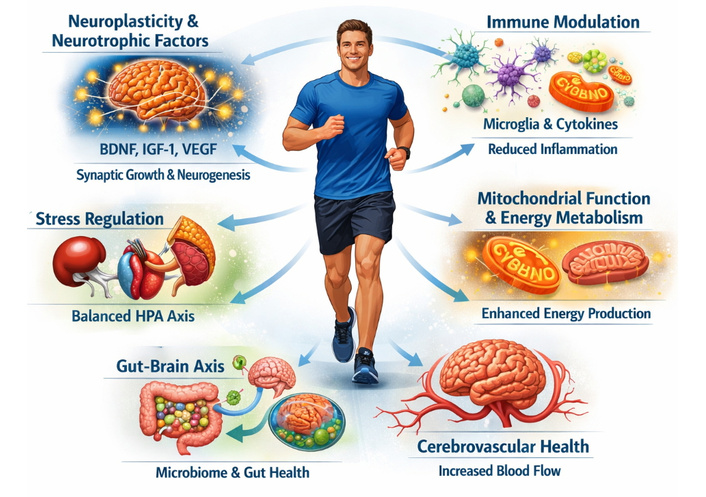
Exercise-induced effects on brain health across interconnected biological systems. Regular physical activity triggers coordinated adaptations at molecular, cellular, and systemic levels. Exercise enhances neuroplasticity through increased neurotrophic signaling (e.g., BDNF, IGF-1, and VEGF), reduces neuroinflammation via immune modulation, improves mitochondrial function and energy metabolism, and supports cerebrovascular and endothelial health. In parallel, exercise regulates stress-response systems and autonomic function and influences the gut–brain axis through microbiome-mediated signaling. Together, these integrated mechanisms contribute to improved cognitive function, emotional regulation, and resilience in psychiatric, neurological, and post-viral conditions. BDNF: brain-derived neurotrophic factor; IGF-1: insulin-like growth factor 1; VEGF: vascular endothelial growth factor; HPA: hypothalamic–pituitary–adrenal.
One of the most well-characterized mechanisms underlying the effects of exercise on the brain is the enhancement of neuroplasticity [41–44]. Physical activity robustly increases the expression of brain-derived neurotrophic factor (BDNF) [45, 46], along with other neurotrophins such as insulin-like growth factor 1 (IGF-1) and vascular endothelial growth factor (VEGF) [47], promoting synaptic plasticity, dendritic remodeling, and neurogenesis, particularly in the hippocampus. These processes are critically impaired in conditions such as depression [48], schizophrenia [49], and neurodegenerative diseases [50, 51], and their restoration may partly contribute to exercise-induced improvements in cognition, mood, and stress resilience.
Chronic low-grade inflammation is a shared pathological feature of many psychiatric and neurological disorders, as well as long COVID [52]. Exercise modulates immune function by reducing pro-inflammatory cytokines, increasing anti-inflammatory mediators, and altering microglial activation toward a more neuroprotective phenotype. Through these effects, exercise may counteract inflammation-driven synaptic dysfunction, neuronal damage, and sickness behavior, potentially contributing to symptom improvement across diverse brain disorders.
Impaired mitochondrial function and altered brain energy metabolism have emerged as implicated mechanisms in depression [53], BD [54, 55], neurodegeneration [56–58] and post-viral syndromes [59–61]. Exercise enhances mitochondrial biogenesis, efficiency, and oxidative capacity, improving cellular energy availability and reducing oxidative stress. These adaptations are likely relevant for symptoms particularly relevant for symptoms such as fatigue, cognitive slowing, and reduced stress tolerance, which are prominent in both neurological diseases and long COVID.
Exercise has been associated with improved cerebral blood flow and endothelial function, which may support oxygen and nutrient delivery to the brain [62–65]. Vascular dysfunction is increasingly recognized as a contributor to cognitive impairment, mood disorders, and neurodegeneration. By restoring cerebrovascular health, exercise may exert both neuroprotective and cognitive-enhancing effects, although causal relationships remain to be fully established, particularly in aging populations and individuals with vascular comorbidities.
Dysregulations of the HPA axis and autonomic nervous system are common in psychiatric disorders and long COVID. Regular physical activity contributes to improved stress regulation by normalizing cortisol dynamics, enhancing parasympathetic tone, and increasing stress resilience [66–69]. These effects may partially contribute to exercise-induced reductions in anxiety, depressive symptoms, and autonomic dysfunction.
Emerging evidence suggests that exercise influences the gut microbiota [70, 71], increasing microbial diversity and the production of metabolites with neuroactive and anti-inflammatory properties. Through gut–brain signaling pathways, these changes may further modulate immune function, neurotransmission, and behavior, although the clinical relevance of these pathways in humans remains incompletely understood. Taken together, these mechanisms highlight exercise as a multimodal biological intervention capable of simultaneously targeting core processes implicated in psychiatric disorders, neurological diseases, and long COVID. Importantly, the relative contribution of each pathway likely depends on disease context, exercise modality, intensity, and individual vulnerability, underscoring the need for personalized and mechanistically informed exercise prescriptions.
Taken together, these mechanistic considerations provide a biological framework that may help contextualize the available clinical evidence on exercise interventions in long COVID. To better contextualize the clinical translation of exercise interventions in long COVID, we synthesized the current evidence base across psychiatric and neurological domains according to four levels: (i) indirect evidence from non-long COVID populations, (ii) direct evidence from long COVID studies, (iii) expert-opinion or consensus-based recommendations, and (iv) key evidence gaps.
This stratification, summarized in Table 1, highlights the marked imbalance between the growing mechanistic and indirect clinical rationale supporting exercise and the still limited disorder-specific evidence in post-COVID populations, and serves as an organizing framework for the subsequent sections, where the evidence is critically appraised in terms of methodological strength, clinical applicability, and degree of extrapolation. For clarity and readability, references are not exhaustively reported in the table but are detailed and critically discussed in the corresponding sections.
Evidence stratification of exercise effects across psychiatric and neurological domains in long COVID.
| Condition | Indirect evidence (non-long COVID populations) | Direct long COVID evidence | Expert-opinion/consensus recommendations | Key evidence gaps |
|---|---|---|---|---|
| Depression/MDD symptoms | Strong evidence from MDD (RCTs, SRs, MAs) showing reductions in depressive symptoms and relapse risk | Limited RCT evidence in long COVID; small trials suggest improvements in mood and QoL but no disorder-specific endpoints | Exercise recommended as adjunctive therapy, preferably supervised moderate-intensity aerobic ± resistance training | Lack of large RCTs in long COVID with validated psychiatric outcomes; unclear dose–response relationship |
| Anxiety symptoms | Robust evidence in anxiety disorders (RCTs, MAs) showing reduced anxiety sensitivity and physiological arousal | Very limited post-COVID specific data; heterogeneous symptom-level outcomes reported in rehabilitation studies | Moderate-intensity aerobic exercise recommended; individualized pacing advised | No long COVID specific anxiety disorder trials; unclear effect on severe anxiety phenotypes |
| PTSD | Strong evidence from PTSD populations supporting aerobic and mind–body interventions | No direct long COVID trials | Exercise as adjunct to trauma-focused therapy; yoga/tai chi often recommended | No long COVID specific PTSD studies; unclear interaction with post-viral neuroinflammation |
| Schizophrenia spectrum symptoms | Strong indirect evidence supporting improvements in negative symptoms, cognition, and cardiometabolic health | No direct evidence | Structured supervised exercise programs recommended | No long COVID specific studies; adherence in post-viral fatigue unknown |
| Bipolar spectrum symptoms | Limited psychiatric evidence suggests benefits but risk of mood destabilization | No direct evidence in long COVID | Low-to-moderate intensity exercise with clinical monitoring recommended | No data in post-viral populations; safety profile unclear |
| Neurological dysfunction (motor/cognitive sequelae) | Strong evidence from stroke, MS, neurodegeneration showing benefits in mobility, cognition, and function | Sparse direct evidence; small rehabilitation studies suggest improvements in function but limited neurological specificity | Structured aerobic + task-oriented rehabilitation recommended with supervision | No disease-specific long COVID neurological trials; unclear long-term neuroplastic effects |
| Cognitive impairment (“brain fog”) | Strong indirect evidence in mild cognitive impairments, dementia prevention, and depression-related cognitive dysfunction | Small RCTs and SRs show inconsistent or modest improvements in cognition; many negative or neutral findings | Moderate aerobic exercise with gradual progression suggested to support attention and processing speed | Lack of standardized cognitive endpoints; unclear responders vs. non-responders; symptom fluctuation not addressed |
| Autonomic dysfunction | Indirect evidence from autonomic disorders supports recumbent exercise and graded verticalization | Very limited direct evidence; mostly observational rehabilitation data | Recumbent or semi-recumbent aerobic training, slow progression, close monitoring advised | Lack of RCTs; unclear optimal progression protocols and safety thresholds |
This table presents an evidence map of exercise interventions across psychiatric and neurological domains in long COVID, categorizing the literature into four levels: (i) indirect evidence from non-long COVID populations, (ii) direct long COVID evidence, (iii) expert-opinion or consensus-based recommendations, and (iv) key evidence gaps. It highlights the imbalance between strong mechanistic and indirect support and the limited availability of high-quality, disorder-specific evidence in long COVID, and serves as a framework for the critical appraisal developed in the subsequent sections. This table provides a synthetic evidence overview; detailed references and critical appraisal of each evidence category are presented in the corresponding sections of the manuscript. MDD: major depressive disorder; RCTs: randomized controlled trials; SRs: systematic reviews; MAs: meta-analyses; QoL: quality of life; PTSD: post-traumatic stress disorder; MS: multiple sclerosis.
These converging mechanistic pathways provide a biological framework for the clinical translation of exercise interventions, which is further explored in the following two sections: “Exercise in Long COVID Patients with Pre-existing or COVID-Related Psychiatric Disorders” and “Exercise in Long COVID Patients with Pre-existing or COVID-Related Neurological Disorders”.
Exercise has shown clinically relevant benefits across major psychiatric disorders, including MDD, anxiety disorders, schizophrenia, BD, and PTSD. These effects are likely mediated through the biological mechanisms described earlier, including modulation of neuroplasticity, immune-inflammatory pathways, and stress system regulation.
Overall, increasing clinical evidence indicates that structured exercise interventions can improve psychiatric symptoms and functional outcomes, both as stand-alone and adjunctive treatments. Furthermore, available evidence suggests a potential dose-response relationship between exercise parameters and clinical outcomes. In broad outline, moderate intensity (approximately 3–5 sessions per week) and interventions lasting around 8–12 weeks appear to be associated with the most consistent benefits in clinical trials. However, the optimal dosing likely varies depending on psychiatric diagnosis, symptom severity, and individual tolerance, and remains to be fully established.
Evidence is strongest for MDD, where multiple RCTs, SRs and MAs demonstrate robust reductions in depressive symptoms, with additional benefits on anhedonia, cognitive function, and relapse prevention. For example, a mechanistic study [48] further supports the role of exercise in MDD. In a 3-week physical activity intervention (n = 23) compared with a control condition (n = 18), both groups showed reductions in depressive symptoms, although the decreases in clinician rated scores were significantly greater following physical activity. Furthermore, several MAs have suggested that aerobic and resistance training may lead to moderate-to-large reductions in depressive symptoms [72–74]. For example, a large SR and MA [72] including 32 RCTs (n = 3,243 participants) and 26 studies in MA (n = 2,681 participants) reported that exercise is associated with significant reductions in depressive and anxiety symptoms in individuals diagnosed with depression or anxiety. These findings have been replicated across other SRs and MAs [73, 74]. Exercise is also associated with improvements in anhedonia [75, 76], cognitive function [77, 78], and relapse prevention [79]. For example, a RCT [75] in individuals with anhedonia and other moderate depressive symptoms (n = 56) compared an 8-week running group (n = 19), stretching group (n = 19), and control group (n = 18). In the running group, greater benefits of symptoms were associated with longer training duration, higher energy expenditure, and lower peak heart rate. Overall, physical activity appeared to improve anhedonia, particularly its anticipatory component, in individuals with depressive symptoms.
Similar but more variable effects are observed in anxiety disorders, including generalized anxiety disorder, panic disorder, and social anxiety disorder, with consistent reductions in anxiety symptoms reported across MAs [80–82]. Both acute and long-term exercise may reduce anxiety symptoms. Aerobic exercise may be particularly effective in reducing sensitivity to physiological arousal, a key feature of anxiety pathology [83, 84]. For example, a brief intervention study by Broman-Fulks and Storey [84] investigated individuals with high anxiety sensitivity (n = 24), randomly assigned to either six 20-minute sessions of moderate-intensity aerobic exercise or a no-exercise control condition. The exercise group showed significant reductions in anxiety sensitivity and anxiety-related symptoms compared with controls. Overall, the findings suggest that even brief aerobic exercise may reduce anxiety vulnerability, likely through modulation of physiological arousal and stress reactivity.
On the contrary, evidence supporting exercise in BDs is emerging but remains more limited and heterogeneous than in depressive and anxiety disorders [85]. A SR of observational studies and small clinical trials reports that regular physical activity is associated with reduced depressive symptom burden, improved sleep, and better overall functioning [86]. However, concerns have been raised about the potential for vigorous or poorly structured exercise to precipitate manic or hypomanic symptoms in vulnerable individuals [87].
Individuals with schizophrenia experience markedly high rates of physical inactivity, contributing to poor cardiometabolic health and reduced life expectancy [88, 89]. Exercise interventions in this population have been associated with benefits that extend beyond physical health, including improvements in negative symptoms, cognitive performance, and QoL [90–92]. For instance, a pragmatic RCT [89] in patients with schizophrenia spectrum disorders and metabolic syndrome (n = 48; 33 completers) evaluated a 12-week intervention combining aerobic exercise and behavioral counselling versus usual care. The intervention group showed improvements in waist circumference, negative symptoms, and autonomous motivation for exercise, as well as increased physical activity levels at 24-month follow-up. Overall, the findings suggest potential benefits of combined exercise and behavioral interventions on cardiometabolic and psychological outcomes, with possible sustained effects on motivation and lifestyle behavior. Furthermore, an MA [90] of 20 studies showing that supervised exercise interventions (~90 min/week of moderate-to-vigorous activity) improve psychiatric symptoms, neurocognition, and functional outcomes, with additional benefits on physical fitness and cardiometabolic risk factors. In this context, neuroimaging studies suggest that regular exercise may be associated with partial normalization of hippocampal volume and connectivity changes [93, 94].
Exercise has also demonstrated promise as an adjunctive intervention in PTSD, with evidence indicating reductions in symptom severity, hyperarousal, and comorbid depression [92, 95].
Overall, these findings support exercise as an effective adjunctive intervention across psychiatric disorders, with the strongest evidence in MDD and more heterogeneous effects in other conditions. As described earlier, these effects likely arise from convergent neurobiological mechanisms, although the magnitude of clinical benefit varies across diagnostic categories.
Despite the substantial evidence supporting exercise interventions in established psychiatric disorders, direct evidence in long COVID populations remains limited. To date, no RCTs have specifically evaluated exercise interventions in patients with long COVID and comorbid psychiatric disorders using clinically defined psychiatric endpoints. Existing studies in post-COVID populations primarily focus on heterogeneous symptom clusters such as fatigue, mood disturbances, cognitive complaints, or general functional recovery, rather than disorder specific outcomes.
Nevertheless, evidence from psychiatric populations and emerging post-COVID rehabilitation studies suggests a potential role for exercise in individuals with long COVID and neuropsychiatric symptoms. In this context, exercise may represent a plausible adjunctive intervention, although its efficacy in post-viral conditions remains to be established. Table 2 summarizes the recommended exercise types, main benefits, and precautions for each psychiatric disorder.
Summary of exercise recommendations for major psychiatric disorders.
| Population | Exercise intervention | EB | Key considerations | Reported/potential effects | Ref. |
|---|---|---|---|---|---|
| MDD | Moderate-intensity aerobic training, resistance training, or combined programs (~3–5 sessions/week, 8–12 weeks; supervised when possible) | RCTs, SRs, MAs | Strong heterogeneity in protocols; best outcomes with structured and supervised programs; gradual progression recommended in severe depression | Reduces depressive symptoms, improves anhedonia, cognitive function, stress resilience, and relapse prevention | [72–79] |
| Anxiety disorders | Moderate-intensity aerobic exercise (acute and long-term), low–moderate resistance training | RCTs, SRs, MAs | Avoid excessive intensity in highly sensitive patients; monitor physiological arousal and panic-related symptoms | Reduces anxiety symptoms, autonomic reactivity, and anxiety sensitivity; improves stress tolerance | [80–84] |
| BD | Low-to-moderate intensity aerobic exercise and resistance training (structured, closely monitored) | SRs | Risk of mood destabilization with excessive or poorly regulated intensity; requires clinical monitoring and individual tailoring | May reduce depressive symptoms, improve sleep, functioning, and physical health | [85–87] |
| Schizophrenia spectrum disorders | Structured aerobic and resistance training (often supervised, group-based or combined with behavioral interventions; ~90 min/week moderate–vigorous activity) | RCTs, SRs, MAs | Low motivation, cognitive deficits, and social withdrawal may limit adherence; supervision improves engagement | Improves negative symptoms, cognition, functional outcomes, motivation; benefits cardiometabolic health | [88–94] |
| PTSD | Aerobic exercise, resistance training, and mind–body interventions (e.g., yoga, and tai chi) | RCTs, SRs | Should be integrated with trauma-focused psychotherapy; monitor somatic and emotional reactivity | Reduces hyperarousal, depressive symptoms, and PTSD severity; improves emotion regulation and resilience | [92, 95] |
The main benefits are based on evidence from randomized controlled trials and meta-analyses [72–95]. Precautions reflect clinical guidance and considerations for safe implementation. EB: evidence base (study type); Ref.: key-reference; MDD: major depressive disorder; RCTs: randomized controlled trials; SRs: systematic reviews; MAs: meta-analyses; BD: bipolar disorder; PTSD: post-traumatic stress disorders.
For clinical implementation, supervised and individually tailored exercise programs should be prioritized, as evidence from psychiatric populations consistently shows that they improve adherence and clinical outcomes more effectively than non-supervised or non-individualized approaches. Moderate-intensity aerobic exercise appears to be the most consistently beneficial modality for mood, cognitive function, and fatigue, whereas higher-intensity protocols, although potentially associated with greater physiological adaptations, may be less well tolerated in long COVID populations.
Emerging but still preliminary evidence suggests that in long COVID patients with depressive symptoms, structured exercise particularly programs combining aerobic and resistance training has been associated with meaningful improvements in mood, QoL, and overall functioning, often exceeding outcomes seen with self-directed rehabilitation. These benefits are thought to arise from enhanced neuroplasticity, reductions in systemic inflammation, and normalization of stress physiology, although larger well-powered trials are still needed to confirm these mechanisms and their clinical relevance [96, 97]. Thus, these mechanisms remain largely inferential.
For BD spectrum symptoms, exercise should be carefully tailored in intensity and duration and clinically monitored to minimize the risk of mood destabilization; low-to-moderate intensity aerobic or resistance training is generally preferred. In schizophrenia spectrum disorders, structured and supported programs may improve cognition, motivation, and functional outcomes, although adherence can be limited by low motivation and social isolation, which may be mitigated through individualized and group-based approaches. In PTSD and patients with prominent somatic symptoms, mind–body interventions such as yoga and tai chi may provide additional benefits by supporting autonomic regulation and emotional resilience.
Overall, exercise represents a versatile and mechanistically plausible adjunctive strategy for long COVID patients experiencing psychiatric sequelae. Its efficacy is optimized when programs are individualized, supervised, and integrated with other therapeutic approaches, allowing safe and meaningful improvements across mood, cognition, and overall functioning.
In long COVID patients with pre-existing or newly developed neurological disorders, exercise may represent a potentially valuable adjunctive intervention to support cognitive, motor, and functional recovery [98–100]. High-quality RCTs specifically targeting well-defined neurological diagnoses in long COVID remain scarce; however, indirect evidence from neurological rehabilitation and emerging post-COVID studies suggests clinically meaningful benefits when exercise is appropriately tailored [96, 101]. A summary of the available evidence is reported in Table 3.
Summary of exercise recommendations for major neurologic disorders.
| Population | Exercise intervention | EB | Key considerations | Reported/potential effects | Ref. |
|---|---|---|---|---|---|
| Neuro-degenerative diseases/mild cognitive impairment | Moderate-intensity aerobic training ± resistance training (typically structured supervised programs, ~3–5 sessions/week, 8–24 weeks) | RCTs, MAs | Effects may depend on baseline cognitive status, adherence, and vascular comorbidities; heterogeneity in protocols | Associated with improvements in global cognition, executive function, attention, and gait performance | [8, 9, 50, 51] |
| Post-stroke patients with persistent motor deficits | Task-oriented motor rehabilitation combined with low-to-moderate intensity aerobic exercise and physiotherapy | RCTs, SRs | Individualized, goal-oriented interventions; strong dependence on lesion severity and rehabilitation timing | Improves functional mobility, walking capacity, balance, and ADLs | [107–109] |
| Peripheral neuropathic symptoms | Neuromotor training and progressive resistance exercises | RCTs, OS | Gradual progression required; monitoring for fatigue and sensory deficits essential | May improve proprioception, balance, and functional autonomy; reduced fall risk | [113, 114] |
| Epilepsy and demyelinating disorders (e.g., MS) | Supervised aerobic and resistance training within structured rehabilitation programs | SRs, MAs | Requires neurological supervision; exercise tolerance and safety monitoring essential | Associated with improved physical fitness, fatigue reduction, and functional outcomes; evidence mixed for disease activity effects | [115–117] |
| Autonomic dysfunction/exercise intolerance | Recumbent or semi-recumbent aerobic training, low-impact strengthening, graded verticalization protocols | RCTs, OS | Strong need for pacing strategies; symptom-contingent progression; risk of post-exertional intolerance | May improve exercise tolerance, endurance, and functional capacity when carefully titrated | [38, 111] |
The main benefits are based on evidence from randomized controlled trials and meta-analyses [97–116]. Precautions reflect clinical guidance and considerations for safe implementation. EB: evidence base (study type); Ref.: key-reference; RCTs: randomized controlled trials; MAs: meta-analyses; SRs: systematic reviews; ADLs: activities of daily living; OS: observational studies; MS: multiple sclerosis.
Long COVID may exacerbate pre-existing neurological disorders or unmask latent vulnerabilities, leading to worsening of motor symptoms, cognitive decline, increased fatigue, autonomic instability, and reduced functional reserve [32, 102]. Taquet et al. [102] analyzed over 1.28 million patients and showed that SARS-CoV-2 infection is associated with a long-term increased risk of neurological and psychiatric disorders compared with other respiratory infections. While mood and anxiety disorders tend to normalize over time, risks of cognitive impairment, dementia, epilepsy, and seizures remain elevated for up to two years, indicating persistent neurological sequelae.
In patients with neurodegenerative diseases, MS, epilepsy, or prior cerebrovascular events, persistent systemic inflammation, immune dysregulation, and autonomic impairment associated with post-COVID condition may contribute to amplifying baseline neurological deficits and accelerating functional deconditioning.
Also in neurological populations, the effects of exercise depend on modality, intensity, frequency, and duration. Moderate-intensity aerobic exercise is generally well-tolerated and consistently associated with functional benefits, whereas higher-intensity protocols may induce greater neuroplastic and neurotrophic adaptations but are often less well-tolerated, particularly in individuals with post-exertional symptom exacerbation. Resistance and neuromotor training may further improve muscle strength, balance, and functional independence.
In long COVID individuals reporting persistent cognitive dysfunction (“brain fog”), moderate-intensity aerobic exercise delivered with gradual progression may contribute to improvements in attention, processing speed, and working memory [14, 40, 103], although findings remain inconsistent and not reproducible. For example, a recent RCT [103] evaluated an 8-week cardiopulmonary rehabilitation program in individuals with long COVID (n = 40; rehabilitation group vs. control). The intervention consisted of an individualized program delivered three times per week, combining light-to-moderate aerobic exercise, resistance training, and respiratory exercises. Although the rehabilitation group showed significant reductions in perceived stress and depressive symptoms compared with controls, no significant between-group differences were observed in neuropsychological test performance. Furthermore, a recent SR including 9 studies and approximately 672 patients with long COVID reported improvements in fatigue and dyspnea following structured exercise interventions. However, the findings suggest limited exercise-related effects on cognitive performance. In addition, cognitive fatigability and symptom fluctuation require careful pacing strategies, shorter sessions when needed, and close monitoring to avoid post-exertional worsening [104–106].
Based largely on evidence from non-COVID literature, evidence from stroke rehabilitation trials indicates that repetitive, task-oriented motor training combined with low-to-moderate intensity aerobic exercise (generally 3–5 sessions per week over 8–12 weeks) can improve multiple motor and non-motor endpoints, including gait speed, functional mobility, and activities of daily living [107, 108]. These findings are further supported by SR evidence, which reports consistent improvements in upper extremity function following task-oriented rehabilitation approaches [109]. These findings support the potential role of combining aerobic conditioning with task-specific training to enhance functional recovery, although their applicability to long COVID populations remains to be established. In this context, programs should be individualized and symptom-contingent, taking into account fatigue, autonomic instability, and fluctuating tolerance frequently observed in long COVID [38, 110, 111].
Similarly, in individuals with long COVID who experience peripheral neuropathic symptoms, balance impairment, or sensory disturbances, neuromotor and strength-based interventions may enhance proprioception, reduce fall risk, and support overall physical autonomy [98, 112, 113], although direct evidence in long COVID populations remains limited. Autonomic dysfunction, including orthostatic intolerance and exercise intolerance, is common in long COVID and necessitates specific adaptations [110]. Recumbent or semi-recumbent aerobic modalities, low-impact strengthening, and gradual verticalization protocols are often better tolerated in the early phases. Progression should be individualized, based on daily functional capacity and symptom variability.
In patients with epilepsy, demyelinating disorders, or significant neurological instability, exercise programs should be supervised and coordinated with neurological care to ensure safety and optimize adherence. As reported in some reviews and MAs [114–117], structured, supported interventions have been associated with better functional outcomes compared with unsupervised activity.
Overall, available evidence from neurological rehabilitation studies suggests that structured exercise interventions of approximately 6–24 weeks, depending on condition severity and modality, can produce clinically meaningful improvements in motor and cognitive outcomes. However, direct evidence specifically in long COVID neurological populations remains limited and heterogeneous and further disease-specific studies are needed to confirm these preliminary observations.
Exercise may represent a multimodal, mechanistically grounded intervention for both psychiatric and neurological sequelae of long COVID. Its effects span cognitive, motor, emotional, and autonomic domains. These broad system-wide adaptations position exercise as a potential adjunctive strategy that complements pharmacological and rehabilitative approaches.
In individuals with pre-existing or newly developed psychiatric or neurological disorders, long COVID may exacerbate symptoms, unmask latent vulnerabilities, and reduce functional reserve. Evidence, though still limited in long COVID populations, indicates that structured, individualized, and supervised exercise programs may improve cognition, mobility, mood, endurance, and QoL. The greatest benefits are observed when interventions are tailored to symptom severity, comorbidities, and daily functional capacity, with careful pacing to avoid post-exertional symptom exacerbation.
Overall, while mechanistic and indirect clinical evidence is relatively strong, the lack of high-quality, disease-specific RCTs in long COVID remains a major limitation. Future research should focus on disease-specific protocols, optimal intensity and frequency, long-term adherence, and mechanistic correlations to further refine recommendations and facilitate clinical translation.
BD: bipolar disorder
BDNF: brain-derived neurotrophic factor
HPA: hypothalamic–pituitary–adrenal
IGF-1: insulin-like growth factor 1
MAs: meta-analyses
MDD: major depressive disorder
MS: multiple sclerosis
PTSD: post-traumatic stress disorder
QoL: quality of life
RCTs: randomized controlled trials
SRs: systematic reviews
VEGF: vascular endothelial growth factor
During the preparation of this work, the author used ChatGPT (OpenAI, 2023; https://chatgpt.com/) to generate Figure 1. After utilizing the tool, the author reviewed and edited the content as necessary and takes full responsibility for the final content of the publication.
GV: Validation, Supervision, Methodology, Visualization, Writing—original draft, Writing—review & editing, Project administration. The author read and approved the submitted version.
The author declares that he has no conflicts of interest.
Not applicable.
Not applicable.
Not applicable.
Not applicable.
Not applicable.
© The Author(s) 2026.
Open Exploration maintains a neutral stance on jurisdictional claims in published institutional affiliations and maps. All opinions expressed in this article are the personal views of the author(s) and do not represent the stance of the editorial team or the publisher.
Copyright: © The Author(s) 2026. This is an Open Access article licensed under a Creative Commons Attribution 4.0 International License (https://creativecommons.org/licenses/by/4.0/), which permits unrestricted use, sharing, adaptation, distribution and reproduction in any medium or format, for any purpose, even commercially, as long as you give appropriate credit to the original author(s) and the source, provide a link to the Creative Commons license, and indicate if changes were made.



View: 848
Download: 18
Times Cited: 0


