 Perspective


Affiliation:
Department of Animal and Veterinary Sciences, California State Polytechnic University, Pomona, CA 91768, USA
Email: lkrusinski@cpp.edu
ORCID: https://orcid.org/0000-0001-7387-3839


Explor Foods Foodomics. 2026;4:1010142 DOI: https://doi.org/10.37349/eff.2026.1010142
Received: March 23, 2026 Accepted: April 22, 2026 Published: May 06, 2026
Academic Editor: Noureddine Benkeblia, University of Life Sciences, Jamaica
Regenerative agriculture has emerged as a promising framework for improving the sustainability of food systems. Interest is also growing in its potential to enhance food nutrient density. Mechanistic links between agricultural practices, soil health, and food composition are biologically plausible and supported by emerging evidence. However, substantial variability in nutrient composition across production systems, combined with methodological limitations in current research, has hindered consistent conclusions. Concurrently, regenerative and grass-fed and finished certification programs in the United States have expanded rapidly, standardizing production practices and, in some cases, incorporating environmental indicators such as soil health and biodiversity. Yet these frameworks rely primarily on the verification of practices (obligations of means) rather than the measurement of outcomes (obligations of results), particularly at the level of food composition. Despite this, nutrition-related claims, both explicit and implicit, are increasingly associated with these systems, while routine measurement of nutrient density remains absent. This perspective examines the intersection of regenerative agriculture, nutrient density, and certification systems, highlighting a structural gap between production practices, communicated claims, and measurable outcomes, and proposes a shift toward integrating obligations of results, including standardized nutrient profiling and improved data transparency, alongside existing practice-based standards. Drawing on examples such as the Bleu-Blanc-Coeur initiative, we argue that hybrid frameworks combining practices with outcome-based verification are feasible and could strengthen the scientific basis of regenerative agriculture, support more rigorous evaluation of food quality, and improve transparency and trust within the food system.
Current agricultural systems in the United States (U.S.) have achieved unprecedented productivity, yet this success has been accompanied by growing concerns about ecological degradation, declining soil health, and the nutritional quality of food [1, 2]. In response to these challenges, regenerative agriculture and agroecology have emerged as prominent frameworks aimed at addressing these challenges by restoring soil functions, enhancing biodiversity, and improving ecosystem and farmer resilience [3]. Alongside these improvements, there has been increasing interest in nutrient density as a key indicator of food quality, reflecting a broader shift from prioritizing food quantity to evaluating food composition and functional value, including its emphasis in recent U.S. Dietary Guidelines [4, 5]. This perspective examines the relationship between regenerative agriculture, nutrient density, and certification systems in the U.S. and argues for integrating outcome-based verification to better link production practices with measurable food quality.
Regenerative agriculture is frequently associated with the hypothesis that improved soil health can enhance the nutritional profile of foods [5]. Advances in foodomics and analytical techniques have further enabled the characterization of these complex nutritional attributes, reinforcing interest in potential links between agricultural practices and food composition [6, 7]. However, large variations in nutrient density are expected in regenerative systems due to management practices, geography, climate, and food types [8]. Despite these uncertainties, regenerative agriculture has rapidly expanded within food systems through a growing number of certifications and market-driven labels [9]. These frameworks play an important role in standardizing and incentivizing practices such as cover cropping, reduced tillage, and crop diversification. Yet, they are primarily based on the verification of practices rather than the measurement of outcomes, particularly with respect to food nutrient density [10].
This reflects a broader reliance on obligations of means, in which adherence to prescribed practices is used as a proxy for desired environmental and nutritional outcomes. While practical and scalable, this approach assumes that implementing regenerative practices will reliably translate into measurable improvements in food quality. In the case of nutrient density, this assumption is only rarely tested, as most certification systems do not require routine analytical measurement of crops or transparent reporting of nutrient density. This leads to a growing transparency gap: claims regarding regenerative production and improved food nutrient density are increasingly communicated to consumers without corresponding verification. We argue that current certification frameworks are limited by their reliance on obligations of means and propose a shift toward incorporating obligations of results, including standardized nutrient measurement and improved transparency.
A central claim underlying regenerative agriculture is that improvements in soil health can translate into enhanced nutritional quality of food [5]. Soil functions as a dynamic system regulating nutrient availability and microbial activity, and regenerative practices such as cover cropping, reduced tillage, livestock integration, and increased crop diversity aim to increase soil organic matter and nutrient retention, thereby influencing plant nutrient uptake and metabolism [5, 11].
Several mechanisms have been proposed to explain how soil health could affect food nutrient density. Increased organic matter can improve cation exchange capacity and mineral availability, enhancing uptake of elements such as magnesium, zinc, and iron [12]. Soil microbial communities can facilitate nutrient mobilization and influence plant signaling pathways that regulate the synthesis of secondary metabolites, including polyphenols and other phytochemicals [13]. Reduced reliance on synthetic inputs and slower plant growth rates in some regenerative systems have been hypothesized to favor greater nutrient accumulation relative to yield [5]. There is evidence that the nutrient density of edible crops is increased under agroecological systems in some contexts, although findings are derived from specific studies and may not be generalizable across all crops and environments [14]. However, the existing evidence base remains heterogeneous and methodologically fragmented, which limits the generalizability of these findings.
In animal production systems, regenerative practices are often associated with pasture-based feeding, diversified forage, and adaptive grazing management [8]. These factors influence the nutritional composition of animal-derived foods through changes in feed quality and metabolism [15]. For example, grass-finished beef systems have been associated with improved fatty acid profiles, including greater concentrations of omega-3 polyunsaturated fatty acids (n-3 PUFA) and conjugated linoleic acid (CLA), as well as variations in fat-soluble vitamins and antioxidants [16]. However, as with cropping systems, these differences are not uniform and can be influenced by breed, feed composition, seasonality, and management practices [8]. For example, a nutritional survey of commercially available grass-finished beef showed substantial variations in fatty acid composition among grass-finished beef samples, especially regarding the omega-6:omega-3 fatty acid ratio across producers, with some samples resembling feedlot-finished beef [17]. These findings highlight that even within a single production category defined by feeding practices, nutritional composition can vary substantially across producers. Additionally, these commercially sourced beef samples did not come from controlled experimental systems, meaning that the production practices were inferred from labeling and producer claims rather than independently standardized or verified.
Methodological inconsistencies further limit the comparability of results. Analytical approaches to measuring food nutrient density vary widely, ranging from targeted assays of individual nutrients to broader metabolomic profiling [7]. Few studies employ standardized protocols or longitudinal designs that would allow robust attribution of observed differences to specific agricultural practices. Moreover, some of the current evidence relies on observational comparisons of commercial or farm-derived food samples (e.g., analyzing beef samples from the supermarket labeled as “grass-finished” without any guarantees of production practices used). While this reflects the current state of market-available foods, it relies heavily on trusting the producers and their management practices, and it contributes to the heterogeneity of testing. In contrast, controlled trials are regarded as the gold standard and allow precise evaluation of production practices and nutrient density outcomes. This highlights a fundamental limitation in the current evidence base and underscores the need for more rigorous, outcome-oriented research designs.
Despite this uncertainty, assertions that regenerative agriculture produces more nutrient-dense foods are increasingly present in both scientific discourse and market-facing communications. This growing alignment between a plausible hypothesis and expanding claims (without large-scale verification) created a critical gap. It is within this gap that certification systems and labeling frameworks operate, often focusing only on obligations of means (production and management practices).
The expansion of regenerative agriculture in the U.S. has been accompanied by a growing number of certification programs and verification frameworks that seek to operationalize regenerative principles within agricultural systems. These include third-party certifications, industry-led standards, and outcome-oriented ecological monitoring programs. As summarized in Table 1, these systems vary in scope and structure but collectively shape how regenerative agriculture is defined, implemented, and communicated.
Overview of selected grass-fed/finished and regenerative agriculture certifications and verification approaches in the United States.
| Certification | Scope | Verification approachA | Environmental outcomes measured | Nutrition-related claims (website)B | Nutrient density testing required | Link and reference |
|---|---|---|---|---|---|---|
| Regenerative Organic Certified® (ROC™) | Crop and livestock | Practice-based with tiered requirements | Yes–Soil tests, carbon modeling, biodiversity indicators | Yes | No | https://regenorganic.org/ [26] |
| American Grassfed® Association (AGA) | Livestock | Practice-based (feeding and management standards) | No | Yes | No | https://www.americangrassfed.org/ [27] |
| Certified Regenerative by A Greener World (AGW) | Crop and livestock | Practices, planning, and monitored indicators | Yes–Soil, water, biodiversity, climate metrics | Yes | No | https://agreenerworld.org/ [28] |
| Certified Grassfed by A Greener World (AGW) | Livestock | Practices-based (100% forage diet, animal welfare standards) | No | Yes | No | https://agreenerworld.org/ [29] |
| Regenified™ | Crop and livestock | Practices, scoring, and soil testing | Yes–Soil testing, ecosystem processes, scoring system | Yes | No | https://regenified.com/ [30] |
| Land to Market™ | Crop and livestock | Outcome-based (ecological monitoring) | Yes–Biodiversity, soil cover, ecosystem function | No | No | https://www.landtomarket.com/ [31] |
| Soil Regen Regenerative Verified® | Crop and livestock | Soil testing and practice verification | Yes–Soil health via the Haney test | Yes | No | https://www.agsoilregen.com/ [32] |
AVerification approaches and outcomes measured were verified using publicly available standards. BNutrition-related claims include both explicit statements regarding food nutritional quality and implicit associations (e.g., grass-finished or regenerative systems linked to improved nutritional value). Notably, none of the certification schemes listed require routine analytical measurement of food nutrient composition as part of their verification frameworks.
Across the certifications examined, a consistent pattern emerges in how verification is conducted. Most programs rely primarily on the assessment of management practices. These practices are typically evaluated through documentation, farm audits, and in some cases, structured planning tools (e.g., regenerative management plans). Several programs also incorporate environmental indicators such as soil health metrics, biodiversity assessments, and carbon-related measurements. In this respect, regenerative certification frameworks extend and, in some cases, build upon existing process-based certification models such as the United States Department of Agriculture (USDA) National Organic Program (NOP). Organic certification in the U.S. is defined by legally enforceable standards that regulate inputs and production practices but do not require direct measurement of food composition [18]. Regenerative certifications are predominantly administered by private organizations and are not governed by a unified federal definition or regulatory standard [19]. As a result, the use of the term “regenerative” in food labeling is shaped by a combination of private certification schemes and, in some cases, voluntary substantiation requirements for marketing claims.
Since 2016, the USDA has no longer maintained the “grass-fed” and “grass-finished” labels. The program was discontinued, leaving certification and verification largely to third-party organizations [20]. When in place, these claims related to production practices were supported by documentation and affidavits. Thus, both private certification systems and federal regulatory pathways emphasize verification of practices and processes rather than direct assessment of outcomes at the level of food composition. An important implication of this structure is that environmental outcomes are increasingly incorporated into certification frameworks, while food-level outcomes remain largely unmeasured. Several programs include soil testing, ecological monitoring, or ecosystem-based indicators as part of their verification approaches. These developments represent a shift toward incorporating measurable environmental outcomes within certification systems.
Nutrition-related claims are present to varying degrees across certification programs and associated communications. Some programs explicitly reference improved nutritional outcomes, while others are embedded within broader narratives linking regenerative or grass-fed systems to food nutrient density. For example, regenerative agriculture and grass-fed systems have been described as producing “more nutritious” foods, and certain verification programs reference improvements in micronutrient content and fatty acid composition on their websites, often based on limited studies or general scientific literature rather than standardized, ongoing compositional testing. However, as summarized in Table 1, none of the certification frameworks examined require routine food nutrient density testing as part of their verification process.
This distinction highlights a structural asymmetry within current certification systems. Practices are specified and verified, and in some cases, environmental outcomes are measured, yet claims or implications related to food nutrient density are not systematically evaluated through direct analysis of the products themselves. Instead, soil health and ecological indicators are often used as proxies for broader system performance, including potential nutritional benefits. The growing emphasis on nutrition-related claims within regenerative and grass-fed systems also reflects broader consumer preferences. Previous research indicates that consumers are willing to pay price premiums for foods associated with perceived health benefits, including attributes related to nutrient density or improved nutritional profiles [21]. While environmental and sustainability claims are increasingly valued, evidence suggests that health-related attributes tend to have a stronger influence on purchasing decisions [21]. In this context, the absence of outcome-based verification for food nutrient density represents not only a scientific limitation but also a market-relevant gap.
Taken together, the current U.S. certification landscape can be understood as a system that has begun to incorporate elements of outcome-based verification at the environmental level, while remaining largely grounded in practice-based assurance with respect to food nutrient density. The absence of outcome-based measurement has implications that extend beyond certification design. In the current system, food quality is often inferred from production practices rather than verified through direct analysis of food composition. This limits the ability to evaluate variability in nutrient density across production systems, constrains the development of a robust evidence base, and creates an asymmetry of information in which consumers are provided with detailed information about how food is produced but limited data on the measurable characteristics of the food itself. These limitations point to a broader structural issue in how agricultural and food quality standards are defined and assessed. Figure 1 illustrates current practice-based certification systems (left panel) and the proposed hybrid, outcome-verified model (right panel).
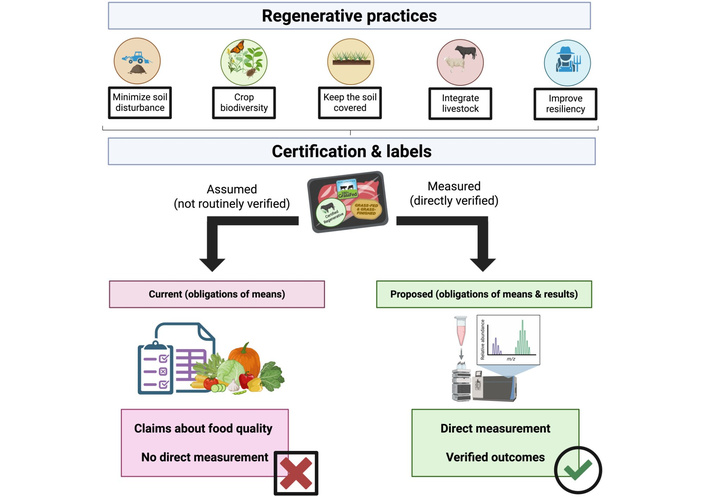
Conceptual framework illustrating obligations of means (left) versus obligations of results (right) in regenerative food systems. Regenerative practices are translated into certification labels through verification of production methods (obligations of means). The left panel represents current practice-based certification models, where claims about food quality are assumed rather than directly verified. The right panel illustrates a proposed hybrid framework incorporating direct measurement of food composition, enabling outcome-based verification of nutrient-related attributes and improved transparency.
Current regenerative and grass-fed/finished certification systems in the U.S. are largely structured around obligations of means, in which adherence to specified practices is used as a proxy for desired outcomes. Under this model, producers implement management strategies with the expectation that these practices will improve soil health, ecosystem function, and, in some cases, food nutrient density. Verification focuses on whether practices are followed rather than whether specific outcomes are achieved. This approach has clear advantages: it is relatively straightforward to define, audit, scale, and align with existing frameworks such as organic certifications. However, as regenerative agriculture becomes increasingly associated with claims related to nutrient density and human health, the limitations of a purely practice-based model become more apparent. The relationship between agricultural practices and food composition is influenced by multiple interacting factors, and the implementation of regenerative practices does not necessarily result in consistent or predictable changes in nutrient composition across systems. In this context, reliance on practices alone is insufficient to substantiate outcome-level claims related to food nutrient density.
Incorporating outcome-based metrics could support continuous improvement by enabling benchmarking across producers, providing feedback on management practices, and creating performance-based incentives that reward measurable gains in food quality. For example, emerging platforms are beginning to offer laboratory testing and data analysis to measure nutrient outcomes and benchmark performance against USDA and retail datasets [22]. This approach aligns with emerging frameworks such as the Regen10 Outcomes Framework, which emphasizes defining and measuring regenerative outcomes, supporting alignment, accountability, and value-based incentives across supply chains while allowing flexibility across diverse production contexts [23]. It was previously reported that the predominance of practice-based certifications prevents continuous improvement, and that outcome-based certifications would be more effective in stimulating progress [24].
An obligation of results framework would complement current models by requiring the definition and verification of measurable outcomes. Applied to food systems, this involves incorporating direct measurement of food composition alongside existing environmental indicators. A transition toward such a framework could be implemented through hybrid models that retain practice-based standards while integrating outcome-based verification. Environmental metrics, such as soil organic matter, biodiversity, and water quality, could continue to be used, while food-level outcomes could be assessed through standardized nutrient profiling. In practice, outcome-based measurement would need to prioritize a limited set of indicators that are both nutritionally relevant and analytically feasible. Rather than relying on full-spectrum metabolomics (which remains costly and difficult to scale), targeted panels could be used, including fatty acid profiles (e.g., omega-6 to omega-3 ratio), key minerals (e.g., iron, zinc), and selected vitamins or bioactive compounds (e.g., vitamin E). These indicators are already commonly measured in food and nutrition research and could serve as practical entry points for outcome-based verification. A tiered approach may also be appropriate, where simpler and lower-cost measurements are implemented broadly, while more comprehensive analyses are applied in research settings.
In addition to methodological considerations, the implementation of outcome-based verification will depend on cost and feasibility across different production systems. Testing requirements may vary in complexity and cost, and therefore, a tiered approach that prioritizes lower-cost, high-impact indicators may be necessary to ensure accessibility, particularly for small and mid-sized producers. In this context, cost-effectiveness will be critical, with testing strategies needing to balance analytical precision with practical value for producers and supply chains. Approaches such as shared testing infrastructure, cooperative models, or integration with existing certification systems may help reduce costs and improve accessibility for smaller operations.
Advances in foodomics and rapid analytical technologies further support the feasibility of such approaches at scale. An example of this combined approach is provided by the French Bleu-Blanc-Coeur initiative, which combines obligations of means with obligations of results and serves as a proof-of-concept that hybrid systems are operationally feasible. Producers are required to implement specific feeding and agricultural practices while also meeting nutritional criteria in the resulting products, such as target thresholds for the omega-6 to omega-3 fatty acid ratio, supported by routine analytical testing and a growing body of scientific evidence [25]. This model demonstrates that practice-based standards and outcome-based verification can be integrated within a functioning agricultural system. Elements of this approach, including the use of targeted nutritional indicators and routine product-level testing, could be adapted or piloted in U.S. certification systems to strengthen links between production practices and measurable food quality.
Importantly, outcome-based frameworks must account for natural variability in food composition. Their implementation also requires supporting data infrastructure, which will be critical for scaling these approaches from pilot studies to broader commercial implementation. It includes the development of standardized data platforms that enable aggregation and comparison of food composition data across production systems, while also addressing challenges related to data ownership, privacy, and interoperability. Approaches such as anonymized data aggregation, third-party data management, and integration with existing certification and supply-chain platforms may help balance transparency with producer confidentiality. Emerging efforts from industry and research groups, including platforms focused on nutrient density assessment and data integration, illustrate how such systems could be developed and implemented in practice [22]. Future efforts should prioritize the development of standardized protocols for nutrient density assessment, integration of compositional data into certification and supply chain systems, and the expansion of longitudinal and multi-site studies linking agricultural practices to measurable outcomes. Integrating obligations of results into regenerative agriculture would enable claims about food nutrient density to be evaluated against empirical evidence, strengthening both scientific understanding and transparency. Rather than replacing existing practice-based systems, such an approach would extend them, bridging the gap between how food is produced and how its quality is verified.
Regenerative agriculture has emerged as a promising framework for improving the sustainability of food systems, with increasing attention to its potential to improve food nutrient density. While the biological mechanisms linking soil health, agricultural practices, and food composition are supported by emerging evidence, current research remains limited by variability, methodological constraints, and a lack of standardized measurement approaches. At the same time, certification systems in the U.S. have largely evolved around the verification of practices, with limited incorporation of outcome-based metrics at the level of food composition. This creates a structural gap between how food is produced, how it is communicated, and how its nutrient density is verified. Nutrition-related claims, whether explicit or implicit, are increasingly associated with regenerative and grass-fed and finished systems. However, they are not systematically supported by direct measurement of nutrient density. As consumer demand and market premiums for health-related attributes continue to grow, this disconnect becomes both a scientific and economic challenge.
Addressing this gap requires moving beyond a reliance on obligations of means alone and toward integrating obligations of results into certification and research frameworks. Combining practice-based standards with outcome-based verification offers a pathway to align agricultural production with measurable food quality. Future efforts should prioritize the development of standardized nutrient profiling protocols, the identification of cost-effective indicator panels suitable for large-scale implementation, and the integration of food composition data into certification and supply chain systems. A practical, phased roadmap may facilitate this transition, beginning with pilot programs and targeted nutrient panels, followed by standardization and benchmarking across systems, and ultimately integration into certification frameworks and supply chain transparency mechanisms. In parallel, longitudinal and multi-site studies will be critical for generating robust and generalizable evidence linking agricultural practices to measured food composition. Such an approach would strengthen the evidence linking soil, food, and health, while enhancing transparency, accountability, and trust within the food system.
U.S.: United States
USDA: United States Department of Agriculture
LK: Conceptualization, Investigation, Software, Validation, Visualization, Writing—original draft, Writing—review & editing. The author read and approved the submitted version.
Lucas Krusinski, who is the Young Editorial Board Member of Exploration of Foods and Foodomics, had no involvement in the decision-making or the review process of this manuscript.
Not applicable.
Not applicable.
Not applicable.
Not applicable.
This research received no external funding.
© The Author(s) 2026.
Open Exploration maintains a neutral stance on jurisdictional claims in published institutional affiliations and maps. All opinions expressed in this article are the personal views of the author(s) and do not represent the stance of the editorial team or the publisher.
Copyright: © The Author(s) 2026. This is an Open Access article licensed under a Creative Commons Attribution 4.0 International License (https://creativecommons.org/licenses/by/4.0/), which permits unrestricted use, sharing, adaptation, distribution and reproduction in any medium or format, for any purpose, even commercially, as long as you give appropriate credit to the original author(s) and the source, provide a link to the Creative Commons license, and indicate if changes were made.



View: 3964
Download: 109
Times Cited: 0


