 Commentary


Affiliation:
1Department of Internal Medicine, Independent Researcher, 41100 Modena, Italy
†These authors share the first authorship.
Email: a.lonardo@libero.it
ORCID: https://orcid.org/0000-0001-9886-0698


 ,
Affiliation:
2Institute of Molecular Pathobiochemistry, Experimental Gene Therapy and Clinical Chemistry (IFMPEGKC), RWTH University Hospital Aachen, D-52074 Aachen, Germany
†These authors share the first authorship.
ORCID: https://orcid.org/0000-0003-3888-0931
Explor Drug Sci. 2026;4:1008180 DOI: https://doi.org/10.37349/eds.2026.1008180
Received: August 24, 2026 Accepted: September 22, 2026 Published: November 19, 2026
Academic Editor: Fernando Albericio, University of KwaZulu-Natal, South Africa, Universidad de Barcelona, Spain
Metabolic dysfunction-associated steatohepatitis (MASH) is the more rapidly progressive inflammatory-degenerative variant of metabolic dysfunction-associated steatotic liver disease (MASLD) and is closely and bi-directionally linked to metabolic dysfunction. In MASH, fibrotic progression drives much of its long-term clinical risk. A recent investigation by Noureddin and colleagues examined whether the beneficial effects of survodutide, a dual glucagon receptor/glucagon-like peptide-1 receptor (GLP-1R) agonist, on liver endpoints were mediated primarily through body-weight reduction or through weight reduction–independent mechanisms. The post hoc mediation analysis of a phase 2 MASH trial suggested that improvements in steatosis-related endpoints were largely weight reduction–dependent, whereas inflammation- and fibrosis-related endpoints appeared to be predominantly weight reduction–independent. These findings are relevant because they support the possibility that dual glucagon receptor/GLP-1R agonism may improve MASH through mechanisms extending beyond weight loss alone. However, the study remains exploratory, limited by its post hoc design, modest sample size, pooled dosing strategy, and lack of definitive mechanistic validation. Prospective, well-designed clinical and translational studies are now required to delineate the mechanisms that underpin the hepatic effects of survodutide.
In 1980, Ludwig et al. [1] coined the term “nonalcoholic steatohepatitis” (NASH) to describe a previously unrecognized condition that histologically resembled alcohol-related steatohepatitis but occurred in people without substantial alcohol consumption. Decades of basic and clinical investigation have since recast this negatively defined entity within a positive, pathophysiology-based nomenclature: metabolic dysfunction-associated steatohepatitis (MASH) [2]. MASH lies within the broader spectrum of metabolic dysfunction-associated steatotic liver disease (MASLD), a systemic disorder that is a leading cause of chronic liver disease and is associated with diverse extrahepatic manifestations and complications [3].
Sterile, metabolic-associated inflammation in steatohepatitis provides a stimulus for fibrosis progression [4, 5]. Moreover, fibrosis stage is strongly associated with adverse long-term risks of cirrhosis, end-stage liver disease, hepatocellular carcinoma, liver-related death [6, 7], and major extrahepatic outcomes. Indeed, liver fibrosis serves as a barometer of systemic health [8] and is associated with the risks of cardiovascular disease [9], chronic kidney disease [10], and extrahepatic cancers [11, 12].
Specific objectives of MASH treatment are the resolution of steatohepatitis and regression of fibrosis with agents that can address the inflammatory, metabolic, and fibrotic dimensions of MASH simultaneously [13]. Although these achievements represent a formidable therapeutic challenge, MASH can nevertheless regress with lifestyle changes [14]—although these are difficult to sustain—and may respond to a limited range of currently approved pharmacotherapies (Table 1) [15–18]. Based on the clinical trials illustrated in Table 1 [15–18], resmetirom became the first U.S. Food and Drug Administration (FDA)-approved pharmacotherapy for MASH with moderate to advanced fibrosis in 2024, and semaglutide was conditionally approved by the FDA in 2025 for MASH with F2–F3 fibrosis.
Key clinical trials of lifestyle and pharmacological interventions for NASH/MASH: histological and fibrosis outcomes.
| Author/Year/Ref | Methods | Key findings | Conclusion |
|---|---|---|---|
| Vilar-Gomez et al., 2015 [14] | Prospective, 52-week lifestyle-intervention cohort of 293 adults with biopsy-proven NASH; 261 had paired liver biopsies. Participants received dietary and physical-activity counselling, and histological change was related to achieved weight loss. | Overall, 25% achieved NASH resolution, 47% had a reduction in NAFLD Activity Score, and 19% had fibrosis regression. Among patients losing ≥ 10% of body weight, all had a reduction in activity score, 90% achieved NASH resolution, and 45% had fibrosis regression. | Lifestyle-induced weight loss was associated with graded histological benefit; 7%–10% reduction in body weight was associated with meaningful histological improvement, whereas weight loss ≥ 10% may induce higher rates of NASH resolution and fibrosis regression. |
| Newsome et al., 2021 [15] | Double-blind, phase 2 trial of 320 adults with biopsy-confirmed NASH and F1–F3 fibrosis, randomly assigned to once-daily s.c. semaglutide 0.1 mg, 0.2 mg, or 0.4 mg, or placebo, for 72 weeks. Primary histological analyses focused on participants with F2–F3 fibrosis. | NASH resolution without fibrosis worsening occurred in 59% with semaglutide 0.4 mg versus 17% with placebo. Fibrosis improvement occurred in 43% versus 33%, a non-significant difference. Mean weight loss was 13% versus 1%, with gastrointestinal adverse events more frequent on semaglutide. | Semaglutide substantially increased NASH resolution but did not significantly improve fibrosis, indicating a strong effect on disease activity without established antifibrotic efficacy in this trial. |
| Harrison et al., 2024 [16] | Ongoing, double-blind, phase 3 trial in 966 adults with biopsy-confirmed NASH and F1B–F3 fibrosis, randomly assigned 1:1:1 to oral resmetirom 80 mg, resmetirom 100 mg, or placebo once daily. Dual primary histological endpoints were assessed at 52 weeks. | NASH resolution without fibrosis worsening occurred in 25.9% and 29.9% with resmetirom 80 mg and 100 mg, respectively, versus 9.7% with placebo. Fibrosis improvement by at least one stage without worsening of activity score occurred in 24.2% and 25.9%, respectively, vs. 14.2% with placebo; LDL cholesterol also fell significantly. | Both resmetirom doses improved steatohepatitis resolution and fibrosis compared with placebo, supporting liver-directed thyroid hormone receptor-β agonism as an effective disease-modifying strategy. |
| Sanyal et al., 2024 [17] | In this 48-week phase 2 trial, adults with biopsy-proven MASH and fibrosis stage F1–F3 were randomly assigned in a 1:1:1:1 ratio to receive once-weekly s.c. survodutide at 2.4, 4.8, or 6.0 mg, or placebo. The trial included a 24-week rapid dose-escalation phase followed by a 24-week maintenance phase. The primary endpoint was histologic improvement in MASH without worsening of fibrosis. Secondary endpoints included ≥ 30% reduction in LFC and biopsy-proven fibrosis improvement of ≥ 1 stage. | Among 293 randomized participants who received ≥ 1 dose of study drug, MASH improvement without fibrosis worsening occurred in 47%, 62%, and 43% of those receiving survodutide 2.4, 4.8, and 6.0 mg, respectively, vs. 14% with placebo (P < 0.001 for the quadratic dose–response model). LFC fell by ≥ 30% in 63%, 67%, 57% and 14% of participants, respectively, and fibrosis improved by ≥ 1 stage in 34%, 36%, 34% and 22%. Nausea, diarrhea, and vomiting were more common with survodutide than placebo (66% vs. 23%, 49% vs. 23%, and 41% vs. 4%, respectively), whereas serious adverse events were similar between groups. | Survodutide improved MASH without worsening fibrosis more effectively than placebo, supporting further evaluation in phase 3 trials. |
| Sanyal et al., 2025 [18] | Ongoing multicenter, randomized, double-blind, placebo-controlled phase 3 trial of 1,197 adults with biopsy-defined MASH and F2–F3 fibrosis, assigned 2:1 to once-weekly s.c. semaglutide 2.4 mg or placebo for 240 weeks. The planned week-72 interim analysis included the first 800 participants. | MASH resolution without fibrosis worsening occurred in 62.9% with semaglutide versus 34.3% with placebo. Fibrosis improvement without worsening of MASH occurred in 36.8% versus 22.4%, and combined MASH resolution and fibrosis improvement in 32.7% versus 16.1%. Mean body-weight change was −10.5% versus −2.0%. | Once-weekly semaglutide 2.4 mg improved both steatohepatitis and fibrosis outcomes in patients with MASH and moderate or advanced fibrosis, although longer-term follow-up remains ongoing. |
LDL: low-density lipoprotein; LFC: liver fat content; MASH: metabolic dysfunction-associated steatohepatitis; NAFLD: nonalcoholic fatty liver disease; NASH: nonalcoholic steatohepatitis; s.c.: subcutaneous.
Interpretation of therapeutic benefit in MASH remains complex because histological improvement may result from both weight-loss–mediated metabolic effects and mechanisms that act more directly on hepatic inflammation, injury, and fibrogenesis. This distinction is particularly relevant in patients with F2–F3 fibrosis, a population at increased risk of progression and therefore central to current clinical and regulatory priorities. In this context, understanding whether improvement reflects weight reduction alone or additional pharmacological activity is essential for positioning new agents within the evolving therapeutic landscape. Survodutide offers an opportunity to explore this question because its effects may extend beyond body-weight reduction. By considering clinically meaningful weight-loss thresholds, histological endpoints, and recently emerging comparators such as resmetirom and semaglutide 2.4 mg, this commentary aims to guide readers toward a clearer interpretation of survodutide’s potential role in MASH management.
Survodutide is a dual glucagon receptor (GCGR) and glucagon-like peptide-1 receptor (GLP-1R) agonist that is being developed for obesity and MASH, including advanced fibrosis and cirrhosis [19]. Its rationale rests on complementary actions: GLP-1R agonism suppresses appetite and supports glycemic control, whereas GCGR agonism may increase energy expenditure, hepatic lipid oxidation, and mitochondrial metabolism, with preclinical evidence suggesting additional modulation of inflammatory and fibrogenic pathways [20, 21].
Development followed a rational translational sequence. Biomarker-guided comparison of 19 GCGR/GLP-1R co-agonists linked cellular potency to oral glucose tolerance as a marker of GLP-1R activity and to hepatic nicotinamide N-methyltransferase (NNMT) expression and circulating fibroblast growth factor 21 (FGF21) as markers of GCGR engagement. Survodutide was selected because it retained GLP-1-like glucose lowering while producing pronounced weight loss in diet-induced obese mice. These findings established the central hypothesis that GLP-1R-mediated reduction in energy intake could be complemented by GCGR-mediated energy expenditure and liver-directed metabolism [22].
The first decisive clinical test prioritized obesity. In a 46-week, randomized, double-blind phase 2 trial of 387 adults without diabetes, once-weekly survodutide produced dose-dependent mean weight reductions from 6.2% at 0.6 mg to 14.9% at 4.8 mg, versus 2.8% with placebo. Gastrointestinal adverse events were frequent, and treatment completion was approximately 60%, identifying tolerability and dose escalation as practical constraints. Nevertheless, the magnitude and dose-responsiveness of weight loss validated the preclinical premise and justified evaluation in metabolically driven liver disease [23].
The subsequent 48-week phase 2 trial moved from metabolic efficacy to biopsy-defined disease modification. Among 293 participants with MASH and F1–F3 fibrosis, improvement in MASH without fibrosis worsening occurred in 47%, 62%, and 43% with survodutide 2.4 mg, 4.8 mg, and 6.0 mg, respectively, versus 14% with placebo. A liver-fat reduction of at least 30% occurred in 57–67% versus 14%, and one-stage fibrosis improvement in 34–36% versus 22%. The nonlinear response—4.8 mg outperforming 6.0 mg—again indicated that greater exposure need not yield greater benefit when gastrointestinal intolerance limits effective treatment. Concordant histological and imaging responses nevertheless established proof of concept for dual GCGR/GLP-1R agonism in MASH and supported phase 3 evaluation [17].
A parallel phase 1 program extended investigation into cirrhosis, a population often excluded from metabolic trials. Single-dose exposure was broadly similar across Child-Pugh classes and matched controls, and 28-week multiple dosing indicated no pharmacokinetic requirement for dose adjustment. Exploratory reductions in liver fat, stiffness, liver volume, weight, and disease markers were encouraging, but the small open-label design cannot establish efficacy or long-term safety. Its main contribution was to show that compensated and decompensated cirrhosis did not preclude further study, while underscoring the need to monitor sarcopenia, nutrition, and decompensation alongside weight loss [24].
Later mechanistic studies refined this clinical logic. Tracing and neuronal-activation experiments showed that survodutide reaches circumventricular organs and adjacent appetite-regulating nuclei without uniformly crossing the blood-brain barrier. GLP-1R, but little GCGR, was detected in key satiety regions; selective GCGR agonism reduced weight without suppressing food intake or activating these nuclei. These observations support complementary components of action: GLP-1R-dependent central appetite suppression and GCGR-associated energy expenditure and peripheral metabolism [25].
GCGR agonism strengthens the biological rationale for dual incretin therapy in MASH but complicates interpretation. It may promote weight loss and hepatic fat mobilization, yet raises concerns regarding glucose control, cardiovascular parameters, aminotransferases, and bile acid metabolism. Limited hepatic GLP-1R and GCGR expression argues against a mainly direct, receptor-mediated hepatoprotective effect. Histological benefit should therefore be interpreted as integrated systemic signaling involving the central nervous system, pancreas, adipose tissue, and gut. Demonstrating benefit beyond weight loss alone is essential to establish whether dual agonists such as survodutide are genuinely differentiated in MASH. Survodutide’s development has followed a coherent trajectory, from receptor-balanced candidate selection and robust weight-loss validation to biopsy-based testing in MASH and exploratory assessment in cirrhosis. The program now provides evidence of metabolic efficacy and a credible hepatic signal, but its central mechanistic question remains unresolved: what proportion of liver benefit is attributable to weight loss, and what proportion reflects glucagon-linked hepatic pharmacology? Resolving this distinction will require prespecified mediation analyses, longitudinal metabolic and fibrosis biomarkers, body-composition profiling, mechanistic substudies and longer-term clinical outcomes. Because body-weight change is an imprecise mediator, similar weight loss may capture different changes in visceral and subcutaneous fat, lean mass, fluid balance and insulin sensitivity. Moreover, gastrointestinal adverse events, appetite suppression, dietary intake, physical activity, adherence and discontinuation can jointly affect both weight and liver endpoints, introducing treatment-induced confounding.
Noureddin and colleagues [26] address a central question in MASH therapeutics: are survodutide’s hepatic benefits explained by weight reduction, or does the drug confer additional liver-directed effects? Their post hoc causal mediation analysis used data from a 48-week randomized phase 2 trial in adults with biopsy-confirmed MASH and F1–F3 fibrosis. It included 170 participants with F2–F3 fibrosis and paired biopsies; survodutide doses were pooled against placebo. Treatment assignment was the exposure, percentage body-weight change was the mediator, and histological or non-invasive liver measures were the outcomes. Models were adjusted for baseline weight, type 2 diabetes, and fibrosis stage, partitioning the total effect into weight-mediated and statistically weight-independent components [26]. The clinical signal was substantial.
Mediation analysis sharpened interpretation. In this post hoc analysis, effects were considered significant if the 95% CI excluded the null value. Weight reduction accounted for 66.7% of the effect on MASH resolution without fibrosis worsening and 71.8% of the effect on MASH improvement without fibrosis worsening, but only 36.3% of the effect on fibrosis improvement without MASH worsening. A similar pattern emerged for non-invasive measures: weight mediated 58.2% of the magnetic resonance imaging-proton density fat fraction (MRI-PDFF) effect and 77.4% of the controlled attenuation parameter effect, but only 16.5% for aspartate aminotransferase (AST) and 38.6% for the enhanced liver fibrosis (ELF) score. Alanine aminotransferase (ALT), N-terminal type III collagen propeptide (PRO-C3), the FibroScan-aspartate aminotransferase score (FAST), and liver stiffness also improved predominantly through the weight-independent component. The mediated proportion increased over time for liver fat and MASH activity, suggesting that the balance could evolve beyond 48 weeks. Figure 1 summarizes this study at a glance.
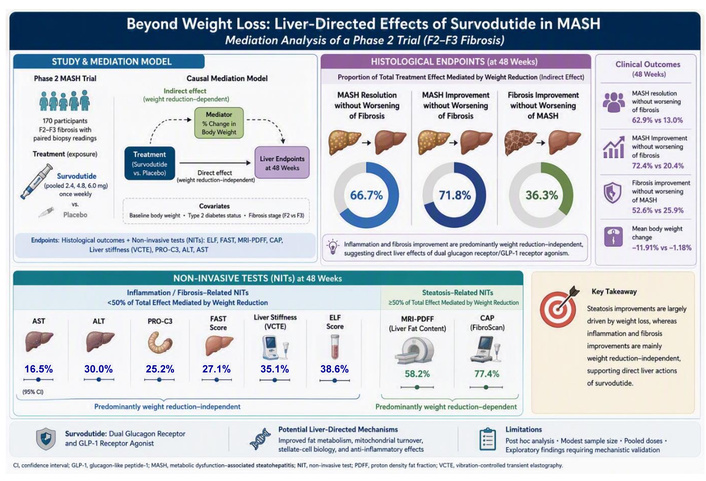
Beyond weight loss: liver-directed effects of survodutide in MASH. Schematic summary of the post hoc mediation analysis of a phase 2 trial evaluating survodutide, a dual glucagon receptor (GCGR)/glucagon-like peptide-1 receptor agonist, in patients with MASH and F2–F3 fibrosis [26]. The mediation model partitioned treatment effects into weight-reduction-dependent indirect and weight-reduction-independent direct components. Histological endpoints related to MASH resolution and MASH improvement were predominantly mediated by weight reduction (66.7% and 71.8% of the total treatment effect, respectively), whereas improvement in fibrosis without worsening of MASH showed a larger weight-reduction-independent contribution, with only 36.3% of the treatment effect mediated by weight loss. A similar pattern was observed for non-invasive tests: steatosis-related markers (MRI-PDFF and CAP) were largely weight loss-mediated, whereas fibrosis- and inflammation-related biomarkers (AST, ALT, PRO-C3, FAST, liver stiffness measurement, and ELF score) were predominantly weight-reduction-independent. These findings support the hypothesis that survodutide may exert liver-directed anti-inflammatory and anti-fibrotic effects beyond its substantial impact on body weight, potentially through mechanisms related to GCGR agonism, although direct mechanistic confirmation remains lacking. MRI-PDFF: magnetic resonance imaging-proton density fat fraction; CAP: controlled attenuation parameter; AST: aspartate aminotransferase; ALT: alanine aminotransferase; PRO-C3: N-terminal type III collagen propeptide; FAST: FibroScan-aspartate aminotransferase score; ELF: enhanced liver fibrosis.
This divergence is biologically plausible. Steatosis is closely linked to energy balance, adipose lipolysis, insulin resistance, and substrate delivery; substantial weight loss should therefore explain much of the reduction in liver fat and necroinflammation. Fibrogenesis is more complex, integrating hepatocyte injury, immune signaling, extracellular-matrix turnover, macrophage phenotypes, and stellate-cell activation. Survodutide combines GLP-1R-mediated appetite suppression and glycemic benefit with GCGR engagement, which can increase hepatic lipid oxidation, mitochondrial flux, and energy expenditure. A larger residual effect on fibrosis-related than on steatosis-related outcomes is therefore compatible with complementary metabolic and liver-directed actions but does not prove them.
The development program supports this hypothesis. Biomarker-guided screening of 19 dual GCGR/GLP-1R agonists linked cellular potency to in-vivo target engagement. Survodutide preserved glucose-lowering efficacy while producing marked weight loss in diet-induced obese mice and measurable GCGR engagement [22]. The proposed division of labor was clear: GLP-1R agonism would reduce food intake and support glycemic control, whereas GCGR agonism would increase energy expenditure and alter hepatic substrate handling.
Clinical development first tested obesity. This validated the metabolic premise and justified progression into MASH. Yet only about 60% completed treatment, and gastrointestinal events were frequent, underscoring that biological efficacy cannot be separated from dose escalation, tolerability, and sustained exposure [23].
The transition from obesity efficacy to biopsy-defined MASH improvement was logical but not inevitable. Weight reduction can improve steatohepatitis and, when substantial, fibrosis, yet these outcomes do not move in synchrony. Survodutide’s distinctive proposition is that GCGR agonism might accelerate hepatic lipid disposal and influence pathways not captured by body weight. The mediation analysis attempts to quantify this proposition by asking whether hepatic outcomes differ by randomized treatment after accounting for weight change. It should be emphasized that total body-weight change is an imperfect proxy for obesity-related metrics, as it does not capture changes in visceral fat, ectopic lipid mobilization, muscle mass, or systemic glycemic control. Therefore, a residual weight-independent signal may reflect unmeasured metabolic factors or residual confounding rather than direct hepatic GCGR activation.
Moreover, “direct effect” requires discipline. In mediation analysis, it denotes the component not statistically transmitted through the prespecified mediator; it does not demonstrate direct receptor action in hepatocytes, macrophages, or stellate cells. The residual estimate could include changes in glycemia, insulin sensitivity, visceral adiposity, diet, lipid flux, inflammation, or energy expenditure. Total weight change is also incomplete: identical losses can reflect different changes in visceral fat, subcutaneous fat, lean tissue, or fluid. A weight-independent effect might therefore remain mediated through body composition or nutrient flux. Moreover, mediation-derived direct effect is a statistically estimated, assumption-dependent measure and should not be interpreted as evidence of intrinsic hepatic pharmacological activity, which requires direct pharmacological assessment.
Randomization does not remove all uncertainty because the mediator was not randomized. Valid partitioning requires control of mediator–outcome confounding, correct temporal ordering, appropriate model specification, and careful handling of treatment-induced confounders. Survodutide might affect adherence, gastrointestinal symptoms, diet, physical activity, glycemia, and retention, each influencing both weight and hepatic outcomes. Paired-biopsy participants also represent survivors of treatment and follow-up; if tolerability or response affected biopsy availability, selection could distort estimates.
Further limitations temper interpretation. The analysis was post hoc, exploratory, and restricted to 170 participants with F2–F3 fibrosis and paired biopsies. Pooling doses improved precision but obscured dose-specific mediation despite nonlinear efficacy and tolerability. Biopsy remains vulnerable to sampling and reader variability, and adjustment for baseline weight, diabetes, and fibrosis stage cannot eliminate unmeasured confounding. Generalizability to F1 disease, cirrhosis, lean MASLD, and routine practice is uncertain. Weight loss had not plateaued at week 48, so both mediation and fibrosis estimates might change with longer exposure.
The clinical implications should be proportionate. Weight reduction remains a principal mechanism, explaining most improvements in liver fat and MASH activity. Yet therapies producing similar mean weight loss might not be interchangeable for fibrosis because receptor profile, tissue distribution, exposure, and downstream signaling could shape hepatic responses. The sizeable weight-independent component supports further study of dual GCGR/GLP-1R agonism in patients at high fibrotic risk but does not establish superiority over other incretin-based or liver-directed therapies. The decisive test is whether benefit is reproducible, durable, tolerable, and ultimately prevents decompensation, hepatocellular carcinoma, transplantation, and death.
The parallel phase 1 cirrhosis study illustrates both ambition and caution. Exposure was broadly similar across Child-Pugh classes and controls, and 28-week dose escalation did not indicate a need for pharmacokinetic dose adjustment. Exploratory reductions in liver fat, stiffness, liver volume, weight, and disease markers were encouraging, but a small open-label study cannot establish efficacy or long-term safety in this vulnerable patient population [24]. In cirrhosis, weight reduction is not an unqualified benefit: sarcopenia, frailty, portal hypertension, malnutrition, and decompensation can alter the benefit-risk balance.
Noureddin and colleagues [26] have reframed, rather than resolved, a central question. Survodutide appears to improve liver fat and MASH activity largely through weight reduction, whereas much of the apparent effect on fibrosis and inflammatory markers is not explained by change on the scale. This finding is plausible but inferential: it does not prove direct antifibrotic action, only estimates the effect left unexplained after one mediator is considered. That component deserves investigation, not inflation. The next phase must establish whether it reflects specific hepatic pharmacology, persists beyond 48 weeks, and improves outcomes that matter to patients. Recent data extend the therapeutic context for MASH. In adults with obesity and at-risk MASLD, Kaplan et al. [27] reported that survodutide reduced MRI-PDFF-measured liver fat and body weight more than placebo, although interpretation is limited by the 48-week duration and recruitment confined to the United States and Spain. Additionally, two Phase III studies of survodutide are ongoing, LIVERAGE in adults with MASH and moderate or advanced fibrosis, and LIVERAGE-Cirrhosis in those with MASH and cirrhosis [28]. These studies are expected to clarify some of the unanswered questions regarding these innovative pharmacotherapies in MASH. Among such unanswered questions is the safety/efficacy profile in individuals with MASH. These patients face distinct challenges depending on liver histology, with those in non-cirrhotic stages being typically exposed to a high risk of cardiovascular disorders [29]. In this connection, Survodutide could potentially mark a turning point in cardiometabolic therapy by simultaneously targeting key pathways that underlie obesity, MASH, cardiovascular disease, and cardiorenal risk [30]. If ongoing outcomes trials confirm its benefit–risk profile, dual GCGR/GLP-1R agonism may become a defining therapeutic strategy for high-risk patients across the cardiometabolic spectrum [30].
ALT: alanine aminotransferase
AST: aspartate aminotransferase
ELF: enhanced liver fibrosis
FDA: Food and Drug Administration
GCGR: glucagon receptor
GLP-1R: glucagon-like peptide-1 receptor
MASH: metabolic dysfunction-associated steatohepatitis
MASLD: metabolic dysfunction-associated steatotic liver disease
MRI-PDFF: magnetic resonance imaging-proton density fat fraction
NASH: nonalcoholic steatohepatitis
PRO-C3: N-terminal type III collagen propeptide
Authors used GPT 5.3-chat and Copilot to improve the readability and language of the manuscript. Microsoft 365 Copilot was also used to create Figure 1. After using these AI tools, the authors reviewed and edited the content as needed and take full responsibility for the content of the published article.
AL and RW: Conceptualization, Data curation, Formal analysis, Investigation, Methodology, Project administration, Software, Supervision, Validation, Visualization, Writing—original draft, Writing—review & editing. Both authors read and approved the submitted version.
Amedeo Lonardo, who serves as Associate Editor of Exploration of Drug Science, and Ralf Weiskirchen, who serves as Guest Editor and Associate Editor of Exploration of Drug Science, had no involvement in the decision-making or review process of this manuscript.
Not applicable.
Not applicable.
Not applicable.
Not applicable.
Not applicable.
© The Author(s) 2026.
Open Exploration maintains a neutral stance on jurisdictional claims in published institutional affiliations and maps. All opinions expressed in this article are the personal views of the author(s) and do not represent the stance of the editorial team or the publisher.
Copyright: © The Author(s) 2026. This is an Open Access article licensed under a Creative Commons Attribution 4.0 International License (https://creativecommons.org/licenses/by/4.0/), which permits unrestricted use, sharing, adaptation, distribution and reproduction in any medium or format, for any purpose, even commercially, as long as you give appropriate credit to the original author(s) and the source, provide a link to the Creative Commons license, and indicate if changes were made.



View: 96
Download: 4
Times Cited: 0


